Can relations emerge from experience before they have names?
Current stateA continuing multimodal VSA workbench with persistent concerns, learned relations, inspectable knowledge, and later representation experiments
Tabula Rasa asks how a mind can acquire useful structure without beginning with a catalog of named concepts and relations. An observation should be able to join an existing pattern, alter it, or remain something new; later evidence should be able to correct the connection.
The prototype brings perception, memory, interpretation, and further work into a continuing cycle. Observing another part of a recording, recalling a related memory, comparing alternatives, or composing remembered content can contribute to the same persistent concern. Changing attention does not discard unfinished work.
The wider aim is a mind whose experience changes what it understands, notices, and undertakes, including reflection and a developing disposition across sessions. Tabula Rasa was established as its own research project; its interfaces were not dictated by Sophia. The later representation experiments helped lead toward Cliste.
Why this approach
From retained data to acquired structure
An inspectable memory makes it possible to intervene on what was acquired. Removing a relevant association, keeping an unrelated one, or changing encounter order tests which parts of the history support a later response.
The later axis work asks a different question: whether one mechanism can recover an ordering without being told that it represents time, position, or magnitude. Those studies helped separate structure learned from the stream from structure supplied by sensor identities, encodings, and the analysis method.
Remembering, revising, and choosing the next operation
A continuing concern keeps its observations, recalled alternatives, provisional interpretation, and unfinished work together. The shared cycle can choose another observation when the available evidence is insufficient, compare remembered candidates, and let the revised interpretation affect later recall. Recorded controls remove relevant memory or suppress a revision to check that these connections matter.
The numerical learning studies also revisit earlier experience to compare predictive models and reopen questions contradicted by later outcomes. The larger requirement is for what the system learns to change its own priorities and longer-term commitments; a retained concern or a supplied selection rule is not yet an acquired disposition.
Where it stands
The continuing workbench combines a photo, video, and audio library with VSA reconstruction, persistent concerns, interpretation revisions, and a shared action selector. New evidence can change an interpretation and the next proposed operation. The selector’s priorities, costs, and similarity rules are supplied; the saved experiments test whether remembered evidence and revision affect its decisions.
Conversation provides a constrained interface to that state. A local language model interprets requests and proposes source-supported structures during reading; factual recall comes from unbinding the acquired VSA profiles and checking retained evidence. Readers can inspect the source passage, memory change, and numerical recall, including a replay with a particular binding withheld.
Other connected capabilities learn relationships from marked spatial or temporal examples and compose remembered appearances into requested scenes or short episodes. Their annotations, roles, and motion rules remain explicit. The later unnamed-axis and video-association studies below investigate what more of that structure might be acquired instead.
What the work has shown
The same mechanism recovered three kinds of ordering
On separate synthetic streams, the same unnamed-connection pipeline recovered temporal, spatial, and magnitude order with absolute rank correlations of about 0.99, 1.00, and 1.00 across three seeds. Only the temporal stream produced a reliable direction. Early spurious directions weakened as more observations accumulated.
Putting all three axes into one stream preserved joint information but did not separate it into distinct axes. The mechanism recovered each ordering in isolation; separating simultaneous relations remained unresolved.
Associations contributed information that the cue did not contain
In the earlier visual-association study, twelve delayed queries recovered an earlier detail after sixteen unrelated images and a fresh-process restart. Removing the acquired links or disrupting the relevant continuity removed every correct delayed answer; removing equally sized unrelated material preserved all twelve. No single cue-matching observation contained the requested detail.
Four initially biased lookalike matches were wrong before contradictory pixels corrected them. This was acquired and revisable association over supplied panel proposals and matching rules. It was an early causal memory test, not evidence that segmentation or a general object concept had been learned.
Real visual forms expose a capacity problem hidden by random vectors
The video memory recovered all tested bundled patches up to 32 items, about 99% at 128, and about 95–96% at a full frame. Random-vector controls retained about 99–99.7% at the full-frame scale. The encoded appearances were strongly correlated and occupied far fewer effective dimensions than the hypervector width suggested.
The co-presence reconstruction still beat shuffled and absent associations on both clips, while mean cue color beat it on Andor. The practical question became how to acquire a useful vocabulary and spread its representations without mistaking algebra supplied by sensor identity for structure learned from visual content.
Selected recorded studies. Each keeps its original conditions, date, interpretation, and limits.
Representation spike · 29 September 2026
Reconstructing a scene from a partial cue
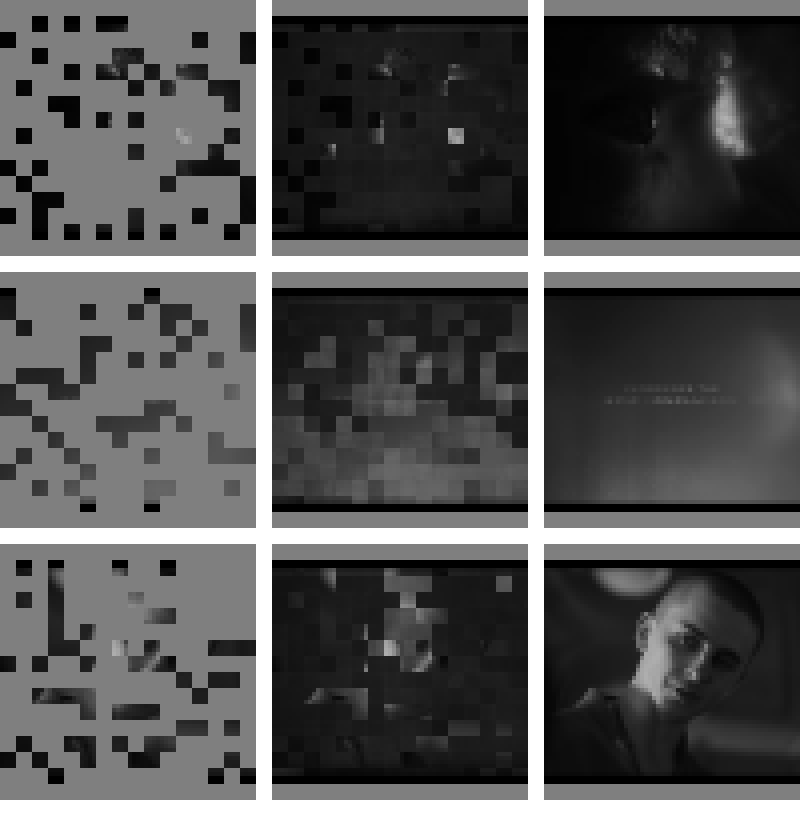
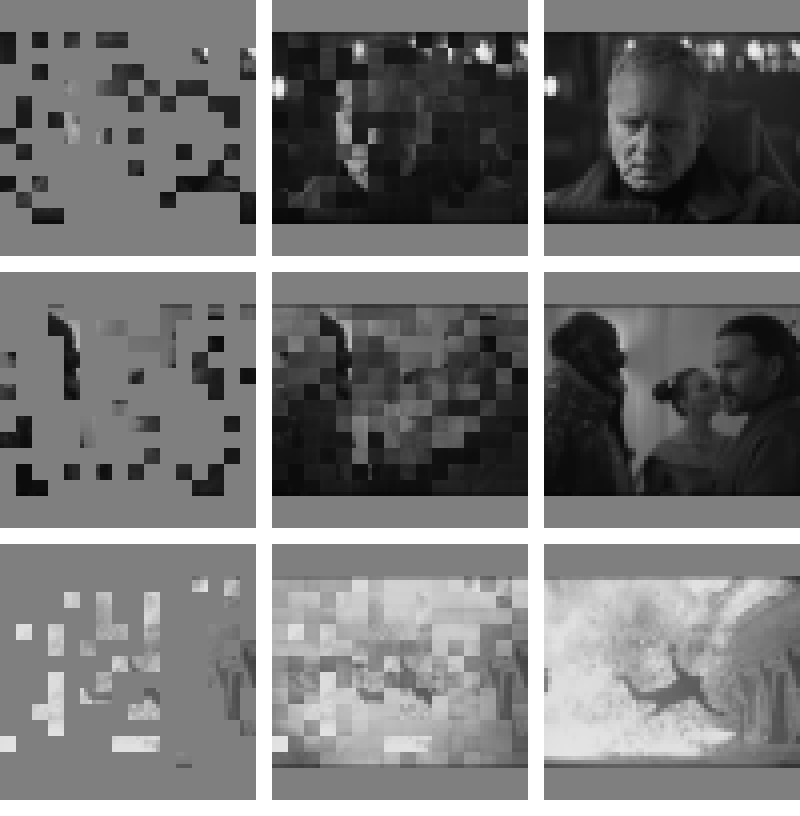
A watcher builds a vocabulary of patch appearances and their co-presence while watching every other training frame. A random quarter of a held-out frame provides the cue; associations select appearances for the missing patches. The first 70% of each clip supplies the training portion, with evaluation in the remaining 30%.
The setup supplies sensor identities, patching, thresholds, and the association rule. It uses no text or pretrained model. The score is pixel mean squared error on the missing patches; lower is better. Results below average the three recorded seeds.
Mean reconstruction error across three seeds per clip
Method
Dune
Andor
Learned co-presence
0.0278
0.0361
Shuffled graph
0.1030
0.1363
No graph
0.1101
0.1507
Vector geometry alone
0.0405
0.0414
Mean cue color
0.0343
0.0329
Best in vocabulary (floor)
0.0055
0.0095
Dune · Seed 1. Left to right: partial cue, reconstructed response, true frame. Original saved output; placement on the real grid is for display.Open original ↗Andor · Seed 1. Left to right: partial cue, reconstructed response, true frame. Original saved output; placement on the real grid is for display.Open original ↗
Acquired associations improved reconstruction
The learned co-presence graph has lower reconstruction error than the shuffled and absent-graph controls in all three seeds of both clips. The mean-color control has lower error on Andor. These comparisons support a contribution from the acquired associations in this setup, with a simple baseline still doing better on one clip.
Limits
These are frames from two experienced sources, not novel scenes from a broad distribution. Sensor identity is supplied. The vocabulary floor uses the true target to select the best available patch and is not a usable predictor.
Original output from the same measurement procedure.
What remains open
Separate relations that occur together, beyond recovering one isolated hidden axis.
Learn useful perceptual organization without relying on supplied panel geometry or sensor identity.
Learn which expectations apply and which operations are useful, so later experience can revise the same continuing mind’s interpretations, priorities, and commitments.