Type a section name and press Enter. Use “help” for the list.
Cliste experiment
Frozen encoder compatibility diagnostic
Registered 8 Oct 2026 · Snapshot 12 Oct 2026
The question
Distinguish cross-version encoder mismatch from partial-cue matching within an updated representation, using a frozen two-by-two diagnostic.
Why this experiment?
A memory can only preserve what its sensory interface encodes. These studies separate encoder quality, decoder quality and compatibility with earlier stored vectors.
How it works
Change one component or input representation at a time and evaluate immediate reconstruction on separate images. Keep old-vector readback visible so gains on new inputs do not hide compatibility losses.
Follow this part of the investigation: Sharper perception can also change the language of memory →Implementation and comparison details
Freeze both cue and bank encoder generations in four matched cells. Reuse exact parent cues, corruption mask, complete region geometry and original acquired memories; regenerated banks use original native pixels. No training, endpoint selection or checkpoint installation.
What happened
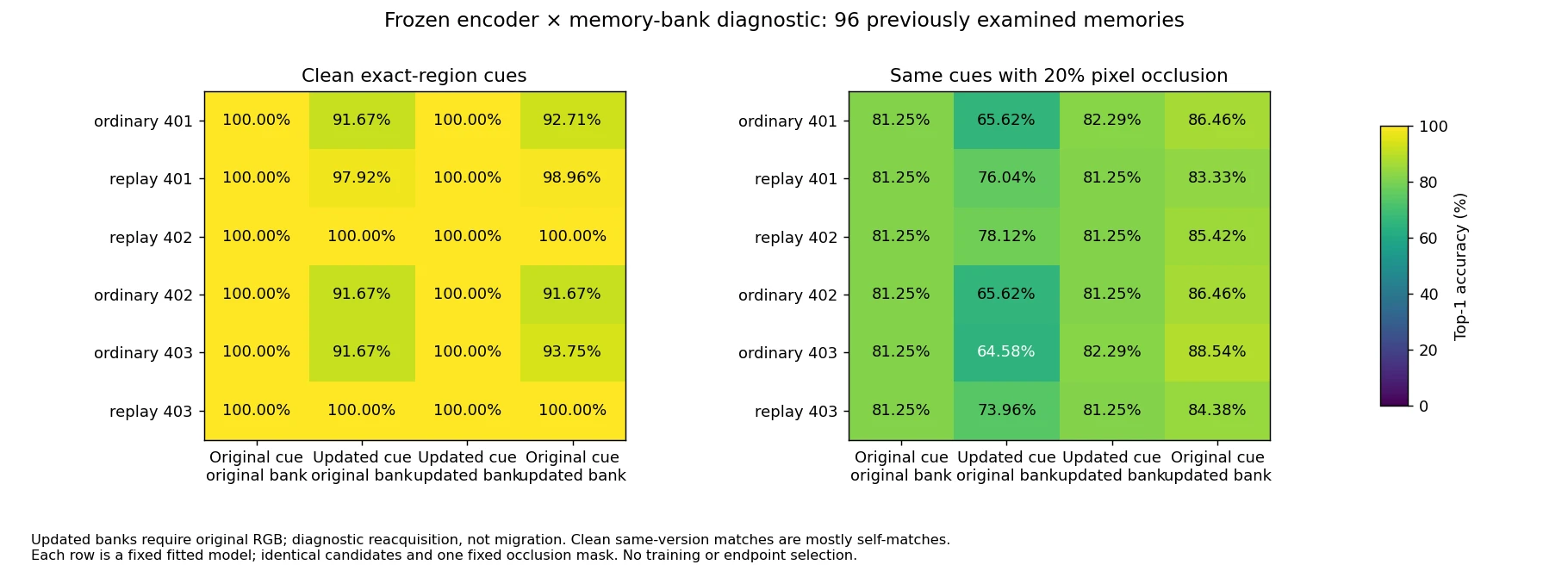
The frozen 2 × 2 diagnostic supports a cross-version matching cost. Re-encoding the comparison bank raises occluded-cue top-1 accuracy from 65.28% to 81.94% for ordinary continuation and from 76.04% to 81.25% for replay; the original baseline is 81.25%. Paired gains are +16.67 percentage points [95% interval 9.72, 24.31] and +5.21 [1.39, 9.72]. Within-version top-1 change remains unresolved, and correct-memory cosine margins are lower. All 38 cells and parent repeats pass; independent statistics checks pass 61,578/61,578 and bank replay 475/475. Counterfactual banks require original RGB. No memory migration, training or checkpoint adoption occurs. The worker took 240.0 seconds, peaked at 8.41 GiB CPU resident memory and 225.5 MiB PyTorch GPU allocation; each transient full bank uses 1.948 GiB.
Results and visual artifacts
Open a figure for its input, comparison, and result. Click an image to enlarge it.
The encoder turns a viewed image into vectors; the memory bank holds vectors created earlier. This diagnostic asks whether continued training makes new cue vectors incompatible with old memories. Each comparison crosses the original or updated cue encoder with the original or re-encoded bank. “Ordinary” trains on new images alone; “replay” adds rehearsal of old-vector decoding. Numbers 401–403 identify three training seeds, not image classes. Re-encoding the bank uses the original photographs, so it diagnoses compatibility but is not a way to migrate memory without source images.
Does a new encoder still match memories made by the old encoder?
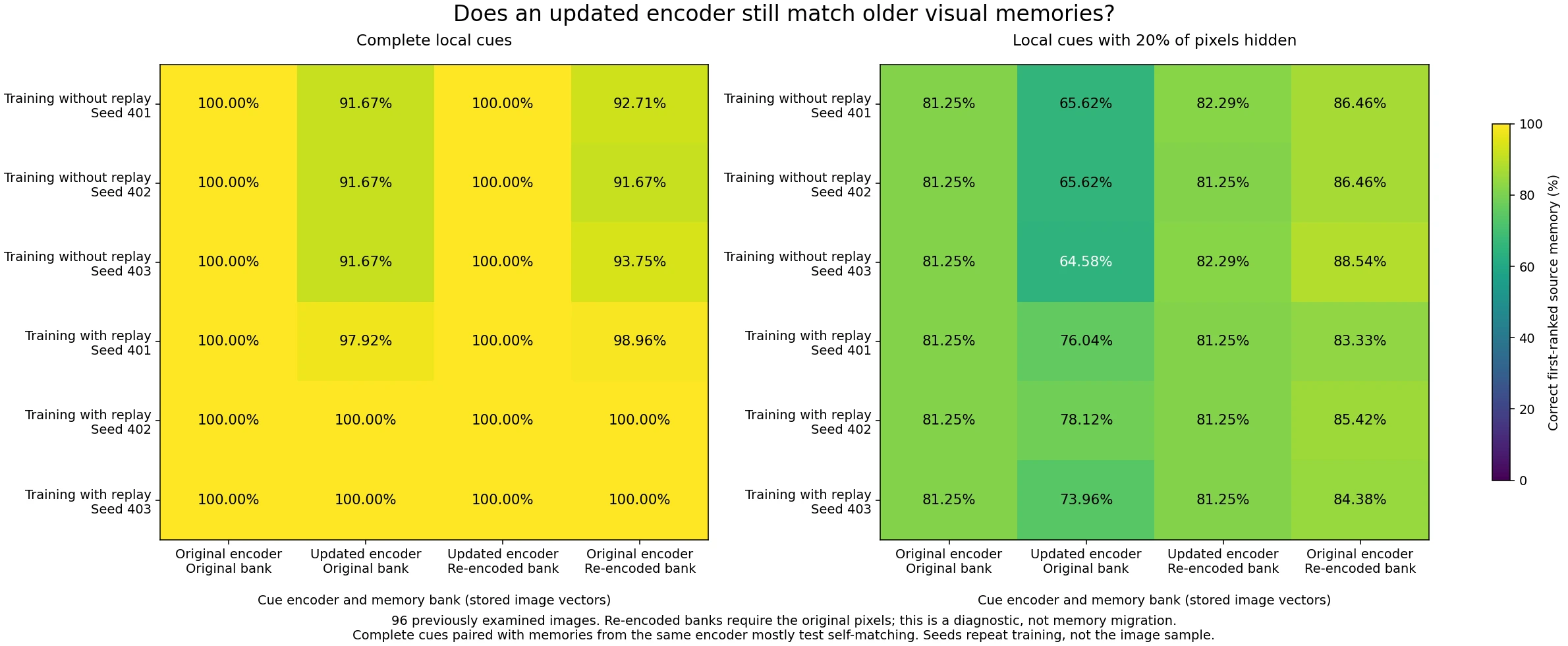
Replotted from saved outputs with clarified labels. The original recorded figure remains available.
Does a new encoder still match memories made by the old encoder? — original layout
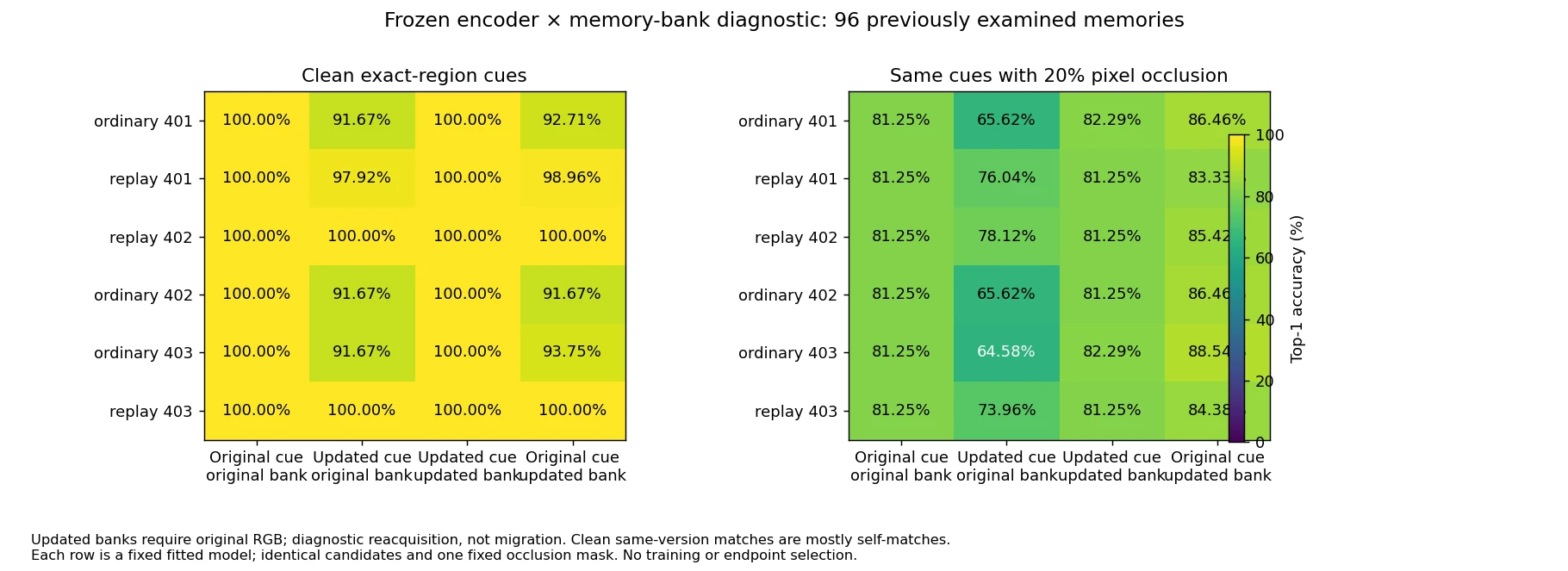
Display derivative: WebP quality 90; maximum edge 2400 px. Original scientific pixels remain in the source run; do not measure this preview.
Training on new images only — first six partial-cue queries
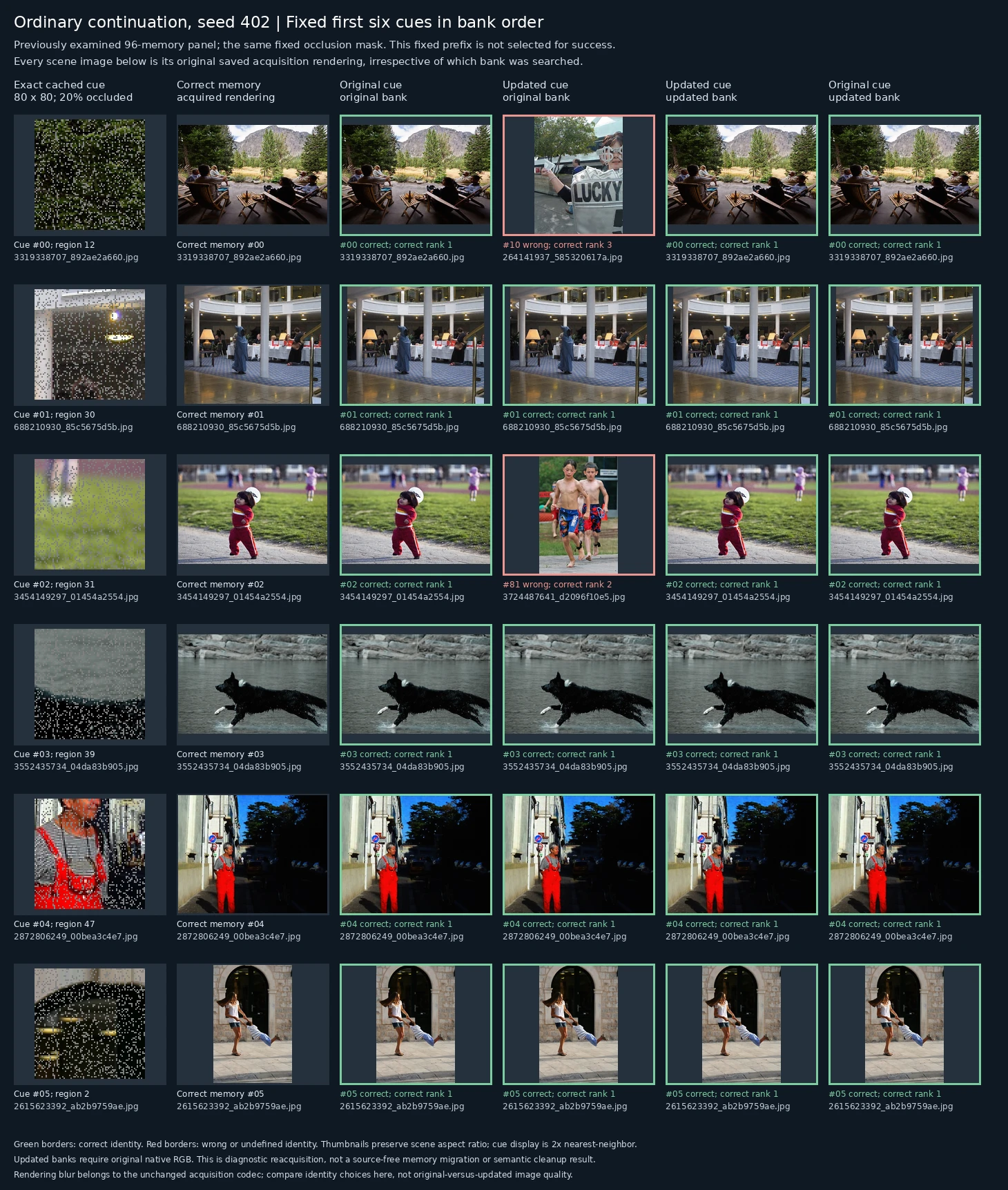
Display derivative: WebP quality 90; maximum edge 2400 px. Original scientific pixels remain in the source run; do not measure this preview.
Training on new images only — examples where re-encoding changes the answer
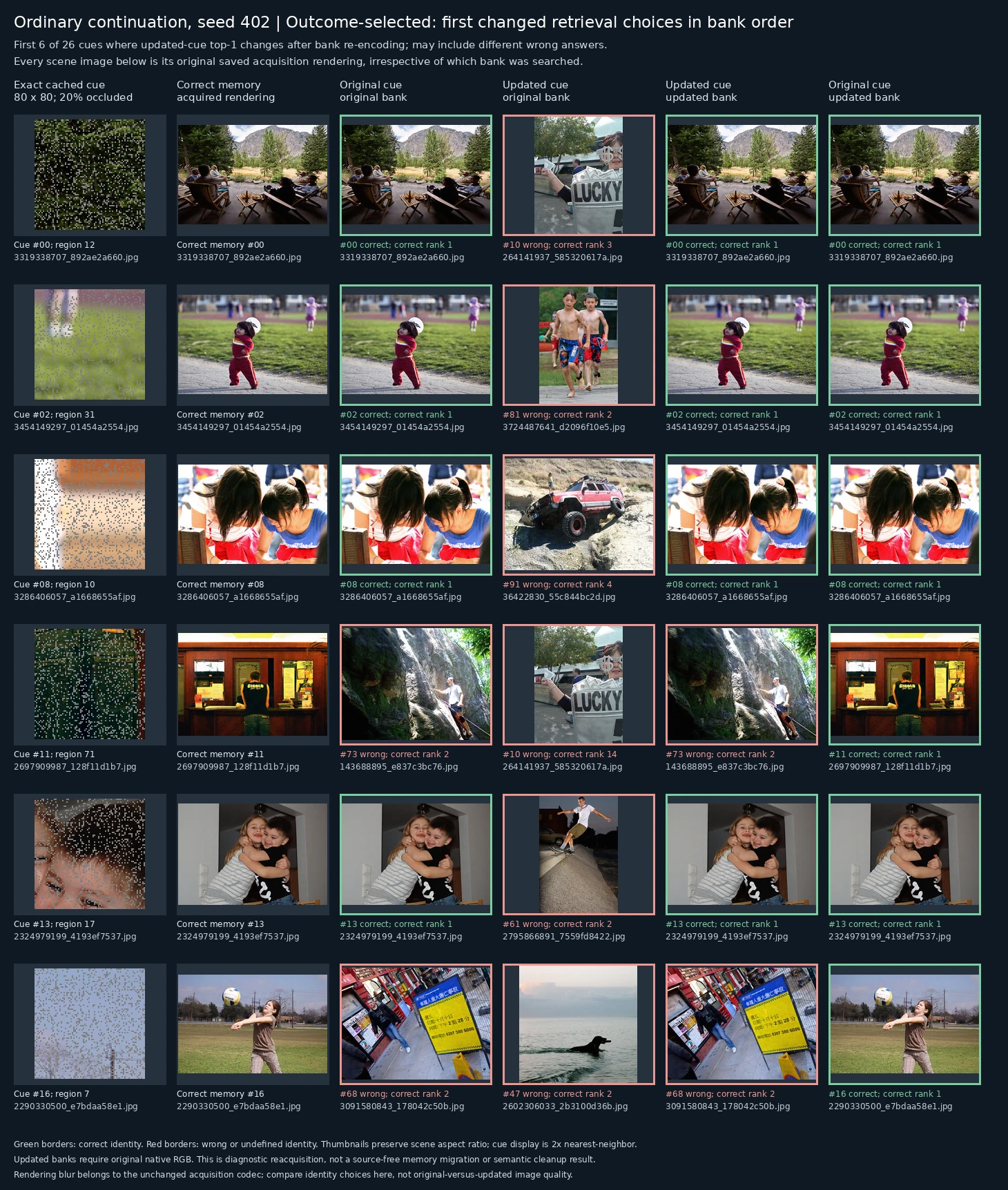
Display derivative: WebP quality 90; maximum edge 2400 px. Original scientific pixels remain in the source run; do not measure this preview.
Training with memory rehearsal — first six partial-cue queries
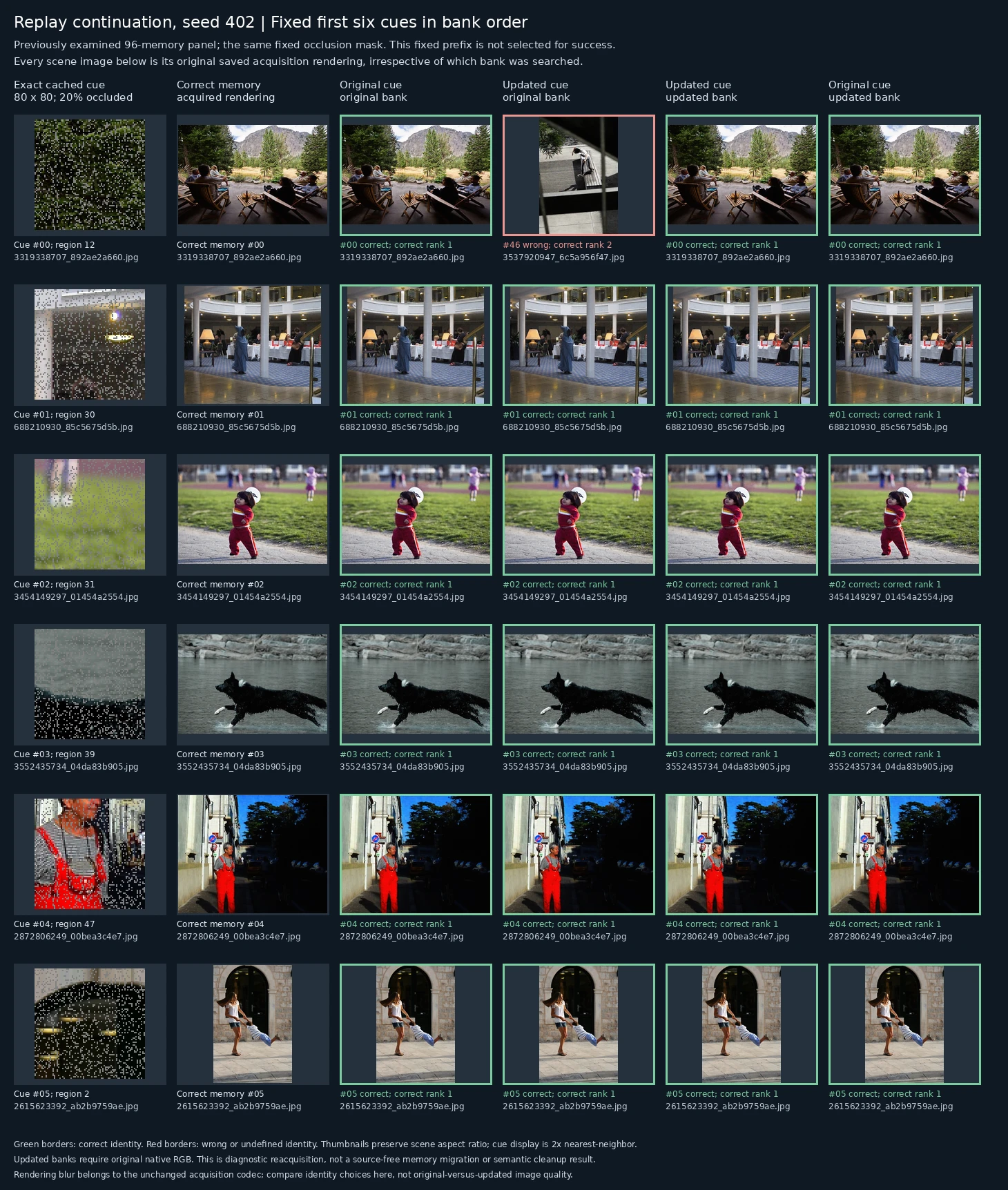
Display derivative: WebP quality 90; maximum edge 2400 px. Original scientific pixels remain in the source run; do not measure this preview.
Training with memory rehearsal — examples where re-encoding changes the answer
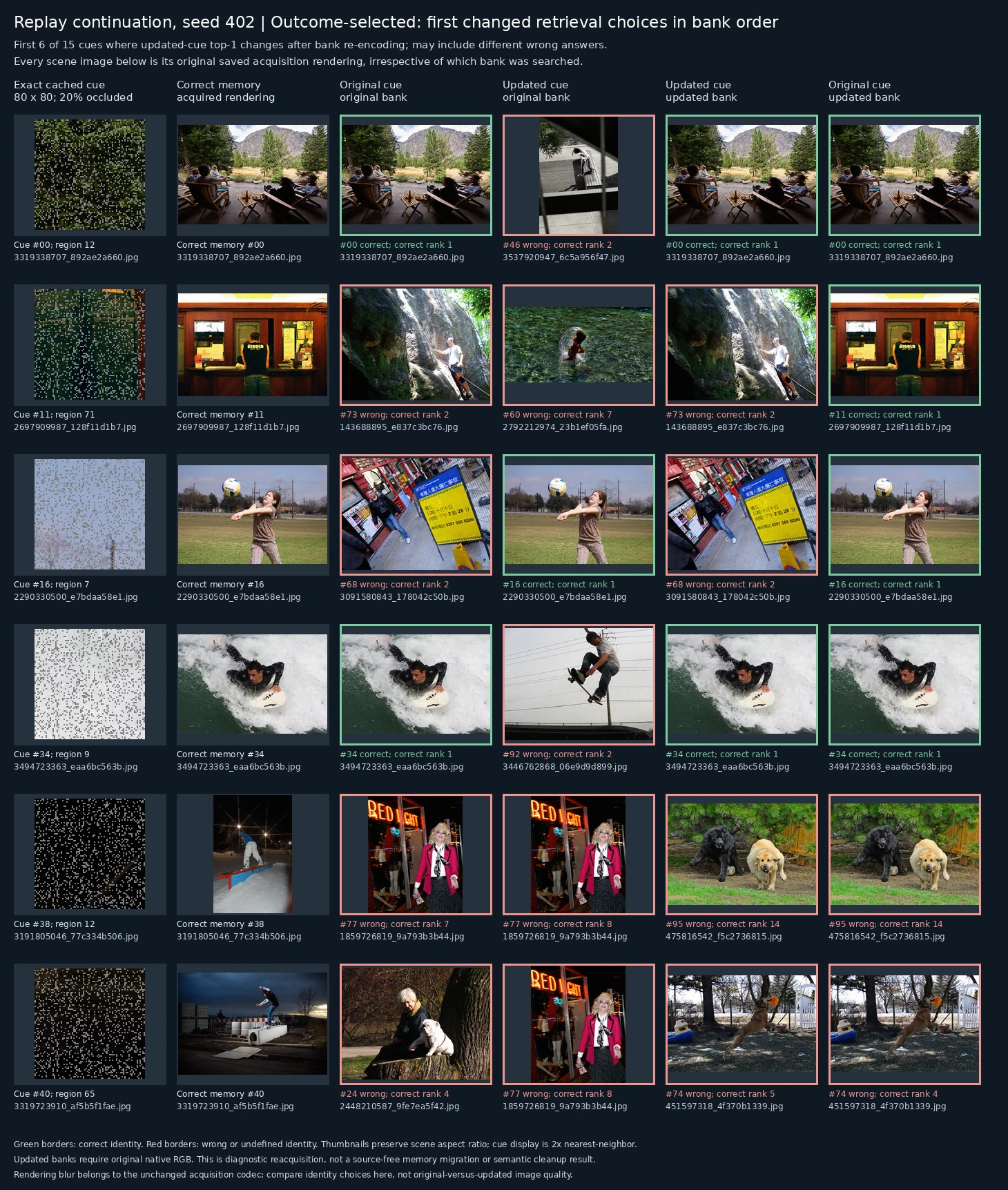
Display derivative: WebP quality 90; maximum edge 2400 px. Original scientific pixels remain in the source run; do not measure this preview.
Limits and next question
This is a post-result diagnostic on 96 previously examined memories and one fixed 20% occlusion mask, not a fresh held-out test. Regenerating banks requires original pixels; it is a counterfactual comparison, not source-free memory migration. Geometry and cue selection are supplied structure. Retrieval is appearance-instance matching, not semantic cleanup. Intervals are conditional on the fixed fits and images; overlap with zero does not establish equivalence. Bank recovery does not prove an invertible or useful bridge, and failure does not prove information destruction. Report regional bank bytes, peak CPU/GPU memory, durable storage and elapsed time. Parent evidence and operative memories stay unchanged; no training or checkpoint adoption occurs.
Next question. Use the fixed within-version and cross-version contrasts to justify a later encoder intervention; further training requires its own plan and new final sources.
Inspect the evidence
Download the methods and measurements for this experiment. Large training and saved-state files are not included.