Type a section name and press Enter. Use “help” for the list.
A reader’s walkthrough
From visual experience to usable memory
I’m developing Cliste as a cognitive substrate for Sophia: a system that can acquire experience, remember it and use its contents in later thought and action. These experiments begin with vision because a remembered image can be inspected directly. Vision is the starting sense, not the intended boundary of cognition.
This walkthrough follows the questions that changed the research direction. It groups related experiments rather than treating every attempt as a separate discovery. The linked records preserve measurements, controls, failures and image examples.
What enters the system?
The visual-memory path takes pixels, not captions or text prompts. Learned neural encoders and decoders connect images with 16,384-dimensional complex vectors. VSA supplies the operations for composing and querying those representations.
Some machinery is supplied: network architecture, position codes, visibility masks, clocks and the requests used by each experiment. Experiences and the pattern bank are acquired. A learned feature is not automatically an object or a named concept, and a supplied position is not a learned spatial relationship.
The recurring vector operations
Here ⊙ means element-by-element multiplication. Open a term for its concrete role.
Binding: attach content to a role
A feature vector f can be multiplied element by element by a position vector p. The result f ⊙ p represents that feature at that position. The role qualifies this particular content; simply adding f and p would not preserve the same attachment. These complex position vectors are supplied keys, not words the system has learned.
feature at position a = f_a ⊙ p_a
Bundling: combine several qualified contents
Add the bound features into a single regional vector. A sum can carry several contents at once while keeping their roles available for later queries. Here each region combines 64 feature positions, and the implementation retains the sum’s magnitude.
M = f_a ⊙ p_a + f_b ⊙ p_b + other bound features
Unbinding: ask for one part
Multiply the bundle by the complex conjugate of a position key. That cancels the requested key, but the other bundled terms remain as interference. An unbound vector is therefore a noisy estimate of a feature, not an exact extraction.
M ⊙ conjugate(p_a) = f_a + interference from other positions
Cleanup: compare with acquired patterns
Compare a noisy estimate with patterns collected from experience and, when justified, substitute a plausible pattern. This can stabilize recall, but a near match may erase a distinction needed later. The studies test when substitution helps rather than assuming nearest means correct.
noisy estimate → compare acquired patterns → substitute or keep uncertainty
Exchange: use selected parts in an operation
Subtract two selected features at their old positions and add them at the exchanged positions. The compact formula below does both at once. The difference term updates the whole bundle; it is not an image to decode on its own. Its usefulness depends on the selected features. This exchanges internal feature positions; it does not by itself identify or move an object in a photograph.
M′ = M + (k_a − k_b) ⊙ (p_b − p_a)
Follow the questions
The public pages include summary figures and fixed examples, with selected methods and results records. Larger complete output archives remain in the local research records; figure selections are stated on each experiment page.
1. Can an experience survive after its image file is gone?The first step established continuing intake, retained vector readout and restart before making claims about understanding.
Input and machinery
The initial life received twelve natural photographs, followed by more photographs and sampled frames from two trailers. A pretrained visual network admitted center-cropped 64 × 64 images. Those crops, not the original full-resolution scenes, defined what the system could remember.
Choice and reason
The tests saved one accumulating life, removed source-image access from the readout worker, and checked pauses, interruption and restart. This isolates whether retained vectors actually supply the rendered content, rather than an original image or a disconnected demonstration.
Result and next question
The registered continuity and source-denied readback controls passed. Readback still used a supplied episode address: that is evidence for durable content, not yet recall from a visual fragment. The obvious blur also made the encoder and decoder themselves the next objects of study.
Follow the evidence
2. Sharper perception can also change the language of memoryBetter reconstruction was achievable, but cropping, decoder tradeoffs and compatibility with old vectors had to be separated.
Input and machinery
Component studies used natural photographs and writing, with independent evaluation sets. Encoder-only training held the decoder fixed; decoder-only training held the encoder fixed. These are learned sensory interfaces, distinct from the autobiographical memories acquired later.
What changed
Encoder refinement cut immediate reconstruction error by 47.64% on 1,024 final COCO photographs, with similar transfer to Flickr. Decoder refinement brought a smaller photo gain, but worsened writing on white and readback of stored vectors. A separate magnitude comparison showed that retaining more of the bundle than phase alone helped, while the 64-pixel admission step was still discarding detail.
Native-size perception replaced the single small crop with a coarse overview and local detail regions, preserving image dimensions and aspect ratio through supplied geometric coding. Joint refinement reduced photo error, but the initial native representation cost roughly 39–42 times raw RGB on the measured panels.
Why the next test followed
Changing a codec changes what existing vectors mean to it. Continued training improved new images but damaged old readback; replay reduced that damage. Even then partial-cue matching weakened. A diagnostic that re-encoded comparison memories recovered much of the matching loss, supporting a cross-version mismatch. That diagnostic needed original pixels, so it was not a memory-migration solution. Later component studies kept the codec fixed while testing memory mechanisms.
Follow the evidence
3. Can experience share a vocabulary without losing useful distinctions?Acquired patterns made reuse testable. A simpler eight-bit vector representation was the better supported storage candidate.
Input and machinery
With the native codec fixed, visual feature vectors from encountered photographs populated a shared pattern bank. Stored references can point to those vectors, but the reference is only an address: it is not a hand-authored category such as tree or face.
Choice and reason
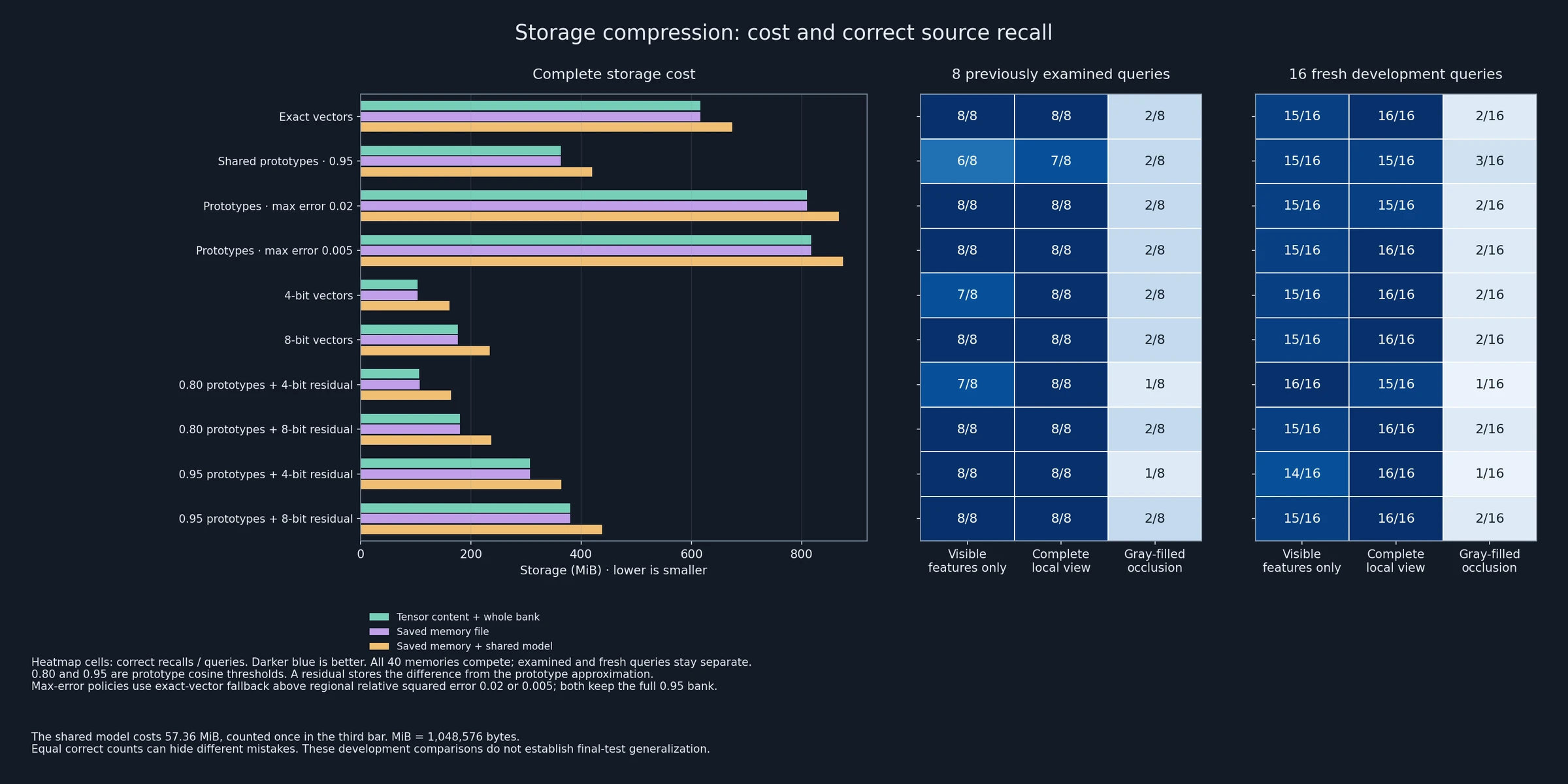
The comparison counted the bank, references, fallback vectors and residual detail instead of reporting only the small pointers. It also tested recall, because a compact reconstruction is useful only if distinctions needed downstream survive. An early cue diagnostic found that filling unseen pixels with gray contaminated the query; composing only fully visible feature terms improved dense-memory recall from 2/8 to 8/8 on the same development examples.
Result and next question
In the matched storage comparison, eight-bit dense vectors preserved every baseline retrieval choice across three assays and cut recorded tensor payload from 616.75 to 176.71 MiB, a 71.35% reduction. Residual detail improved numerical readout at extra cost without changing recall; four-bit alternatives introduced regressions. This supported a bounded storage candidate, not the claim that prototype pointers already solved memory. The next step connected partial cues, retained memory and working use in one life.
Follow the evidence
- Acquire and measure a shared pattern vocabulary →
- Build a cue from what is actually visible →
- Compare storage cost with retained utility →
4. Recall something, hold it, then recover what followedContent, working use and temporal context became connected operations in a persistent life.
Input and machinery
Partial visual fields queried accumulated native-image memories. The worker received pixels and a visibility mask, not a caption describing the answer. Separate tests supplied hold/release commands, replay direction and clocks. The temporal coding and these controls were given; experience supplied the encountered content and its associations.
Choice and reason
A retrieved image must be usable without replacing the incoming world. Working-content tests therefore held a recalled episode across more intake and restart. Temporal tests then asked for earlier or later encounters using retained context. Shuffling physical storage rows and swapping contexts tested whether the answer depended on associations rather than file order or an observer’s timeline.
Result and next question
The wider-cue recall run accepted 25/32 known cues correctly, accepted none wrongly and abstained on seven. Held content survived eight new observations. In the temporal study, all 276 tested choices were correct; forward and backward replay decoded retained content and resumed exactly after restart. These are bounded results with supplied controls. Remembering the next encounter is not predicting what an unseen world will do. The next question was whether smaller cues could initiate this whole path reliably.
Follow the evidence
5. More answers are useful only if the extra confidence is justifiedPartial-cue recall improved, while unfamiliar false accepts and growing-memory competition remained visible.
Choice and reason
Cleanup can turn a noisy estimate into a familiar prototype, but it can also merge two distinguishable views. A dedicated diagnostic found lost recalls as well as successful controlled recovery. Its strict numerical qualification failed; later checks agreed on selected prototypes and recall decisions but still missed an exact runner-up ordering criterion. Those are useful subchecks, not an overall pass.
A separate confidence study adjusted acceptance to the amount of visible evidence while keeping vector contents and rankings fixed. It compared correctly recalled known sources, wrong recalls and unfamiliar cues instead of optimizing only accepted-answer counts.
Result
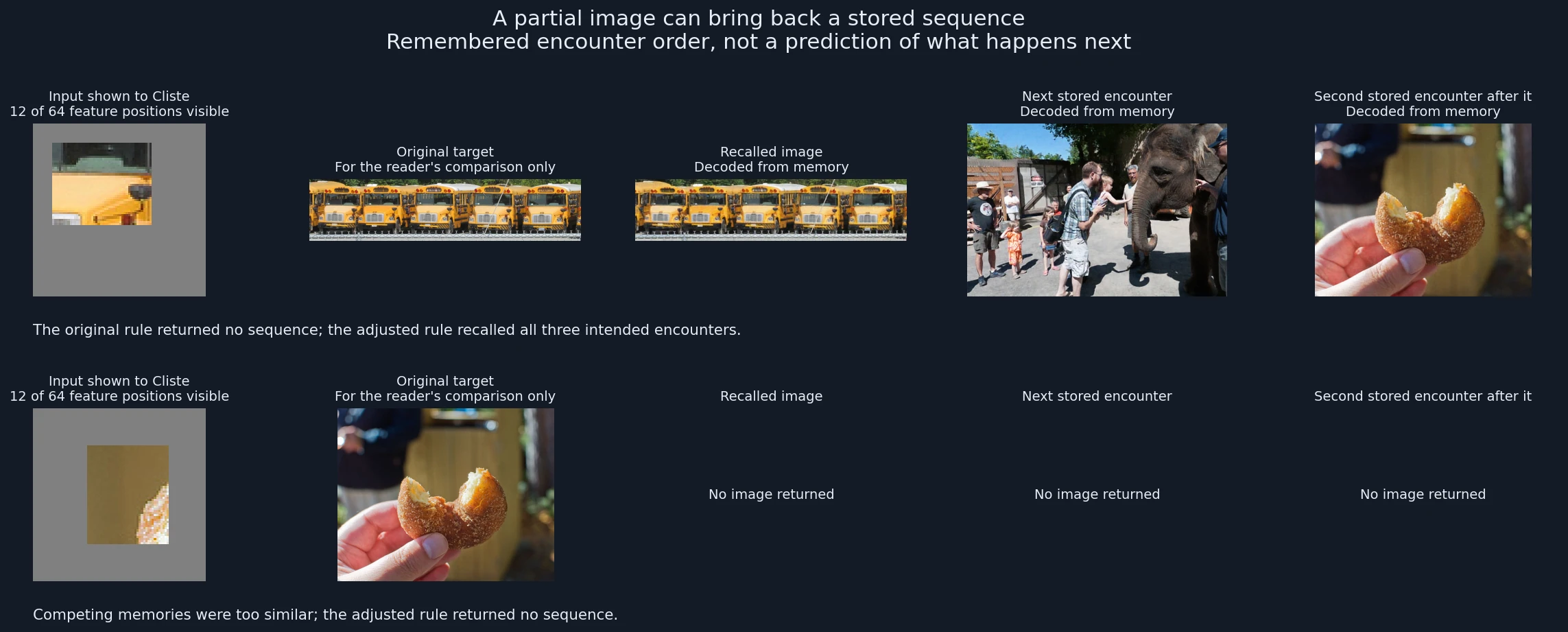
Support-adjusted acceptance raised correct partial recall from 66/192 to 111/192, but unfamiliar false accepts rose from 5/384 to 7/384. It failed the predefined qualification and was not made the default. The subsequent integrated continuation comparison nevertheless tested what the candidate could do: on 32 newly admitted photographs, 60/128 partial-cue paths recovered the intended image and both successors, versus 25/128 for baseline.
What this establishes
A partial visual cue can initiate an actual remembered sequence, including held work and restart. The continuation is based on previously encountered order, with two local views and two visibility levels per photograph. Earlier unknown-source false accepts, regressions as memory grew and weak video results remain in the record. The completed continuation was a recovery of an interrupted execution using already exposed inputs, not a new independent replication.
Follow the evidence
- Where prototype cleanup helps and destroys distinctions →
- Selected decisions agree despite failed strict qualification →
- Balance partial-cue recall against false familiarity →
- A fragment recalls an image and its next two encounters →
6. Make the same recall less expensiveCaching accelerated a demonstrated path without changing its answers or quietly treating speed as better cognition.
Choice and reason
Searching compact memories repeatedly reconstructed and transferred the same regional vectors. An optional cache kept those exact reconstructed vectors on the GPU. The timed comparison used 64 cue fields from 16 photographs, repeated three times against a 135-encounter history.
Result and tradeoff
Once warm, median full-query time fell from 4.154 to 1.022 seconds, a 75.4% reduction, at a temporary cost of 2.99 GiB. All 384 paired decisions agreed, including unchanged mistakes and refusals. The cache is not durable memory and does not improve recall quality. With the computational cost bounded, the next priority returned to using the contents of memory rather than further tuning this implementation.
Follow the evidence
7. Similar parts are not necessarily the right parts for a changeA sequence of controls changed the question from nearest-pattern accuracy to useful operation-specific combinations.
Input and machinery
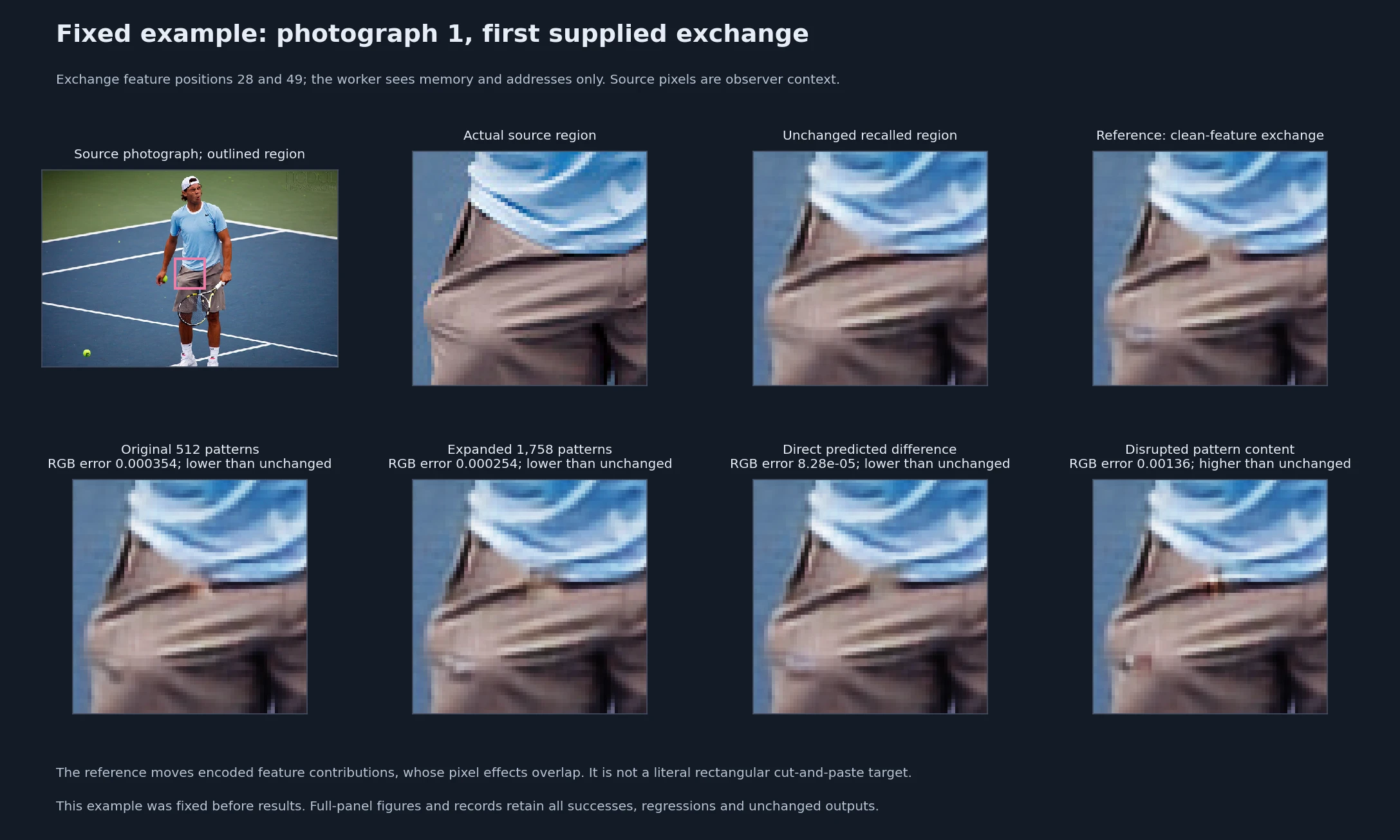
These studies supplied an image address, a region and two feature positions to exchange. The bank held 512 patterns acquired from five earlier photographs; the codec stayed fixed. An observer exchanged the original clean features to define the intended represented operation. That privileged reference is not a real edited photograph.
Why the first result needed another test
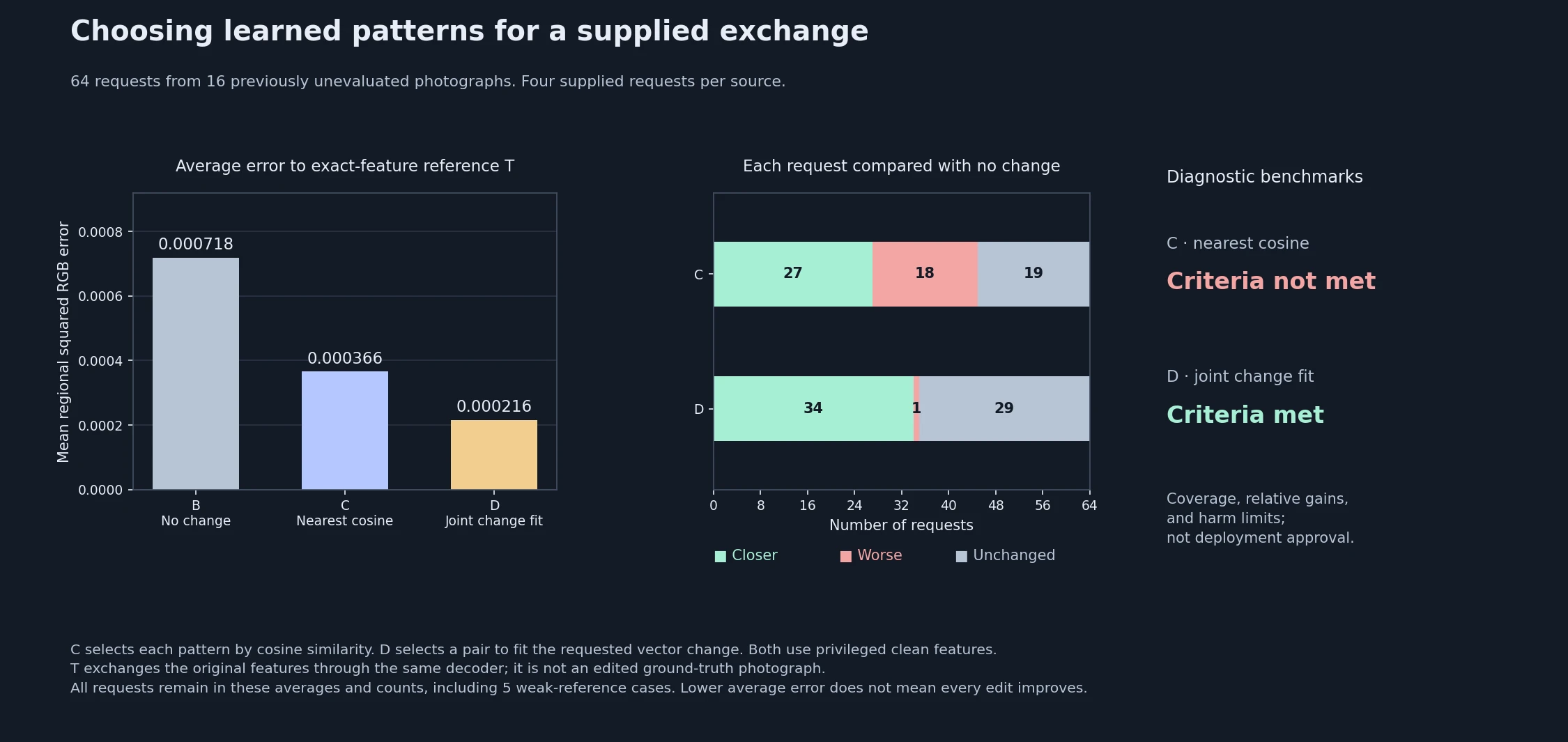
Substituting nearby acquired patterns reduced average error by 48.6% across 32 development exchanges, but only nine improved and twenty worsened. None of 45 fixed acceptance rules qualified, so confirmation inference did not run. A follow-up gave the selector clean features to separate vocabulary approximation from noisy recovery. Even clean nearest-cosine selection worsened 19 of 64 new requests and missed the reliability benchmark.
The consequential change
Rather than enlarge the vocabulary immediately, the next comparison chose both patterns together for the vector difference needed by the exchange. On 64 new requests this cut mean error by 41.0% versus choosing each clean feature’s nearest pattern separately: 34 improved, one worsened slightly and 29 made no change. The joint selector met the provisional benchmark without adding patterns or training the codec.
Both selectors received privileged clean features. The result establishes useful combinations in the existing bank under those conditions; it does not establish that the original constituents were identified. The unresolved question became whether retained memory could supply an equally useful operation target.
Follow the evidence
- Attempt an exchange using acquired patterns →
- Separate approximation from noisy bundle recovery →
- Select a pair for the change it needs to express →
8. Remove the privileged clean featuresBackground correction improved recovery, but the tested joint memory-only rule did not inherit the clean-feature success.
Choice and reason
The operative worker now selected solely from retained vectors, supplied position roles and the same acquired bank. Original unbinding was compared with subtracting the bank’s estimated average background before independent selection. Joint selection fitted two patterns to that same corrected memory. A shuffled-memory control selected from another photograph, testing whether matching content mattered. Clean-feature selection stayed as a privileged reference.
Result
Across 64 requests from 16 new photographs, background correction reduced mean decoded error by 41.2% versus original unbinding. Joint fitting then increased error by 6.1% versus corrected independent selection. Joint improved 29 requests, worsened 14 and left 21 unchanged; ten changed requests at least doubled regional error. It beat the shuffled-memory control but failed the utility benchmark. Clean selection again qualified, with 32 improved, one worsened and 31 unchanged.
What follows
The fixed bank and decoder can support useful changes when suitable information is available. Matching retained memory carries signal, but this recovery rule does not use it reliably enough. The next comparison kept the improved corrected baseline and used exact other-position subtraction to test how much interference obstructed the same paired selector.
Follow the evidence
9. Separate interference from the operation targetExact subtraction helped the same selector, while clean operation-directed selection retained a substantial advantage.
Choice and reason
The previous study corrected background using the bank’s average pattern. This diagnostic instead subtracted the actual contribution of the other 62 positions, using original features that a memory-only system would not have. It then repeated the same paired selector on the same 64 requests. A second privileged control supplied the clean pair sum, removing the stored-versus-reencoded residual too. Every selected exchange still acted on untouched stored memory.
Result
Exact cancellation reduced mean regional error by 24.4% versus the same selector with estimated background. It improved 25 requests, worsened ten and tied on 29 in that direct comparison. The source-bootstrap interval supported the improvement. Against leaving memory unchanged, cancellation improved 32 requests, worsened nine and left 23 unchanged; six changed requests at least doubled regional error.
Removing the remaining stored-versus-reencoded residual changed only two outcomes, both slightly worse. The earlier clean-difference selector still had 44.3% lower average error than the clean pair-sum selector. Isolating two constituents and estimating the difference needed by an operation are different objectives. The existing bank supports useful changes more reliably under the latter privileged condition.
What follows
Interference contributes to the tested selector’s error, but this result does not make it the sole problem. All photographs were already evaluated, and exact subtraction was privileged. This motivated a shared learned readout aimed at the operation-relevant difference, using retained memory and supplied roles at evaluation. The next chapter follows that comparison on independent photographs.
Follow the evidence
10. Train a shared read operation and inspect what changedTraining retained 23 useful changes without observed regressions, but produced many more no-ops and did not improve average decoded accuracy.
What was learned, and what stayed fixed
The new component estimates the feature difference needed by a supplied exchange from corrected unbindings of stored memory. It was trained on 64 photographs, selected using 16 validation photographs, and evaluated on 16 further photographs. The encoder, decoder, 512-pattern bank and exchange stayed fixed. The operative worker could not inspect original features.
The readout optimized 4,097 coefficients and also acquired an 8 MiB basis with 2,097,152 entries. Evaluation used withheld pairings and positions excluded from gradient and basis fitting. Those position groups already occurred in validation, and their contents remained in bundled memories; the independently new evidence is the evaluation photographs.
Result: fewer losses, more missed changes
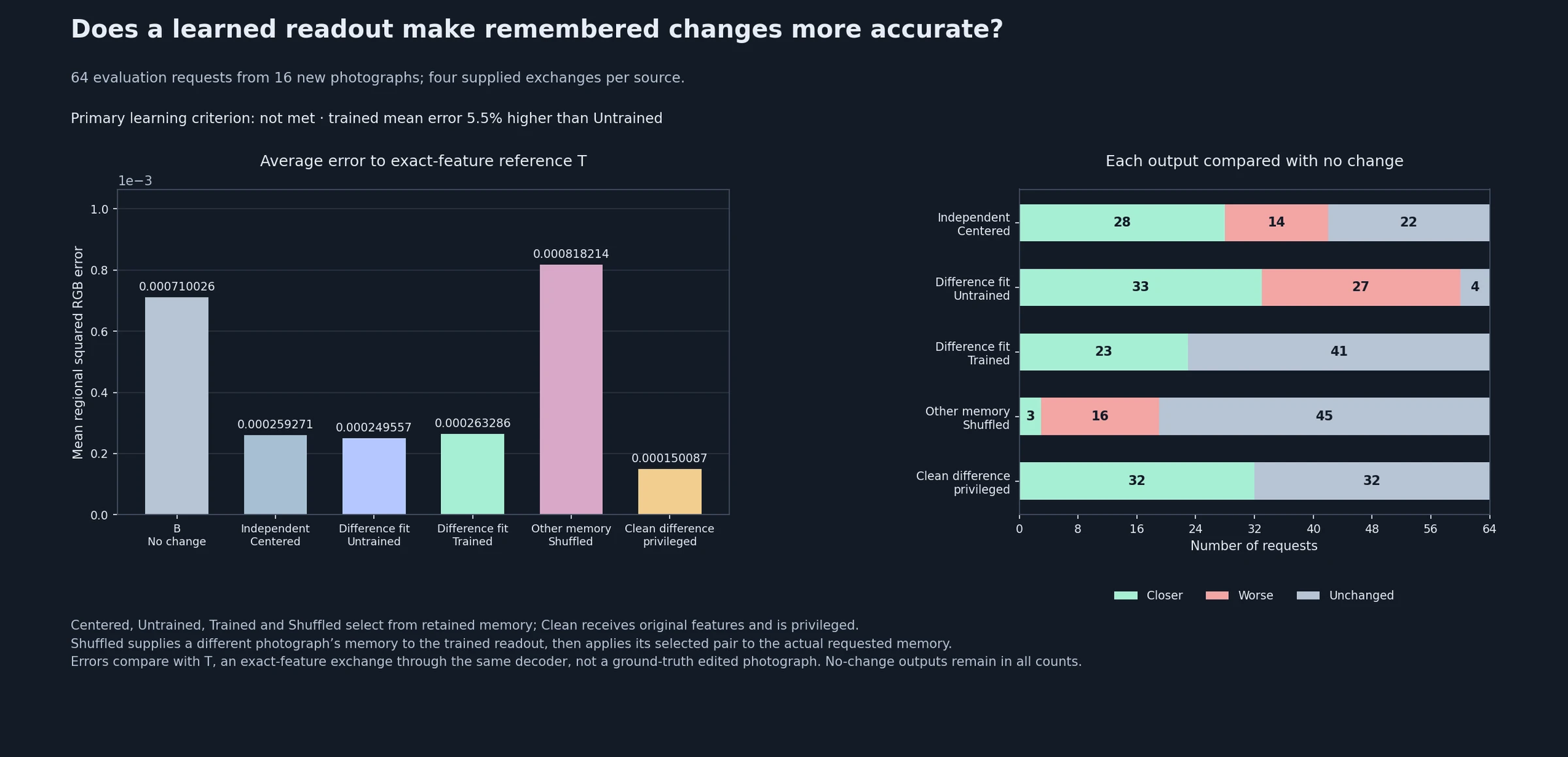
On 64 requests, Trained improved 23, worsened none and left 41 unchanged. Its 23 changes covered 12 photographs. Untrained improved 33, worsened 27 and left four unchanged. Training converted all 27 untrained losses into no-ops, but also lost ten useful changes. A no-op selects the same pattern twice; it is not evidence of learned confidence.
Trained mean error was 62.9% below unchanged memory, but 5.5% above Untrained and 1.55% above corrected independent selection. The primary interval crossed zero, so it missed the learning-improvement criterion and was not promoted. The privileged Clean selector again produced useful changes: 32 improved, none worsened and 32 unchanged.
Why the falling training curve is not the final answer
Validation vector loss fell from 327.946 to 20.538, but an analytic zero-difference output would score 0.836 on the same saved targets. The fixed 1,024-step budget ended while loss was still declining, well above that feasible reference. Zero difference would make no changes, so lower vector loss is not itself useful composition.
The learned global scale was 0.2495; the remaining correction was much smaller in amplitude. Without a scalar-only control, its particular contribution is unresolved. The next question is whether simple attenuation explains the conservative behavior, and whether convergence-checked training can recover more useful changes without bringing back the observed harms. No additional training was added within that closed study; the next chapter follows the separately registered comparison.
Follow the evidence
11. Separate attenuation from learned correctionA convergence-checked fit recovered more useful exchanges; scalar attenuation alone did not explain the learned benefit.
Choice and reason
The previous readout scaled its input down substantially, but its correction had never been removed in a controlled comparison. This study kept that checkpoint, removed only its correction, fitted a scalar alone, and fitted the full scalar-plus-correction model to numerical convergence. All four used the same saved training data, basis, encoder, decoder, acquired patterns and weighted vector objective. The full fit solved the fixed linear least-squares problem directly; validation did not choose an endpoint.
After all four checkpoints were locked, 16 new photographs entered the continuing memory and supplied 64 exchanges. At evaluation, each readout received retained vectors and position roles, without original images or feature targets. The original-feature Clean selector remained a separate privileged reference.
Result: correction adds useful changes
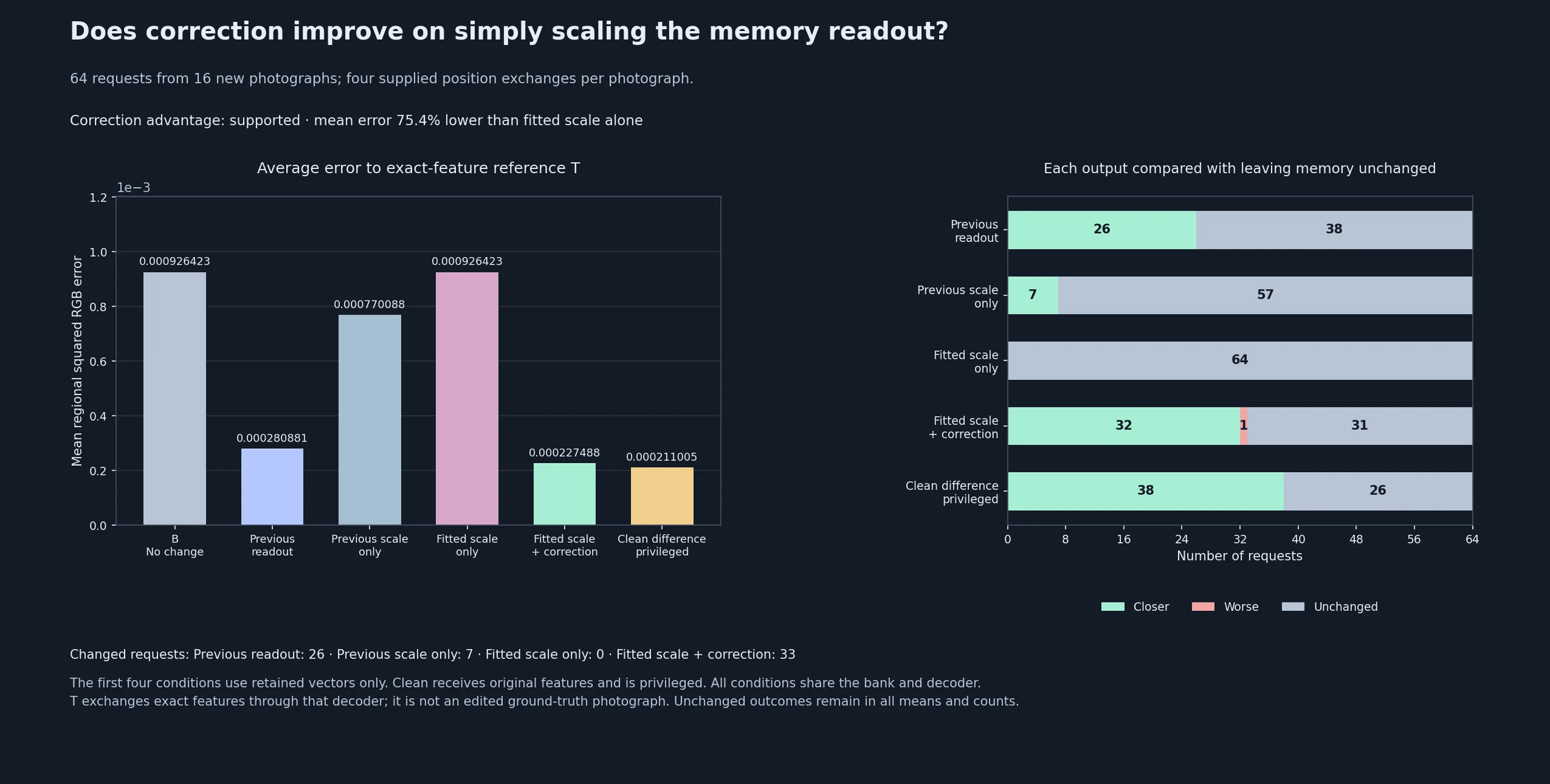
The full fit improved 32 requests, worsened one and left 31 unchanged. Mean decoded error was 75.4% below fitted scalar attenuation, which made no changes, and descriptively 19.0% below the previous readout. The registered scalar comparison had a positive source-bootstrap interval. All 26 previously useful exchanges remained useful; six more improved.
The earlier correction mattered too: keeping its scalar but removing its correction produced seven useful changes instead of 26. The small correction amplitude had not been evidence of a small contribution to discrete pattern selection. Full validation vector loss reached 0.2304, below the fitted scalar’s 0.8316 and the zero-output reference’s 0.8363.
The one regression increased regional RGB error by 18.4%; edge error improved and no request doubled regional error. It nevertheless failed the predefined rule requiring no increase in excess harm over the previous readout’s zero observed regressions. The primary correction advantage passed; the full bounded-use criterion did not, and the component was not automatically promoted.
What follows
There is now evidence that learning a shared read operation can recover useful changes from retained content beyond simple attenuation. It remains a supplied feature-position exchange, with 31 no-ops and no autonomous object or action selection. Both position groups had appeared in validation; the evaluation photographs were independently new.
The next useful test is a short, reversible working-memory sequence: make a change, hold it through new experience, then perform another operation while preserving the original memories. Set downstream tolerances before that fresh-input experiment and assess useful effects and collateral changes. This result does not call for another automatic component-optimization sweep.
Follow the evidence
12. Use changed working content after new experienceA held edit survived new admissions and restart, then supported a second exchange; reading the updated content outperformed reading the original memory.
Choice and reason
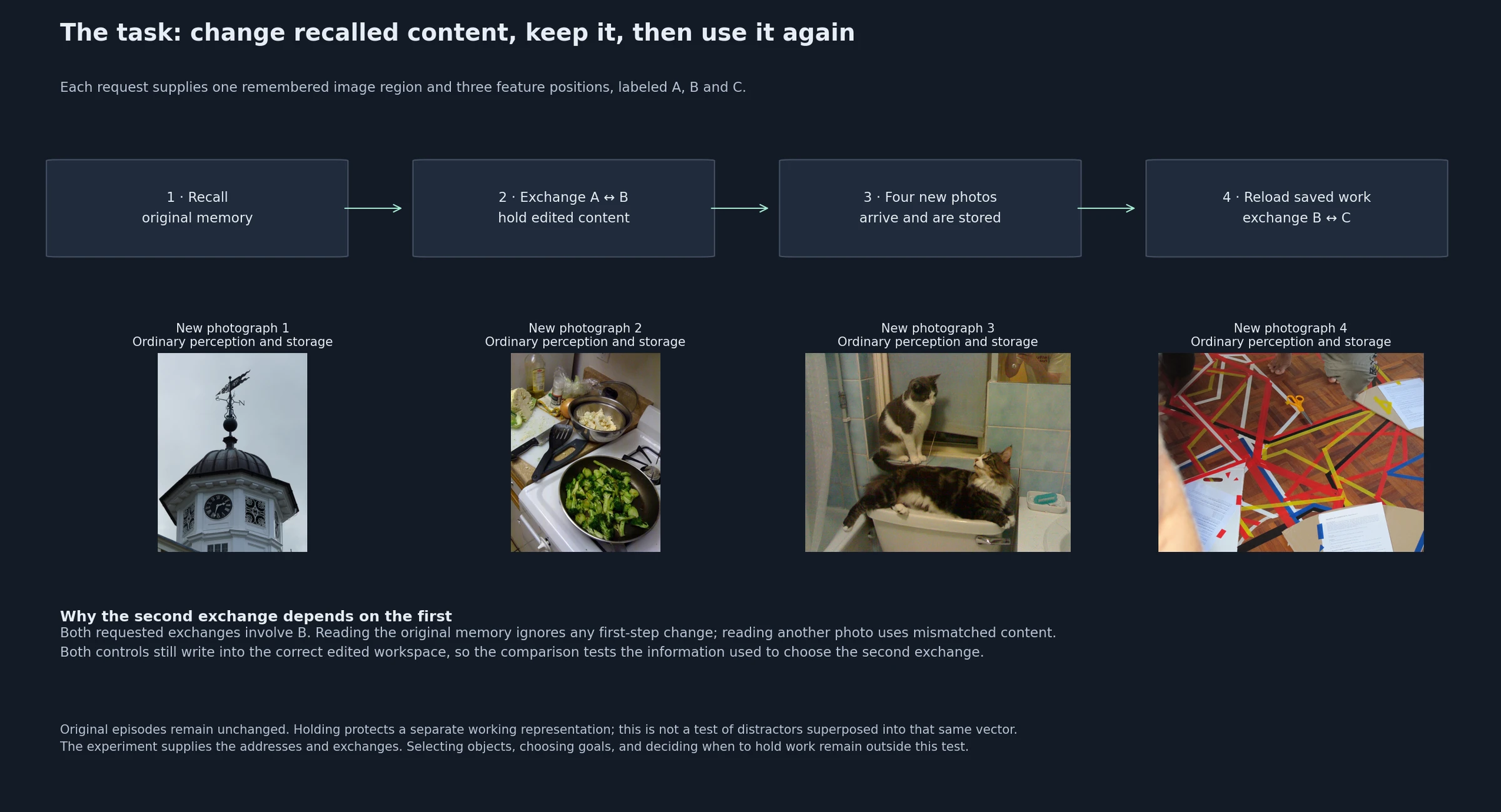
The preceding study showed a useful learned correction. This next test kept the readout, encoder, decoder and acquired bank fixed, asking whether an edited representation could remain useful in a sequence. Sixteen fresh photographs supplied 32 requests. Each identified three feature positions A, B and C: exchange A with B, hold that work while four more photographs arrive, save and reload it, then exchange B with C. The shared position B makes the second request depend on the first result.
With exact features X, Y and Z, the intended progression is A:X B:Y C:Z → A:Y B:X C:Z → A:Y B:Z C:X. Each exchange removes the old bound contributions from the whole regional bundle and adds them under their exchanged roles. The difference vector is an update to that bundle, not an image decoded by itself. Here joint cleanup chooses an acquired prototype pair whose difference approximates the required update; it does not establish two separately recognized objects or feature identities.
The operative processes could access retained vectors, supplied addresses and the frozen readout, but no source images or original-feature targets. Separate observer targets exchange clean features through the same decoder. The feature positions have overlapping pixel effects; they are not rectangular image cutouts.
Result: the second operation adds useful work
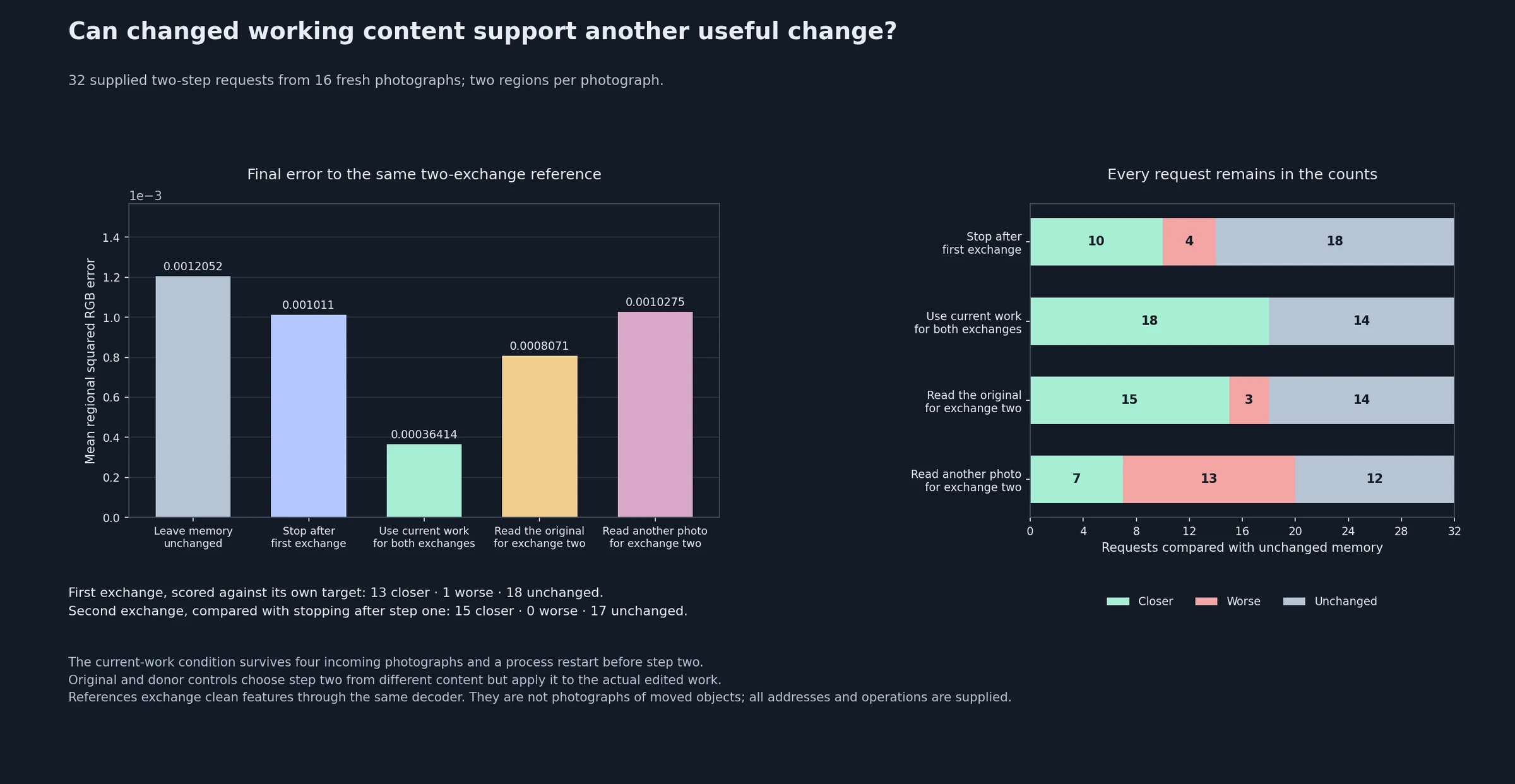
The final output improved 18 requests across 14 photographs, worsened none in regional RGB error and left 14 unchanged. Mean final error was 69.8% below unchanged memory. Compared with stopping after the first exchange, the second exchange improved 15 requests, worsened none in RGB error and left 17 unchanged; mean final error fell by 64.0%.
Choosing step two from the original stale memory instead of current edited content increased mean error: the actual current-work condition was 54.9% lower. It was also 64.6% lower than choosing from another photograph’s edited content. Both controls applied their chosen update to the correct edited workspace. Their disadvantage therefore supports the value of the content used for the second choice, not simply the fact that another operation occurred. Whole-photograph bootstrap intervals supported both comparisons; stale outperformance was reported as a diagnostic, not an acceptance requirement.
Immediate, uninterrupted and restarted operations produced exactly the same vectors. Held content survived all four new admissions, original experiences remained exact, and recorded undo restored the original work exactly. The life grew from 287 to 307 unique encounters. Repeated experimental branches do not add extra unique experiences.
What passing the criteria does and does not mean
All prospective criteria for a bounded working-sequence candidate passed. They required useful coverage, a positive final benefit, a content-matching advantage, useful second operations and limited final RGB harm. They did not require every intermediate step or edge measure to improve. The first exchange had one RGB regression against its own intermediate target; final edge error worsened on three requests despite RGB improvement, including one edge-error doubling. All these cases remain in the figures.
Holding protects a separate working representation. The incoming photographs were acquired normally, but they were not superposed as distractors into that working vector. Persistence uses an experimental capsule and exact undo uses recorded before-vectors. This is evidence for preserved, reusable derived work, not learned inverse operations, neural distraction resistance, object selection or autonomous goals.
The earlier attenuation study’s harm criterion and failed bounded-use verdict remain unchanged. This sequence used separately registered provisional tolerances for reversible work. It was not a post-hoc relaxation of that earlier experiment.
What follows
The roadmap requires an acquired vocabulary that develops through experience. Growth, refinement and merging, unfamiliar-input handling, and transfer across location, orientation, scale and context remain open. Useful operations with a fixed bank do not establish these capabilities. A proposed scene-completion study has been set aside because its priority over those requirements was not established.
The next chapter follows the first append-only vocabulary experiment. It compares later partial recall with and without newly acquired patterns while retaining exactly the same episodic experience. It also measures whether earlier recall, temporal replay and editing survive the additional admissions. Stored-vector preservation alone would not establish retained behavior.
Follow the evidence
13. Grow the vocabulary, then test whether it helpsMore acquired patterns improved cleanup, but recall without cleanup remained stronger. Earlier behavior survived on the original path; expanded cleanup lost two previously correct recalls.
Choice and reason
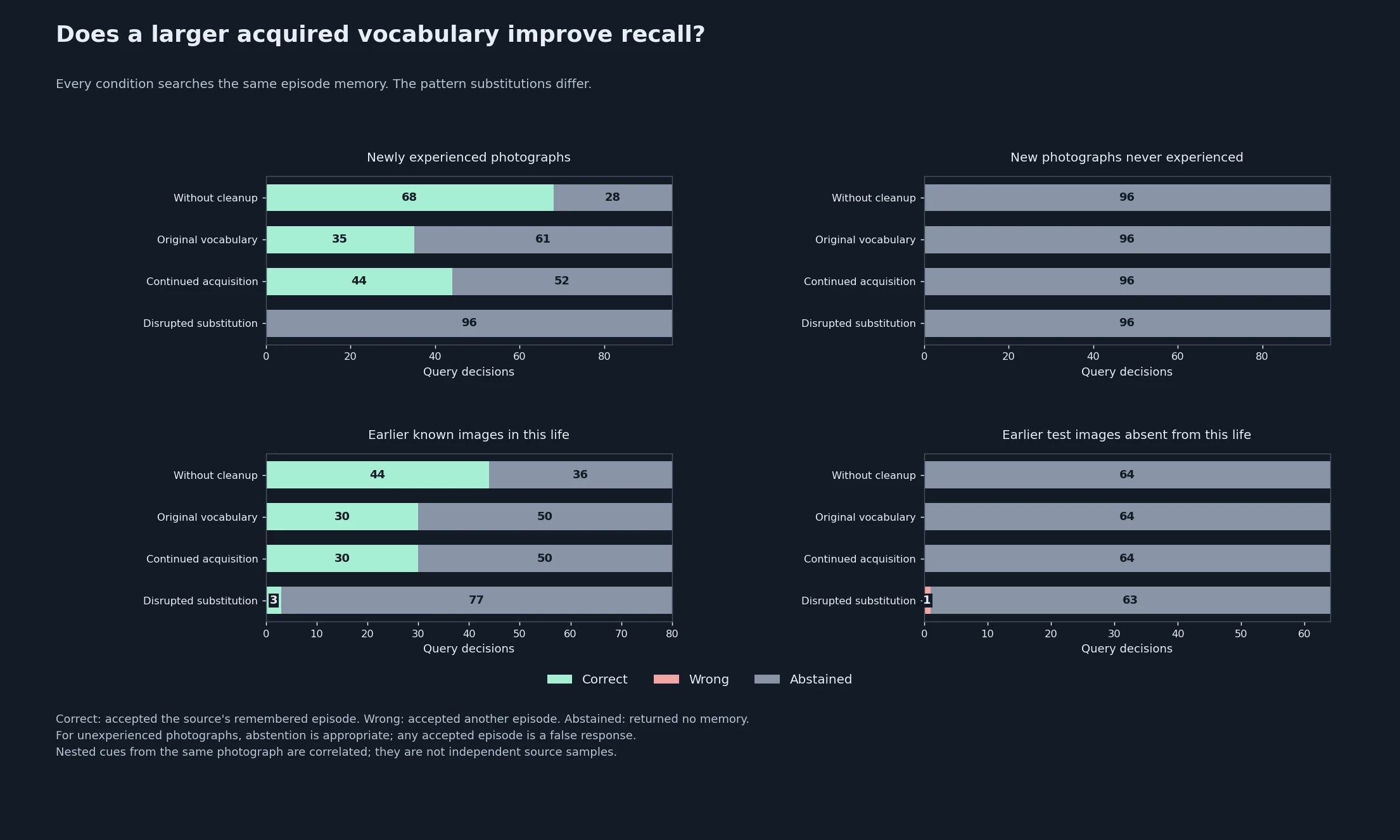
An acquired vocabulary should develop with experience and support later behavior. To isolate its contribution, 16 fresh photographs entered one shared memory, taking the life from 307 to 323 encounters. The encoder, decoder, episodes and acceptance rule stayed fixed. Each partial cue was then tested without cleanup, with the original 512-pattern bank, with the expanded bank, and with deliberately disrupted pattern correspondence.
Six local or partial cues per acquisition photograph supplied 96 new-photo fields. Sixteen never-admitted photographs supplied another 96, and the earlier evaluation packet contributed 80 known and 64 unfamiliar fields. The separate query process received cues and vector state, without full source photographs or scoring labels. These new-photo queries revisit acquisition images; they do not establish transfer to new instances or poses.
A baseline first measured earlier recall, temporal replay and all 32 editing sequences. The first acquisition launch then failed before inference because generated bytecode violated source isolation. The completed retry used identical inputs and scientific settings with bytecode writing disabled. The failed attempt remains part of the record.
Result: a larger bank helps a weak cleanup path
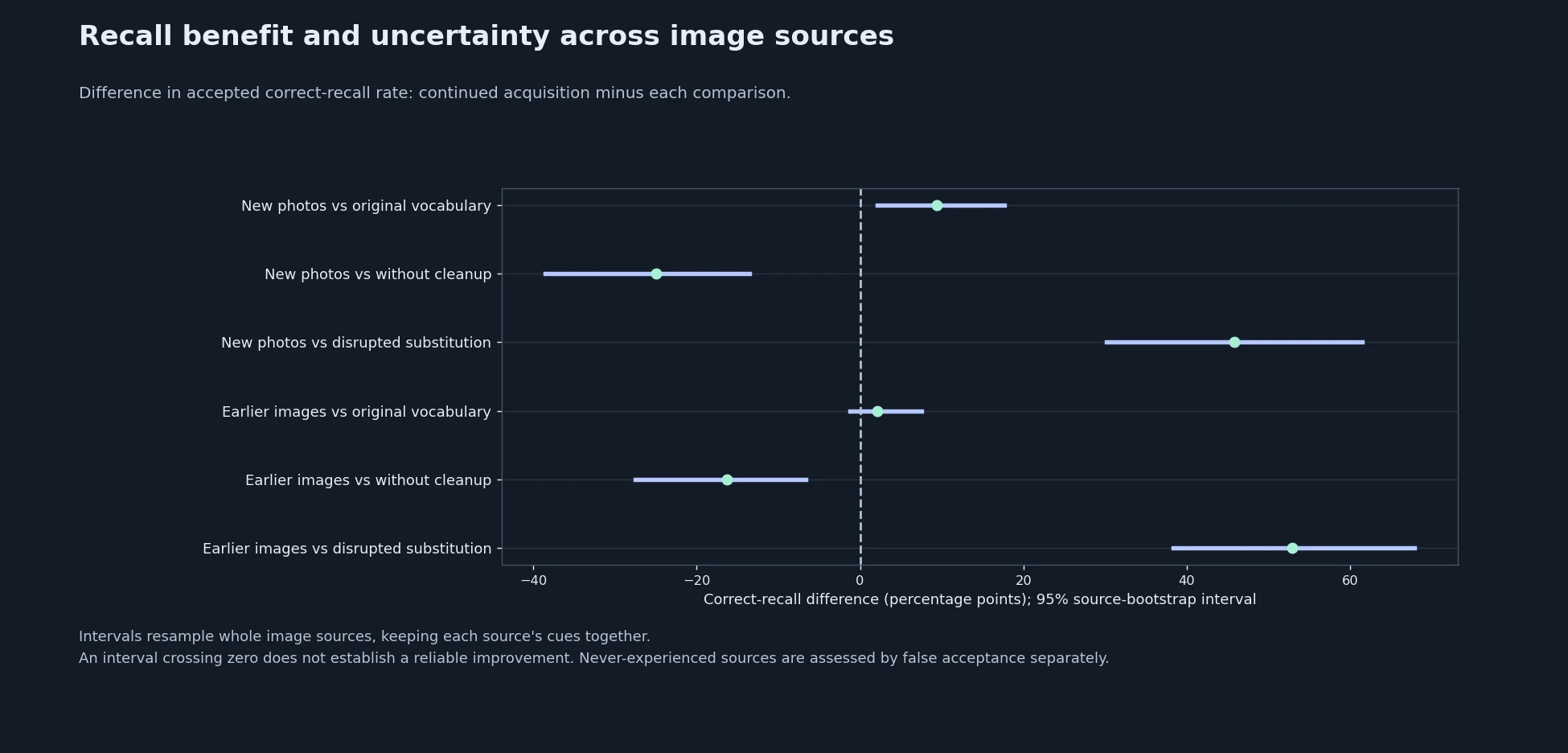
The vocabulary grew from 512 to 1,758 patterns. Expanded cleanup correctly recalled 44 of 96 new-photo cues, compared with 35 using the original bank and 68 without cleanup. Its net gain over the original bank was nine cues: 12 gains and three losses. Resampling whole photographs gave a 9.4-percentage-point gain with a 95% interval of 2.1 to 17.7 points. Against no cleanup it remained 25.0 points worse.
Both cleanup banks recalled 30 of 80 earlier known cues, but that equal total hid two old correct recalls lost and two gained. The individual-retention criterion therefore failed, giving the formal verdict no qualified acquisition benefit. All three legitimate conditions rejected all 160 unfamiliar cues after acquisition and made no wrong known-image responses; remaining known-image responses were abstentions.
This is not just an acceptance-threshold problem. On the new-photo cues, the correct memory ranked first 91 times without cleanup, 62 with the original bank and 70 with the expanded bank. Replacing visible features with prototypes discarded useful ranking information on this panel. More capacity alone does not resolve that loss, and this result does not establish that every form of cleanup would behave the same way.
What earlier behavior survived
The established no-cleanup path retained all 44 earlier correct recalls without newly wrong responses. Qualified two-step temporal replay retained success at all 31 shared accepted anchors. All 32 supplied two-edit sequences reproduced both edited vectors, selected handles and final decoded crops exactly; undo and untouched content also passed. Those edits used the original bank and readout, so this is not evidence of editing with new patterns.
The replay allowance was 14 million comparisons; the default four-million limit continued to refuse the search. Native held save, restart and release were checked at the preceding 307-encounter baseline, while acquisition verified the parent-plus-suffix state and vocabulary reload. These are specific retained behaviors, not certification that every historical capability is integrated. The independent audit passed after checking saved query vectors, decisions, occurrence records, selected scores and retention comparisons; it did not independently rerun the encoder, decoder or clock search.
What reuse means, and what it costs
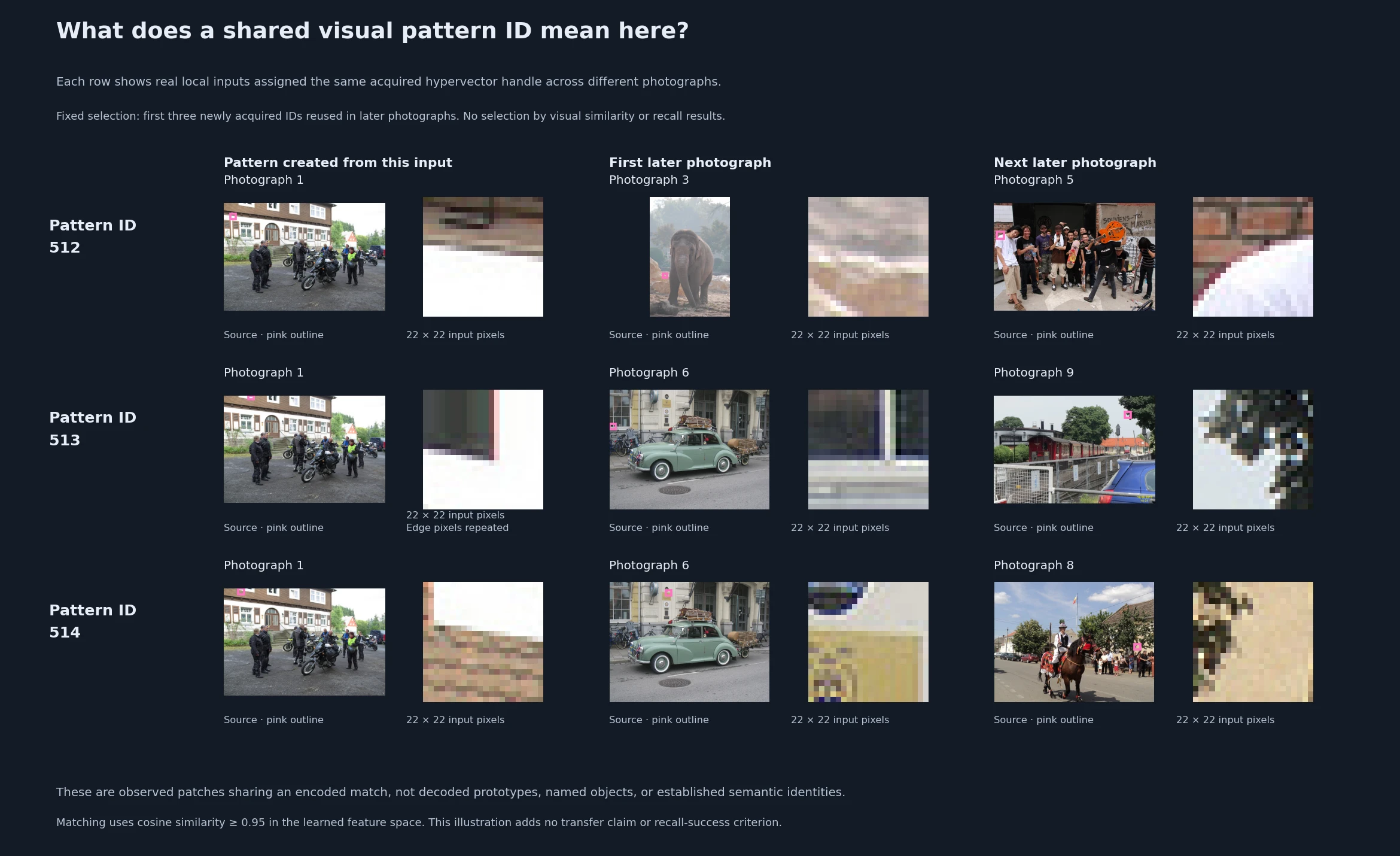
Among the 1,246 appended prototypes, 540 IDs were reused in later photographs, accounting for 21,462 later-photo occurrences. The examples show the first three eligible IDs and their actual encoder input patches. Sharing an ID means an encoded numerical match; the ledger does not label each match as correct or identify a semantic object. Within-photo matches can also come from overlapping feature windows.
Occurrence IDs occupy 0.89 MiB. Added vectors, slots, IDs and metadata together cost 156.71 MiB, beside the dense episodic memories and their new episode suffix. The references are compact, but the current system adds them rather than replacing the dense representation. Compression remains an untested replacement question.
What follows
Keep no cleanup as the default and retain the acquisition mechanism as an experimental candidate. The useful next comparison is at the existing learned memory-only feature-difference readout: on independent photographs, compare selecting patterns from the original and expanded banks with applying the predicted difference directly. Hold the codec, fitted readout and background correction statistics fixed; otherwise changing the bank also changes the correction and confounds the comparison.
The hypothesis was that patterns acquired from other photographs could help interpret imperfect memory readouts even though replacing reliable incoming features harmed recall. The next chapter follows that completed comparison, including individual regressions, new-ID use and retention of earlier behavior. Useful selective cleanup, refinement and consolidation, erroneous-merge handling, transfer across pose and context, and continuing integration remain open under milestone 1.3.
Follow the evidence
- Measure earlier behavior before vocabulary acquisition →
- Preserved launch failure before inference →
- Completed acquisition comparison, readable report and independent audit →
14. Test acquired patterns on independent photographsThe learned difference supports useful memory operations, but expanding the vocabulary adds no established quality gain. Direct prediction improves more requests and also introduces more losses.
Choice and reason
This study moved the question from cleaning up incoming cues to interpreting imperfect memory readouts. Sixteen independently new photographs entered the continuing life, taking it from 323 to 339 encounters. Neither vocabulary acquired patterns from them. Two fixed regions and two position-pair strata per photograph supplied 64 exchanges.
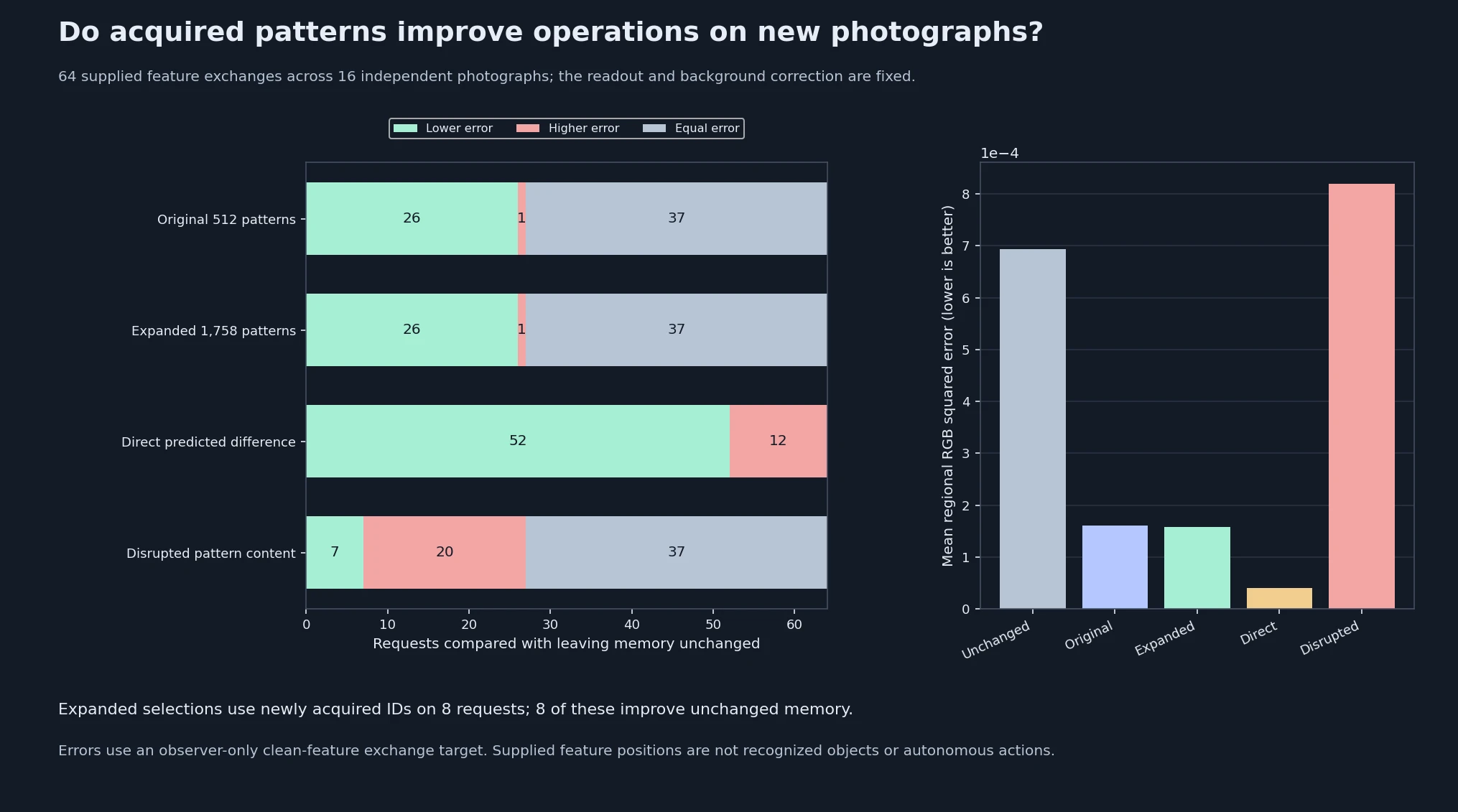
The original 512-pattern bank and expanded 1,758-pattern bank received exactly the same learned predicted difference. The codec, readout and original-bank background correction stayed fixed. Direct application of the predicted difference, unchanged memory and disrupted pattern content provided controls. Position groups had appeared in previous validation; the independent evidence was the photographs.
The operation process received retained vectors and supplied position addresses, without original images or clean features. An observer separately formed each requested exchange from original features through the same decoder. The target tests composition of overlapping feature contributions, not raw photographic fidelity, rectangular cut-and-paste, recognized objects or an autonomously chosen action.
Result: useful operations, no established gain from expansion
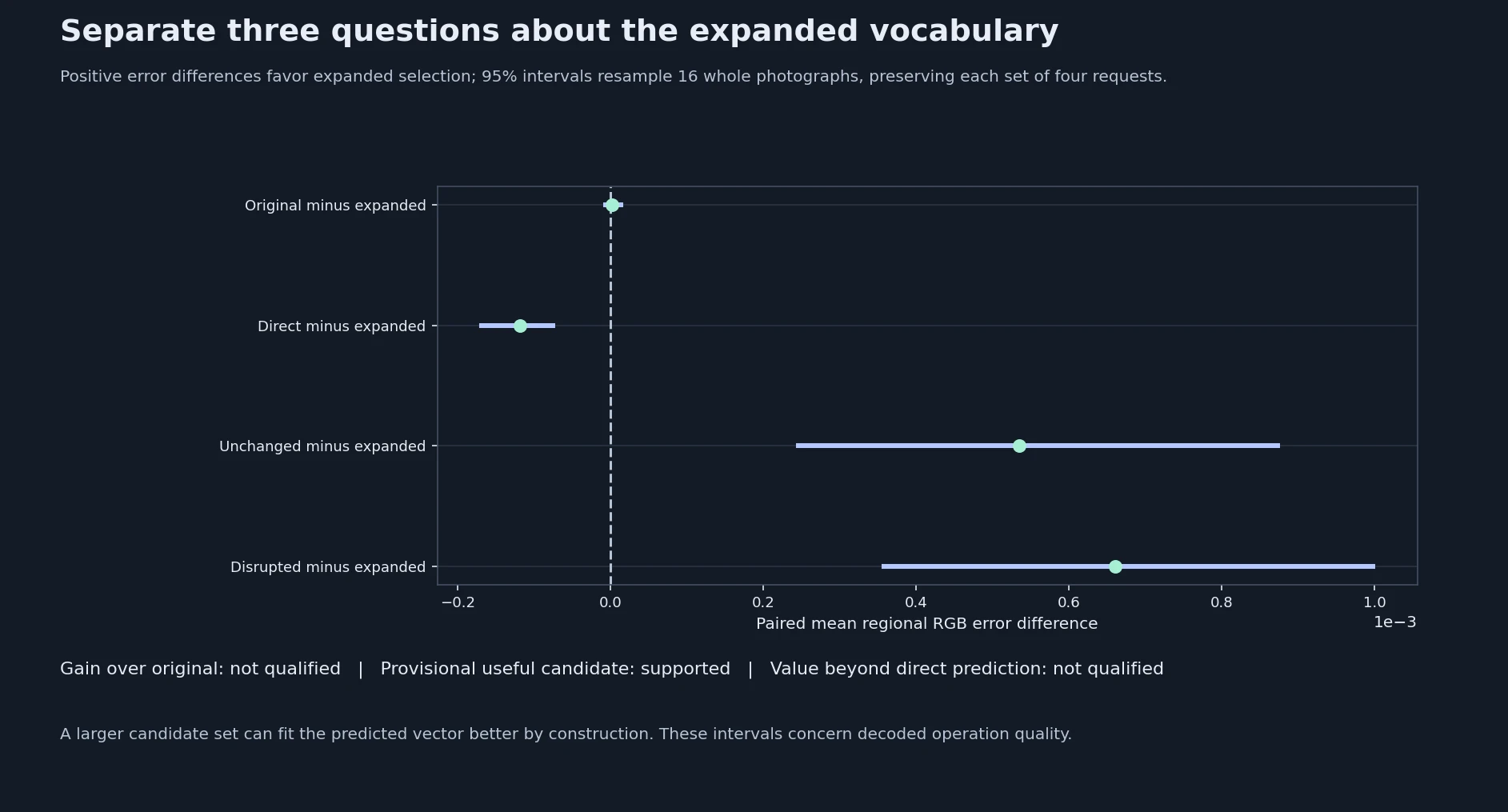
Expanded selection improved 26 requests across 13 photographs, worsened one and left 37 unchanged. Mean RGB error was 77.1% below unchanged memory. The original bank had the same outcome counts. Expansion improved five requests relative to the original bank, worsened three and left 56 equal; its descriptive 1.1% mean-error reduction had an uncertainty interval crossing zero.
Direct prediction improved 52 requests and worsened 12. Its mean error was 74.8% below expanded selection and lower on every one of the 16 source photographs. Whole-photograph bootstrap intervals supported the direct advantage while preserving the four correlated operations per photograph.
Appended pattern IDs appeared on eight requests across six photographs. All eight improved unchanged memory, five improved the original bank and three worsened it; direct prediction was better on all eight. New patterns can participate in independent-image operations, but participation is not demonstrated added value. Disrupting their selected content worsened quality, supporting content-specific operations within the prototype path.
Why lower mean error is not the whole decision
All 12 direct RGB regressions occurred among the 37 requests both banks left unchanged. Direct prediction improved the other 25 of those requests and all 27 on which the banks acted. The prototypes suppressed useful changes as well as all observed direct RGB mistakes; that is not calibrated confidence.
Eleven direct losses exceeded a 10% increase and eight doubled error, so the same provisional harm allowance would reject direct prediction. The doubling cases started from small errors above the registered denominator floor. The largest rose from 0.00000128 to 0.00012682 and contributed 63.9% of summed error increases; the other seven ended at or below 0.00001897. These are localized regional errors, with untouched content preserved exactly. The absolute context does not change the prospective harm verdict.
Expanded selection's sole RGB loss was an 8.8% increase also present with the original bank, using original pattern IDs. Expanded selection met the provisional usefulness criteria, but neither its superiority over the original bank nor value beyond direct prediction was established. Edge comparisons retain additional regressions: two for expanded selection and 15 for direct prediction.
What survived, and what was verified
After admission, all 44 earlier correct recalls remained correct on the established no-cleanup path, with no newly wrong responses. Qualified temporal replay retained both successors at 31 shared anchors. All 32 earlier two-edit sequences reproduced their vectors, handles and final crops exactly using the original bank and readout. The 14-million-comparison replay allowance remained necessary; the default four-million limit still refused the search.
The independent audit passed across all 64 operation updates, 320 decoded crops, 960 scalar errors, eight exhaustive pair-selection checks and the recorded retention comparisons. These are specific retained behaviors, not every historical capability. The operation worker took 100.1 seconds, including 36.1 seconds for selection. The run occupied 411.1 MiB before presentation artifacts, while retaining its dense parent memories.
What this changes under milestone 1.3
Keep the existing defaults. The original acquired vocabulary still supports useful operations; this study does not establish that expansion adds quality. Another automatic increase in capacity, or another exchange-accuracy sweep, would not address the main remaining vocabulary questions.
A proposed vocabulary comparison asks which fixed acquired patterns preserve useful distinctions across placement, offsets between region boundaries, rotation, scale and context, and which wrongly join confusable content. Independent natural inputs with observer-known correspondences, confusable and unfamiliar controls, and partial recall without cleanup could guide refinement and consolidation. This remains open work; it is not the current experiment.
The subsequent evaluation clarification treats storage as one of several reasons for reusable patterns, alongside cleanup, composition and generalization. Large measured savings can justify modest accuracy losses if the intended uses remain useful. Compare total retained bytes and downstream behavior under prospective tolerances; a larger bank need not improve pixel error to earn a role. Predictable growth justifies addressing storage before capacity fails. This changes future evaluation, not the completed comparison or its verdict.
The next chapter introduces another intended use: recollection that can be combined with current working content and rendered as an imagined image. Existing recall and editing scores cannot settle whether representations support that function. Direct bundling is the first diagnostic, before choosing a new generative network or a more elaborate composition mechanism.
Follow the evidence
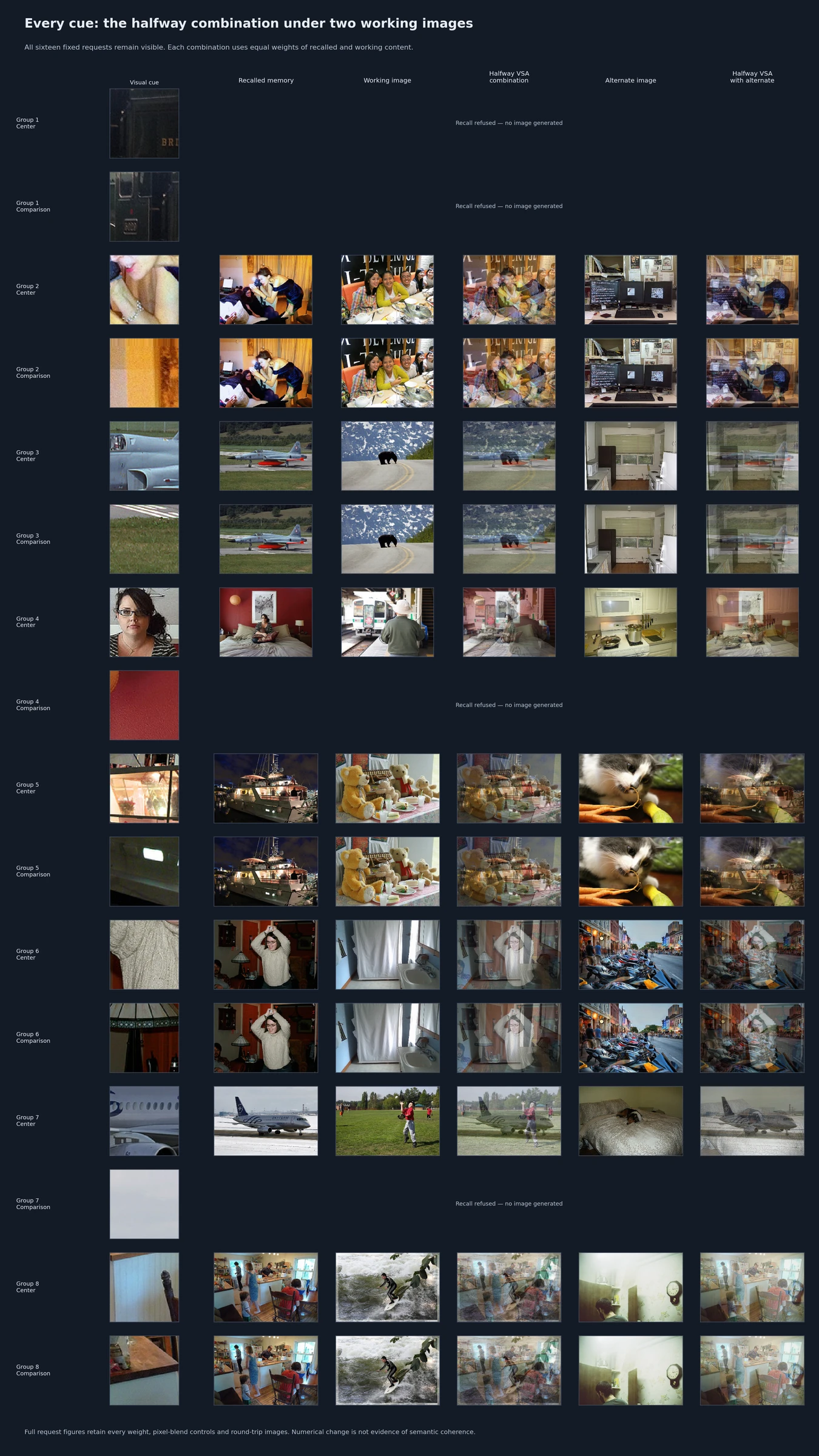
15. Combine recollection with what is currently activeMeasured and independently audited: 12 correct recalls, four refusals and no wrong recalls. Direct VSA bundling renders recognizable source content as contextual superposition, largely as transparent overlays. An organized new scene is not demonstrated.
Why direct bundling comes first
The broader goal is a visual response to what several pictures bring to mind. Recollection and imagination should share access to experience: one recovers an encountered event, while the other may construct content that was not stored as a whole. Present recall and supplied-edit scores do not establish whether the representation supports that use.
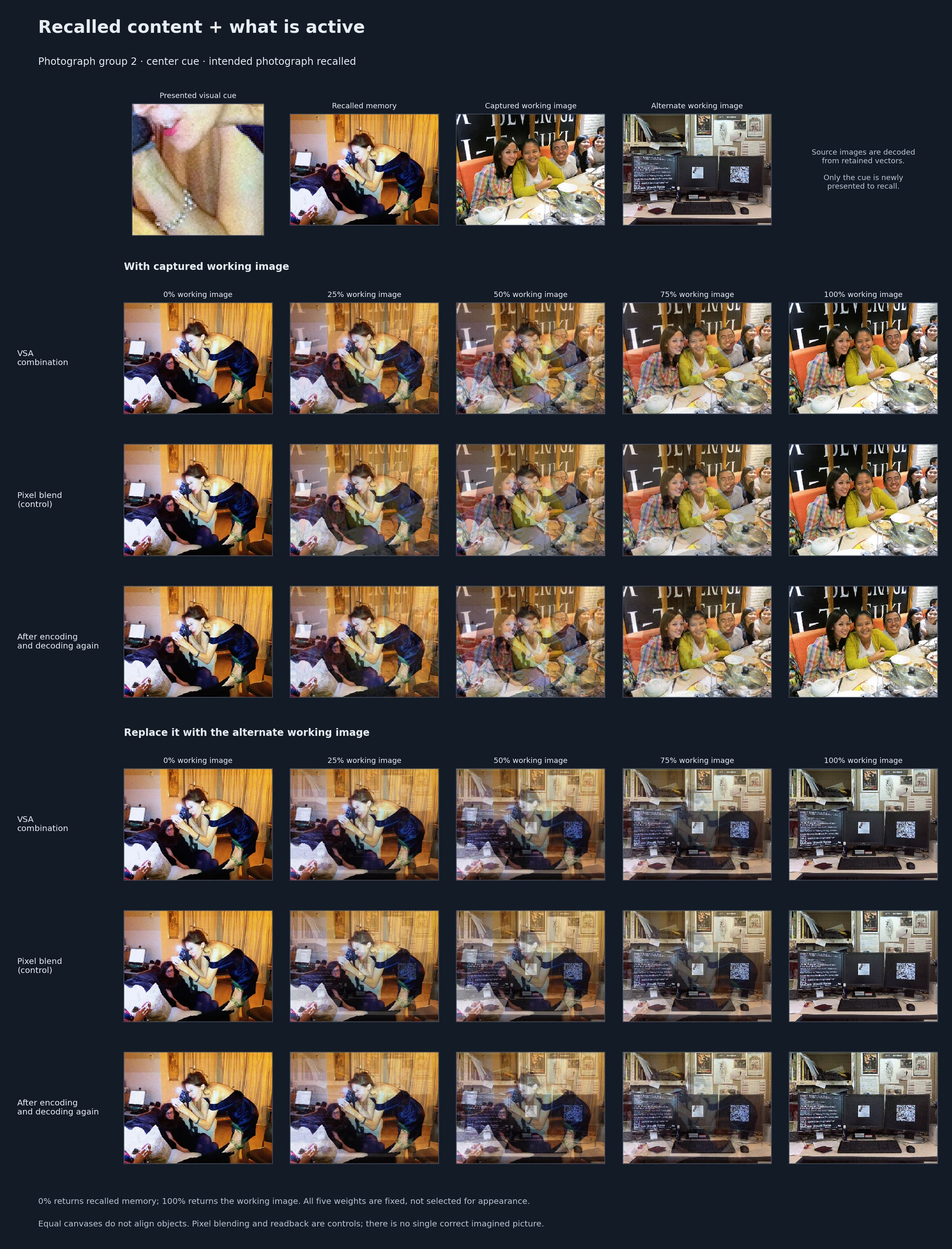
The first increment tests the available machinery directly. Capture the working percept before a visual cue triggers recall, retain both representations, and form a weighted VSA bundle. The same fixed decoder renders the result. No new generative network is trained, and no semantic organization is assumed. A poor blend would diagnose this particular construction, not settle whether VSA can support imagination.
Inputs and the supplied structure
Eight groups each contain three independent fresh photographs: a recall target, a supplied working context and an alternate context. Two native image shapes are chosen by a fixed source-ranking rule; each group shares its shape, with no resizing. Equal canvases align coordinates, not objects. Twenty-four new admissions extended the 339-encounter parent to 363 encounters for this diagnostic.
Each target provides two fixed 80-by -80 visual cues, one from a central region and one from a predetermined comparison region. All cue pixels are visible. Context addresses are supplied to establish the controlled working state; the expected recalled identity remains in observer records. Ordinary content-based recall selects the memory. A refusal or incompatible layout remains a recorded outcome, without replacing the cue or choosing an answer for the system.
What the controls distinguish
Working-image weights of 0%, 25%, 50%, 75% and 100% combine the recalled and active regional vectors and their overview vectors. The endpoints copy the original retained states exactly. Interior weights use the declared raw weighted-sum arithmetic, without coordinate-wise unit normalization. Every weight is retained rather than choosing the most attractive picture.
Each generated image is shown beside a pixel blend of the separately decoded source images. A second comparison replaces the working context with another image while preserving the recalled content and weights. These separate what the VSA decoder does from ordinary image blending and from the influence of a particular active image.
The generated image is also encoded and decoded again. This round trip measures what survives the perceptual interface; it is not an unreported improvement step or a correct target. During generation, full original photographs and observer answers are unavailable. The worker can encode the explicitly presented cue and its own generated images.
Current context is not yet a learned persona
Current context is changing active content. A persona would be a more persistent, revisable influence on salience, retrieval and composition. This diagnostic supplies visual working content and fixed weights; it does not learn dispositions, concerns or a persona.
Assigning a name such as curiosity to a random vector would not give that vector the named meaning. A useful persistent modifier needs acquired effects or explicitly declared training. The later three-picture response also requires evidence about selection and organization; the present cue/context groups are controlled probes of a starting mechanism.
What the actual outputs show
Twelve of sixteen cues recalled the intended photograph; four were refused and none recalled the wrong photograph. Seven of the eight source groups therefore produced mixtures. In five groups, both cues recalled identical source content and produced identical mixtures. These repeated cue outcomes are not additional independent generation examples. All sixteen request figures and the overview are visible, including the refusals.
Visual inspection of every request shows recognizable contributions from both sources, with increasing dominance as the working-image weight rises. The interiors largely resemble transparent overlays: people overlap other people or furniture, an aircraft overlaps a bear or kitchen, and a boat overlaps toys or a cat. Alternate contexts visibly change the picture, but the examples do not demonstrate selection and arrangement of constituents into a coherent new scene.
The VSA outputs are not numerically identical to pixel blending. At equal weights, mean RGB squared differences from the pixel-blend controls are about 0.000562 and 0.000565 for the two context conditions, averaged across the seven generated groups on a 0-to-1 scale. The generated pictures remain visually similar after encoding and decoding again; their mean squared changes are about 0.000120 and 0.000117. These are descriptive measurements, not quality thresholds or a test of imagination.
Execution, visual inspection and independent audit are complete. The first audit used four CPU threads instead of the prescribed eight and stopped on last-bit differences in recomputed metrics. The largest absolute difference was 5.24 × 10⁻¹⁰, and no recall outcome changed. A full diagnostic matched every saved metric exactly with eight threads, and the subsequent audit passed without changing scientific outputs or tolerances. Both audit attempts and the diagnosis remain linked from the run page.
The result demonstrates a controllable route from recalled and active VSA content to a mixed image. It does not yet establish useful imagination, a learned persona or semantic scene organization. There is no single correct imagined image in this diagnostic, and a stable round trip cannot supply that missing criterion. The accepted next experiment introduces a learned conditional denoiser for missing visual content. This gives the specialist an explicit training objective and independently held-out photographs; context-dependent memory activation remains a separate open question. Milestone 1.3's vocabulary and storage requirements remain open.
Follow the evidence
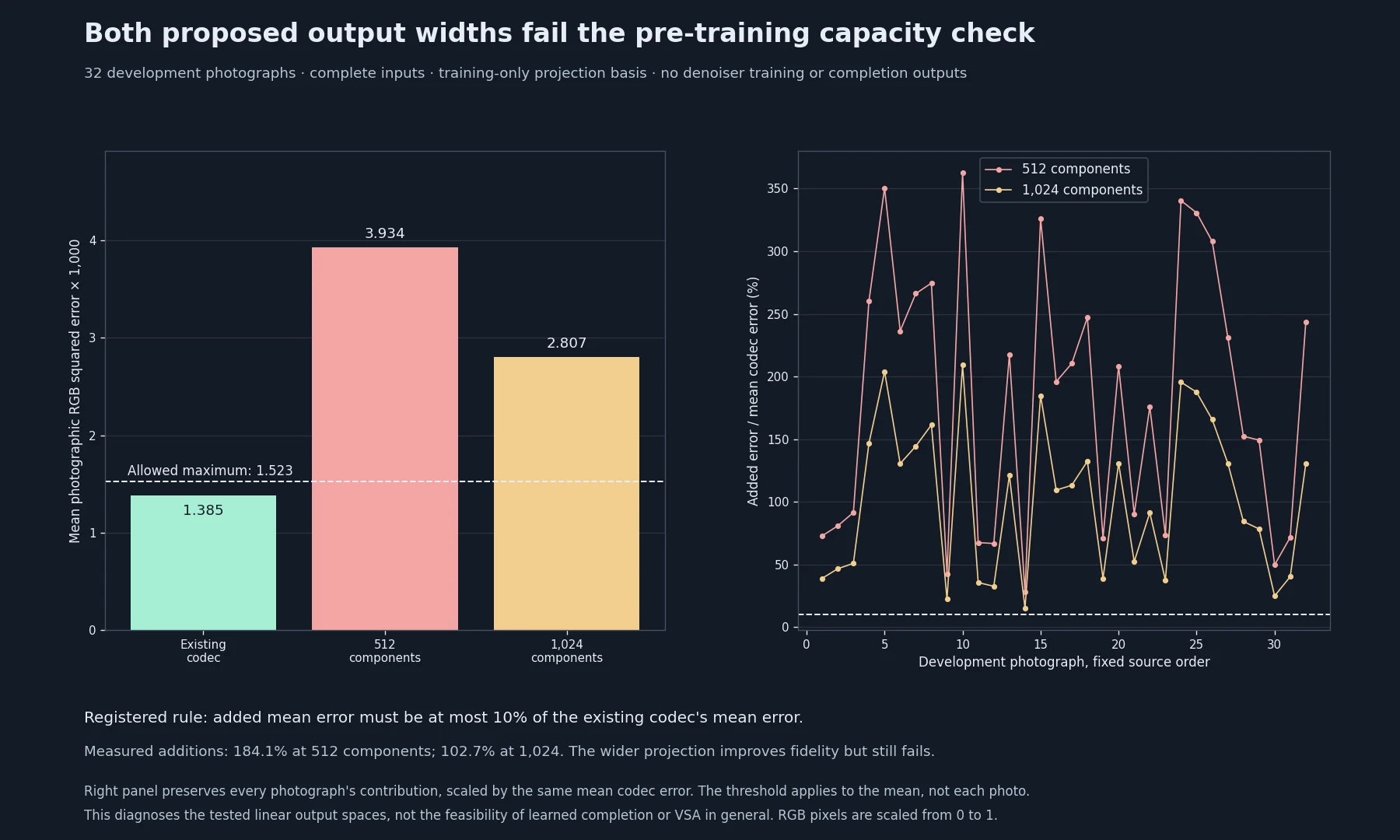
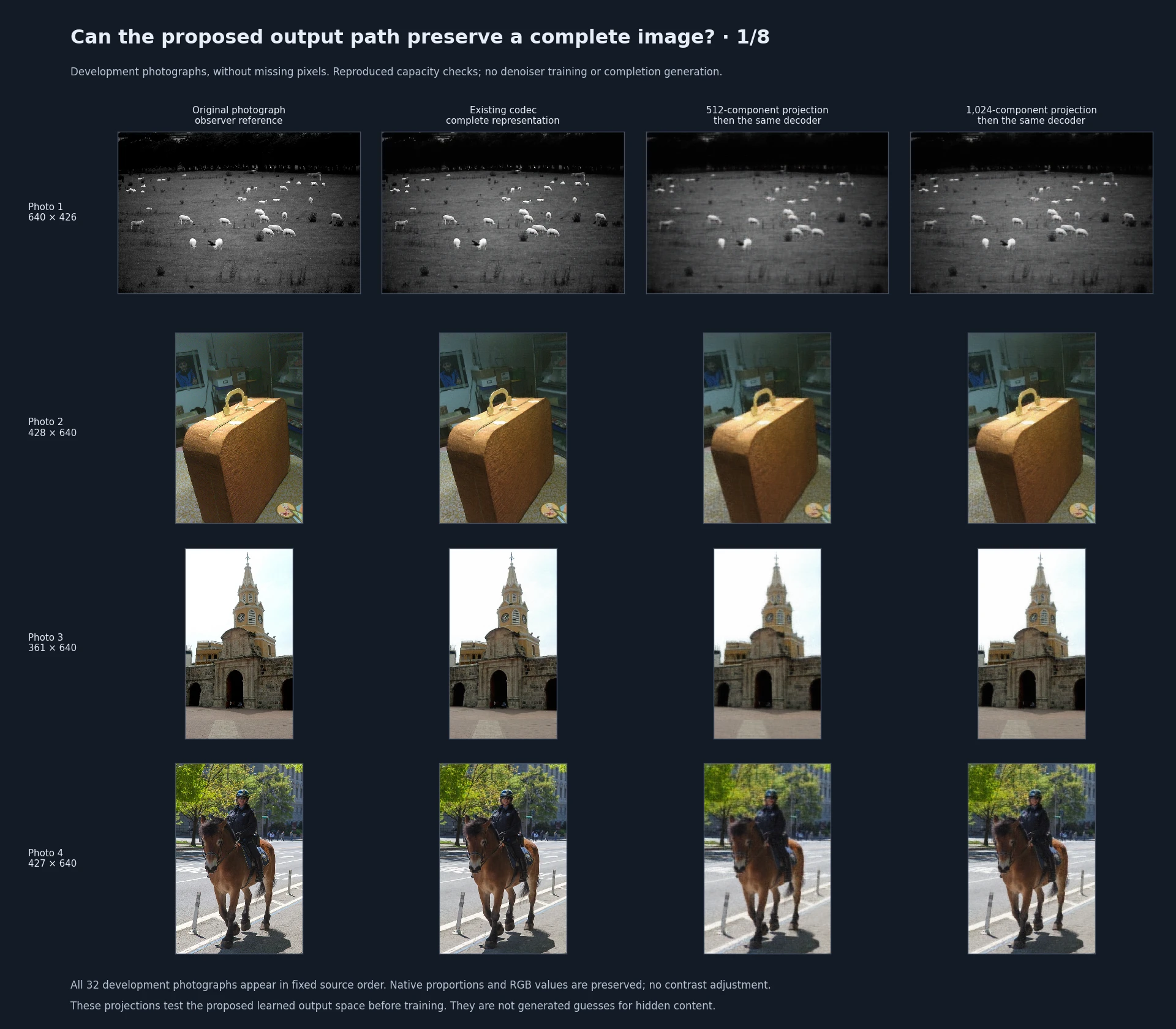
16. Learn to complete missing visual contentStopped before training: both proposed output spaces exceeded the registered added-error allowance on complete development images. All 32 image comparisons were preserved in an exact post-run replay. No denoiser or missing-content completion was evaluated.
What happened before training
The proposed specialist first had to show that its output space could preserve complete visual content. A training-only linear basis projected each regional representation through 512 or 1,024 components, and the unchanged codec rendered the result. This used full development images, not hidden-content generation.
The existing codec’s mean photographic RGB squared error was 0.001385 on 32 development photographs. The 512-component path increased it to 0.003934; 1,024 components reduced that to 0.002807. These add 184.1% and 102.7% to the baseline error. The registered maximum addition was 10%, equivalent to a total error of approximately 0.001523. Both widths failed, so denoising training and the 960-output test comparison did not run.
The original capacity worker retained every measurement but not the intermediate pictures. A later observer-only replay used the same frozen qualifier, inputs and seed to capture them; every recorded qualification number matched exactly. The eight image sheets show every development photograph in fixed order, including the original, native codec and both projected versions. These images are reproduced capacity checks, not generated completions.
Preparation and encoding did finish for all 576 photographs and both masks. The separate test images received no generated completions. The existing codec and 363-encounter life were preserved. Independent validation and the full report remain separate records on the run page.
Why move from bundling to a learned specialist
Direct bundling already gave an interpretable answer: it rendered recognizable contributions from both sources largely as transparent overlays. Combining vectors does not, by itself, teach the decoder which missing structures fit a scene. The next comparison supplies a learning objective rather than attributing scene organization to untrained arithmetic.
The specialist receives masked regional VSA content, spatial coordinates and visibility. Training teaches it to remove noise and predict complete regional vectors; the existing decoder renders the predictions. Hyperdimensional VSA remains the operative representation. The network’s internal width is model capacity, not evidence of compressed memory storage.
What the inputs reveal and conceal
The fixed source budget is 512 training, 32 development and 32 test photographs. Images retain their native resolutions within declared resource bounds; no curated object inventory or geometry grouping defines the task. Two rectangular masks per image are chosen by source identity and fixed seeds, without inspecting outcomes.
Missing pixels are replaced before every encoder path, including the overview. The explicit visibility map is supplied with the representation. Changing every hidden source pixel must leave the entire operative input unchanged. Original pixels and complete target representations are confined to training or observer evaluation as appropriate.
Training photographs are new to recorded experiments but belong to the ancestral codec’s training collection. Development and test photographs instead come from a newly acquired COCO test archive outside recorded codec training and earlier experimental exposures. Entire photographs belong to one split, and source and near-duplicate checks precede encoding.
The registered comparison, contingent on capacity
The plan required capacity qualification before its fixed 2,000-update training budget. Only a passing output space could proceed. Neither qualified. The remaining comparisons below describe the registered but unexecuted evaluation, not measured completion results.
Each of 32 held-out photographs supplies two masks. Four predetermined samples are retained for meaningful, shuffled and absent learned regional context. Unchanged masked decoding, acquired-pattern cleanup and nearest training memory provide additional controls: fifteen outputs per request, 960 in total. No held-out sample is selected as the best.
Every rendering uses the same masked overview. The absent-context control removes learned regional conditioning, not every source of visible information. Complete originals shown in the gallery are observer-only references, unavailable to the operative process.
Measure the hidden interior, the full missing area, visible surroundings and boundary separately. Report individual harms and whole-photograph uncertainty alongside mean performance. Lower photographic error is useful evidence, but visual inspection is still needed to distinguish coherent completion from blurred or copied content.
What this does not yet establish
The continuing 363-encounter life, codec and existing readout paths remain unchanged. Specialist training does not constitute new autobiographical admissions, persona learning or proof that every prior capability is retained.
This is one bounded rectangular-occlusion study. A useful result would support learning compatible machinery over VSA content; it would not establish unrestricted imagination, solved vocabulary refinement or reduced total storage. Those questions remain connected requirements for the continuing cognitive substrate.
What the failure changes
The immediate question is whether a different output architecture can express adequate detail before learning to predict it. Increasing a restricted projection’s width improved this check, but the tested fallback still failed. This does not establish a general dimensional limit or a verdict against VSA-based completion.
Preserve the failed result and its threshold. Any revised architecture needs its own prospective capacity and downstream evaluation; this record does not authorize an unbounded search or prove a new method useful. The broader vocabulary, storage and cognition requirements remain open.
Follow the evidence
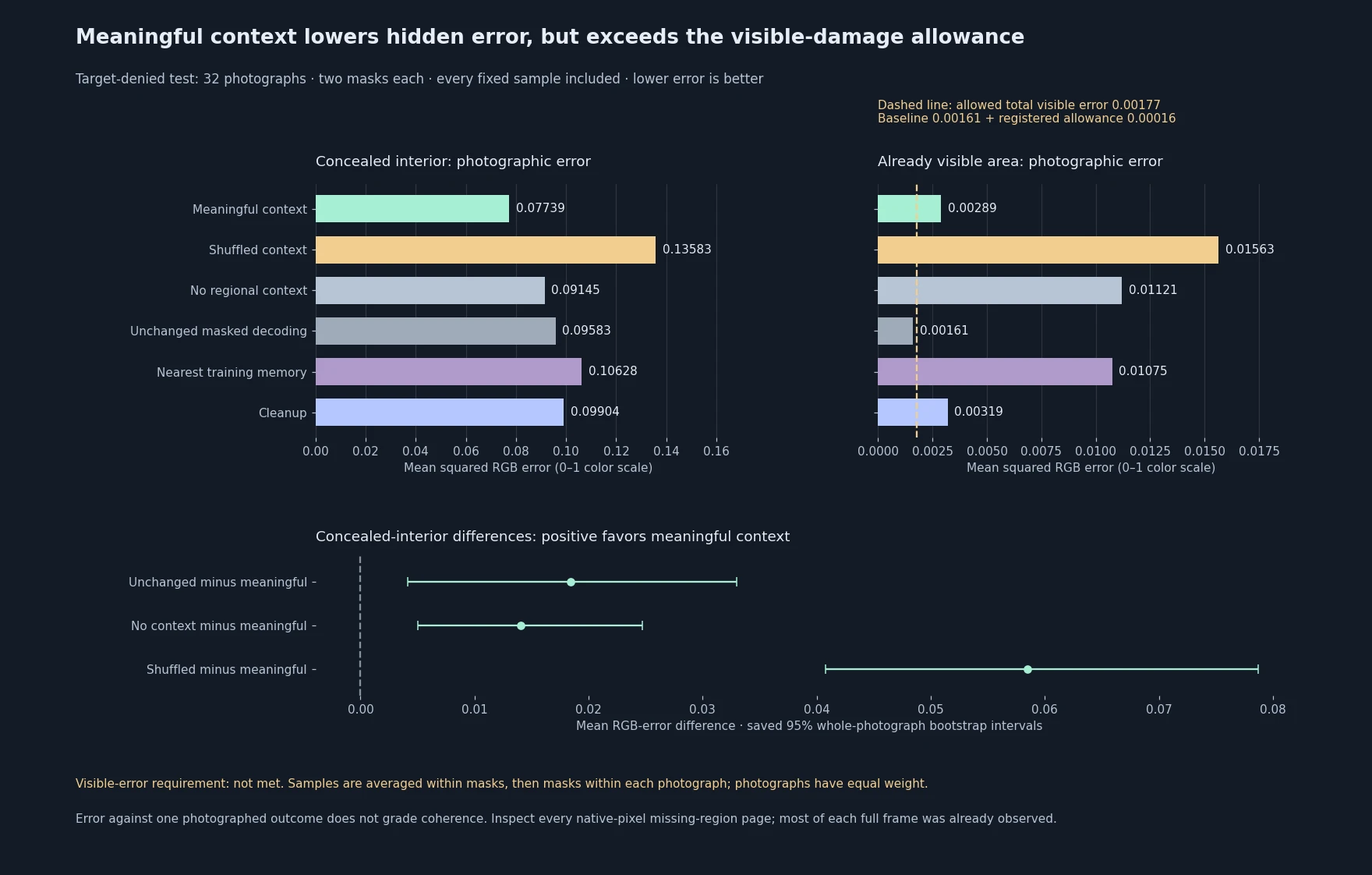
17. Keep full-dimensional values in the learned specialistAll 960 completion outputs are saved and the independent audit passed. Meaningful context lowers mean concealed-interior error, but visible-area error increases beyond the registered allowance, so the candidate does not qualify. Native-pixel detail sheets expose the missing-region quality; visual review did not establish coherent completion.
What changes and why
The failed capacity check concerns two particular linear output spaces. It does not establish that all smaller internal calculations lose important information. The follow-up uses compact queries and keys only to determine regional attention weights; those weights combine full 16,384-dimensional complex context values.
A shared coordinate-wise network predicts real and imaginary outputs using noisy content, masked local content, attended context, the masked overview, coordinate identity and supplied geometry/time controls. Full-dimensional values remain available through the computation. Coordinate identity parameters are learned machinery, not acquired concepts. There is no clean-input identity bypass.
This removes the tested fixed-subspace restriction without guaranteeing useful learning. Coordinating detail across coordinates, preserving boundaries and avoiding averaging remain empirical questions.
Preserve the comparison and bound the work
Reuse exactly the previous source partition and masked input packets: 512 training photographs, 32 development photographs and 32 separate test photographs, all at their native resolutions. The previous development capacity results were known. The follow-up completed all predetermined test requests without selecting a new checkpoint or preferred samples.
Keep the fixed 2,000-update training budget, final checkpoint, four predetermined sample seeds and all original test controls. A benchmark checks cost before fitting; numerical or resource failure remains an incomplete result. This authorizes one candidate, not an open-ended architecture search.
The target-denied completion panel remains 64 image-mask requests and fifteen outputs per request. Every renderer retains the same masked overview. Wholly visible regional vectors must remain exact; hidden interiors, boundaries, visible damage, diversity and all images receive separate inspection.
Denoising and completion are different evidence
A privileged development diagnostic adds known noise to complete target vectors and tests three nonzero noise levels. It compares meaningful, shuffled and absent context with the noisy input, a training-only Gaussian estimate and the training mean. The first four fixed development sources are shown at every level and arm.
Because those noisy vectors contain target information, this diagnostic measures denoising. It does not establish completion of genuinely concealed content or novelty. The independent target-denied completion panel runs regardless of diagnostic quality, unless execution itself fails.
The existing codec and 363-encounter life remain unchanged. Training loss and the target-exposed diagnostic do not establish coherent completion. The concealed-input comparison provides separate evidence: numerical contextual benefit accompanied by excessive visible-area damage.
Read missing-region evidence, not just the whole image
Each rectangular mask hides only part of the photograph. Much of a full-frame rendering is already observed content, so a recognizable whole scene is not evidence that its missing part was completed well.
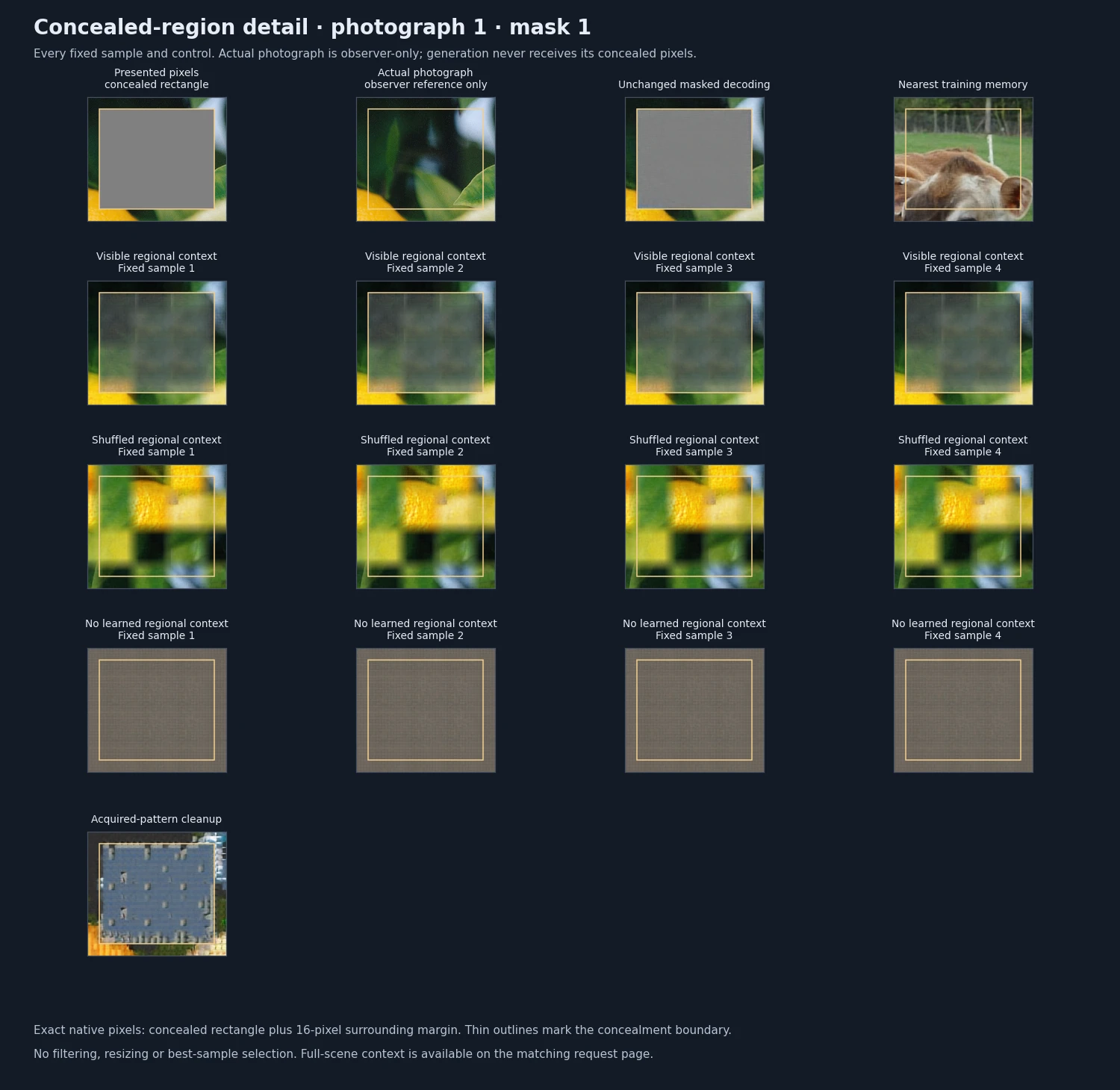
Every completed test request therefore receives both a full-scene page and a native-pixel detail sheet: the actual missing rectangle plus a 16-pixel visible boundary margin. All four fixed samples and every control remain available, without best-sample selection. Privileged denoising checks use similarly labeled detail views, separate from actual completion.
Pages appeared only after their actual outputs were saved. Original test pixels were used solely for observer comparisons after generation. The first fixed completion and diagnostic examples are linked below; neither was selected for visual quality, and every other request remains available on the run page.
What the completed comparison shows
Meaningful context reduces mean concealed-interior RGB error by 19.2% against unchanged masked decoding, 15.4% against no regional context and 43.0% against shuffled context. Whole-photograph bootstrap intervals favor meaningful context in all three comparisons. Twenty-two photographs improve against unchanged decoding and ten worsen, after averaging their masks and samples.
Mean error in already visible pixels increases from 0.001605 to 0.002889, about 80%, beyond the registered 10% allowance. Sixty-three of 64 requests exceed their individual visible-error allowance. The candidate therefore fails its numerical qualification even though its contextual prediction benefit is measurable.
Exact preservation of wholly visible regional vectors is narrower than exact preservation of all visible pixels: regions spanning the concealment boundary contribute to visible pixels too. Photographic error also does not grade structural plausibility. Visual assessment and the independent audit remain separate from these numeric outcomes.
Follow the evidence
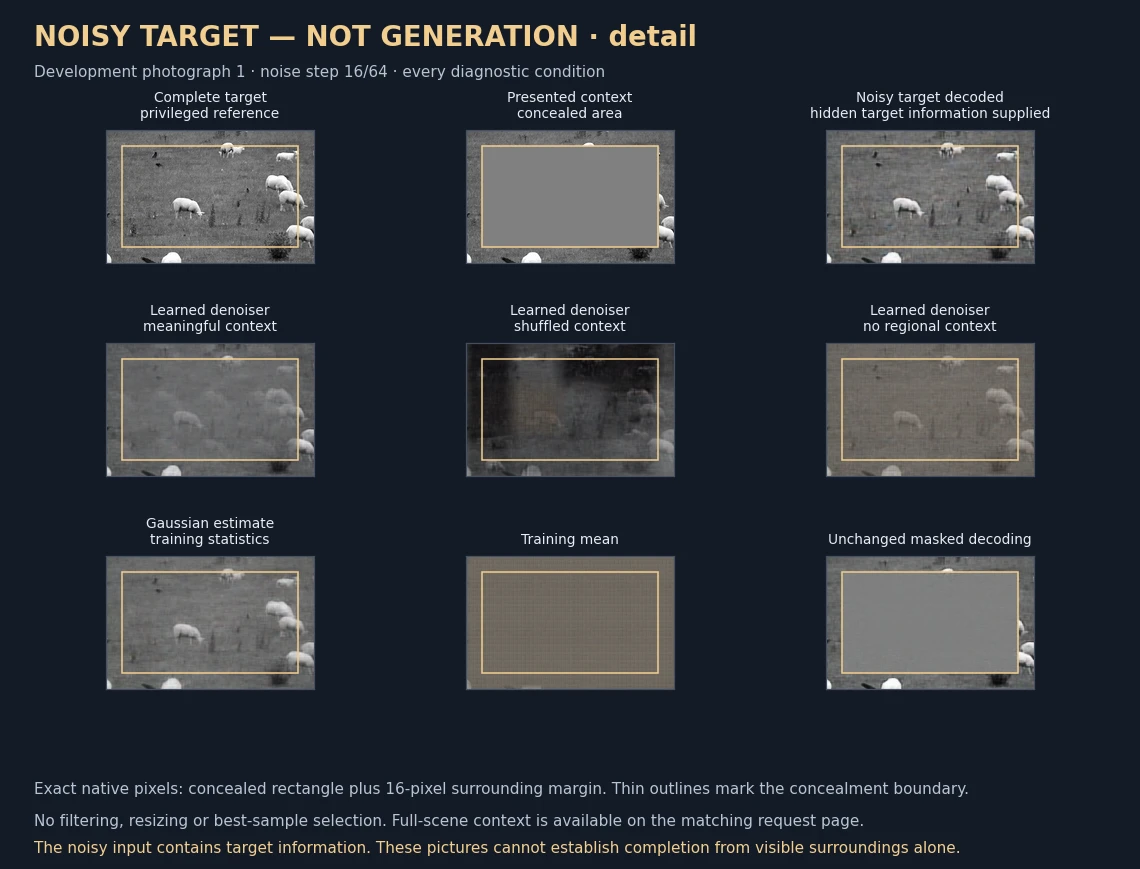
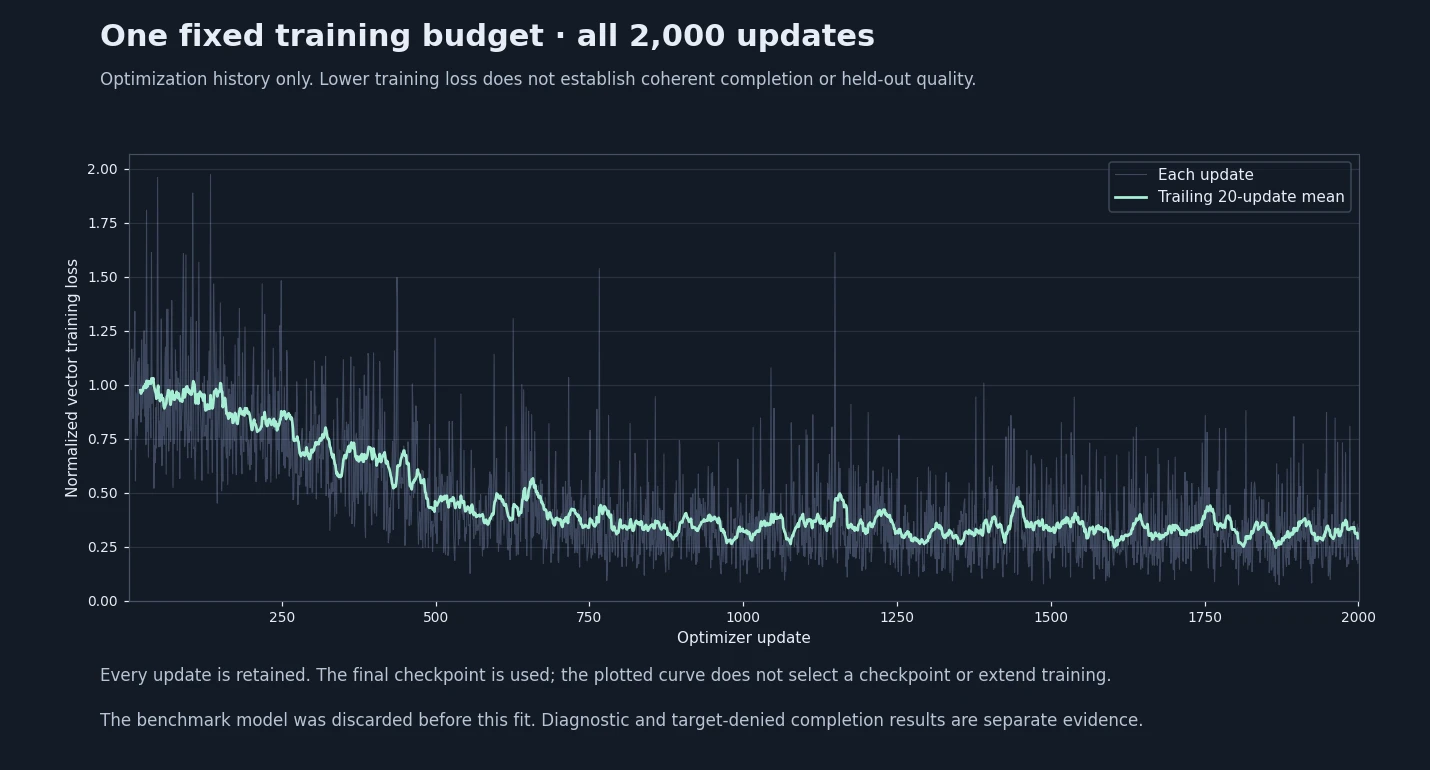
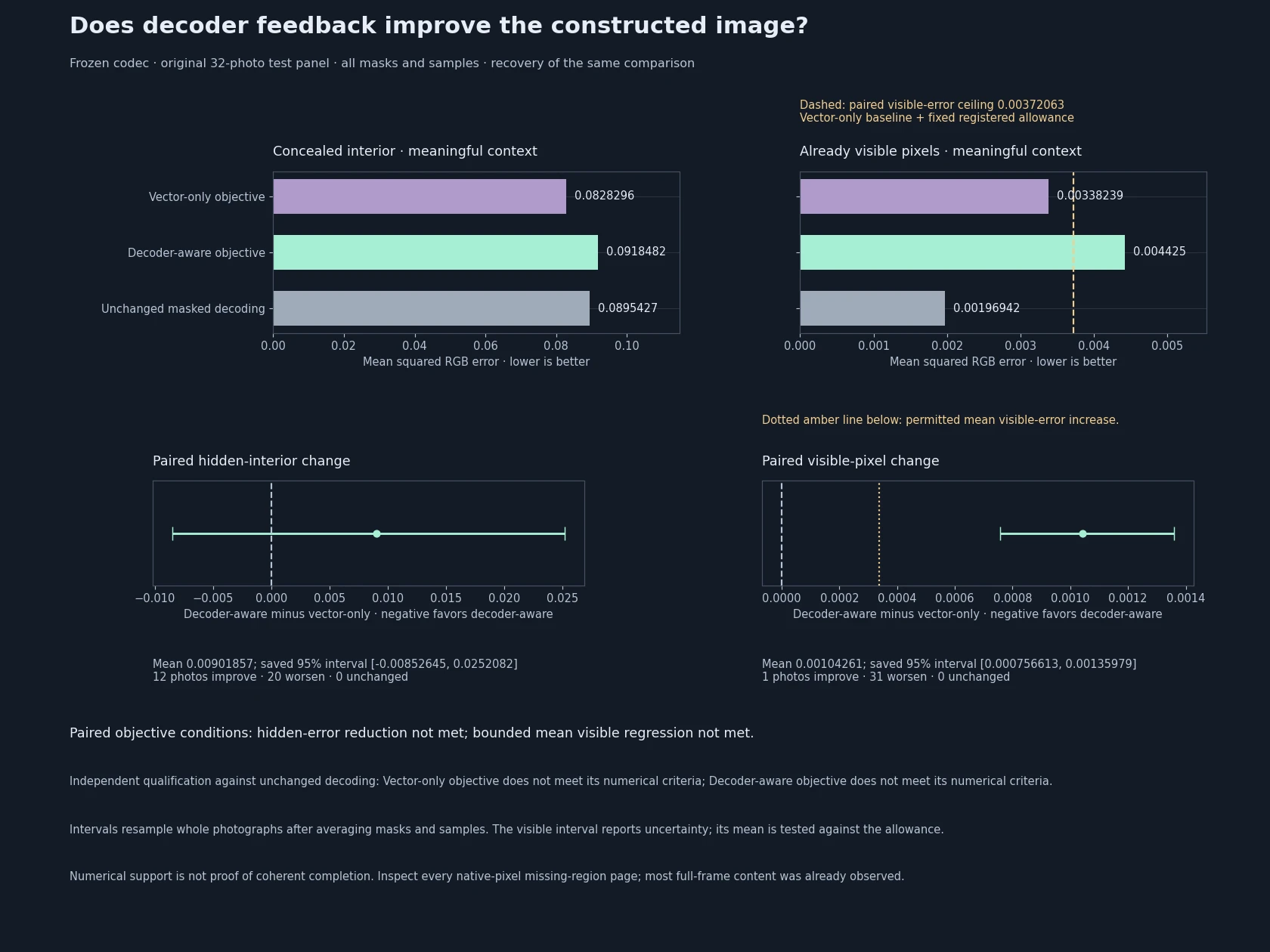
18. Does image feedback improve filling a hidden rectangle?Hide a rectangle in a photograph, ask the trained component to fill it by constructing VSA vectors, then decode the result. Adding the fixed image-feedback loss improved the separate noisy-target diagnostic, but did not qualify hole filling: mean hidden-interior error rose by 10.9% with an uncertain paired difference, and mean visible-pixel error rose by 30.8%. Independent audit passed; the recovered comparison is closed. This continues the original exposed panel, not another independent test.
What the component is asked to do
The input is a photograph with a rectangle hidden. The remaining pixels are encoded, the trained predictor constructs VSA vectors for the missing content, and the fixed decoder turns the result into an image. The complete original is withheld from prediction and shown afterward as an evaluation reference.
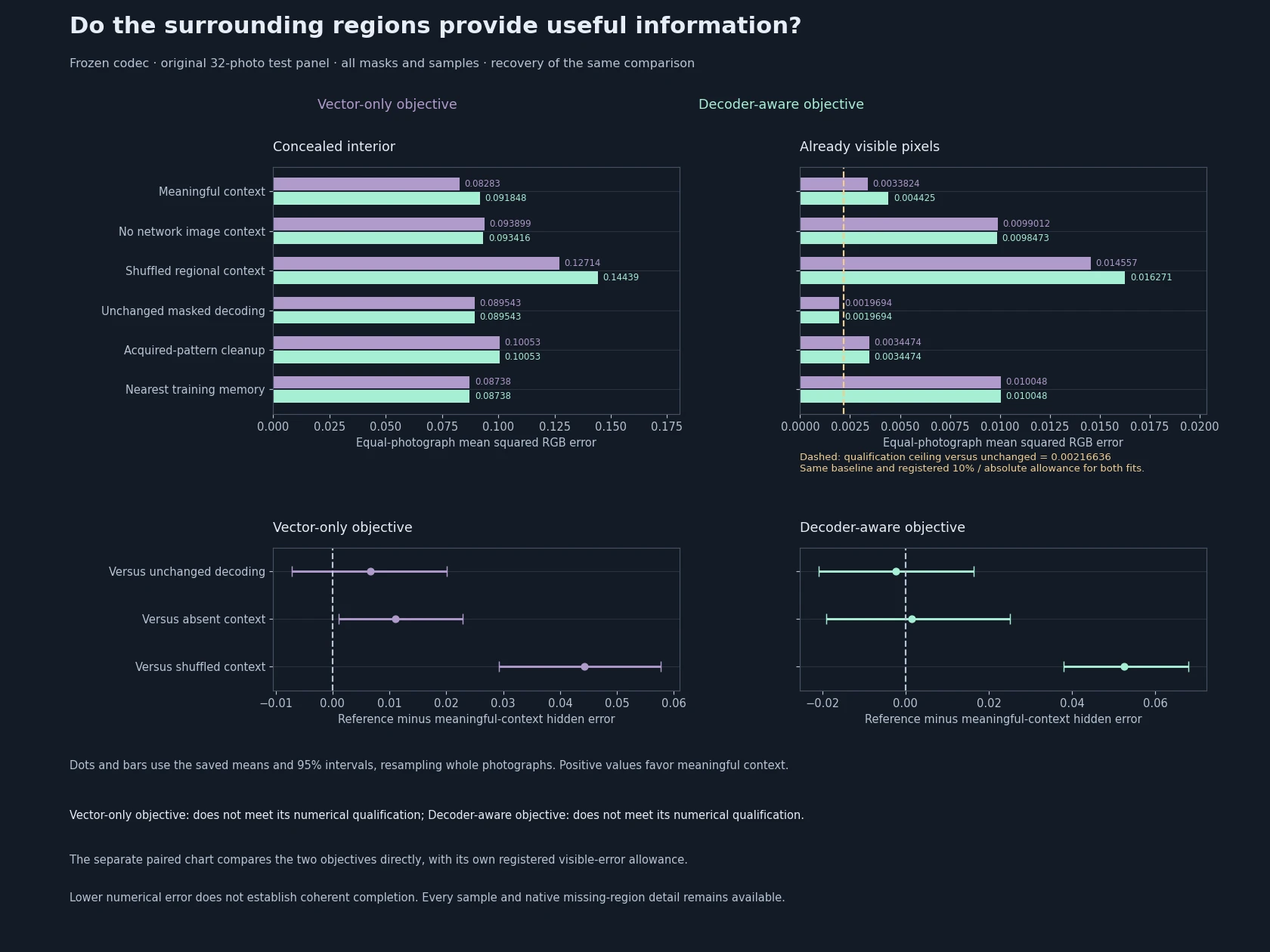
Meaningful context supplies the encoded regions at their correct positions. Shuffled context assigns those encoded regions to wrong positions before prediction. The control labeled 'No learned regional context' removes photo input only from the predictor. The decoder still receives the masked photograph, and wholly visible encoded regions are restored after prediction, so the entire system retains photographic context.
The control asks: Does supplying the photograph to the predictor help beyond the photographic information already supplied to the decoder? The main comparison asks whether adding decoded-pixel feedback during training makes this hole-filling operation better.
The question left by the previous result
The previous specialist learned something useful from visible context, but its predictions damaged visible pixels and did not convincingly reconstruct missing structure. In the separate noisy-target diagnostic, improving vector distance did not always improve the decoded image.
That makes the objective worth testing: perhaps vector error alone gives inadequate feedback about the visual consequences of constructed content. It does not prove that the loss caused the failures. Limited model capacity or training could also contribute. A matched comparison can isolate the effect of adding this feedback without changing those other conditions.
One change, two fresh fits
Both models start afresh with the same full-dimensional architecture, the same 512 training photographs and immutable encoded packets, matching initialization, source order, noise draws and context dropout, and exactly 2,000 updates. A short decoder-aware benchmark is discarded before either fit starts. Neither model is selected by its held-out score.
The control minimizes the existing vector error. The decoder-aware objective adds ten times the average of hidden-pixel and visible-pixel reconstruction errors, with equal weight for those two supports. This prevents the larger visible area from dominating simply because it contains more pixels. The coefficient and support weights are fixed for this experiment, not tuned.
The existing decoder stays frozen. During training, gradients pass through its VSA readout and image reconstruction to the specialist that constructs the vectors. Both training workers receive the same original training pixels. Neither sampling worker receives them or the held-out originals.
Fresh evaluation and separate judgments
The prior development and test images have been exposed, so this comparison selects 32 fresh development photographs and 32 fresh test photographs from the COCO test archive, excluding recorded exposures and duplicate decoded pixels. Native resolutions and two fixed masks are retained. Concealment precedes every encoder path, including the overview.
Development denoising receives corrupted clean-target information and remains explicitly privileged. Actual completion starts from independent noise and masked context. Each objective saves all four fixed samples for meaningful, shuffled and absent context, plus unchanged decoding, acquired cleanup and nearest-training-memory controls: 960 outputs per objective.
On preserved figures, 'No learned regional context' means 'No image context supplied to predictor': the same trained network receives zeros for both regional image vectors and its coarse image overview. Its learned weights, geometry, visibility mask and noise remain. After prediction, wholly visible regions are restored, and the final renderer still receives the shared masked overview. The photograph therefore remains context for the overall system. The causal question is: Does supplying the photograph to the predictor help beyond the photographic information already supplied to the decoder? This is neither an untrained model nor a final image produced without any context.
The primary comparison averages seeds and masks within each test photograph before comparing objectives. Support requires a whole-photograph uncertainty interval below zero for the decoder-aware minus vector-only hidden-interior error, and mean visible-error growth within the fixed allowance. Each candidate is also judged against unchanged decoding. Every sample is retained and visually inspected; lower pixel error alone cannot establish a coherent completion.
What is qualified so far
Preparation saved the source selection without running the learned model. The frozen preflight records 321 affected completion and gallery checks plus 123 existing continuing-life, recall and isolation checks passing. Qualification with the actual codec checks rendering agreement, useful gradients and unchanged decoder parameters. These are implementation checks, not new completion-quality results.
The 363-encounter life and its acquired vocabulary remain fixed. This is a bounded investigation of compatible learned machinery, not a replacement for the open vocabulary-refinement, transformed-view reuse or storage questions. The complete local research archive retains the interruption, exact recovery, completed measurements and every fixed output. The public pages below summarize these records and show selected figures.
Recover the interrupted comparison without changing it
The process terminated after both 2,000-update fits, both component diagnostics, all 64 vector-only completion requests and 59 decoder-aware requests. The cause is unknown. An unfinished atomic-write temporary file is preserved separately and is not counted as a valid result. The interruption does not establish a model-quality outcome.
The recovery inherits completed stages byte for byte and repeats all 64 decoder-aware requests in a fresh output directory. Every tensor and metadata field in the original 59 completed requests must agree exactly before paired observation. Inherited launch receipts are checked at their original locations; no training, parameters, source selection or success criteria change.
These photographs and partial outputs have already been exposed. This is a continuation of the same comparison, not a new independent test or another replicate. The interrupted run remains visible alongside the recovery record.
What the measured comparison shows
With meaningful context, mean concealed-interior RGB error is 0.08283 for vector-only training and 0.09185 with decoder feedback. Twelve photographs improve and twenty worsen. The paired difference is 0.00902, with a 95% whole-photograph interval from -0.00853 to 0.02521; this does not establish a reliable improvement or a definite population-level regression.
Mean error in already visible pixels rises from 0.003382 to 0.004425. Thirty-one of 32 photographs worsen. The paired increase is 0.001043, beyond the allowed 0.000338; its interval is entirely positive. Neither fit meets its separate numerical qualification against unchanged masked decoding. These are regional and visible-pixel measurements, not a semantic coherence score.
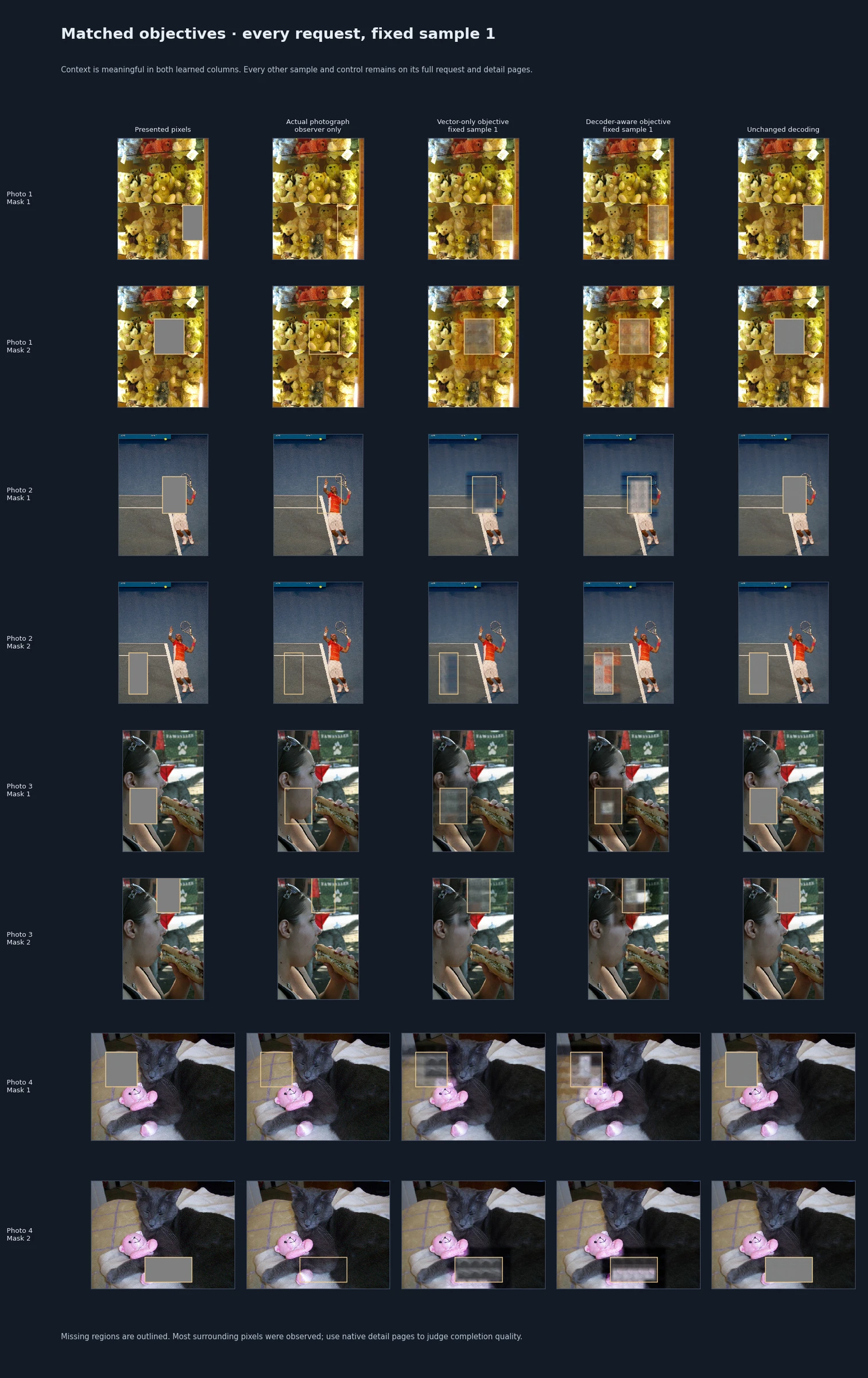
Every sample remains available at full-scene and native missing-region scale. Review finds some more compatible colors and brightness, but repeated or misplaced motifs and unresolved boundaries remain. Improved denoising of noisy target information does not establish completion from concealed input. The fixed loss intervention is informative without qualifying the resulting specialist.
The separate noisy-target diagnostic gives a narrower positive result: image feedback reduced hidden-pixel reconstruction error by 19.9% to 29.8% against the matched model across the three tested noise levels. Those inputs contain corrupted clean-target information. Their improvement therefore does not establish the ability to fill a rectangle whose original content is withheld.
The independent numerical audit passed, and the comparison is closed. The exact recovery proof, copied-figure identity records, visual reviews and compute costs are linked on the run page. This continues the original exposed panel, not another independent test. The following chapter develops the subsequently authorized strategy spike, using temporal interpolation as its first bounded comparison.
Follow the evidence
- Interrupted paired comparison: completed fits, partial outputs and preserved evidence →
- Audited recovered comparison: all outputs, exact repeated prefix and measured limits →
19. Which mechanism should construct new visual content?Three comparisons separate conversion fidelity from the contribution of learned construction; none yet establishes coherent middle-scene prediction.
Why step back
The earlier masked-photograph studies found some contextual benefit but did not establish coherent filling of missing content. The next question is architectural: what construction mechanism should work with the existing VSA memory? This spike is separate from the continuing mind, so an experimental constructor cannot change its acquired experience.
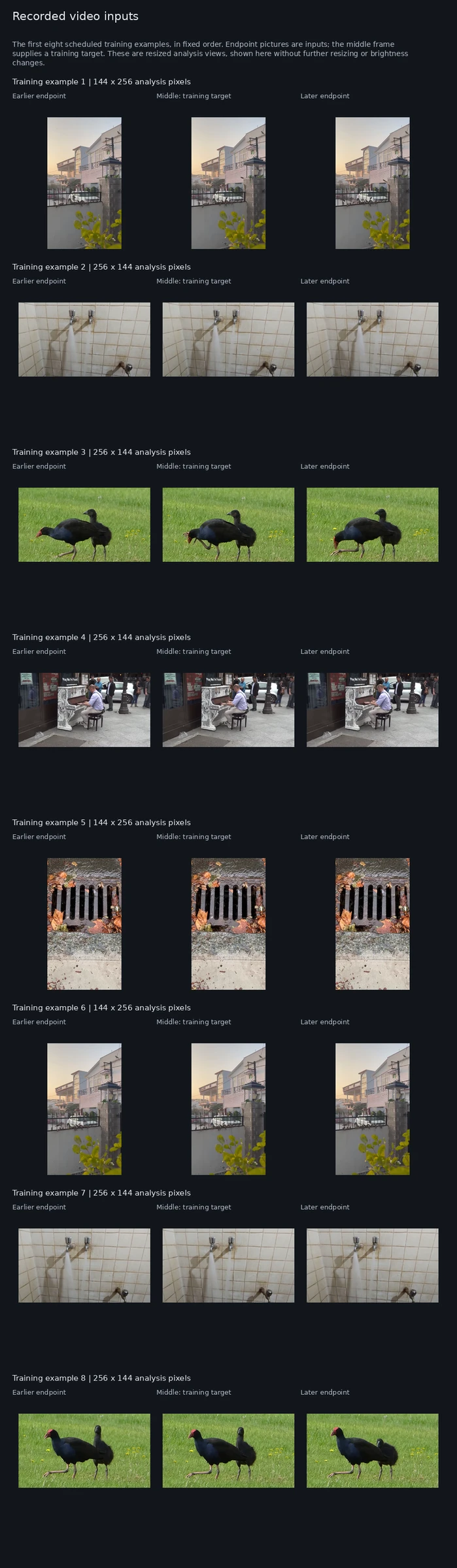
The first comparison uses short natural videos. It supplies a frame before and a frame after an unobserved middle frame. The models must construct that middle frame from the endpoints. The actual middle is a training target and an external test reference. This is temporal prediction, not open-ended imagination.
Qualify the common interface first
Both candidates need spatial features they can manipulate, recovered from the native VSA representation. The existing decoder produces spatial features, but these are not the original encoder features. A learned adapter converts between them; the fixed phase projection and position binding then build full 16,384-dimensional complex vectors for the existing decoder.
First give the adapter the complete middle-frame vector and measure how much image quality that conversion loses. This deliberately supplies the answer representation and tests only the interface. If development reconstruction loses more than the registered allowance, neither constructor is trained. A failed prerequisite is evidence about this route, not a comparison between generators.
The two candidates and controls
The transport model learns where to sample content from the two endpoints and how to combine it. The synthesis model learns new spatial feature values around an initial average. Each predicts both local content and the coarse overview, then recomposes them into VSA before rendering. No original middle pixels, vectors, features, overview or captions reach construction at test time.
Controls copy each endpoint and average their VSA representations. The external observer also measures averages of the original endpoint images and of their decoded images. Every fixed test case is shown, including poor results. Lower pixel error can nominate a follow-up but does not by itself establish visual coherence.
Scope and language direction
The pilot uses nine previously available video sources: five for training, two for development and two for test, with 128, 32 and 32 triplets. Full frames are resized to at most 256 pixels on the longer side. These are reduced analysis views, not a new input-resolution restriction. Neighboring frames are correlated; two test videos are only two independent source groups.
Reading from images and hearing language are intended to reach a common language system. Conversation will be added last as another interface, after language can connect to perceptual experience. This visual spike proceeds independently and uses no language to supply scene meaning or a solution.
Execution record
The first attempt stopped during admission, before fitting: a GPU-backed overview reached the existing CPU-only percept materialization interface. The corrected attempt keeps the same inputs and criteria. An expanded synthetic CUDA check reproduces the old error and verifies admission, reference rendering and isolated reconstruction before the retry. This is an infrastructure correction, not another independent scientific replicate.
What this comparison established
The corrected run completed and the independent audit passed. Conversion of a clean middle-frame vector increased mean RGB error from 0.000843 to 0.001762 on development and from 0.000332 to 0.000749 on test. Both increases stayed within the provisional 0.001 allowance, although relative error more than doubled. The test is about a usable interface, not perfect reconstruction.
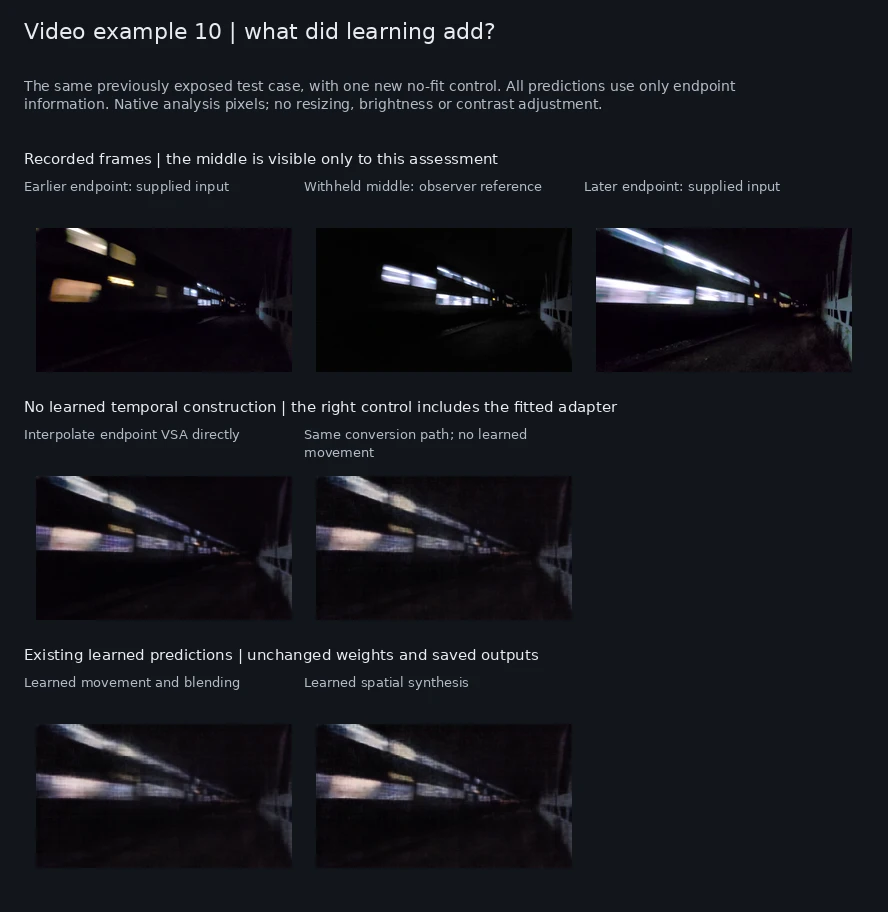
For actual prediction, VSA interpolation had changing-pixel MSE 0.015328. Learned transport reached 0.016589 (+8.2%) and synthesis 0.015987 (+4.3%). Neither improved the average for either test video; each improved six of the 32 individual triplets. Whole-image error was only 2.7% and 2.4% higher, within its damage allowance. The models failed to earn their added complexity rather than catastrophically destroying the scene.
The registered numeric criterion therefore selects neither model. Only two independent test videos were used, with small fixed-budget networks and reduced analysis resolution. No matched untrained feature-interpolation control through the adapter was saved. That missing comparison leaves the cause of the gap partly unresolved: conversion loss and weak temporal learning have not been separated. A privileged original-feature control would need matching training and evaluation conditions.
The life and visual codec remain unchanged. This is evidence about two concrete prototypes and their interface, not a verdict against either strategy family or VSA. The language plan remains reading and hearing through a common system, with conversation added last.
What the matched control clarified
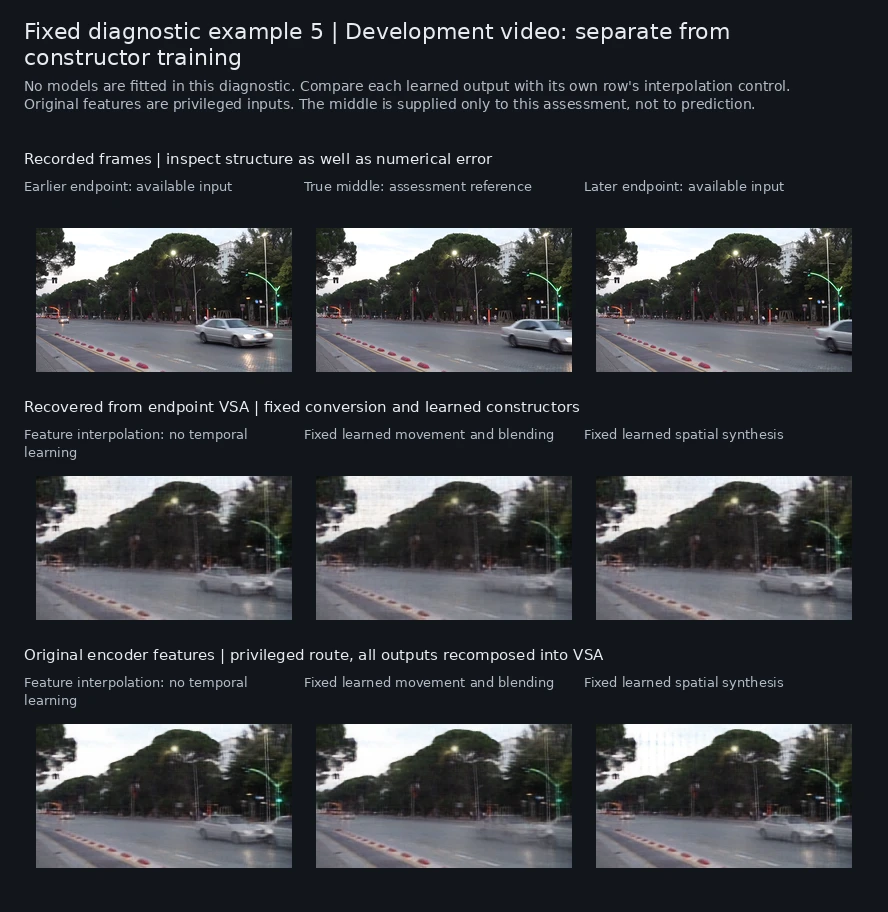
The next diagnostic adds the missing reference: interpolate the recovered spatial features through exactly the same conversion and VSA reconstruction as the learned models. It reuses every earlier learned output and fits nothing. The videos have already been examined, so this is a check of the mechanism rather than fresh validation.
Against that reference, synthesis lowers whole-image error by 0.29%, but changing-pixel error is 0.14% higher overall. It improves changing-pixel error on 25 of 32 cases, usually by a small amount; two harder train examples outweigh many gains. Transport increases changing-pixel error by 3.91%. Neither meets the 5% improvement criterion on both videos. The figures still show doubled moving contours, with recognizable surroundings.
This rules out a substantial learned benefit hidden by the earlier choice of baseline on these examples. It does not prove there is no learning or identify the exact limiting component. The next comparison fits and evaluates on original encoder endpoint features, with its own untrained blend and otherwise matching training conditions, to test whether feature recovery limits useful learning.
Would original encoder features unlock better learning?
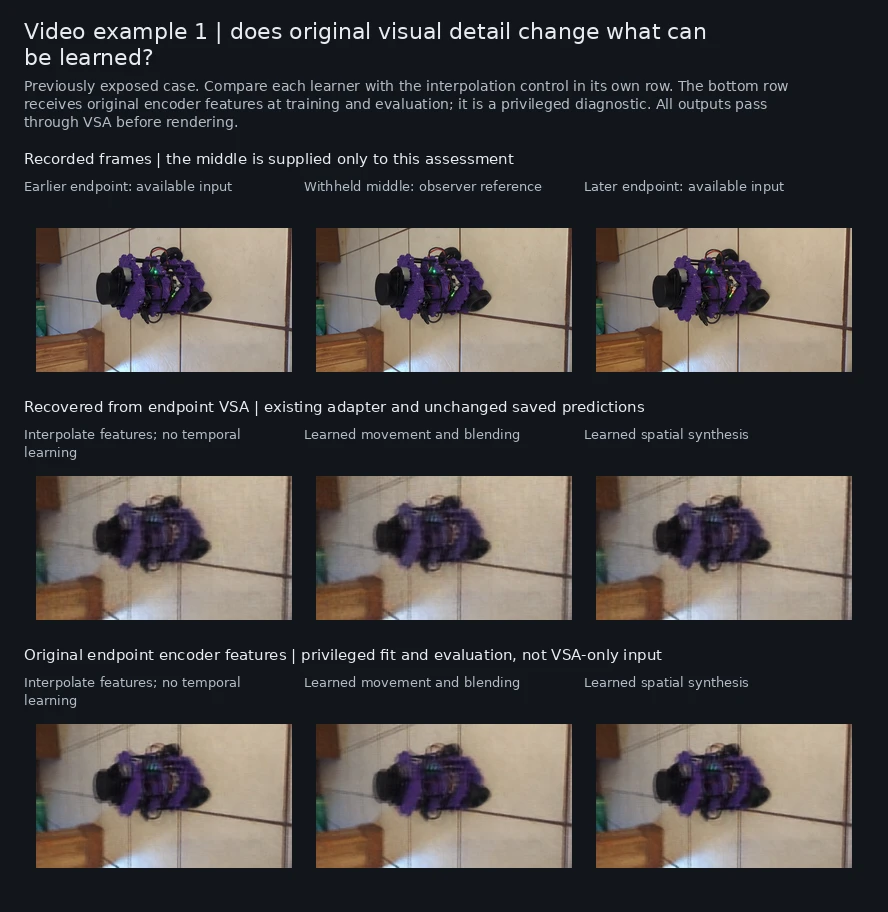
The next comparison supplies original encoder endpoint features during both fitting and testing. Each constructor keeps the same architecture, training videos, targets, normalization, initialization, sample order and 2,000-update budget. Each condition has its own untrained feature blend, and every output still becomes full VSA before decoding. Original features are privileged diagnostic inputs, not a new operative interface.
The original-feature blend lowers whole-image error by 2.91%, changing-pixel error by 4.26%, and static-pixel error by 13.00% relative to recovered features. Recovery quality therefore matters. But against its own original-feature blend, learned transport lowers changing-pixel error only 0.60% overall and synthesis raises it 0.19%. Their effects disagree between the robot and train videos. Neither reaches the required gain on each source.
This gives a stopping point for the spike: do not assume another adapter fit will supply the missing learned behavior. Next assess these existing models on fixed training and development examples, in both feature space and decoded images. That can distinguish weak learning of the examples, weak transfer between videos, and improvements lost in rendering. No further fit or general architecture selection follows automatically.
Did the models learn their familiar examples?
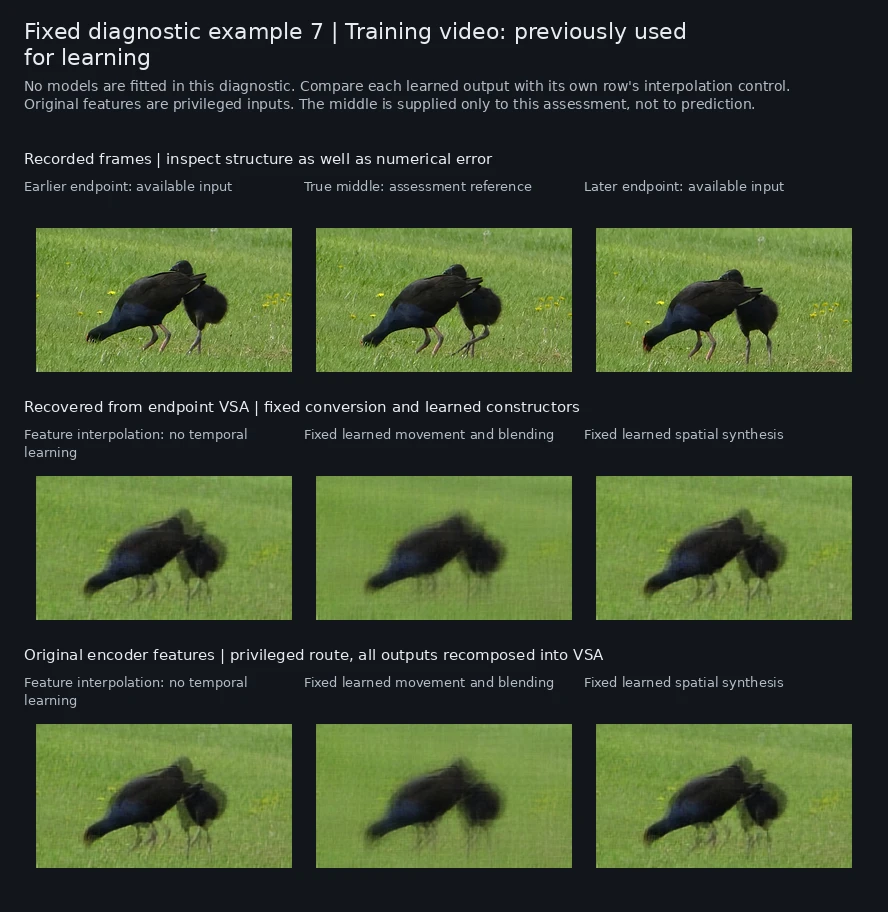
The next diagnostic changes no weights. It evaluates all 128 original training triplets and all 32 development triplets using both existing input routes and their own untrained blends. Each prediction saves its local and overview features, full VSA and decoded image. Middle targets stay outside the isolated worker. Training examples are familiar; development videos were not constructor fit targets but have already been examined, so this is diagnosis rather than fresh validation.
Original-feature transport lowers training feature error 12.37% and whole-image error 6.09%, but raises them 8.38% and 5.14% on development. Both development videos worsen on image error. This is evidence of uneven transfer under the current setup, not evidence that the model learned nothing. The original-feature synthesis model has the same broad training-versus-development contrast.
Recovered synthesis supplies a different lesson: combined training feature error falls 32.06%, but the improvement is concentrated in the coarse overview (59.33%) rather than the local features (1.04%). Training image error falls only 0.99%. It retains a small benefit on development: image error falls 1.05%, with 28 of 32 images improving. Feature loss and visible utility are distinct measures, and a lower feature score alone does not demonstrate coherent construction.
The visual selection was fixed before scoring: the first and last chronological example from every source, 14 comparisons. Recognizable scenes persist, but moving contours often remain doubled or softened. The independent audit reproduces all 960 feature/image comparisons. No model enters the continuing life. A future comparison of output-aware and feature-only learning needs the same broader data and fitting conditions for both, plus unexamined source videos; decoder feedback by itself has not established coherent generation in earlier work either.
Follow the evidence
- Preserved preparation failure: no fit or quality conclusion →
- Corrected execution with unchanged inputs and scientific criteria →
- Matched no-learning control: small synthesis gains, no reliable improvement in changing regions →
- Original encoder features at fit and test: better fidelity, inconsistent learned contribution →
- Frozen training/development diagnosis: learned effects, weak transfer, and feature/image mismatch →
20. Can a change inferred from one image work on another?Relation fitting and continuation through saved VSA were measured. The historical numerical criteria passed, but the decoded structures do not establish correct rotation; rendered rotation remains unqualified.
Why test a reusable change?
The video constructors tried to fill a missing frame. They showed some learned effects, uneven transfer and a mismatch between feature error and visible benefit. A construction subsystem needs broader capabilities: transformations and compositions that can be retained and reused, alongside completion, simulation and elaboration. Reflection or replay could eventually combine those capabilities into alternative sequences.
This experiment starts with one prerequisite: can a relation inferred from one experience become an input to another construction? It does not yet choose a useful sequence or invent an operation family. The current encoder and decoder remain the visual interface; the specialized mechanism inside this test uses numerical fitting rather than new neural training.
What the system sees and does
Each of eight groups has two before-and-after demonstrations and four different query photographs. Each demonstration shows a rotation, uniform scaling and displacement. Cliste receives VSA representations of these pictures, without text instructions, the true transformation values or desired query outputs. The possible geometric family is supplied; the particular values are inferred.
The inferred relation is stored as a VSA bundle and applied to each separate query. Its constructed result is saved in the ordinary visual VSA representation. A different process receives only that saved state and the second relation. It cannot reopen the original query or use the temporary feature array from the first operation. This tests whether the first constructed state remains useful as an input.
The two-step sequence is supplied by the experiment. A fit that lacks enough geometric agreement is refused and becomes an explicit no-change operation. Constructed states keep their lineage and are not admitted as observed events. Boundary replication is supplied image handling, not invented unseen content.
How to read the pictures and controls
Begin with the two before-and-after demonstrations at the top of each explanation sheet. The next row shows a different photograph, its desired first result and the inferred result. The last row shows the desired second result, the actual continuation from saved VSA and the result when true geometry is supplied through the same path. Desired images are external references, not inputs to construction.
The separate control sheet asks whether the result depends on the correct demonstration, whether it incorporates the first change, and how much quality the conversion path itself loses. The skip-first control replaces the first change with an identity conversion, so it has the same number of passes. Directly encoding the desired photograph measures ordinary reconstruction quality; supplying true geometry measures construction quality without inference error. The first query from every group was selected for display in advance; all 32 are measured.
Recorded results and later qualification
Qualification correction: accurate parameters and lower average image error do not establish that the scene rotates correctly. Local structures can be missing, fragmented or incorrectly oriented. A subsequent component diagnostic found this failure even with exact geometry and original encoder features. The historical numerical verdict and downloads remain intact; they must be read separately from the failed rendered-rotation qualification.
Fifteen of sixteen demonstrated relations are accepted. Median geometric displacement error is 0.93% of the image short side, including the refusal. After the second operation, image error is 66.7% lower than unchanged conversion and 60.6% lower than skipping the first change through matched passes. All 32 queries improve against unchanged conversion; 28 improve and four tie against skipping the first change.
All five prospective numerical criteria pass, and an independent audit reproduces all 416 image comparisons and verifies the saved-state ancestry. The first-stage wrong-demonstration confidence interval includes zero, so that comparison remains uncertain despite its positive mean. The one refused relation remains a failed first change; its threshold was not retuned.
The visible problem is not only loss of fine detail. True geometry also produces distorted local structure, while directly encoding the desired picture preserves it. The retained findings concern relation estimation and continuation through constructed state, not a qualified visual rotation mechanism. The comparison does not isolate the failure to the decoder.
Each relation uses 128 KiB of vector values and is stored once for reuse across four queries. That is larger than four ordinary numeric coefficients; this experiment tests representation compatibility, not a storage saving. The continuing life remains unchanged. Another construction capability needs its own prospective test rather than repeated tuning on this panel.
Follow the evidence
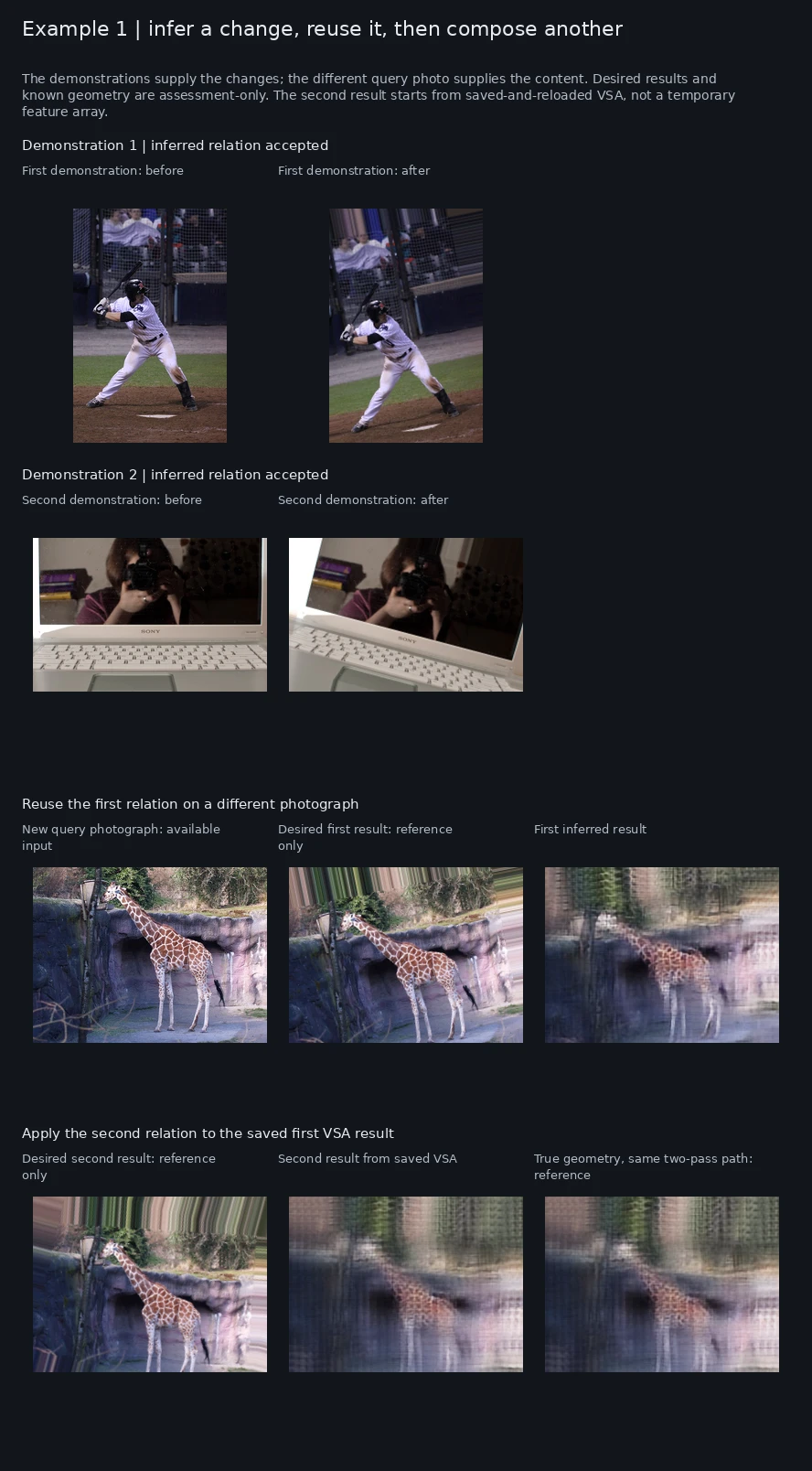
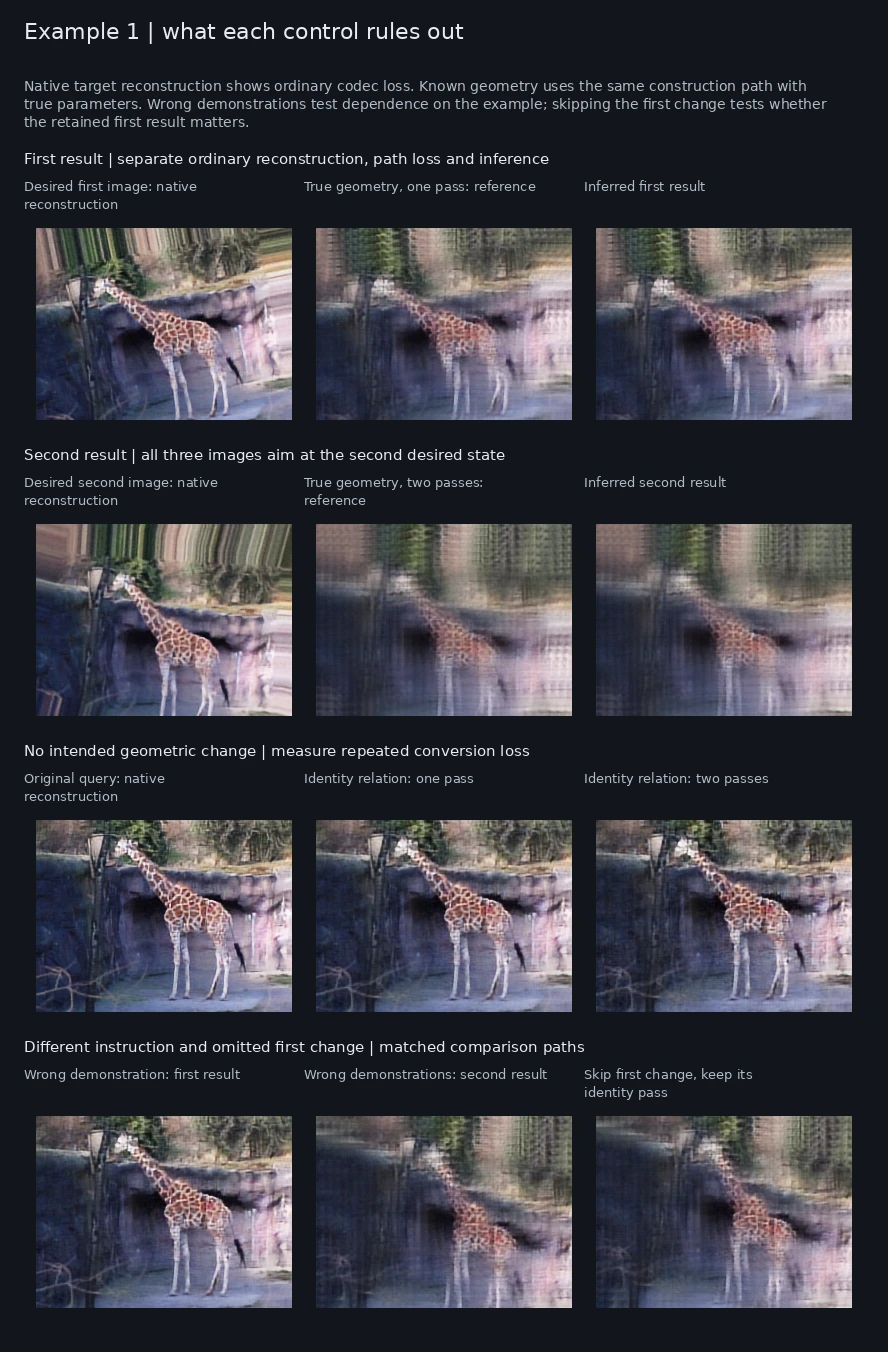
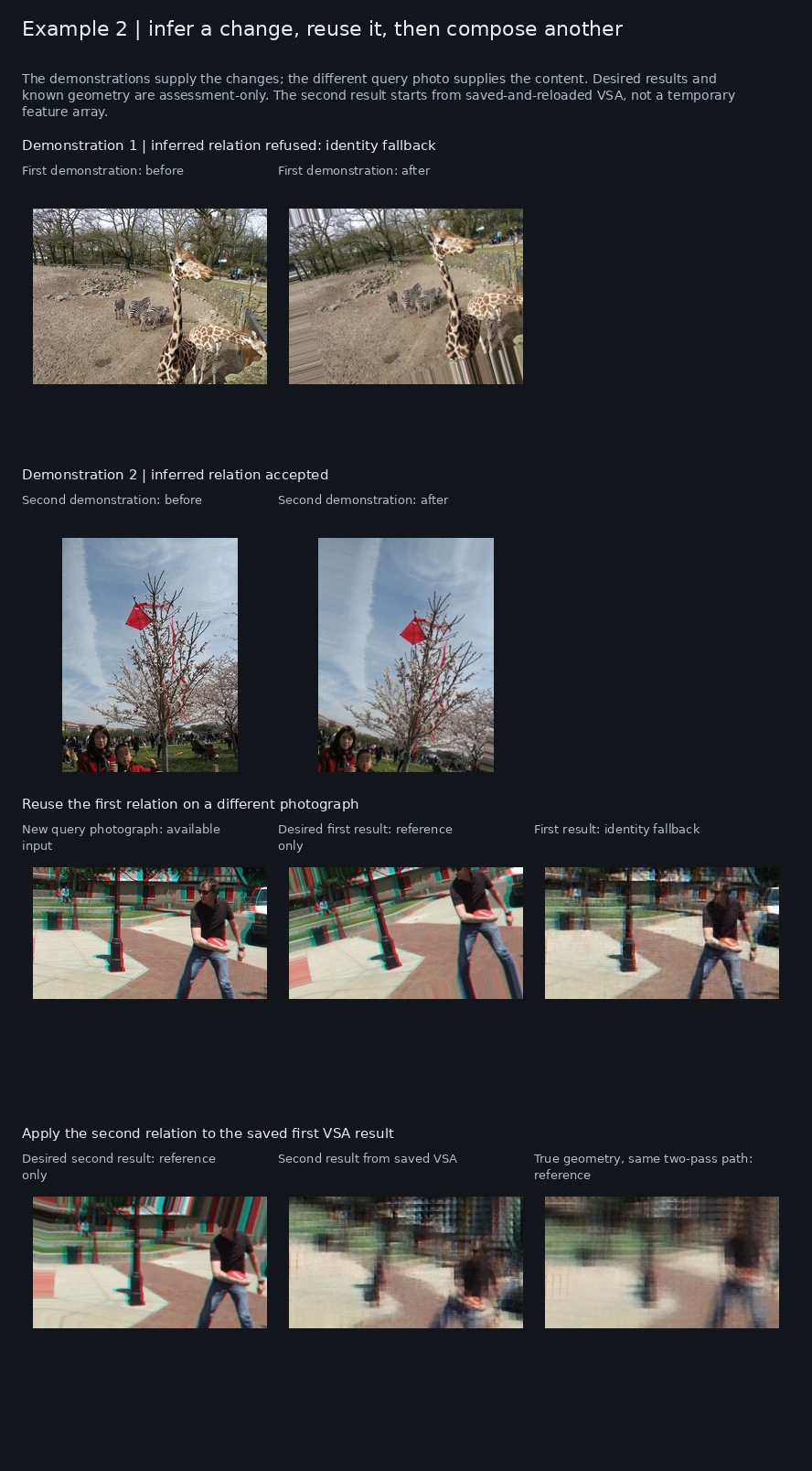
What remains
Relation fitting and continuation through saved VSA have measured evidence, but rendered rotation remains unqualified. A component diagnostic found failure already with original encoder features, not only after recovery from source VSA. The transformation of feature contents needs reconsideration. Semantic changes, useful procedure selection and invention of unseen content remain open; earlier memory evidence is preserved. Reading and hearing are planned as routes to a common language system, with conversation added last as another interface.