run record~/research/cliste/runsAll Cliste runs

Type a section name and press Enter. Use “help” for the list.

Figures: softened for dark viewingDisplay only; image files are unchanged.
← All Cliste runs

Cliste experiment

Shared perceptual vocabulary and reconstructible experience — development-preflight

Execution: completedScientific verdict: candidate merits separate confirmation

The question

Acquire reusable VSA patterns and measure their downstream utility, retained detail and complete storage cost.

Why this experiment?

Reusable patterns could reduce repeated storage and support later operations. The relevant test is useful readback at an honest storage cost, not vocabulary size alone.

How it works

Acquire a bank from encountered visual features and compare storage and readback against simpler vector encodings. Pattern IDs are addresses of acquired vectors, not supplied object categories.

Follow this part of the investigation: Can experience share a vocabulary without losing useful distinctions? →
Implementation and comparison details

Study stage: development-preflight. Acquired vector content, compact occurrence references, registered detail policy and full storage accounting; frozen source and dependencies precede execution.

What happened

Five one-order development conditions completed on16 acquisition and8 independent development photographs. Candidates meeting provisional storage/recall criteria: shared095, conservative095. Persistence and source-denied readback passed; final photographs remain sealed.

Results and visual artifacts

Open a figure for its input, comparison, and result. Click an image to enlarge it.

Can recurring visual patterns be stored once and reused by reference? The vocabulary contains acquired feature-vector prototypes, not supplied object names. A region can point to prototypes or fall back to its full vector. In the chart labels, shared060/shared080/shared095 mean reusable prototypes accepted at cosine similarity thresholds 0.60/0.80/0.95. Conservative095 also limits regional relative squared vector error to 0.10. Restricted080 permits reuse only at the original feature position. Dense means keeping the full vector instead of replacing it with prototype references. The plots compare storage and source-image recall; the photo sheets separately show what this compression does to visible detail.

Prototype reuse trades storage against source-image recall
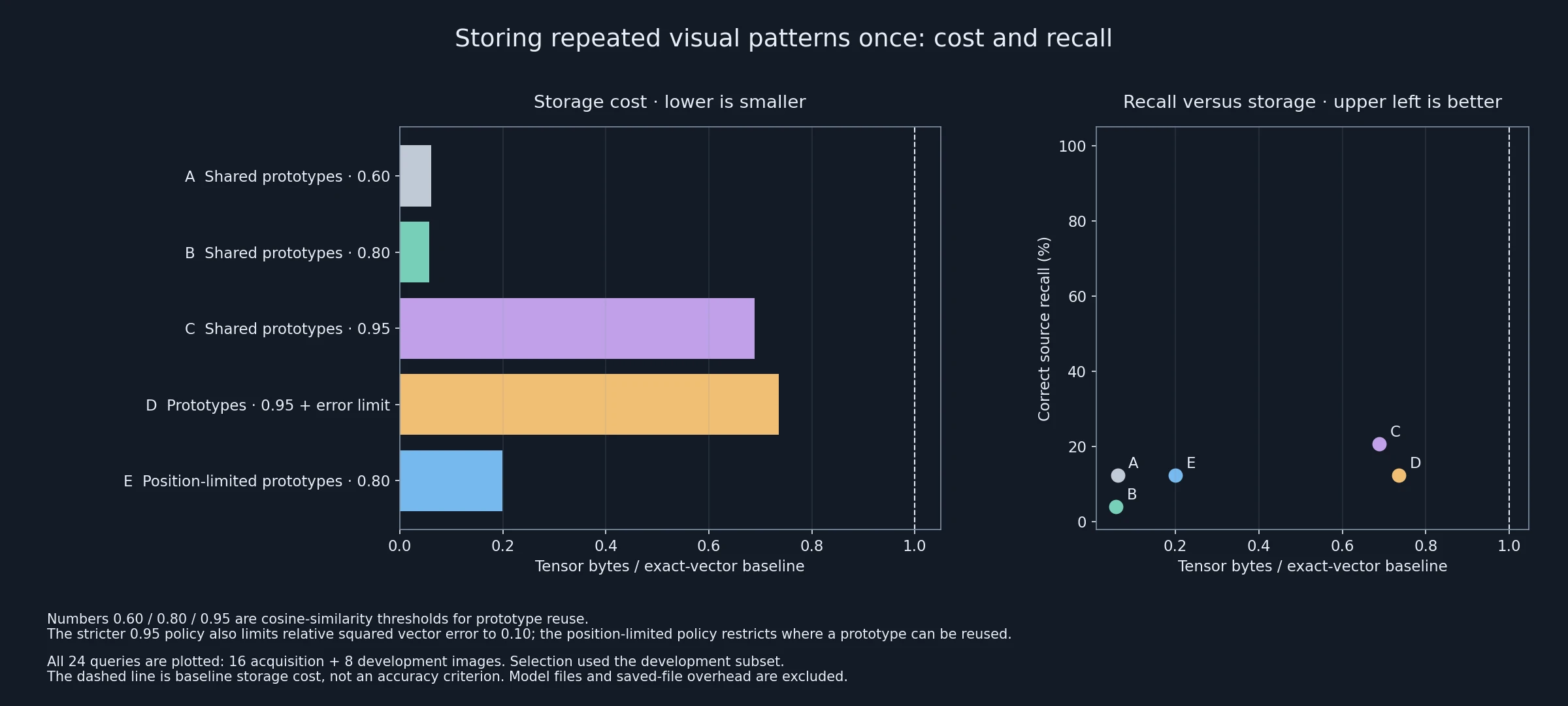
Left: stored tensor size divided by the exact-vector baseline; the dashed line at 1 is equal cost, and lower is smaller. Right: one point per method, with the same storage ratio horizontally and correct recall percentage vertically; upper left is desirable. Recall here includes all 24 queries, comprising 16 acquisition and eight development sources. Method selection uses the separate development group, so this combined chart is not its acceptance test. Tensor size includes the vocabulary and retained image vectors but excludes model files and saved-file overhead. Letters A–E match methods across the two panels. The prototype numbers are cosine-similarity thresholds.

Original recorded figure ↗

How the reusable vocabulary and stored memory grow
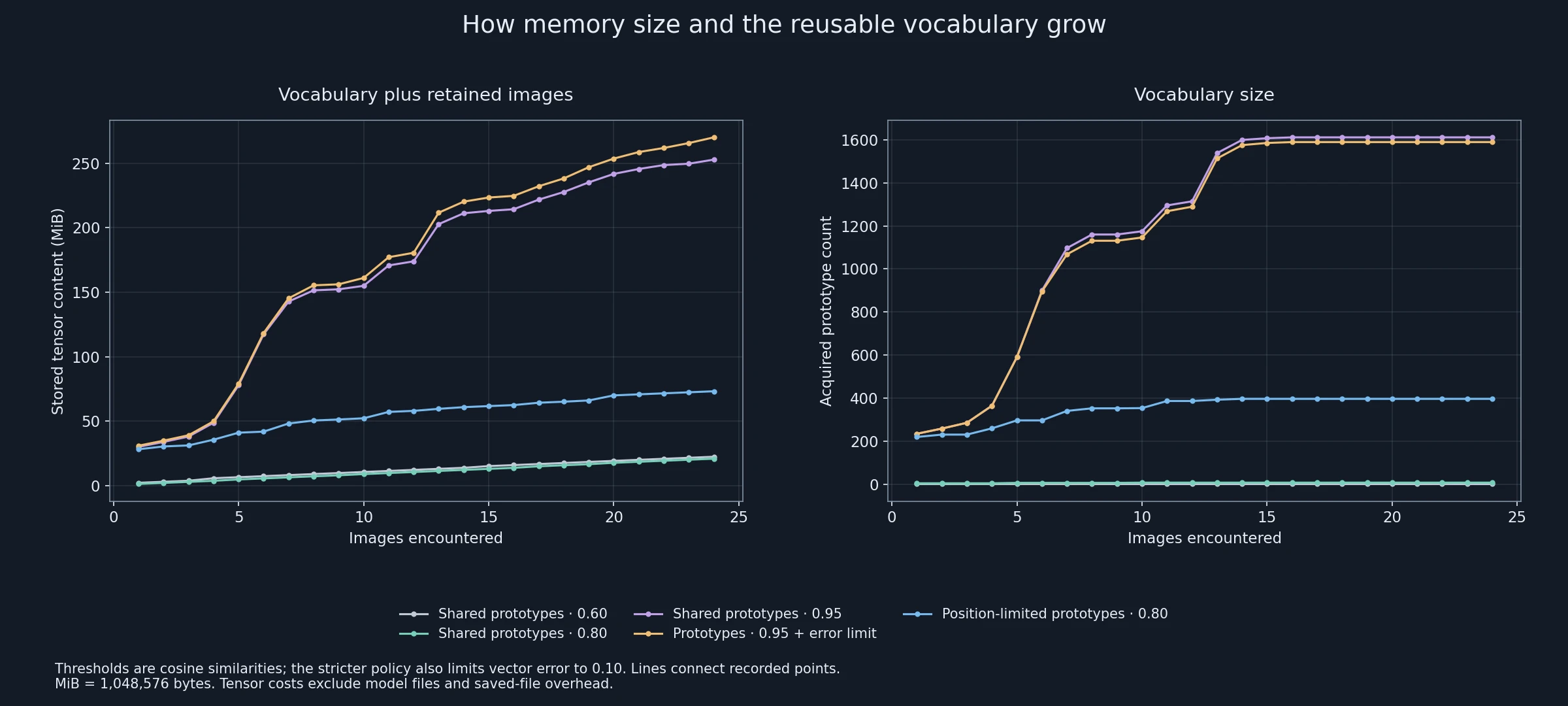
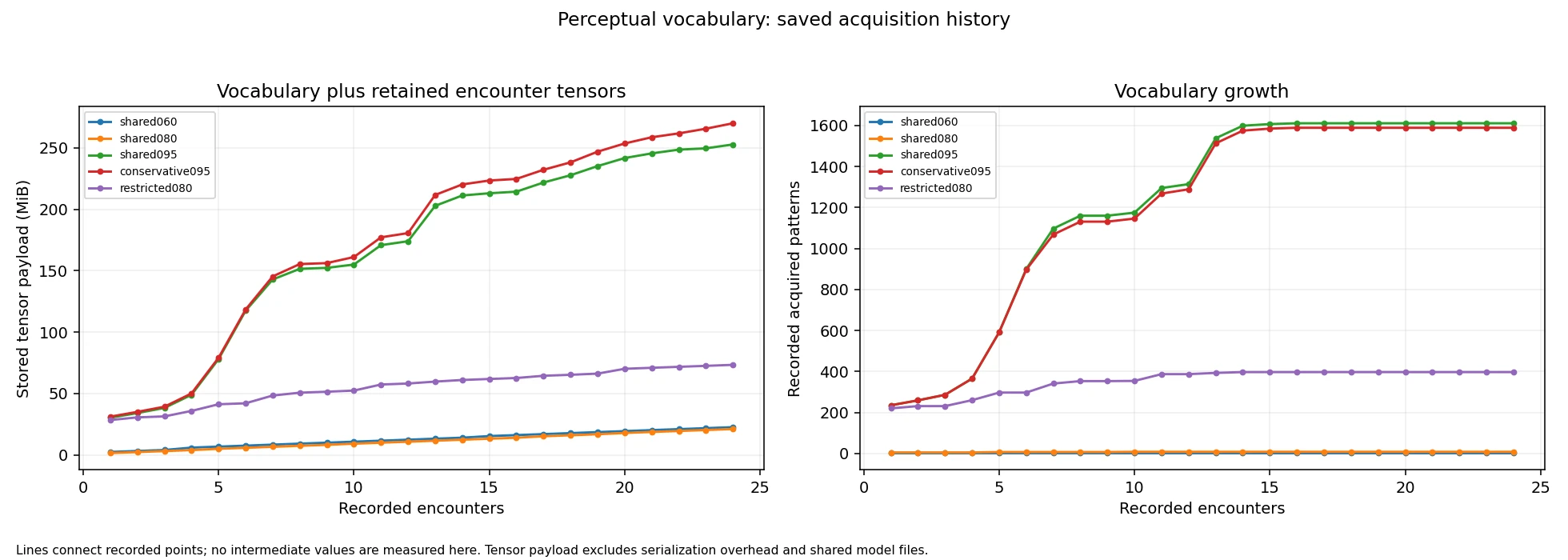
The horizontal axis counts encountered images. Left: total tensor storage, including the learned vocabulary and retained encounters, in MiB. Right: the number of acquired prototype patterns. Each line is one reuse policy, defined above; points are recorded measurements. A smaller vocabulary can save space but may merge distinctions needed for recall or reconstruction. Model files and saved-file overhead are not included in these curves.

Original recorded figure ↗

Shared prototypes at cosine threshold 0.60 — reconstructed photographs
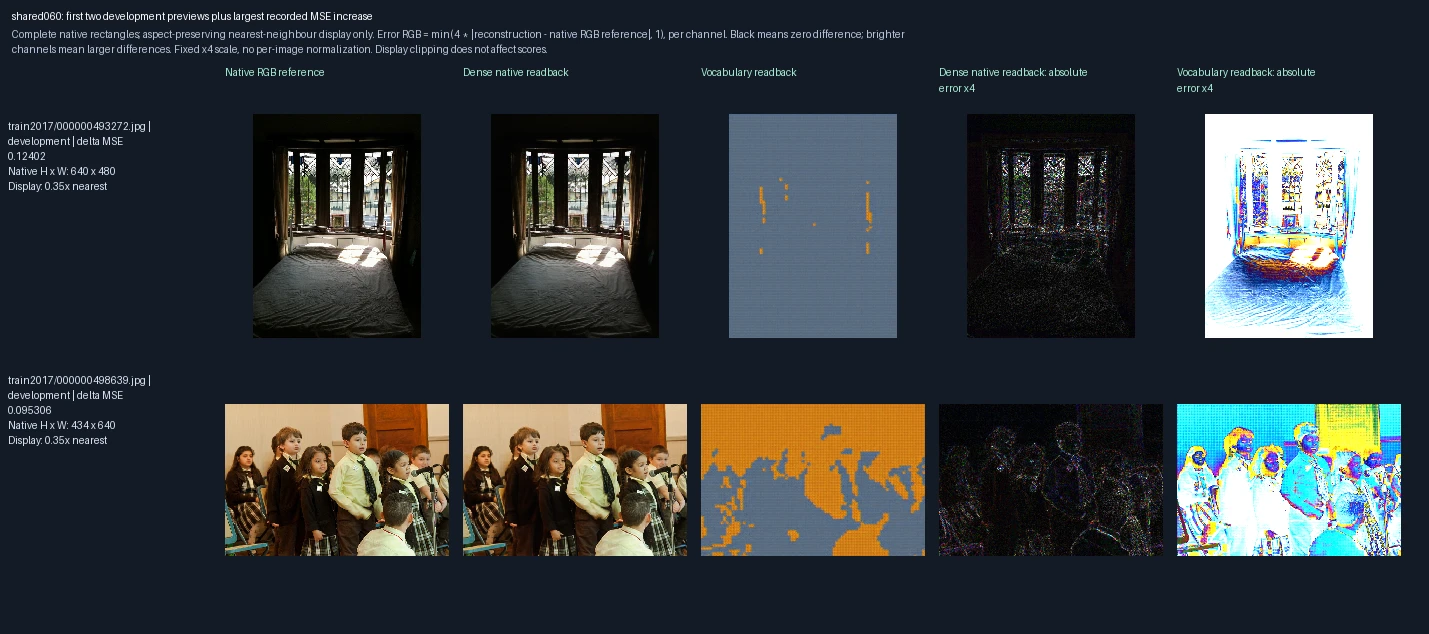
Rows show the first two development photographs, followed by the photograph with the largest increase in reconstruction MSE if it is different. This selection exposes both fixed examples and a failure case; it is not a random sample. Columns show the original, full-vector reconstruction, prototype-based reconstruction, and each reconstruction’s error. MSE is mean squared pixel error; lower is better. Error panels show the absolute RGB difference from the reference, multiplied by four and clipped for display: black means a match; brighter colors mean larger pixel differences. The scale is the same across panels.
Shared prototypes at cosine threshold 0.60 — enlarged detail
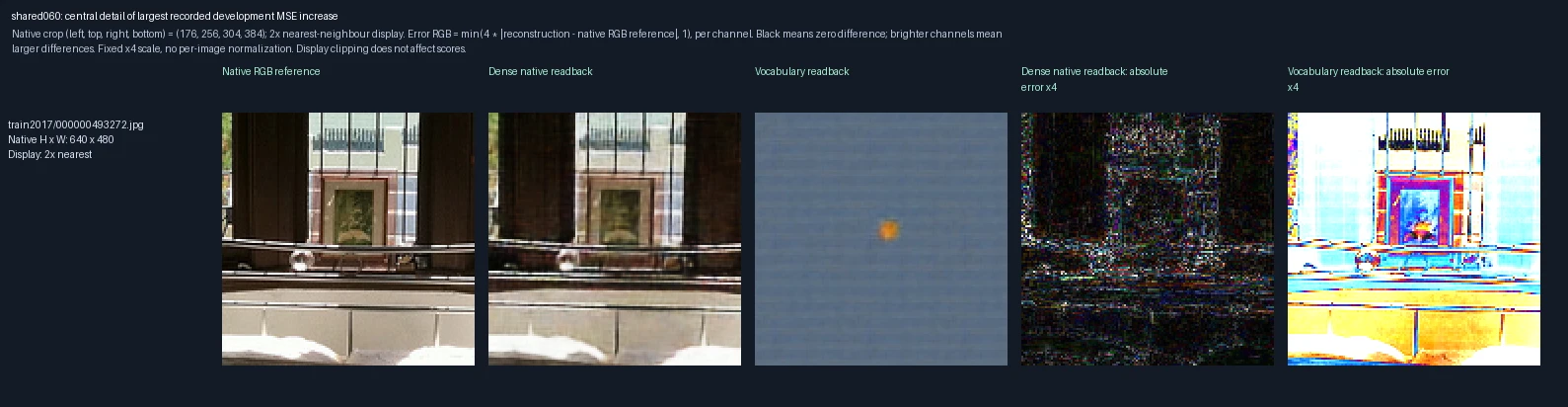
This is the central crop of the development image with the largest whole-image increase in reconstruction MSE for this method. The crop is at most 128 × 128 original pixels, enlarged twofold; the largest error need not lie inside this crop. Columns show the original, full-vector reconstruction, prototype-based reconstruction, and each reconstruction’s error. MSE is mean squared pixel error; lower is better. Error panels show the absolute RGB difference from the reference, multiplied by four and clipped for display: black means a match; brighter colors mean larger pixel differences. The scale is the same across panels.
Shared prototypes at cosine threshold 0.80 — reconstructed photographs
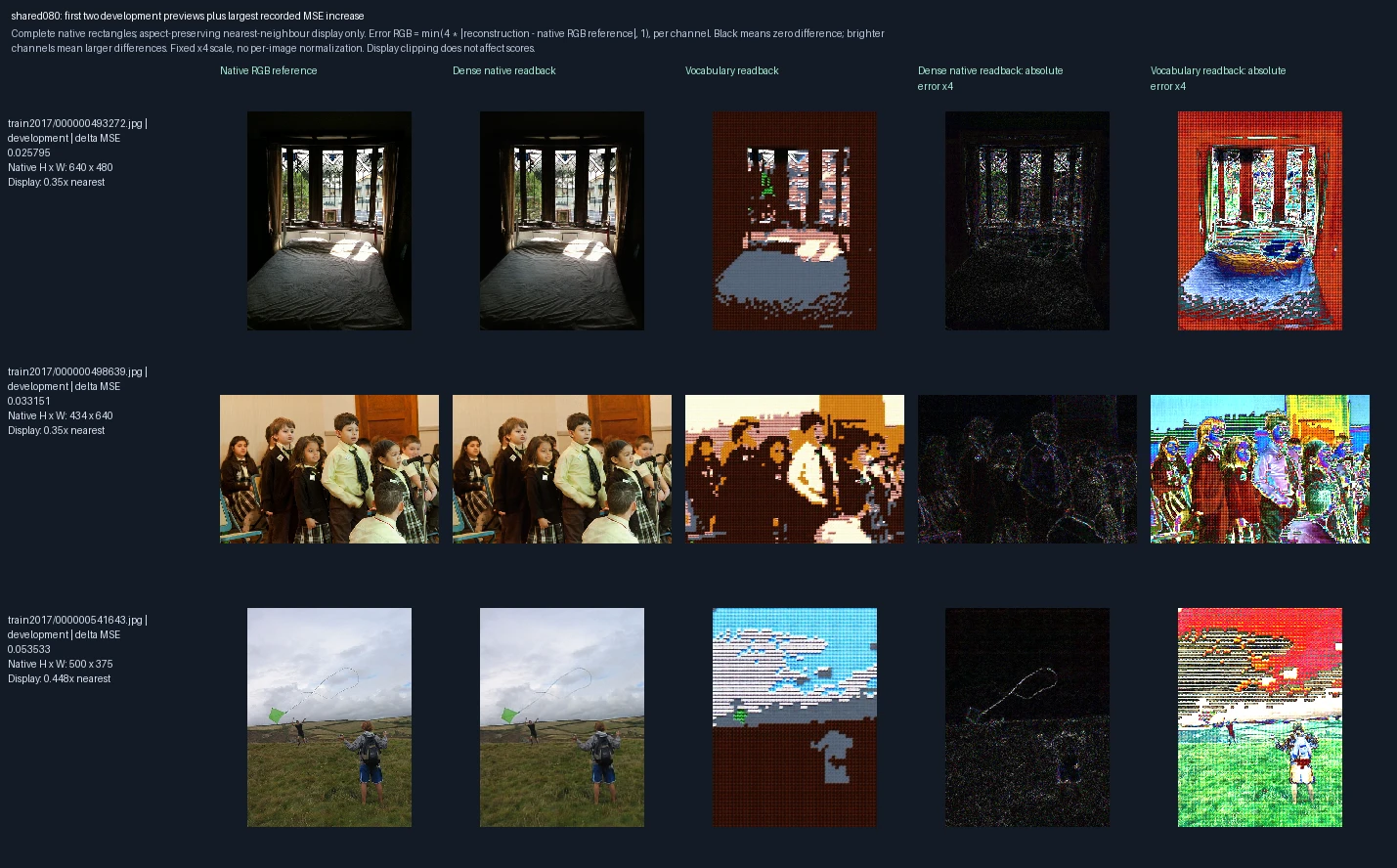
Rows show the first two development photographs, followed by the photograph with the largest increase in reconstruction MSE if it is different. This selection exposes both fixed examples and a failure case; it is not a random sample. Columns show the original, full-vector reconstruction, prototype-based reconstruction, and each reconstruction’s error. MSE is mean squared pixel error; lower is better. Error panels show the absolute RGB difference from the reference, multiplied by four and clipped for display: black means a match; brighter colors mean larger pixel differences. The scale is the same across panels.
Shared prototypes at cosine threshold 0.80 — enlarged detail
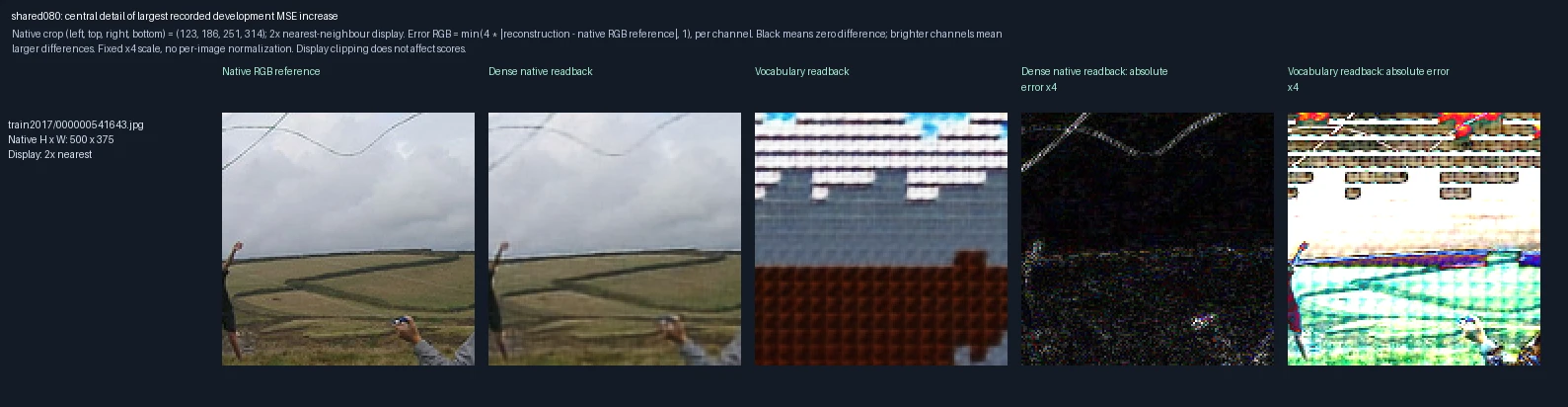
This is the central crop of the development image with the largest whole-image increase in reconstruction MSE for this method. The crop is at most 128 × 128 original pixels, enlarged twofold; the largest error need not lie inside this crop. Columns show the original, full-vector reconstruction, prototype-based reconstruction, and each reconstruction’s error. MSE is mean squared pixel error; lower is better. Error panels show the absolute RGB difference from the reference, multiplied by four and clipped for display: black means a match; brighter colors mean larger pixel differences. The scale is the same across panels.
Shared prototypes at cosine threshold 0.95 — reconstructed photographs
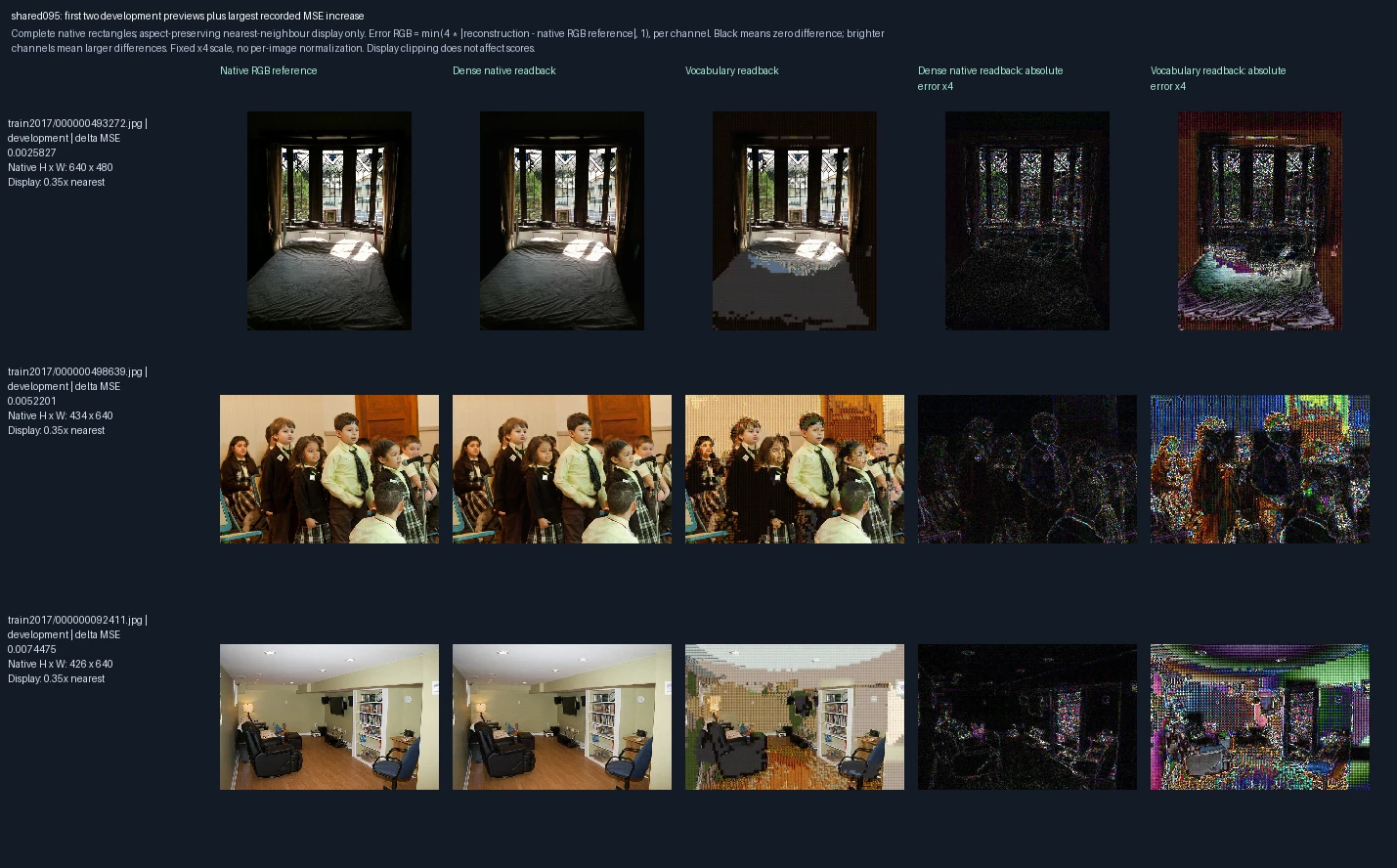
Rows show the first two development photographs, followed by the photograph with the largest increase in reconstruction MSE if it is different. This selection exposes both fixed examples and a failure case; it is not a random sample. Columns show the original, full-vector reconstruction, prototype-based reconstruction, and each reconstruction’s error. MSE is mean squared pixel error; lower is better. Error panels show the absolute RGB difference from the reference, multiplied by four and clipped for display: black means a match; brighter colors mean larger pixel differences. The scale is the same across panels.
Shared prototypes at cosine threshold 0.95 — enlarged detail
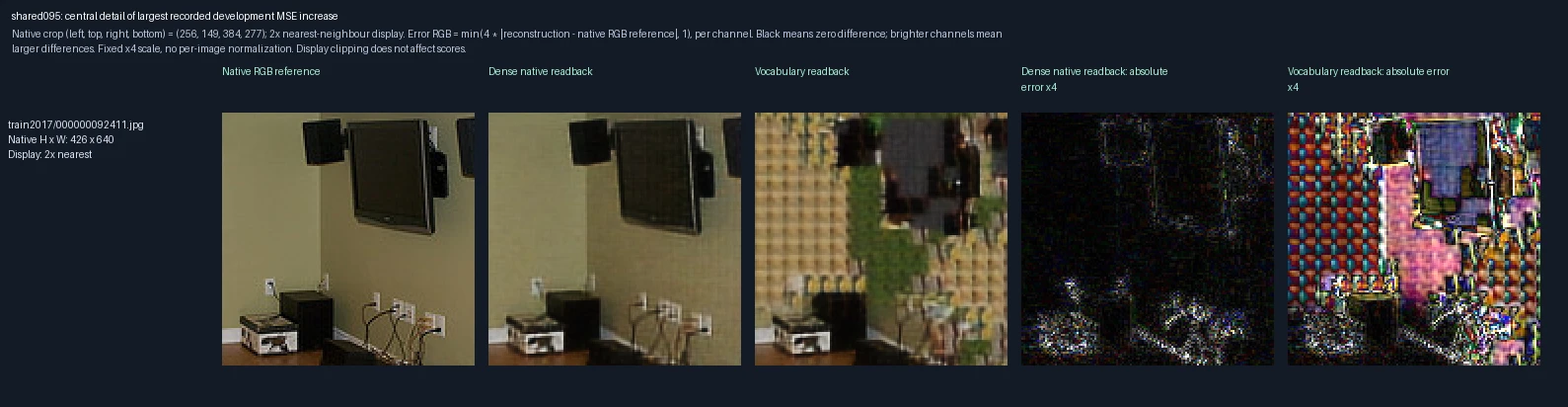
This is the central crop of the development image with the largest whole-image increase in reconstruction MSE for this method. The crop is at most 128 × 128 original pixels, enlarged twofold; the largest error need not lie inside this crop. Columns show the original, full-vector reconstruction, prototype-based reconstruction, and each reconstruction’s error. MSE is mean squared pixel error; lower is better. Error panels show the absolute RGB difference from the reference, multiplied by four and clipped for display: black means a match; brighter colors mean larger pixel differences. The scale is the same across panels.
Shared prototypes at threshold 0.95 with a stricter reconstruction-error limit — reconstructed photographs
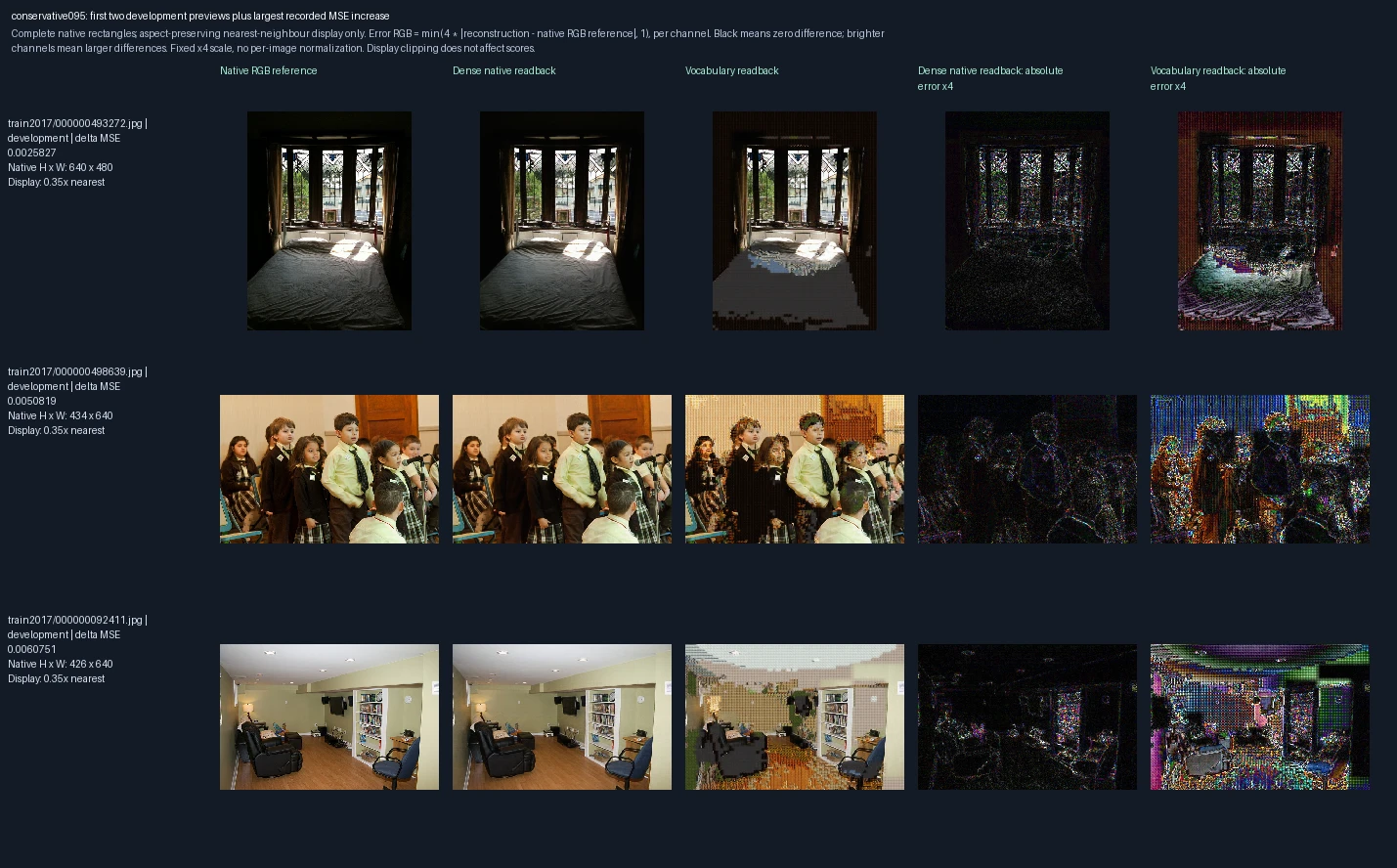
Rows show the first two development photographs, followed by the photograph with the largest increase in reconstruction MSE if it is different. This selection exposes both fixed examples and a failure case; it is not a random sample. Columns show the original, full-vector reconstruction, prototype-based reconstruction, and each reconstruction’s error. MSE is mean squared pixel error; lower is better. Error panels show the absolute RGB difference from the reference, multiplied by four and clipped for display: black means a match; brighter colors mean larger pixel differences. The scale is the same across panels.
Shared prototypes at threshold 0.95 with a stricter reconstruction-error limit — enlarged detail
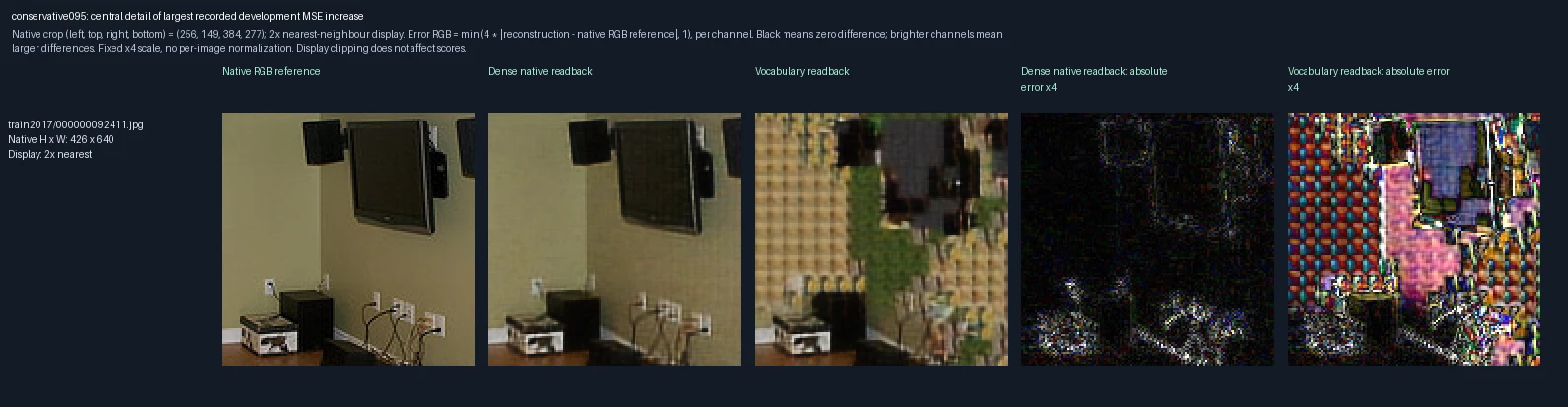
This is the central crop of the development image with the largest whole-image increase in reconstruction MSE for this method. The crop is at most 128 × 128 original pixels, enlarged twofold; the largest error need not lie inside this crop. Columns show the original, full-vector reconstruction, prototype-based reconstruction, and each reconstruction’s error. MSE is mean squared pixel error; lower is better. Error panels show the absolute RGB difference from the reference, multiplied by four and clipped for display: black means a match; brighter colors mean larger pixel differences. The scale is the same across panels.
Prototypes restricted to their original feature positions, at threshold 0.80 — reconstructed photographs
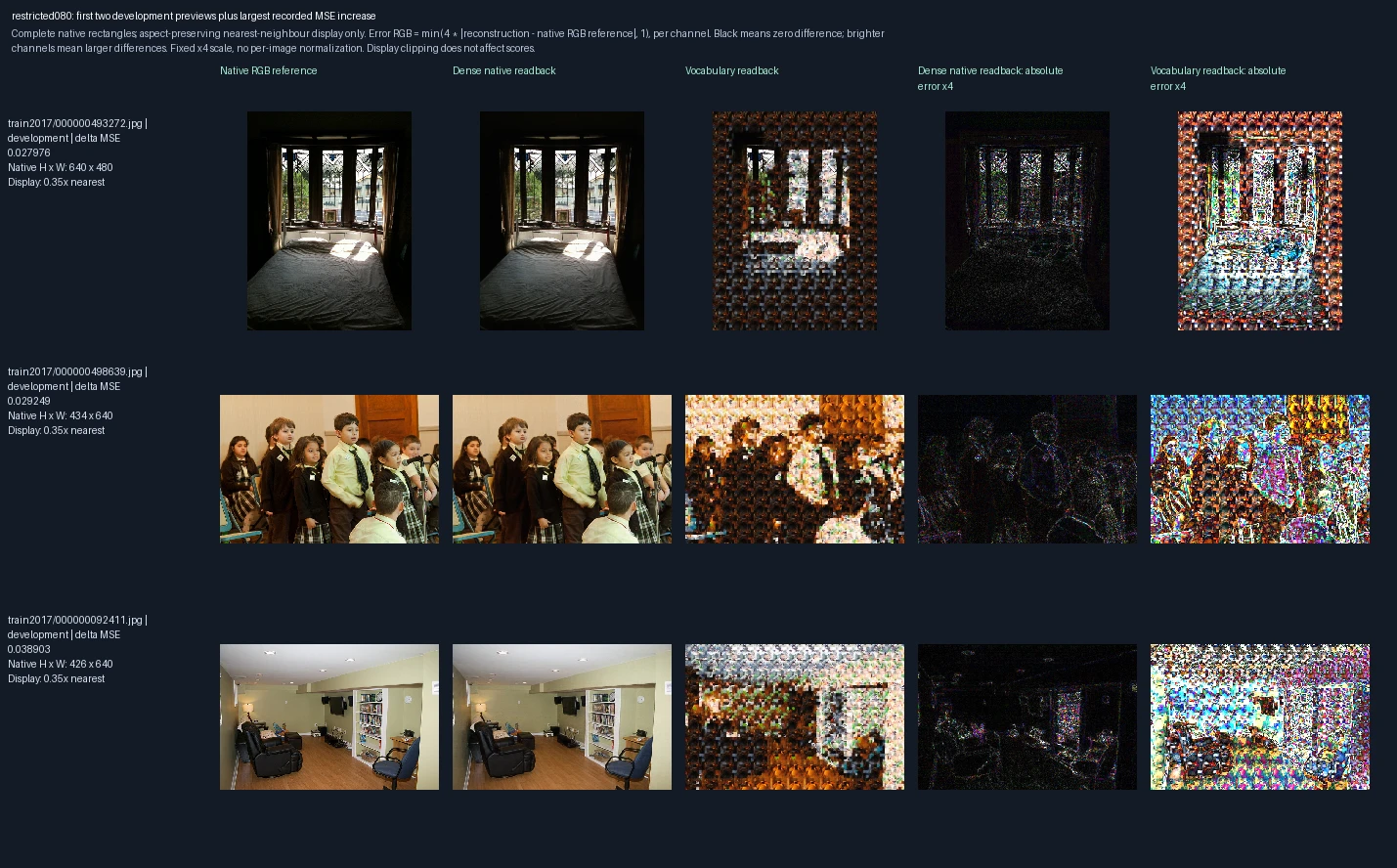
Rows show the first two development photographs, followed by the photograph with the largest increase in reconstruction MSE if it is different. This selection exposes both fixed examples and a failure case; it is not a random sample. Columns show the original, full-vector reconstruction, prototype-based reconstruction, and each reconstruction’s error. MSE is mean squared pixel error; lower is better. Error panels show the absolute RGB difference from the reference, multiplied by four and clipped for display: black means a match; brighter colors mean larger pixel differences. The scale is the same across panels.
Prototypes restricted to their original feature positions, at threshold 0.80 — enlarged detail
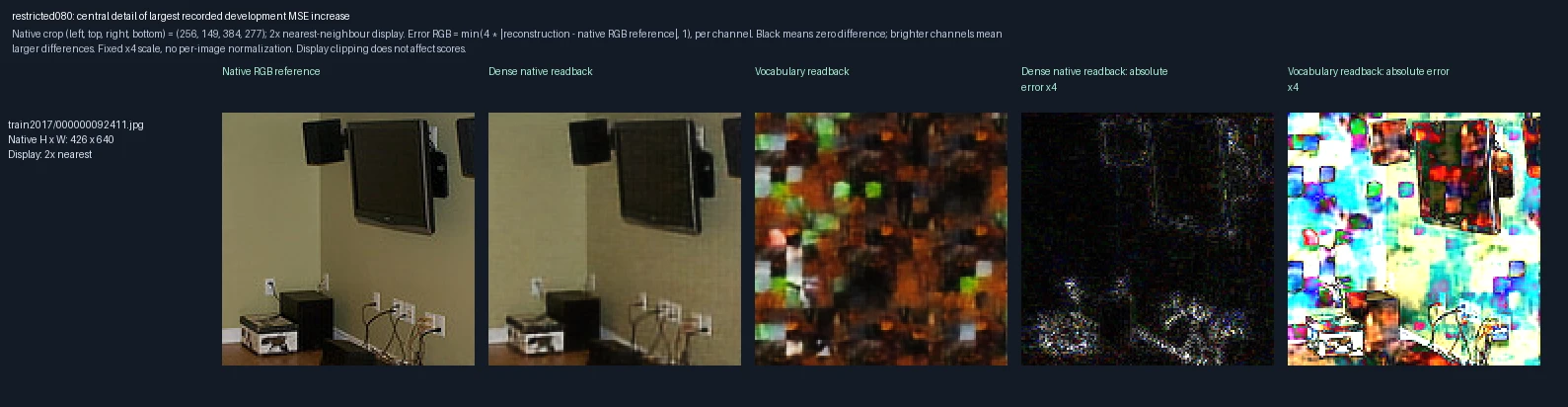
This is the central crop of the development image with the largest whole-image increase in reconstruction MSE for this method. The crop is at most 128 × 128 original pixels, enlarged twofold; the largest error need not lie inside this crop. Columns show the original, full-vector reconstruction, prototype-based reconstruction, and each reconstruction’s error. MSE is mean squared pixel error; lower is better. Error panels show the absolute RGB difference from the reference, multiplied by four and clipped for display: black means a match; brighter colors mean larger pixel differences. The scale is the same across panels.
Reusing visual patterns after a supplied transformation — examples 1
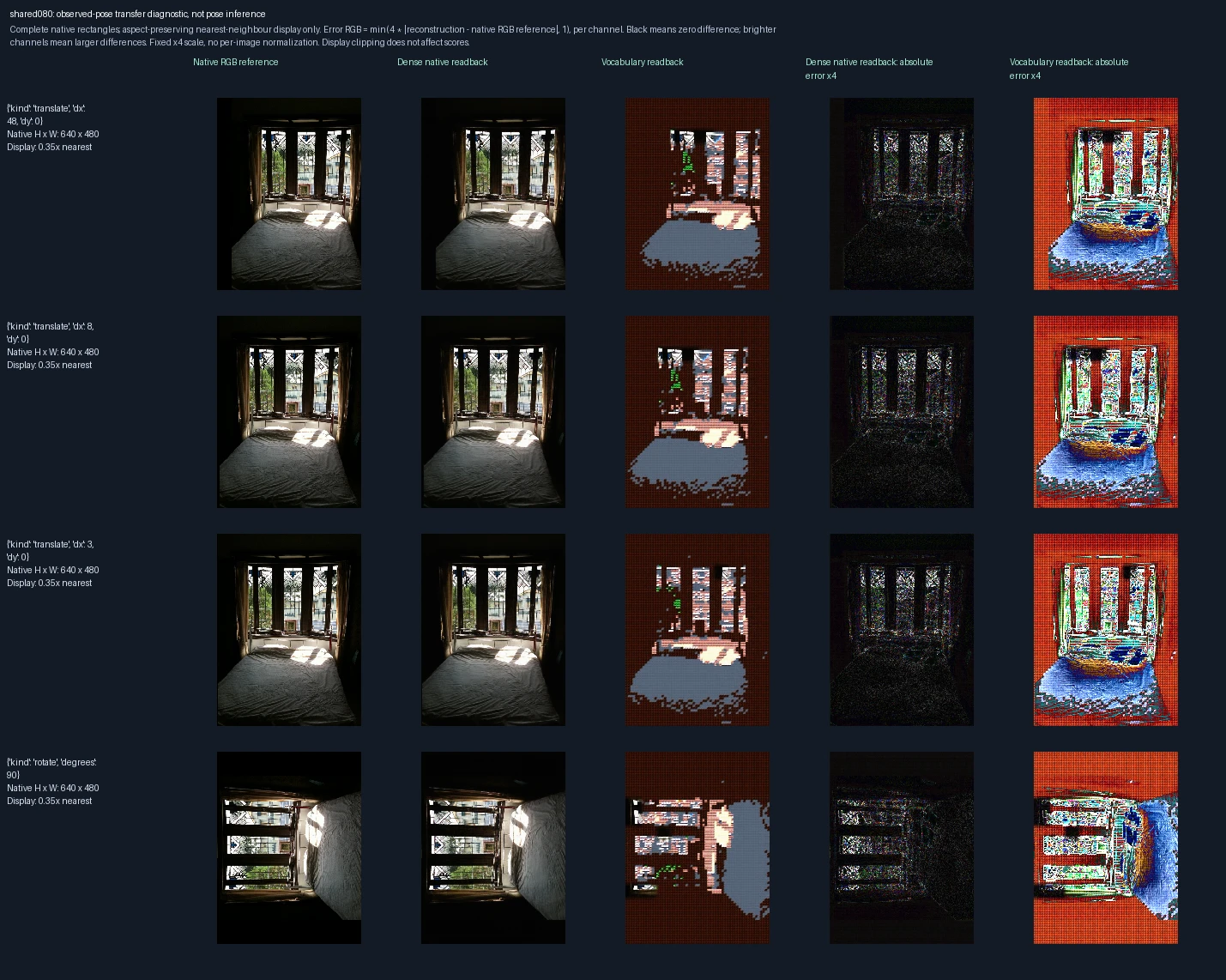
Rows show translations of 48, 8 and 3 pixels, then a 90° rotation, applied to the same development photograph. Columns compare the transformed reference, full-vector reconstruction, prototype-based reconstruction at the 0.80 similarity threshold, and their errors. The acquired vocabulary is fixed during this test. Error panels show the absolute RGB difference from the reference, multiplied by four and clipped for display: black means a match; brighter colors mean larger pixel differences. The scale is the same across panels. This tests encoding and reuse in the supplied new view; it does not show that Cliste inferred the transformation or recognized the scene independently of pose.
Reusing visual patterns after a supplied transformation — examples 2
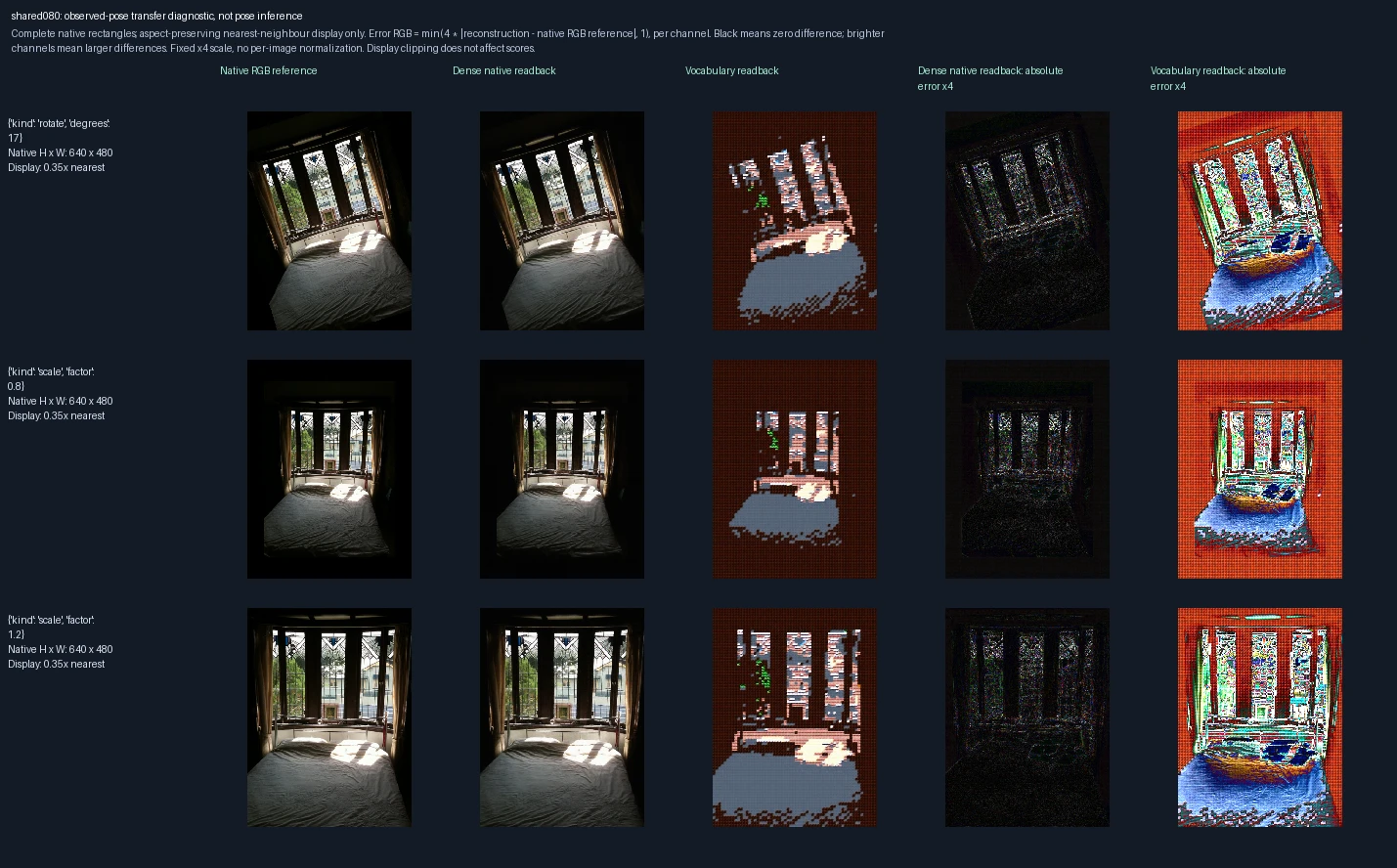
Rows show a 17° rotation, then scaling to 0.8 and 1.2 times the original size, applied to the same development photograph. Columns compare the transformed reference, full-vector reconstruction, prototype-based reconstruction at the 0.80 similarity threshold, and their errors. The acquired vocabulary is fixed during this test. Error panels show the absolute RGB difference from the reference, multiplied by four and clipped for display: black means a match; brighter colors mean larger pixel differences. The scale is the same across panels. This tests encoding and reuse in the supplied new view; it does not show that Cliste inferred the transformation or recognized the scene independently of pose.

Limits and next question

Development preflight selects methods using development evidence only; its outcomes are not final confirmation. The final run uses separately locked methods and inputs. The codec and sensory geometry are supplied machinery; pattern contents are acquired. Compact references are storage addresses, not semantic categories. Count the shared bank, references, structure, fallbacks, versions and model costs. Prototype reuse alone establishes neither object understanding nor integrated milestone 1.3. Rotation, scale, novelty and detail limits remain visible; no checkpoint is installed.

Next question. Use development evidence to specify a separate locked final run; preflight does not establish the final claim.

Inspect the evidence

Download the methods and measurements for this experiment. Large training and saved-state files are not included.