Type a section name and press Enter. Use “help” for the list.
Cliste experiment
Partial-cue construction with unchanged vocabulary memories
Registered 8 Oct 2026 · Snapshot 12 Oct 2026
The question
Diagnose weak partial-cue recall on the previously examined development panel.
Why this experiment?
Reusable patterns could reduce repeated storage and support later operations. The relevant test is useful readback at an honest storage cost, not vocabulary size alone.
How it works
Acquire a bank from encountered visual features and compare storage and readback against simpler vector encodings. Pattern IDs are addresses of acquired vectors, not supplied object categories.
Follow this part of the investigation: Can experience share a vocabulary without losing useful distinctions? →Implementation and comparison details
Three prospectively fixed cue constructions query the same dense and vocabulary snapshots. No acquisition, learning, model selection or final-input opening.
What happened
On8 previously examined development queries, dense recall is 2/8 with gray-filled cues and 8/8 using only fully visible feature terms. The shared095 memory scores 6/8 with the same visible-term cues. All original cue vectors and retrieval cells reproduce exactly; no memory or model changed.
Measurements
| Recorded field | Value |
|---|---|
| dense visible development | 1 |
| shared095 visible development | 0.75 |
Results and visual artifacts
Open a figure for its input, comparison, and result. Click an image to enlarge it.
This diagnostic changes the cue construction while keeping the model and stored memories fixed. It asks whether filling hidden pixels with gray contaminates a recall query. In the chart labels, shared060/shared080/shared095 mean reusable prototypes accepted at cosine similarity thresholds 0.60/0.80/0.95. Conservative095 also limits regional relative squared vector error to 0.10. Restricted080 permits reuse only at the original feature position. Dense means keeping the full vector instead of replacing it with prototype references.
The way a partial visual cue is encoded changes recall
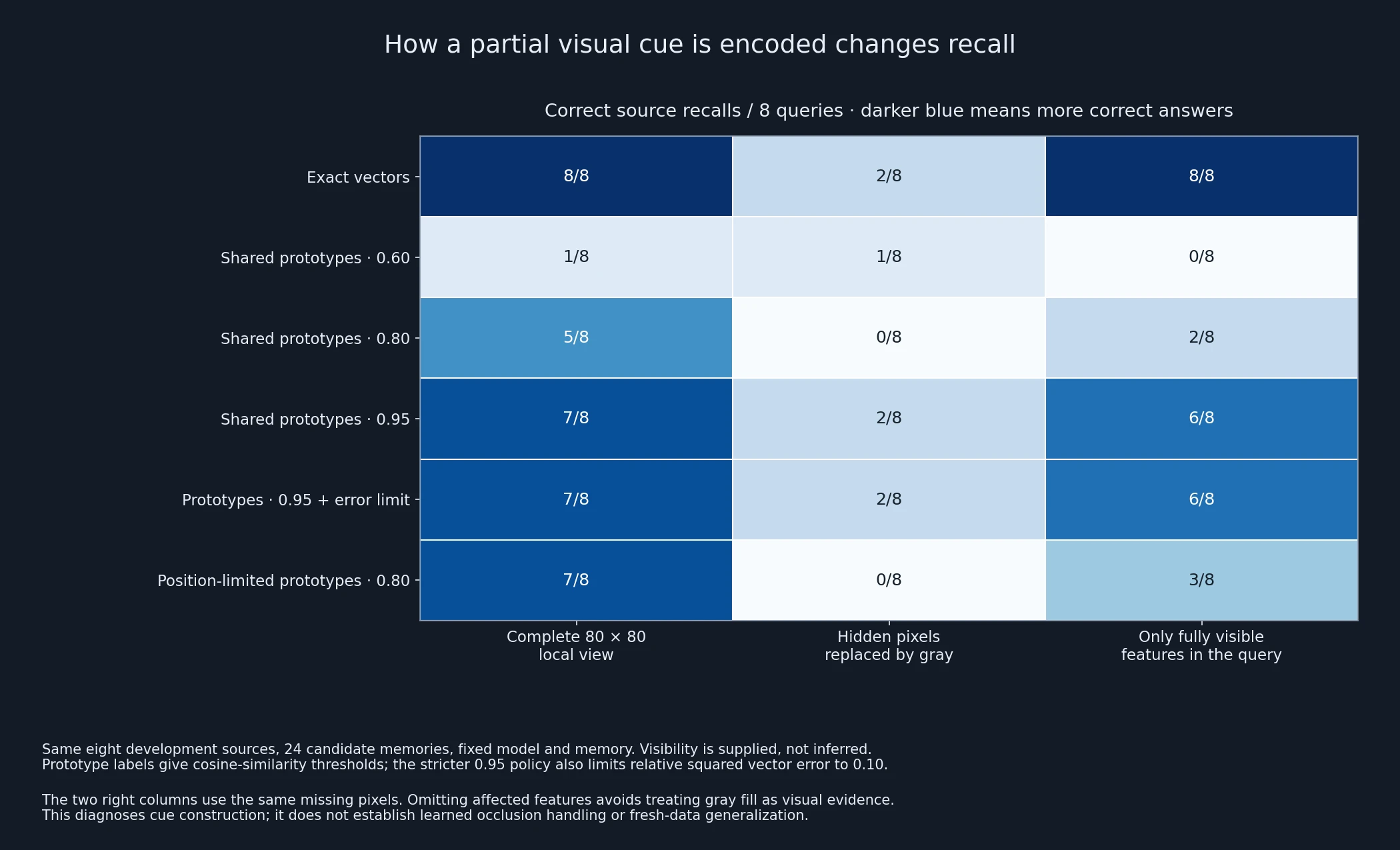
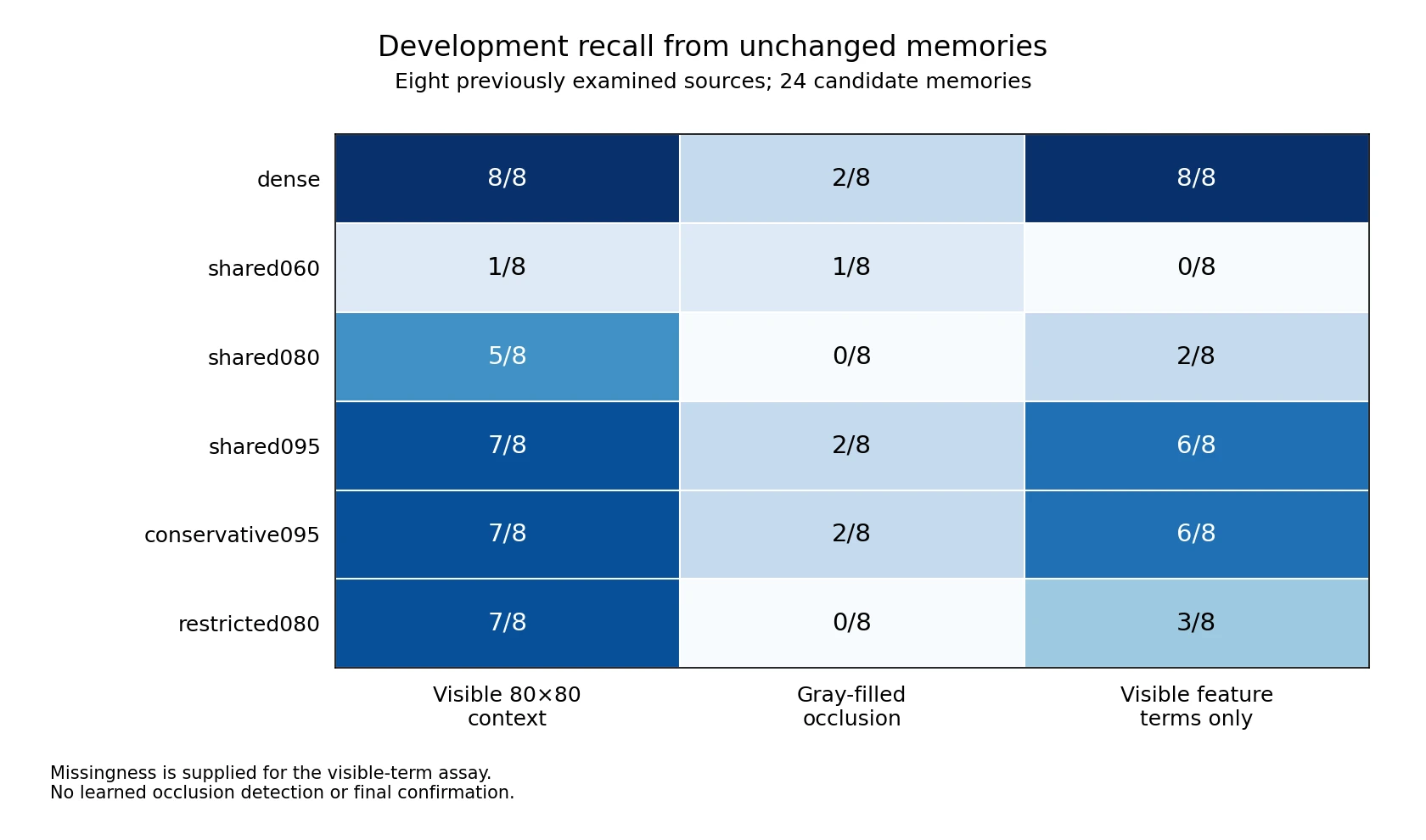
Replotted from saved outputs with clarified labels. The original recorded figure remains available.
Limits and next question
Development preflight selects methods using development evidence only; its outcomes are not final confirmation. The final run uses separately locked methods and inputs. The codec and sensory geometry are supplied machinery; pattern contents are acquired. Compact references are storage addresses, not semantic categories. Count the shared bank, references, structure, fallbacks, versions and model costs. Prototype reuse alone establishes neither object understanding nor integrated milestone 1.3. Rotation, scale, novelty and detail limits remain visible; no checkpoint is installed.
Next question. Use development evidence to specify a separate locked final run; preflight does not establish the final claim.
Inspect the evidence
Download the methods and measurements for this experiment. Large training and saved-state files are not included.