Type a section name and press Enter. Use “help” for the list.
Cliste experiment
Preserving useful distinctions with compact perceptual memory
Registered 8 Oct 2026 · Snapshot 12 Oct 2026
The question
Compare stricter reuse and quantized residual detail with matched-bit dense VSA storage, measuring retained distinctions and complete cost.
Why this experiment?
Reusable patterns could reduce repeated storage and support later operations. The relevant test is useful readback at an honest storage cost, not vocabulary size alone.
How it works
Acquire a bank from encountered visual features and compare storage and readback against simpler vector encodings. Pattern IDs are addresses of acquired vectors, not supplied object categories.
Follow this part of the investigation: Can experience share a vocabulary without losing useful distinctions? →Implementation and comparison details
Ten fixed storage conditions reuse the unchanged codec and previously acquired banks. Sixteen fresh development photographs join the original twenty-four memories; supplied-visibility cues, failure traces and measured prefix costs distinguish storage effects from candidate-set expansion. No learning or final-input opening.
What happened
Eight-bit dense storage preserves every baseline retrieval choice on all three assays while reducing tensor payload from 616.75 to 176.71 MiB (71.35%). Eight-bit residuals improve numerical readback at higher cost without changing recall; four-bit alternatives introduce paired regressions. All 17,055 independent checks and 400 source-denied readbacks pass. Dense8 is the candidate for larger confirmation; the final 32 inputs remain sealed and integration is pending.
Measurements
| Recorded field | Value |
|---|---|
| conditions | 10 |
| fresh sources | 16 |
| total sources | 40 |
| eligible conditions | 3 |
Results and visual artifacts
Open a figure for its input, comparison, and result. Click an image to enlarge it.
This experiment compares ways to reduce stored vector size while preserving recall. Dense4 and dense8 store vector coordinates with 4- and 8-bit precision. Shared080/shared095 use prototypes accepted at cosine thresholds 0.80/0.95; r4/r8 additionally stores a 4-/8-bit residual, the difference from the prototype approximation. Tight002/tight0005 keep exact vectors whenever relative squared vector error would exceed 0.02/0.005. Reconstruction and recall are separate tests: an image can look similar yet select the wrong memory.
How much storage can be saved without changing recall?
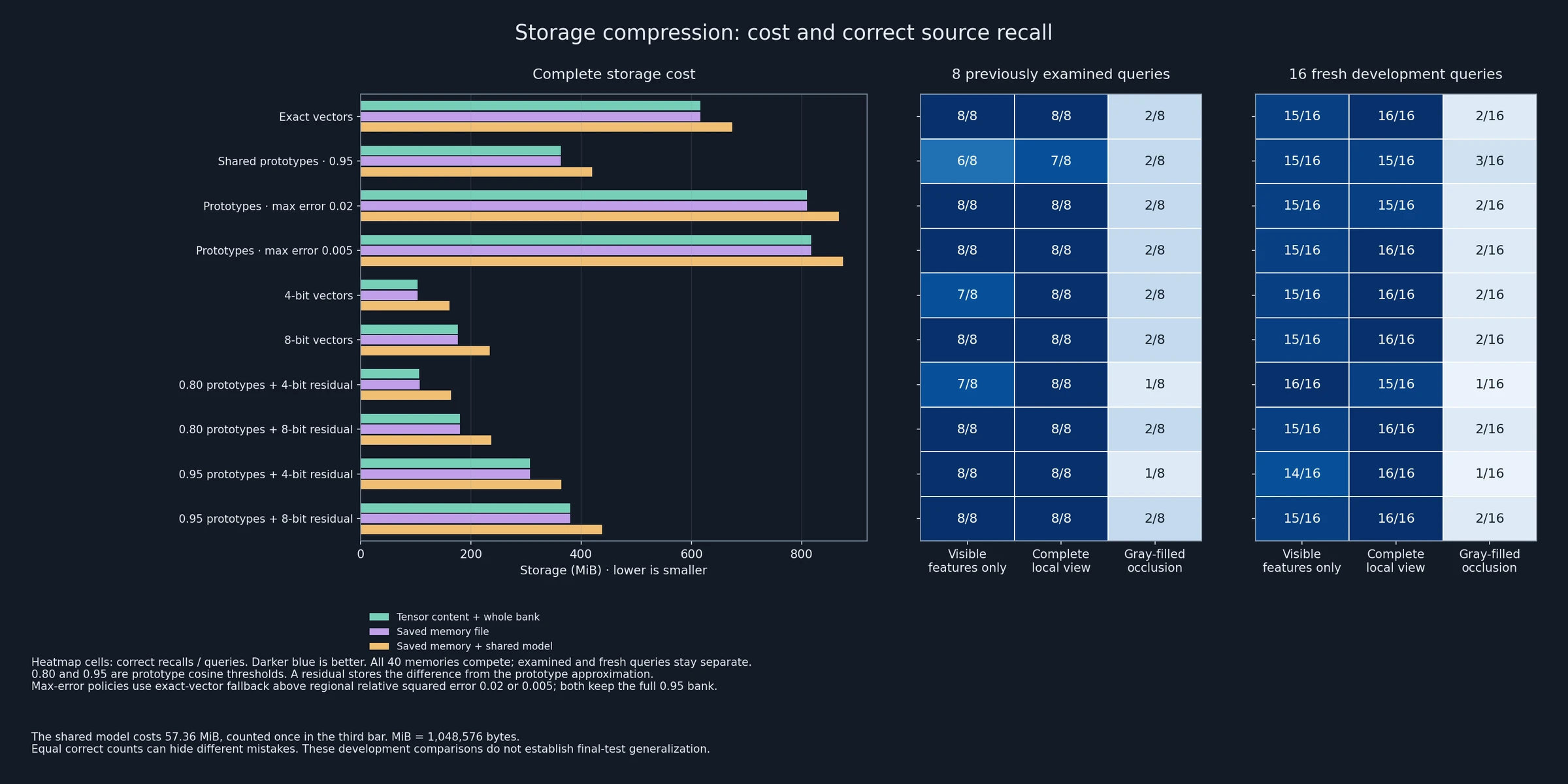
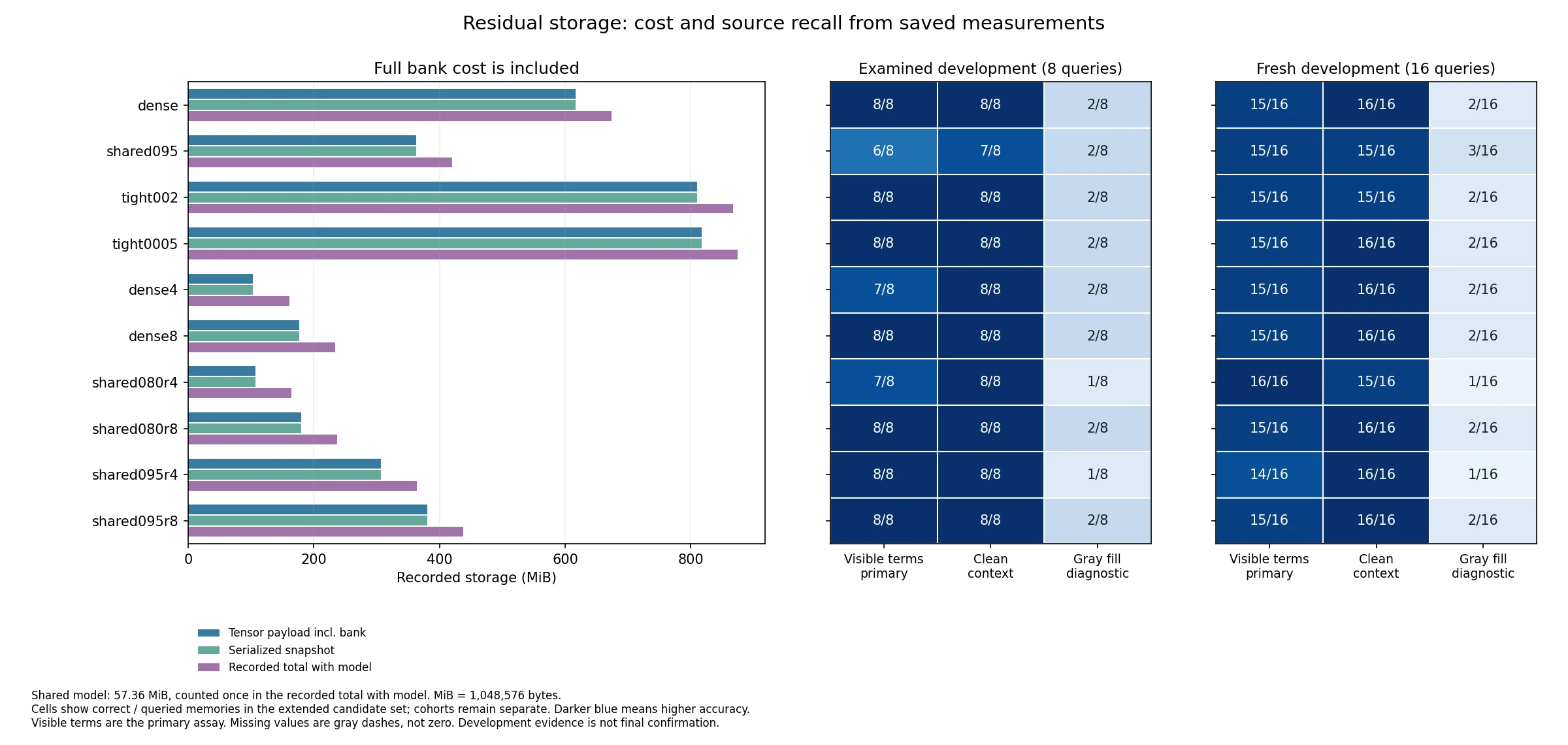
Replotted from saved outputs with clarified labels. The original recorded figure remains available.
How storage grows as more encounters are retained
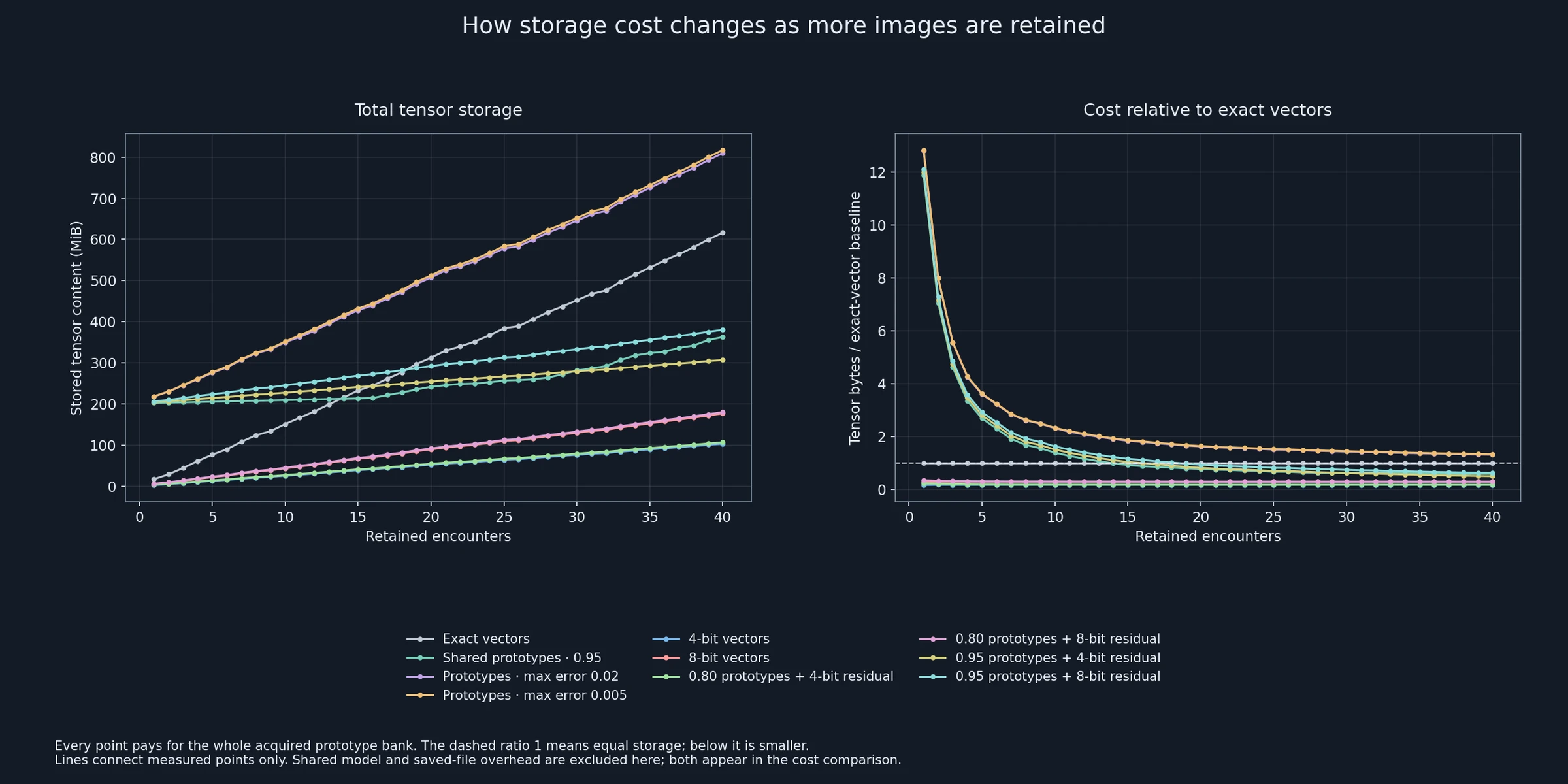
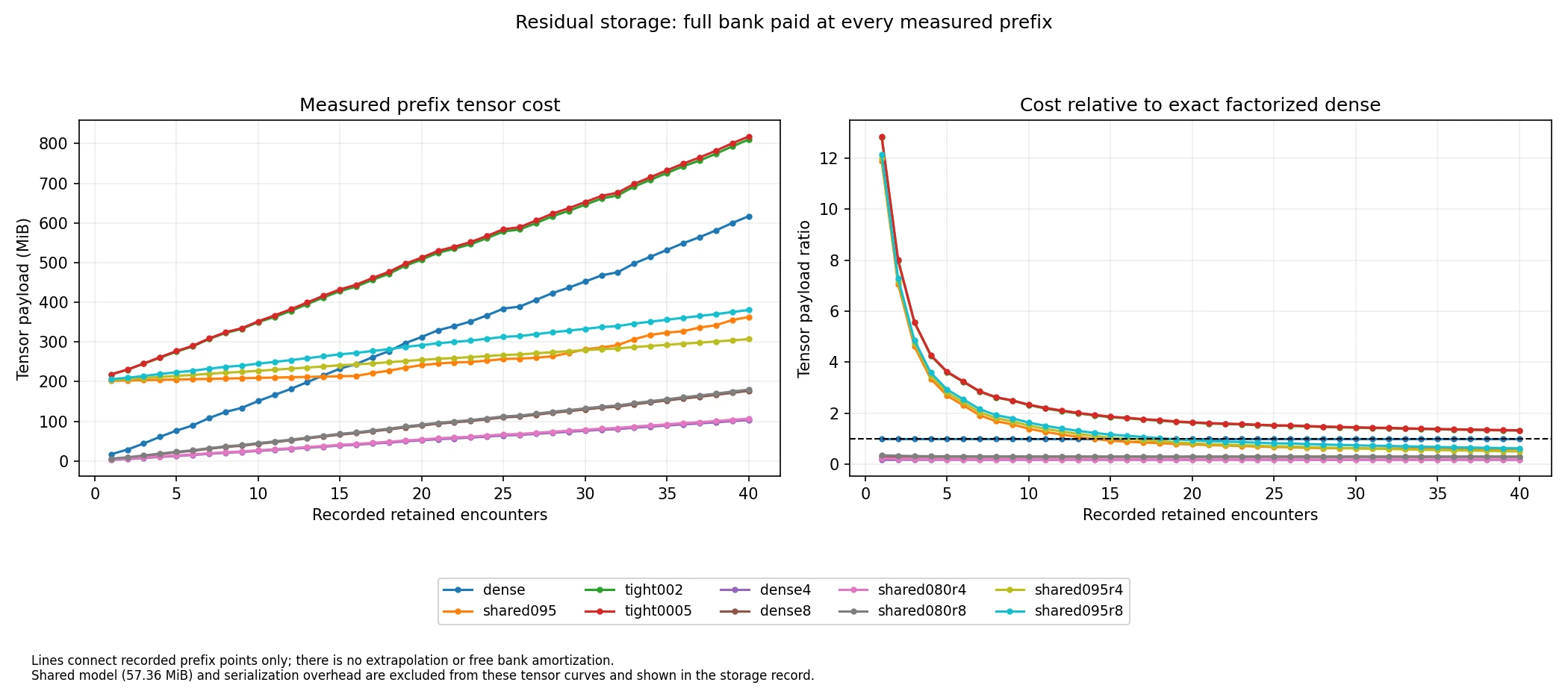
Replotted from saved outputs with clarified labels. The original recorded figure remains available.
4-bit vector storage: reconstructed photographs
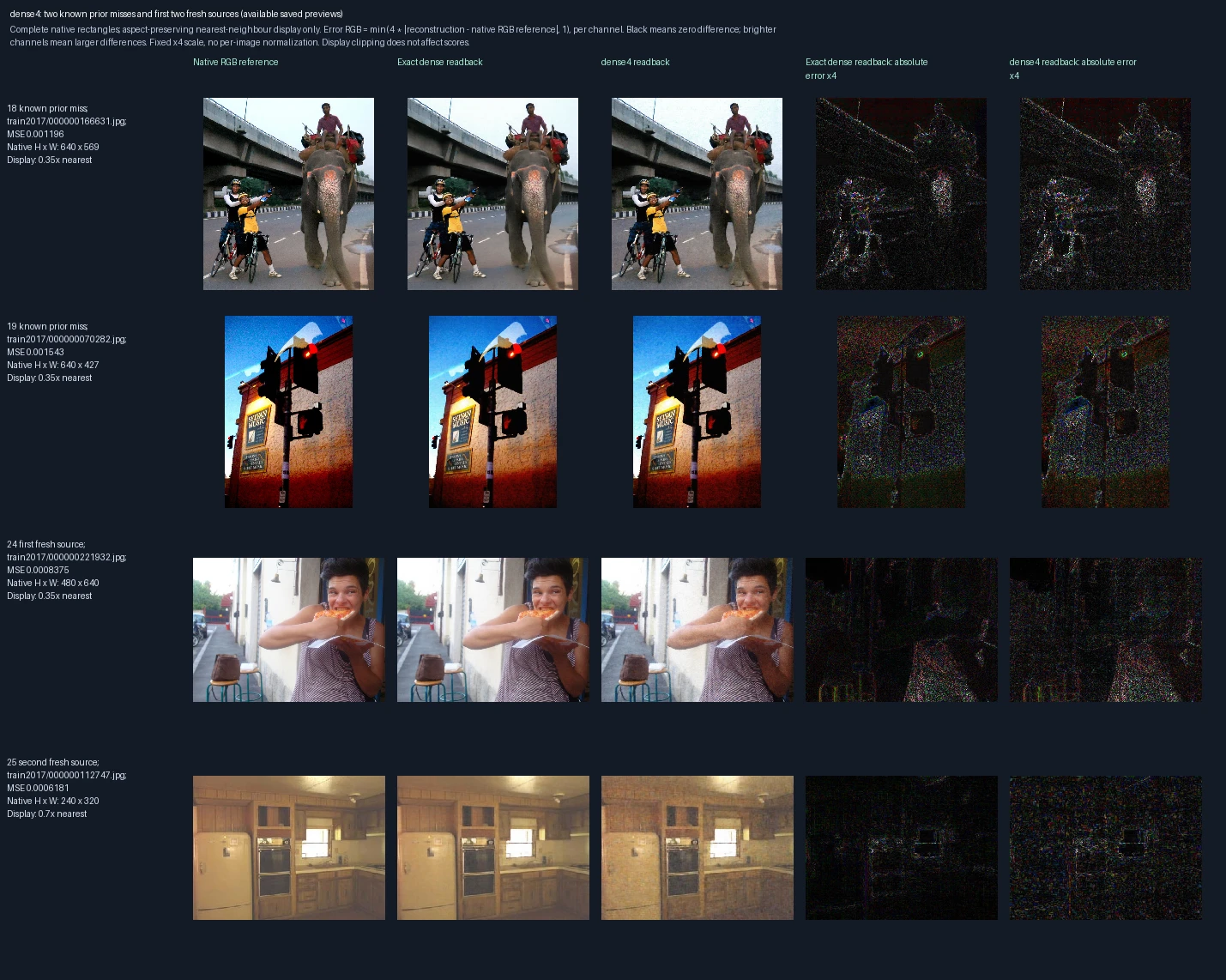
Display derivative: WebP quality 90; maximum edge 2400 px. Original scientific pixels remain in the source run; do not measure this preview.
8-bit vector storage: reconstructed photographs
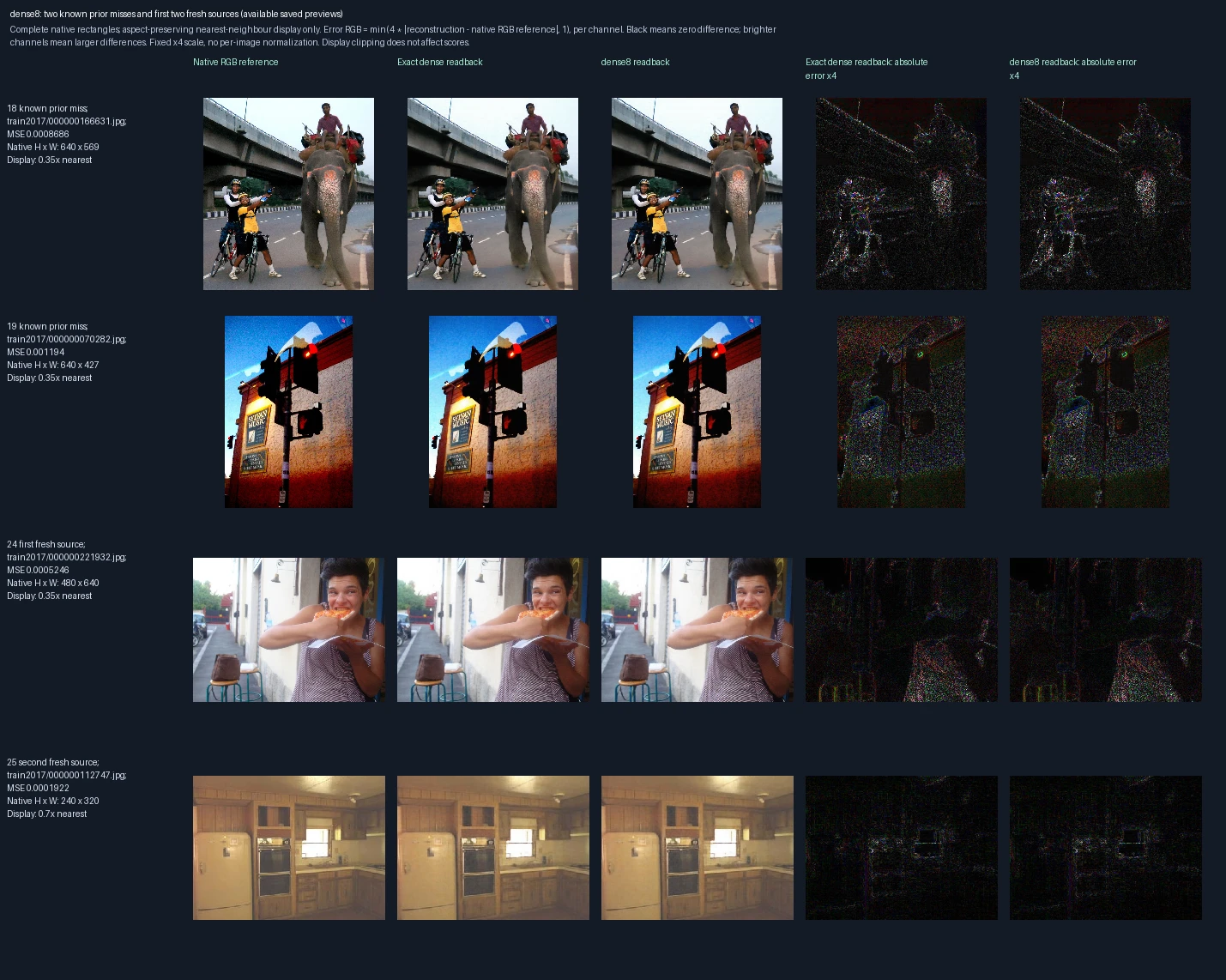
Display derivative: WebP quality 90; maximum edge 2400 px. Original scientific pixels remain in the source run; do not measure this preview.
Prototype reuse at 0.80 similarity plus 4-bit residuals: reconstructed photographs
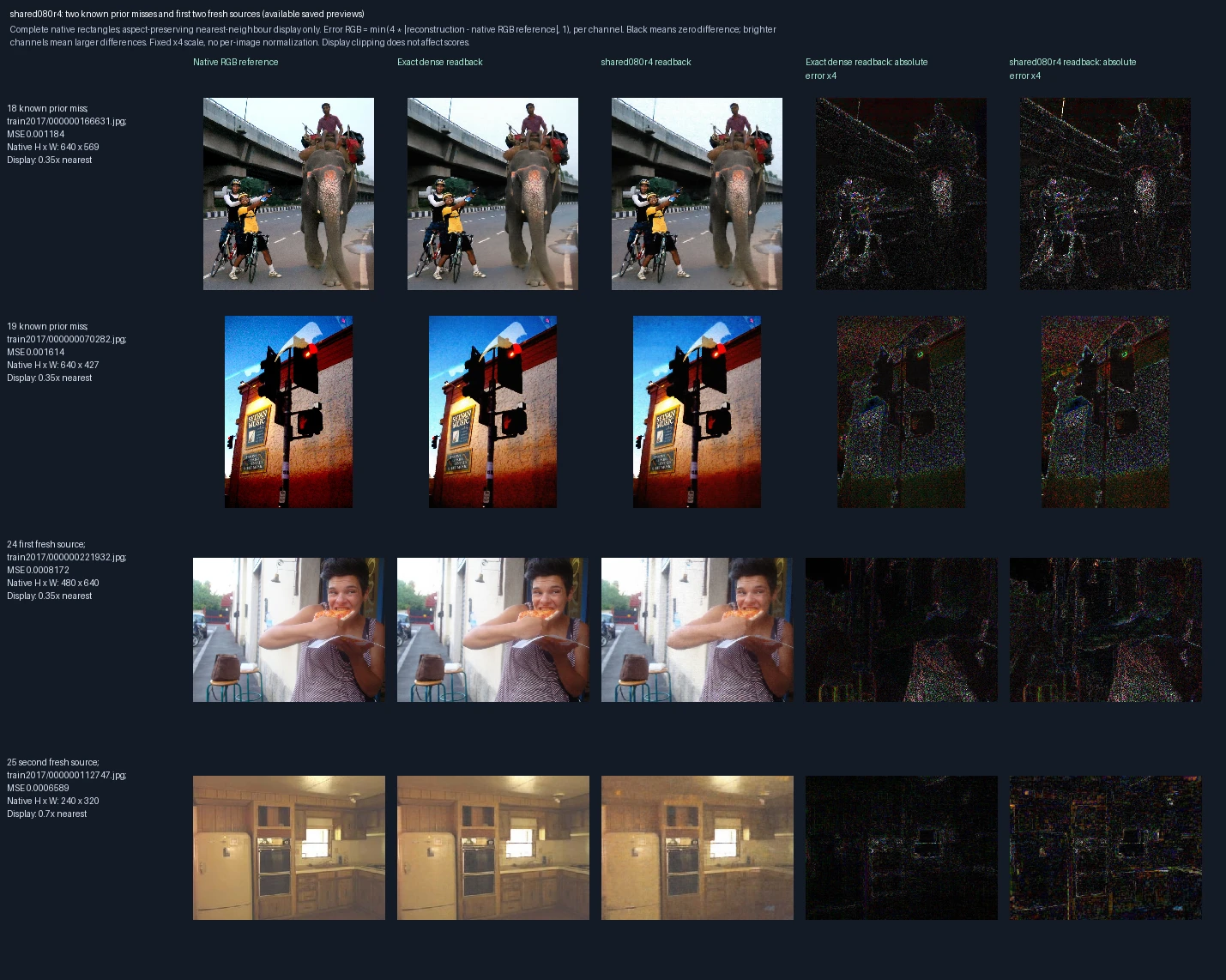
Display derivative: WebP quality 90; maximum edge 2400 px. Original scientific pixels remain in the source run; do not measure this preview.
Prototype reuse at 0.95 similarity plus 4-bit residuals: reconstructed photographs
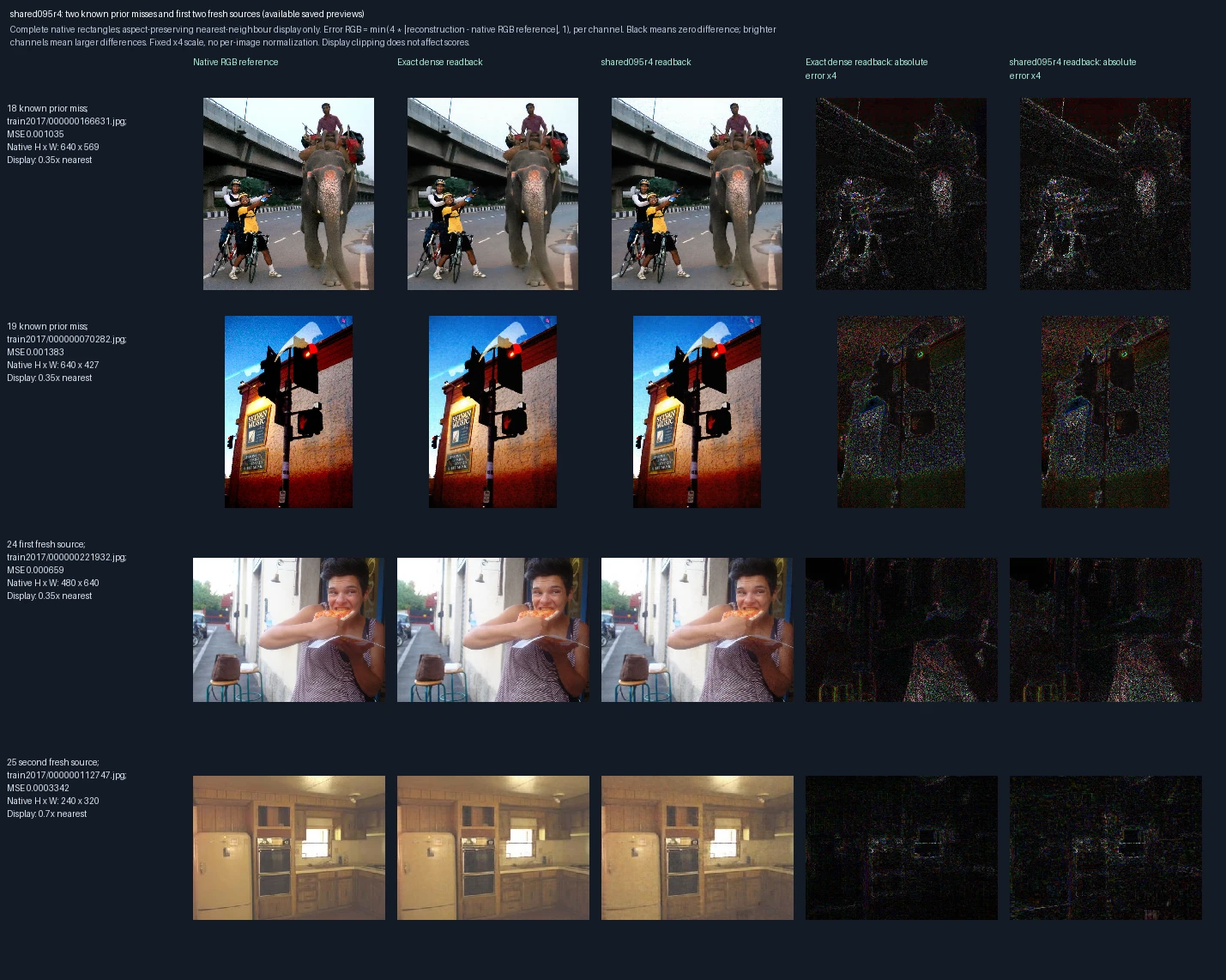
Display derivative: WebP quality 90; maximum edge 2400 px. Original scientific pixels remain in the source run; do not measure this preview.
Prototype reuse at 0.95 similarity without residuals: reconstructed photographs
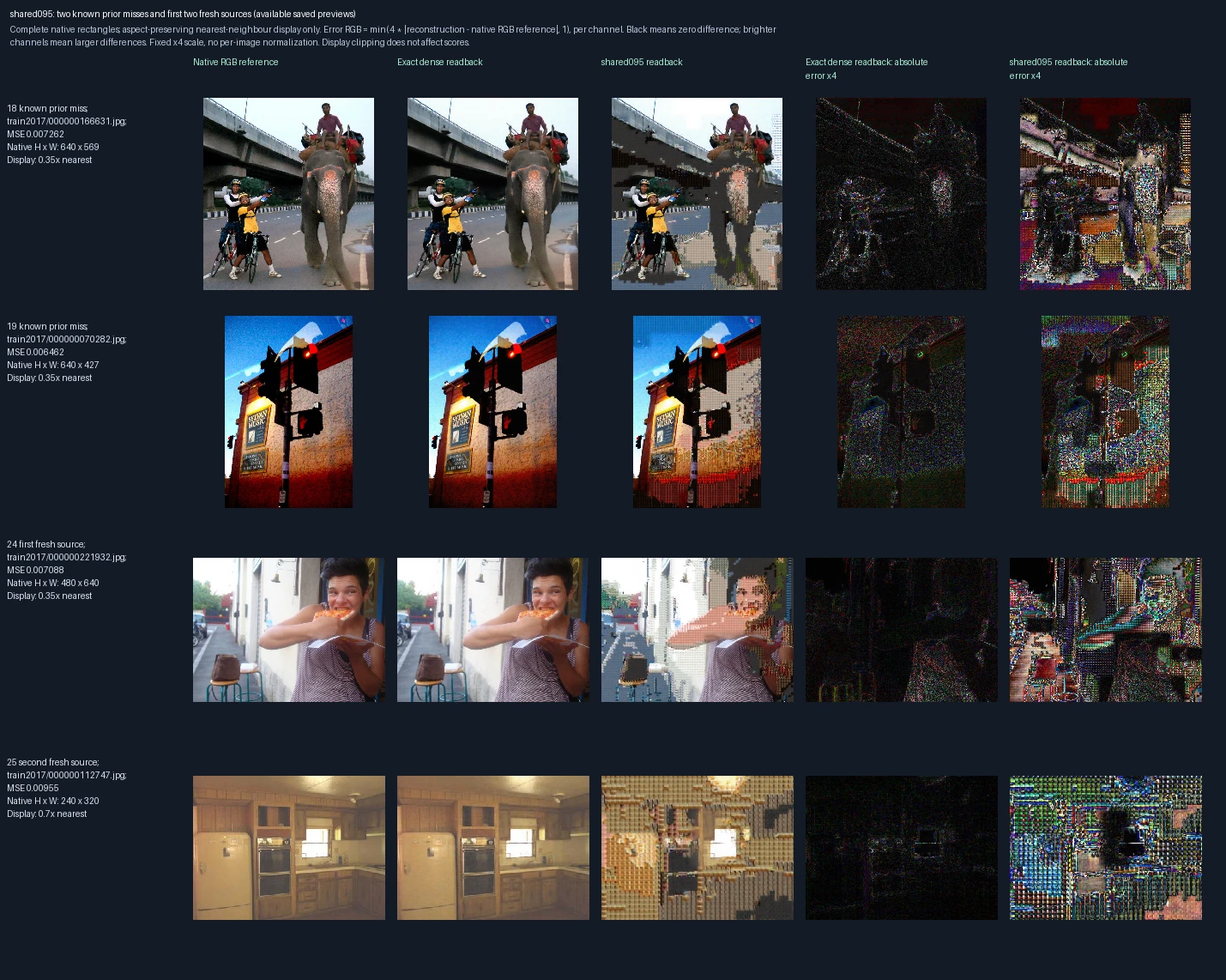
Display derivative: WebP quality 90; maximum edge 2400 px. Original scientific pixels remain in the source run; do not measure this preview.
Limits and next question
This component comparison uses fixed acquired banks and supplied visibility. Examined and fresh development queries are reported separately; repairing known failures is not general noninferiority. Count the entire bank, references, fallbacks, quantized coordinates, scales, envelopes, serialization and model costs. Residuals restore the original VSA space before existing operations. No candidate is installed, the final panel remains sealed, and milestone 1.3 integration remains open.
Next question. Assess whether retained detail improves the full cost/utility tradeoff over dense quantization before separately locking larger confirmation.
Inspect the evidence
Download the methods and measurements for this experiment. Large training and saved-state files are not included.