Type a section name and press Enter. Use “help” for the list.
Cliste experiment
Subtracting interference from remembered parts
Registered 10 Oct 2026 · Snapshot 12 Oct 2026
The question
Does the contribution of other positions prevent a fixed pair selector from making a useful change to remembered content?
Why this experiment?
Bundled features interfere with one another. Privileged subtraction can diagnose how much that interference matters without claiming it is available to an ordinary memory reader.
How it works
Remove the actual contribution of unrelated features using observer-only information, then repeat the same selector. The gain tests an interference contribution; privileged subtraction is not an executable source-free solution.
Follow this part of the investigation: Separate interference from the operation target →Implementation and comparison details
The diagnostic reused 64 supplied feature-position exchanges from 16 previously evaluated photographs. The 175-encounter history, encoder, decoder, 512-pattern bank and exchange operation stayed fixed. Nothing was trained and no new inputs were admitted.
Exact cancellation subtracts the known contribution of the other 62 positions before repeating the same paired selection objective. Clean pair sum also removes the stored-versus-reencoded residual. Both are privileged controls using original features; they are not memory-only recovery methods.
Centered independent selection and the earlier Clean difference selector remain as context. Clean difference fits the operation-relevant vector difference, a different objective from fitting the two-position sum. Every selected exchange acts on original stored memory and is compared with an exact-feature exchange through the same decoder.
What happened
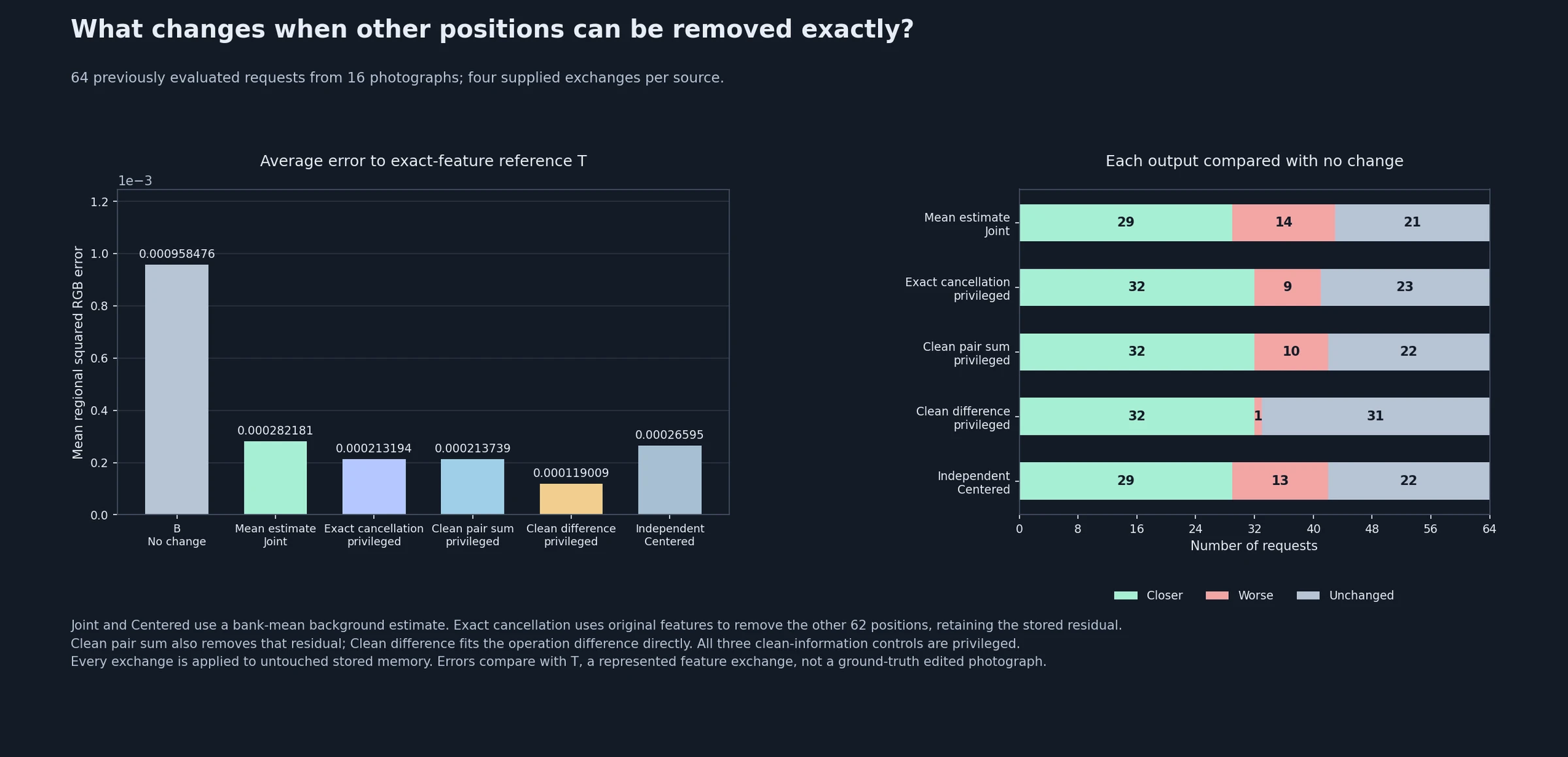
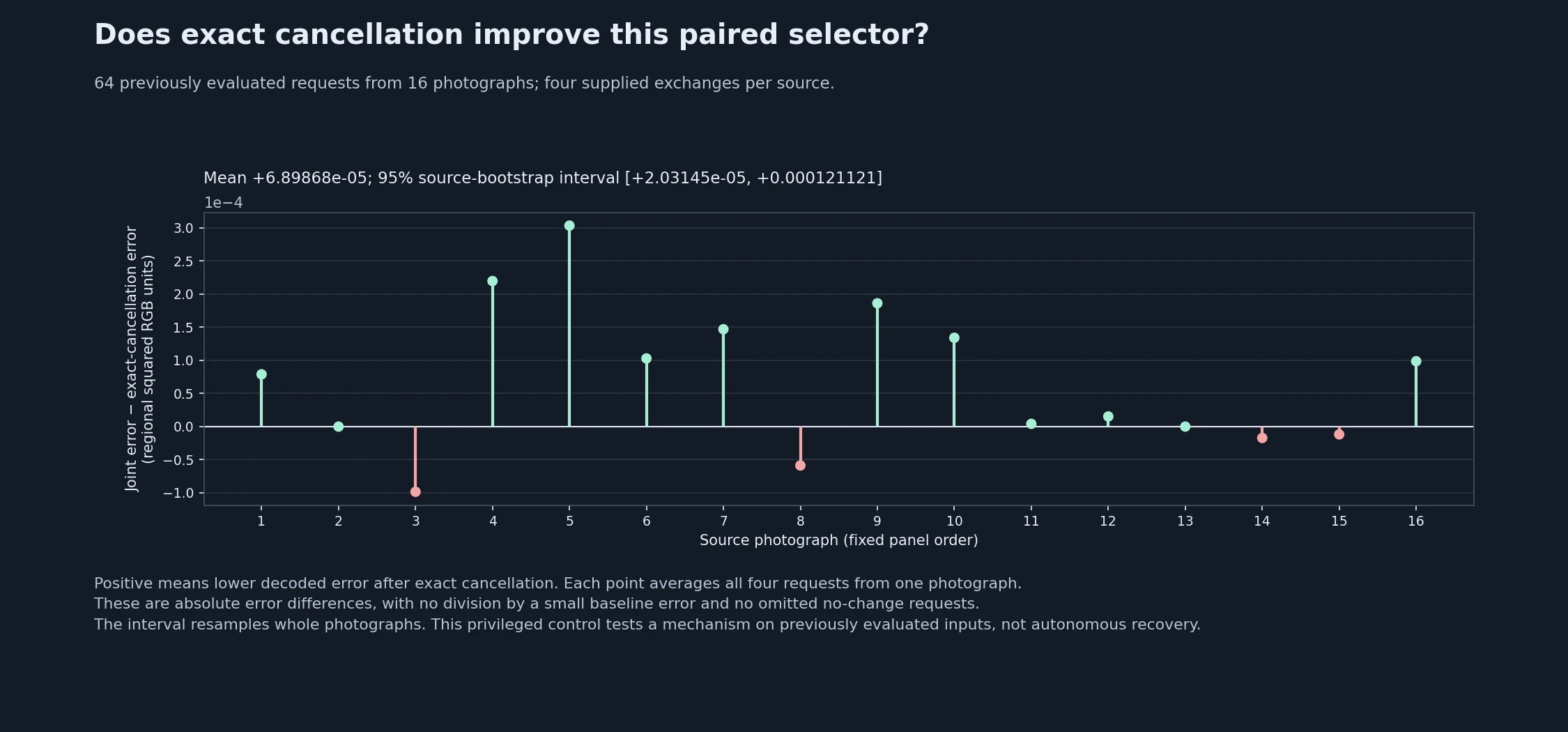
Exact cancellation reduced mean regional squared RGB error by 24.4% versus the same selector with estimated background: 0.000213194 versus 0.000282181. It improved 25 requests, worsened ten and tied on 29 in that direct comparison. The 95% whole-photograph bootstrap interval for the absolute reduction was positive, meeting the predefined mechanism-diagnostic criteria.
Against leaving memory unchanged, cancellation improved 32 requests, worsened nine and left 23 unchanged. Six changed requests at least doubled regional error. Interference removal helped the average without establishing reliable automatic changes.
Removing the remaining stored-versus-reencoded residual changed only two outcomes, both slightly worse. Clean difference retained 44.3% lower mean error than Clean pair sum. The fixed bank supports more useful changes with an operation-directed target; isolating the pair under the paired-sum objective did not recover that advantage.
Independent validation checked 1,665 evidence files and recomputed all 768 pixel and edge measurements. Retained state and codec were preserved, and pixels outside the edited core matched exactly.
Measurements
| Recorded field | Value |
|---|---|
| operations | 64 |
| sources | 16 |
Results and visual artifacts
Open a figure for its input, comparison, and result. Click an image to enlarge it.
Exact cancellation: average error and every request outcome
Display derivative: WebP quality 90; maximum edge 2400 px. Original scientific pixels remain in the source run; do not measure this preview.
Does subtracting other positions help the same selector?
Display derivative: WebP quality 90; maximum edge 2400 px. Original scientific pixels remain in the source run; do not measure this preview.
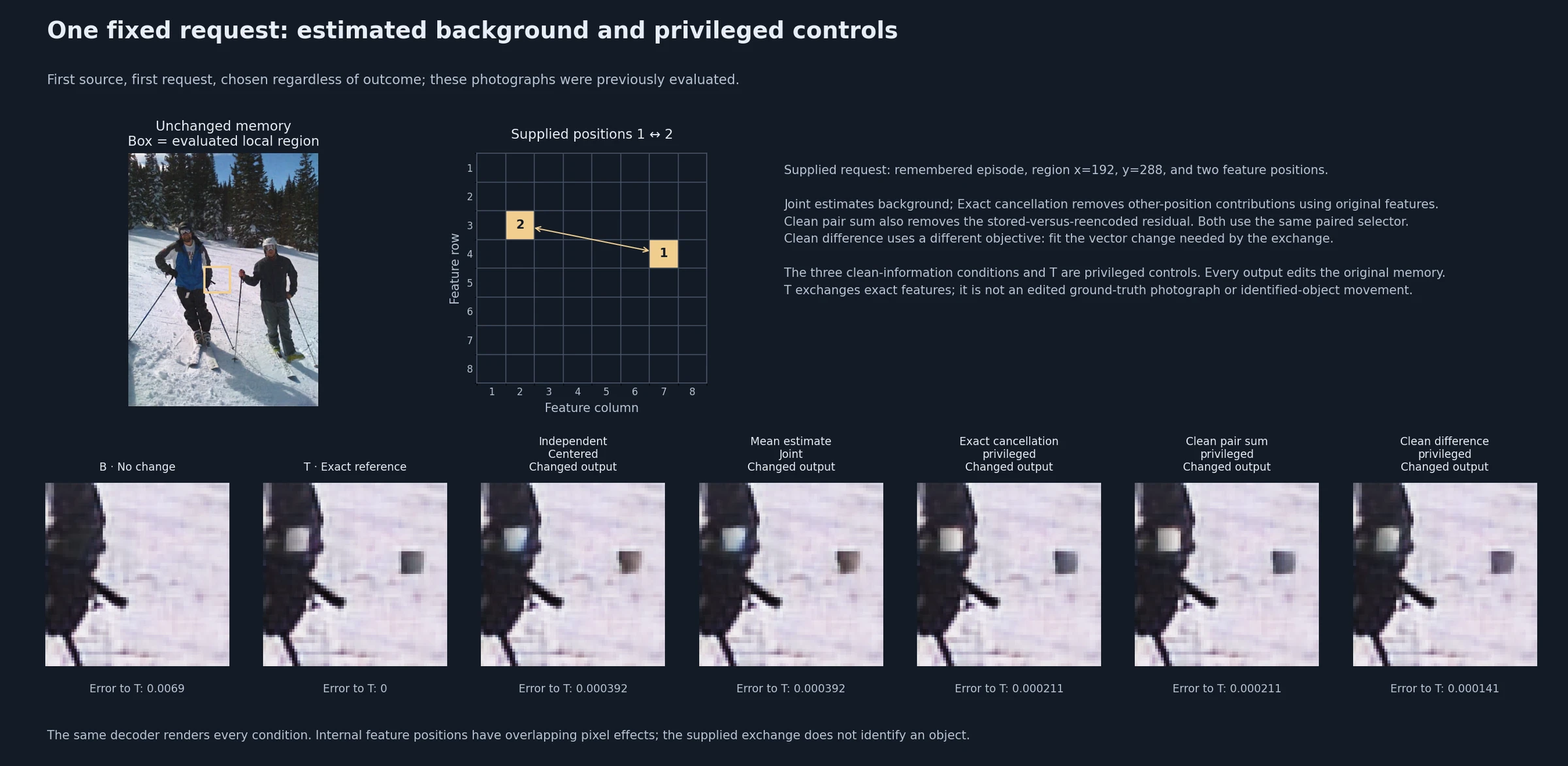
The first supplied exchange, with all diagnostic controls
Display derivative: WebP quality 90; maximum edge 2400 px. Original scientific pixels remain in the source run; do not measure this preview.
Limits and next question
All 64 requests were already evaluated. Exact cancellation and both clean controls use privileged original features. This is a mechanism diagnostic, not new-input generalization or autonomous recovery.
The supplied exchange concerns feature positions with overlapping pixel receptive fields. Its exact-feature reference is not an edited ground-truth photograph or evidence of object movement. Large proportional regional losses can concern small intended changes.
The result supports interference as a contributor to this selector’s error, not the sole cause. Historical normalized adequacy statistics are retained as context; they are neither this study’s primary criterion nor a universal cognition test.
Next question. Can one shared learned readout estimate the difference needed by an operation from retained memory and supplied position roles? Keep the bank, codec and exchange fixed. Use clean features for training targets only, then evaluate separate photographs and held-out position combinations with centered, untrained and shuffled-memory controls.
Inspect the evidence
Download the methods and measurements for this experiment. Large training and saved-state files are not included.