Type a section name and press Enter. Use “help” for the list.
Cliste experiment
Recovering useful patterns from stored memory
Registered 10 Oct 2026 · Snapshot 12 Oct 2026
The question
Can the useful pattern combinations found with clean features also be selected from retained bundled memory, without access to the original image or features?
Why this experiment?
A usable memory operation must work from what was stored. Privileged original features are useful assessment references but cannot supply the answer during recall.
How it works
Select patterns using only retained VSA, position roles and the acquired bank. Compare background correction and joint selection, with shuffled memory as a content-specificity control.
Follow this part of the investigation: Remove the privileged clean features →Implementation and comparison details
The encoder, decoder and bank of 512 learned patterns stayed fixed. The primary comparison used 64 supplied exchanges from 16 new photographs; another 64 previously tested requests were reported separately. Each request identified a remembered image, a region and two feature positions.
Original selected each pattern independently from the unbound memory vector. Centered first subtracted the estimated shared background contribution. Joint used that same correction and fitted both patterns together. Shuffled selected from another photograph’s memory, then applied the pair to the requested image. These four methods could not inspect source images or original features.
Clean repeated the earlier joint selector with privileged original features. All errors compare with an exchange of the exact original features through the same decoder. That reference defines the represented operation, not an edited ground-truth photograph. No model was trained, no patterns were added and no acceptance threshold was fitted.
What happened
Background correction reduced mean regional squared RGB error by 41.2% versus raw independent selection on the new requests: 0.000266 versus 0.000453. Fitting the pair jointly increased error by 6.1% versus corrected independent selection, to 0.000282. The useful change in this comparison was the background correction.
Lower averages did not establish reliable edits. Centered improved 29 requests, worsened 13 and left 22 unchanged. Joint improved 29, worsened 14 and left 21 unchanged. Among Joint’s 43 changed outputs, 13 increased regional error by more than 10% and ten at least doubled it. Centered had 13 such increases and nine doublings among 42 changed outputs. Both missed the predefined diagnostic benchmark.
The privileged Clean control met all six diagnostic criteria again: mean error 0.000119, with 32 requests improved, one worsened and 31 unchanged. Its one worsening exceeded 10% but did not double error. The same vocabulary and decoder can support useful combinations with clean information; recovering useful combinations from the bundle remains unresolved.
Matching memory content mattered: Joint beat selection from another photograph’s memory on 50 requests, lost on seven and tied on seven. The paired source-level comparison supported that advantage, but not an advantage over Centered. Joint changed only six selected pairs relative to Centered; one improved decoded error and five worsened it. These request-level counts are post-experiment descriptions, not extra acceptance criteria.
Independent review checked 2,777 evidence files and recomputed all 1,536 pixel and edge measurements. Unchanged readbacks and pixels outside the selected core matched exactly. The research life grew from 159 to 175 encounters while preserving earlier memories, the acquired bank, codec and held work. The separate reused panel showed the same direction of results and was not pooled with the new photographs.
Measurements
| Recorded field | Value |
|---|---|
| Previously tested requests evaluated | 64 |
| Prospective requests evaluated | 64 |
Results and visual artifacts
Open a figure for its input, comparison, and result. Click an image to enlarge it.
The first four figures cover 64 supplied exchanges from 16 new photographs; the fifth reports previously tested photographs separately. Original recovers each pattern independently from the stored bundle. Centered first subtracts an estimated background; Joint selects both patterns together from that same centered memory. Shuffled selects from another photograph’s memory. Clean receives privileged original features. Every error compares with T, an exact-feature exchange through the same decoder, not an edited ground-truth photograph. Average improvements, worsening requests and no-change outcomes are all shown.
New photographs: memory-based joint selection and its controls
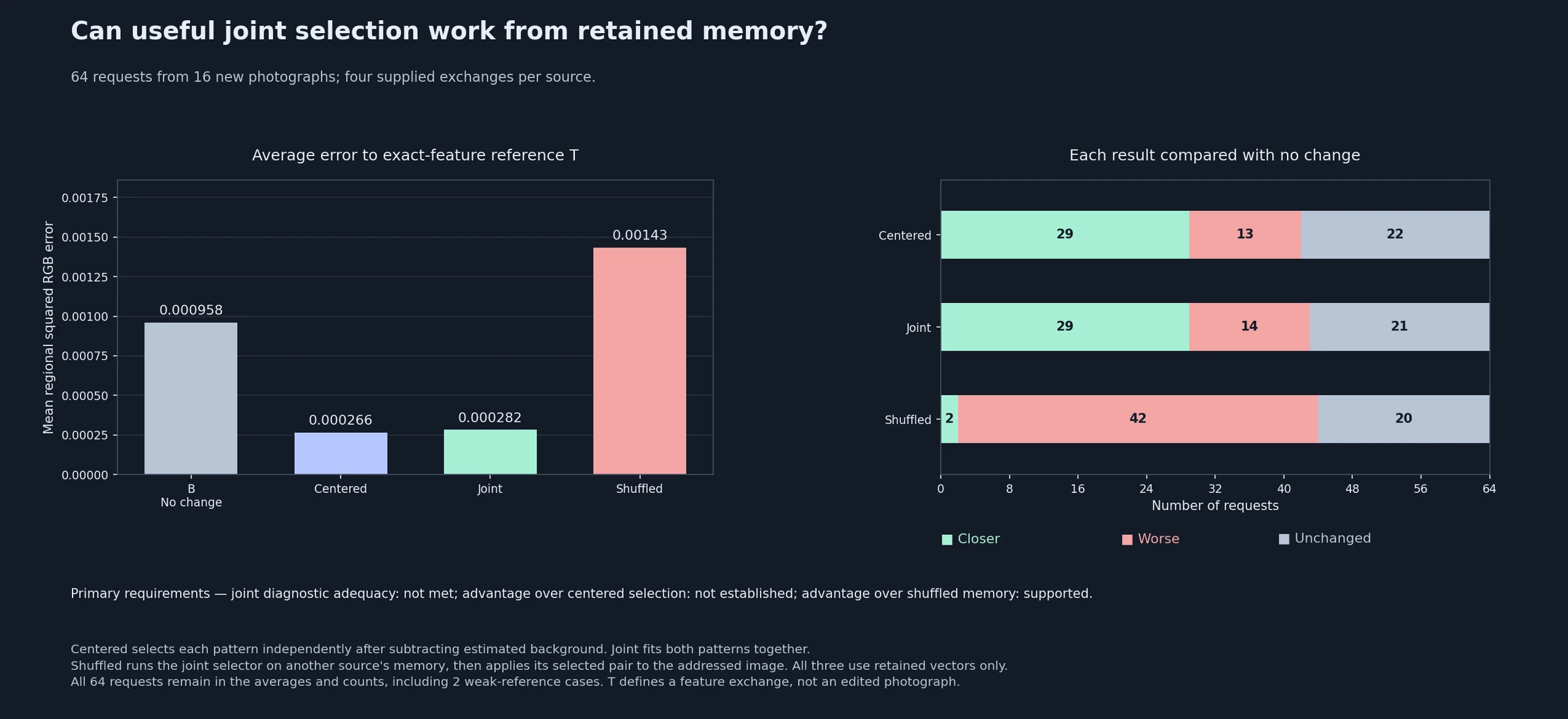
Display derivative: WebP quality 90; maximum edge 2400 px. Original scientific pixels remain in the source run; do not measure this preview.
New photographs: original recovery, background subtraction and clean reference
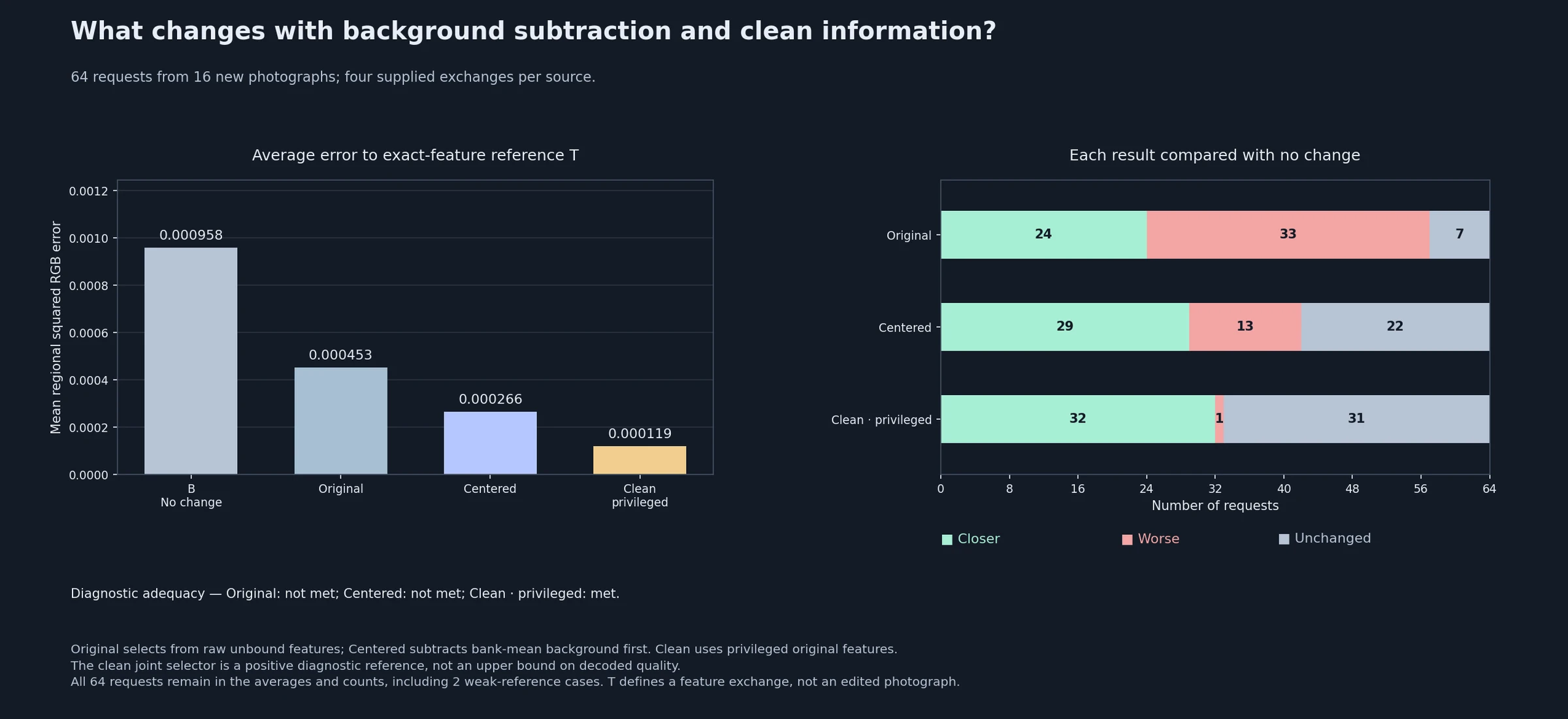
Display derivative: WebP quality 90; maximum edge 2400 px. Original scientific pixels remain in the source run; do not measure this preview.
New photographs: both required paired comparisons
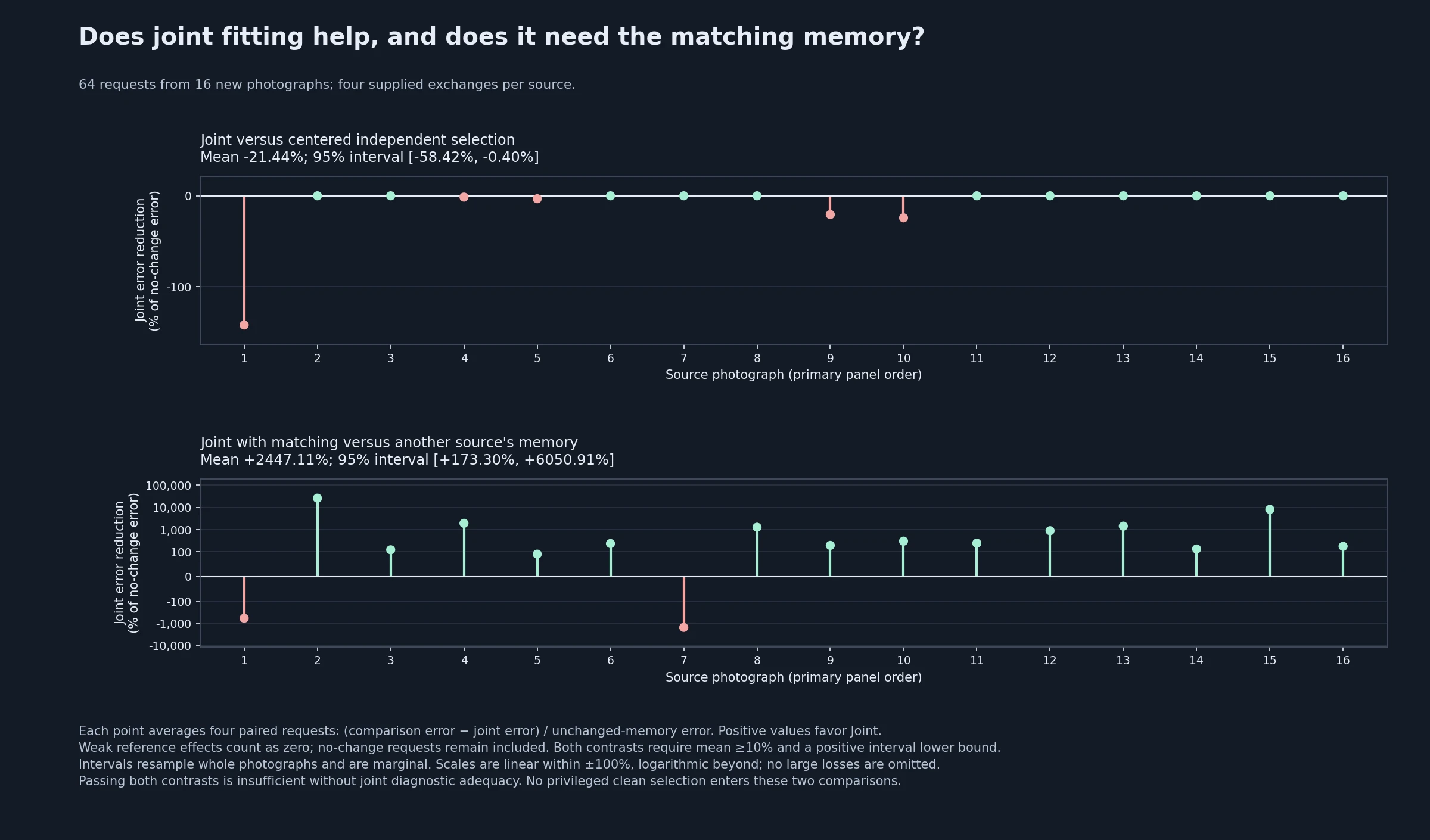
Display derivative: WebP quality 90; maximum edge 2400 px. Original scientific pixels remain in the source run; do not measure this preview.
New photographs: the fixed first supplied exchange
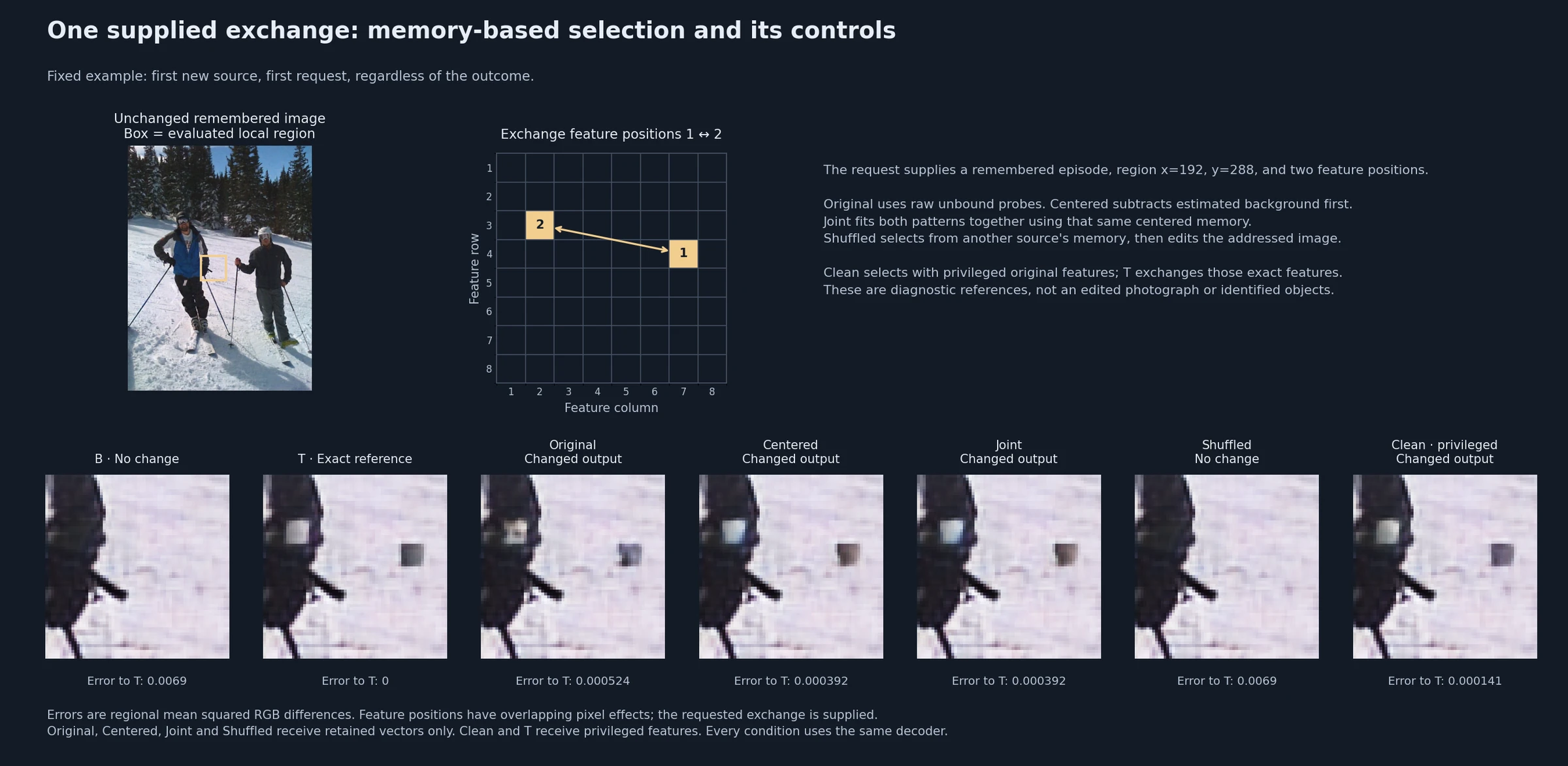
Display derivative: WebP quality 90; maximum edge 2400 px. Original scientific pixels remain in the source run; do not measure this preview.
Previously tested photographs: separate diagnostic results
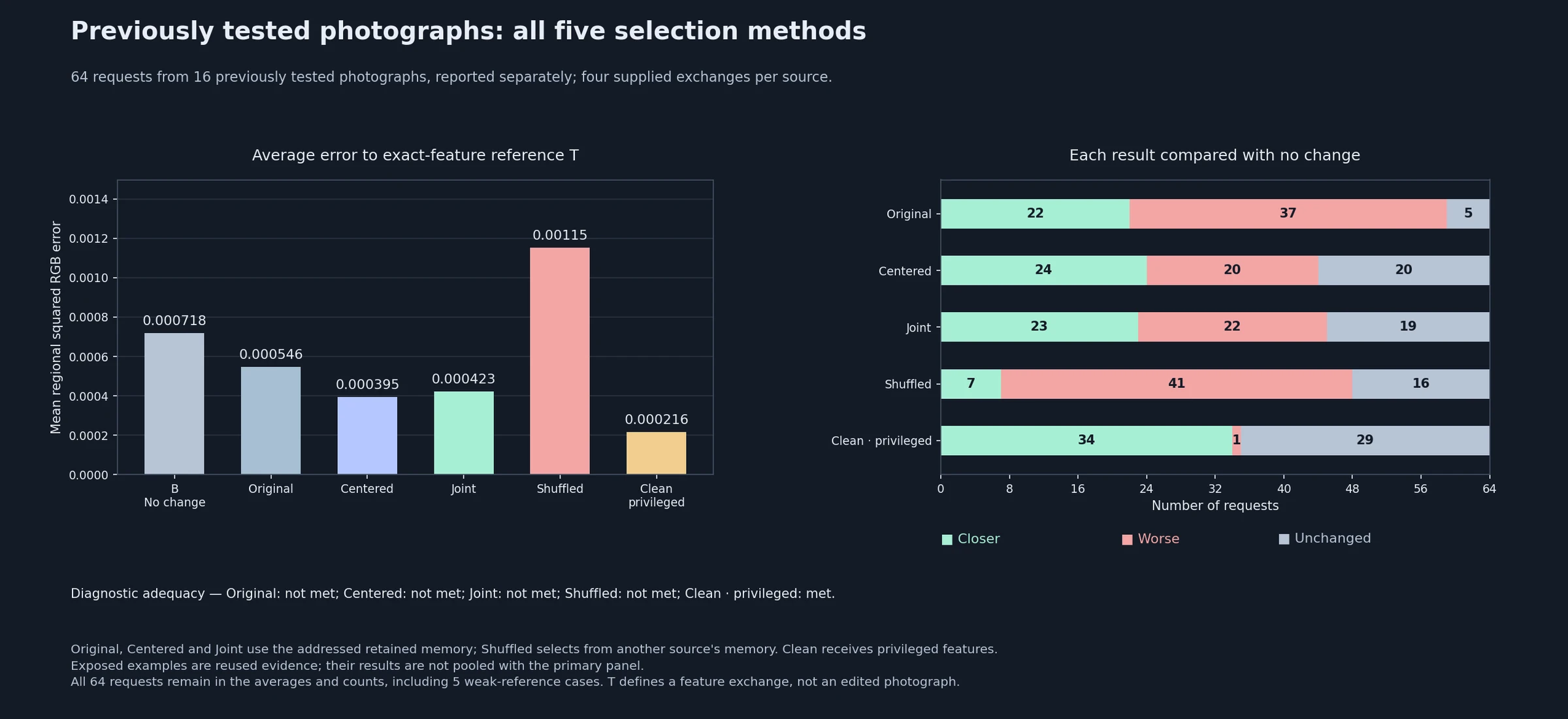
Display derivative: WebP quality 90; maximum edge 2400 px. Original scientific pixels remain in the source run; do not measure this preview.
Limits and next question
Image, region and feature-position addresses were supplied. This tests a represented feature exchange, not autonomous object discovery or object motion. The successful Clean selector remains privileged, and automatic constituent substitution stays disabled.
Large proportional error increases can concern small requested effects; they do not mean the whole image was destroyed. The diagnostic criteria retain those regressions rather than allowing large gains elsewhere to cancel them. Two weak-reference requests remain in the 64-request totals and contribute zero normalized gain.
The estimated background is the learned bank’s mean contribution, not the actual contents of the other positions. Failure of this recovery rule does not establish that the retained information is absent or that another recovery method would fail. The clean reference is not an upper bound on decoded quality.
Next question. Can a shared learned cleanup component estimate the feature difference needed for an exchange from retained vectors and position roles? First use a privileged diagnostic that subtracts the exact contribution of the other positions to check the target before choosing the learned design. Keep the vocabulary, codec and exchange fixed. Clean features would supply training targets only; evaluation would use new photographs and held-out position combinations, with corrected independent, untrained and shuffled-memory controls. This is a proposed experiment, not an established capability.
Inspect the evidence
Download the methods and measurements for this experiment. Large training and saved-state files are not included.