Type a section name and press Enter. Use “help” for the list.
Cliste experiment
Selecting patterns for the change they need to express
Registered 10 Oct 2026 · Snapshot 12 Oct 2026
The question
Can the same learned visual vocabulary produce more useful compositions when patterns are selected together for the change they must express?
Why this experiment?
A nearby visual pattern is not necessarily the right replacement for a requested change. These comparisons test whether selection helps the resulting operation.
How it works
Supply two feature positions to exchange. Compare how candidate patterns are selected, then decode the edited bundle against an observer-only clean-feature exchange. This is a local feature operation, not a command to move a complete object.
Follow this part of the investigation: Similar parts are not necessarily the right parts for a change →Implementation and comparison details
The encoder, decoder and bank of 512 learned patterns stayed fixed. Each request identified a remembered image, a region and two feature positions to exchange. The primary comparison used 64 fixed requests from 16 new photographs; another 64 previously evaluated requests were examined separately.
Independent selection chose each feature’s nearest pattern by cosine similarity. Joint selection examined all 512 × 512 ordered pairs and chose the pair whose bound difference best matched the requested vector change. Both methods received the original clean feature vectors, so this is a privileged diagnostic of selection, not recovery from noisy memory.
The reference exchanged the original features through the same decoder. Errors measure agreement with that represented operation in the selected image region. No patterns were added, no model was trained and no confidence threshold was fitted.
What happened
On the 64 new requests, joint selection reduced mean regional squared RGB error by 41.0% versus independent selection and 69.9% versus leaving memory unchanged: 0.000216, 0.000366 and 0.000718, respectively. It met all six predefined diagnostic criteria, and the paired comparison supported an advantage across source photographs.
Joint selection improved 34 requests, worsened one by 0.203%, and made no change on 29. None of its 35 changed outputs increased error by more than 10% or doubled it. Independent selection improved 27, worsened 18 and left 19 unchanged; it missed the diagnostic benchmark.
The improvement was not only a result of doing less. A post-experiment comparison on the same 35 requests where joint selection acted found 37.5% lower mean error than independent selection. Its individual patterns were less similar to the original features on average: cosine 0.9341 versus 0.9609. A pair can express a useful change without faithfully identifying the original parts.
The separate reused panel showed 48.2% lower mean error with joint selection than with independent selection. It met the diagnostic criteria there too, with 37 improved requests, one slightly worsened and 26 unchanged. Those previously evaluated photographs were not pooled with the new panel.
Independent validation checked 2,202 evidence files and recomputed all 768 pixel and edge measurements. Baseline readbacks and pixels outside the selected core matched exactly. The research life grew from 143 to 159 encounters while preserving earlier memories, the bank, the codec and held work.
Measurements
| Recorded field | Value |
|---|---|
| Previously tested requests evaluated | 64 |
| Prospective requests evaluated | 64 |
Results and visual artifacts
Open a figure for its input, comparison, and result. Click an image to enlarge it.
The first three figures cover 64 supplied requests from 16 new photographs. The last reports 64 previously tested requests separately. B leaves memory unchanged; T exchanges the original features as a reference; C picks each learned pattern by cosine similarity; D picks a pair to fit the requested vector change. Both C and D use privileged clean features. Agreement with T measures this represented operation, not a true edited photograph or recovery of the original parts.
New photographs: averages and individual outcomes
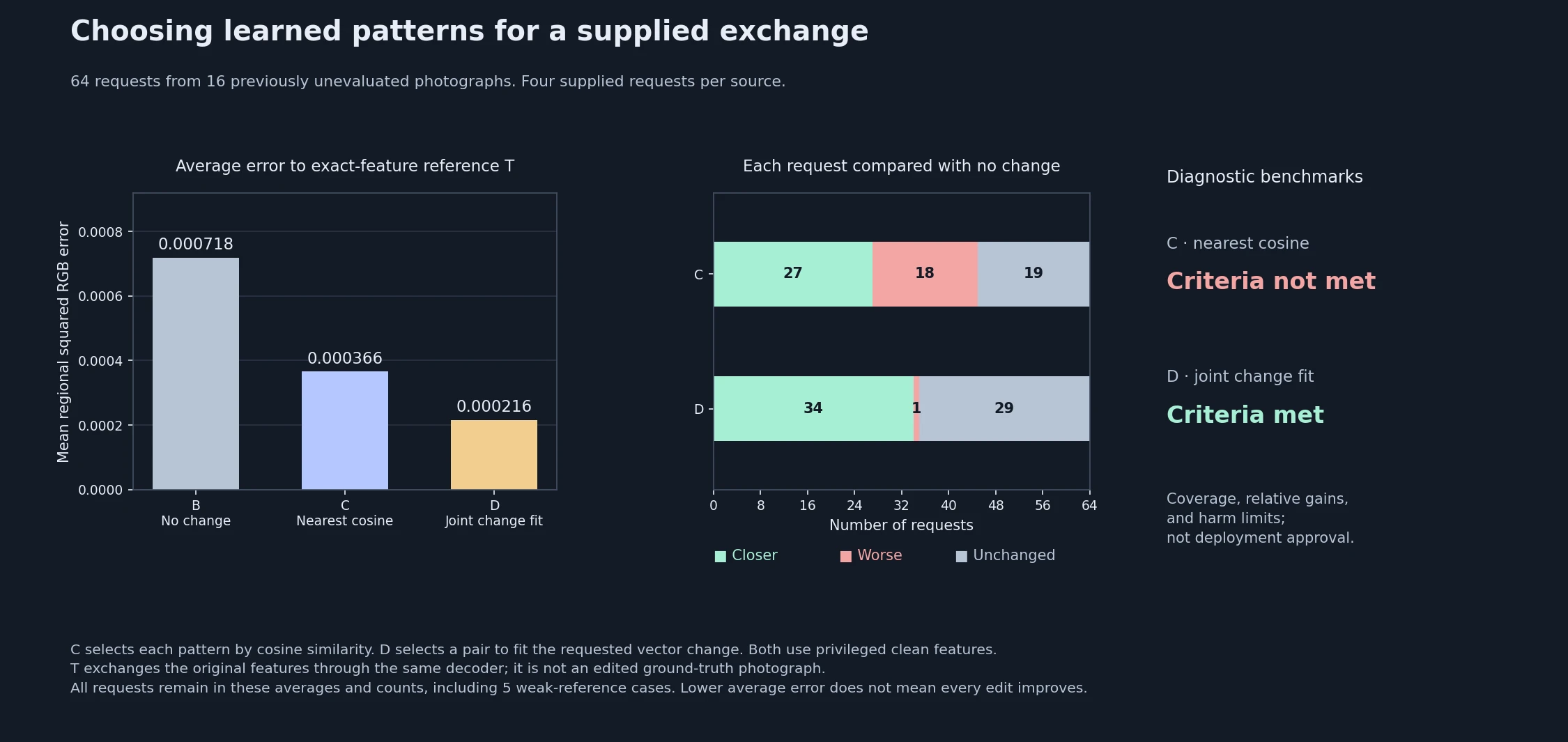
Display derivative: WebP quality 90; maximum edge 2400 px. Original scientific pixels remain in the source run; do not measure this preview.
New photographs: joint selection versus independent similarity
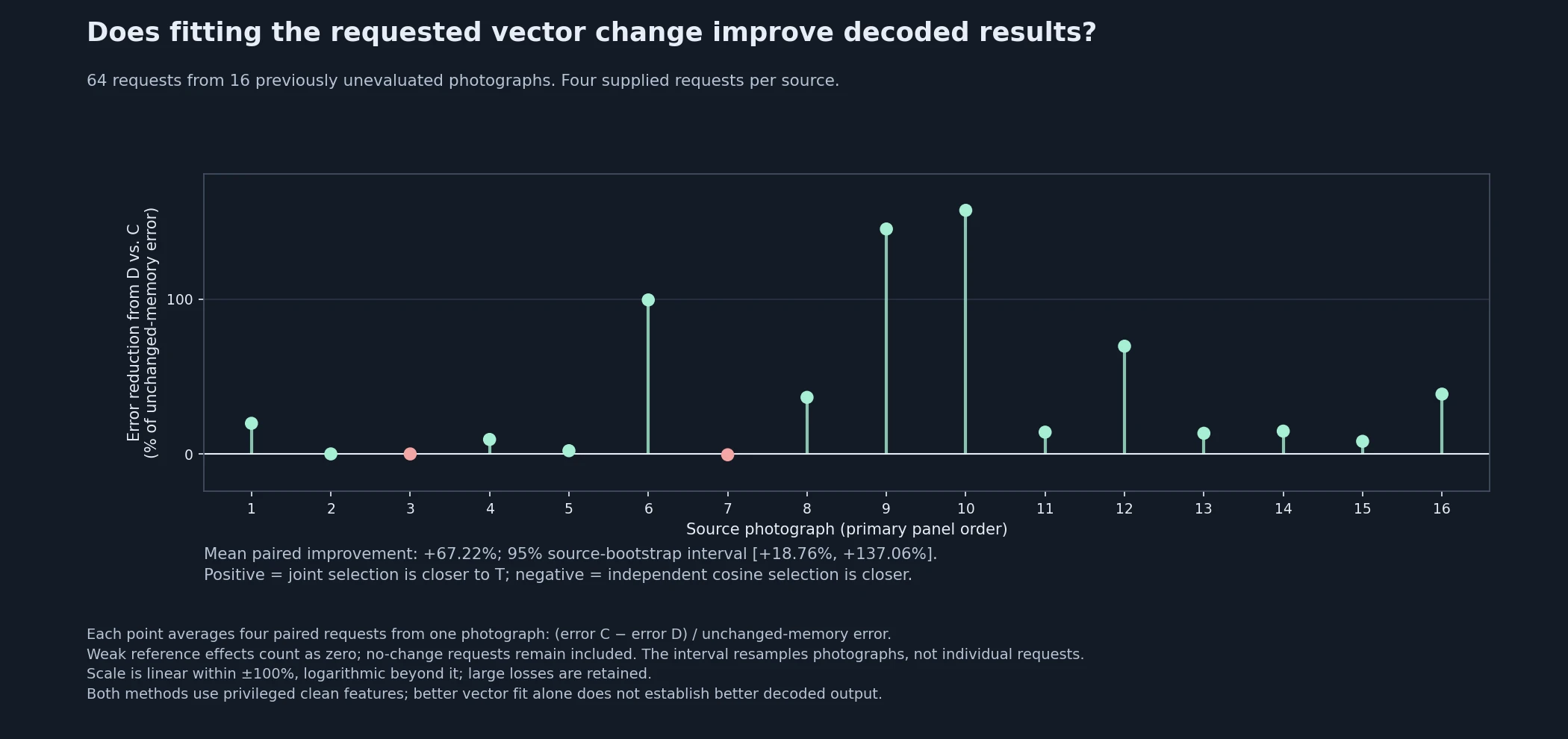
Display derivative: WebP quality 90; maximum edge 2400 px. Original scientific pixels remain in the source run; do not measure this preview.
New photographs: the first supplied exchange
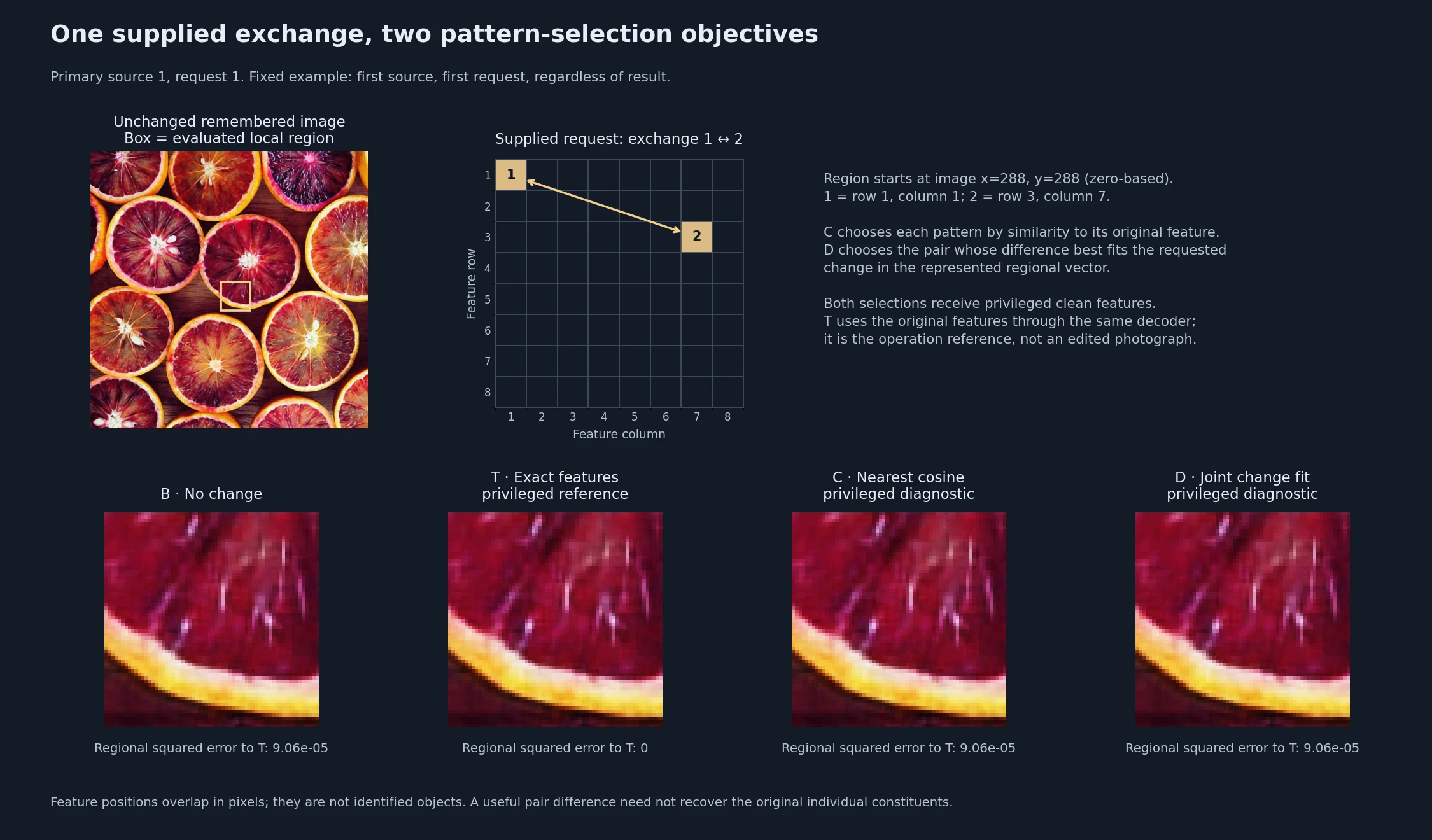
Display derivative: WebP quality 90; maximum edge 2400 px. Original scientific pixels remain in the source run; do not measure this preview.
Previously tested photographs: separate diagnostic outcomes
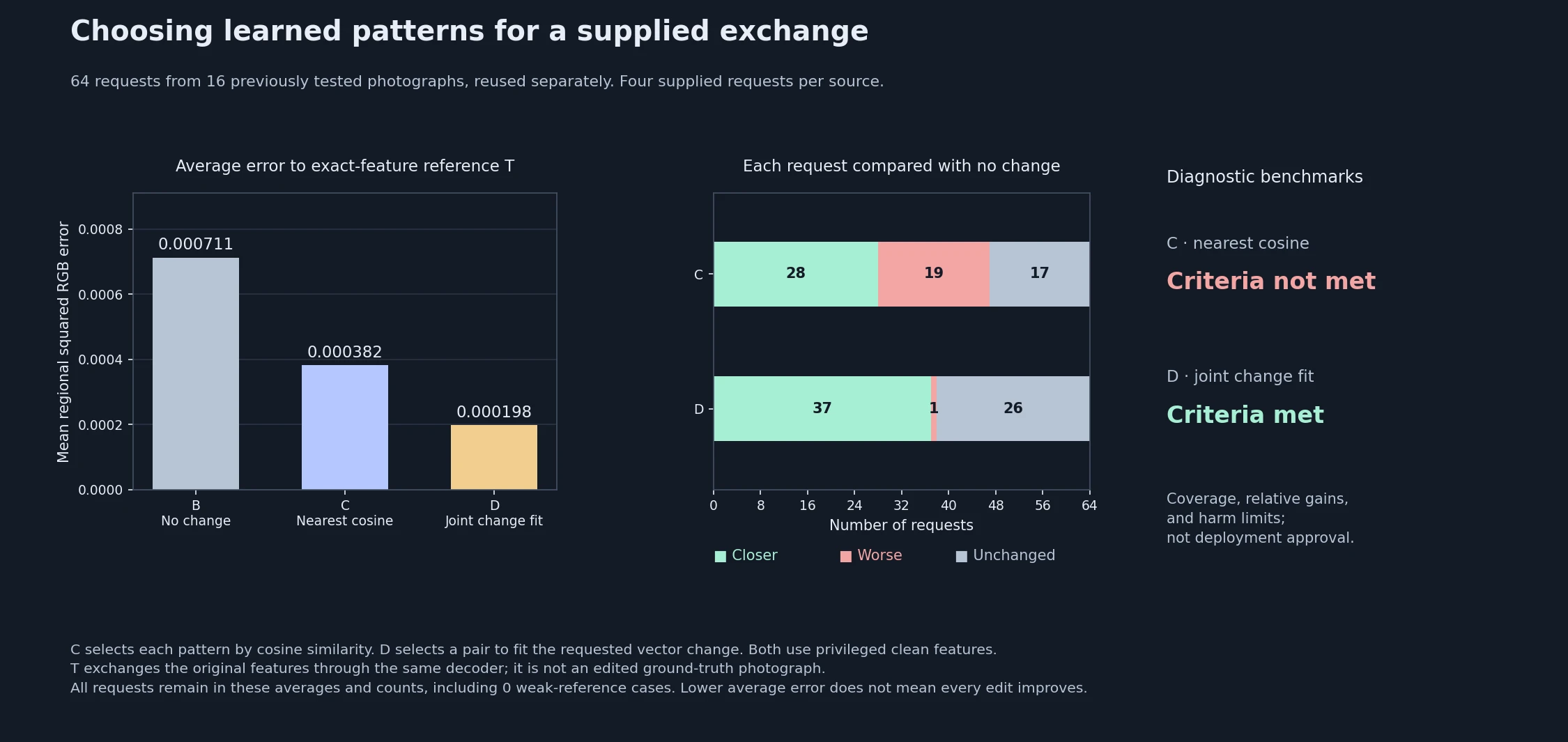
Display derivative: WebP quality 90; maximum edge 2400 px. Original scientific pixels remain in the source run; do not measure this preview.
Limits and next question
Both selectors received privileged clean features, and the feature positions were supplied. This establishes a useful operation-specific diagnostic with the existing vocabulary, not autonomous constituent recovery, object movement or selection from noisy bundled memory. The exact-feature reference is not an edited ground-truth photograph.
Joint selection retained all 19 no-change outcomes from independent selection and added ten more. Those distinctions remain unresolved. The active-request and individual-similarity comparisons are post-experiment descriptions, not additional acceptance criteria.
Four requests share each source photograph. Five requests with weak reference effects remain in the totals and contribute zero normalized gain under the predefined rule. The criteria are provisional diagnostics for this operation, and automatic constituent substitution remains disabled.
Next question. Does the advantage survive when selection receives only retained bundled memory? Keep clean-feature joint selection as a diagnostic reference and compare recovery methods on matched requests before changing the vocabulary or integrating substitution.
Inspect the evidence
Download the methods and measurements for this experiment. Large training and saved-state files are not included.