Type a section name and press Enter. Use “help” for the list.
Cliste experiment
Learning to change remembered content
Registered 10 Oct 2026 · Snapshot 12 Oct 2026
The question
Can a shared learned readout recover an operation-relevant difference from stored VSA memory, so a fixed pattern bank can express a useful change?
Why this experiment?
The earlier memory-only selector left useful changes unrealized. A shared learned readout tests whether recovered information can better guide the same supplied operation.
How it works
Train a shared prediction of the feature difference for a supplied exchange, while keeping the image codec, acquired patterns and operation fixed. Evaluate on separate photographs and count no-change outputs as well as gains and losses.
Follow this part of the investigation: Train a shared read operation and inspect what changed →Implementation and comparison details
The encoder, decoder, 512-pattern bank and exchange stayed fixed. A shared linear readout trained on 64 new photographs, used 16 separate validation photographs to select a checkpoint, then evaluated 64 supplied exchanges on 16 further photographs.
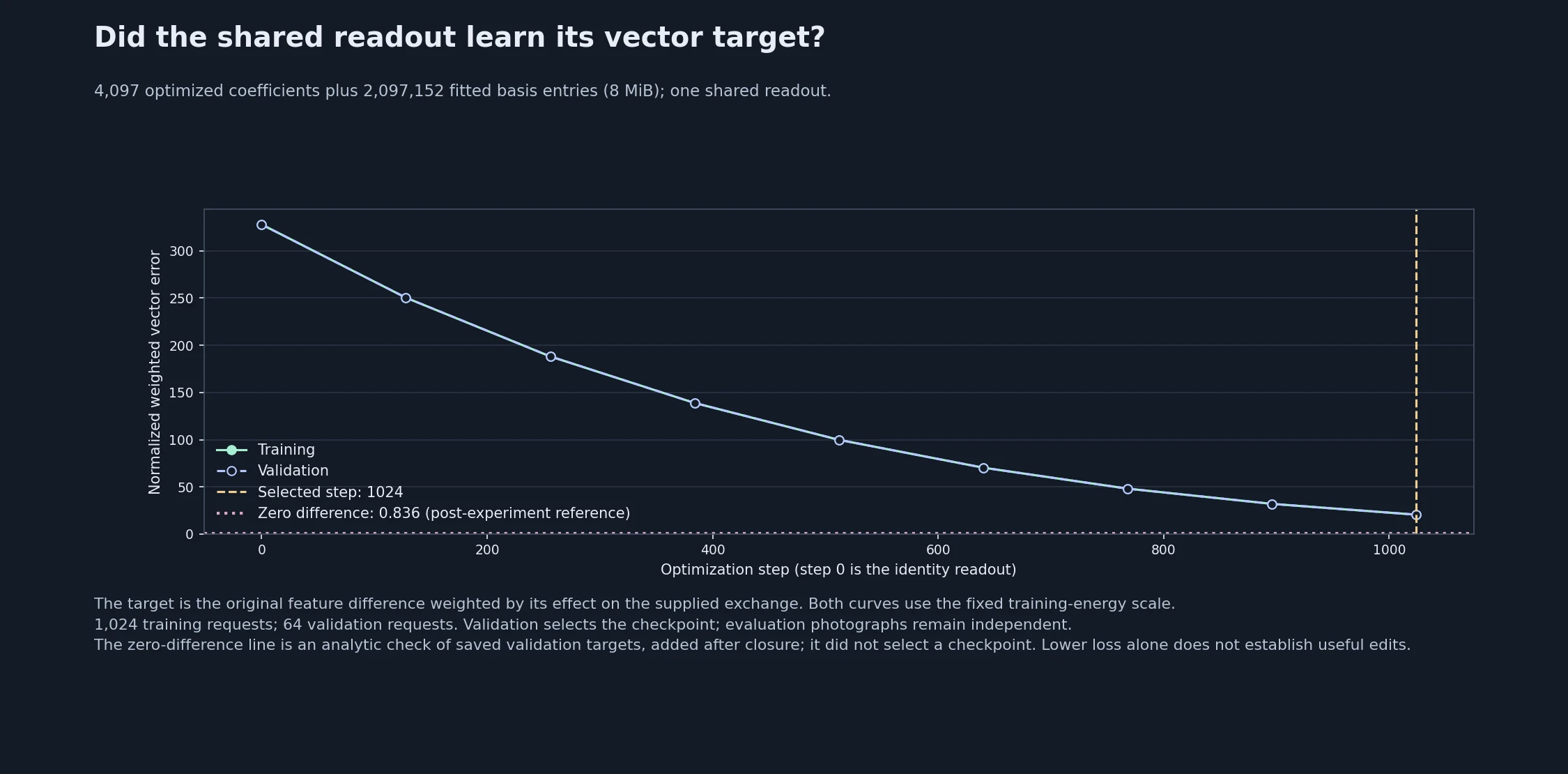
The component optimized 4,097 coefficients and acquired a fixed 8 MiB basis containing 2,097,152 entries. Corrected independent selection, an identity readout, the trained readout and trained inference using another photograph’s memory were compared without access to original features.
Clean selection remained a privileged original-feature control. All errors compare with an exact-feature exchange through the same decoder, defining the represented operation rather than a ground-truth edited photograph.
What happened
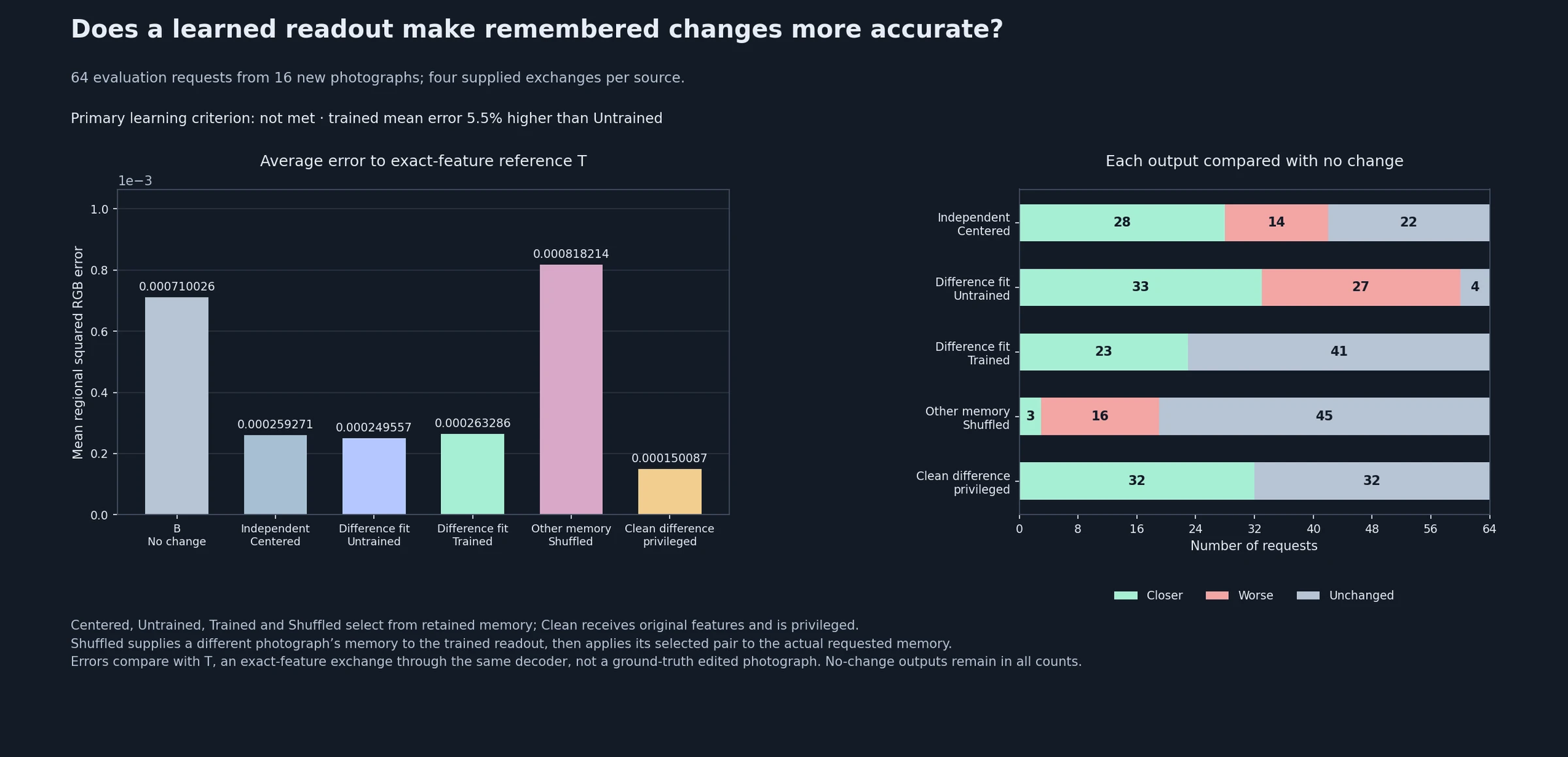
The trained readout improved 23 requests, worsened none and left 41 unchanged, with 23 changes across 12 photographs. Untrained improved 33, worsened 27 and left four unchanged. Post-experiment analysis found that training avoided all 27 untrained losses by making no change, but also lost ten useful changes.
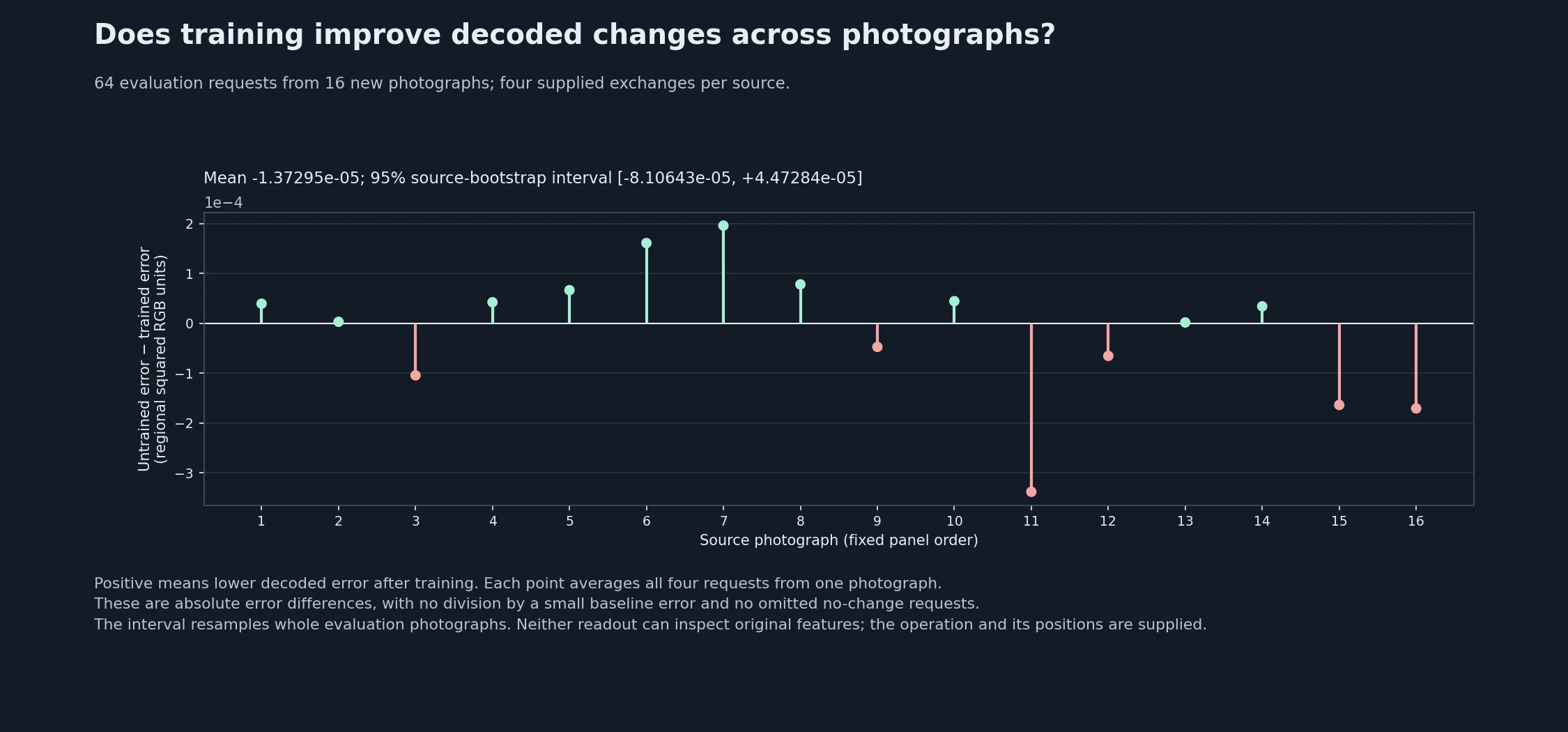
Mean regional squared RGB error was 0.000263286 for Trained: 62.9% below leaving memory unchanged, but 5.5% above Untrained and 1.55% above corrected independent selection. The primary 95% source-bootstrap interval crossed zero. The learning-improvement and bounded-candidate criteria were not met.
The trained readout had no observed regressions against unchanged memory on this panel. Untrained had 25 regional error doublings; corrected independent selection had eight. Matching memory mattered: Trained beat inference using another photograph’s memory. Privileged Clean selection improved 32 requests, worsened none and left 32 unchanged.
Validation vector loss fell from 327.946 to 20.538, but an analytic zero-difference output scores 0.836 on the same saved targets. The budget ended at 1,024 steps while loss was still declining. This post-experiment check identifies unresolved optimization, not a ceiling for the readout architecture. A zero-difference output would make no changes, so vector loss and decoded usefulness remain separate tests.
The global scale learned a value of 0.2495. The residual correction’s output norm was 12.8% of the scaled input’s norm; without a scalar-only control, its contribution to useful pair choices is not isolated. Independent validation checked 1,325 files and recomputed 768 image measurements. State continuity, held work, the bank, codec and pixels outside the edited core were preserved.
Measurements
| Recorded field | Value |
|---|---|
| operations | 64 |
| sources | 16 |
| selected step | 1024 |
Results and visual artifacts
Open a figure for its input, comparison, and result. Click an image to enlarge it.
Learned readout: average error and every request
Display derivative: WebP quality 90; maximum edge 2400 px. Original scientific pixels remain in the source run; do not measure this preview.
Vector learning and checkpoint selection
Display derivative: WebP quality 90; maximum edge 2400 px. Original scientific pixels remain in the source run; do not measure this preview.
Does training help across evaluation photographs?
Display derivative: WebP quality 90; maximum edge 2400 px. Original scientific pixels remain in the source run; do not measure this preview.
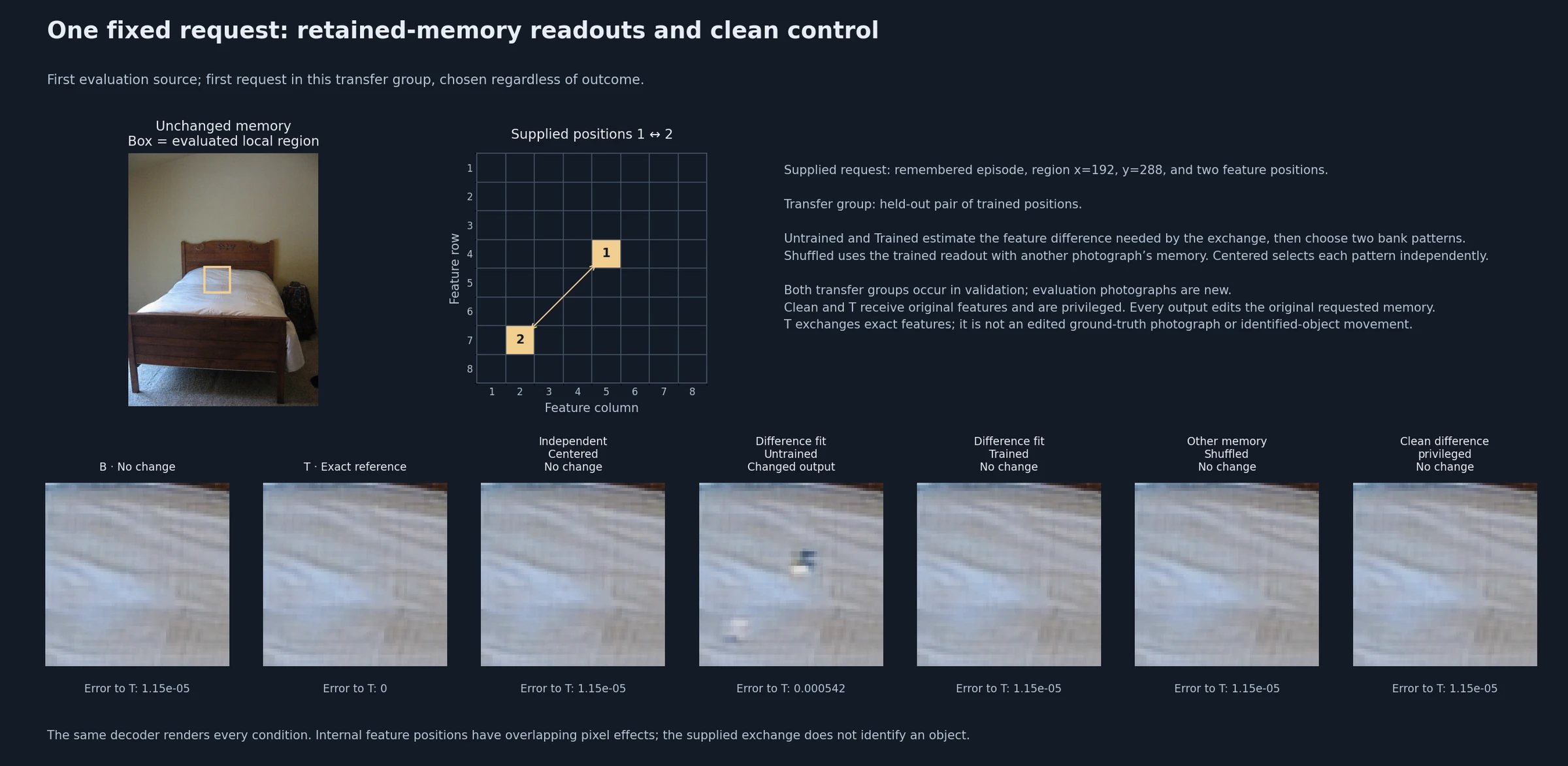
First request: held-out pair of trained positions
Display derivative: WebP quality 90; maximum edge 2400 px. Original scientific pixels remain in the source run; do not measure this preview.
First request: positions excluded from gradient and basis fitting
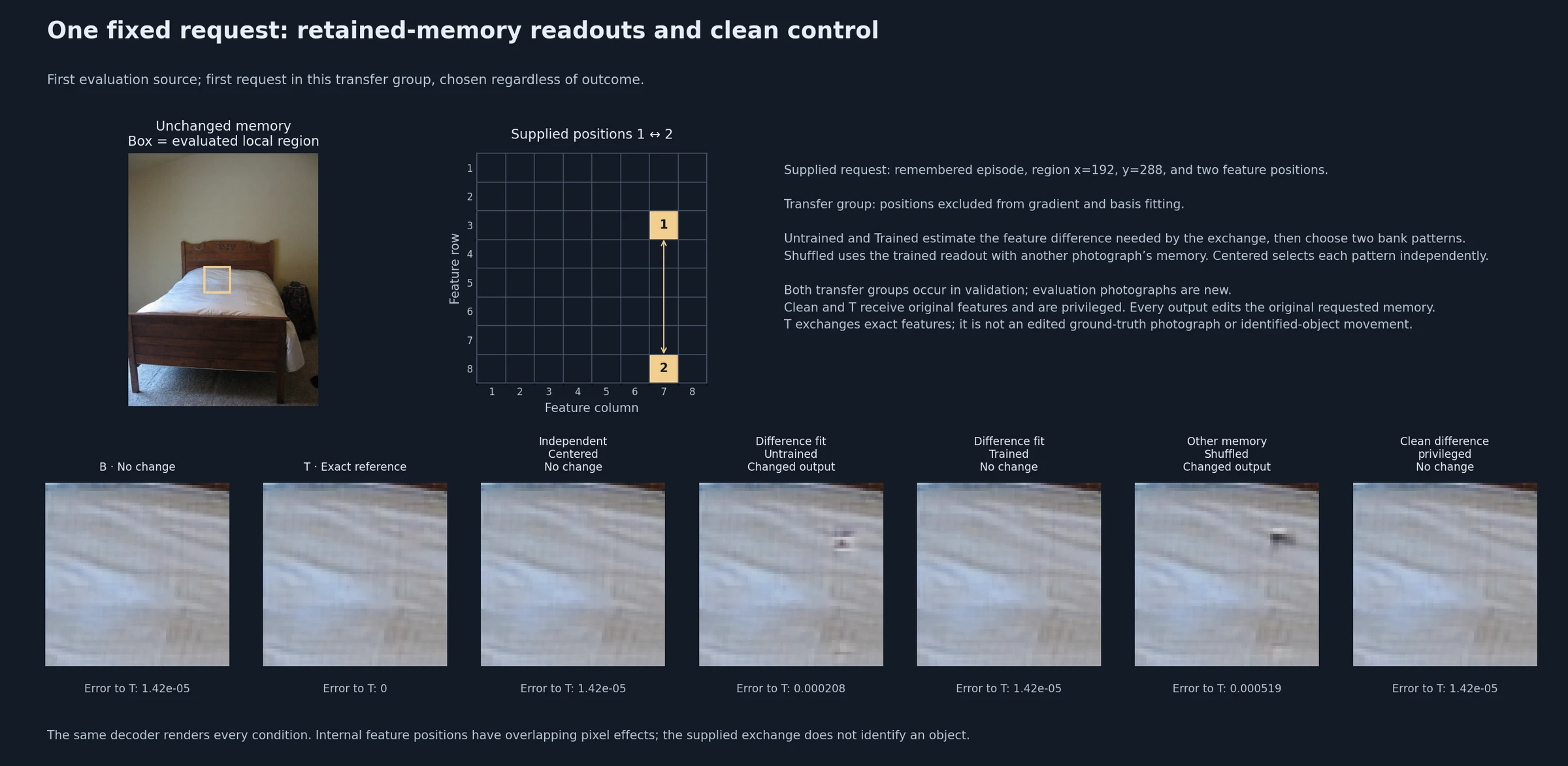
Display derivative: WebP quality 90; maximum edge 2400 px. Original scientific pixels remain in the source run; do not measure this preview.
Every changed output, without selecting by improvement
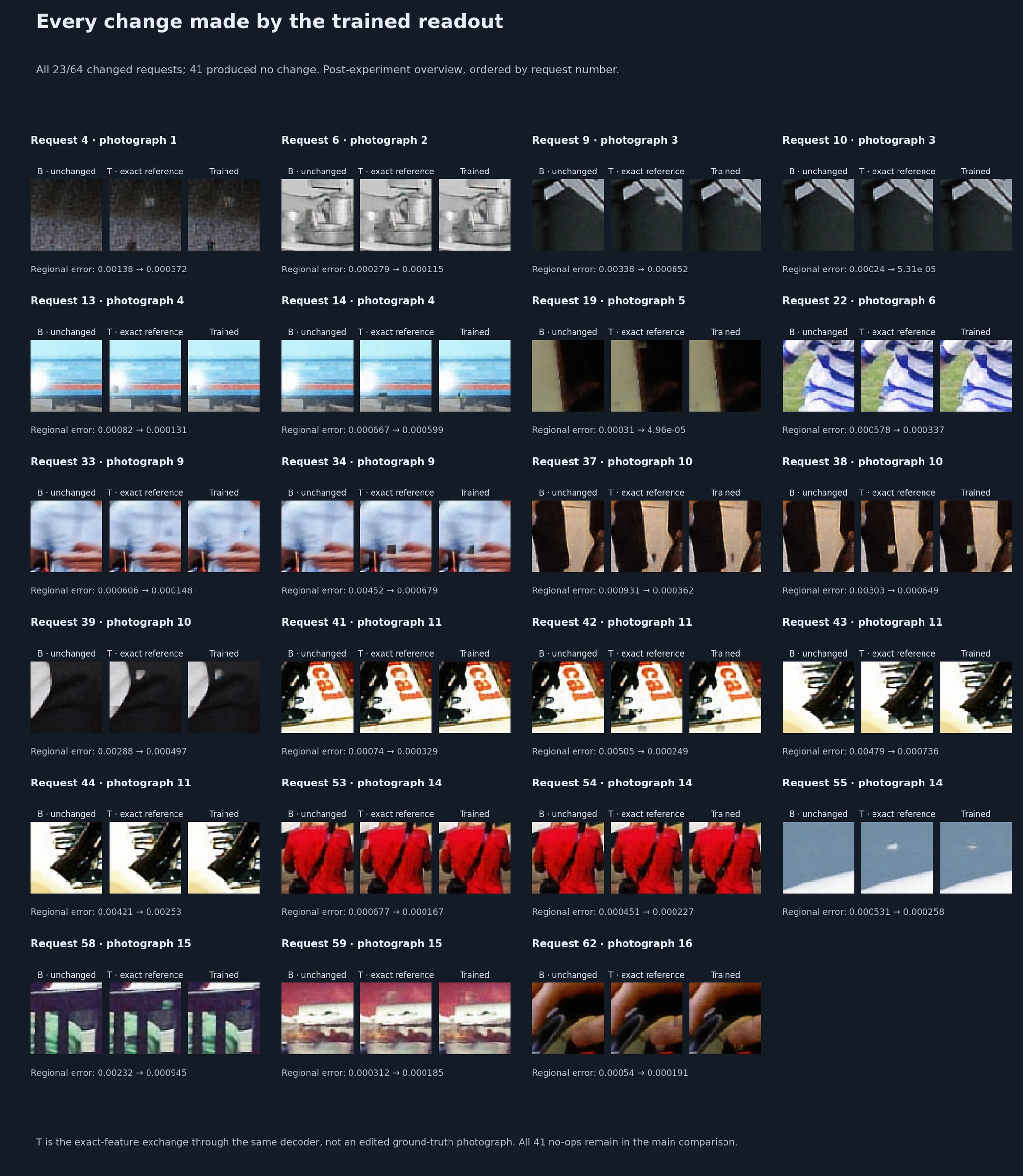
Display derivative: WebP quality 90; maximum edge 2400 px. Original scientific pixels remain in the source run; do not measure this preview.
Limits and next question
No-ops select the same pattern twice; they are not learned confidence judgments. Zero observed losses across these 64 requests does not establish zero risk elsewhere, and the measured tradeoff does not change the failed primary criterion.
The operation and positions were supplied. Withheld position groups appeared in validation tasks and all-position memories, although excluded from gradient and basis fitting. Evaluation photographs were independent; these were not untouched zero-shot position tasks. Clean and the exact-feature reference remain privileged.
The two transfer groups differed: mean error improved 14.6% versus Untrained for withheld pairings of trained positions and worsened 25.4% for positions excluded from gradient and basis fitting. These are descriptive subgroup results, not separate confirmation studies.
Next question. Does simple attenuation explain the conservative behavior, and can convergence-checked readout training recover more useful changes without bringing back the observed harms? No extra training, parameter sweep or automatic integration followed this result.
Inspect the evidence
Download the methods and measurements for this experiment. Large training and saved-state files are not included.