Type a section name and press Enter. Use “help” for the list.
Cliste experiment
Learned correction makes useful changes beyond scalar attenuation
Registered 10 Oct 2026 · Snapshot 12 Oct 2026
The question
Does a learned correction improve the changes made from retained VSA memory, beyond simply reducing the amplitude of its input? Can the same architecture work better when its fixed fitting objective reaches numerical convergence?
Why this experiment?
A learned readout may help simply by shrinking its input. Removing or fitting that part separately tests whether learned correction contributes anything further.
How it works
Compare the earlier checkpoint, its scalar-only form, a fitted scalar and a converged scalar-plus-correction fit. Each uses the same data, codec, pattern bank and operation.
Follow this part of the investigation: Separate attenuation from learned correction →Implementation and comparison details
Four locked readouts share the same encoder, decoder, 512-pattern bank and acquired rank-64 basis: the previous checkpoint; its scalar alone; an analytically fitted scalar; and a fully fitted scalar plus correction. The new fit reuses the saved 1,024 training and 64 validation requests, solves the fixed linear least-squares problem directly, and does not select an endpoint using validation.
Sixteen new photographs entered the continuing memory only after the four checkpoints were locked. Their 64 supplied exchanges identify an image, a region and two feature positions. The operative worker receives retained vectors and structural requests, with source images and clean feature targets unavailable. A separate Clean selector and exact-feature reference receive privileged original features.
What happened
The fully fitted readout improved 32 requests, worsened one and left 31 unchanged. Mean regional squared RGB error was 0.000227488: 75.4% below fitted scalar attenuation and descriptively 19.0% below the previous readout. Fitted scalar attenuation made no changes. The registered primary correction comparison had a positive whole-photograph bootstrap interval.
The earlier correction mattered too. Removing it while keeping its scalar reduced useful exchanges from 26 to seven. The previous readout beat its scalar alone on 24 requests, lost on none and tied on 40; the source-bootstrap interval supported the difference. Small correction amplitude had not established a small contribution to discrete pattern selection.
All 26 previously useful exchanges remained useful, and six additional requests improved. The full fit changed 33 requests across 15 photographs. The privileged Clean selector improved 38, worsened none and left 26 unchanged, with mean error 0.000211005.
The one regression increased regional RGB error by 18.4%; its edge error improved by 11.1%, and no request doubled RGB error. It failed the predefined no-increase-in-excess-harm rule relative to the previous readout’s zero observed regressions. The primary correction advantage passed; the complete bounded-use criterion did not. The recorded rule and verdict remain unchanged.
The full fit passed the numerical convergence checks. Validation vector loss reached 0.2304, versus 20.5379 for the previous checkpoint, 0.8316 for fitted scalar attenuation and 0.8363 for zero output. Independent validation checked 1,162 files and recomputed all 768 pixel and edge measurements. The research life grew from 271 to 287 encounters while preserving original memories, the codec and held work.
Measurements
| Recorded field | Value |
|---|---|
| operations | 64 |
| sources | 16 |
| convergence certified | Pass |
Results and visual artifacts
Open a figure for its input, comparison, and result. Click an image to enlarge it.
Scalar attenuation and correction: average error and every request
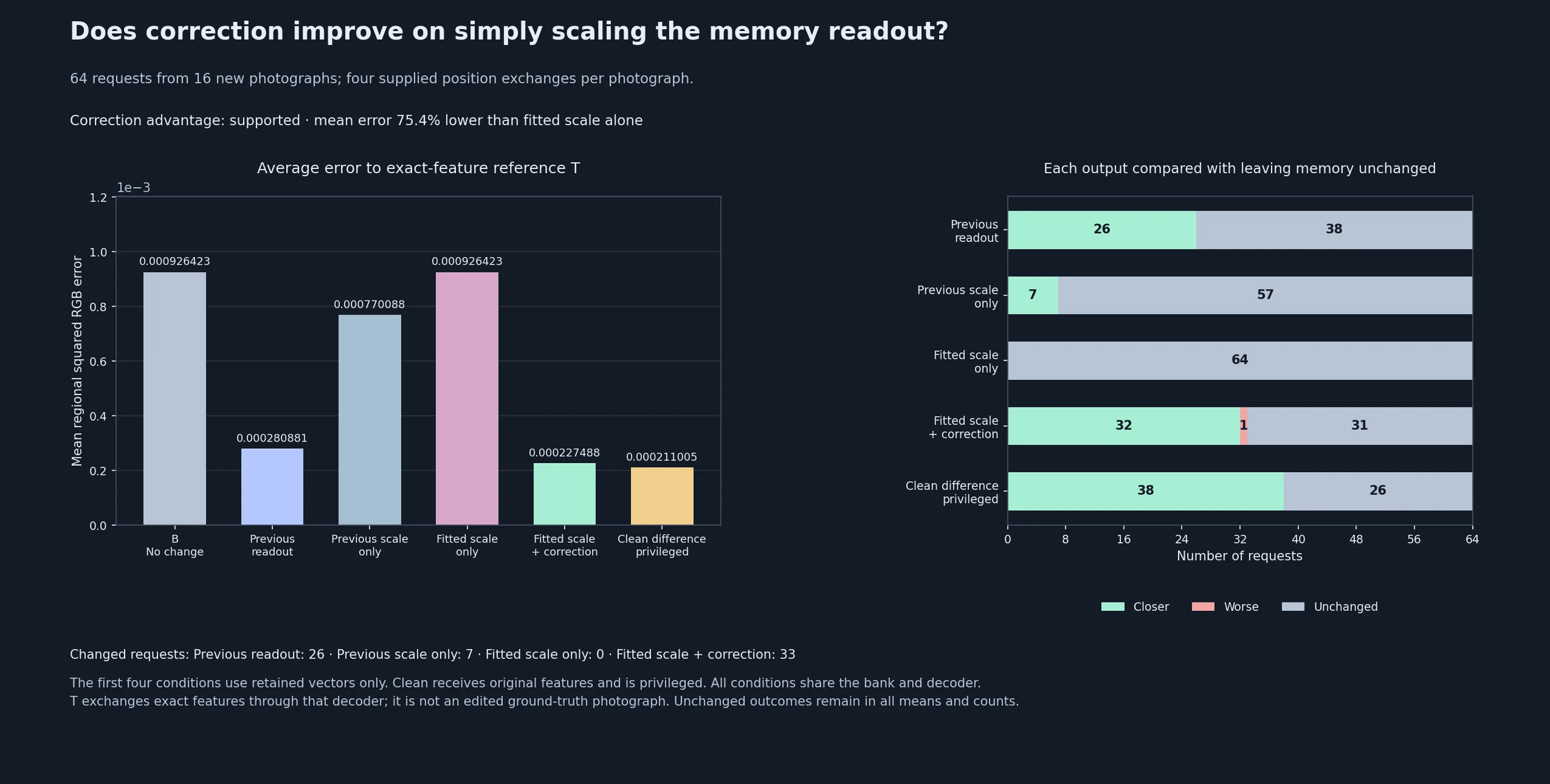
Display derivative: WebP quality 90; maximum edge 2400 px. Original scientific pixels remain in the source run; do not measure this preview.
Vector fitting with the basis and objective held fixed
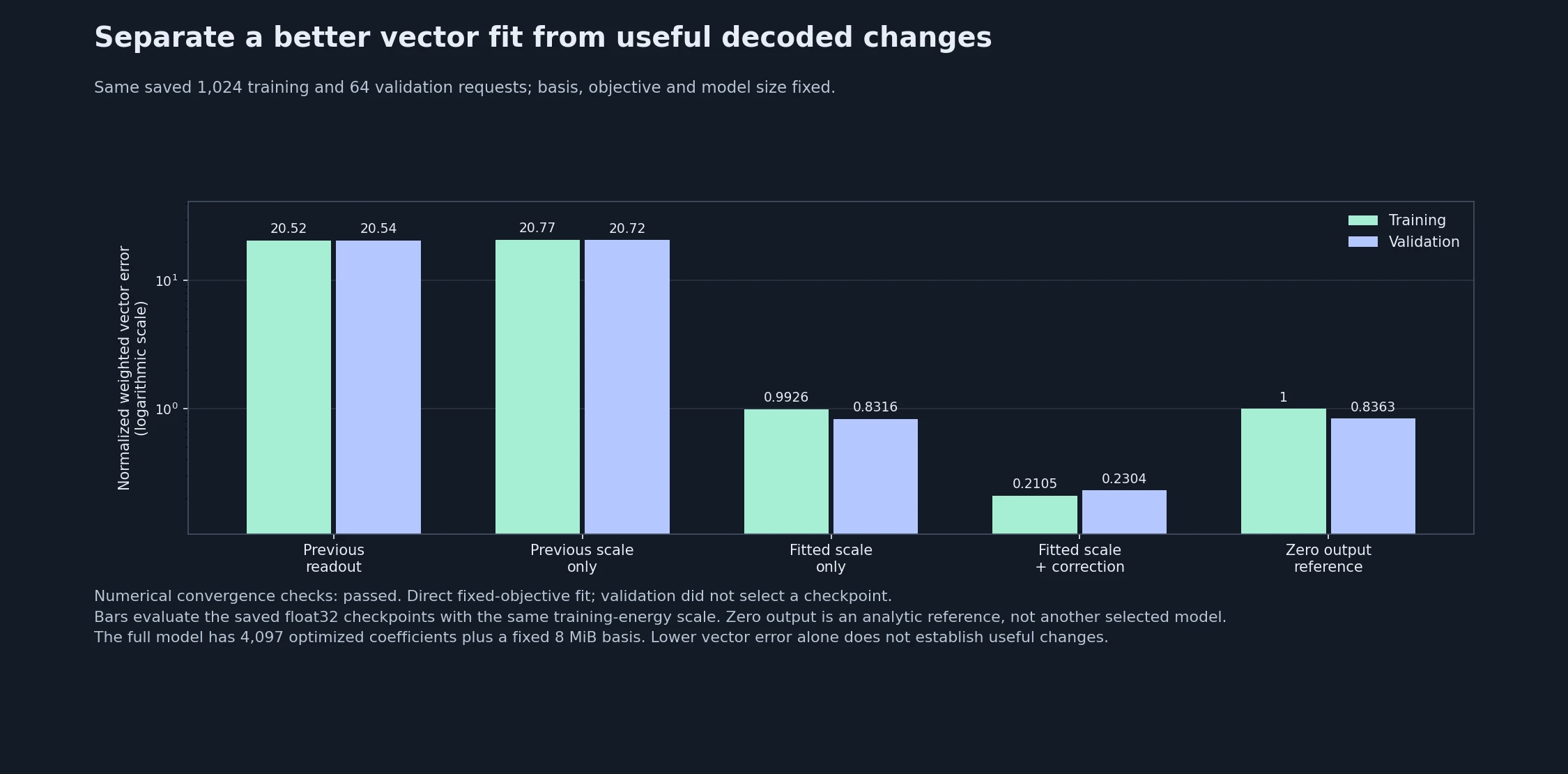
Display derivative: WebP quality 90; maximum edge 2400 px. Original scientific pixels remain in the source run; do not measure this preview.
Correction beyond scalar attenuation, photograph by photograph
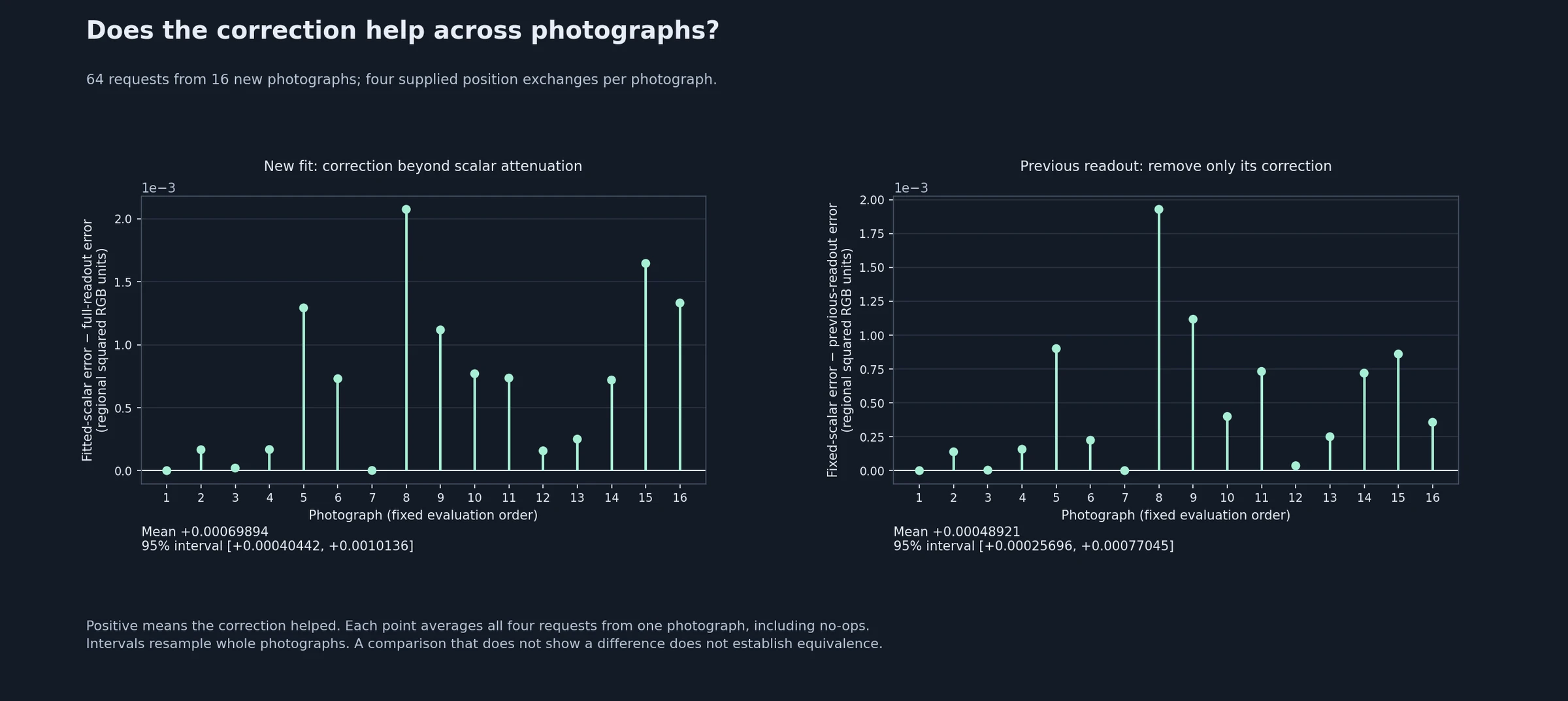
Display derivative: WebP quality 90; maximum edge 2400 px. Original scientific pixels remain in the source run; do not measure this preview.
First request: withheld pairing of training positions
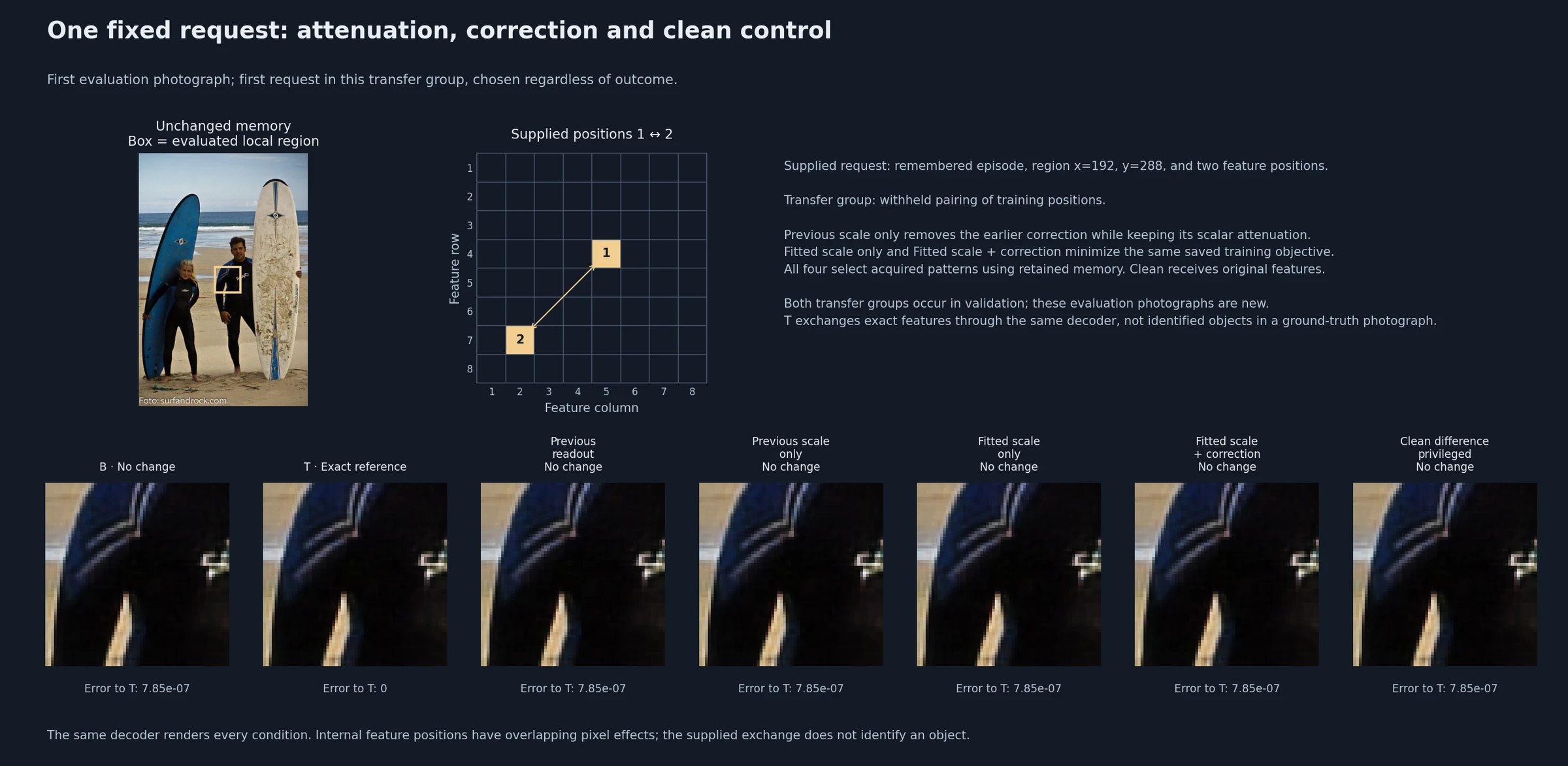
Display derivative: WebP quality 90; maximum edge 2400 px. Original scientific pixels remain in the source run; do not measure this preview.
First request: positions excluded from readout and basis fitting
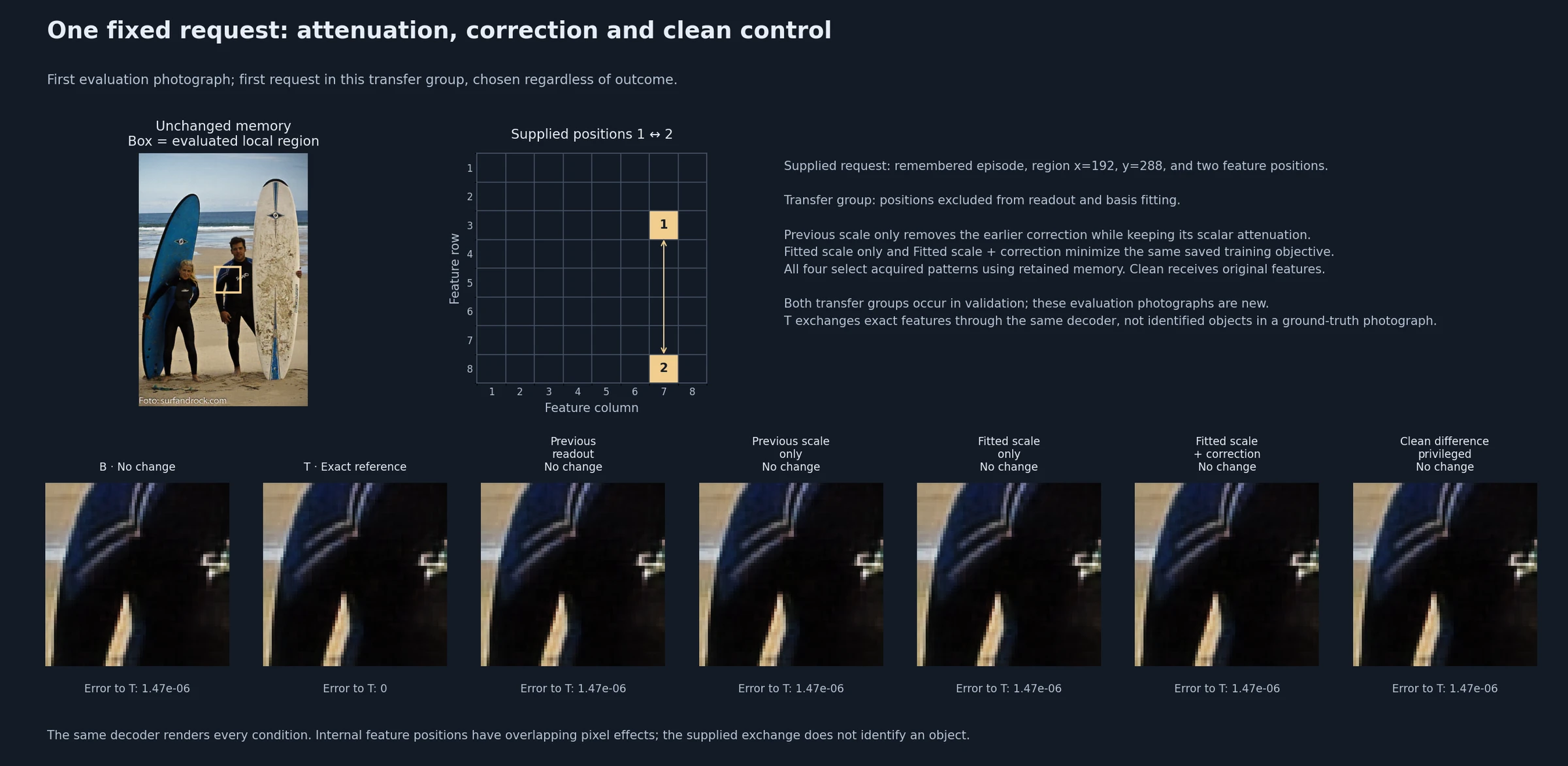
Display derivative: WebP quality 90; maximum edge 2400 px. Original scientific pixels remain in the source run; do not measure this preview.
Every changed request: page 1 of 5
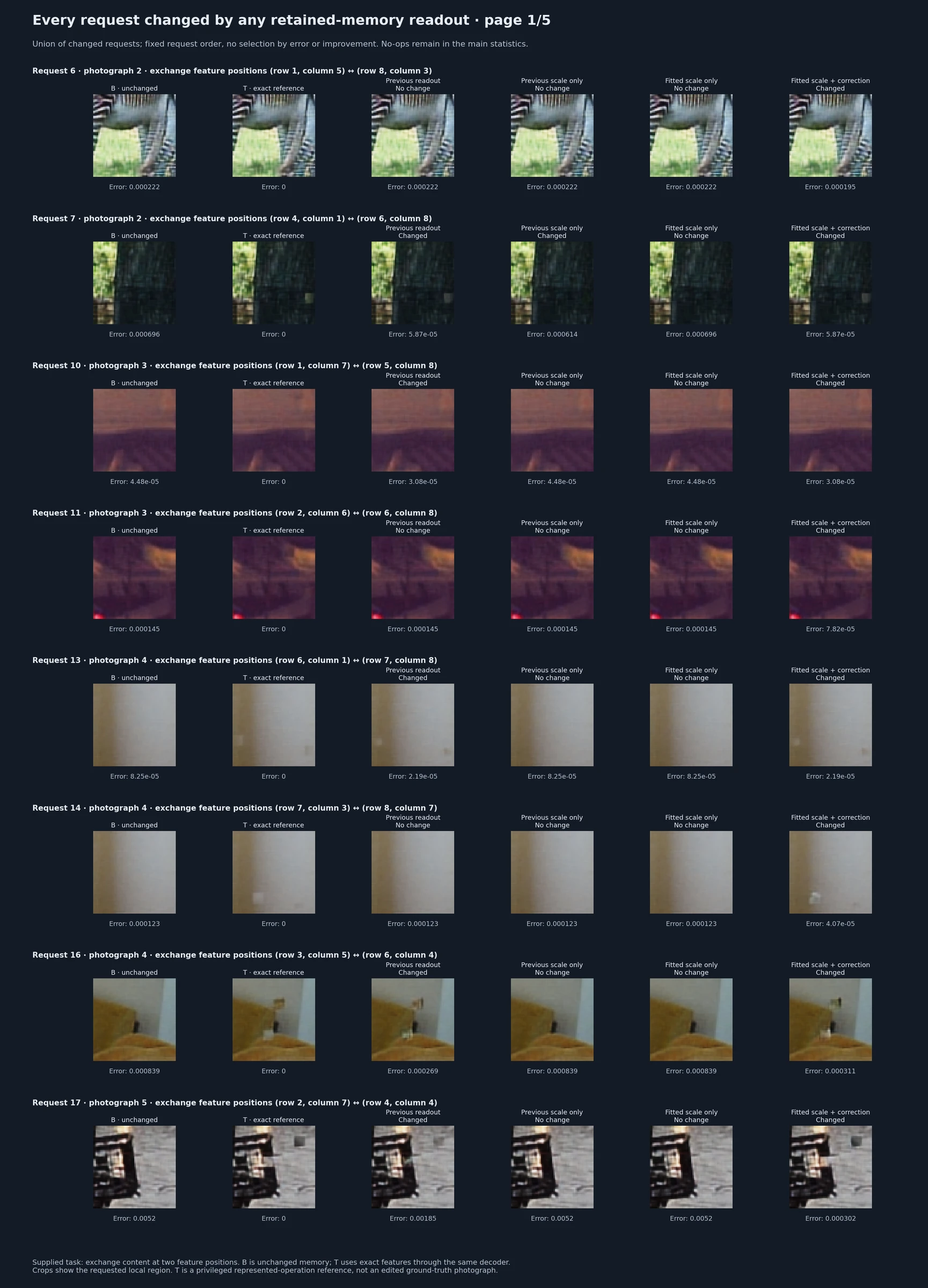
Display derivative: WebP quality 90; maximum edge 2400 px. Original scientific pixels remain in the source run; do not measure this preview.
Every changed request: page 2 of 5
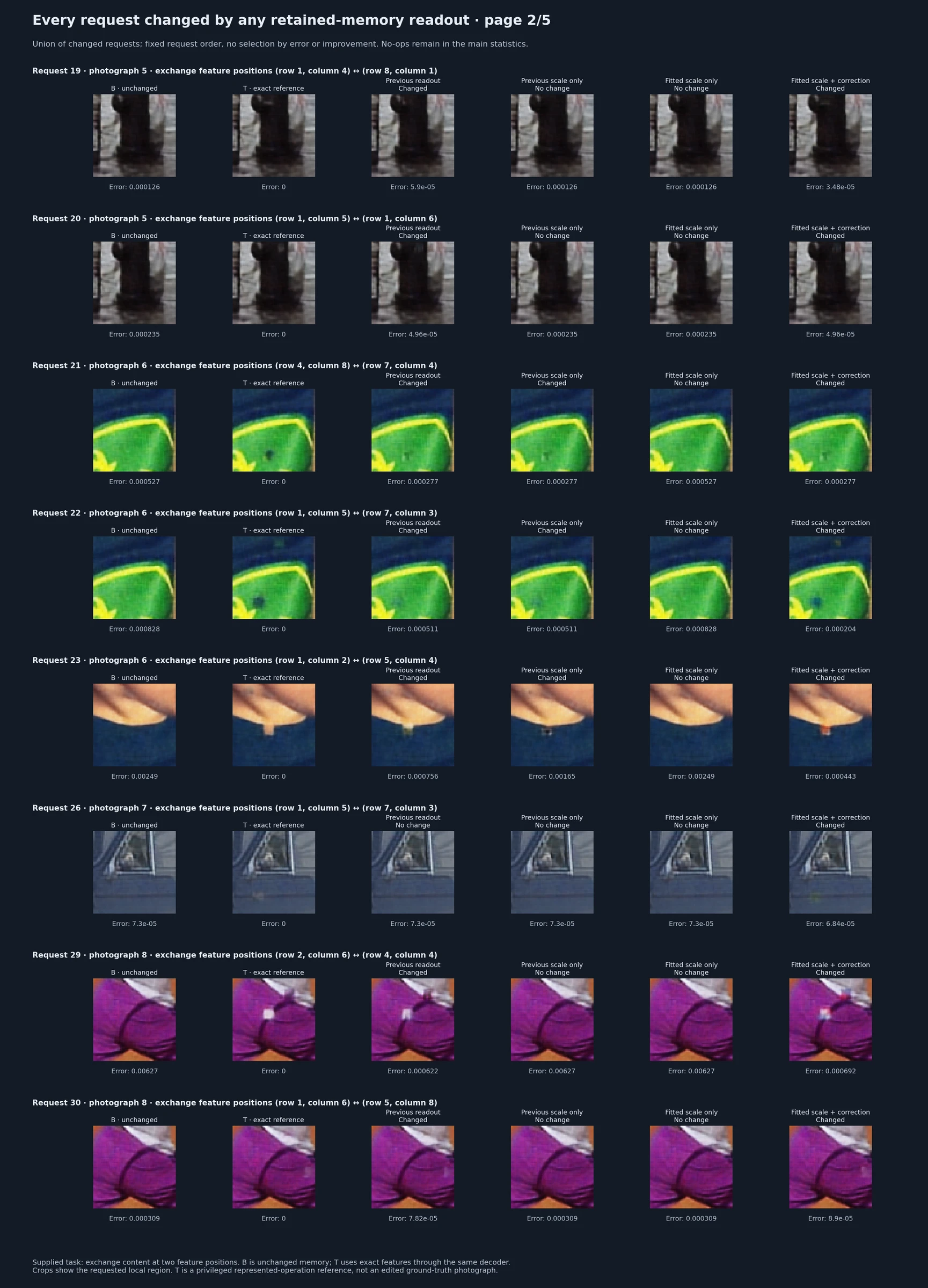
Display derivative: WebP quality 90; maximum edge 2400 px. Original scientific pixels remain in the source run; do not measure this preview.
Every changed request: page 3 of 5
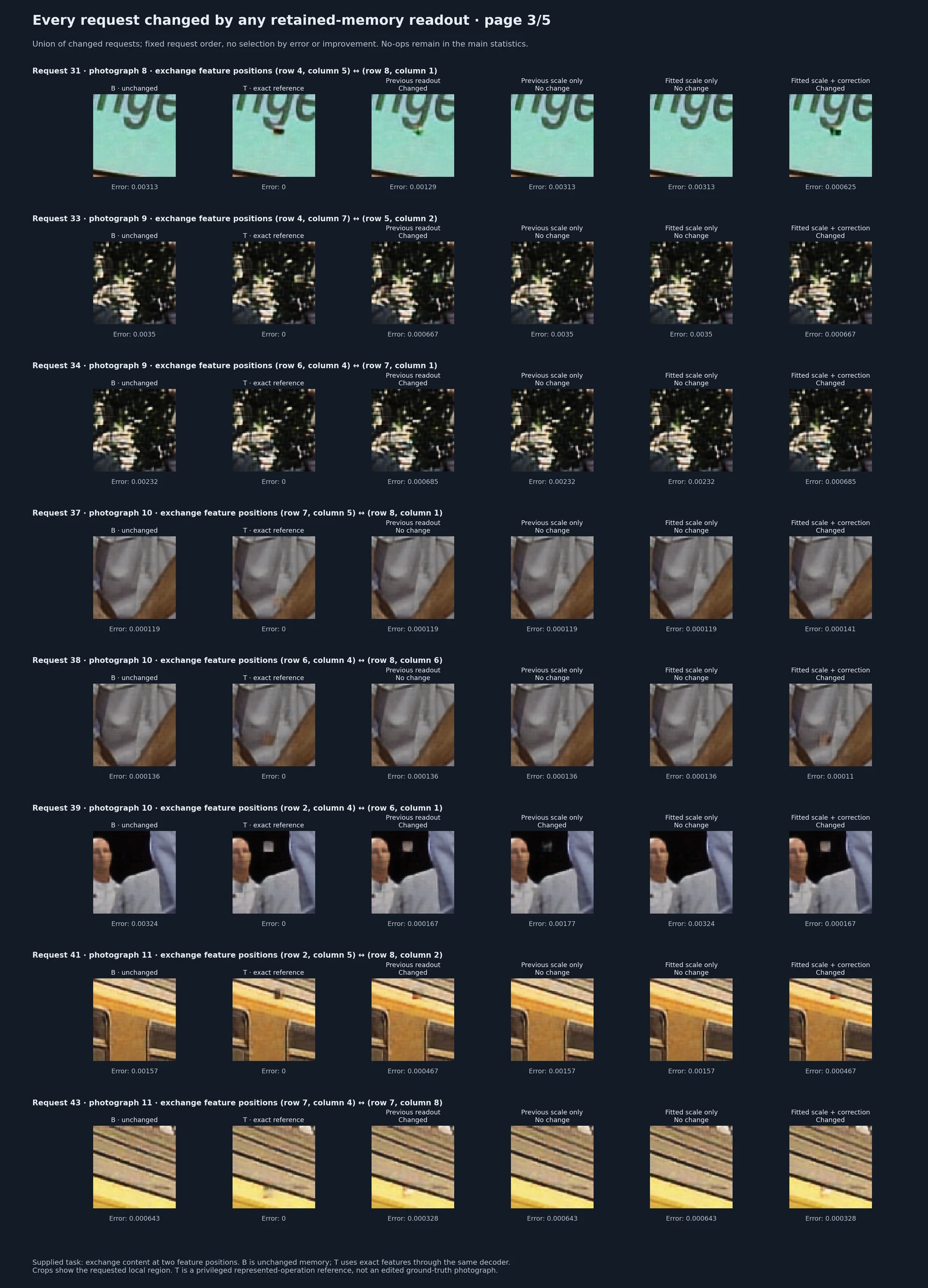
Display derivative: WebP quality 90; maximum edge 2400 px. Original scientific pixels remain in the source run; do not measure this preview.
Every changed request: page 4 of 5
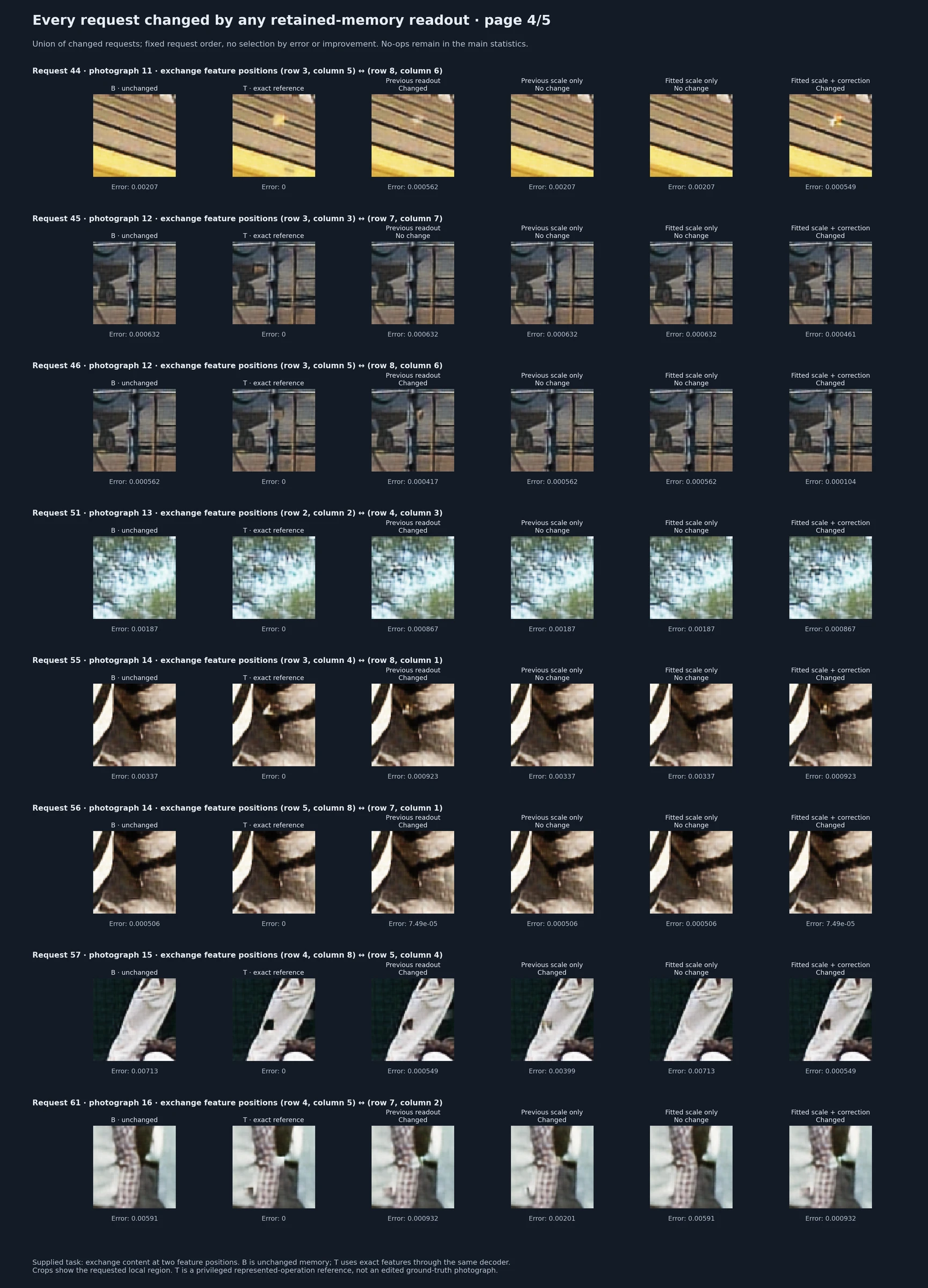
Display derivative: WebP quality 90; maximum edge 2400 px. Original scientific pixels remain in the source run; do not measure this preview.
Every changed request: page 5 of 5
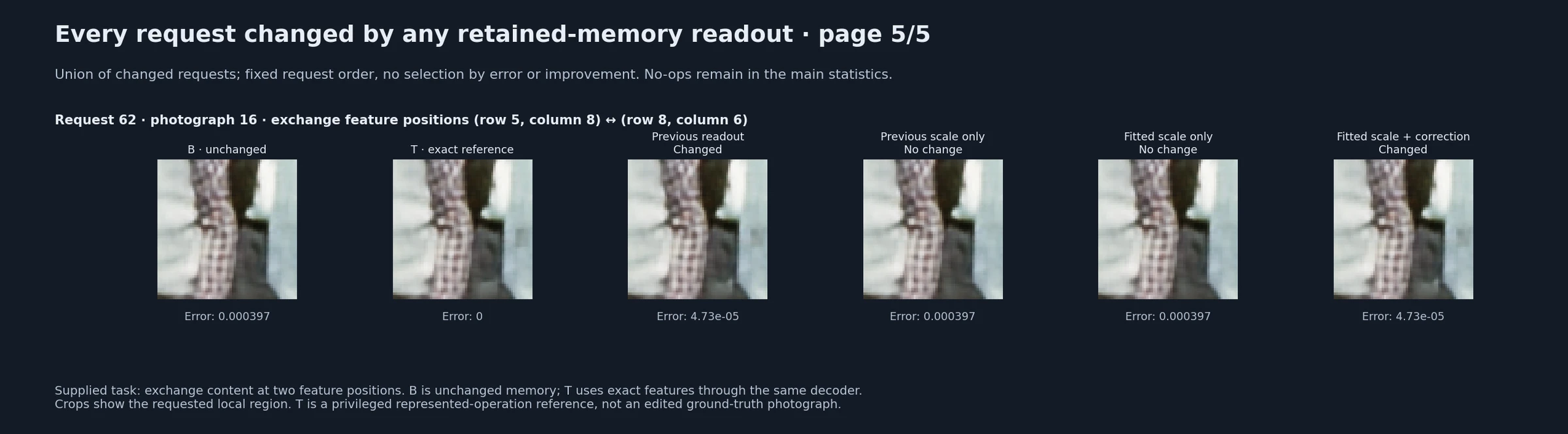
Display derivative: WebP quality 90; maximum edge 2400 px. Original scientific pixels remain in the source run; do not measure this preview.
Limits and next question
The image, local region and feature positions are supplied. The exact-feature reference defines an operation through the same decoder, not an edited ground-truth photograph, autonomous action or movement of an identified object. The Clean selector remains privileged.
Four requests share each photograph. The position groups appeared in prior validation; independently new evidence comes from the evaluation photographs. The readout retains 4,097 optimized coefficients plus the fixed 8 MiB basis with 2,097,152 entries.
Thirty-one full-readout requests made no change by selecting the same bank pattern twice; this is not learned confidence. Lower vector error alone is not sufficient for useful composition. No automatic promotion or additional component-optimization sweep followed this comparison.
Next question. Can the learned exchange support a bounded, reversible working-memory sequence: hold a change through incoming experience, perform another operation, and preserve the original memories exactly? Set downstream tolerances prospectively and test fresh inputs.
Inspect the evidence
Download the methods and measurements for this experiment. Large training and saved-state files are not included.