Type a section name and press Enter. Use “help” for the list.
Cliste experiment
Can edited working content support another operation after new experience?
Registered 10 Oct 2026 · Snapshot 12 Oct 2026
The question
Use the frozen learned readout for two overlapping exchanges, holding the first change through fresh incoming photographs and a restart while preserving original memories.
Why this experiment?
A useful construction must remain usable after it changes. The second operation should depend on the edited state, including after new experience and a restart.
How it works
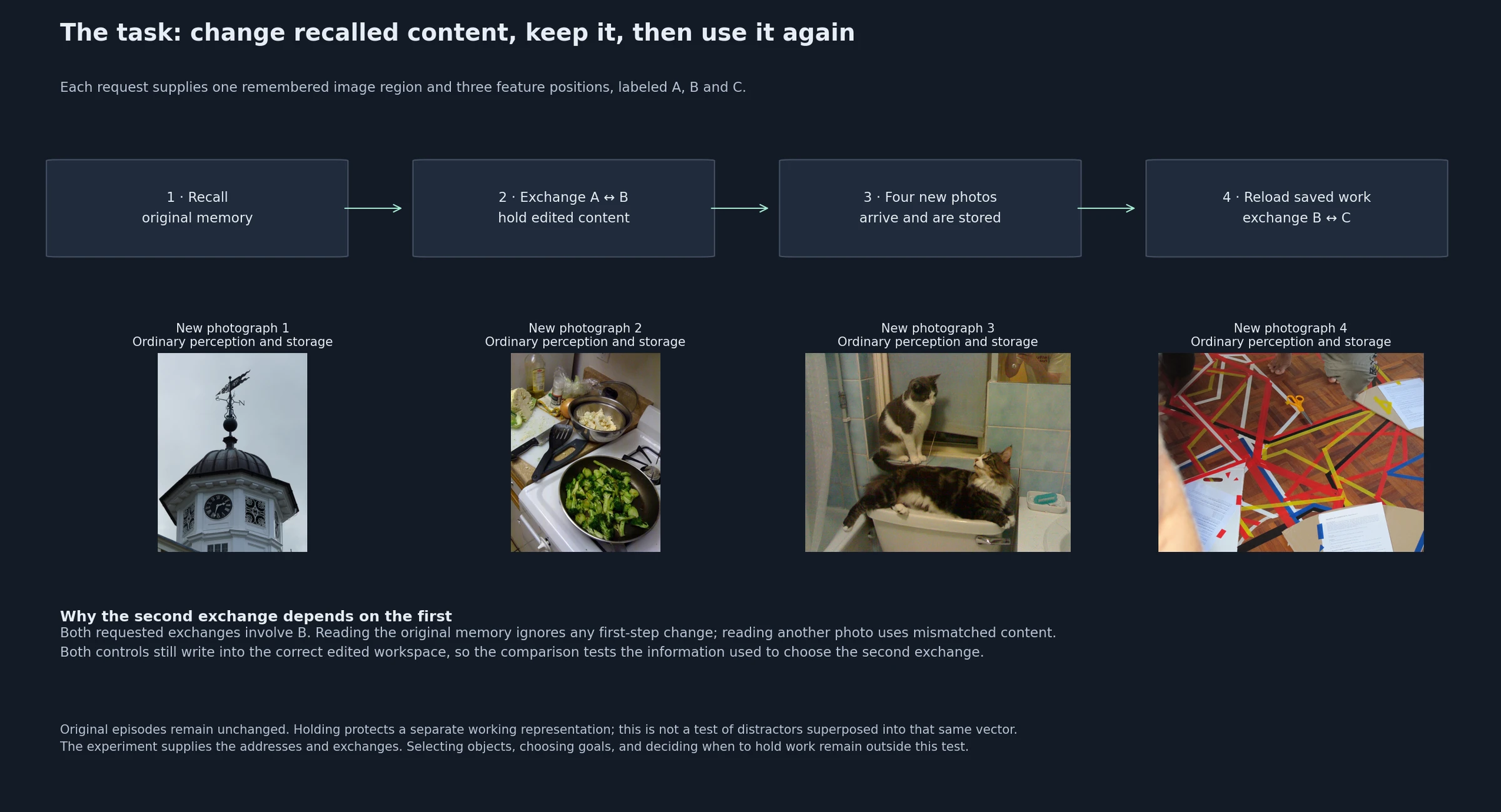
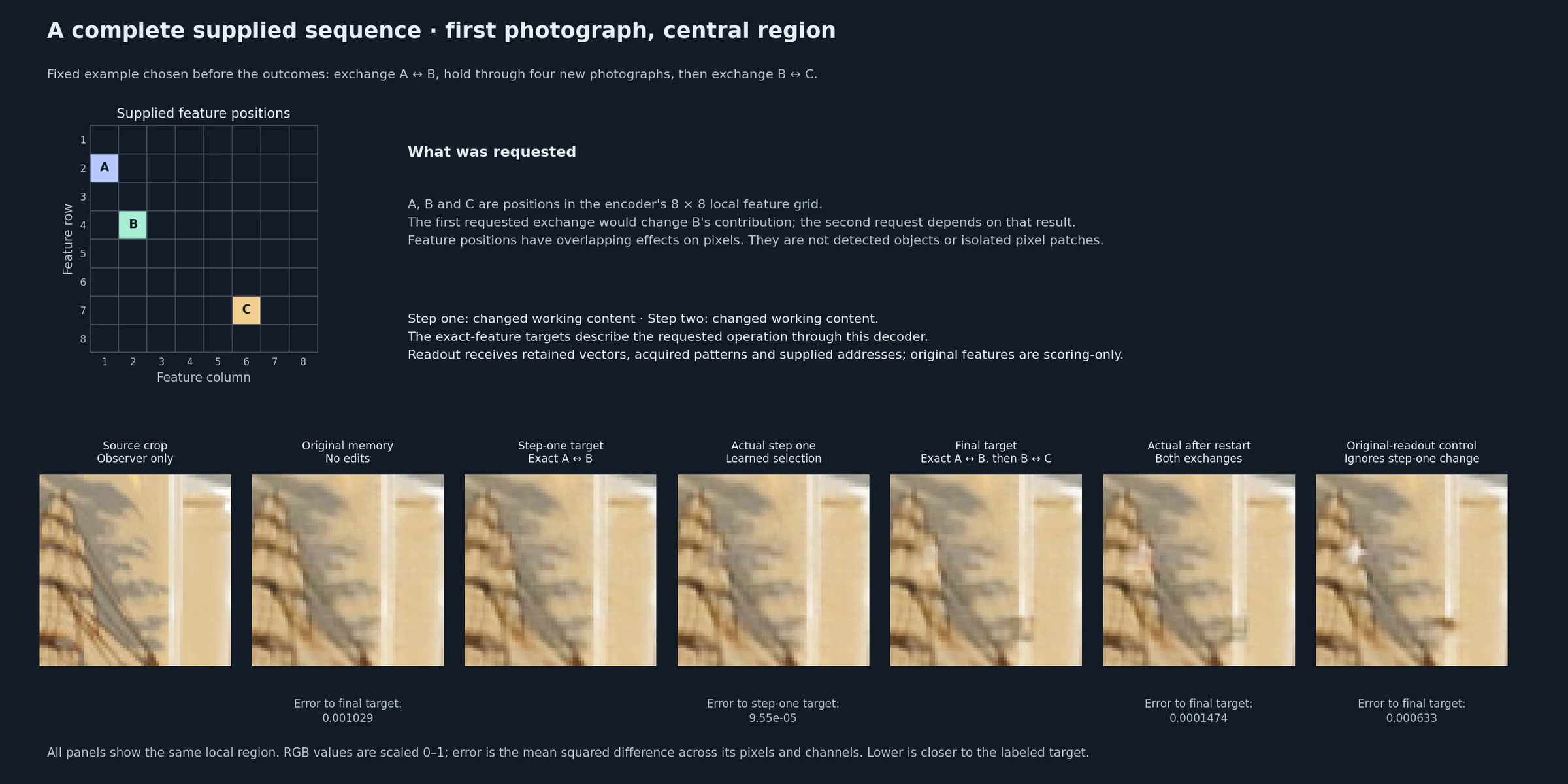
Exchange positions A and B, hold the result while four more photographs arrive, save and reload it, then exchange B and C. Compare reading the updated state with reading the original or another photograph, and verify exact undo.
Follow this part of the investigation: Use changed working content after new experience →Implementation and comparison details
Carry a first learned exchange through held native intake, persist actual edited work, then compare a second operation with stale and shuffled-content controls.
What happened
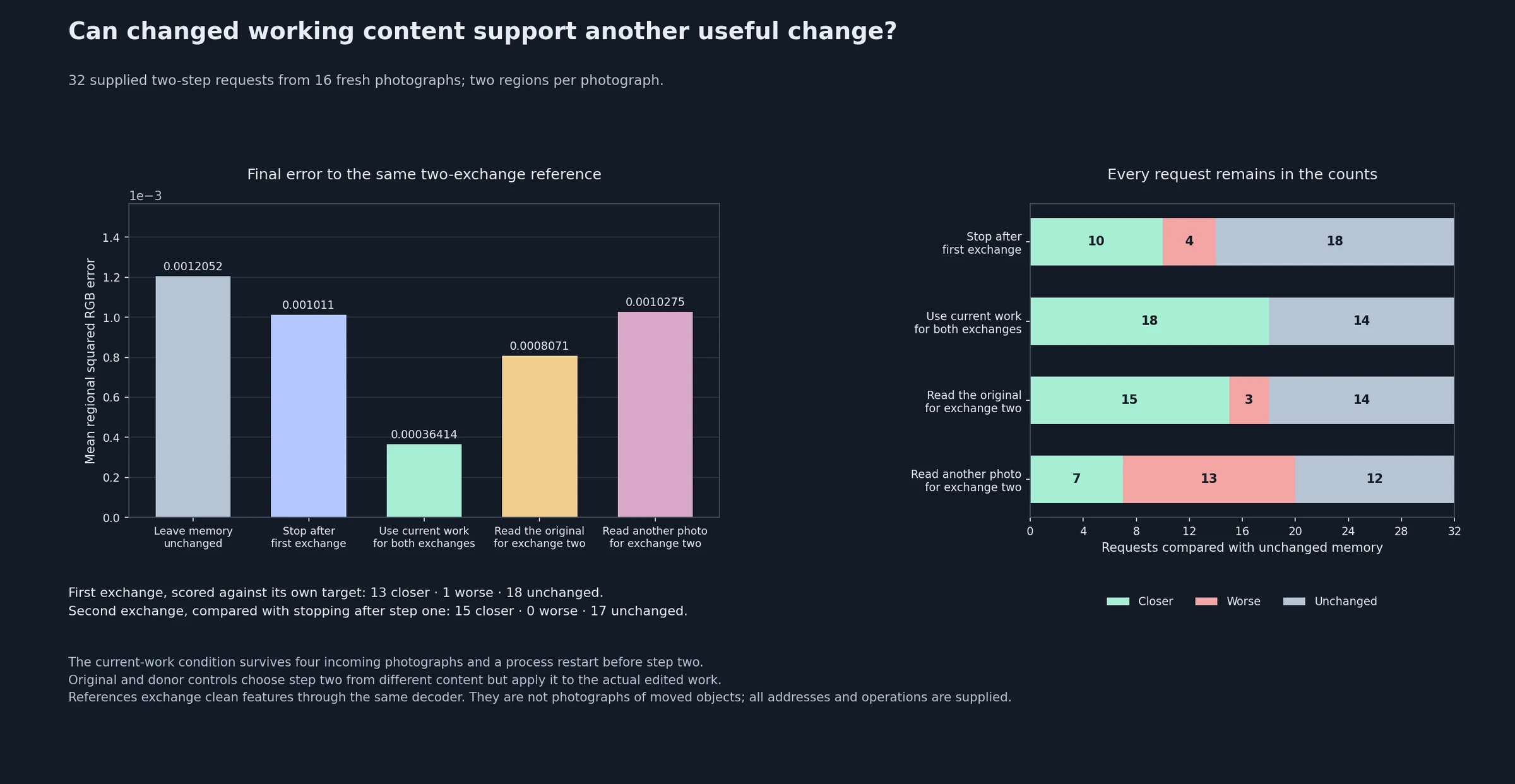
Held edited content supported useful second operations after new experience and restart under the prospective provisional tolerances. Supplied requests, errors and the experimental persistence boundary remain explicit.
Measurements
| Recorded field | Value |
|---|---|
| operations | 32 |
| sources | 16 |
Results and visual artifacts
Open a figure for its input, comparison, and result. Click an image to enlarge it.
This public record includes 4 of 13 saved figures: summary comparisons and fixed examples, including every figure referenced by the guide. Reported aggregates include every case; individual records and complete outputs remain in the research archive.
The complete task and its four intervening photographs
Display derivative: WebP quality 90; maximum edge 2400 px. Original scientific pixels remain in the source run; do not measure this preview.
Useful work after two exchanges: mean error and every request
Display derivative: WebP quality 90; maximum edge 2400 px. Original scientific pixels remain in the source run; do not measure this preview.
First photograph: central region, both requested exchanges
Display derivative: WebP quality 90; maximum edge 2400 px. Original scientific pixels remain in the source run; do not measure this preview.
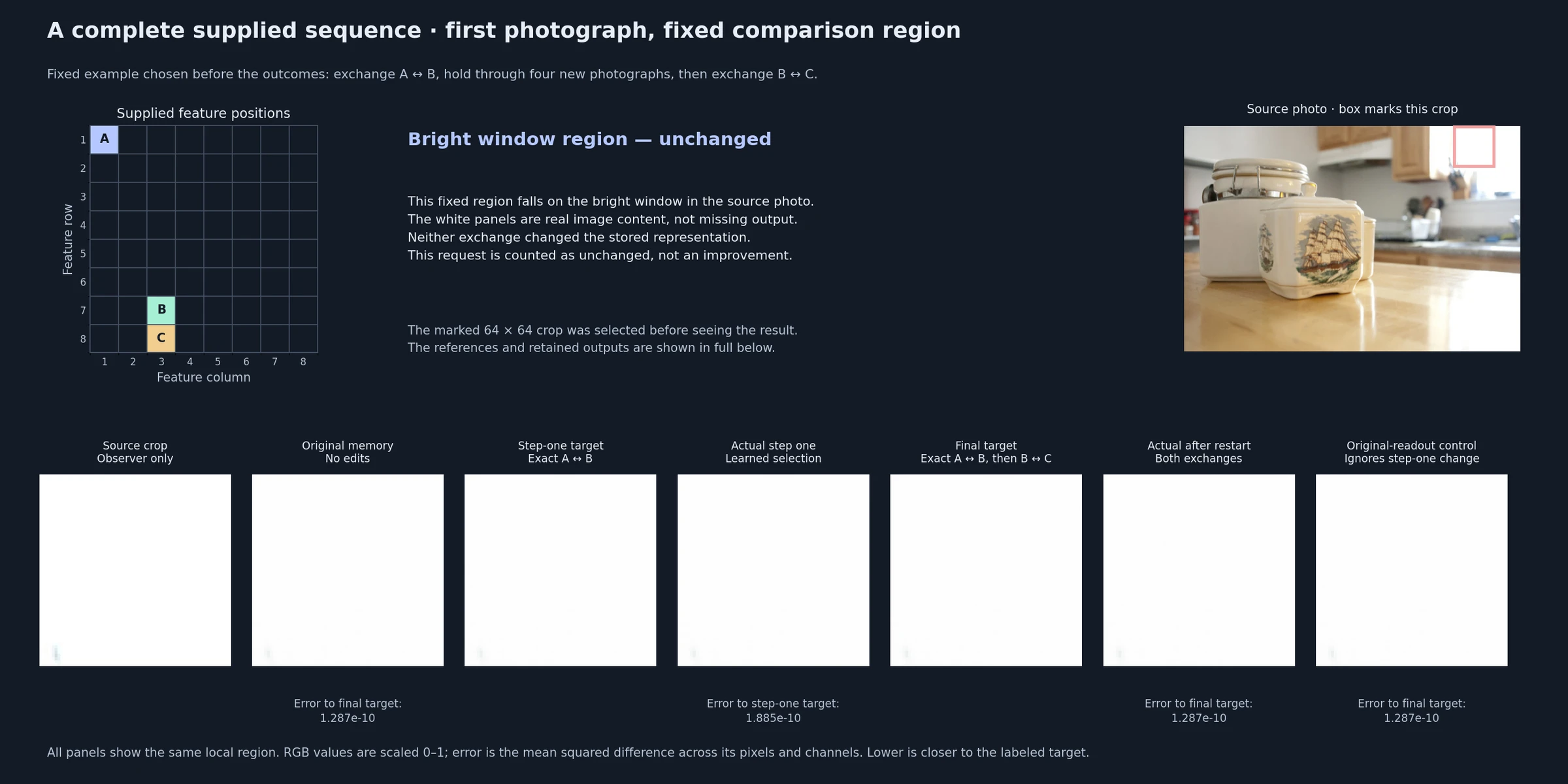
Bright window region — unchanged
Display derivative: WebP quality 90; maximum edge 2400 px. Original scientific pixels remain in the source run; do not measure this preview.
Limits and next question
32 supplied feature-exchange sequences from 16 fresh photographs, four shared incoming photographs, one frozen codec/readout/bank. Protected working storage is not neural distraction resistance. Edited-work persistence is experimental; no default-runtime promotion or learned task selection.
Next question. Use measured cumulative utility, marginal second-operation effects and visible errors to choose the next bounded downstream task or a targeted optimization round.
Inspect the evidence
Download the methods and measurements for this experiment. Large training and saved-state files are not included.