run record~/research/cliste/runsAll Cliste runs

Type a section name and press Enter. Use “help” for the list.

Figures: softened for dark viewingDisplay only; image files are unchanged.
← All Cliste runs

Cliste experiment

Encoder refinement with a fixed decoder

Execution: completedScientific verdict: material improvement

The question

Improve immediate perceptual reconstruction by refining only the encoder through the fixed VSA representation and decoder.

Why this experiment?

A memory can only preserve what its sensory interface encodes. These studies separate encoder quality, decoder quality and compatibility with earlier stored vectors.

How it works

Change one component or input representation at a time and evaluate immediate reconstruction on separate images. Keep old-vector readback visible so gains on new inputs do not hide compatibility losses.

Follow this part of the investigation: Sharper perception can also change the language of memory →
Implementation and comparison details

Only encoder feature extraction and vector projection parameters learn. Decoder, position codes, normalization statistics, VSA operations and input resolution stay fixed; original and zero-rate controls are retained.

What happened

Encoder-only training reduced immediate reconstruction MSE by 47.64% on 1,024 final COCO photographs (95% interval 46.90–48.38%), 45.38% on 1,000 Flickr photographs and 57.50% on the prior 72 inputs. Three seeds agree; all 15 integrity checks pass. All decoder, place-code and normalization-state tensors remain exact. Fine detail remains blurred, and new vectors drift substantially relative to old memory vectors.

Encoder-only refinement: material_improvement; primary relative MSE gain 47.64%, 95% interval [46.90%, 48.38%].

Measurements
Measurements — values preserved from this run
Recorded fieldValue
primary relative gain0.47641889413283456
primary ci95
[
  0.46895234855616774,
  0.48381665774578303
]
external relative gain0.453782666988756
checks passed15
checks total15
training seeds3
display armseed-29
Recorded checks
Recorded checks — values preserved from this run
Recorded fieldValue
registered files unchangedPass
optimization controlsPass
previous lives and evidence unchangedPass
baseline fixed tensors exactPass
baseline all finitePass
baseline production reload equivalentPass
seed-17 fixed tensors exactPass
seed-17 all finitePass
seed-17 production reload equivalentPass
seed-29 fixed tensors exactPass
seed-29 all finitePass
seed-29 production reload equivalentPass
seed-43 fixed tensors exactPass
seed-43 all finitePass
seed-43 production reload equivalentPass

Results and visual artifacts

Open a figure for its input, comparison, and result. Click an image to enlarge it.

The encoder converts pixels into a VSA vector; the decoder turns that vector back into pixels. Only the encoder is trained in this experiment. The model receives a 64 × 64 RGB image; photographs are center-cropped and resized before encoding. Enlargement here adds no detail. Development examples help select a model; final test examples assess that selected model. Training-control examples deliberately test whether fitting works. Replay examples are earlier images encoded again, not reconstructions from untouched old memory vectors. Error panels show four times the absolute RGB difference from the reference, separately for each color channel, clipped at full brightness. Darker pixels mean smaller errors; black is zero or below the display’s precision. The scale is fixed across examples, not adjusted to make each image look better.

COCO test photographs: effect of encoder refinement
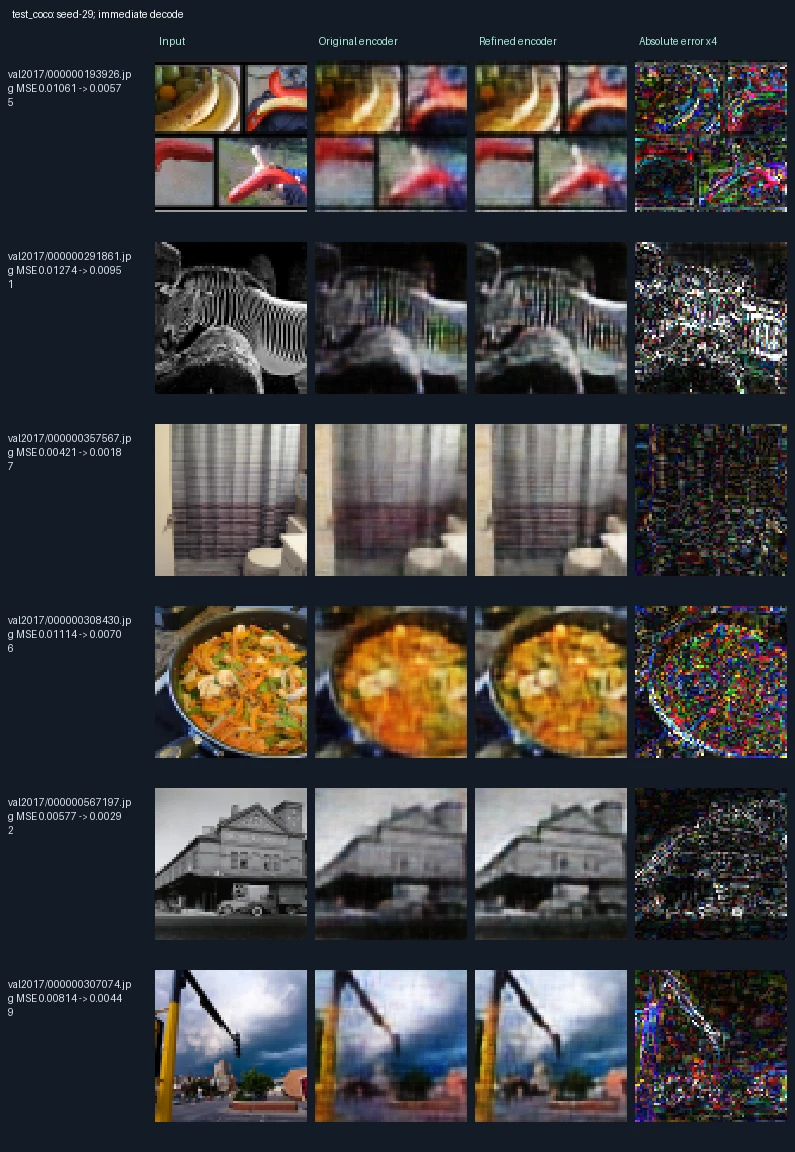
The first six test examples in predetermined order, not selected for reconstruction quality. Left to right: input pixels, reconstruction from the original encoder’s vector, reconstruction from the refined encoder’s vector, and the refined output’s error. The same fixed decoder reconstructs both vectors. MSE is mean squared RGB error on values scaled to 0–1; lower is better. Arrows in row labels compare the starting and refined models. The model receives a 64 × 64 RGB image; photographs are center-cropped and resized before encoding. Enlargement here adds no detail. Error panels show four times the absolute RGB difference from the reference, separately for each color channel, clipped at full brightness. Darker pixels mean smaller errors; black is zero or below the display’s precision. The scale is fixed across examples, not adjusted to make each image look better.
Encoder refinement: largest gains on test photographs
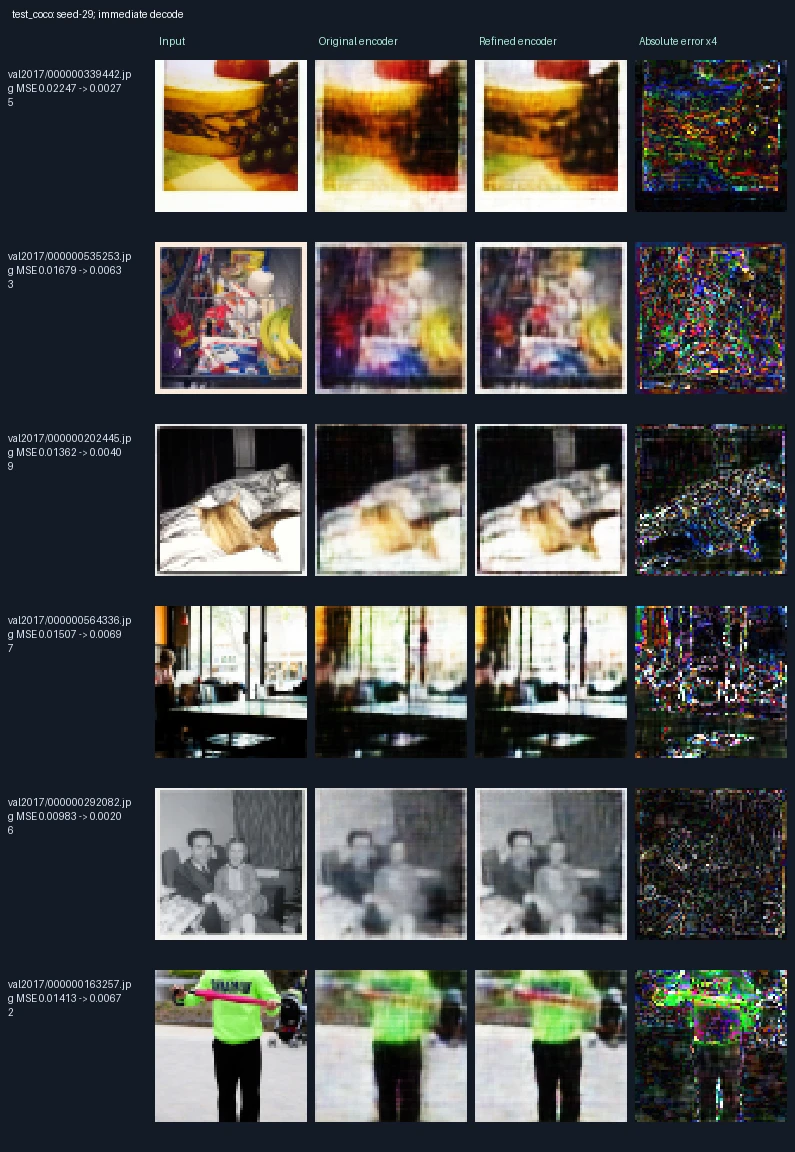
The six COCO test images with the largest decrease in MSE, selected after evaluation to expose the range of effects. Left to right: input pixels, reconstruction from the original encoder’s vector, reconstruction from the refined encoder’s vector, and the refined output’s error. The same fixed decoder reconstructs both vectors. MSE is mean squared RGB error on values scaled to 0–1; lower is better. Arrows in row labels compare the starting and refined models. The model receives a 64 × 64 RGB image; photographs are center-cropped and resized before encoding. Enlargement here adds no detail. Error panels show four times the absolute RGB difference from the reference, separately for each color channel, clipped at full brightness. Darker pixels mean smaller errors; black is zero or below the display’s precision. The scale is fixed across examples, not adjusted to make each image look better.
Encoder refinement: smallest gains on test photographs
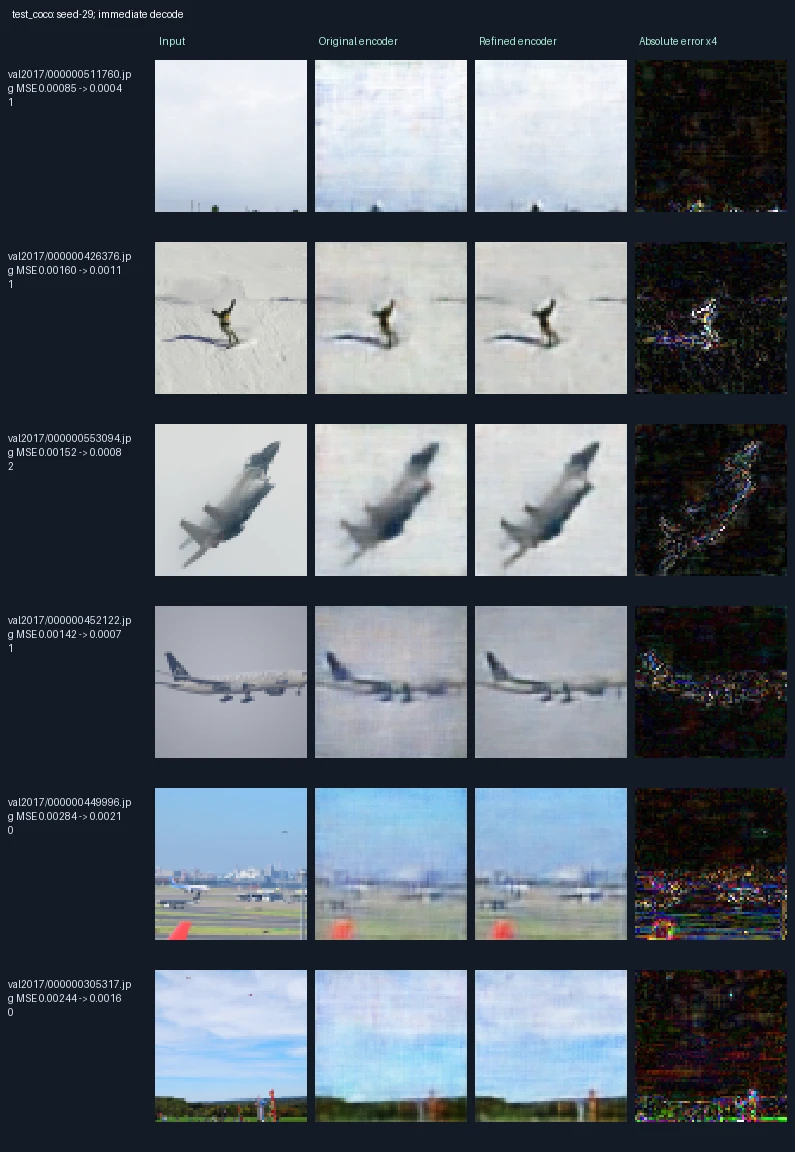
The six COCO test images with the smallest decrease in MSE, selected after evaluation to expose the range of effects. All six improved; the panel does not show regressions. Left to right: input pixels, reconstruction from the original encoder’s vector, reconstruction from the refined encoder’s vector, and the refined output’s error. The same fixed decoder reconstructs both vectors. MSE is mean squared RGB error on values scaled to 0–1; lower is better. Arrows in row labels compare the starting and refined models. The model receives a 64 × 64 RGB image; photographs are center-cropped and resized before encoding. Enlargement here adds no detail. Error panels show four times the absolute RGB difference from the reference, separately for each color channel, clipped at full brightness. Darker pixels mean smaller errors; black is zero or below the display’s precision. The scale is fixed across examples, not adjusted to make each image look better.
Flickr test photographs: effect of encoder refinement
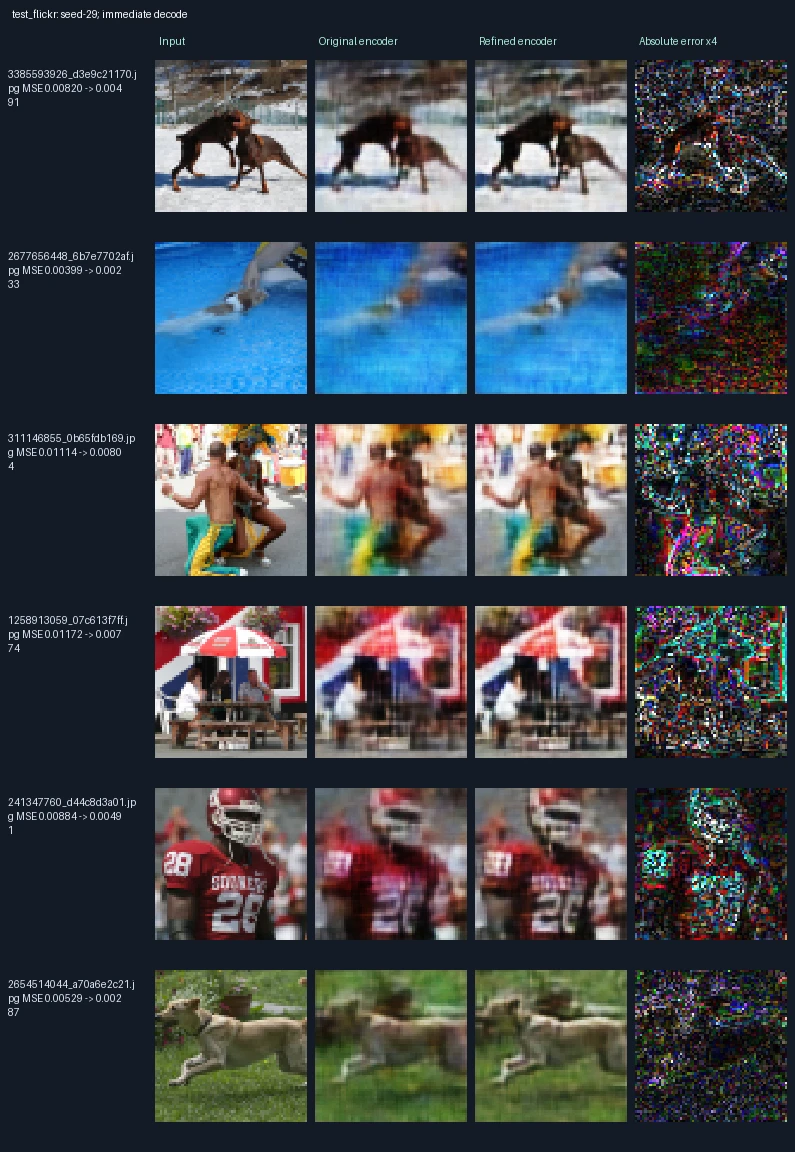
The first six test examples in predetermined order, not selected for reconstruction quality. Left to right: input pixels, reconstruction from the original encoder’s vector, reconstruction from the refined encoder’s vector, and the refined output’s error. The same fixed decoder reconstructs both vectors. MSE is mean squared RGB error on values scaled to 0–1; lower is better. Arrows in row labels compare the starting and refined models. The model receives a 64 × 64 RGB image; photographs are center-cropped and resized before encoding. Enlargement here adds no detail. Error panels show four times the absolute RGB difference from the reference, separately for each color channel, clipped at full brightness. Darker pixels mean smaller errors; black is zero or below the display’s precision. The scale is fixed across examples, not adjusted to make each image look better.
Encoder refinement: encoding earlier photographs again 0–5
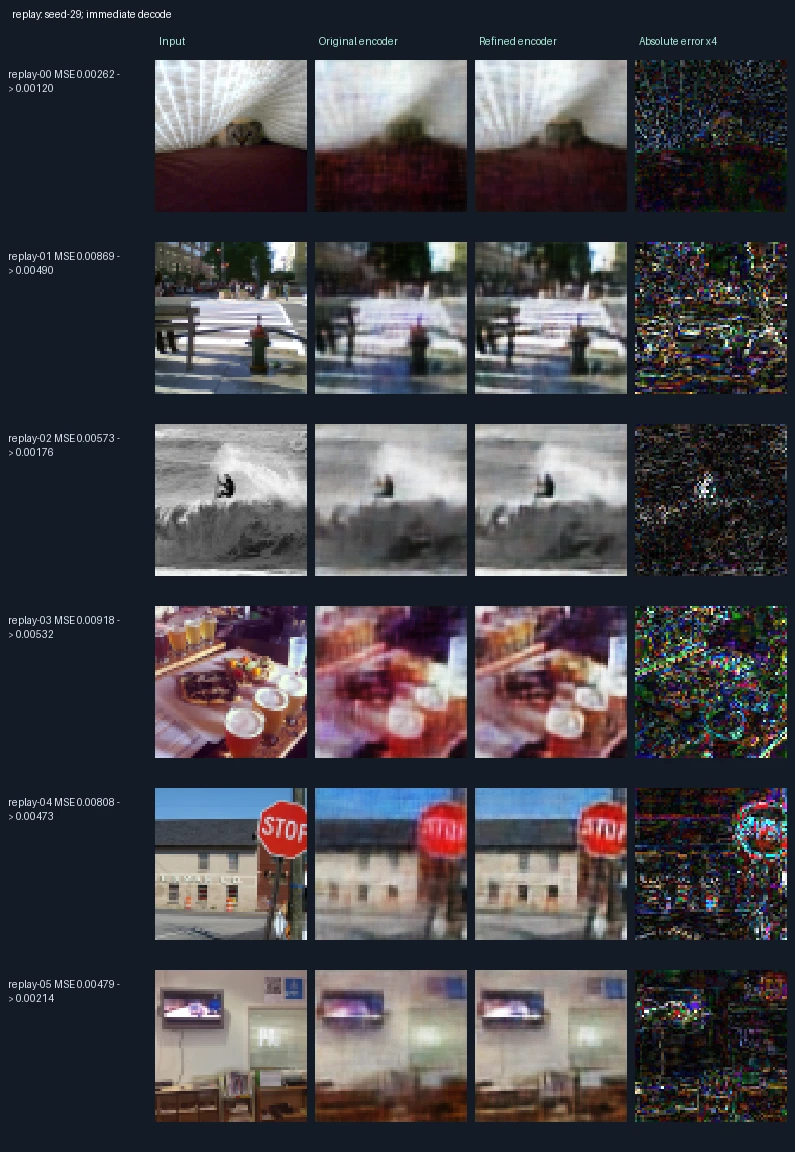
Earlier images are encoded again and immediately decoded. This tests reconstruction of familiar content; it does not show that untouched old memories remain compatible. Left to right: input pixels, reconstruction from the original encoder’s vector, reconstruction from the refined encoder’s vector, and the refined output’s error. The same fixed decoder reconstructs both vectors. MSE is mean squared RGB error on values scaled to 0–1; lower is better. Arrows in row labels compare the starting and refined models. The model receives a 64 × 64 RGB image; photographs are center-cropped and resized before encoding. Enlargement here adds no detail. Error panels show four times the absolute RGB difference from the reference, separately for each color channel, clipped at full brightness. Darker pixels mean smaller errors; black is zero or below the display’s precision. The scale is fixed across examples, not adjusted to make each image look better.
Encoder refinement: encoding earlier photographs again 6–11
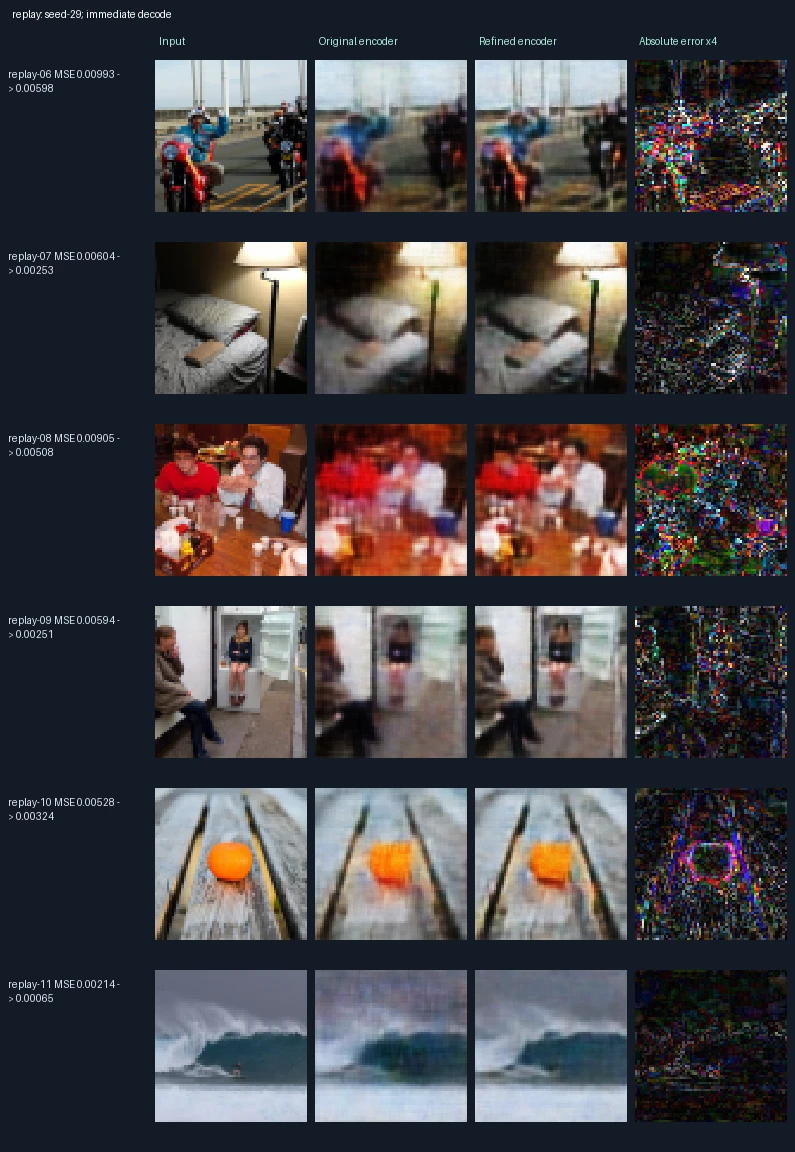
Earlier images are encoded again and immediately decoded. This tests reconstruction of familiar content; it does not show that untouched old memories remain compatible. Left to right: input pixels, reconstruction from the original encoder’s vector, reconstruction from the refined encoder’s vector, and the refined output’s error. The same fixed decoder reconstructs both vectors. MSE is mean squared RGB error on values scaled to 0–1; lower is better. Arrows in row labels compare the starting and refined models. The model receives a 64 × 64 RGB image; photographs are center-cropped and resized before encoding. Enlargement here adds no detail. Error panels show four times the absolute RGB difference from the reference, separately for each color channel, clipped at full brightness. Darker pixels mean smaller errors; black is zero or below the display’s precision. The scale is fixed across examples, not adjusted to make each image look better.
Encoder refinement: encoding earlier photographs again 12–17
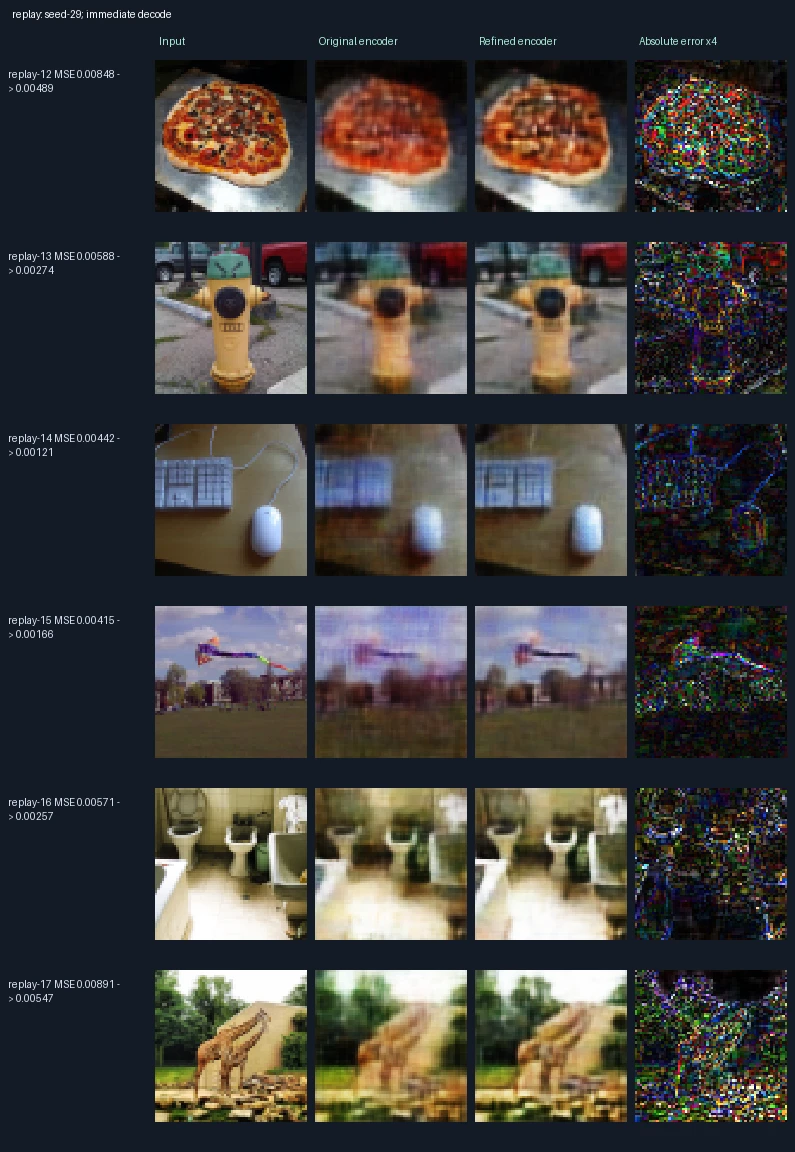
Earlier images are encoded again and immediately decoded. This tests reconstruction of familiar content; it does not show that untouched old memories remain compatible. Left to right: input pixels, reconstruction from the original encoder’s vector, reconstruction from the refined encoder’s vector, and the refined output’s error. The same fixed decoder reconstructs both vectors. MSE is mean squared RGB error on values scaled to 0–1; lower is better. Arrows in row labels compare the starting and refined models. The model receives a 64 × 64 RGB image; photographs are center-cropped and resized before encoding. Enlargement here adds no detail. Error panels show four times the absolute RGB difference from the reference, separately for each color channel, clipped at full brightness. Darker pixels mean smaller errors; black is zero or below the display’s precision. The scale is fixed across examples, not adjusted to make each image look better.
Encoder refinement: encoding earlier photographs again 18–23
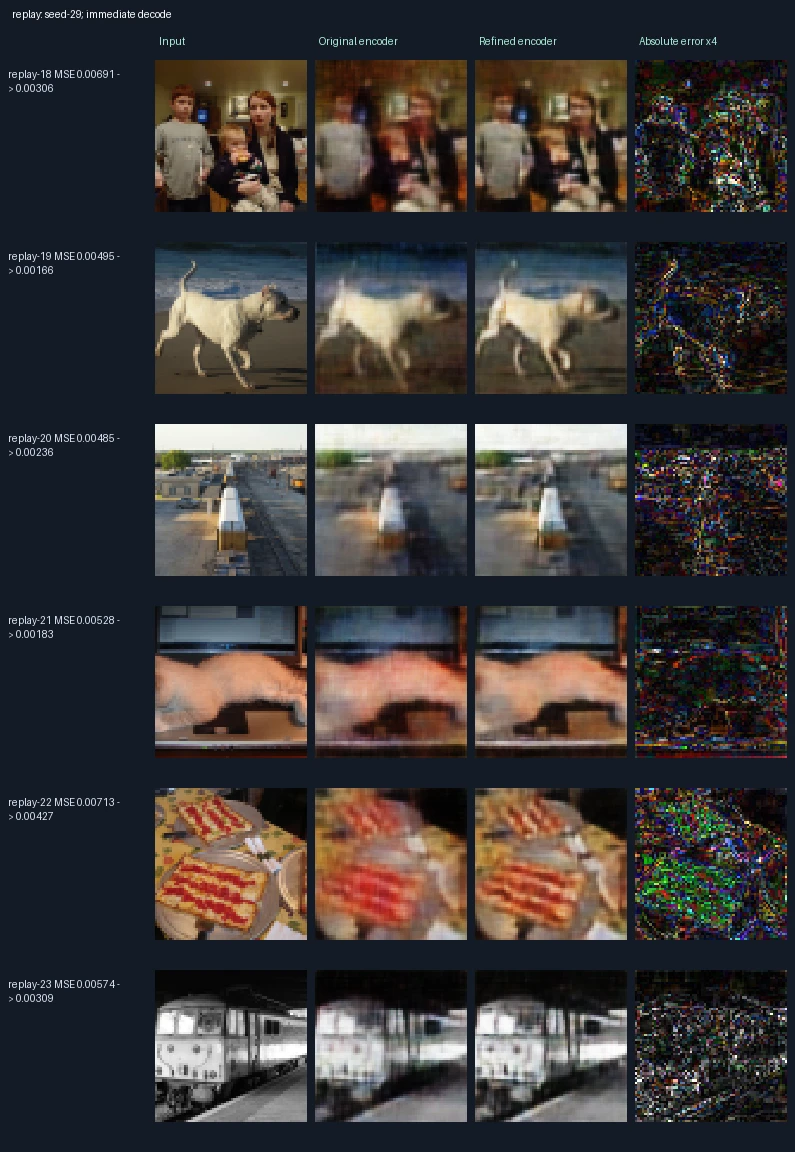
Earlier images are encoded again and immediately decoded. This tests reconstruction of familiar content; it does not show that untouched old memories remain compatible. Left to right: input pixels, reconstruction from the original encoder’s vector, reconstruction from the refined encoder’s vector, and the refined output’s error. The same fixed decoder reconstructs both vectors. MSE is mean squared RGB error on values scaled to 0–1; lower is better. Arrows in row labels compare the starting and refined models. The model receives a 64 × 64 RGB image; photographs are center-cropped and resized before encoding. Enlargement here adds no detail. Error panels show four times the absolute RGB difference from the reference, separately for each color channel, clipped at full brightness. Darker pixels mean smaller errors; black is zero or below the display’s precision. The scale is fixed across examples, not adjusted to make each image look better.
Encoder refinement: encoding earlier Andor video frames again 24–29
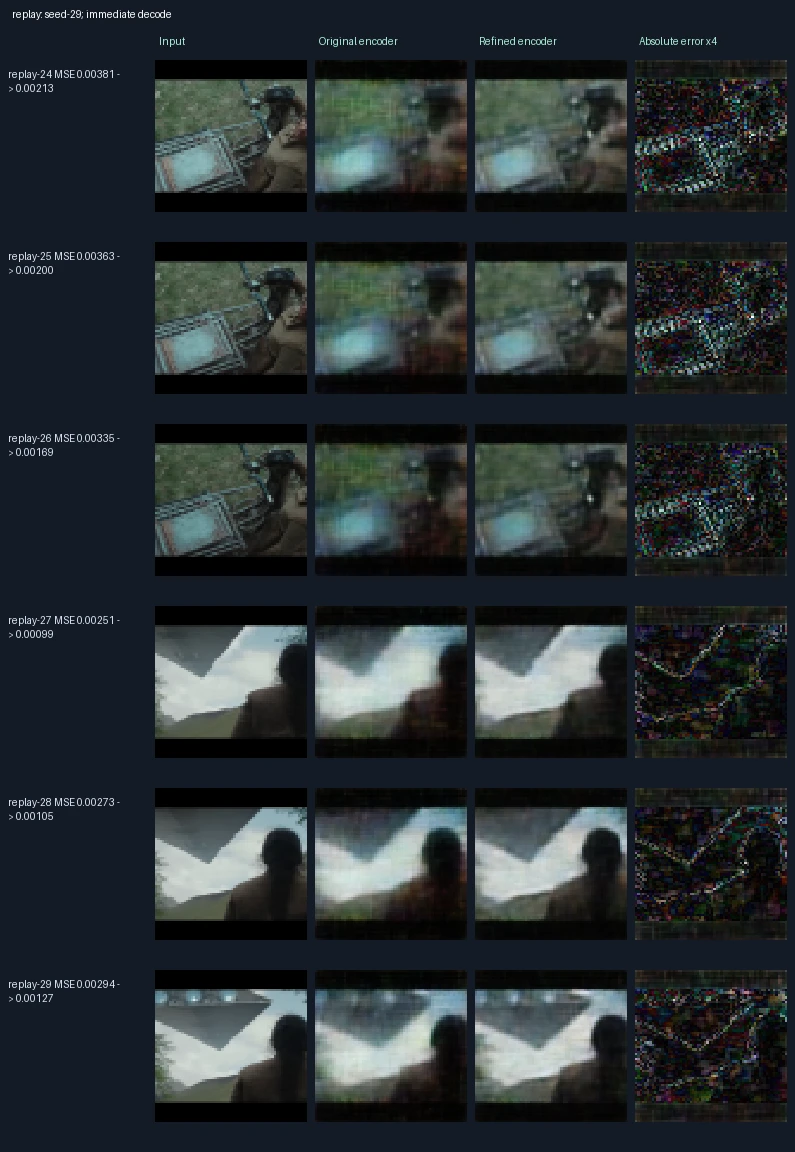
Earlier images are encoded again and immediately decoded. This tests reconstruction of familiar content; it does not show that untouched old memories remain compatible. Left to right: input pixels, reconstruction from the original encoder’s vector, reconstruction from the refined encoder’s vector, and the refined output’s error. The same fixed decoder reconstructs both vectors. MSE is mean squared RGB error on values scaled to 0–1; lower is better. Arrows in row labels compare the starting and refined models. The model receives a 64 × 64 RGB image; photographs are center-cropped and resized before encoding. Enlargement here adds no detail. Error panels show four times the absolute RGB difference from the reference, separately for each color channel, clipped at full brightness. Darker pixels mean smaller errors; black is zero or below the display’s precision. The scale is fixed across examples, not adjusted to make each image look better.
Encoder refinement: encoding earlier Andor video frames again 30–35
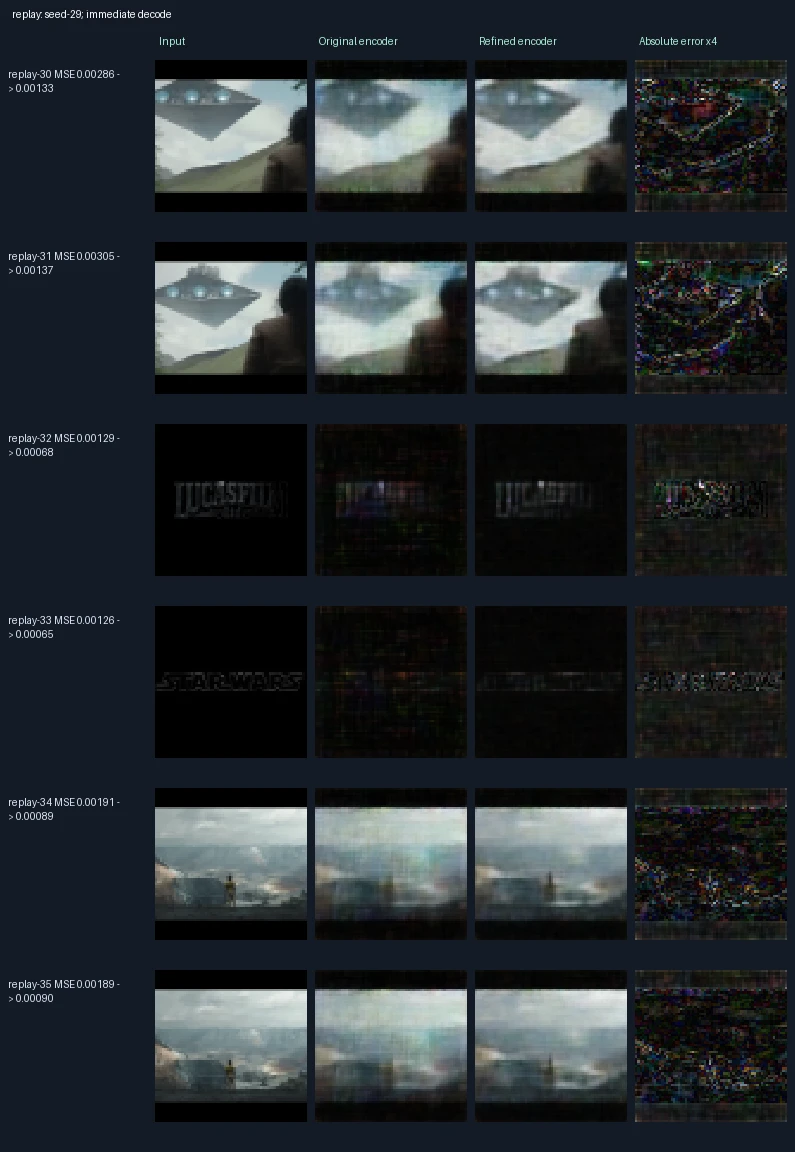
Earlier images are encoded again and immediately decoded. This tests reconstruction of familiar content; it does not show that untouched old memories remain compatible. Left to right: input pixels, reconstruction from the original encoder’s vector, reconstruction from the refined encoder’s vector, and the refined output’s error. The same fixed decoder reconstructs both vectors. MSE is mean squared RGB error on values scaled to 0–1; lower is better. Arrows in row labels compare the starting and refined models. The model receives a 64 × 64 RGB image; photographs are center-cropped and resized before encoding. Enlargement here adds no detail. Error panels show four times the absolute RGB difference from the reference, separately for each color channel, clipped at full brightness. Darker pixels mean smaller errors; black is zero or below the display’s precision. The scale is fixed across examples, not adjusted to make each image look better.
Encoder refinement: encoding earlier Andor video frames again 36–41
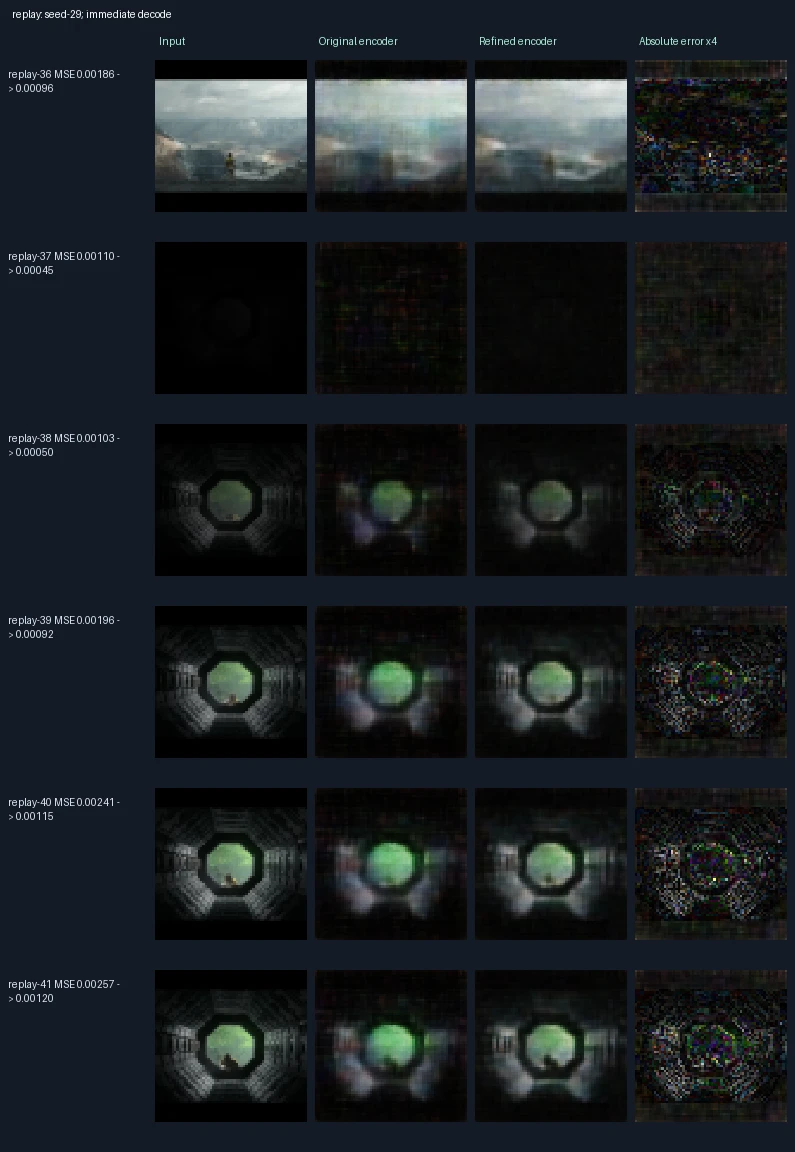
Earlier images are encoded again and immediately decoded. This tests reconstruction of familiar content; it does not show that untouched old memories remain compatible. Left to right: input pixels, reconstruction from the original encoder’s vector, reconstruction from the refined encoder’s vector, and the refined output’s error. The same fixed decoder reconstructs both vectors. MSE is mean squared RGB error on values scaled to 0–1; lower is better. Arrows in row labels compare the starting and refined models. The model receives a 64 × 64 RGB image; photographs are center-cropped and resized before encoding. Enlargement here adds no detail. Error panels show four times the absolute RGB difference from the reference, separately for each color channel, clipped at full brightness. Darker pixels mean smaller errors; black is zero or below the display’s precision. The scale is fixed across examples, not adjusted to make each image look better.
Encoder refinement: encoding earlier Andor video frames again 42–47
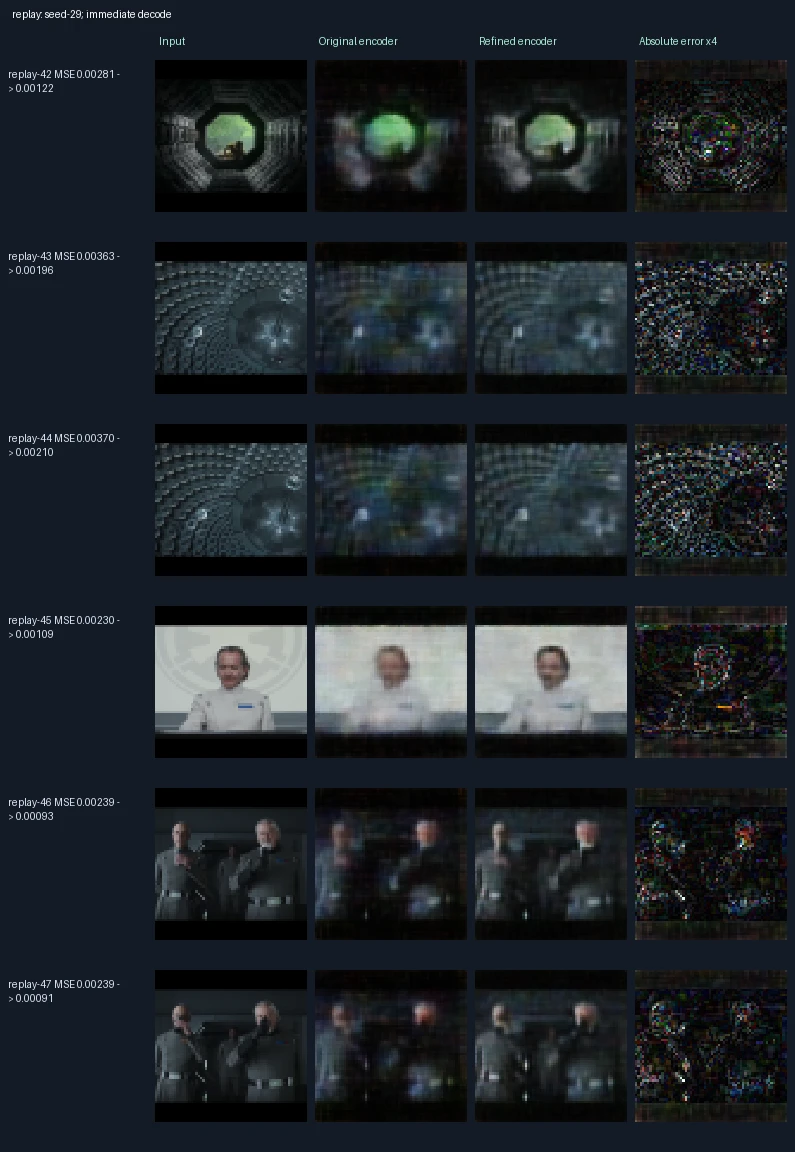
Earlier images are encoded again and immediately decoded. This tests reconstruction of familiar content; it does not show that untouched old memories remain compatible. Left to right: input pixels, reconstruction from the original encoder’s vector, reconstruction from the refined encoder’s vector, and the refined output’s error. The same fixed decoder reconstructs both vectors. MSE is mean squared RGB error on values scaled to 0–1; lower is better. Arrows in row labels compare the starting and refined models. The model receives a 64 × 64 RGB image; photographs are center-cropped and resized before encoding. Enlargement here adds no detail. Error panels show four times the absolute RGB difference from the reference, separately for each color channel, clipped at full brightness. Darker pixels mean smaller errors; black is zero or below the display’s precision. The scale is fixed across examples, not adjusted to make each image look better.
Encoder refinement: encoding earlier Dune video frames again 48–53
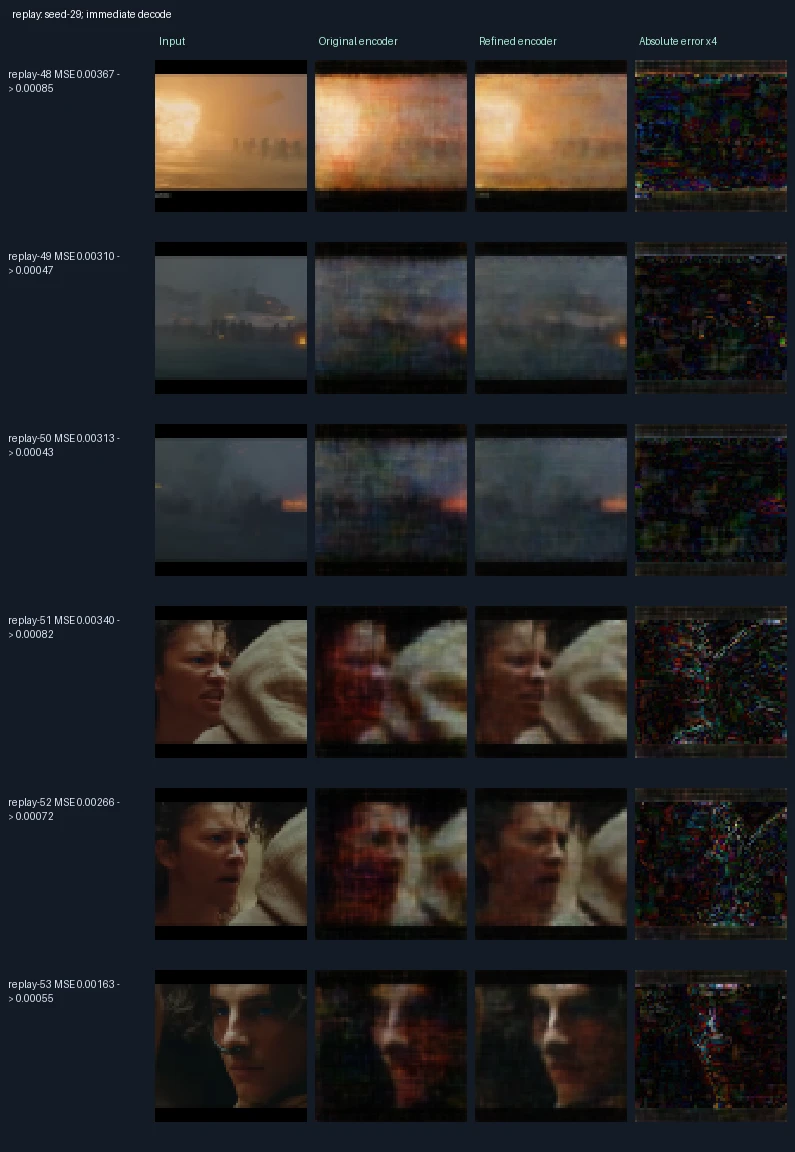
Earlier images are encoded again and immediately decoded. This tests reconstruction of familiar content; it does not show that untouched old memories remain compatible. Left to right: input pixels, reconstruction from the original encoder’s vector, reconstruction from the refined encoder’s vector, and the refined output’s error. The same fixed decoder reconstructs both vectors. MSE is mean squared RGB error on values scaled to 0–1; lower is better. Arrows in row labels compare the starting and refined models. The model receives a 64 × 64 RGB image; photographs are center-cropped and resized before encoding. Enlargement here adds no detail. Error panels show four times the absolute RGB difference from the reference, separately for each color channel, clipped at full brightness. Darker pixels mean smaller errors; black is zero or below the display’s precision. The scale is fixed across examples, not adjusted to make each image look better.
Encoder refinement: encoding earlier Dune video frames again 54–59
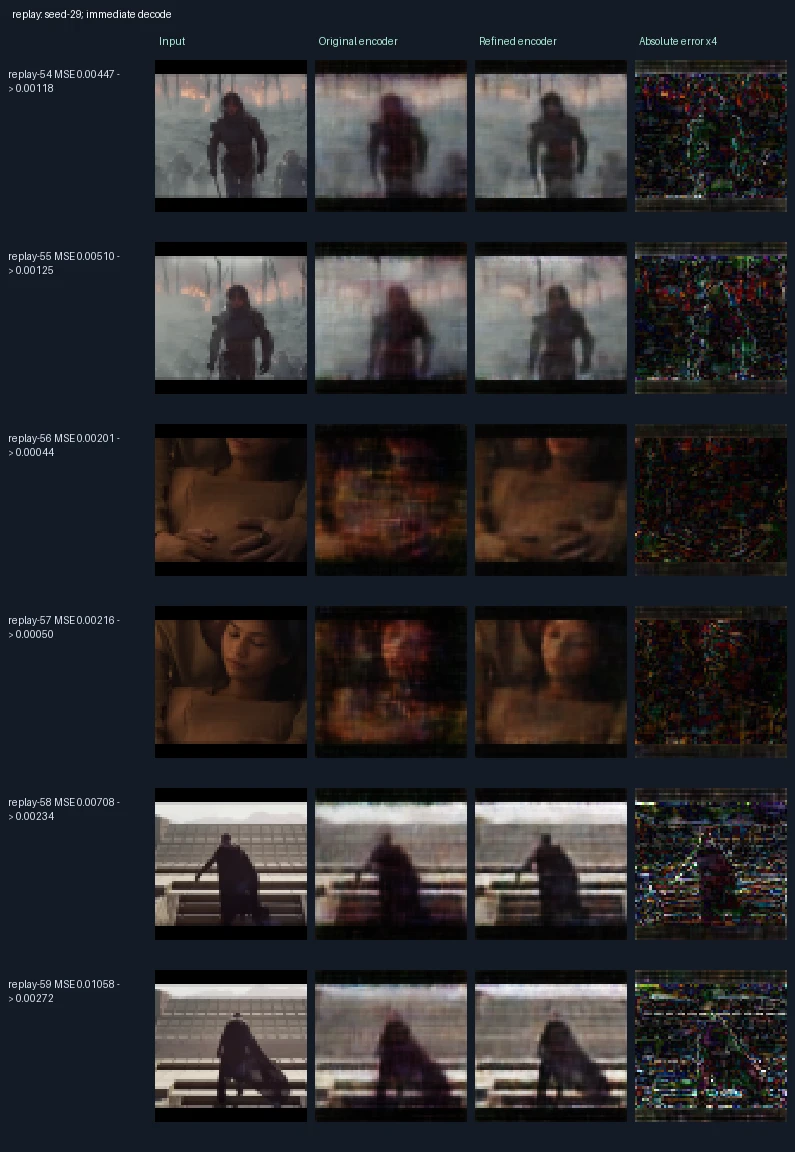
Earlier images are encoded again and immediately decoded. This tests reconstruction of familiar content; it does not show that untouched old memories remain compatible. Left to right: input pixels, reconstruction from the original encoder’s vector, reconstruction from the refined encoder’s vector, and the refined output’s error. The same fixed decoder reconstructs both vectors. MSE is mean squared RGB error on values scaled to 0–1; lower is better. Arrows in row labels compare the starting and refined models. The model receives a 64 × 64 RGB image; photographs are center-cropped and resized before encoding. Enlargement here adds no detail. Error panels show four times the absolute RGB difference from the reference, separately for each color channel, clipped at full brightness. Darker pixels mean smaller errors; black is zero or below the display’s precision. The scale is fixed across examples, not adjusted to make each image look better.
Encoder refinement: encoding earlier Dune video frames again 60–65
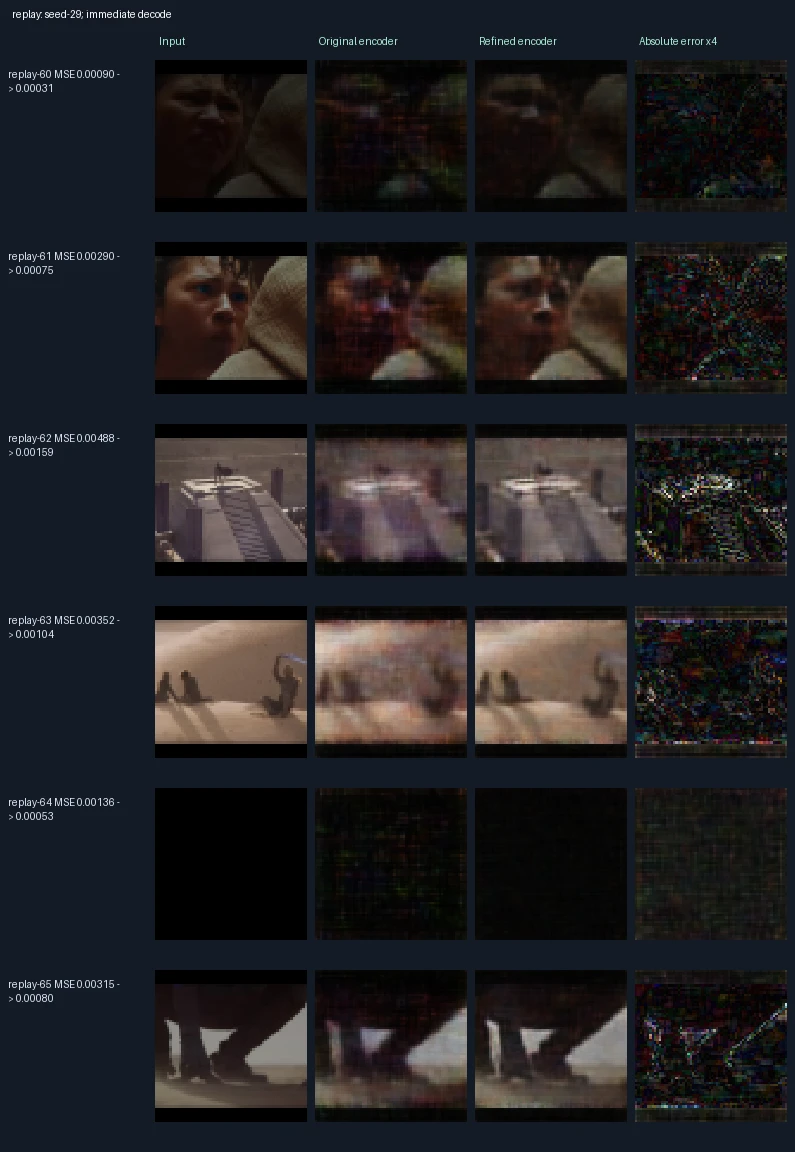
Earlier images are encoded again and immediately decoded. This tests reconstruction of familiar content; it does not show that untouched old memories remain compatible. Left to right: input pixels, reconstruction from the original encoder’s vector, reconstruction from the refined encoder’s vector, and the refined output’s error. The same fixed decoder reconstructs both vectors. MSE is mean squared RGB error on values scaled to 0–1; lower is better. Arrows in row labels compare the starting and refined models. The model receives a 64 × 64 RGB image; photographs are center-cropped and resized before encoding. Enlargement here adds no detail. Error panels show four times the absolute RGB difference from the reference, separately for each color channel, clipped at full brightness. Darker pixels mean smaller errors; black is zero or below the display’s precision. The scale is fixed across examples, not adjusted to make each image look better.
Encoder refinement: encoding earlier Dune video frames again 66–71
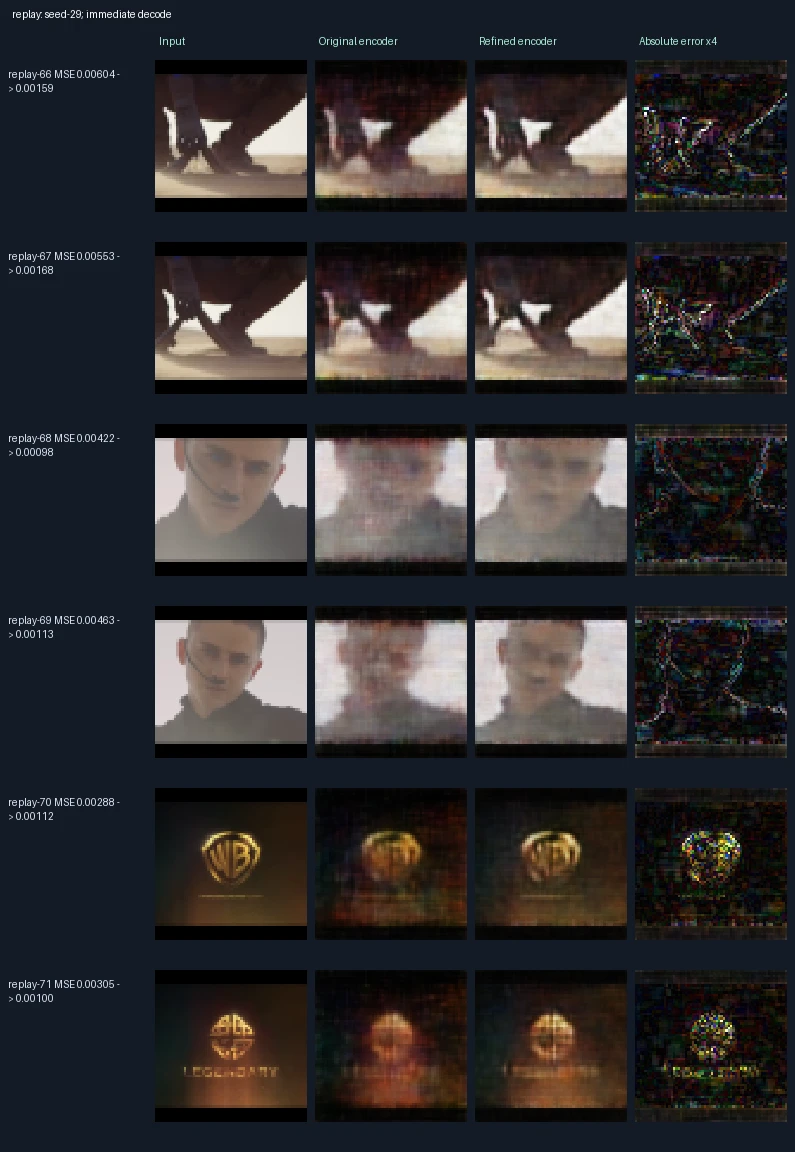
Earlier images are encoded again and immediately decoded. This tests reconstruction of familiar content; it does not show that untouched old memories remain compatible. Left to right: input pixels, reconstruction from the original encoder’s vector, reconstruction from the refined encoder’s vector, and the refined output’s error. The same fixed decoder reconstructs both vectors. MSE is mean squared RGB error on values scaled to 0–1; lower is better. Arrows in row labels compare the starting and refined models. The model receives a 64 × 64 RGB image; photographs are center-cropped and resized before encoding. Enlargement here adds no detail. Error panels show four times the absolute RGB difference from the reference, separately for each color channel, clipped at full brightness. Darker pixels mean smaller errors; black is zero or below the display’s precision. The scale is fixed across examples, not adjusted to make each image look better.
Rendered writing on white backgrounds: effect of encoder refinement
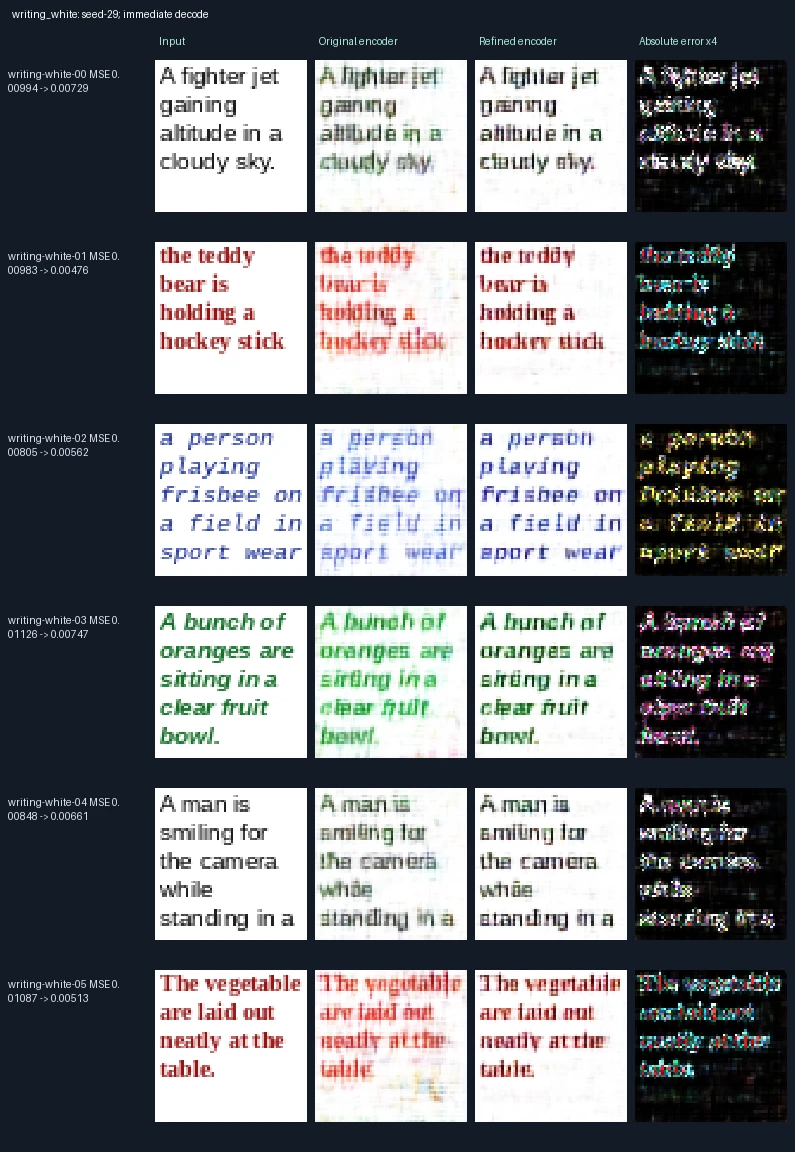
The first six test examples in predetermined order, not selected for reconstruction quality. Left to right: input pixels, reconstruction from the original encoder’s vector, reconstruction from the refined encoder’s vector, and the refined output’s error. The same fixed decoder reconstructs both vectors. MSE is mean squared RGB error on values scaled to 0–1; lower is better. Arrows in row labels compare the starting and refined models. The model receives a 64 × 64 RGB image; photographs are center-cropped and resized before encoding. Enlargement here adds no detail. Error panels show four times the absolute RGB difference from the reference, separately for each color channel, clipped at full brightness. Darker pixels mean smaller errors; black is zero or below the display’s precision. The scale is fixed across examples, not adjusted to make each image look better. Writing is supplied as pixels, so this tests visual detail rather than reading comprehension.
Rendered writing on photographs: effect of encoder refinement
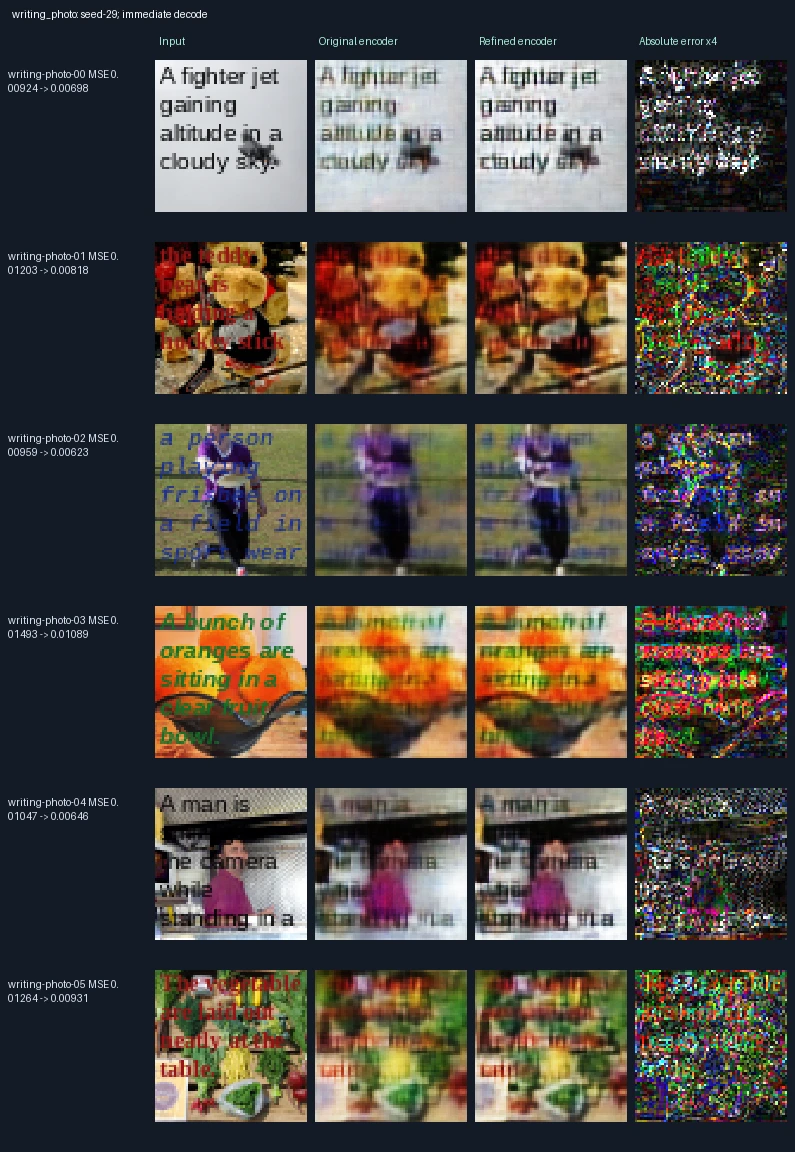
The first six test examples in predetermined order, not selected for reconstruction quality. Left to right: input pixels, reconstruction from the original encoder’s vector, reconstruction from the refined encoder’s vector, and the refined output’s error. The same fixed decoder reconstructs both vectors. MSE is mean squared RGB error on values scaled to 0–1; lower is better. Arrows in row labels compare the starting and refined models. The model receives a 64 × 64 RGB image; photographs are center-cropped and resized before encoding. Enlargement here adds no detail. Error panels show four times the absolute RGB difference from the reference, separately for each color channel, clipped at full brightness. Darker pixels mean smaller errors; black is zero or below the display’s precision. The scale is fixed across examples, not adjusted to make each image look better. Writing is supplied as pixels, so this tests visual detail rather than reading comprehension.
How encoder training changes development-image error
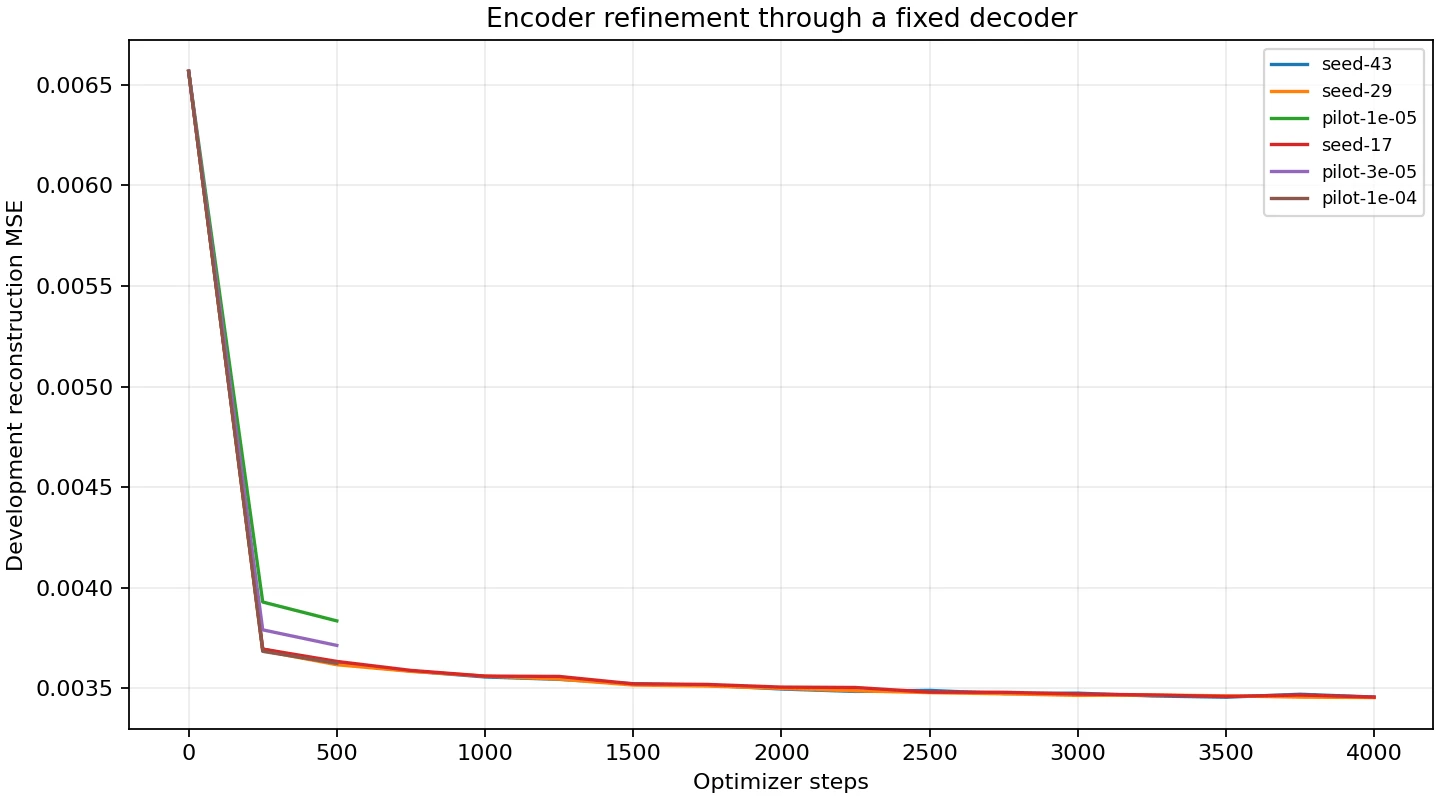
Horizontal axis: optimizer steps, each a weight update. Vertical axis: mean squared reconstruction error on development photographs; lower is better. Short lines are learning-rate trials, while the three long lines are repeated fits with different randomization settings. These development scores choose checkpoints before final testing; a later training step need not be a better model.
Encoder learning check: fitting eight training photographs
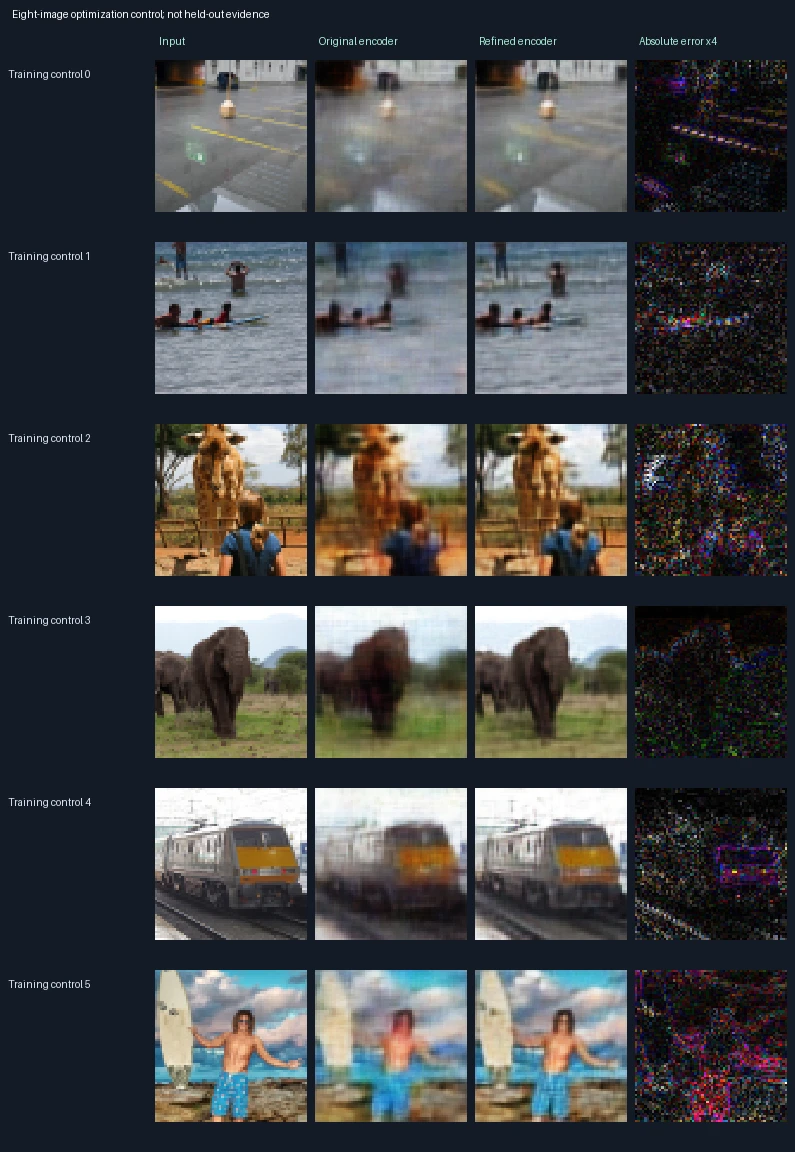
Six of the eight training photographs used in a deliberate fitting check. Left to right: input pixels, reconstruction from the original encoder’s vector, reconstruction from the refined encoder’s vector, and the refined output’s error. The same fixed decoder reconstructs both vectors. Only the encoder is trained. Better reproduction here verifies that weight updates can improve reconstruction, not that the model generalizes to new images. Error panels show four times the absolute RGB difference from the reference, separately for each color channel, clipped at full brightness. Darker pixels mean smaller errors; black is zero or below the display’s precision. The scale is fixed across examples, not adjusted to make each image look better.
Encoder refinement, learning-rate trial (1e-05): 0 weight updates
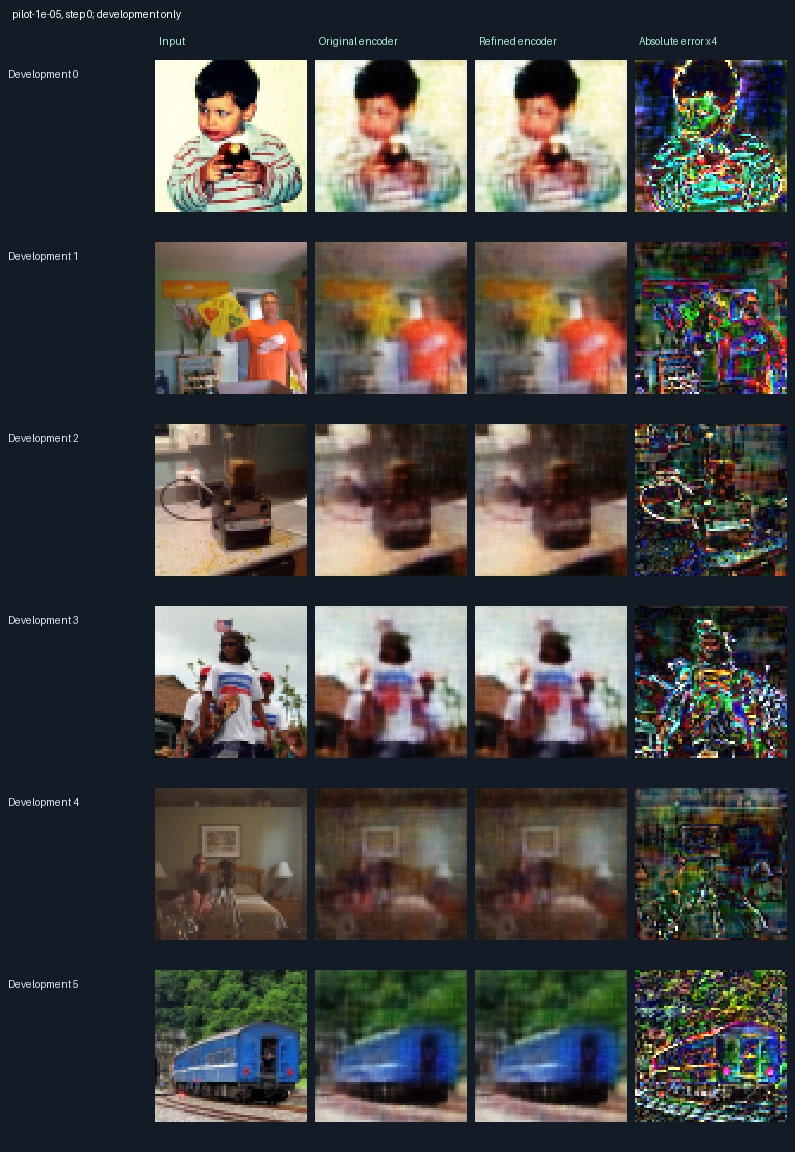
Six fixed development photographs, excluded from gradient updates and used to monitor model quality. Left to right: input pixels, reconstruction from the original encoder’s vector, reconstruction from the refined encoder’s vector, and the refined output’s error. The same fixed decoder reconstructs both vectors. This short trial uses learning rate 1e-05, a setting that controls the size of weight updates. The model receives a 64 × 64 RGB image; photographs are center-cropped and resized before encoding. Enlargement here adds no detail. Error panels show four times the absolute RGB difference from the reference, separately for each color channel, clipped at full brightness. Darker pixels mean smaller errors; black is zero or below the display’s precision. The scale is fixed across examples, not adjusted to make each image look better. Zero updates records the starting model.
Encoder refinement, learning-rate trial (1e-05): 250 weight updates
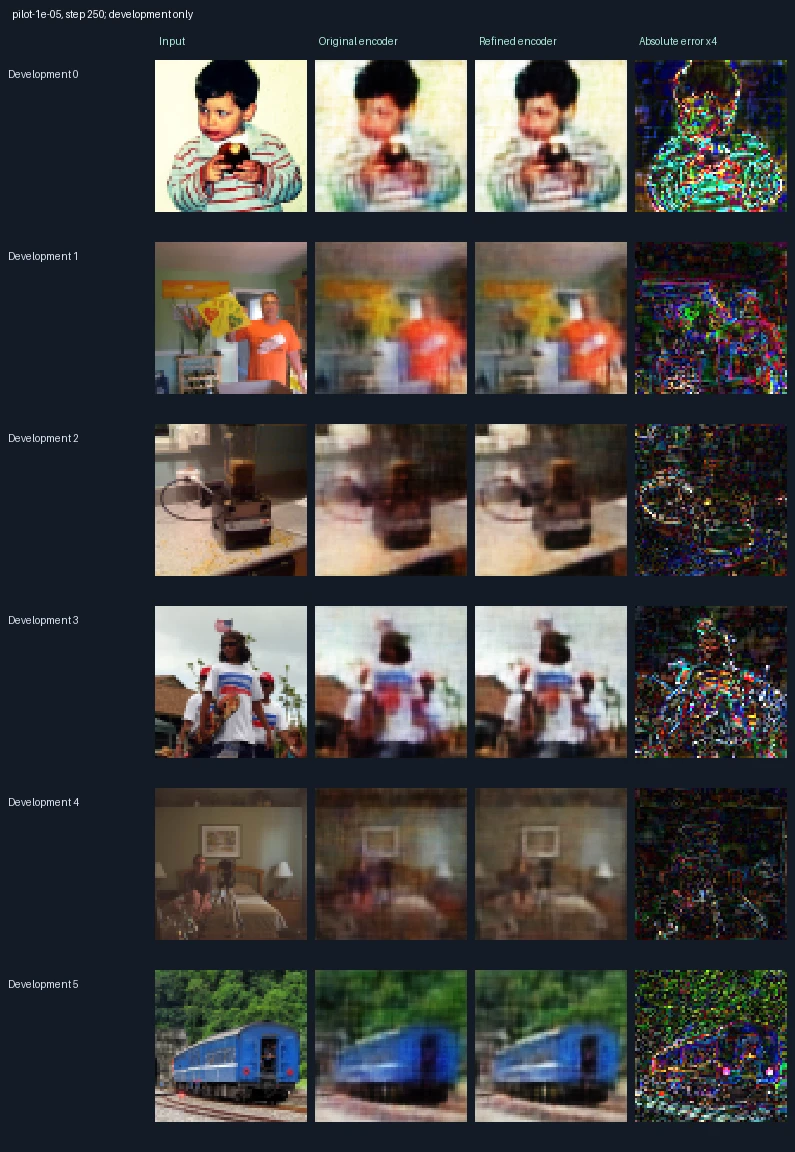
Six fixed development photographs, excluded from gradient updates and used to monitor model quality. Left to right: input pixels, reconstruction from the original encoder’s vector, reconstruction from the refined encoder’s vector, and the refined output’s error. The same fixed decoder reconstructs both vectors. This short trial uses learning rate 1e-05, a setting that controls the size of weight updates. The model receives a 64 × 64 RGB image; photographs are center-cropped and resized before encoding. Enlargement here adds no detail. Error panels show four times the absolute RGB difference from the reference, separately for each color channel, clipped at full brightness. Darker pixels mean smaller errors; black is zero or below the display’s precision. The scale is fixed across examples, not adjusted to make each image look better.
Encoder refinement, learning-rate trial (1e-05): 500 weight updates
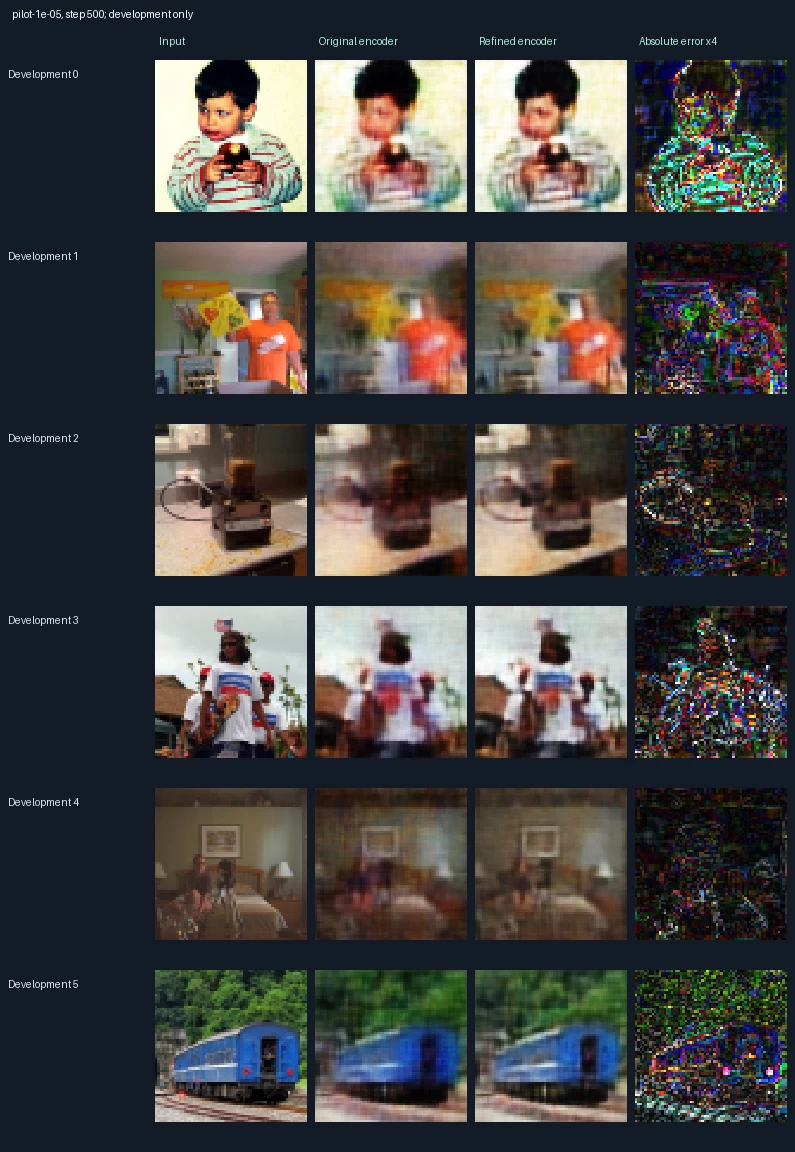
Six fixed development photographs, excluded from gradient updates and used to monitor model quality. Left to right: input pixels, reconstruction from the original encoder’s vector, reconstruction from the refined encoder’s vector, and the refined output’s error. The same fixed decoder reconstructs both vectors. This short trial uses learning rate 1e-05, a setting that controls the size of weight updates. The model receives a 64 × 64 RGB image; photographs are center-cropped and resized before encoding. Enlargement here adds no detail. Error panels show four times the absolute RGB difference from the reference, separately for each color channel, clipped at full brightness. Darker pixels mean smaller errors; black is zero or below the display’s precision. The scale is fixed across examples, not adjusted to make each image look better.
Encoder refinement, learning-rate trial (3e-05): 0 weight updates
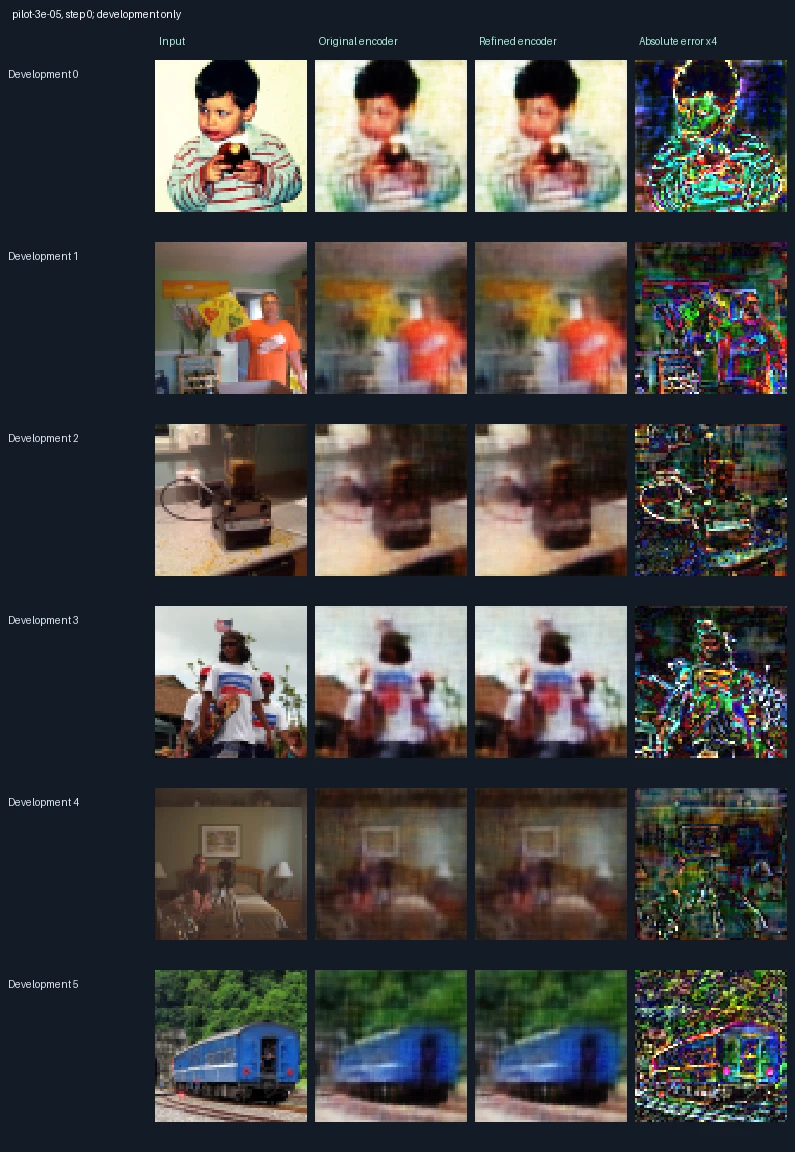
Six fixed development photographs, excluded from gradient updates and used to monitor model quality. Left to right: input pixels, reconstruction from the original encoder’s vector, reconstruction from the refined encoder’s vector, and the refined output’s error. The same fixed decoder reconstructs both vectors. This short trial uses learning rate 3e-05, a setting that controls the size of weight updates. The model receives a 64 × 64 RGB image; photographs are center-cropped and resized before encoding. Enlargement here adds no detail. Error panels show four times the absolute RGB difference from the reference, separately for each color channel, clipped at full brightness. Darker pixels mean smaller errors; black is zero or below the display’s precision. The scale is fixed across examples, not adjusted to make each image look better. Zero updates records the starting model.
Encoder refinement, learning-rate trial (3e-05): 250 weight updates
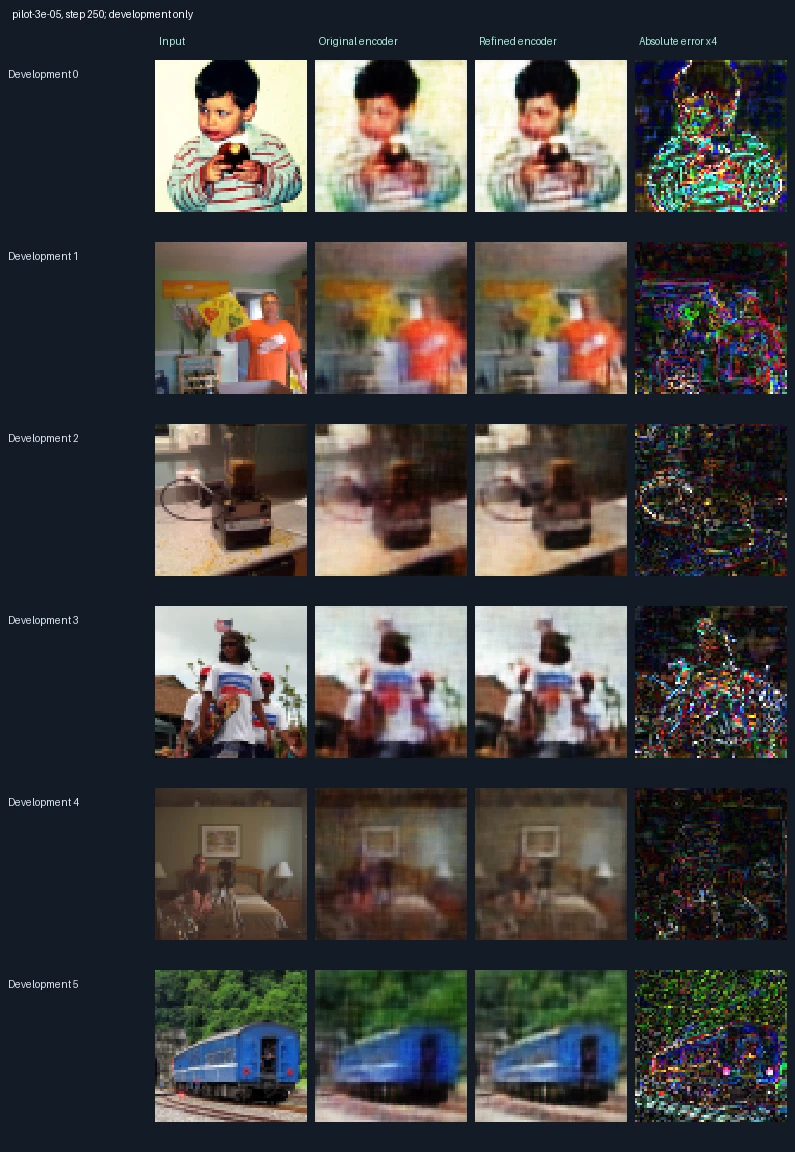
Six fixed development photographs, excluded from gradient updates and used to monitor model quality. Left to right: input pixels, reconstruction from the original encoder’s vector, reconstruction from the refined encoder’s vector, and the refined output’s error. The same fixed decoder reconstructs both vectors. This short trial uses learning rate 3e-05, a setting that controls the size of weight updates. The model receives a 64 × 64 RGB image; photographs are center-cropped and resized before encoding. Enlargement here adds no detail. Error panels show four times the absolute RGB difference from the reference, separately for each color channel, clipped at full brightness. Darker pixels mean smaller errors; black is zero or below the display’s precision. The scale is fixed across examples, not adjusted to make each image look better.
Encoder refinement, learning-rate trial (3e-05): 500 weight updates
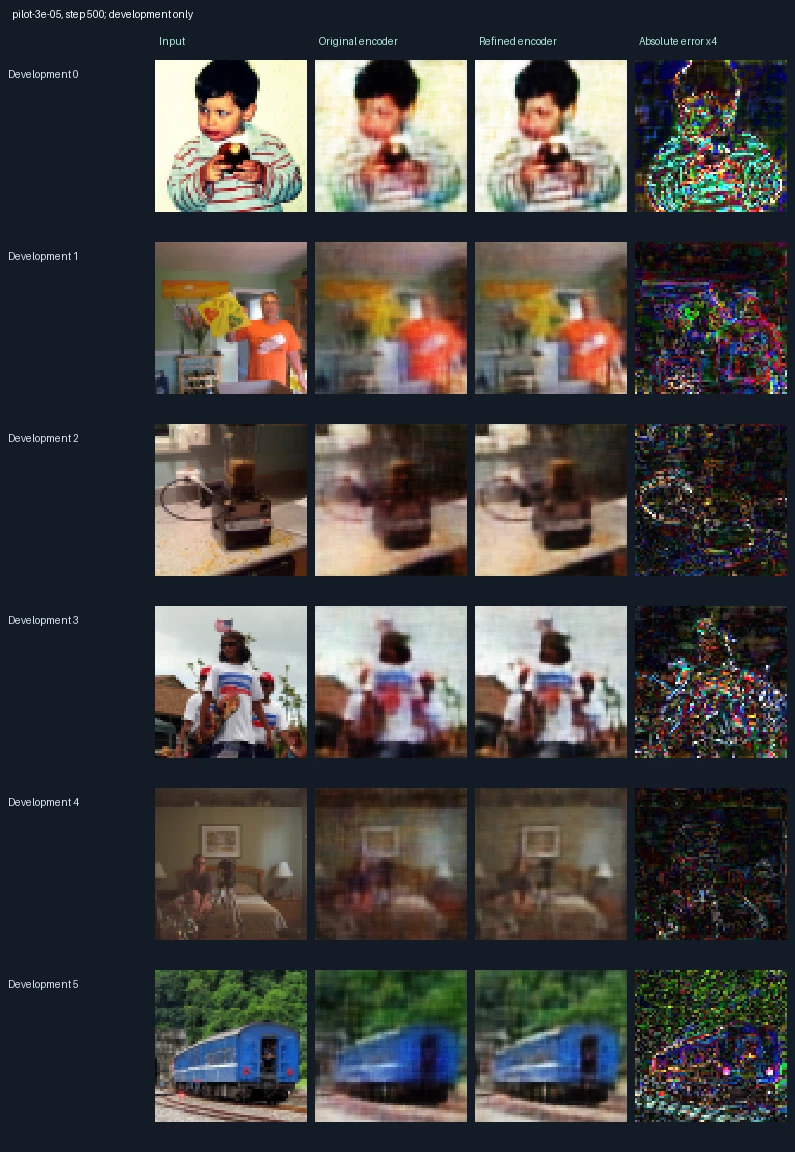
Six fixed development photographs, excluded from gradient updates and used to monitor model quality. Left to right: input pixels, reconstruction from the original encoder’s vector, reconstruction from the refined encoder’s vector, and the refined output’s error. The same fixed decoder reconstructs both vectors. This short trial uses learning rate 3e-05, a setting that controls the size of weight updates. The model receives a 64 × 64 RGB image; photographs are center-cropped and resized before encoding. Enlargement here adds no detail. Error panels show four times the absolute RGB difference from the reference, separately for each color channel, clipped at full brightness. Darker pixels mean smaller errors; black is zero or below the display’s precision. The scale is fixed across examples, not adjusted to make each image look better.
Encoder refinement, learning-rate trial (1e-04): 0 weight updates
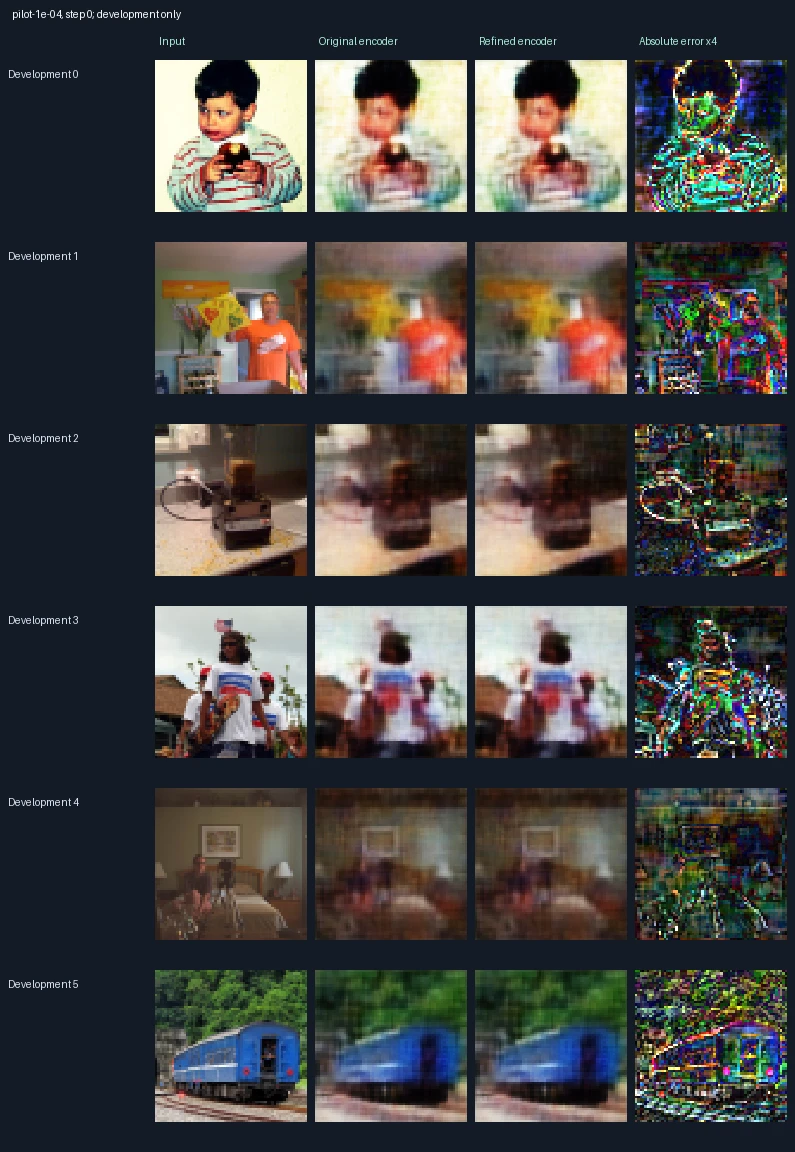
Six fixed development photographs, excluded from gradient updates and used to monitor model quality. Left to right: input pixels, reconstruction from the original encoder’s vector, reconstruction from the refined encoder’s vector, and the refined output’s error. The same fixed decoder reconstructs both vectors. This short trial uses learning rate 1e-04, a setting that controls the size of weight updates. The model receives a 64 × 64 RGB image; photographs are center-cropped and resized before encoding. Enlargement here adds no detail. Error panels show four times the absolute RGB difference from the reference, separately for each color channel, clipped at full brightness. Darker pixels mean smaller errors; black is zero or below the display’s precision. The scale is fixed across examples, not adjusted to make each image look better. Zero updates records the starting model.
Encoder refinement, learning-rate trial (1e-04): 250 weight updates
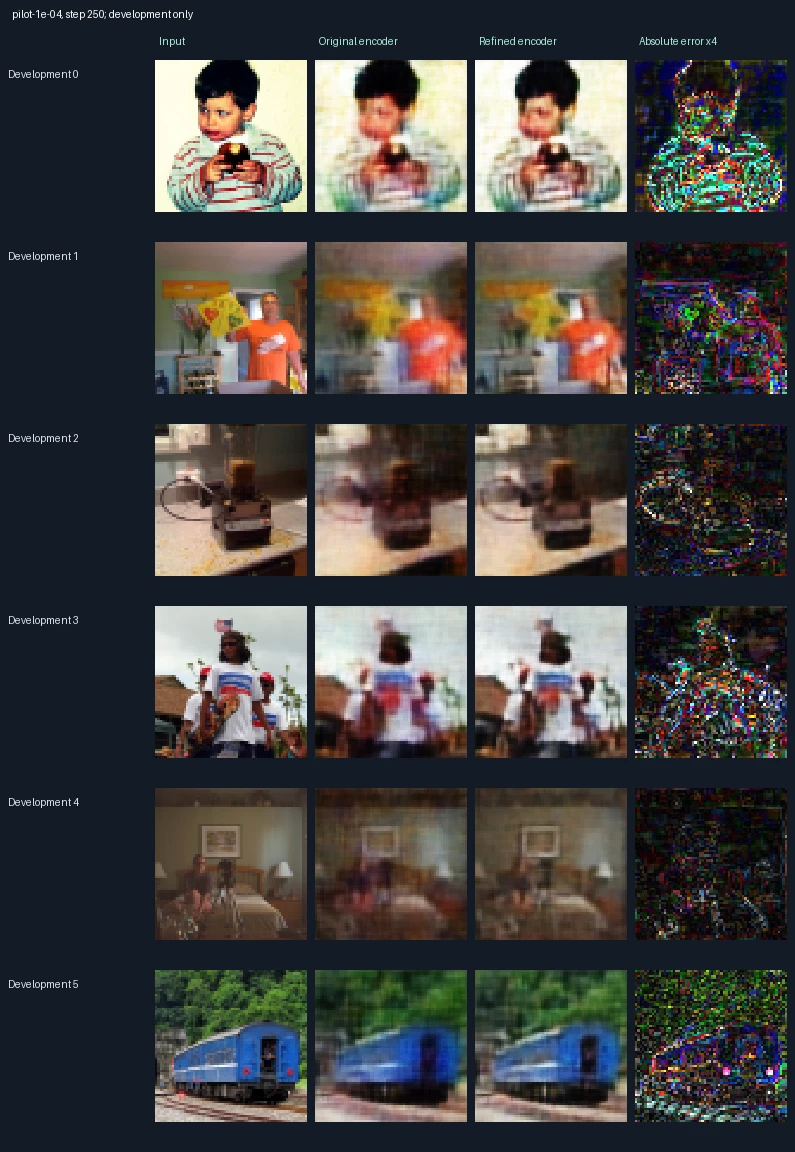
Six fixed development photographs, excluded from gradient updates and used to monitor model quality. Left to right: input pixels, reconstruction from the original encoder’s vector, reconstruction from the refined encoder’s vector, and the refined output’s error. The same fixed decoder reconstructs both vectors. This short trial uses learning rate 1e-04, a setting that controls the size of weight updates. The model receives a 64 × 64 RGB image; photographs are center-cropped and resized before encoding. Enlargement here adds no detail. Error panels show four times the absolute RGB difference from the reference, separately for each color channel, clipped at full brightness. Darker pixels mean smaller errors; black is zero or below the display’s precision. The scale is fixed across examples, not adjusted to make each image look better.
Encoder refinement, learning-rate trial (1e-04): 500 weight updates
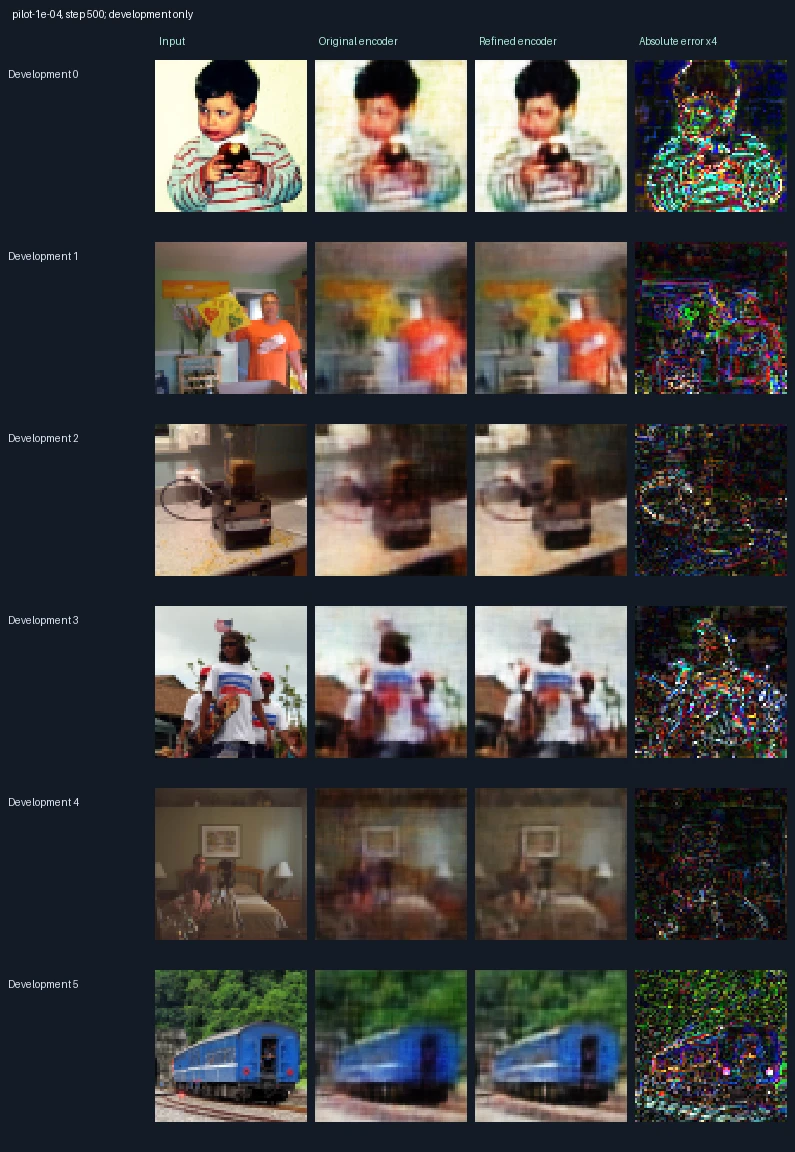
Six fixed development photographs, excluded from gradient updates and used to monitor model quality. Left to right: input pixels, reconstruction from the original encoder’s vector, reconstruction from the refined encoder’s vector, and the refined output’s error. The same fixed decoder reconstructs both vectors. This short trial uses learning rate 1e-04, a setting that controls the size of weight updates. The model receives a 64 × 64 RGB image; photographs are center-cropped and resized before encoding. Enlargement here adds no detail. Error panels show four times the absolute RGB difference from the reference, separately for each color channel, clipped at full brightness. Darker pixels mean smaller errors; black is zero or below the display’s precision. The scale is fixed across examples, not adjusted to make each image look better.
Encoder refinement, training repetition 1: 0 weight updates
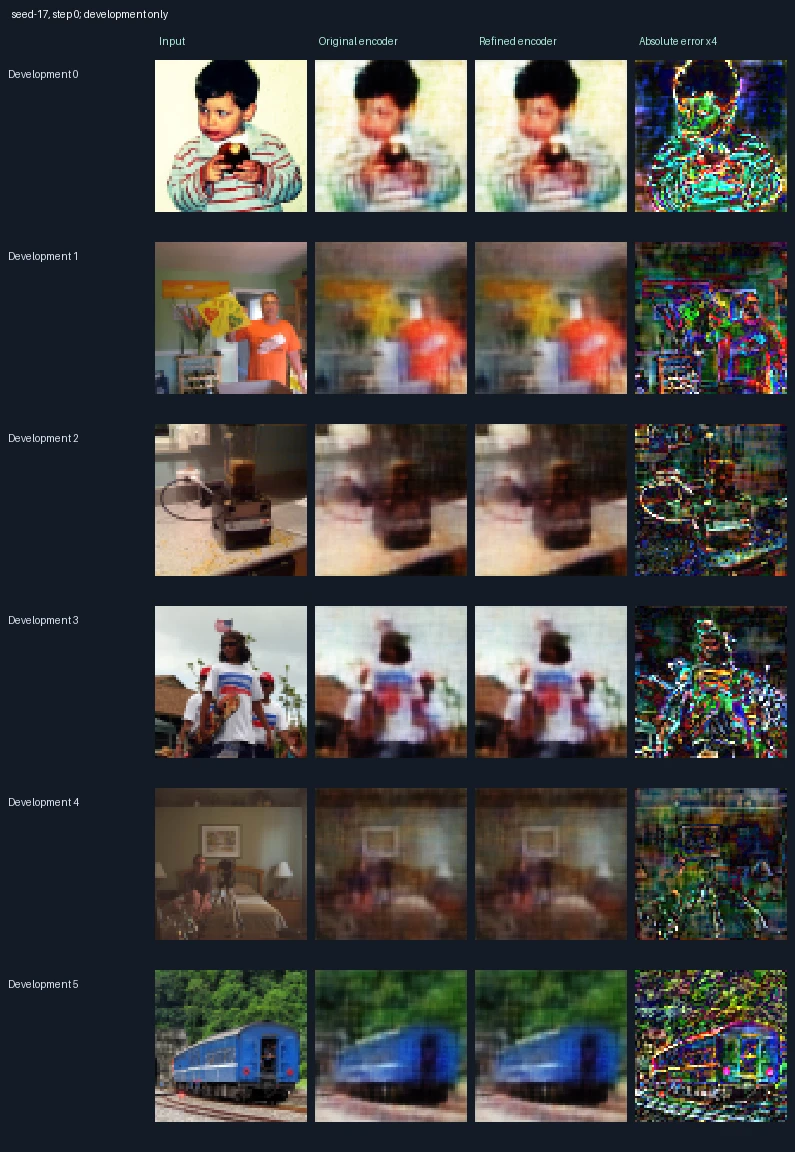
Six fixed development photographs, excluded from gradient updates and used to monitor model quality. Left to right: input pixels, reconstruction from the original encoder’s vector, reconstruction from the refined encoder’s vector, and the refined output’s error. The same fixed decoder reconstructs both vectors. This is training repetition 1; the image label “seed-17” identifies its randomization setting. The model receives a 64 × 64 RGB image; photographs are center-cropped and resized before encoding. Enlargement here adds no detail. Error panels show four times the absolute RGB difference from the reference, separately for each color channel, clipped at full brightness. Darker pixels mean smaller errors; black is zero or below the display’s precision. The scale is fixed across examples, not adjusted to make each image look better. Zero updates records the starting model.
Encoder refinement, training repetition 1: 250 weight updates
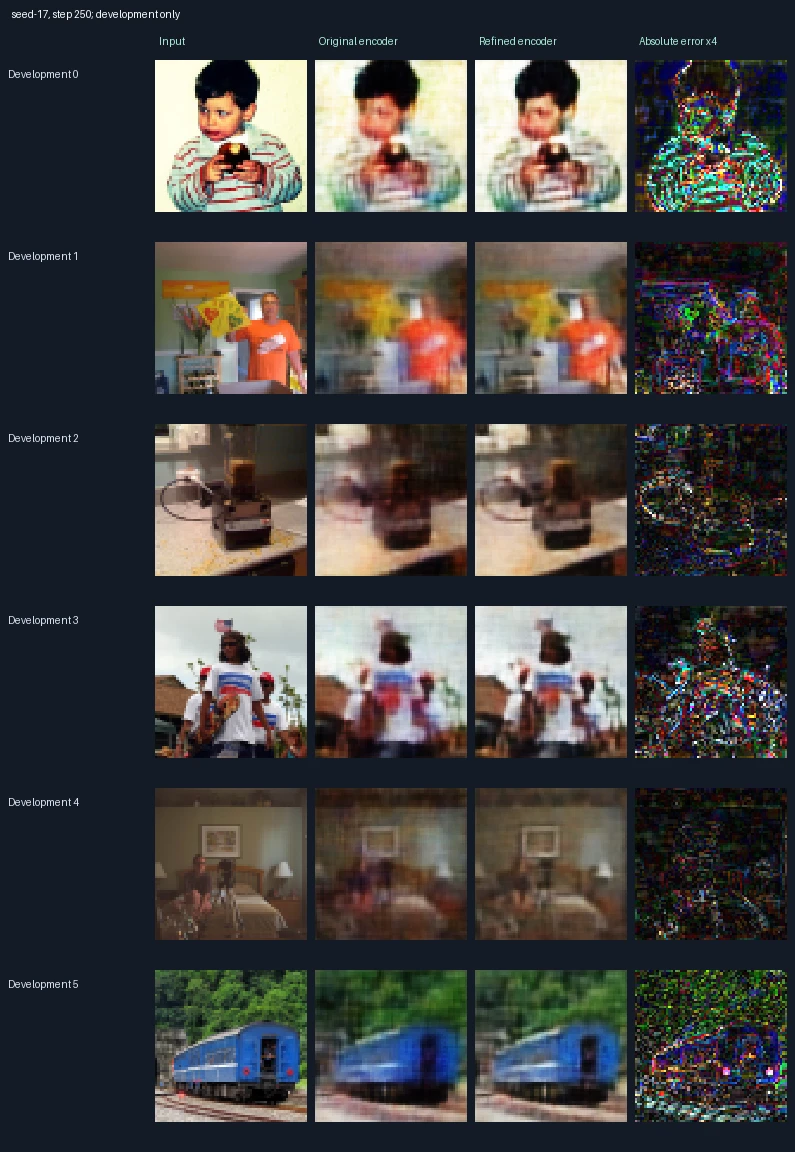
Six fixed development photographs, excluded from gradient updates and used to monitor model quality. Left to right: input pixels, reconstruction from the original encoder’s vector, reconstruction from the refined encoder’s vector, and the refined output’s error. The same fixed decoder reconstructs both vectors. This is training repetition 1; the image label “seed-17” identifies its randomization setting. The model receives a 64 × 64 RGB image; photographs are center-cropped and resized before encoding. Enlargement here adds no detail. Error panels show four times the absolute RGB difference from the reference, separately for each color channel, clipped at full brightness. Darker pixels mean smaller errors; black is zero or below the display’s precision. The scale is fixed across examples, not adjusted to make each image look better.
Encoder refinement, training repetition 1: 500 weight updates
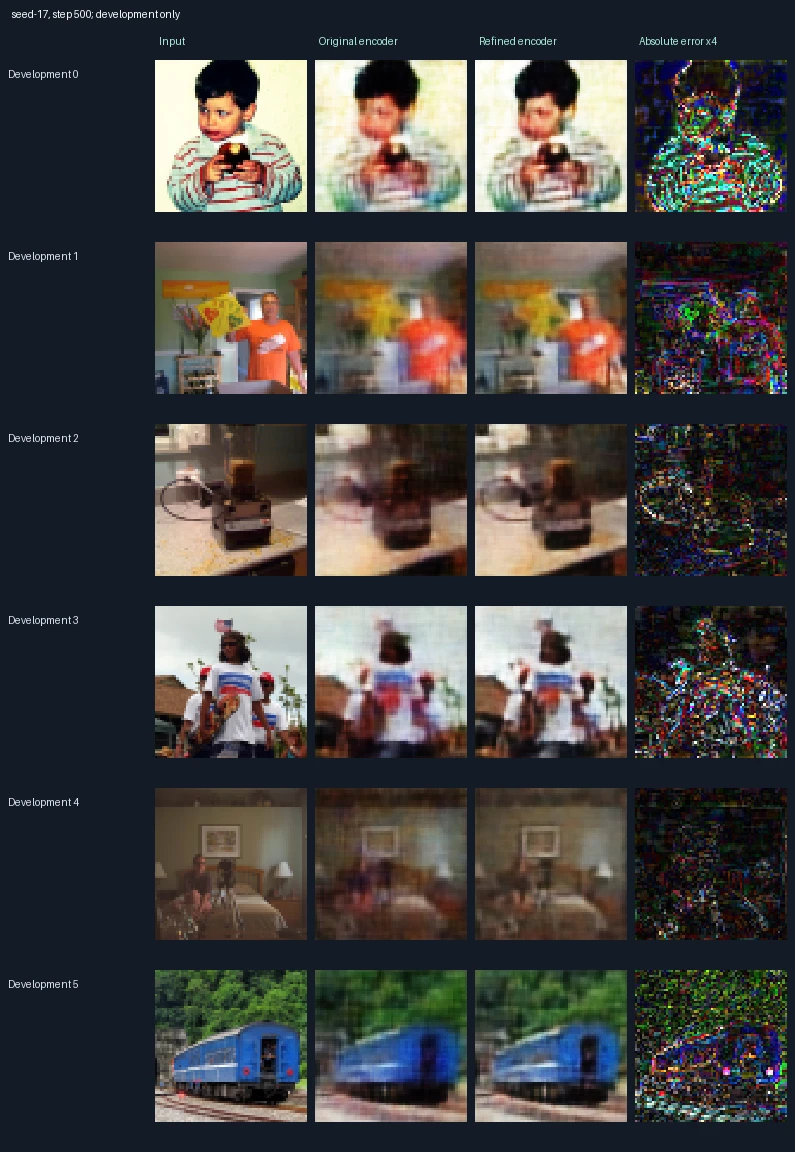
Six fixed development photographs, excluded from gradient updates and used to monitor model quality. Left to right: input pixels, reconstruction from the original encoder’s vector, reconstruction from the refined encoder’s vector, and the refined output’s error. The same fixed decoder reconstructs both vectors. This is training repetition 1; the image label “seed-17” identifies its randomization setting. The model receives a 64 × 64 RGB image; photographs are center-cropped and resized before encoding. Enlargement here adds no detail. Error panels show four times the absolute RGB difference from the reference, separately for each color channel, clipped at full brightness. Darker pixels mean smaller errors; black is zero or below the display’s precision. The scale is fixed across examples, not adjusted to make each image look better.
Encoder refinement, training repetition 1: 750 weight updates
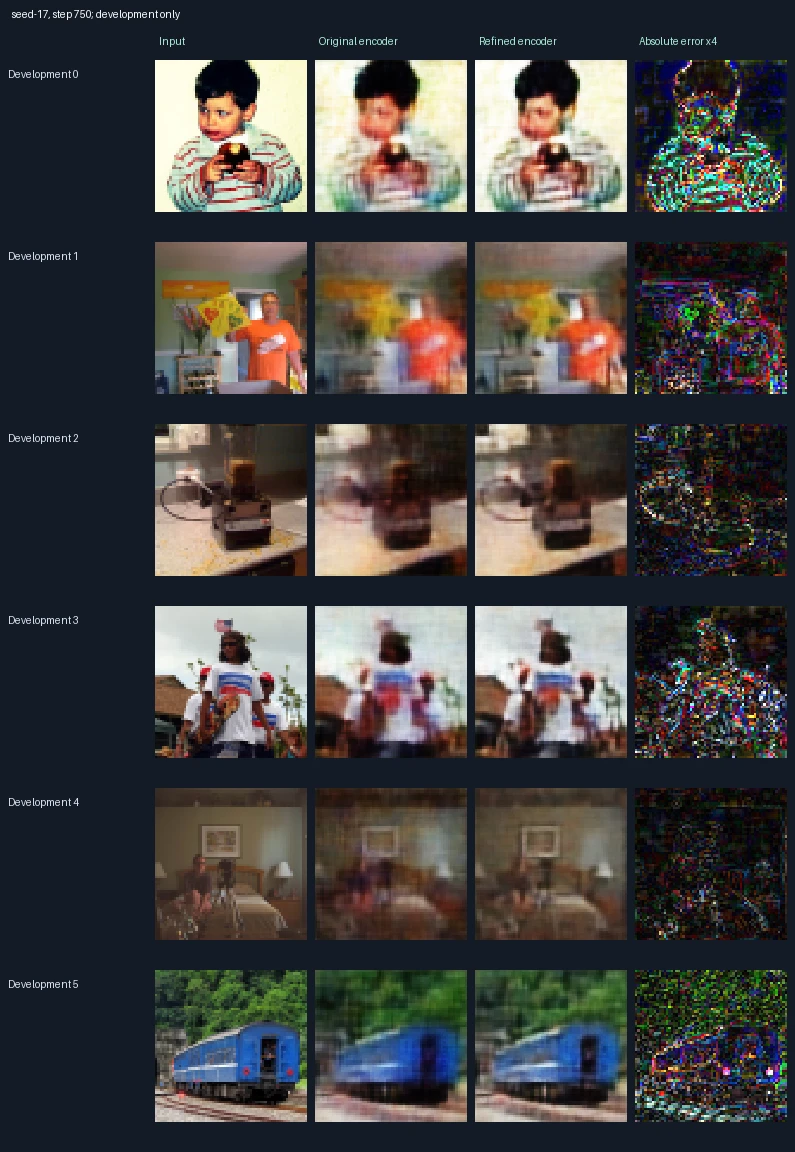
Six fixed development photographs, excluded from gradient updates and used to monitor model quality. Left to right: input pixels, reconstruction from the original encoder’s vector, reconstruction from the refined encoder’s vector, and the refined output’s error. The same fixed decoder reconstructs both vectors. This is training repetition 1; the image label “seed-17” identifies its randomization setting. The model receives a 64 × 64 RGB image; photographs are center-cropped and resized before encoding. Enlargement here adds no detail. Error panels show four times the absolute RGB difference from the reference, separately for each color channel, clipped at full brightness. Darker pixels mean smaller errors; black is zero or below the display’s precision. The scale is fixed across examples, not adjusted to make each image look better.
Encoder refinement, training repetition 1: 1,000 weight updates
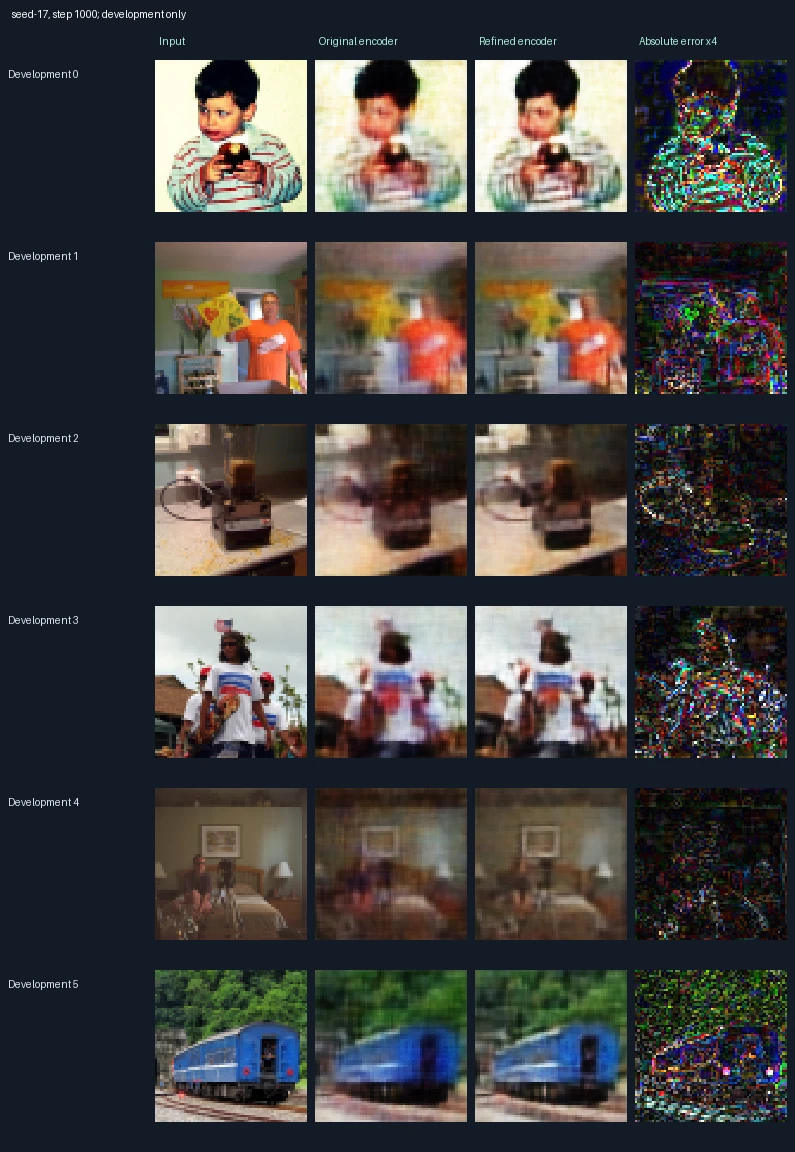
Six fixed development photographs, excluded from gradient updates and used to monitor model quality. Left to right: input pixels, reconstruction from the original encoder’s vector, reconstruction from the refined encoder’s vector, and the refined output’s error. The same fixed decoder reconstructs both vectors. This is training repetition 1; the image label “seed-17” identifies its randomization setting. The model receives a 64 × 64 RGB image; photographs are center-cropped and resized before encoding. Enlargement here adds no detail. Error panels show four times the absolute RGB difference from the reference, separately for each color channel, clipped at full brightness. Darker pixels mean smaller errors; black is zero or below the display’s precision. The scale is fixed across examples, not adjusted to make each image look better.
Encoder refinement, training repetition 1: 1,250 weight updates
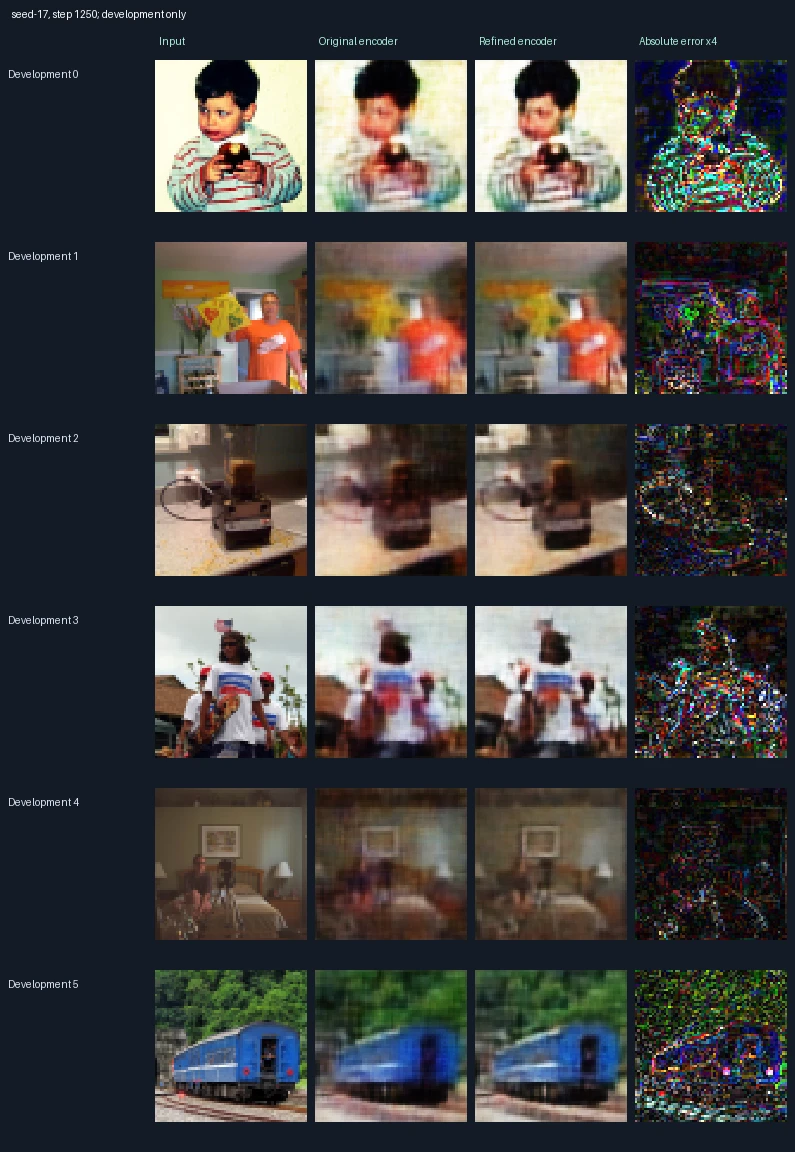
Six fixed development photographs, excluded from gradient updates and used to monitor model quality. Left to right: input pixels, reconstruction from the original encoder’s vector, reconstruction from the refined encoder’s vector, and the refined output’s error. The same fixed decoder reconstructs both vectors. This is training repetition 1; the image label “seed-17” identifies its randomization setting. The model receives a 64 × 64 RGB image; photographs are center-cropped and resized before encoding. Enlargement here adds no detail. Error panels show four times the absolute RGB difference from the reference, separately for each color channel, clipped at full brightness. Darker pixels mean smaller errors; black is zero or below the display’s precision. The scale is fixed across examples, not adjusted to make each image look better.
Encoder refinement, training repetition 1: 1,500 weight updates
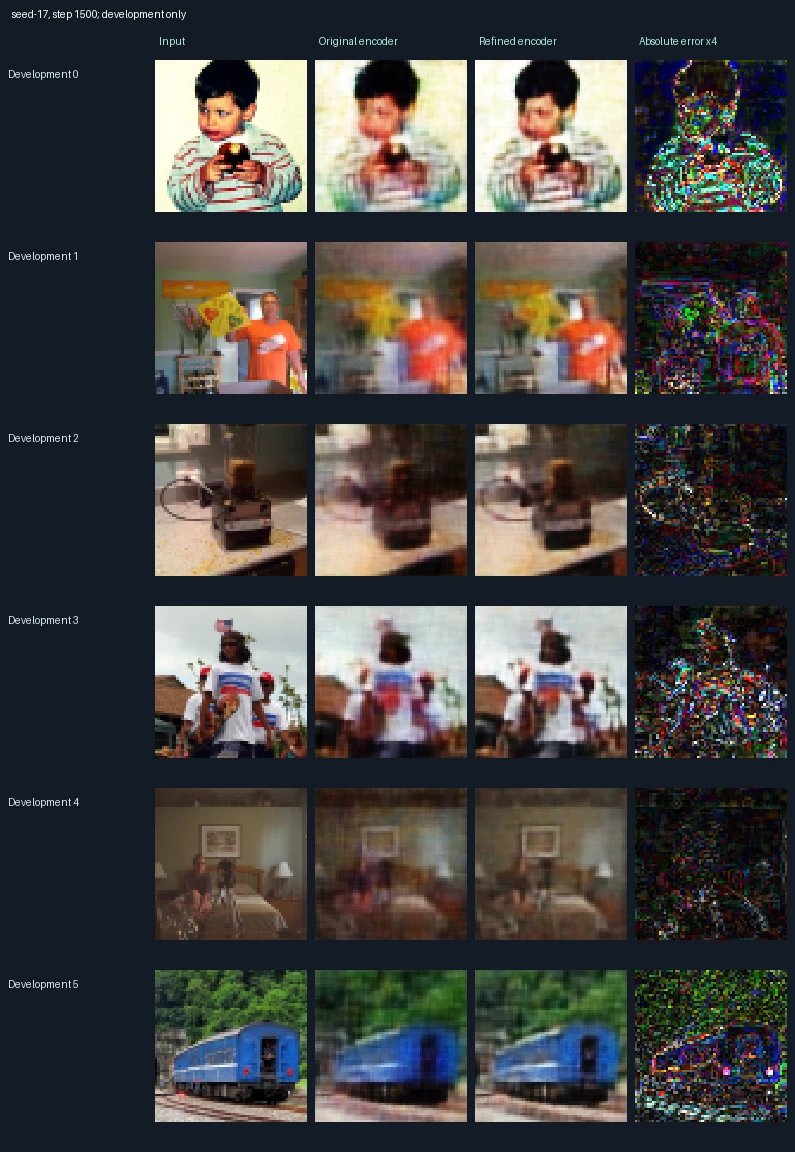
Six fixed development photographs, excluded from gradient updates and used to monitor model quality. Left to right: input pixels, reconstruction from the original encoder’s vector, reconstruction from the refined encoder’s vector, and the refined output’s error. The same fixed decoder reconstructs both vectors. This is training repetition 1; the image label “seed-17” identifies its randomization setting. The model receives a 64 × 64 RGB image; photographs are center-cropped and resized before encoding. Enlargement here adds no detail. Error panels show four times the absolute RGB difference from the reference, separately for each color channel, clipped at full brightness. Darker pixels mean smaller errors; black is zero or below the display’s precision. The scale is fixed across examples, not adjusted to make each image look better.
Encoder refinement, training repetition 1: 1,750 weight updates
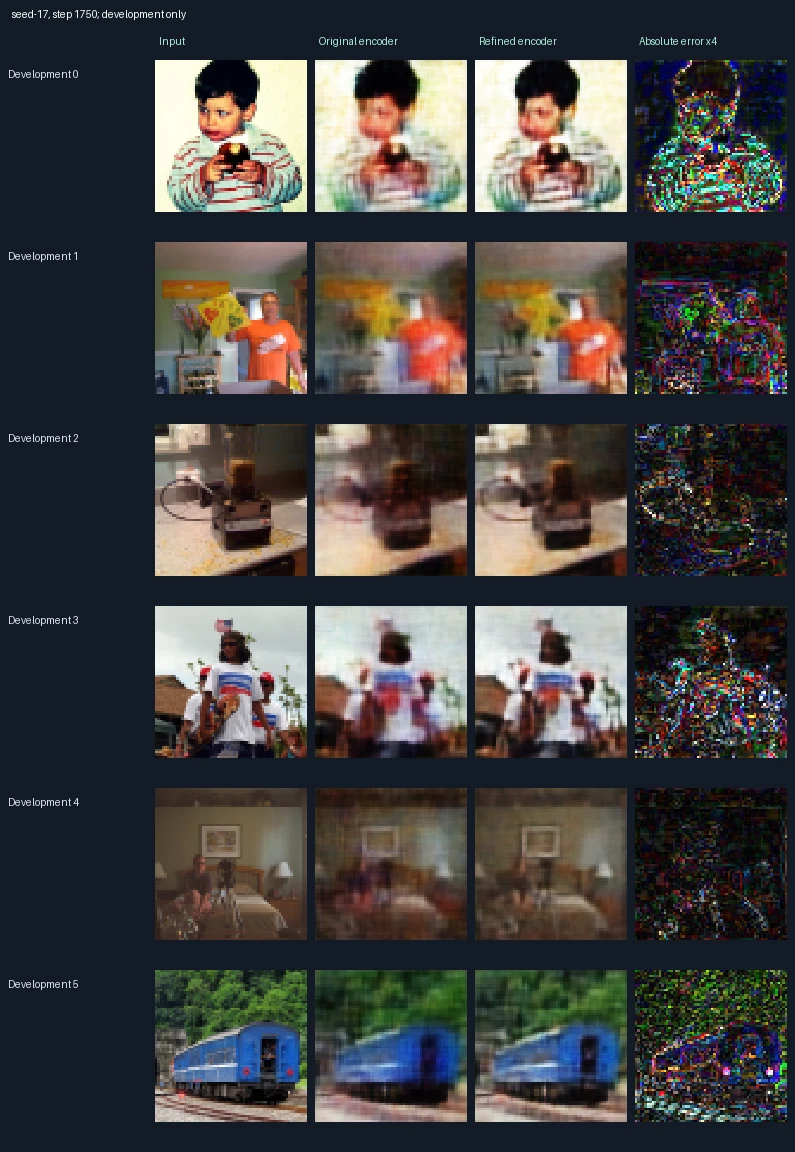
Six fixed development photographs, excluded from gradient updates and used to monitor model quality. Left to right: input pixels, reconstruction from the original encoder’s vector, reconstruction from the refined encoder’s vector, and the refined output’s error. The same fixed decoder reconstructs both vectors. This is training repetition 1; the image label “seed-17” identifies its randomization setting. The model receives a 64 × 64 RGB image; photographs are center-cropped and resized before encoding. Enlargement here adds no detail. Error panels show four times the absolute RGB difference from the reference, separately for each color channel, clipped at full brightness. Darker pixels mean smaller errors; black is zero or below the display’s precision. The scale is fixed across examples, not adjusted to make each image look better.
Encoder refinement, training repetition 1: 2,000 weight updates
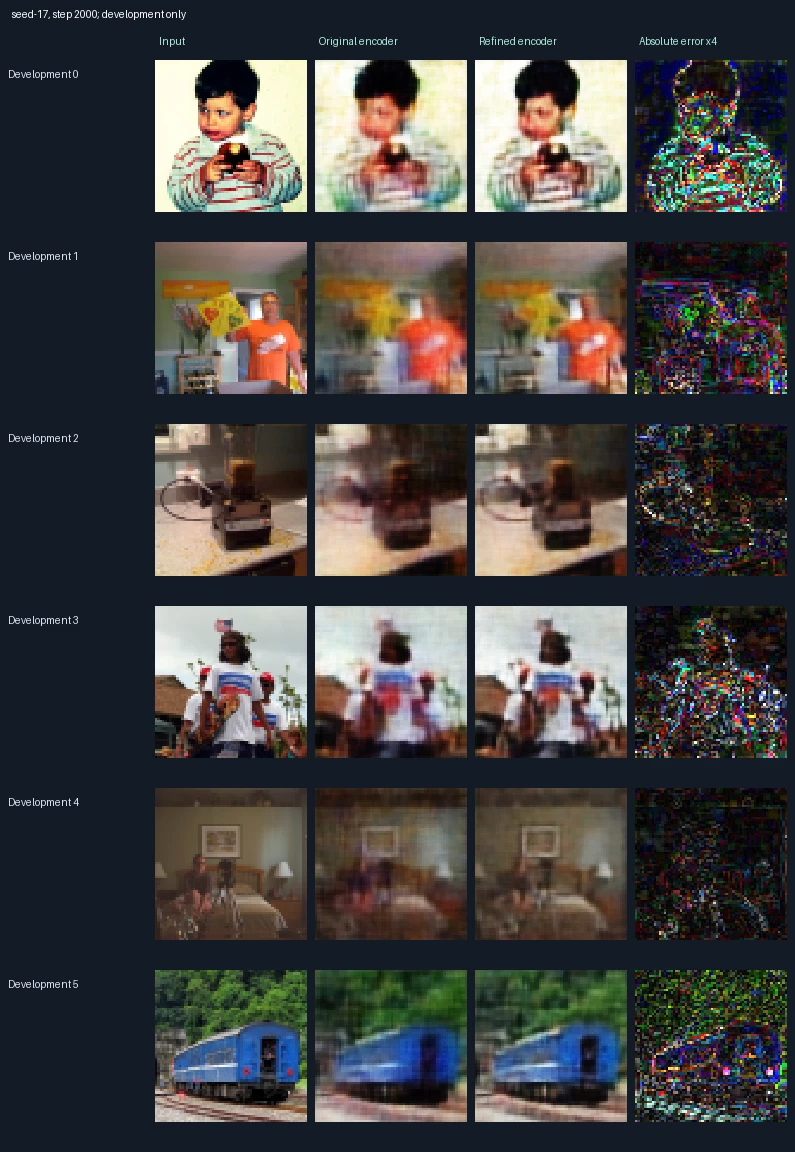
Six fixed development photographs, excluded from gradient updates and used to monitor model quality. Left to right: input pixels, reconstruction from the original encoder’s vector, reconstruction from the refined encoder’s vector, and the refined output’s error. The same fixed decoder reconstructs both vectors. This is training repetition 1; the image label “seed-17” identifies its randomization setting. The model receives a 64 × 64 RGB image; photographs are center-cropped and resized before encoding. Enlargement here adds no detail. Error panels show four times the absolute RGB difference from the reference, separately for each color channel, clipped at full brightness. Darker pixels mean smaller errors; black is zero or below the display’s precision. The scale is fixed across examples, not adjusted to make each image look better.
Encoder refinement, training repetition 1: 2,250 weight updates
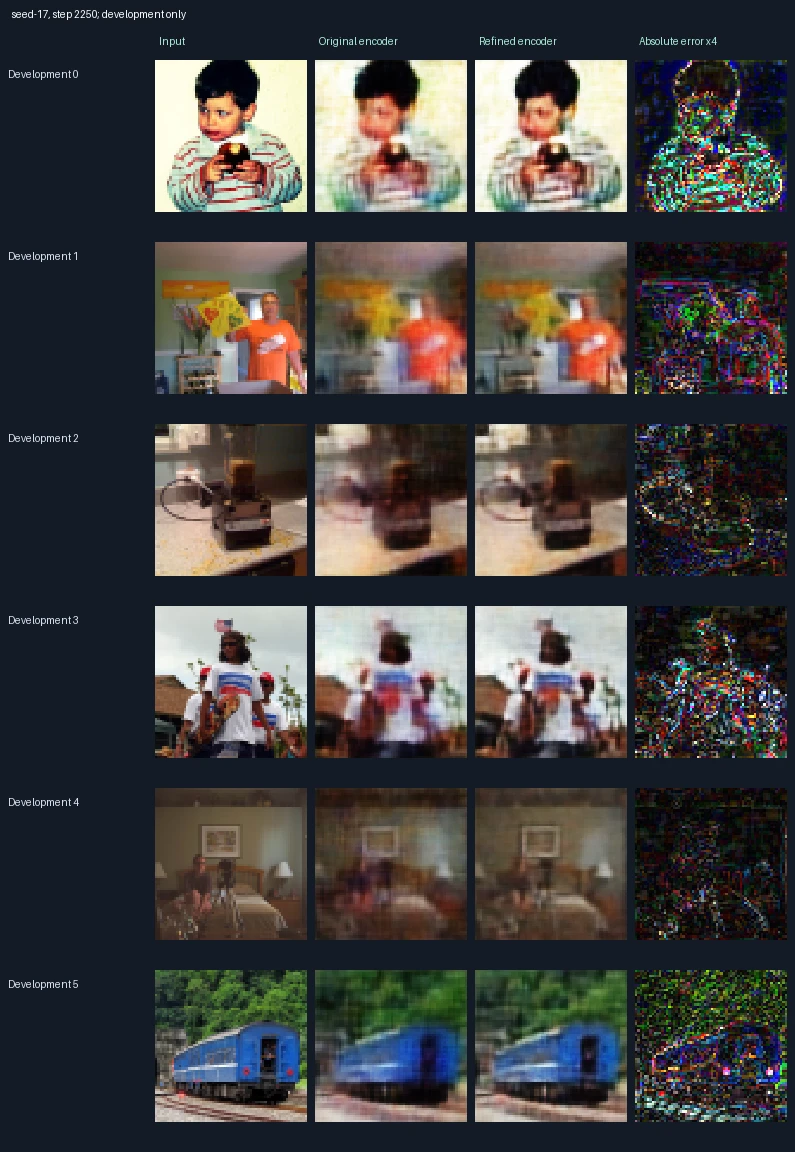
Six fixed development photographs, excluded from gradient updates and used to monitor model quality. Left to right: input pixels, reconstruction from the original encoder’s vector, reconstruction from the refined encoder’s vector, and the refined output’s error. The same fixed decoder reconstructs both vectors. This is training repetition 1; the image label “seed-17” identifies its randomization setting. The model receives a 64 × 64 RGB image; photographs are center-cropped and resized before encoding. Enlargement here adds no detail. Error panels show four times the absolute RGB difference from the reference, separately for each color channel, clipped at full brightness. Darker pixels mean smaller errors; black is zero or below the display’s precision. The scale is fixed across examples, not adjusted to make each image look better.
Encoder refinement, training repetition 1: 2,500 weight updates
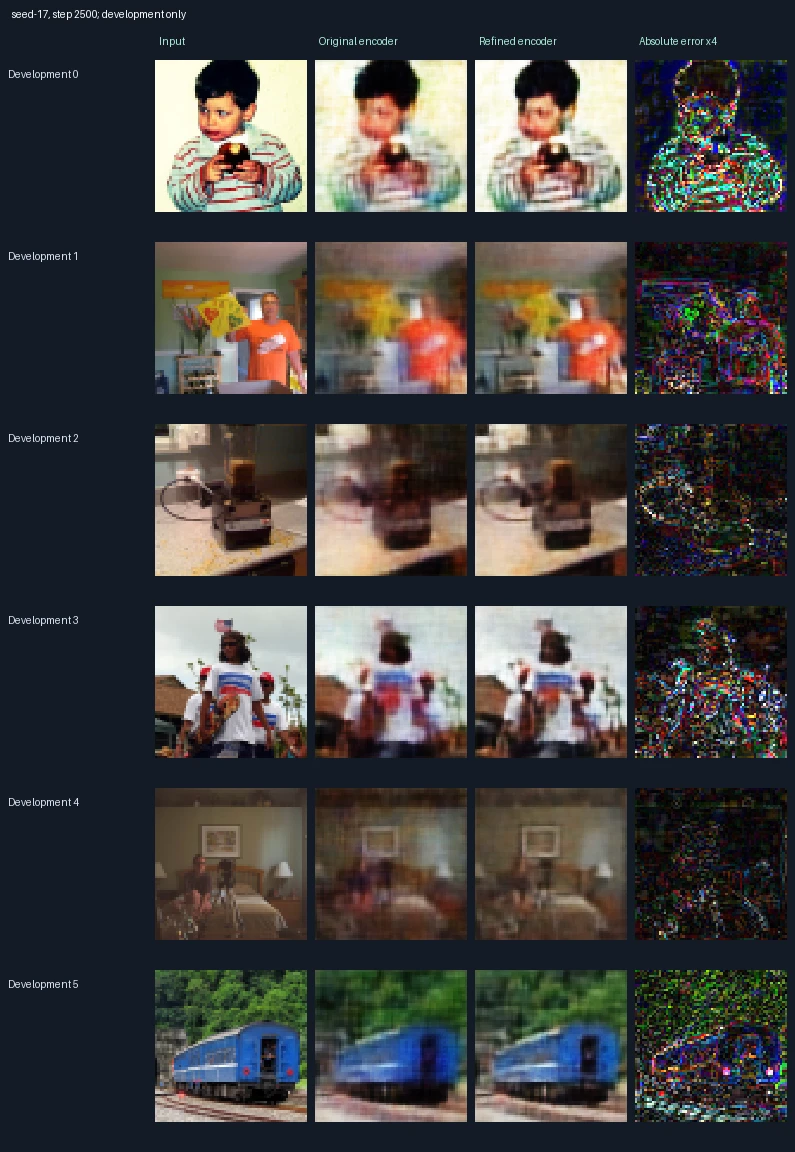
Six fixed development photographs, excluded from gradient updates and used to monitor model quality. Left to right: input pixels, reconstruction from the original encoder’s vector, reconstruction from the refined encoder’s vector, and the refined output’s error. The same fixed decoder reconstructs both vectors. This is training repetition 1; the image label “seed-17” identifies its randomization setting. The model receives a 64 × 64 RGB image; photographs are center-cropped and resized before encoding. Enlargement here adds no detail. Error panels show four times the absolute RGB difference from the reference, separately for each color channel, clipped at full brightness. Darker pixels mean smaller errors; black is zero or below the display’s precision. The scale is fixed across examples, not adjusted to make each image look better.
Encoder refinement, training repetition 1: 2,750 weight updates
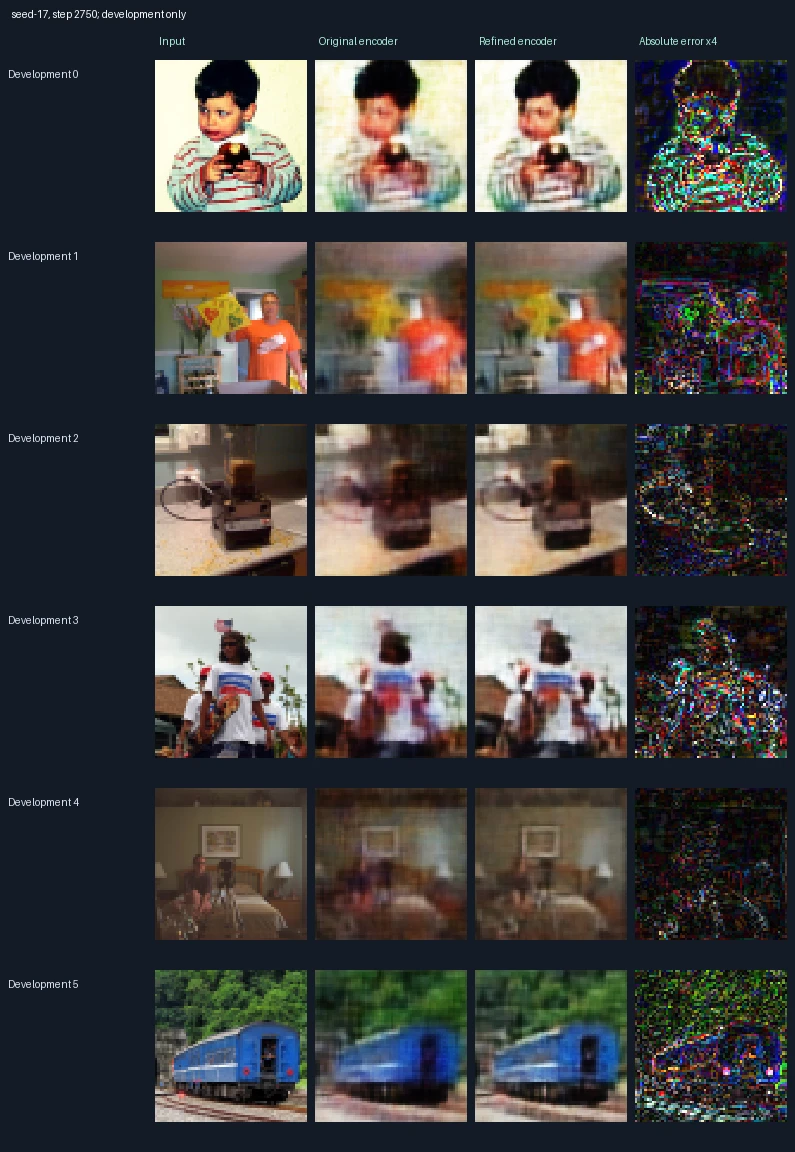
Six fixed development photographs, excluded from gradient updates and used to monitor model quality. Left to right: input pixels, reconstruction from the original encoder’s vector, reconstruction from the refined encoder’s vector, and the refined output’s error. The same fixed decoder reconstructs both vectors. This is training repetition 1; the image label “seed-17” identifies its randomization setting. The model receives a 64 × 64 RGB image; photographs are center-cropped and resized before encoding. Enlargement here adds no detail. Error panels show four times the absolute RGB difference from the reference, separately for each color channel, clipped at full brightness. Darker pixels mean smaller errors; black is zero or below the display’s precision. The scale is fixed across examples, not adjusted to make each image look better.
Encoder refinement, training repetition 1: 3,000 weight updates
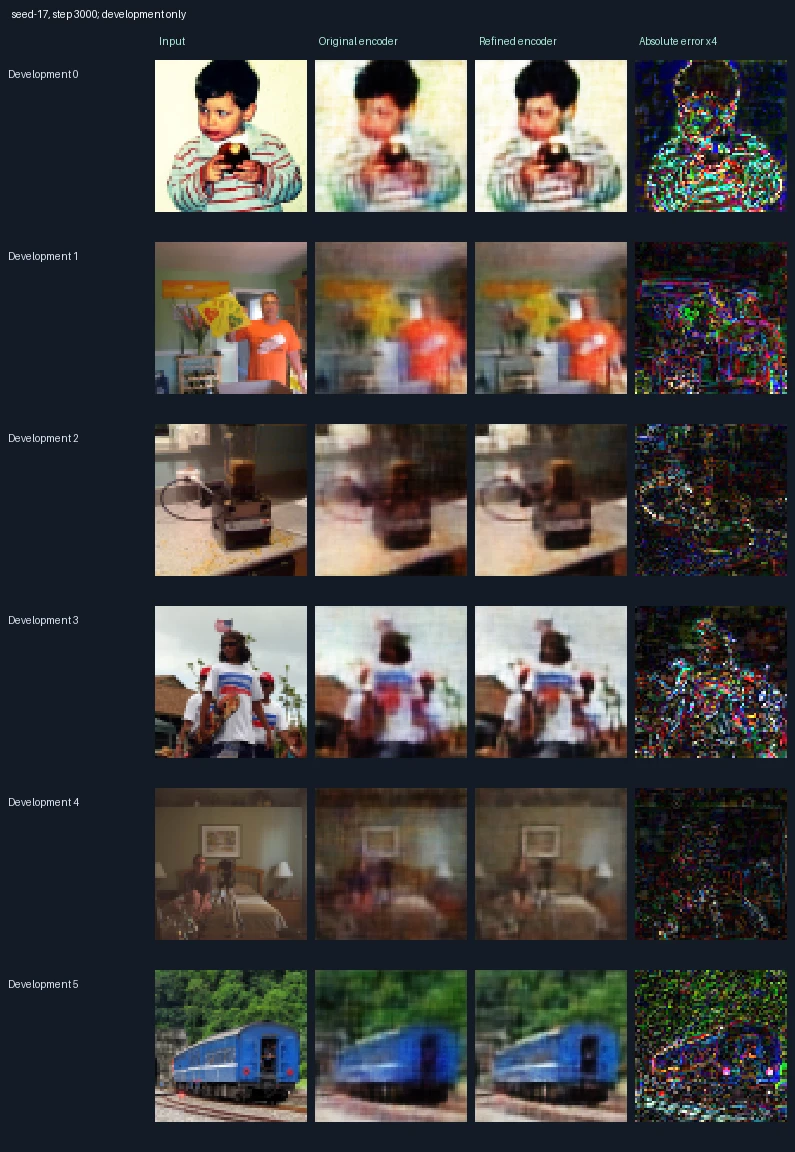
Six fixed development photographs, excluded from gradient updates and used to monitor model quality. Left to right: input pixels, reconstruction from the original encoder’s vector, reconstruction from the refined encoder’s vector, and the refined output’s error. The same fixed decoder reconstructs both vectors. This is training repetition 1; the image label “seed-17” identifies its randomization setting. The model receives a 64 × 64 RGB image; photographs are center-cropped and resized before encoding. Enlargement here adds no detail. Error panels show four times the absolute RGB difference from the reference, separately for each color channel, clipped at full brightness. Darker pixels mean smaller errors; black is zero or below the display’s precision. The scale is fixed across examples, not adjusted to make each image look better.
Encoder refinement, training repetition 1: 3,250 weight updates
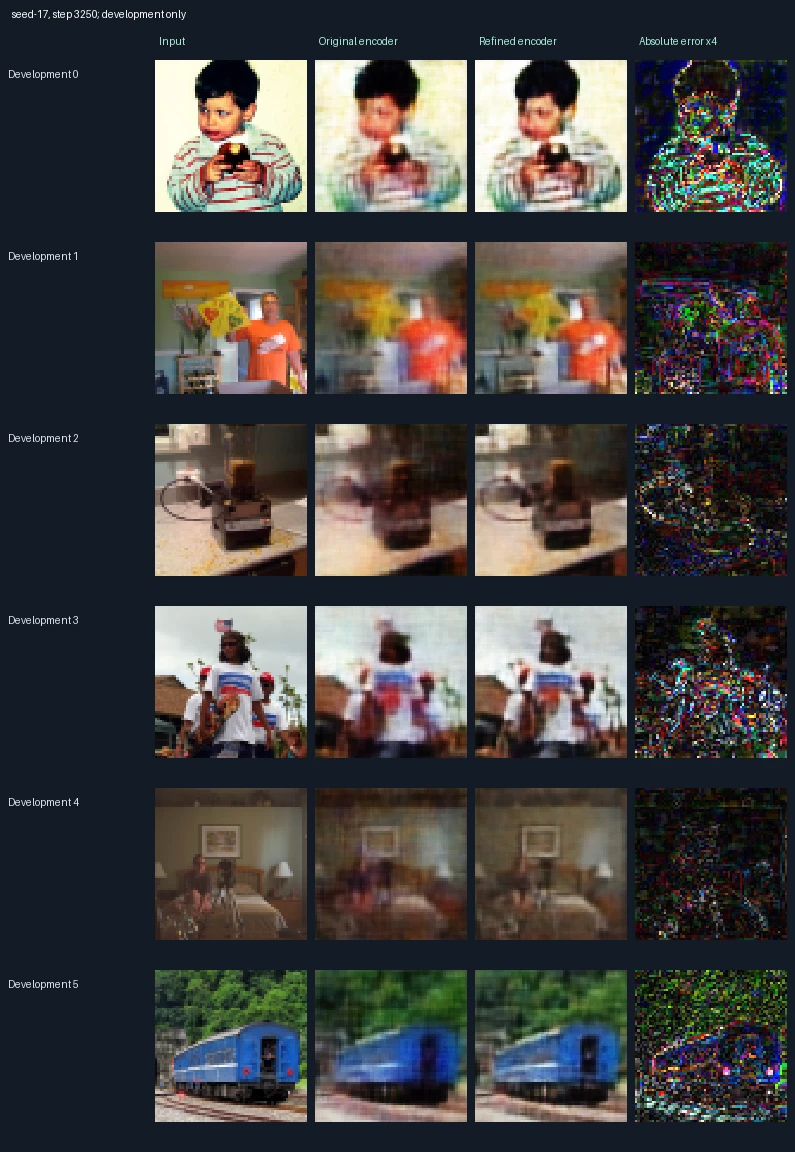
Six fixed development photographs, excluded from gradient updates and used to monitor model quality. Left to right: input pixels, reconstruction from the original encoder’s vector, reconstruction from the refined encoder’s vector, and the refined output’s error. The same fixed decoder reconstructs both vectors. This is training repetition 1; the image label “seed-17” identifies its randomization setting. The model receives a 64 × 64 RGB image; photographs are center-cropped and resized before encoding. Enlargement here adds no detail. Error panels show four times the absolute RGB difference from the reference, separately for each color channel, clipped at full brightness. Darker pixels mean smaller errors; black is zero or below the display’s precision. The scale is fixed across examples, not adjusted to make each image look better.
Encoder refinement, training repetition 1: 3,500 weight updates
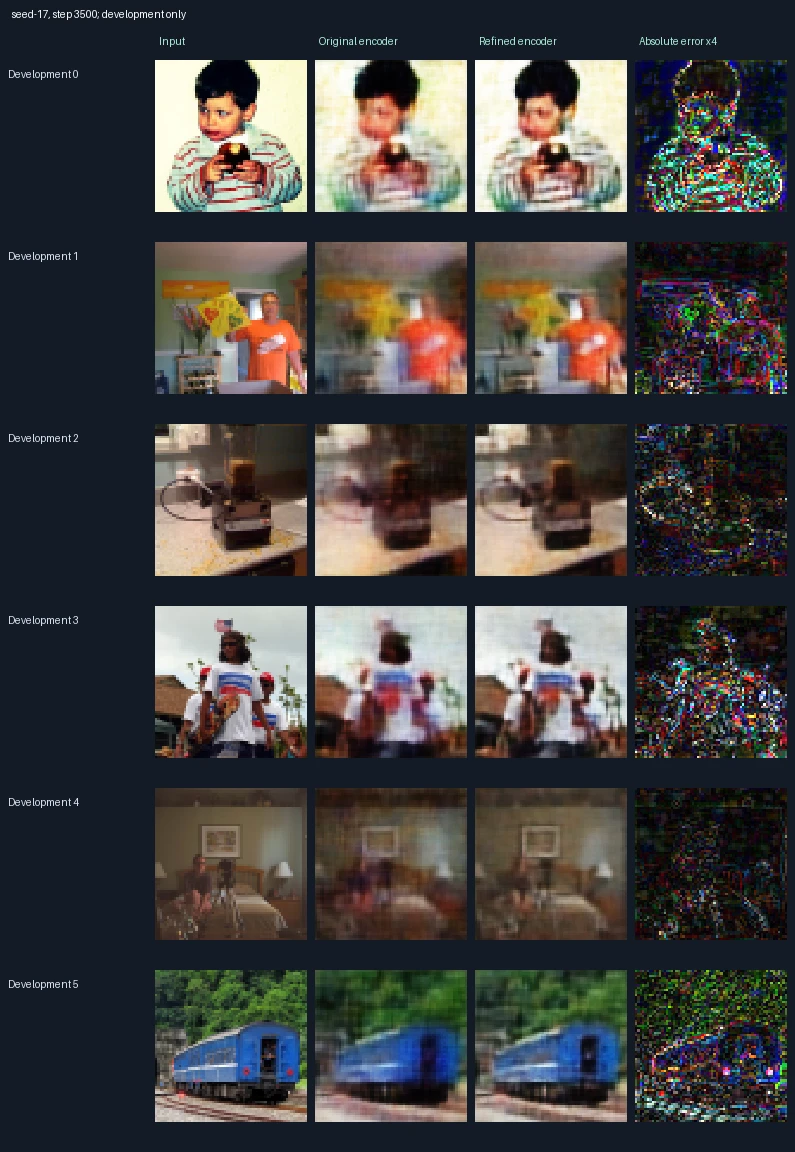
Six fixed development photographs, excluded from gradient updates and used to monitor model quality. Left to right: input pixels, reconstruction from the original encoder’s vector, reconstruction from the refined encoder’s vector, and the refined output’s error. The same fixed decoder reconstructs both vectors. This is training repetition 1; the image label “seed-17” identifies its randomization setting. The model receives a 64 × 64 RGB image; photographs are center-cropped and resized before encoding. Enlargement here adds no detail. Error panels show four times the absolute RGB difference from the reference, separately for each color channel, clipped at full brightness. Darker pixels mean smaller errors; black is zero or below the display’s precision. The scale is fixed across examples, not adjusted to make each image look better.
Encoder refinement, training repetition 1: 3,750 weight updates
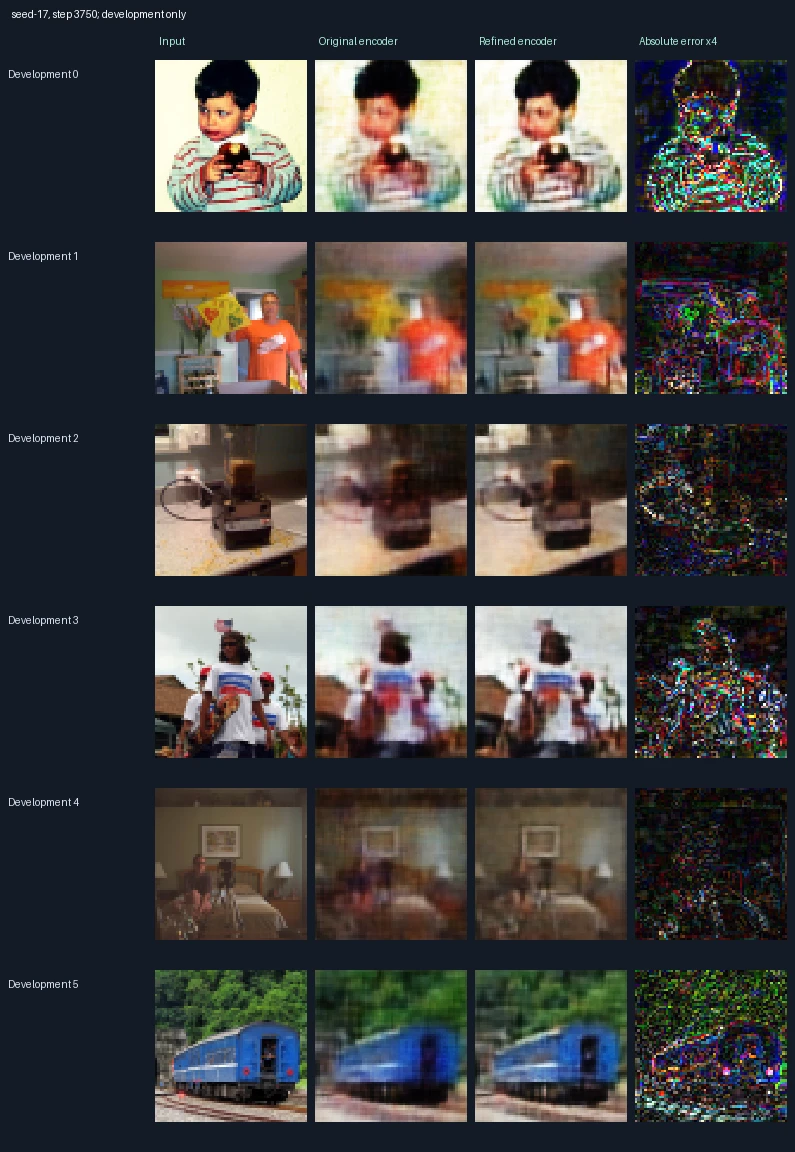
Six fixed development photographs, excluded from gradient updates and used to monitor model quality. Left to right: input pixels, reconstruction from the original encoder’s vector, reconstruction from the refined encoder’s vector, and the refined output’s error. The same fixed decoder reconstructs both vectors. This is training repetition 1; the image label “seed-17” identifies its randomization setting. The model receives a 64 × 64 RGB image; photographs are center-cropped and resized before encoding. Enlargement here adds no detail. Error panels show four times the absolute RGB difference from the reference, separately for each color channel, clipped at full brightness. Darker pixels mean smaller errors; black is zero or below the display’s precision. The scale is fixed across examples, not adjusted to make each image look better.
Encoder refinement, training repetition 1: 4,000 weight updates
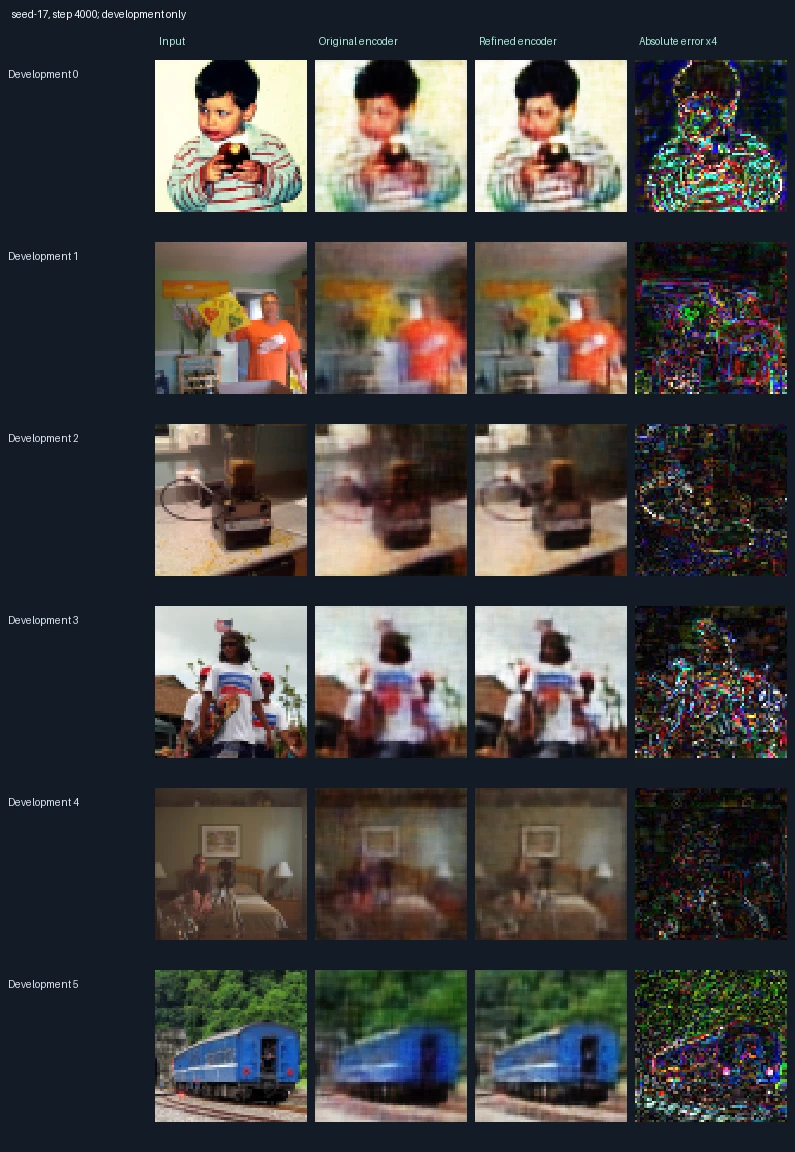
Six fixed development photographs, excluded from gradient updates and used to monitor model quality. Left to right: input pixels, reconstruction from the original encoder’s vector, reconstruction from the refined encoder’s vector, and the refined output’s error. The same fixed decoder reconstructs both vectors. This is training repetition 1; the image label “seed-17” identifies its randomization setting. The model receives a 64 × 64 RGB image; photographs are center-cropped and resized before encoding. Enlargement here adds no detail. Error panels show four times the absolute RGB difference from the reference, separately for each color channel, clipped at full brightness. Darker pixels mean smaller errors; black is zero or below the display’s precision. The scale is fixed across examples, not adjusted to make each image look better.
Encoder refinement, training repetition 2: 0 weight updates
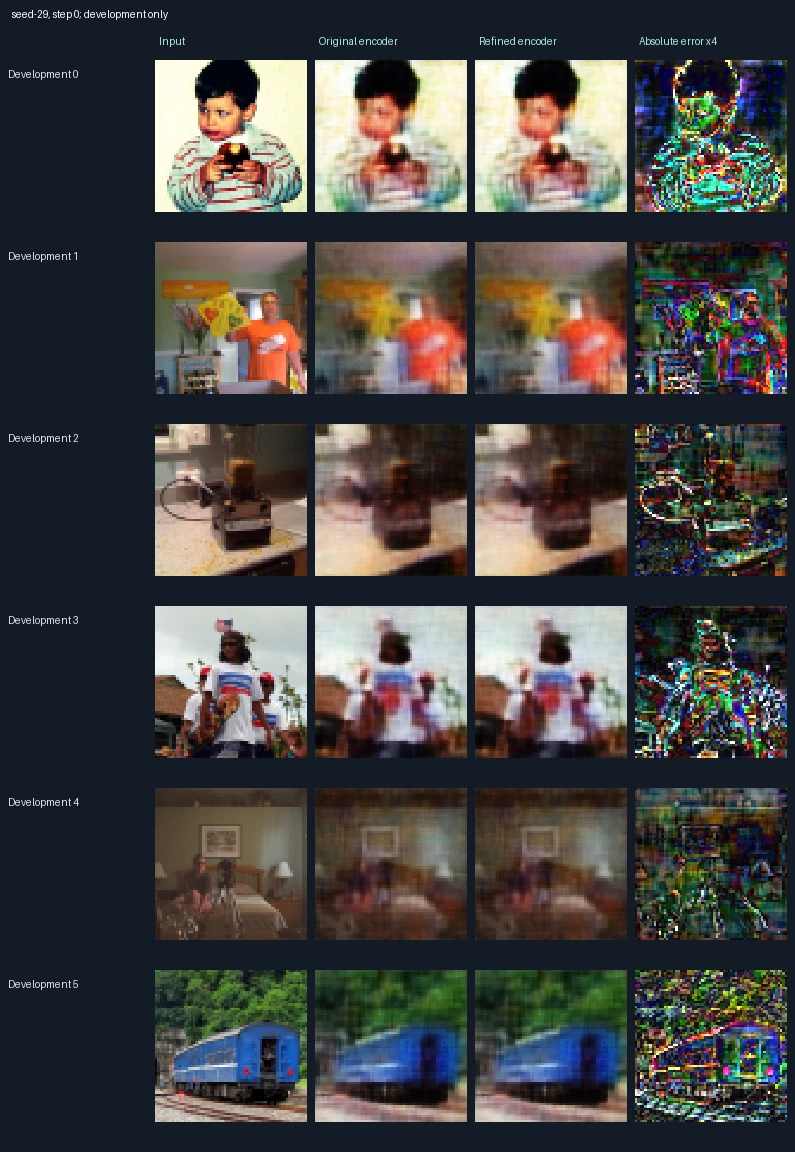
Six fixed development photographs, excluded from gradient updates and used to monitor model quality. Left to right: input pixels, reconstruction from the original encoder’s vector, reconstruction from the refined encoder’s vector, and the refined output’s error. The same fixed decoder reconstructs both vectors. This is training repetition 2; the image label “seed-29” identifies its randomization setting. The model receives a 64 × 64 RGB image; photographs are center-cropped and resized before encoding. Enlargement here adds no detail. Error panels show four times the absolute RGB difference from the reference, separately for each color channel, clipped at full brightness. Darker pixels mean smaller errors; black is zero or below the display’s precision. The scale is fixed across examples, not adjusted to make each image look better. Zero updates records the starting model.
Encoder refinement, training repetition 2: 250 weight updates
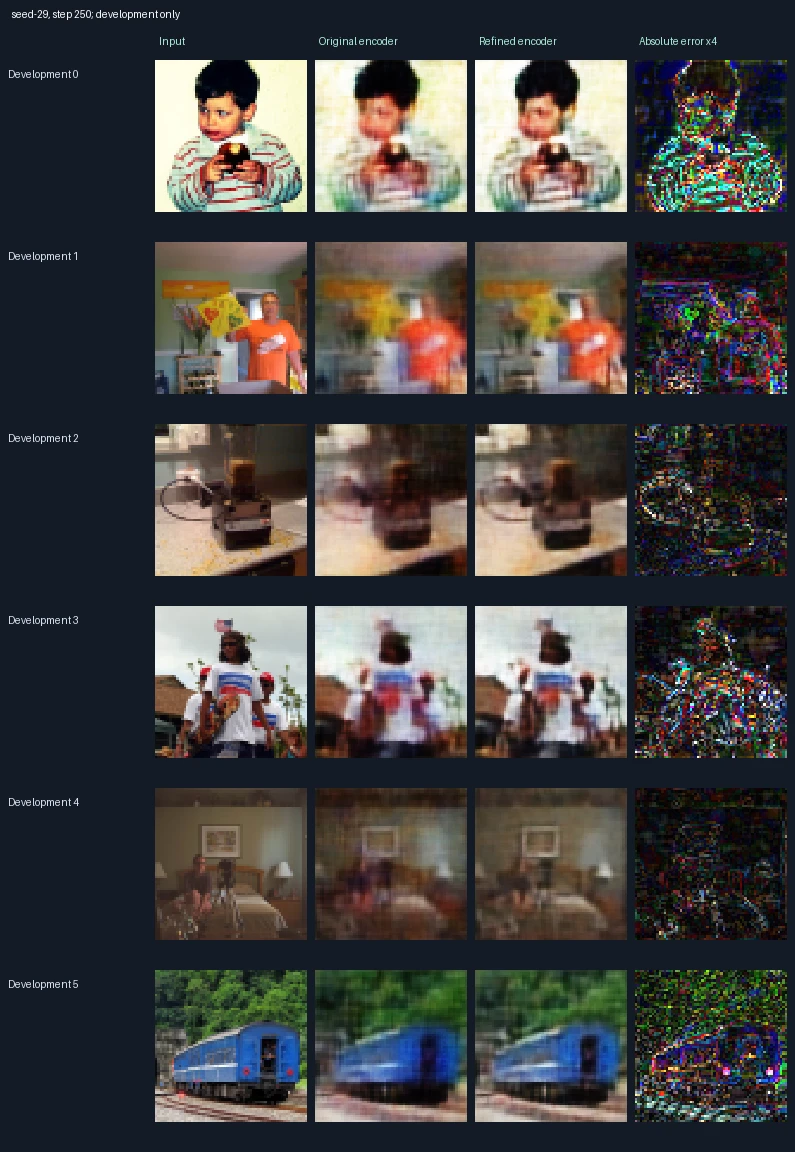
Six fixed development photographs, excluded from gradient updates and used to monitor model quality. Left to right: input pixels, reconstruction from the original encoder’s vector, reconstruction from the refined encoder’s vector, and the refined output’s error. The same fixed decoder reconstructs both vectors. This is training repetition 2; the image label “seed-29” identifies its randomization setting. The model receives a 64 × 64 RGB image; photographs are center-cropped and resized before encoding. Enlargement here adds no detail. Error panels show four times the absolute RGB difference from the reference, separately for each color channel, clipped at full brightness. Darker pixels mean smaller errors; black is zero or below the display’s precision. The scale is fixed across examples, not adjusted to make each image look better.
Encoder refinement, training repetition 2: 500 weight updates
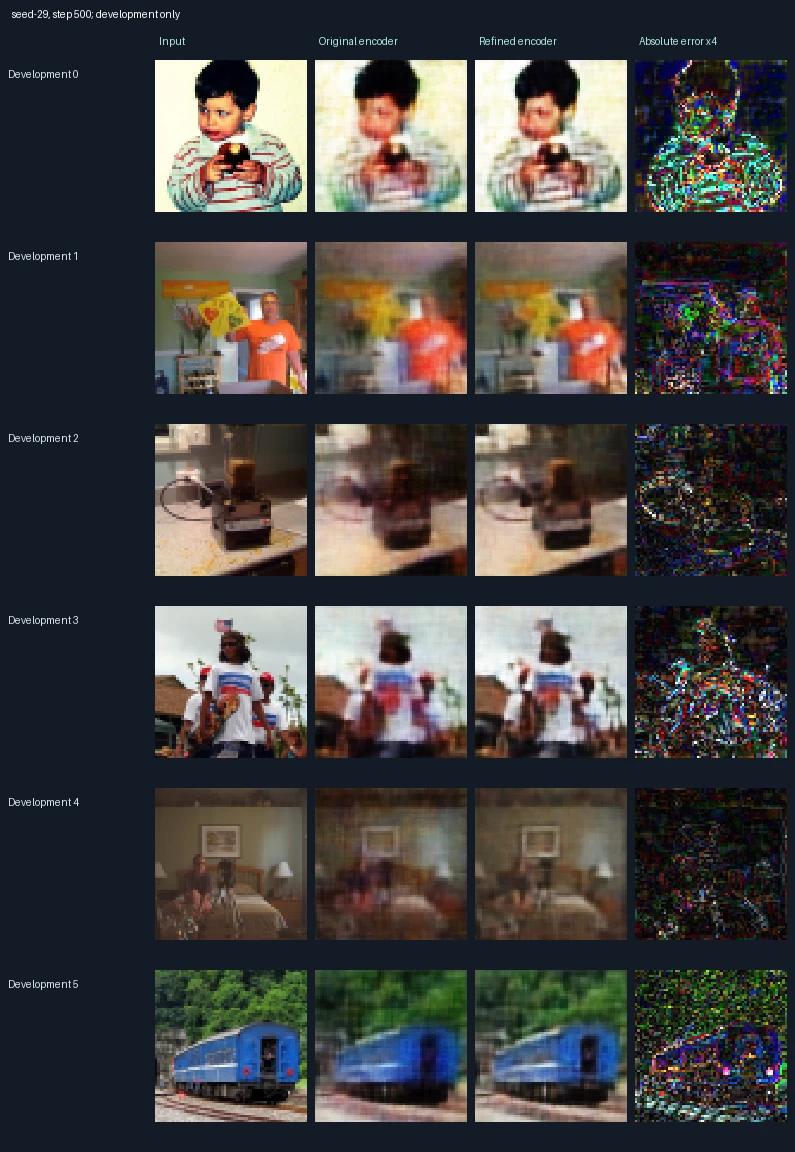
Six fixed development photographs, excluded from gradient updates and used to monitor model quality. Left to right: input pixels, reconstruction from the original encoder’s vector, reconstruction from the refined encoder’s vector, and the refined output’s error. The same fixed decoder reconstructs both vectors. This is training repetition 2; the image label “seed-29” identifies its randomization setting. The model receives a 64 × 64 RGB image; photographs are center-cropped and resized before encoding. Enlargement here adds no detail. Error panels show four times the absolute RGB difference from the reference, separately for each color channel, clipped at full brightness. Darker pixels mean smaller errors; black is zero or below the display’s precision. The scale is fixed across examples, not adjusted to make each image look better.
Encoder refinement, training repetition 2: 750 weight updates
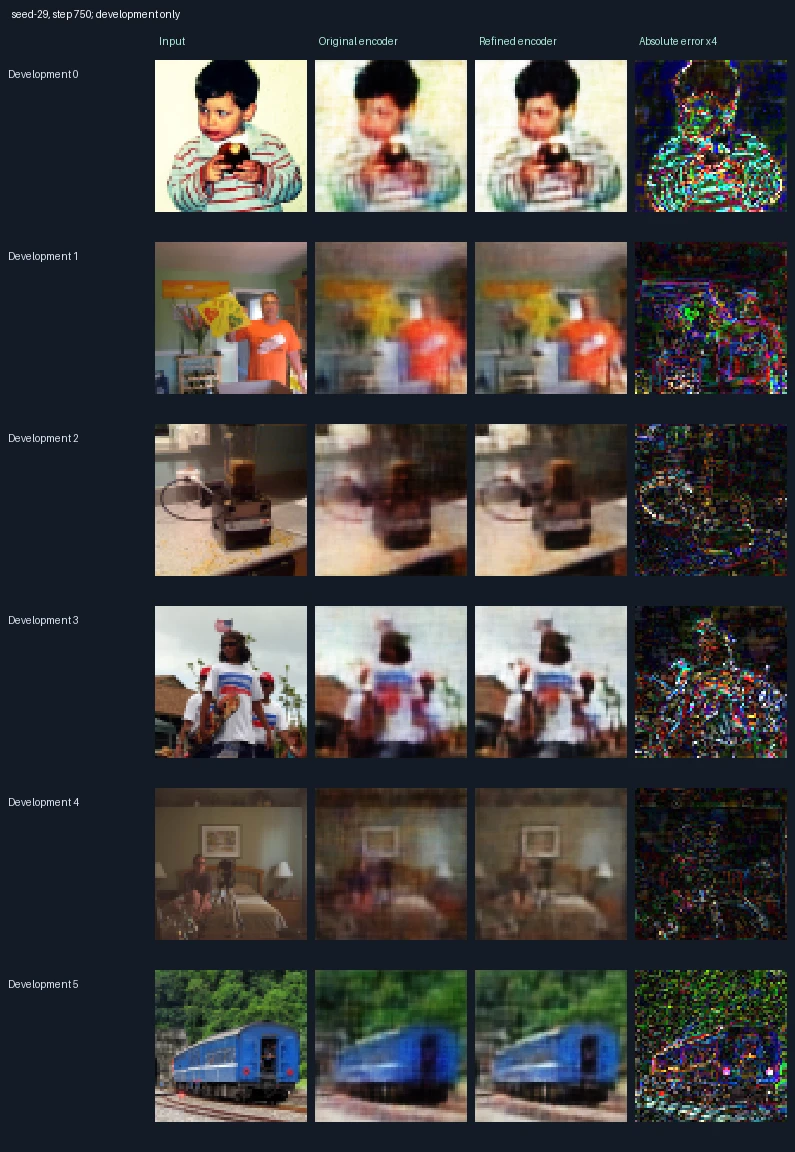
Six fixed development photographs, excluded from gradient updates and used to monitor model quality. Left to right: input pixels, reconstruction from the original encoder’s vector, reconstruction from the refined encoder’s vector, and the refined output’s error. The same fixed decoder reconstructs both vectors. This is training repetition 2; the image label “seed-29” identifies its randomization setting. The model receives a 64 × 64 RGB image; photographs are center-cropped and resized before encoding. Enlargement here adds no detail. Error panels show four times the absolute RGB difference from the reference, separately for each color channel, clipped at full brightness. Darker pixels mean smaller errors; black is zero or below the display’s precision. The scale is fixed across examples, not adjusted to make each image look better.
Encoder refinement, training repetition 2: 1,000 weight updates
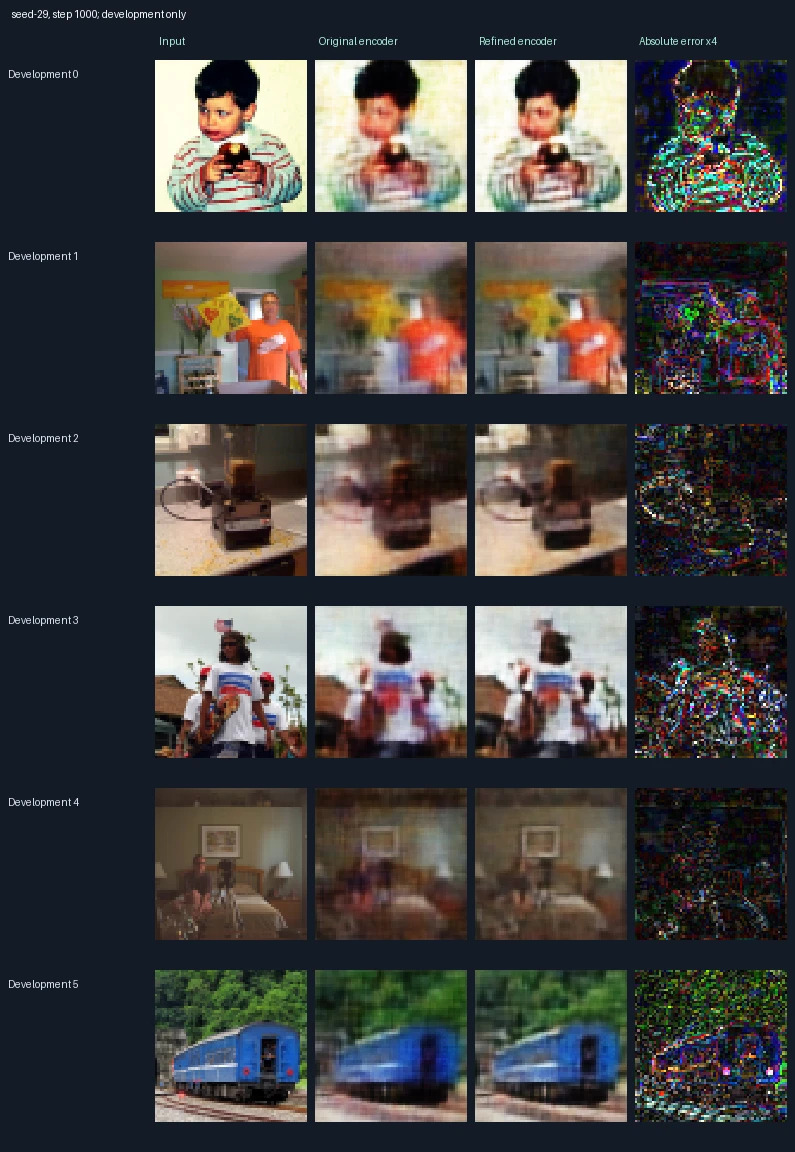
Six fixed development photographs, excluded from gradient updates and used to monitor model quality. Left to right: input pixels, reconstruction from the original encoder’s vector, reconstruction from the refined encoder’s vector, and the refined output’s error. The same fixed decoder reconstructs both vectors. This is training repetition 2; the image label “seed-29” identifies its randomization setting. The model receives a 64 × 64 RGB image; photographs are center-cropped and resized before encoding. Enlargement here adds no detail. Error panels show four times the absolute RGB difference from the reference, separately for each color channel, clipped at full brightness. Darker pixels mean smaller errors; black is zero or below the display’s precision. The scale is fixed across examples, not adjusted to make each image look better.
Encoder refinement, training repetition 2: 1,250 weight updates
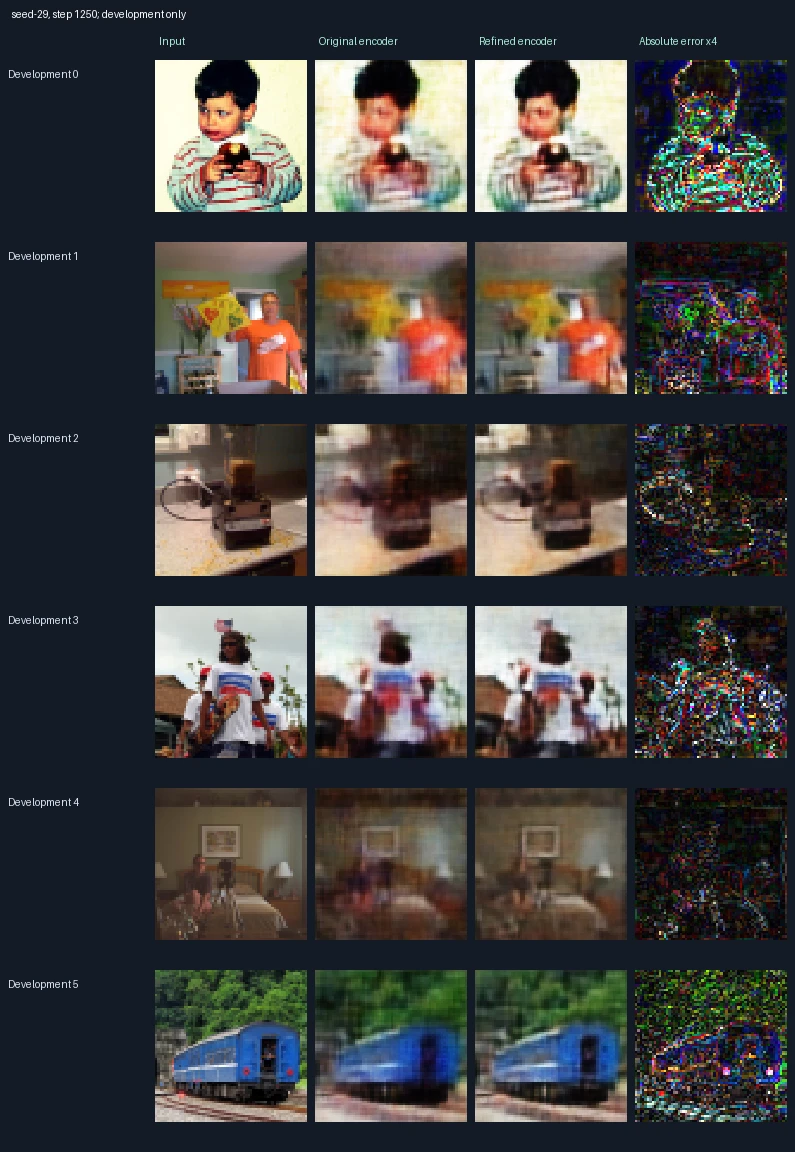
Six fixed development photographs, excluded from gradient updates and used to monitor model quality. Left to right: input pixels, reconstruction from the original encoder’s vector, reconstruction from the refined encoder’s vector, and the refined output’s error. The same fixed decoder reconstructs both vectors. This is training repetition 2; the image label “seed-29” identifies its randomization setting. The model receives a 64 × 64 RGB image; photographs are center-cropped and resized before encoding. Enlargement here adds no detail. Error panels show four times the absolute RGB difference from the reference, separately for each color channel, clipped at full brightness. Darker pixels mean smaller errors; black is zero or below the display’s precision. The scale is fixed across examples, not adjusted to make each image look better.
Encoder refinement, training repetition 2: 1,500 weight updates
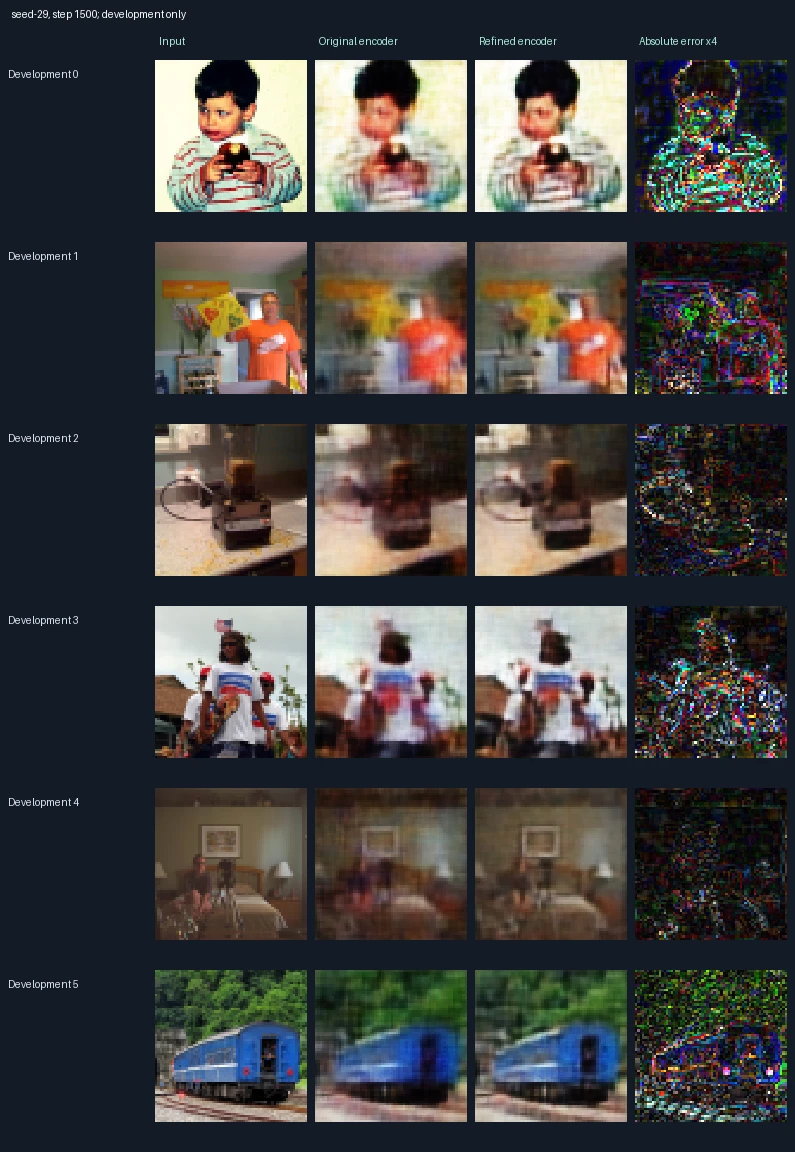
Six fixed development photographs, excluded from gradient updates and used to monitor model quality. Left to right: input pixels, reconstruction from the original encoder’s vector, reconstruction from the refined encoder’s vector, and the refined output’s error. The same fixed decoder reconstructs both vectors. This is training repetition 2; the image label “seed-29” identifies its randomization setting. The model receives a 64 × 64 RGB image; photographs are center-cropped and resized before encoding. Enlargement here adds no detail. Error panels show four times the absolute RGB difference from the reference, separately for each color channel, clipped at full brightness. Darker pixels mean smaller errors; black is zero or below the display’s precision. The scale is fixed across examples, not adjusted to make each image look better.
Encoder refinement, training repetition 2: 1,750 weight updates
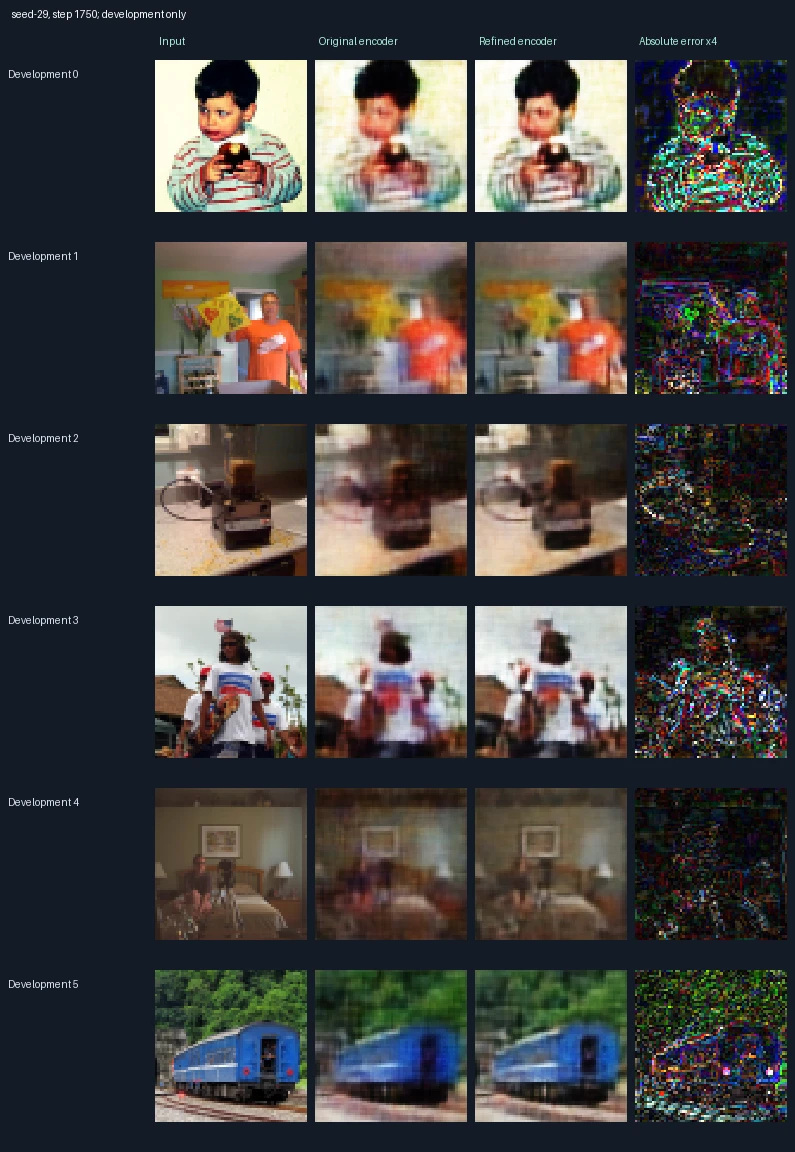
Six fixed development photographs, excluded from gradient updates and used to monitor model quality. Left to right: input pixels, reconstruction from the original encoder’s vector, reconstruction from the refined encoder’s vector, and the refined output’s error. The same fixed decoder reconstructs both vectors. This is training repetition 2; the image label “seed-29” identifies its randomization setting. The model receives a 64 × 64 RGB image; photographs are center-cropped and resized before encoding. Enlargement here adds no detail. Error panels show four times the absolute RGB difference from the reference, separately for each color channel, clipped at full brightness. Darker pixels mean smaller errors; black is zero or below the display’s precision. The scale is fixed across examples, not adjusted to make each image look better.
Encoder refinement, training repetition 2: 2,000 weight updates
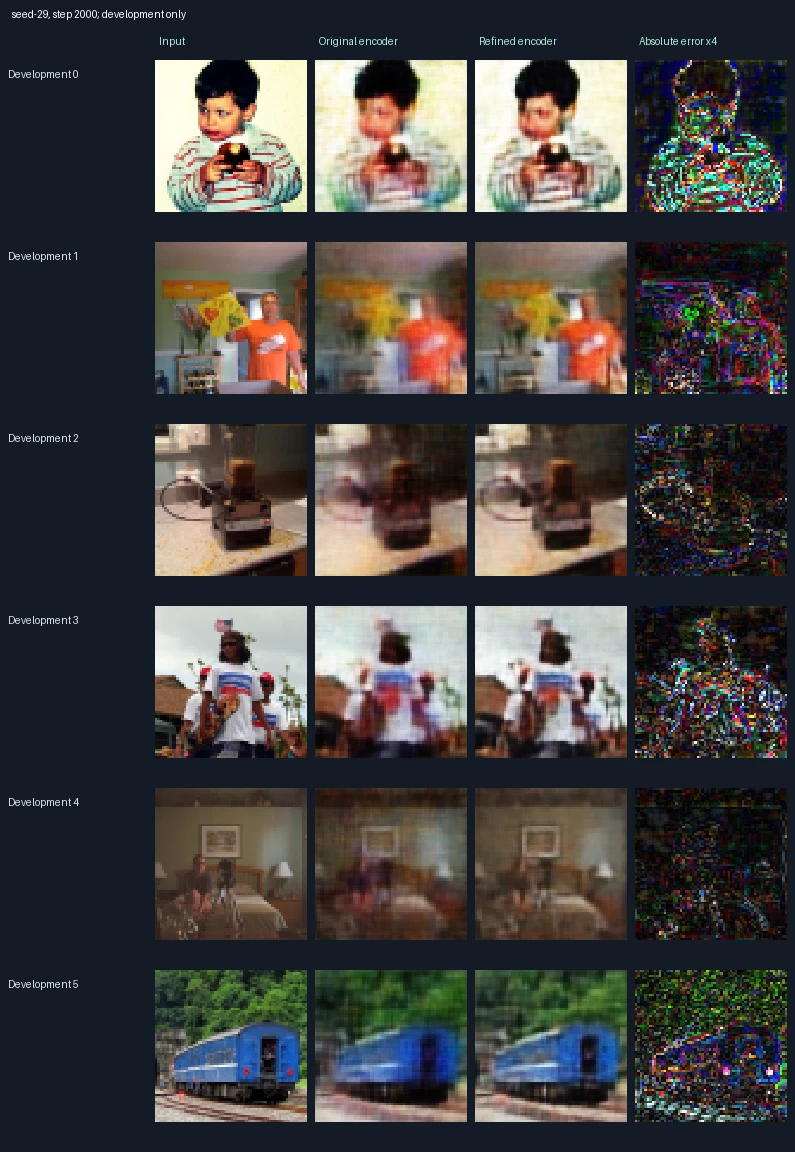
Six fixed development photographs, excluded from gradient updates and used to monitor model quality. Left to right: input pixels, reconstruction from the original encoder’s vector, reconstruction from the refined encoder’s vector, and the refined output’s error. The same fixed decoder reconstructs both vectors. This is training repetition 2; the image label “seed-29” identifies its randomization setting. The model receives a 64 × 64 RGB image; photographs are center-cropped and resized before encoding. Enlargement here adds no detail. Error panels show four times the absolute RGB difference from the reference, separately for each color channel, clipped at full brightness. Darker pixels mean smaller errors; black is zero or below the display’s precision. The scale is fixed across examples, not adjusted to make each image look better.
Encoder refinement, training repetition 2: 2,250 weight updates
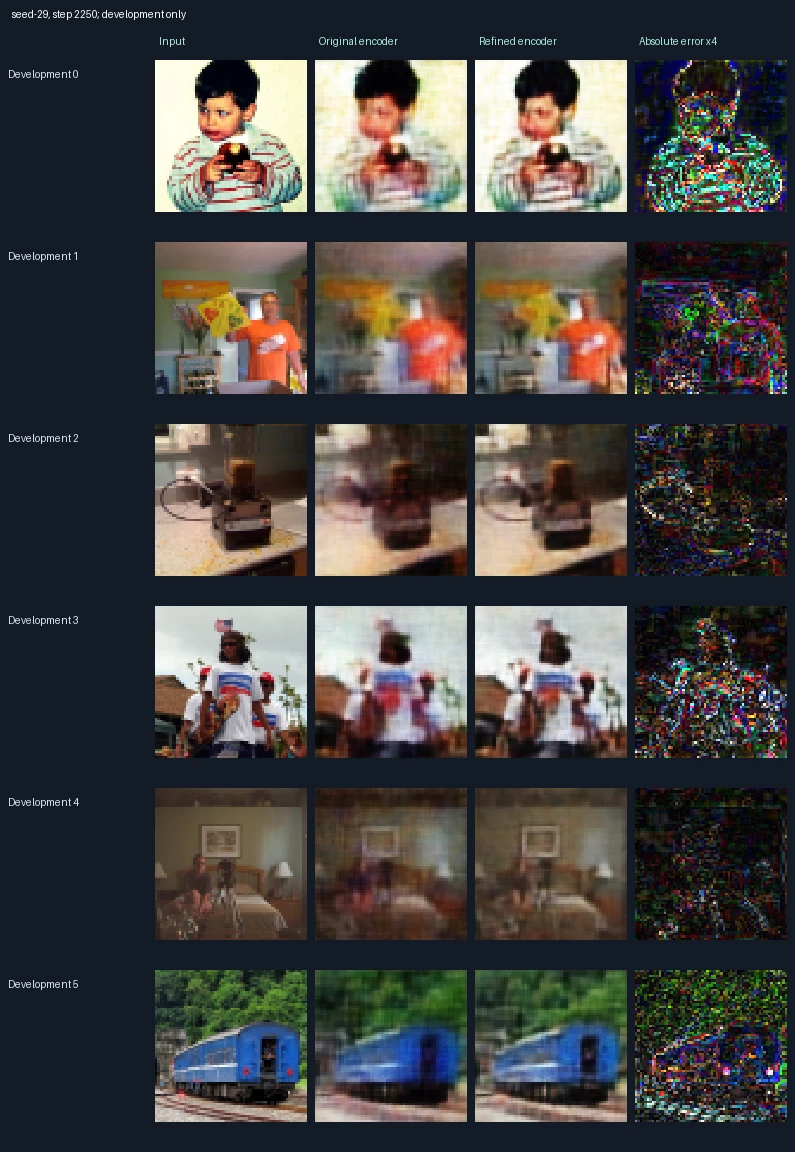
Six fixed development photographs, excluded from gradient updates and used to monitor model quality. Left to right: input pixels, reconstruction from the original encoder’s vector, reconstruction from the refined encoder’s vector, and the refined output’s error. The same fixed decoder reconstructs both vectors. This is training repetition 2; the image label “seed-29” identifies its randomization setting. The model receives a 64 × 64 RGB image; photographs are center-cropped and resized before encoding. Enlargement here adds no detail. Error panels show four times the absolute RGB difference from the reference, separately for each color channel, clipped at full brightness. Darker pixels mean smaller errors; black is zero or below the display’s precision. The scale is fixed across examples, not adjusted to make each image look better.
Encoder refinement, training repetition 2: 2,500 weight updates
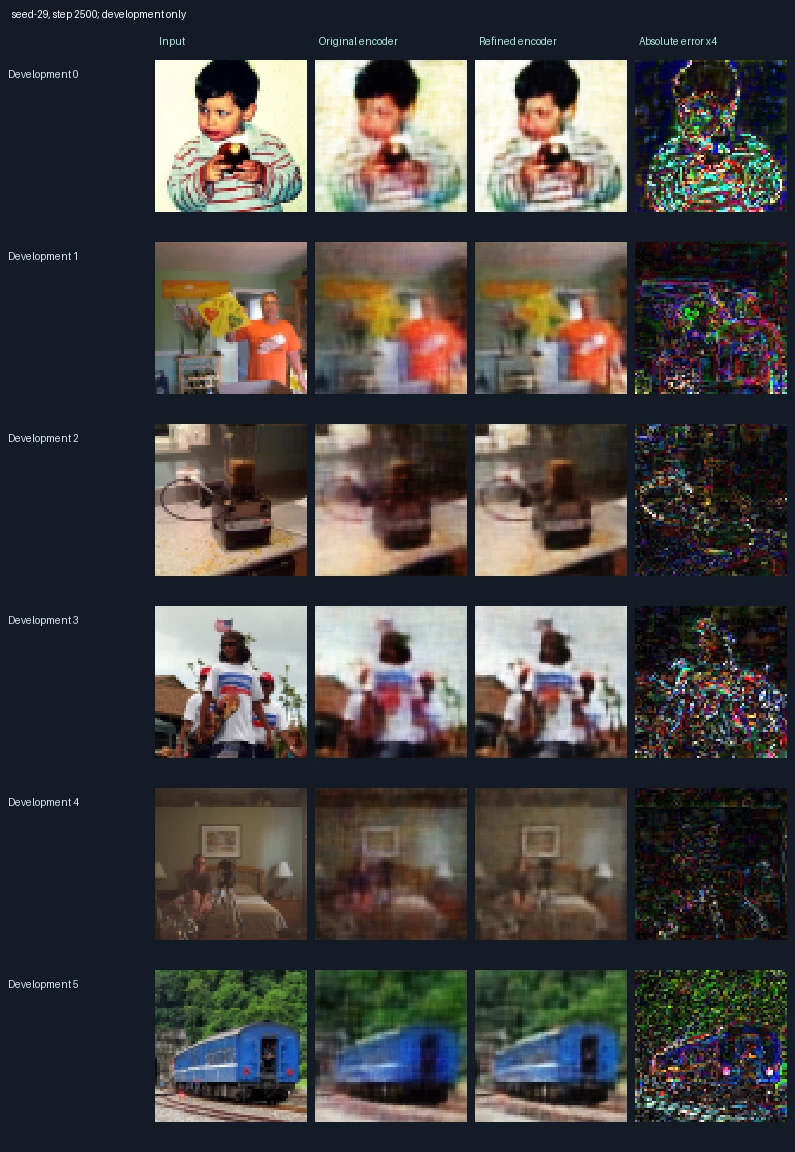
Six fixed development photographs, excluded from gradient updates and used to monitor model quality. Left to right: input pixels, reconstruction from the original encoder’s vector, reconstruction from the refined encoder’s vector, and the refined output’s error. The same fixed decoder reconstructs both vectors. This is training repetition 2; the image label “seed-29” identifies its randomization setting. The model receives a 64 × 64 RGB image; photographs are center-cropped and resized before encoding. Enlargement here adds no detail. Error panels show four times the absolute RGB difference from the reference, separately for each color channel, clipped at full brightness. Darker pixels mean smaller errors; black is zero or below the display’s precision. The scale is fixed across examples, not adjusted to make each image look better.
Encoder refinement, training repetition 2: 2,750 weight updates
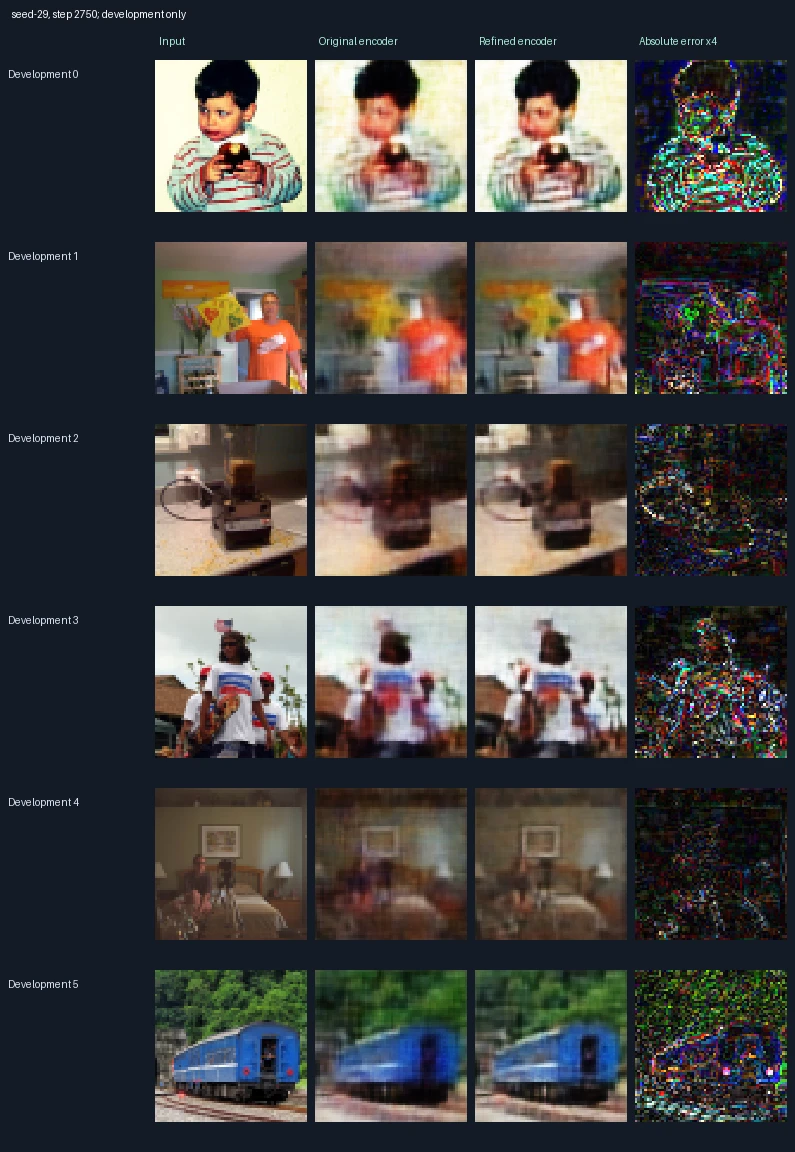
Six fixed development photographs, excluded from gradient updates and used to monitor model quality. Left to right: input pixels, reconstruction from the original encoder’s vector, reconstruction from the refined encoder’s vector, and the refined output’s error. The same fixed decoder reconstructs both vectors. This is training repetition 2; the image label “seed-29” identifies its randomization setting. The model receives a 64 × 64 RGB image; photographs are center-cropped and resized before encoding. Enlargement here adds no detail. Error panels show four times the absolute RGB difference from the reference, separately for each color channel, clipped at full brightness. Darker pixels mean smaller errors; black is zero or below the display’s precision. The scale is fixed across examples, not adjusted to make each image look better.
Encoder refinement, training repetition 2: 3,000 weight updates
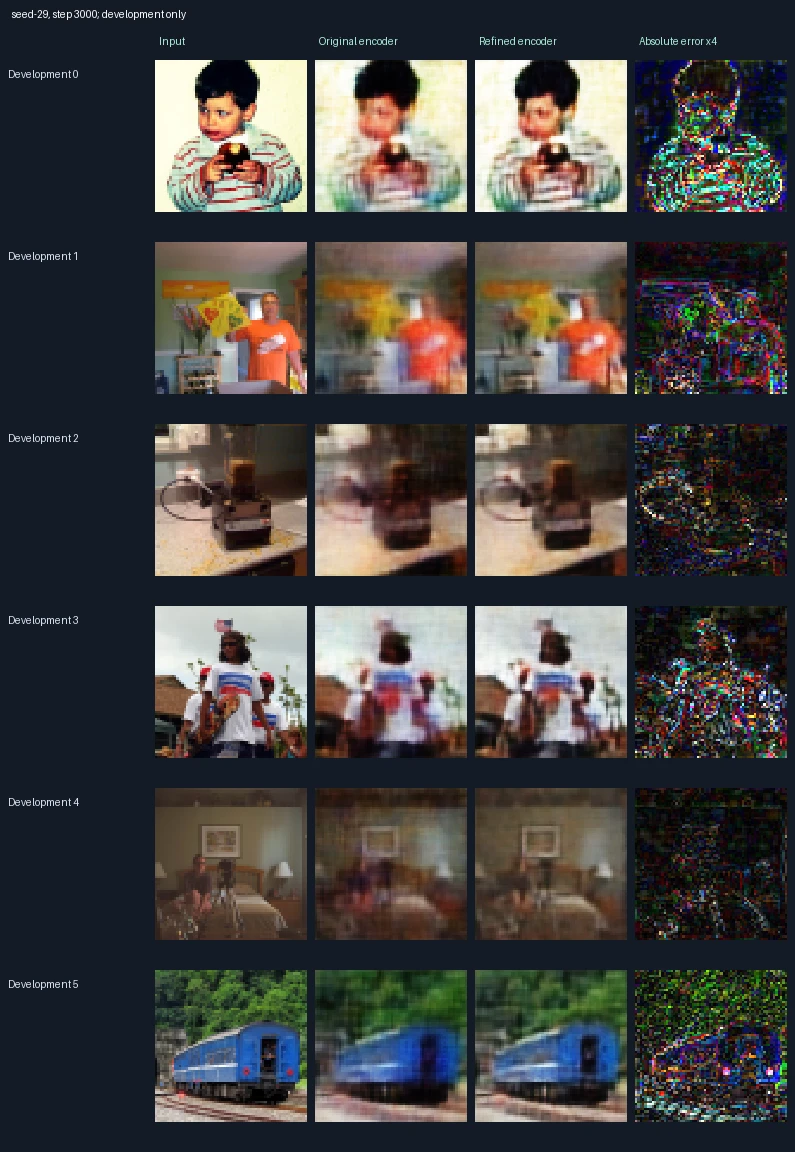
Six fixed development photographs, excluded from gradient updates and used to monitor model quality. Left to right: input pixels, reconstruction from the original encoder’s vector, reconstruction from the refined encoder’s vector, and the refined output’s error. The same fixed decoder reconstructs both vectors. This is training repetition 2; the image label “seed-29” identifies its randomization setting. The model receives a 64 × 64 RGB image; photographs are center-cropped and resized before encoding. Enlargement here adds no detail. Error panels show four times the absolute RGB difference from the reference, separately for each color channel, clipped at full brightness. Darker pixels mean smaller errors; black is zero or below the display’s precision. The scale is fixed across examples, not adjusted to make each image look better.
Encoder refinement, training repetition 2: 3,250 weight updates
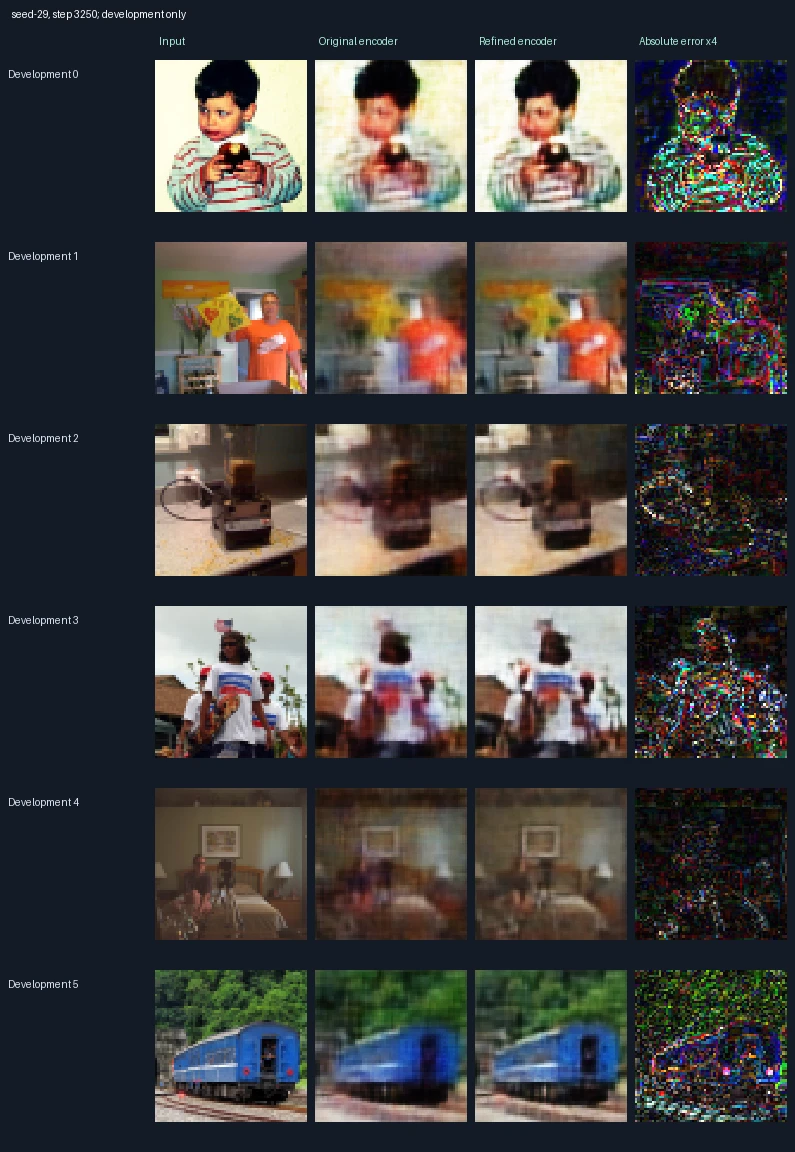
Six fixed development photographs, excluded from gradient updates and used to monitor model quality. Left to right: input pixels, reconstruction from the original encoder’s vector, reconstruction from the refined encoder’s vector, and the refined output’s error. The same fixed decoder reconstructs both vectors. This is training repetition 2; the image label “seed-29” identifies its randomization setting. The model receives a 64 × 64 RGB image; photographs are center-cropped and resized before encoding. Enlargement here adds no detail. Error panels show four times the absolute RGB difference from the reference, separately for each color channel, clipped at full brightness. Darker pixels mean smaller errors; black is zero or below the display’s precision. The scale is fixed across examples, not adjusted to make each image look better.
Encoder refinement, training repetition 2: 3,500 weight updates
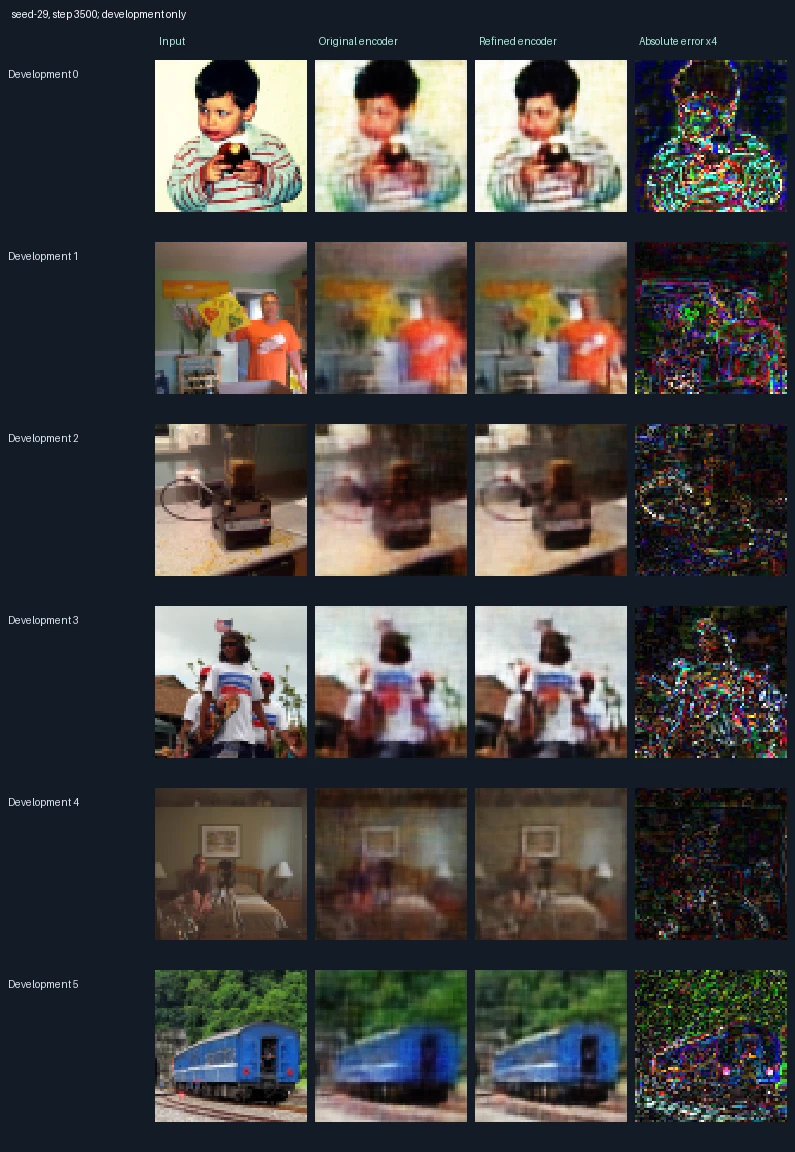
Six fixed development photographs, excluded from gradient updates and used to monitor model quality. Left to right: input pixels, reconstruction from the original encoder’s vector, reconstruction from the refined encoder’s vector, and the refined output’s error. The same fixed decoder reconstructs both vectors. This is training repetition 2; the image label “seed-29” identifies its randomization setting. The model receives a 64 × 64 RGB image; photographs are center-cropped and resized before encoding. Enlargement here adds no detail. Error panels show four times the absolute RGB difference from the reference, separately for each color channel, clipped at full brightness. Darker pixels mean smaller errors; black is zero or below the display’s precision. The scale is fixed across examples, not adjusted to make each image look better.
Encoder refinement, training repetition 2: 3,750 weight updates
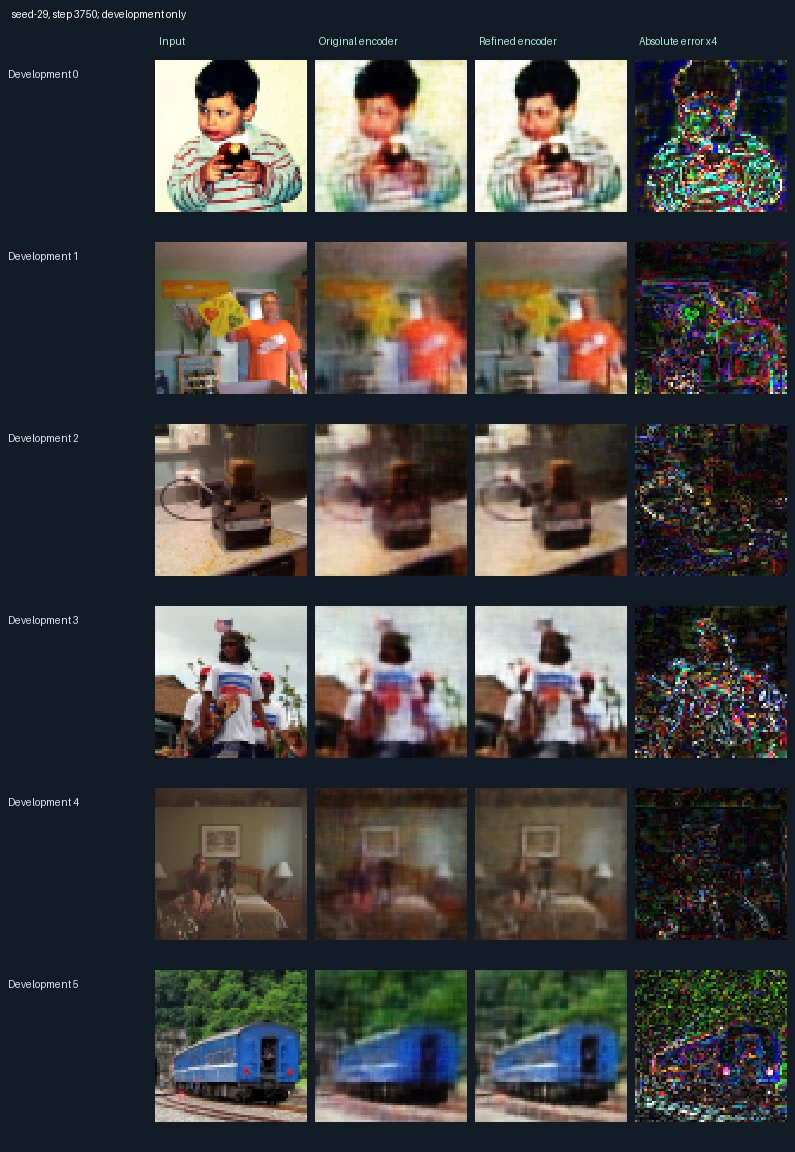
Six fixed development photographs, excluded from gradient updates and used to monitor model quality. Left to right: input pixels, reconstruction from the original encoder’s vector, reconstruction from the refined encoder’s vector, and the refined output’s error. The same fixed decoder reconstructs both vectors. This is training repetition 2; the image label “seed-29” identifies its randomization setting. The model receives a 64 × 64 RGB image; photographs are center-cropped and resized before encoding. Enlargement here adds no detail. Error panels show four times the absolute RGB difference from the reference, separately for each color channel, clipped at full brightness. Darker pixels mean smaller errors; black is zero or below the display’s precision. The scale is fixed across examples, not adjusted to make each image look better.
Encoder refinement, training repetition 2: 4,000 weight updates
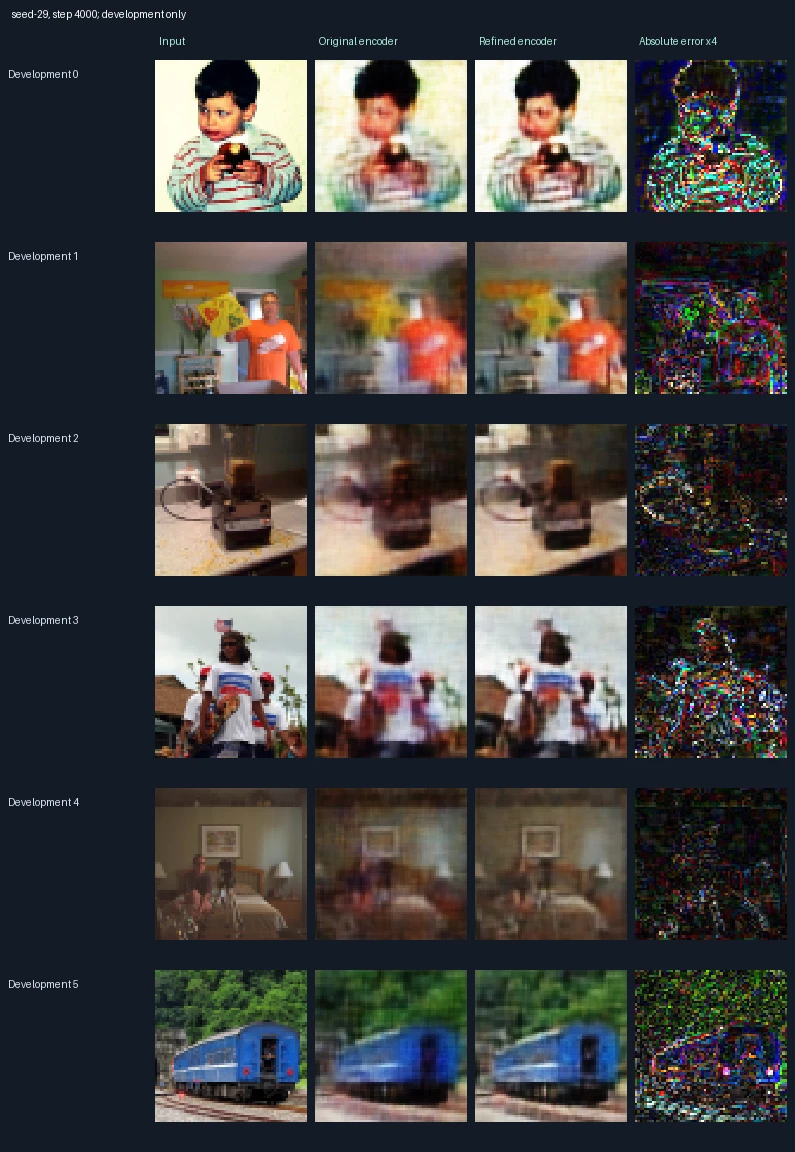
Six fixed development photographs, excluded from gradient updates and used to monitor model quality. Left to right: input pixels, reconstruction from the original encoder’s vector, reconstruction from the refined encoder’s vector, and the refined output’s error. The same fixed decoder reconstructs both vectors. This is training repetition 2; the image label “seed-29” identifies its randomization setting. The model receives a 64 × 64 RGB image; photographs are center-cropped and resized before encoding. Enlargement here adds no detail. Error panels show four times the absolute RGB difference from the reference, separately for each color channel, clipped at full brightness. Darker pixels mean smaller errors; black is zero or below the display’s precision. The scale is fixed across examples, not adjusted to make each image look better.
Encoder refinement, training repetition 3: 0 weight updates
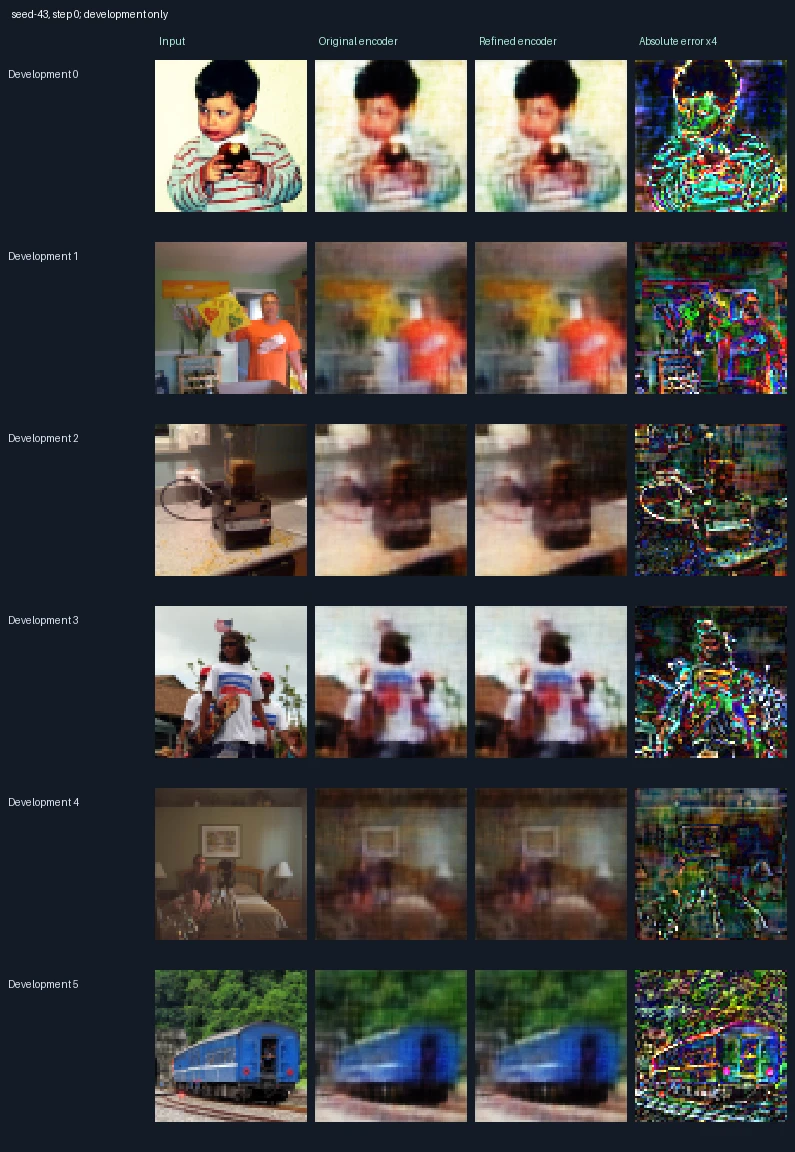
Six fixed development photographs, excluded from gradient updates and used to monitor model quality. Left to right: input pixels, reconstruction from the original encoder’s vector, reconstruction from the refined encoder’s vector, and the refined output’s error. The same fixed decoder reconstructs both vectors. This is training repetition 3; the image label “seed-43” identifies its randomization setting. The model receives a 64 × 64 RGB image; photographs are center-cropped and resized before encoding. Enlargement here adds no detail. Error panels show four times the absolute RGB difference from the reference, separately for each color channel, clipped at full brightness. Darker pixels mean smaller errors; black is zero or below the display’s precision. The scale is fixed across examples, not adjusted to make each image look better. Zero updates records the starting model.
Encoder refinement, training repetition 3: 250 weight updates
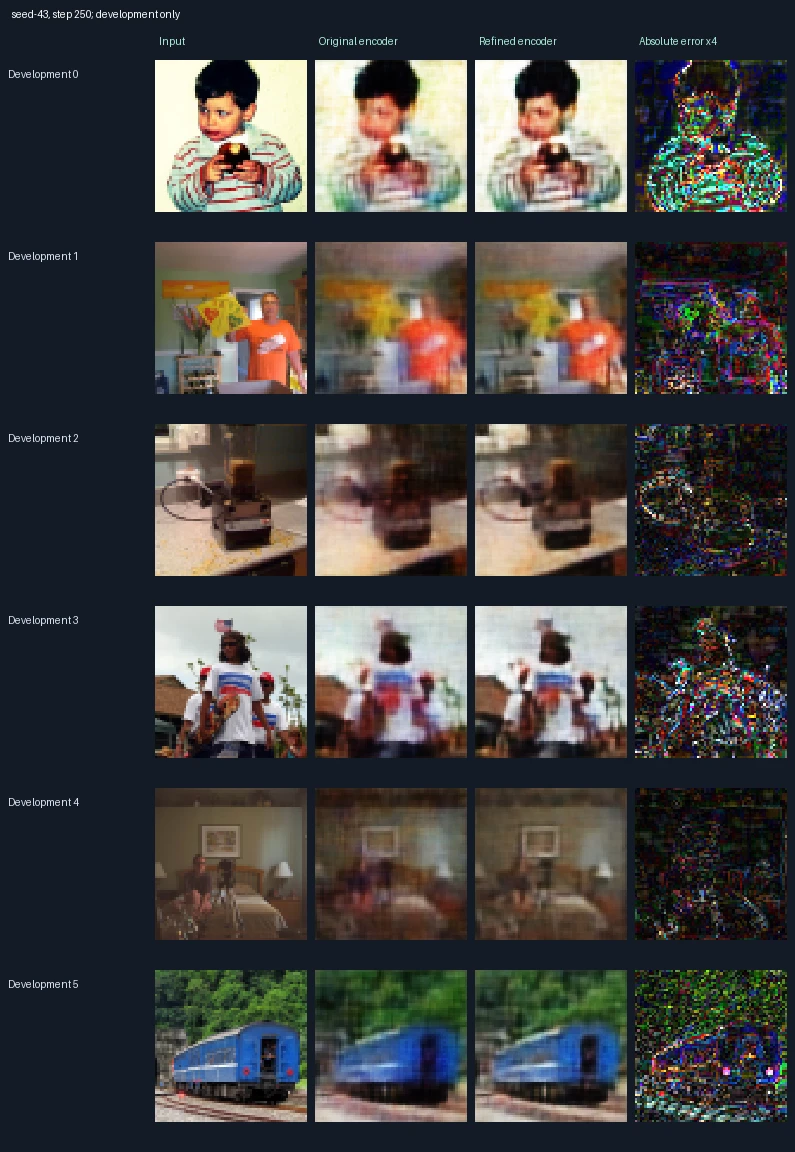
Six fixed development photographs, excluded from gradient updates and used to monitor model quality. Left to right: input pixels, reconstruction from the original encoder’s vector, reconstruction from the refined encoder’s vector, and the refined output’s error. The same fixed decoder reconstructs both vectors. This is training repetition 3; the image label “seed-43” identifies its randomization setting. The model receives a 64 × 64 RGB image; photographs are center-cropped and resized before encoding. Enlargement here adds no detail. Error panels show four times the absolute RGB difference from the reference, separately for each color channel, clipped at full brightness. Darker pixels mean smaller errors; black is zero or below the display’s precision. The scale is fixed across examples, not adjusted to make each image look better.
Encoder refinement, training repetition 3: 500 weight updates
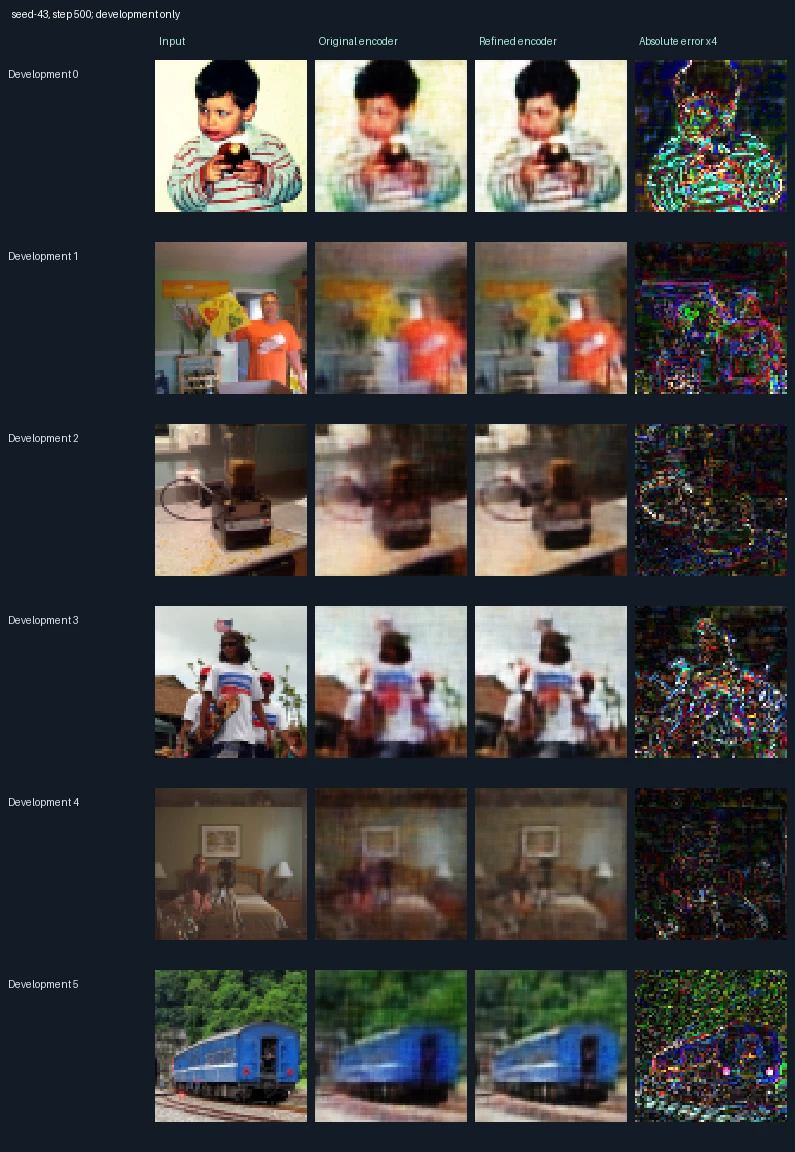
Six fixed development photographs, excluded from gradient updates and used to monitor model quality. Left to right: input pixels, reconstruction from the original encoder’s vector, reconstruction from the refined encoder’s vector, and the refined output’s error. The same fixed decoder reconstructs both vectors. This is training repetition 3; the image label “seed-43” identifies its randomization setting. The model receives a 64 × 64 RGB image; photographs are center-cropped and resized before encoding. Enlargement here adds no detail. Error panels show four times the absolute RGB difference from the reference, separately for each color channel, clipped at full brightness. Darker pixels mean smaller errors; black is zero or below the display’s precision. The scale is fixed across examples, not adjusted to make each image look better.
Encoder refinement, training repetition 3: 750 weight updates
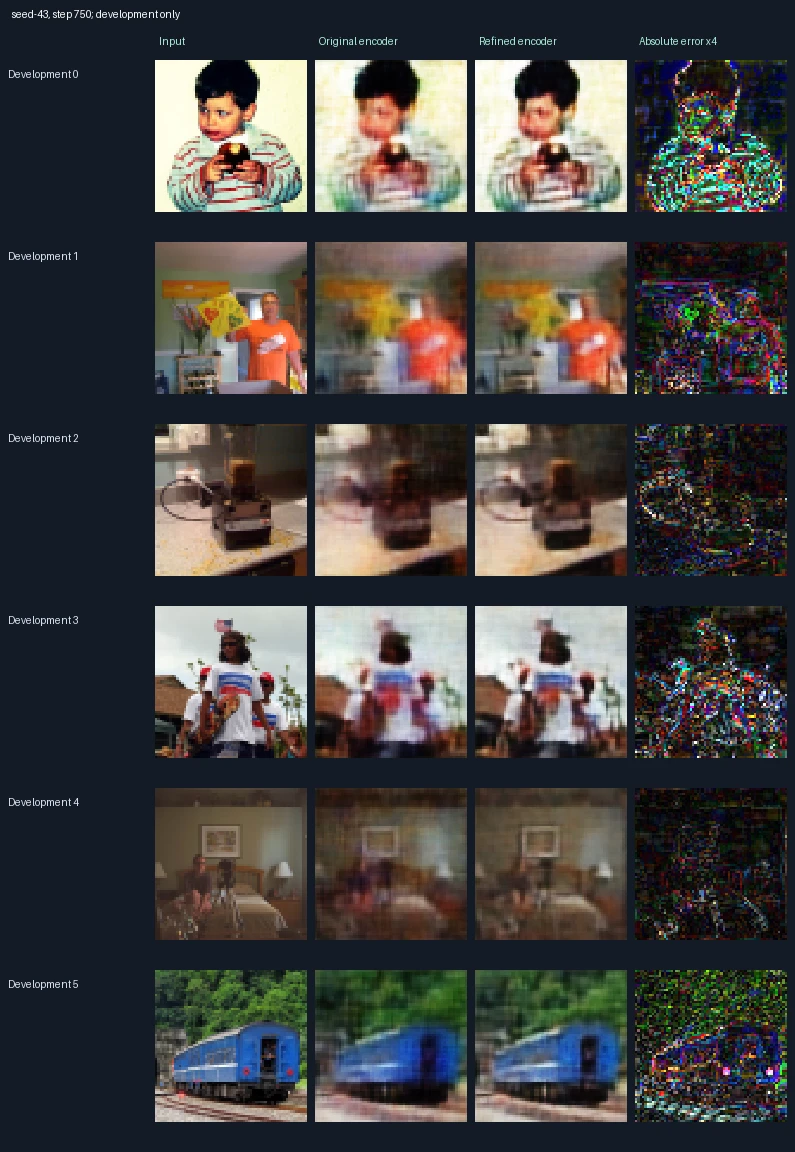
Six fixed development photographs, excluded from gradient updates and used to monitor model quality. Left to right: input pixels, reconstruction from the original encoder’s vector, reconstruction from the refined encoder’s vector, and the refined output’s error. The same fixed decoder reconstructs both vectors. This is training repetition 3; the image label “seed-43” identifies its randomization setting. The model receives a 64 × 64 RGB image; photographs are center-cropped and resized before encoding. Enlargement here adds no detail. Error panels show four times the absolute RGB difference from the reference, separately for each color channel, clipped at full brightness. Darker pixels mean smaller errors; black is zero or below the display’s precision. The scale is fixed across examples, not adjusted to make each image look better.
Encoder refinement, training repetition 3: 1,000 weight updates
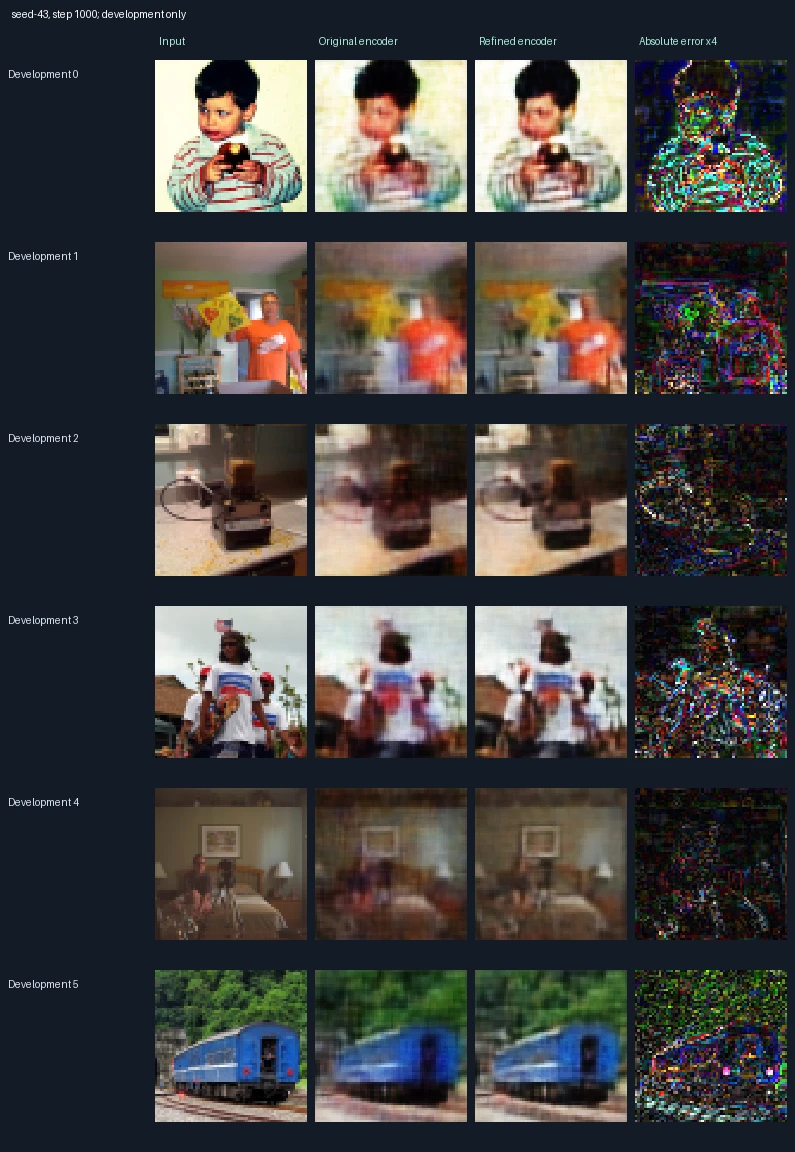
Six fixed development photographs, excluded from gradient updates and used to monitor model quality. Left to right: input pixels, reconstruction from the original encoder’s vector, reconstruction from the refined encoder’s vector, and the refined output’s error. The same fixed decoder reconstructs both vectors. This is training repetition 3; the image label “seed-43” identifies its randomization setting. The model receives a 64 × 64 RGB image; photographs are center-cropped and resized before encoding. Enlargement here adds no detail. Error panels show four times the absolute RGB difference from the reference, separately for each color channel, clipped at full brightness. Darker pixels mean smaller errors; black is zero or below the display’s precision. The scale is fixed across examples, not adjusted to make each image look better.
Encoder refinement, training repetition 3: 1,250 weight updates
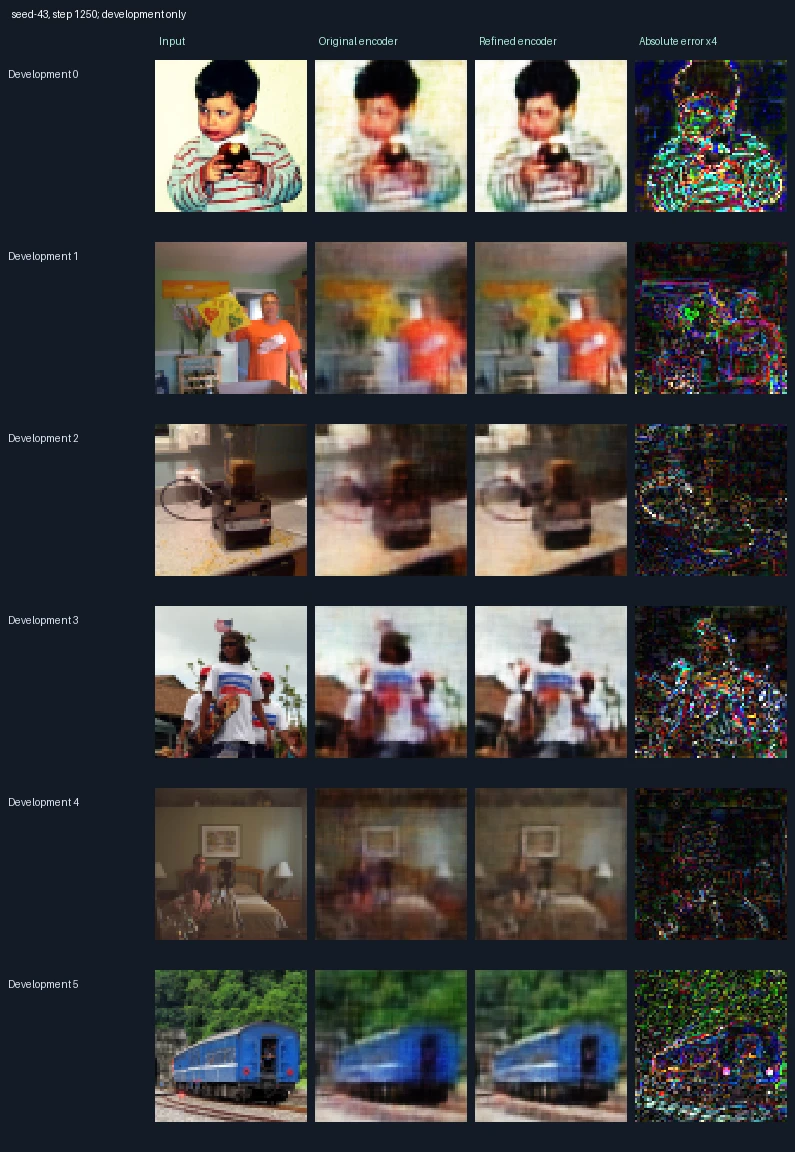
Six fixed development photographs, excluded from gradient updates and used to monitor model quality. Left to right: input pixels, reconstruction from the original encoder’s vector, reconstruction from the refined encoder’s vector, and the refined output’s error. The same fixed decoder reconstructs both vectors. This is training repetition 3; the image label “seed-43” identifies its randomization setting. The model receives a 64 × 64 RGB image; photographs are center-cropped and resized before encoding. Enlargement here adds no detail. Error panels show four times the absolute RGB difference from the reference, separately for each color channel, clipped at full brightness. Darker pixels mean smaller errors; black is zero or below the display’s precision. The scale is fixed across examples, not adjusted to make each image look better.
Encoder refinement, training repetition 3: 1,500 weight updates
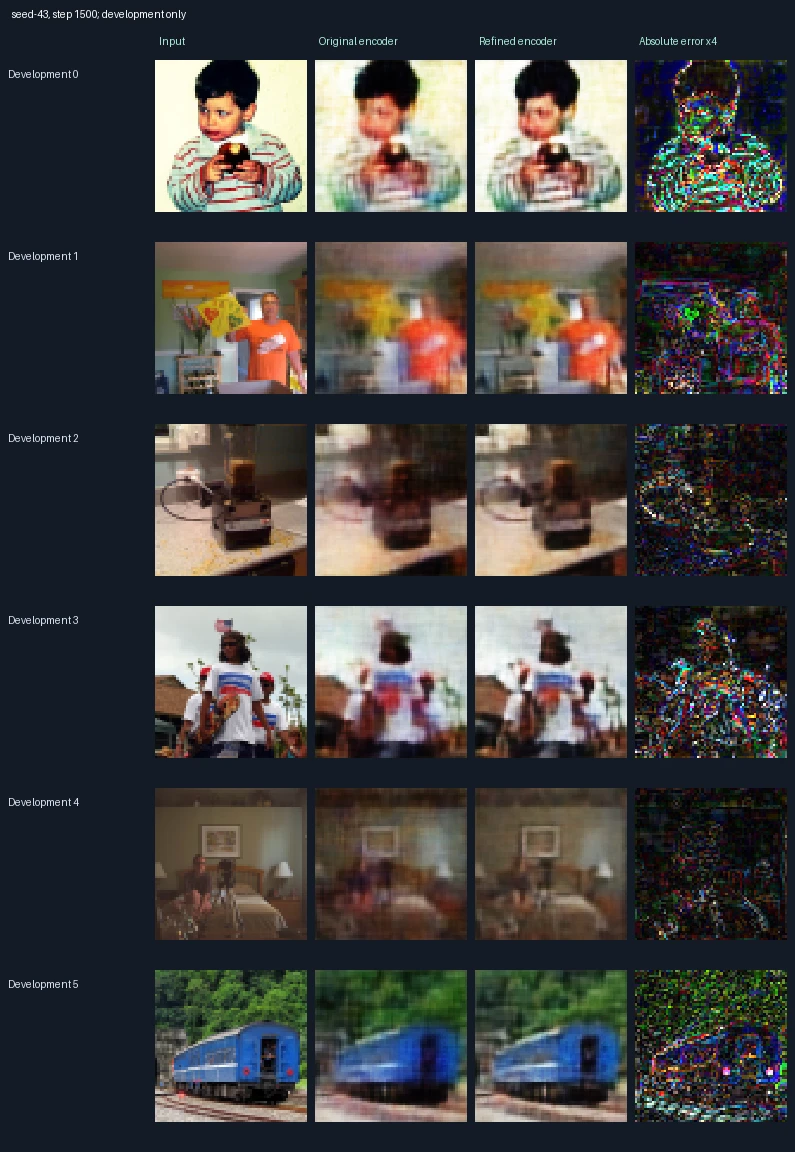
Six fixed development photographs, excluded from gradient updates and used to monitor model quality. Left to right: input pixels, reconstruction from the original encoder’s vector, reconstruction from the refined encoder’s vector, and the refined output’s error. The same fixed decoder reconstructs both vectors. This is training repetition 3; the image label “seed-43” identifies its randomization setting. The model receives a 64 × 64 RGB image; photographs are center-cropped and resized before encoding. Enlargement here adds no detail. Error panels show four times the absolute RGB difference from the reference, separately for each color channel, clipped at full brightness. Darker pixels mean smaller errors; black is zero or below the display’s precision. The scale is fixed across examples, not adjusted to make each image look better.
Encoder refinement, training repetition 3: 1,750 weight updates
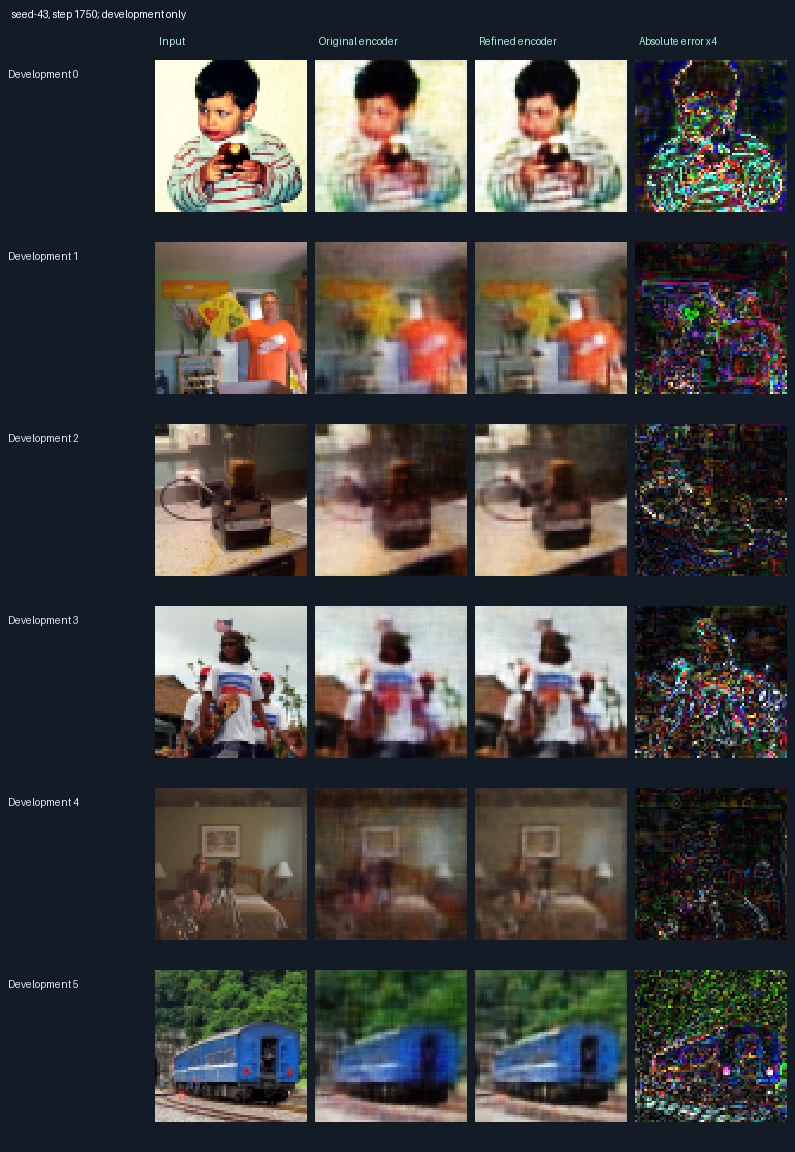
Six fixed development photographs, excluded from gradient updates and used to monitor model quality. Left to right: input pixels, reconstruction from the original encoder’s vector, reconstruction from the refined encoder’s vector, and the refined output’s error. The same fixed decoder reconstructs both vectors. This is training repetition 3; the image label “seed-43” identifies its randomization setting. The model receives a 64 × 64 RGB image; photographs are center-cropped and resized before encoding. Enlargement here adds no detail. Error panels show four times the absolute RGB difference from the reference, separately for each color channel, clipped at full brightness. Darker pixels mean smaller errors; black is zero or below the display’s precision. The scale is fixed across examples, not adjusted to make each image look better.
Encoder refinement, training repetition 3: 2,000 weight updates
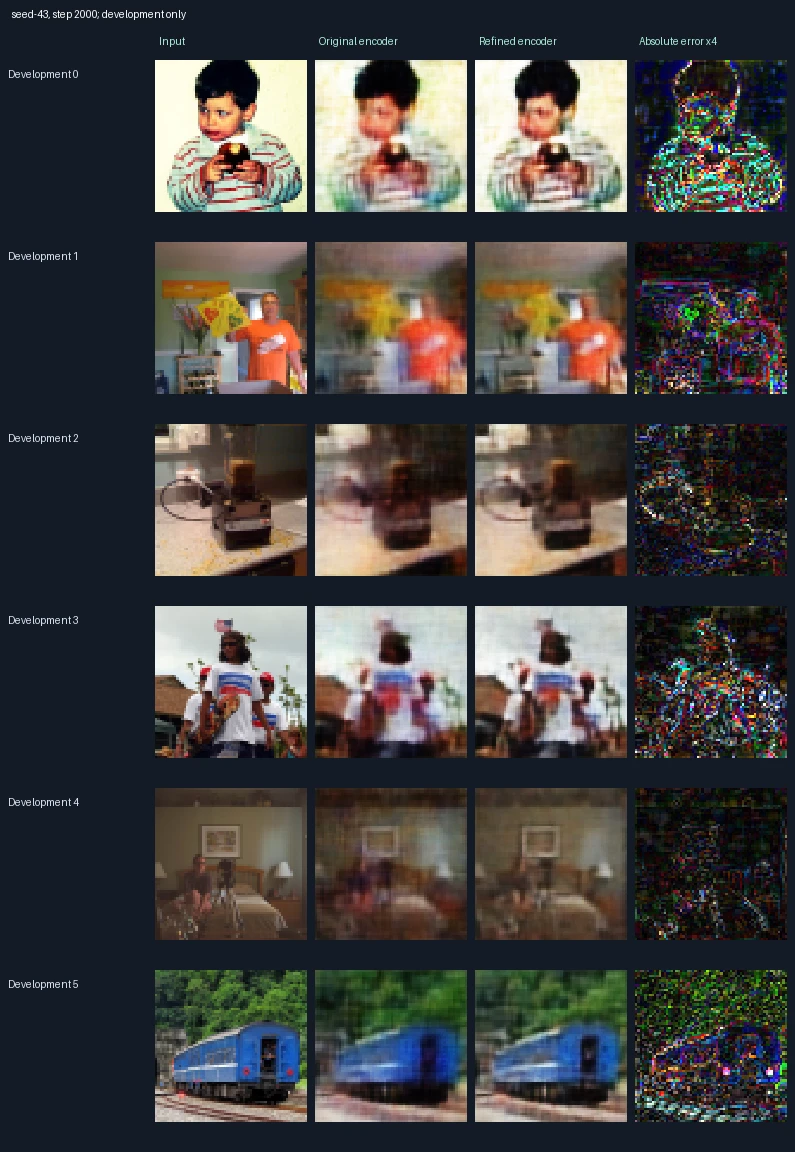
Six fixed development photographs, excluded from gradient updates and used to monitor model quality. Left to right: input pixels, reconstruction from the original encoder’s vector, reconstruction from the refined encoder’s vector, and the refined output’s error. The same fixed decoder reconstructs both vectors. This is training repetition 3; the image label “seed-43” identifies its randomization setting. The model receives a 64 × 64 RGB image; photographs are center-cropped and resized before encoding. Enlargement here adds no detail. Error panels show four times the absolute RGB difference from the reference, separately for each color channel, clipped at full brightness. Darker pixels mean smaller errors; black is zero or below the display’s precision. The scale is fixed across examples, not adjusted to make each image look better.
Encoder refinement, training repetition 3: 2,250 weight updates
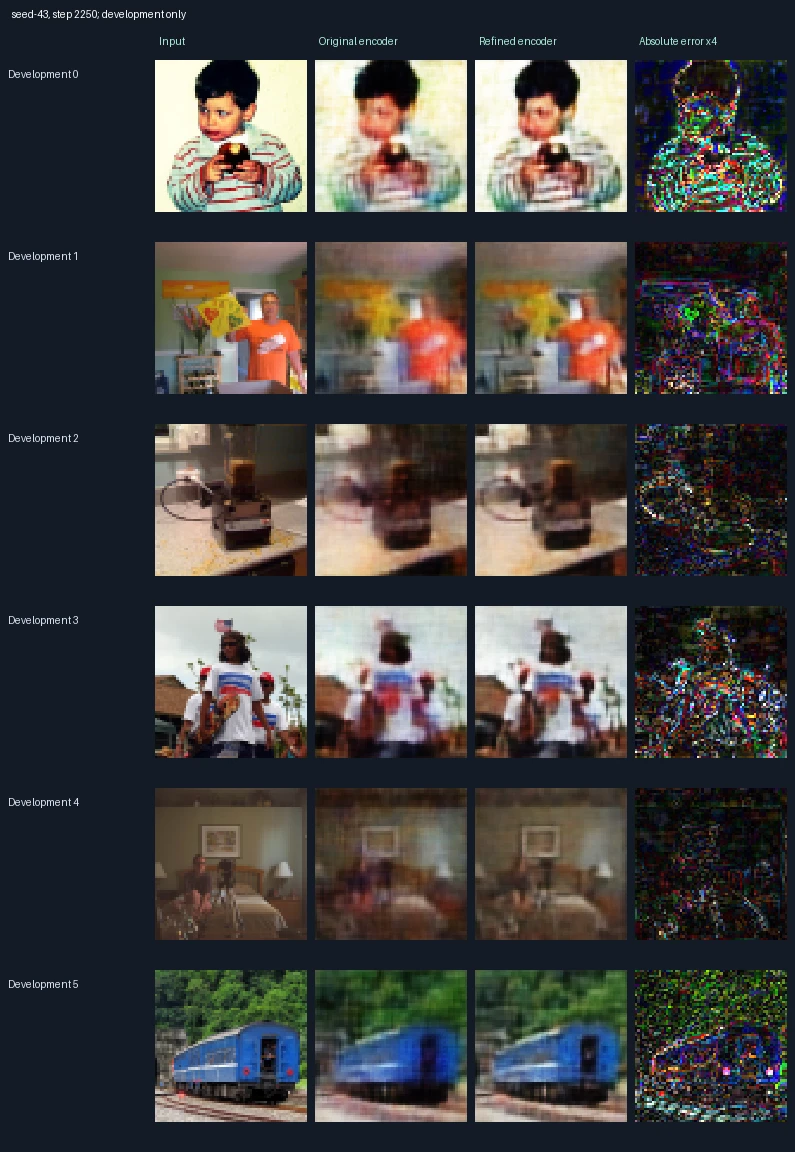
Six fixed development photographs, excluded from gradient updates and used to monitor model quality. Left to right: input pixels, reconstruction from the original encoder’s vector, reconstruction from the refined encoder’s vector, and the refined output’s error. The same fixed decoder reconstructs both vectors. This is training repetition 3; the image label “seed-43” identifies its randomization setting. The model receives a 64 × 64 RGB image; photographs are center-cropped and resized before encoding. Enlargement here adds no detail. Error panels show four times the absolute RGB difference from the reference, separately for each color channel, clipped at full brightness. Darker pixels mean smaller errors; black is zero or below the display’s precision. The scale is fixed across examples, not adjusted to make each image look better.
Encoder refinement, training repetition 3: 2,500 weight updates
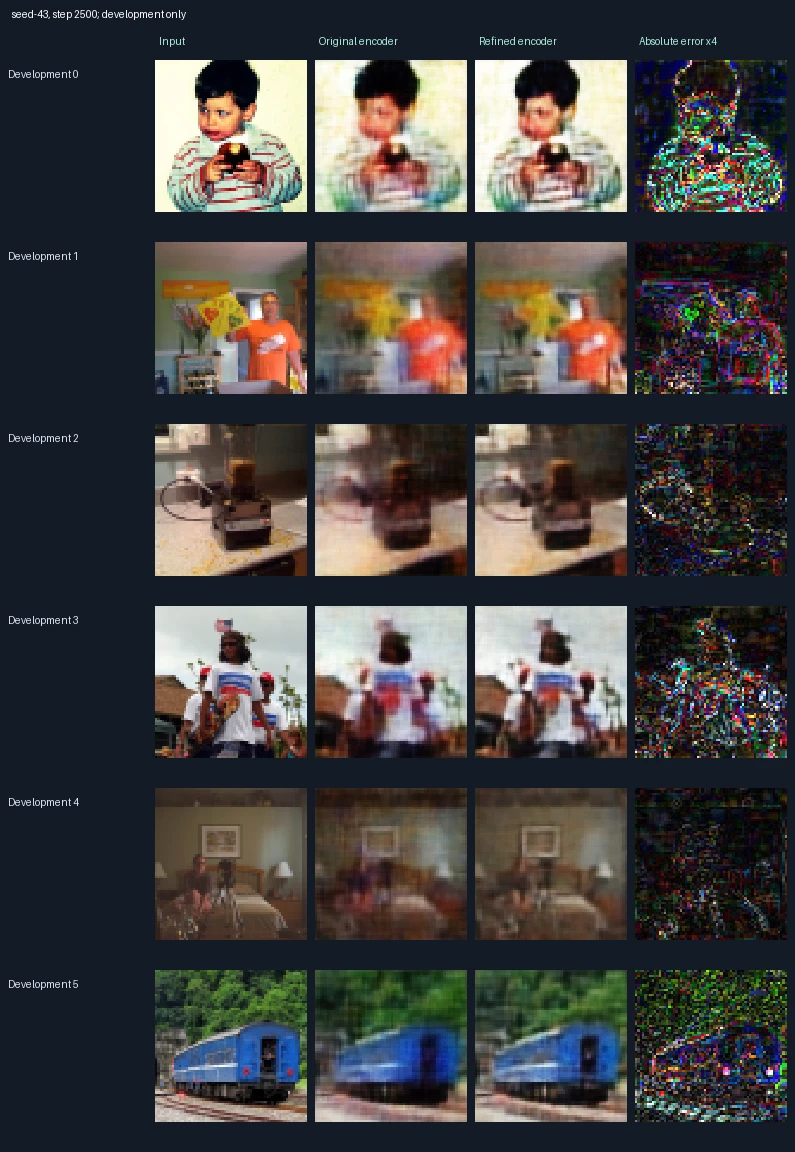
Six fixed development photographs, excluded from gradient updates and used to monitor model quality. Left to right: input pixels, reconstruction from the original encoder’s vector, reconstruction from the refined encoder’s vector, and the refined output’s error. The same fixed decoder reconstructs both vectors. This is training repetition 3; the image label “seed-43” identifies its randomization setting. The model receives a 64 × 64 RGB image; photographs are center-cropped and resized before encoding. Enlargement here adds no detail. Error panels show four times the absolute RGB difference from the reference, separately for each color channel, clipped at full brightness. Darker pixels mean smaller errors; black is zero or below the display’s precision. The scale is fixed across examples, not adjusted to make each image look better.
Encoder refinement, training repetition 3: 2,750 weight updates
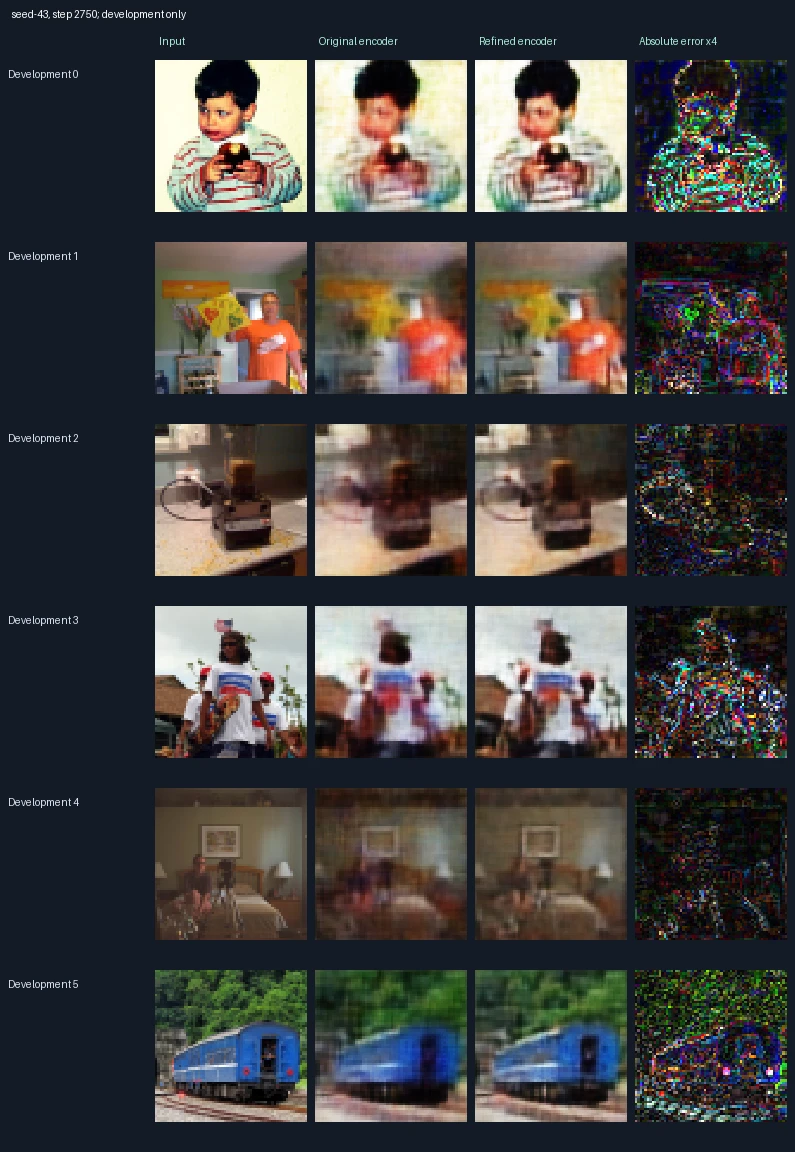
Six fixed development photographs, excluded from gradient updates and used to monitor model quality. Left to right: input pixels, reconstruction from the original encoder’s vector, reconstruction from the refined encoder’s vector, and the refined output’s error. The same fixed decoder reconstructs both vectors. This is training repetition 3; the image label “seed-43” identifies its randomization setting. The model receives a 64 × 64 RGB image; photographs are center-cropped and resized before encoding. Enlargement here adds no detail. Error panels show four times the absolute RGB difference from the reference, separately for each color channel, clipped at full brightness. Darker pixels mean smaller errors; black is zero or below the display’s precision. The scale is fixed across examples, not adjusted to make each image look better.
Encoder refinement, training repetition 3: 3,000 weight updates
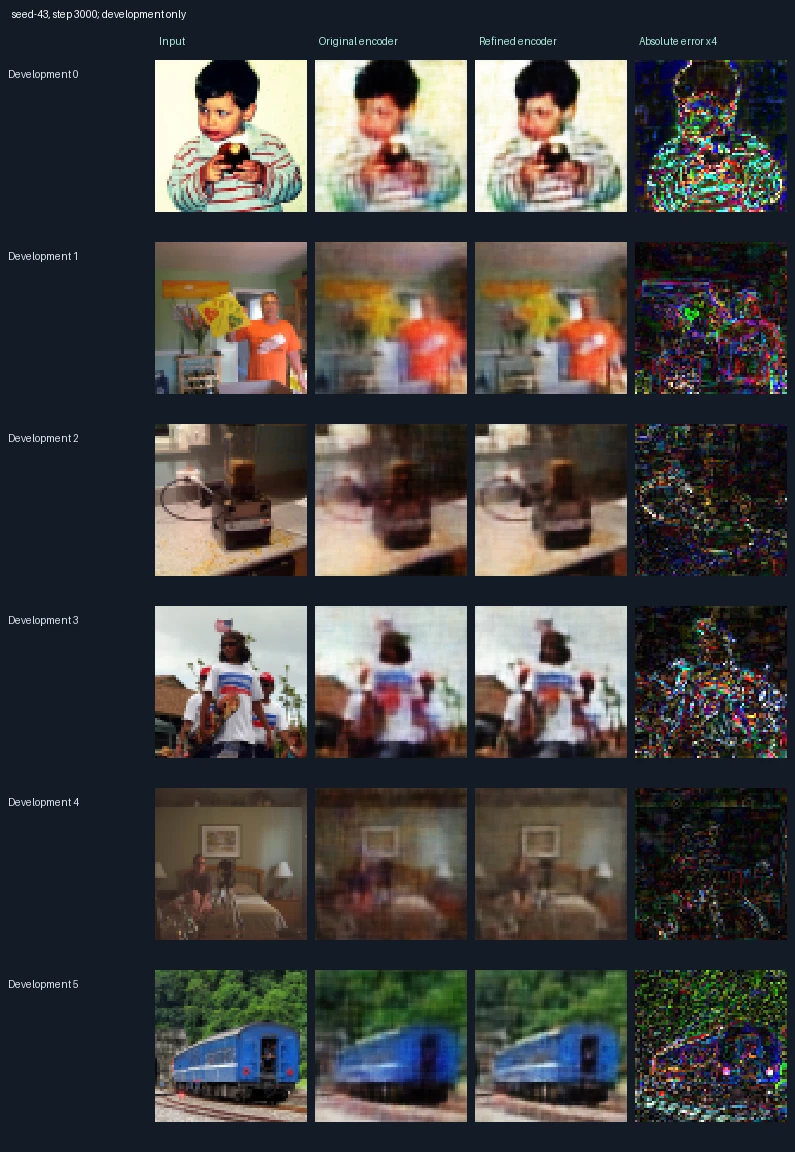
Six fixed development photographs, excluded from gradient updates and used to monitor model quality. Left to right: input pixels, reconstruction from the original encoder’s vector, reconstruction from the refined encoder’s vector, and the refined output’s error. The same fixed decoder reconstructs both vectors. This is training repetition 3; the image label “seed-43” identifies its randomization setting. The model receives a 64 × 64 RGB image; photographs are center-cropped and resized before encoding. Enlargement here adds no detail. Error panels show four times the absolute RGB difference from the reference, separately for each color channel, clipped at full brightness. Darker pixels mean smaller errors; black is zero or below the display’s precision. The scale is fixed across examples, not adjusted to make each image look better.
Encoder refinement, training repetition 3: 3,250 weight updates
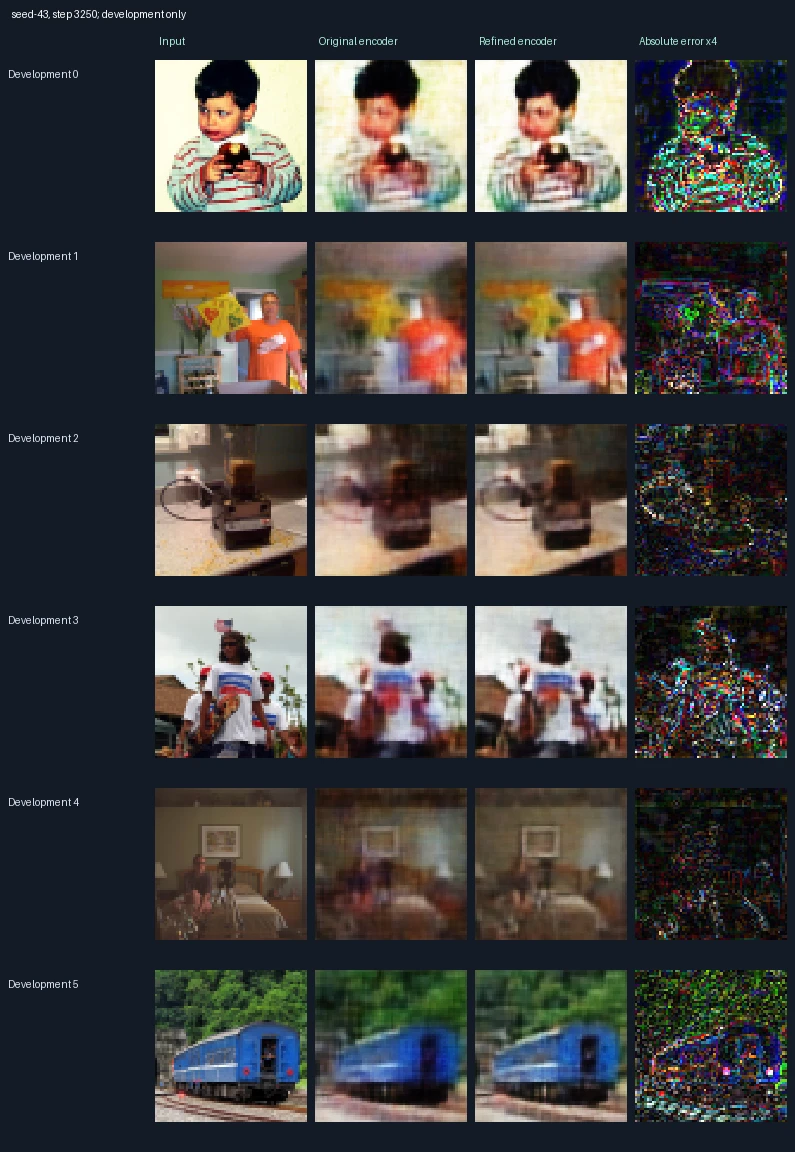
Six fixed development photographs, excluded from gradient updates and used to monitor model quality. Left to right: input pixels, reconstruction from the original encoder’s vector, reconstruction from the refined encoder’s vector, and the refined output’s error. The same fixed decoder reconstructs both vectors. This is training repetition 3; the image label “seed-43” identifies its randomization setting. The model receives a 64 × 64 RGB image; photographs are center-cropped and resized before encoding. Enlargement here adds no detail. Error panels show four times the absolute RGB difference from the reference, separately for each color channel, clipped at full brightness. Darker pixels mean smaller errors; black is zero or below the display’s precision. The scale is fixed across examples, not adjusted to make each image look better.
Encoder refinement, training repetition 3: 3,500 weight updates
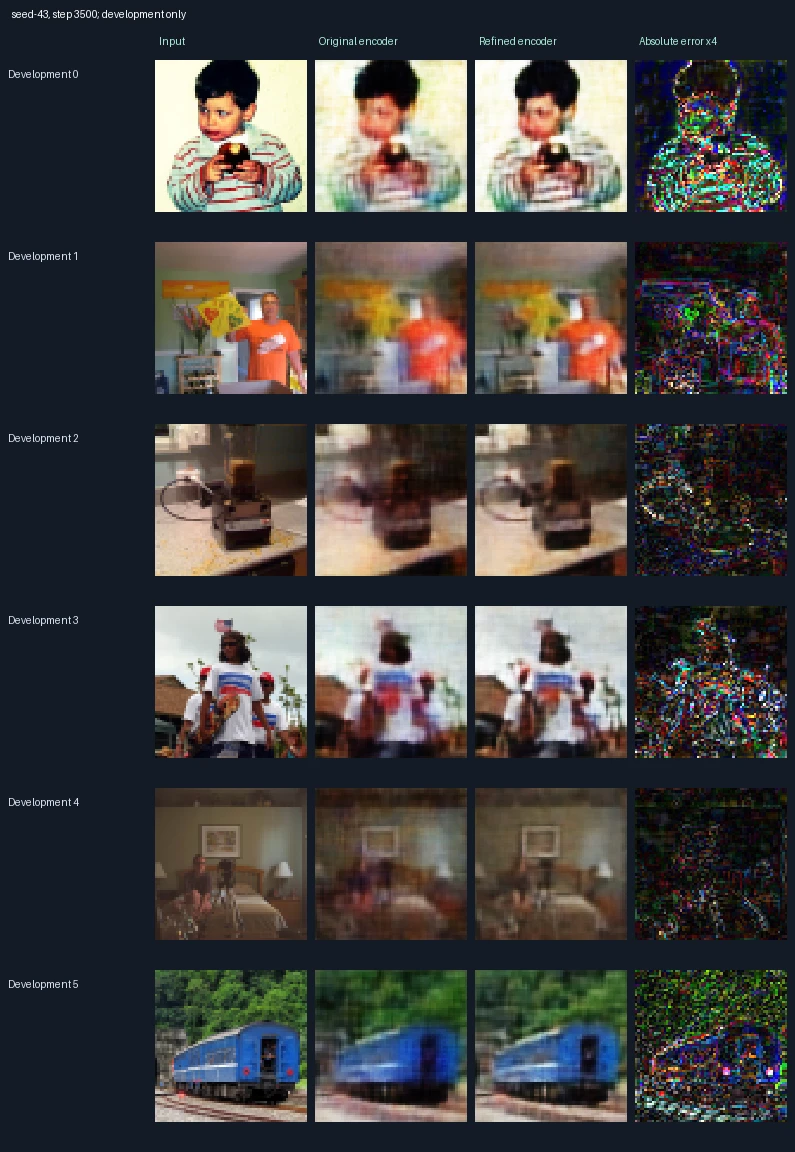
Six fixed development photographs, excluded from gradient updates and used to monitor model quality. Left to right: input pixels, reconstruction from the original encoder’s vector, reconstruction from the refined encoder’s vector, and the refined output’s error. The same fixed decoder reconstructs both vectors. This is training repetition 3; the image label “seed-43” identifies its randomization setting. The model receives a 64 × 64 RGB image; photographs are center-cropped and resized before encoding. Enlargement here adds no detail. Error panels show four times the absolute RGB difference from the reference, separately for each color channel, clipped at full brightness. Darker pixels mean smaller errors; black is zero or below the display’s precision. The scale is fixed across examples, not adjusted to make each image look better.
Encoder refinement, training repetition 3: 3,750 weight updates
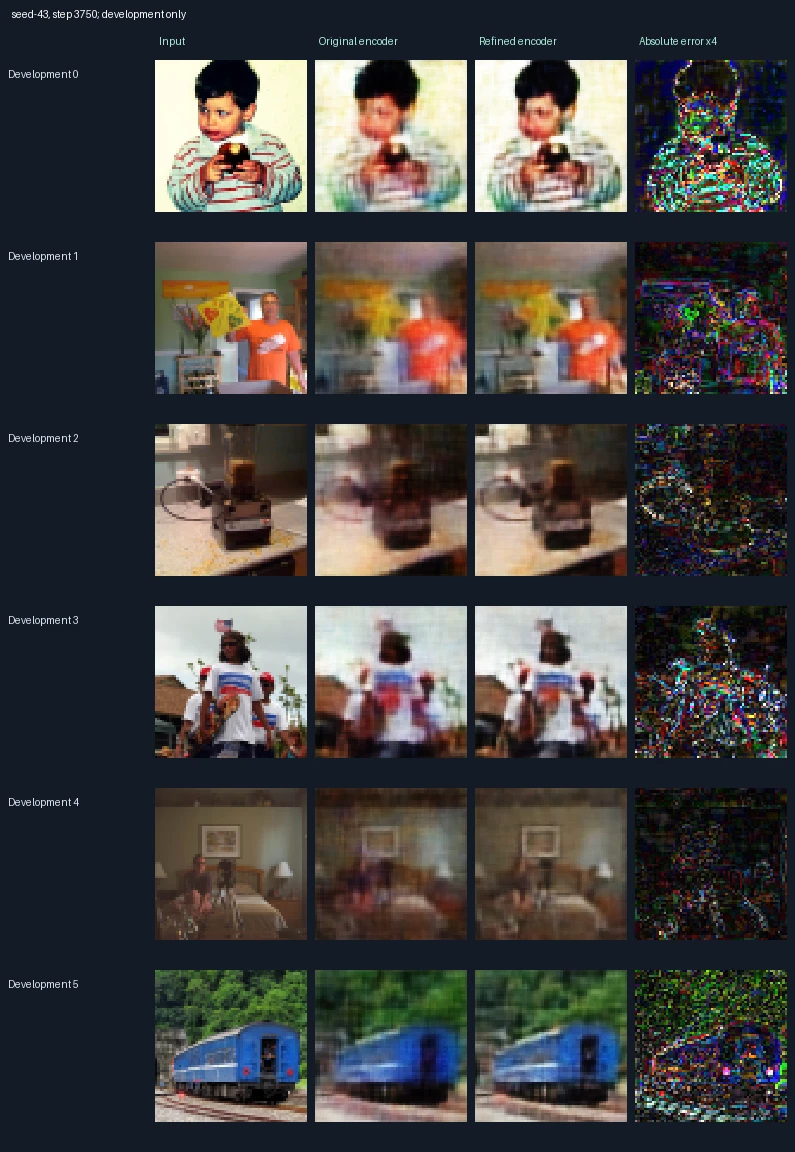
Six fixed development photographs, excluded from gradient updates and used to monitor model quality. Left to right: input pixels, reconstruction from the original encoder’s vector, reconstruction from the refined encoder’s vector, and the refined output’s error. The same fixed decoder reconstructs both vectors. This is training repetition 3; the image label “seed-43” identifies its randomization setting. The model receives a 64 × 64 RGB image; photographs are center-cropped and resized before encoding. Enlargement here adds no detail. Error panels show four times the absolute RGB difference from the reference, separately for each color channel, clipped at full brightness. Darker pixels mean smaller errors; black is zero or below the display’s precision. The scale is fixed across examples, not adjusted to make each image look better.
Encoder refinement, training repetition 3: 4,000 weight updates
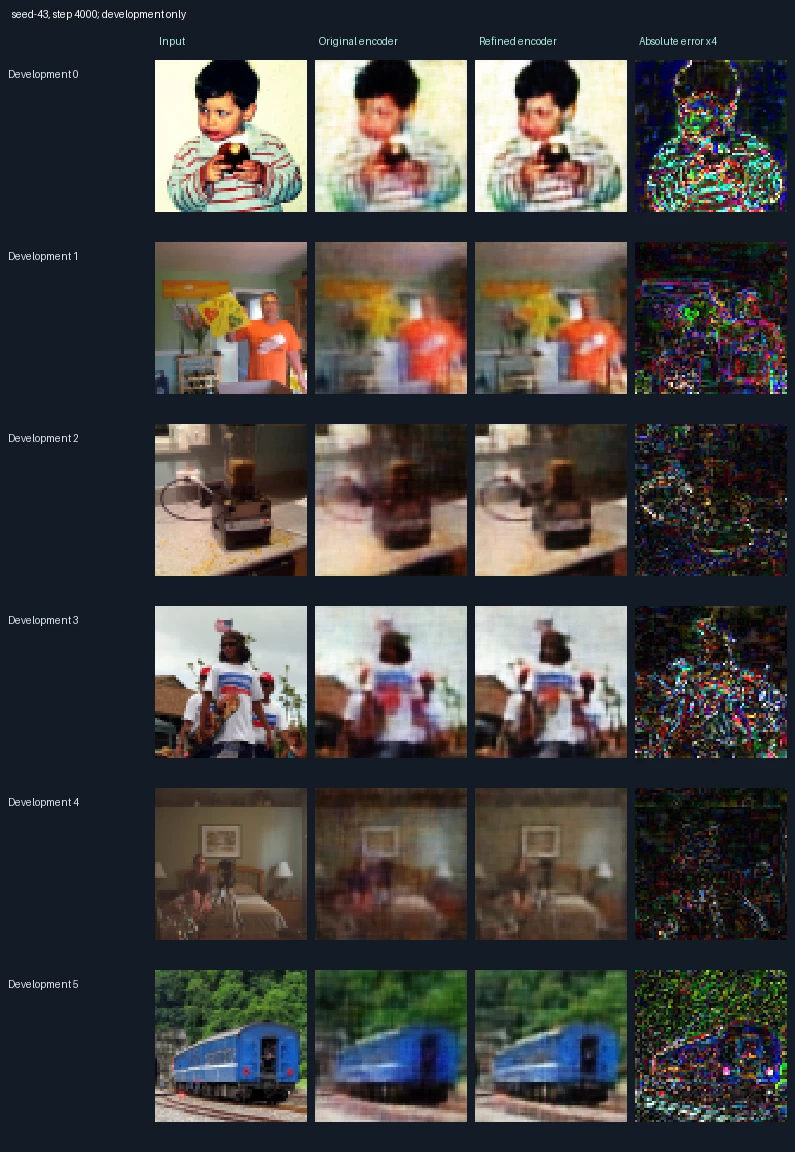
Six fixed development photographs, excluded from gradient updates and used to monitor model quality. Left to right: input pixels, reconstruction from the original encoder’s vector, reconstruction from the refined encoder’s vector, and the refined output’s error. The same fixed decoder reconstructs both vectors. This is training repetition 3; the image label “seed-43” identifies its randomization setting. The model receives a 64 × 64 RGB image; photographs are center-cropped and resized before encoding. Enlargement here adds no detail. Error panels show four times the absolute RGB difference from the reference, separately for each color channel, clipped at full brightness. Darker pixels mean smaller errors; black is zero or below the display’s precision. The scale is fixed across examples, not adjusted to make each image look better.

Limits and next question

This establishes a reconstruction gain for one pretrained 64×64 candidate and training recipe, not optimal encoding or general cognition. Every evaluated image improved in pixel MSE for each seed, but detail is still lost. New vectors match their own old vectors in only 34–36 of 72 replay cases (22/24 photographs); reconstruction alone does not establish memory compatibility or useful semantic/compositional structure. Existing lives retain their original models. Source exposure and near-duplicate screening limits are disclosed in the report.

Next question. How can further encoder refinement preserve more detail and useful vector relationships? Resolve compatibility before adopting the candidate into an old life. Milestone 1.3 remains deferred.

Inspect the evidence

Download the methods and measurements for this experiment. Large training and saved-state files are not included.