run record~/research/cliste/runsAll Cliste runs

Type a section name and press Enter. Use “help” for the list.

Figures: softened for dark viewingDisplay only; image files are unchanged.
← All Cliste runs

Cliste experiment

Encoder refinement with a fixed decoder

Execution: interruptedScientific verdict: No final scientific verdict

The question

Improve immediate perceptual reconstruction by refining only the encoder through the fixed VSA representation and decoder.

Why this experiment?

A memory can only preserve what its sensory interface encodes. These studies separate encoder quality, decoder quality and compatibility with earlier stored vectors.

How it works

Change one component or input representation at a time and evaluate immediate reconstruction on separate images. Keep old-vector readback visible so gains on new inputs do not hide compatibility losses.

Follow this part of the investigation: Sharper perception can also change the language of memory →
Implementation and comparison details

Only encoder feature extraction and vector projection parameters learn. Decoder, position codes, normalization statistics, VSA operations and input resolution stay fixed; original and zero-rate controls are retained.

What happened

Interrupted before final evaluation. A separate registered attempt repeats the unchanged protocol.

Results and visual artifacts

Open a figure for its input, comparison, and result. Click an image to enlarge it.

The encoder converts pixels into a VSA vector; the decoder turns that vector back into pixels. Only the encoder is trained in this experiment. The model receives a 64 × 64 RGB image; photographs are center-cropped and resized before encoding. Enlargement here adds no detail. Development examples help select a model; final test examples assess that selected model. Training-control examples deliberately test whether fitting works. Replay examples are earlier images encoded again, not reconstructions from untouched old memory vectors. Error panels show four times the absolute RGB difference from the reference, separately for each color channel, clipped at full brightness. Darker pixels mean smaller errors; black is zero or below the display’s precision. The scale is fixed across examples, not adjusted to make each image look better.

Encoder refinement: inputs used to monitor training
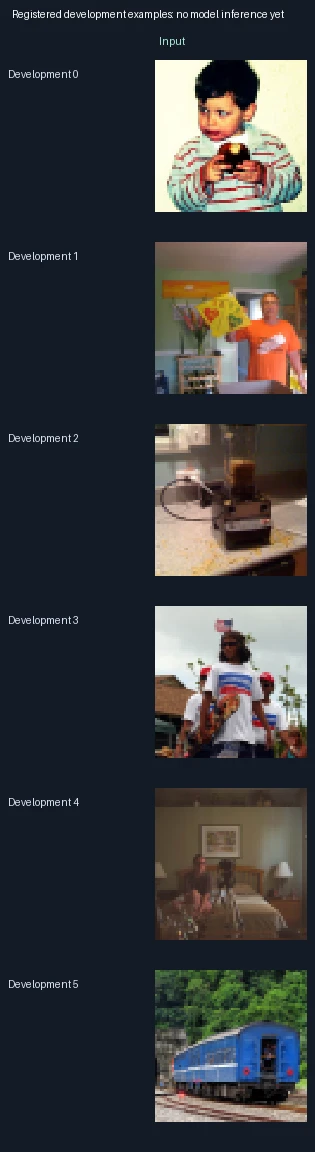
Six development photographs chosen before training, showing only the exact 64 × 64 input pixels. No reconstructions appear in this figure. This attempt was interrupted before final evaluation; these inputs are not a completed result.
Encoder learning check: fitting eight training photographs
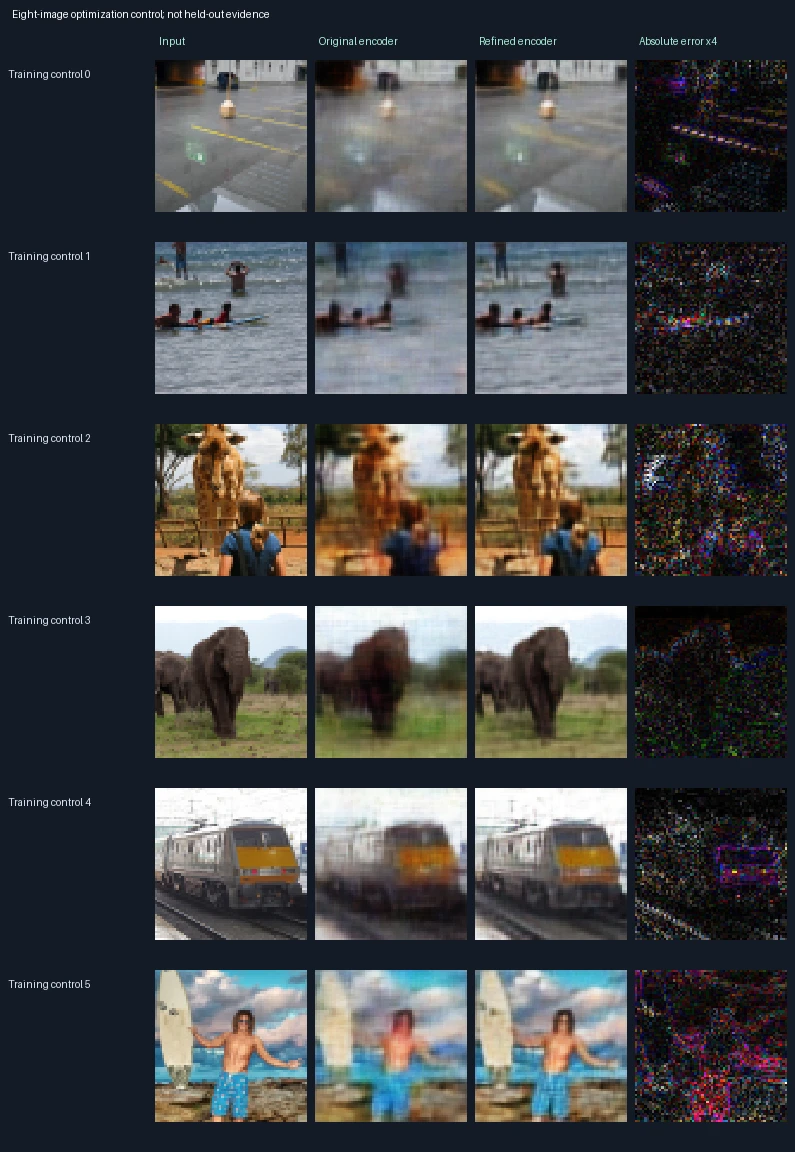
Six of the eight training photographs used in a deliberate fitting check. Left to right: input pixels, reconstruction from the original encoder’s vector, reconstruction from the refined encoder’s vector, and the refined output’s error. The same fixed decoder reconstructs both vectors. Only the encoder is trained. Better reproduction here verifies that weight updates can improve reconstruction, not that the model generalizes to new images. Error panels show four times the absolute RGB difference from the reference, separately for each color channel, clipped at full brightness. Darker pixels mean smaller errors; black is zero or below the display’s precision. The scale is fixed across examples, not adjusted to make each image look better.
Encoder refinement, learning-rate trial (1e-05): 0 weight updates
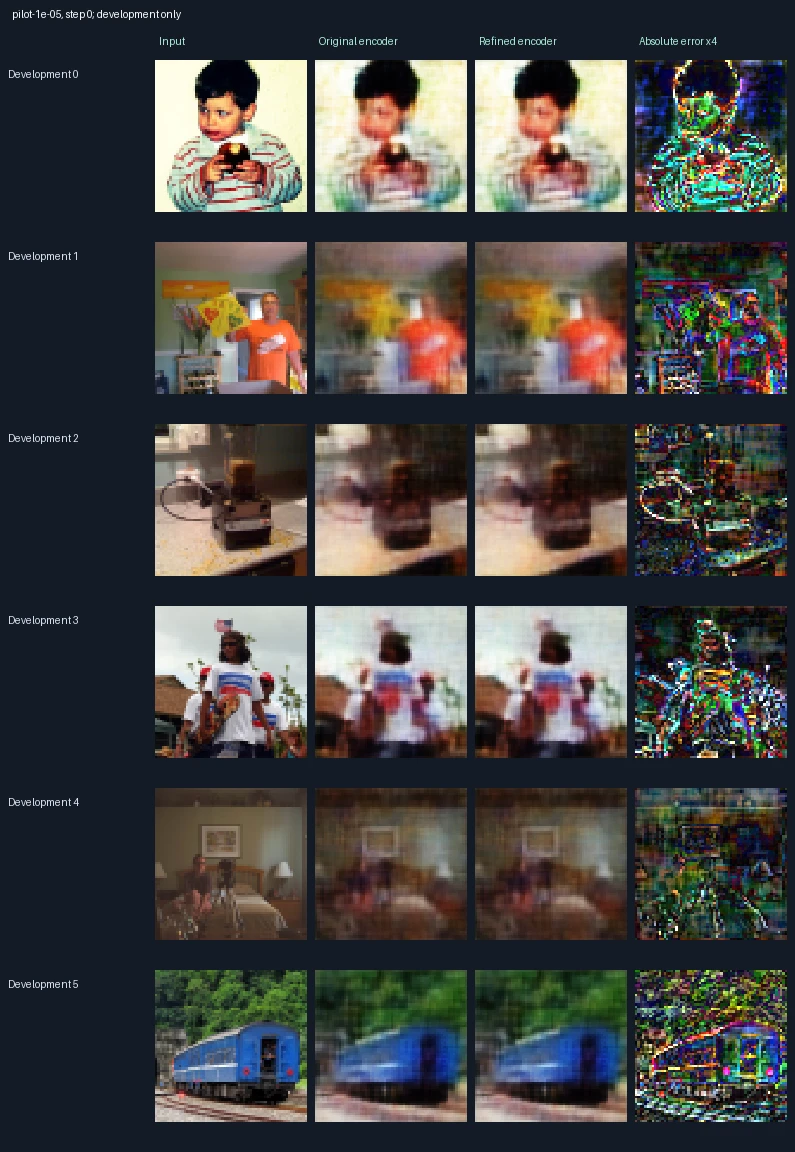
Six fixed development photographs, excluded from gradient updates and used to monitor model quality. Left to right: input pixels, reconstruction from the original encoder’s vector, reconstruction from the refined encoder’s vector, and the refined output’s error. The same fixed decoder reconstructs both vectors. This short trial uses learning rate 1e-05, a setting that controls the size of weight updates. The model receives a 64 × 64 RGB image; photographs are center-cropped and resized before encoding. Enlargement here adds no detail. Error panels show four times the absolute RGB difference from the reference, separately for each color channel, clipped at full brightness. Darker pixels mean smaller errors; black is zero or below the display’s precision. The scale is fixed across examples, not adjusted to make each image look better. This snapshot belongs to an interrupted attempt with no final test conclusion.
Encoder refinement, learning-rate trial (1e-05): 250 weight updates
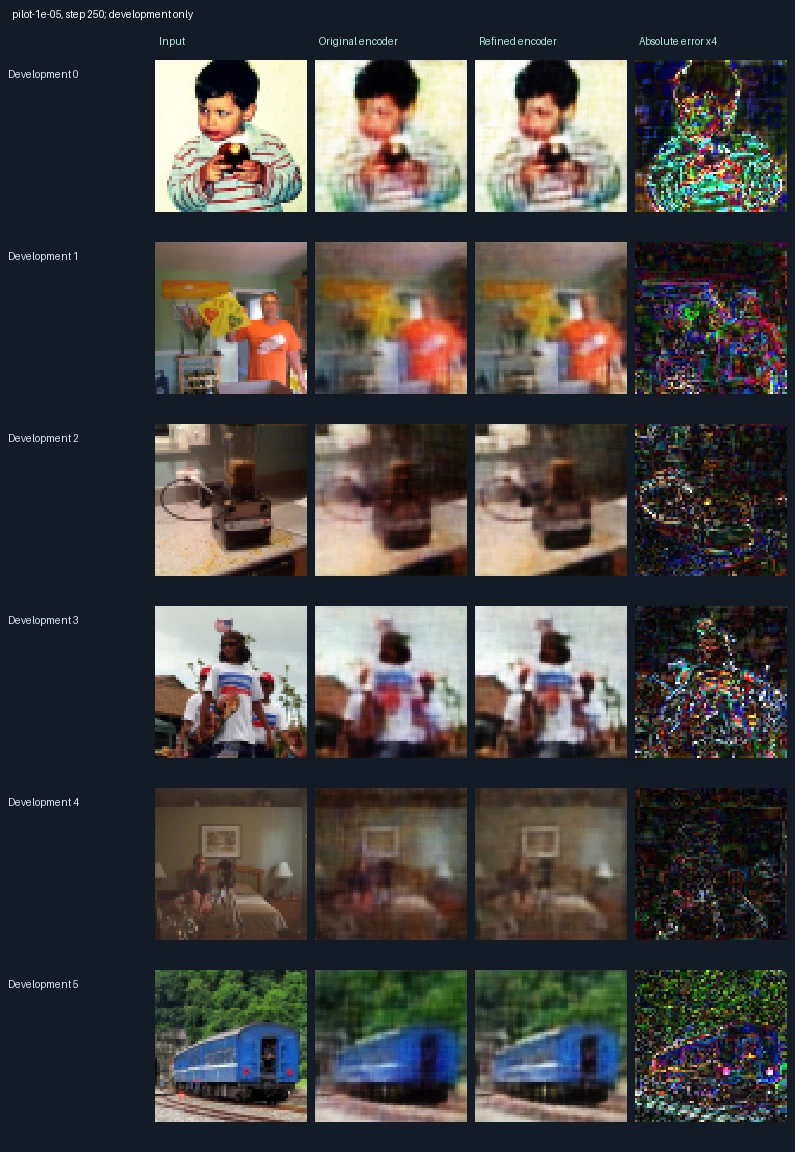
Six fixed development photographs, excluded from gradient updates and used to monitor model quality. Left to right: input pixels, reconstruction from the original encoder’s vector, reconstruction from the refined encoder’s vector, and the refined output’s error. The same fixed decoder reconstructs both vectors. This short trial uses learning rate 1e-05, a setting that controls the size of weight updates. The model receives a 64 × 64 RGB image; photographs are center-cropped and resized before encoding. Enlargement here adds no detail. Error panels show four times the absolute RGB difference from the reference, separately for each color channel, clipped at full brightness. Darker pixels mean smaller errors; black is zero or below the display’s precision. The scale is fixed across examples, not adjusted to make each image look better. This snapshot belongs to an interrupted attempt with no final test conclusion.
Encoder refinement, learning-rate trial (1e-05): 500 weight updates
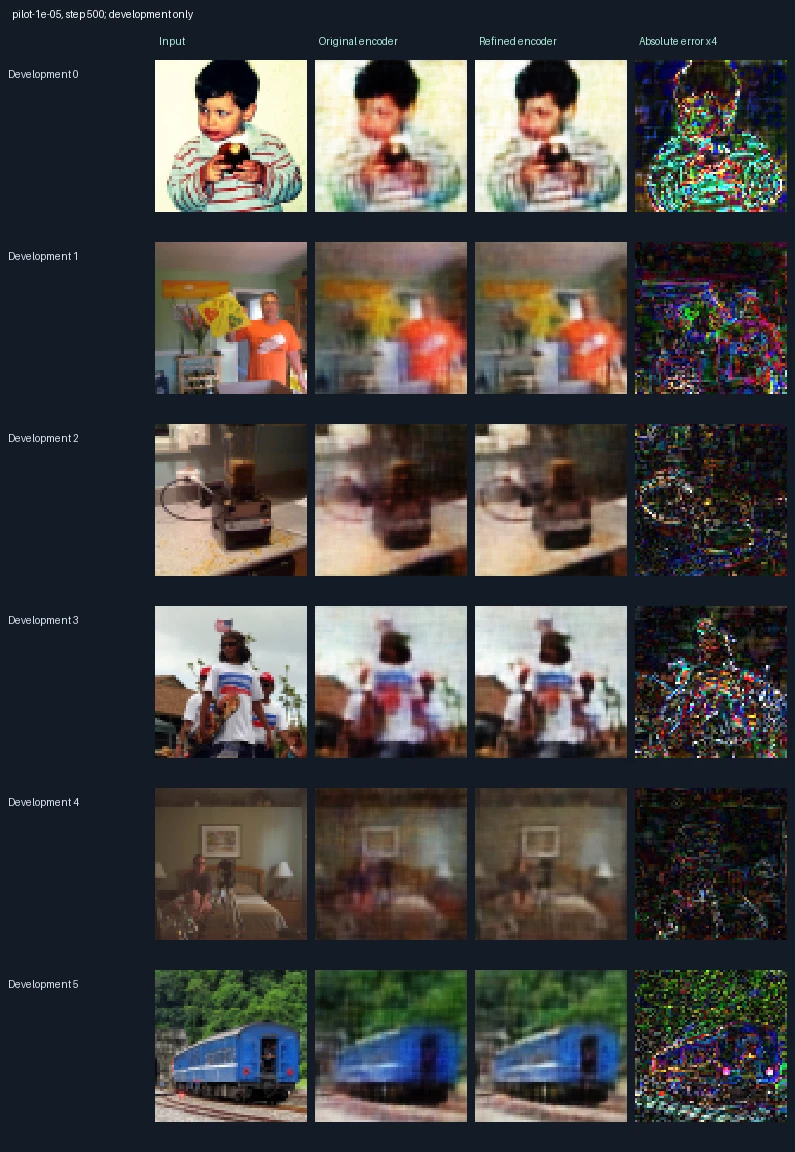
Six fixed development photographs, excluded from gradient updates and used to monitor model quality. Left to right: input pixels, reconstruction from the original encoder’s vector, reconstruction from the refined encoder’s vector, and the refined output’s error. The same fixed decoder reconstructs both vectors. This short trial uses learning rate 1e-05, a setting that controls the size of weight updates. The model receives a 64 × 64 RGB image; photographs are center-cropped and resized before encoding. Enlargement here adds no detail. Error panels show four times the absolute RGB difference from the reference, separately for each color channel, clipped at full brightness. Darker pixels mean smaller errors; black is zero or below the display’s precision. The scale is fixed across examples, not adjusted to make each image look better. This snapshot belongs to an interrupted attempt with no final test conclusion.
Encoder refinement, learning-rate trial (3e-05): 0 weight updates
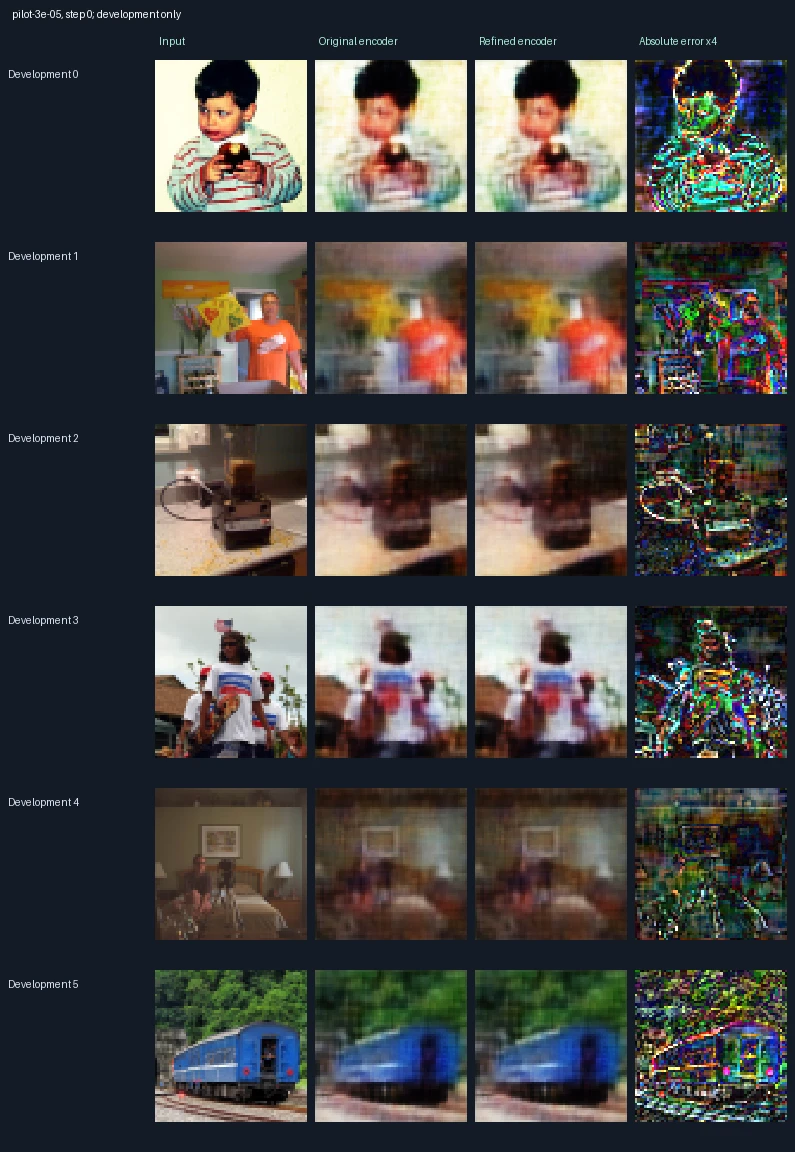
Six fixed development photographs, excluded from gradient updates and used to monitor model quality. Left to right: input pixels, reconstruction from the original encoder’s vector, reconstruction from the refined encoder’s vector, and the refined output’s error. The same fixed decoder reconstructs both vectors. This short trial uses learning rate 3e-05, a setting that controls the size of weight updates. The model receives a 64 × 64 RGB image; photographs are center-cropped and resized before encoding. Enlargement here adds no detail. Error panels show four times the absolute RGB difference from the reference, separately for each color channel, clipped at full brightness. Darker pixels mean smaller errors; black is zero or below the display’s precision. The scale is fixed across examples, not adjusted to make each image look better. This snapshot belongs to an interrupted attempt with no final test conclusion.
Encoder refinement, learning-rate trial (3e-05): 250 weight updates
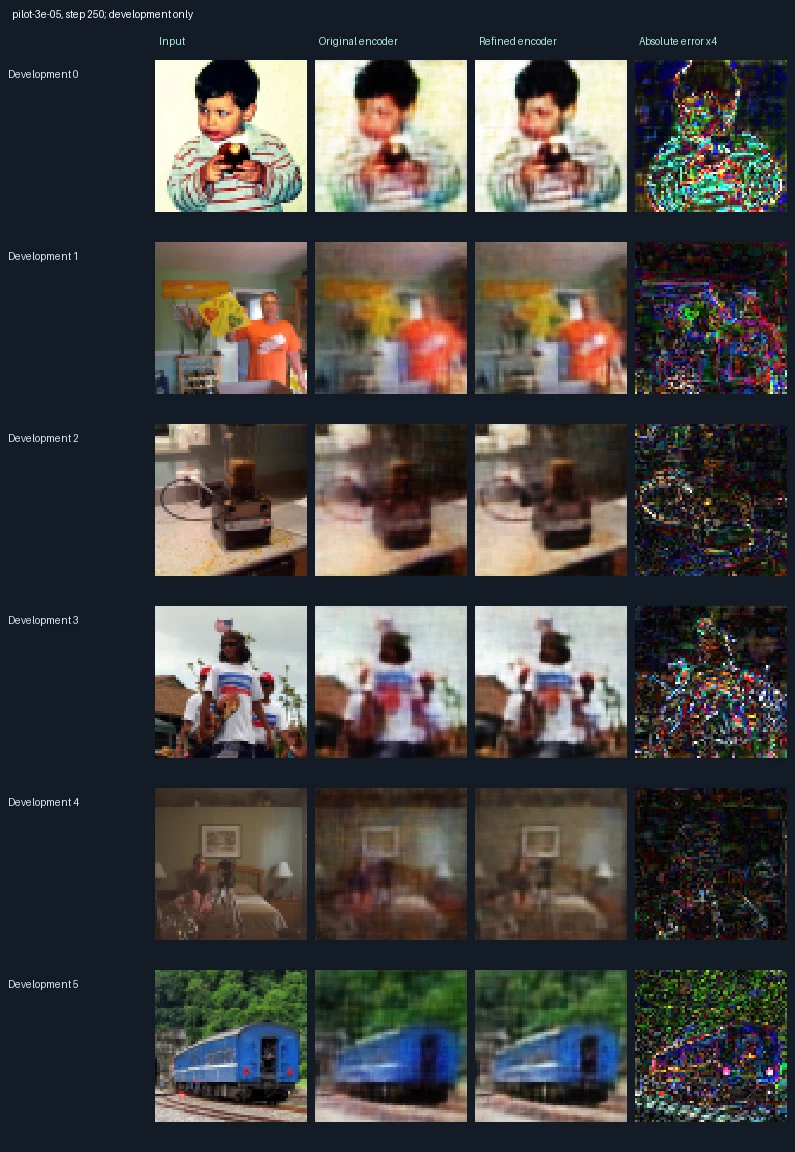
Six fixed development photographs, excluded from gradient updates and used to monitor model quality. Left to right: input pixels, reconstruction from the original encoder’s vector, reconstruction from the refined encoder’s vector, and the refined output’s error. The same fixed decoder reconstructs both vectors. This short trial uses learning rate 3e-05, a setting that controls the size of weight updates. The model receives a 64 × 64 RGB image; photographs are center-cropped and resized before encoding. Enlargement here adds no detail. Error panels show four times the absolute RGB difference from the reference, separately for each color channel, clipped at full brightness. Darker pixels mean smaller errors; black is zero or below the display’s precision. The scale is fixed across examples, not adjusted to make each image look better. This snapshot belongs to an interrupted attempt with no final test conclusion.
Encoder refinement, learning-rate trial (3e-05): 500 weight updates
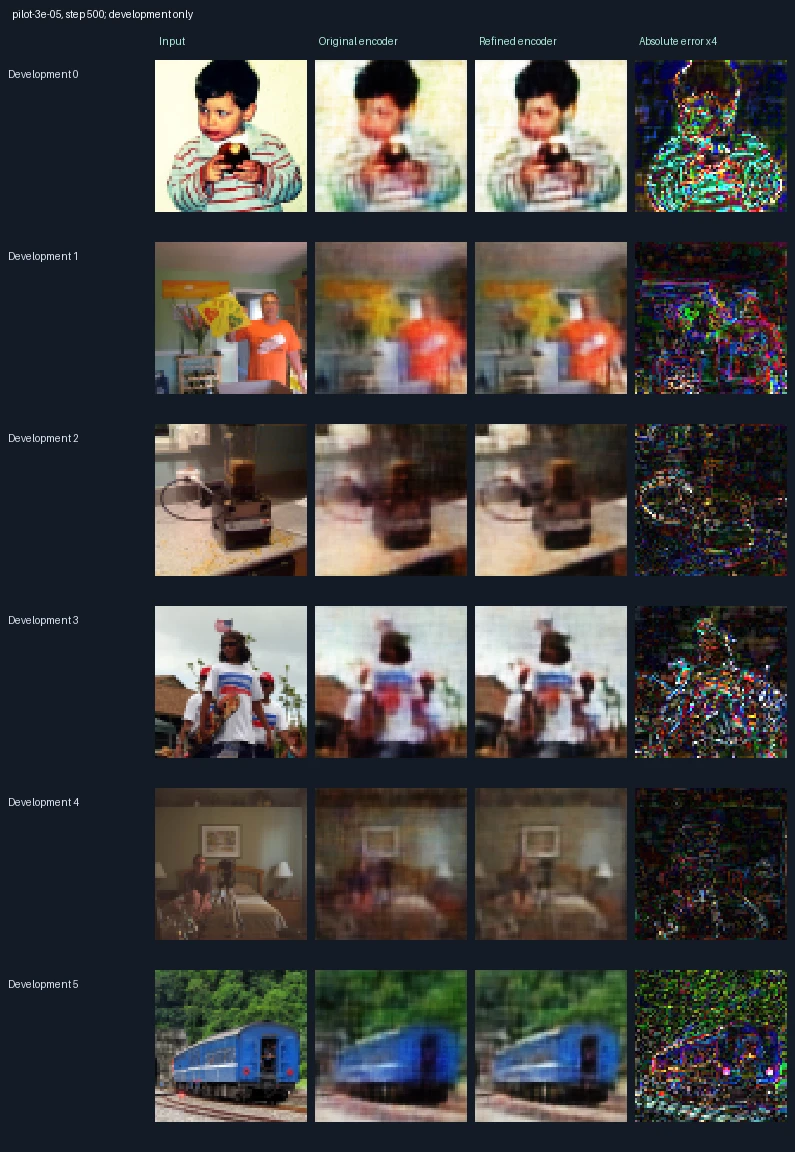
Six fixed development photographs, excluded from gradient updates and used to monitor model quality. Left to right: input pixels, reconstruction from the original encoder’s vector, reconstruction from the refined encoder’s vector, and the refined output’s error. The same fixed decoder reconstructs both vectors. This short trial uses learning rate 3e-05, a setting that controls the size of weight updates. The model receives a 64 × 64 RGB image; photographs are center-cropped and resized before encoding. Enlargement here adds no detail. Error panels show four times the absolute RGB difference from the reference, separately for each color channel, clipped at full brightness. Darker pixels mean smaller errors; black is zero or below the display’s precision. The scale is fixed across examples, not adjusted to make each image look better. This snapshot belongs to an interrupted attempt with no final test conclusion.
Encoder refinement, learning-rate trial (1e-04): 0 weight updates
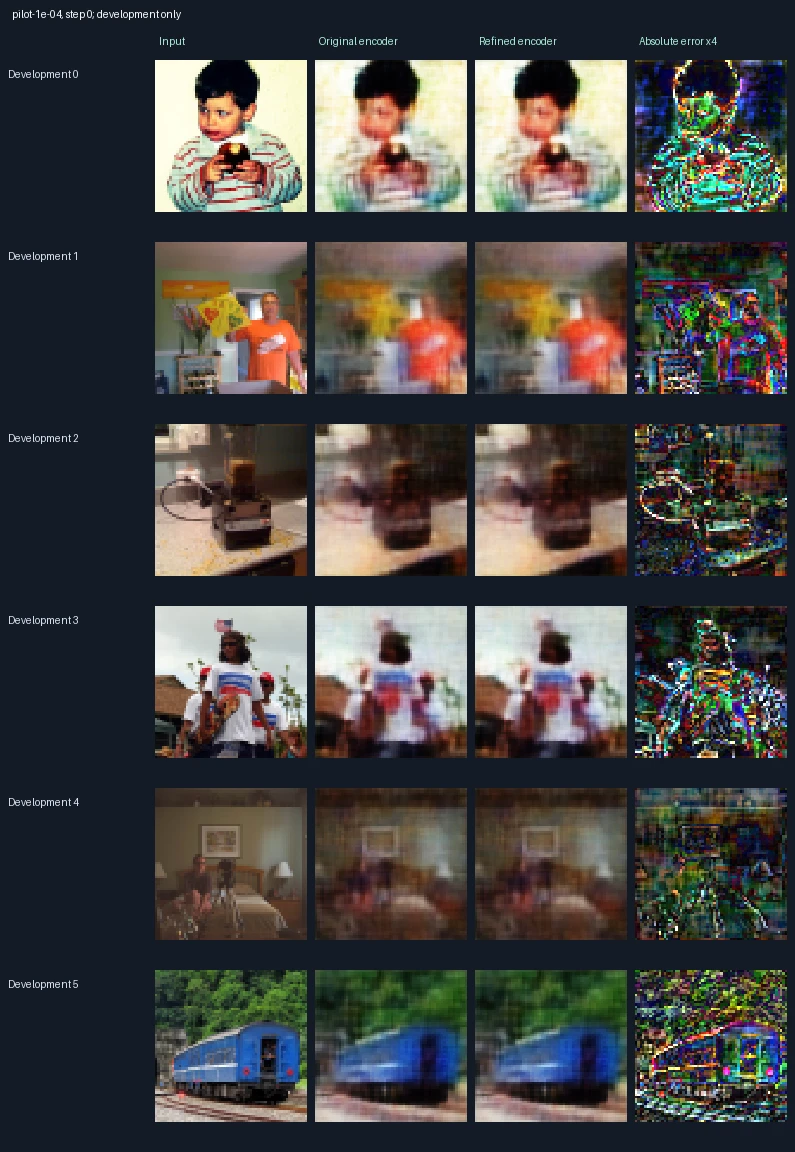
Six fixed development photographs, excluded from gradient updates and used to monitor model quality. Left to right: input pixels, reconstruction from the original encoder’s vector, reconstruction from the refined encoder’s vector, and the refined output’s error. The same fixed decoder reconstructs both vectors. This short trial uses learning rate 1e-04, a setting that controls the size of weight updates. The model receives a 64 × 64 RGB image; photographs are center-cropped and resized before encoding. Enlargement here adds no detail. Error panels show four times the absolute RGB difference from the reference, separately for each color channel, clipped at full brightness. Darker pixels mean smaller errors; black is zero or below the display’s precision. The scale is fixed across examples, not adjusted to make each image look better. This snapshot belongs to an interrupted attempt with no final test conclusion.
Encoder refinement, learning-rate trial (1e-04): 250 weight updates
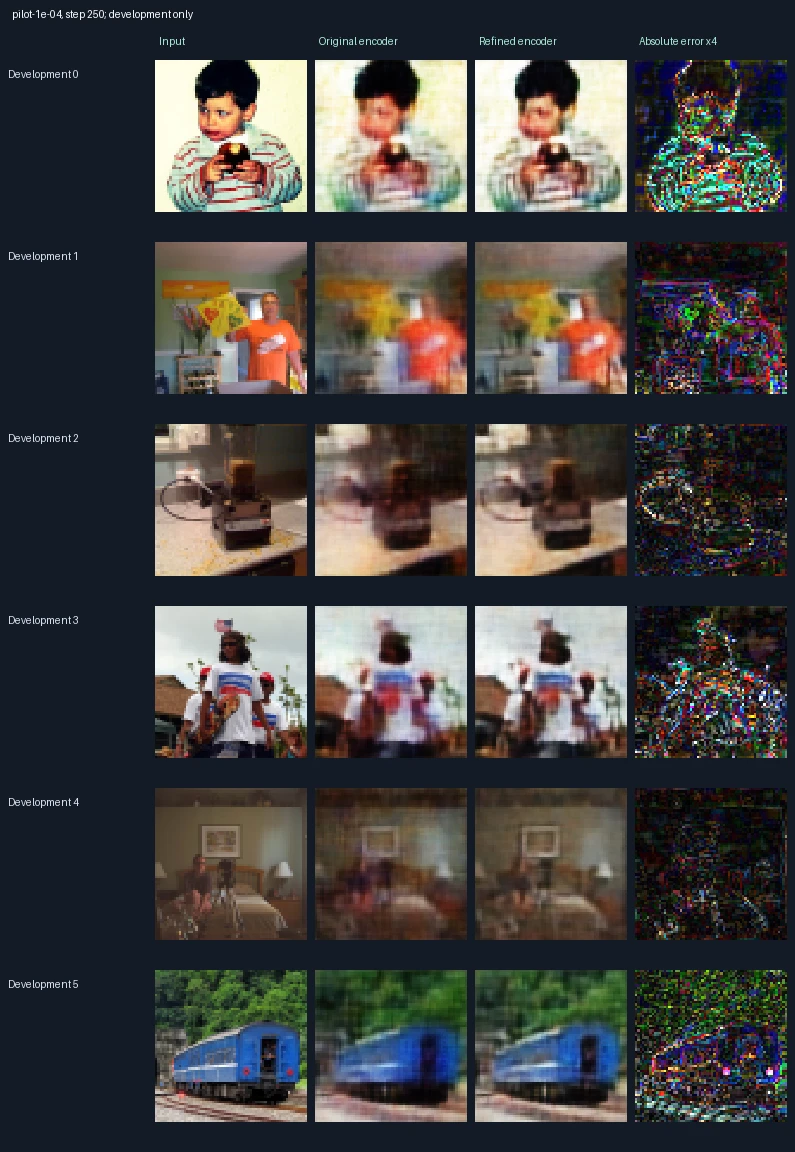
Six fixed development photographs, excluded from gradient updates and used to monitor model quality. Left to right: input pixels, reconstruction from the original encoder’s vector, reconstruction from the refined encoder’s vector, and the refined output’s error. The same fixed decoder reconstructs both vectors. This short trial uses learning rate 1e-04, a setting that controls the size of weight updates. The model receives a 64 × 64 RGB image; photographs are center-cropped and resized before encoding. Enlargement here adds no detail. Error panels show four times the absolute RGB difference from the reference, separately for each color channel, clipped at full brightness. Darker pixels mean smaller errors; black is zero or below the display’s precision. The scale is fixed across examples, not adjusted to make each image look better. This snapshot belongs to an interrupted attempt with no final test conclusion.
Encoder refinement, learning-rate trial (1e-04): 500 weight updates
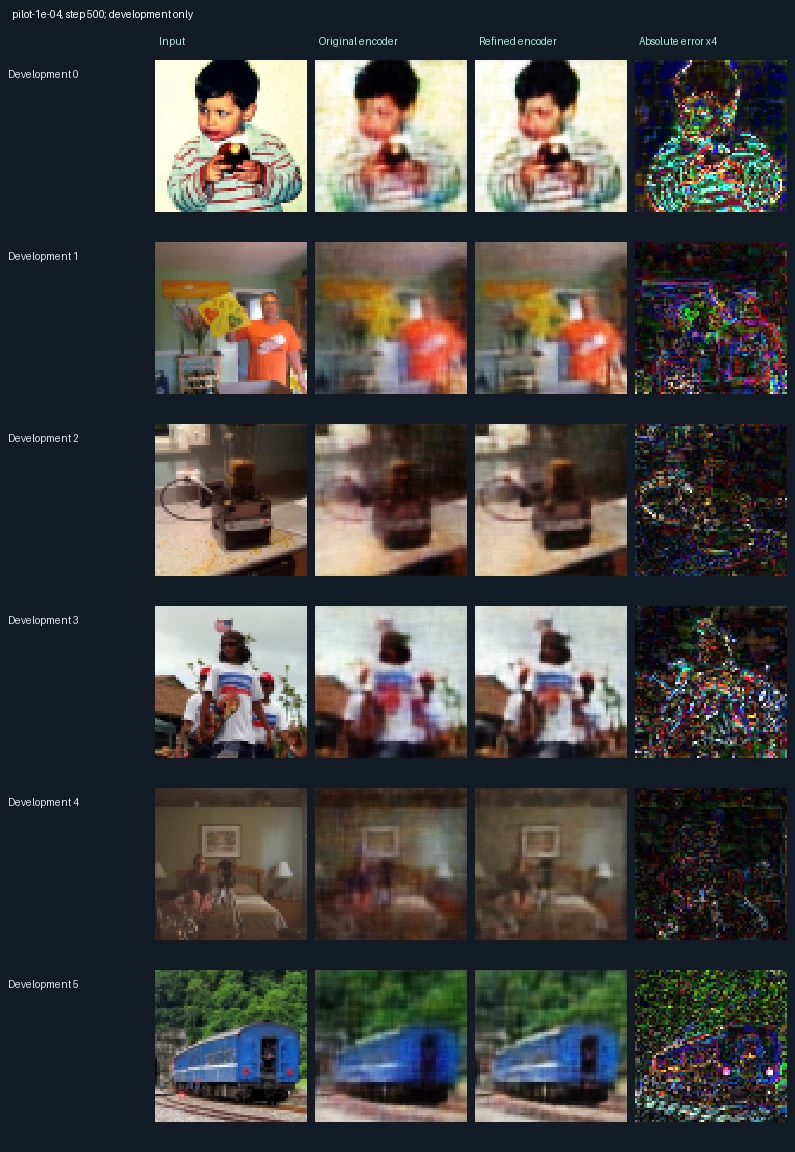
Six fixed development photographs, excluded from gradient updates and used to monitor model quality. Left to right: input pixels, reconstruction from the original encoder’s vector, reconstruction from the refined encoder’s vector, and the refined output’s error. The same fixed decoder reconstructs both vectors. This short trial uses learning rate 1e-04, a setting that controls the size of weight updates. The model receives a 64 × 64 RGB image; photographs are center-cropped and resized before encoding. Enlargement here adds no detail. Error panels show four times the absolute RGB difference from the reference, separately for each color channel, clipped at full brightness. Darker pixels mean smaller errors; black is zero or below the display’s precision. The scale is fixed across examples, not adjusted to make each image look better. This snapshot belongs to an interrupted attempt with no final test conclusion.
Encoder refinement, training repetition 1: 0 weight updates
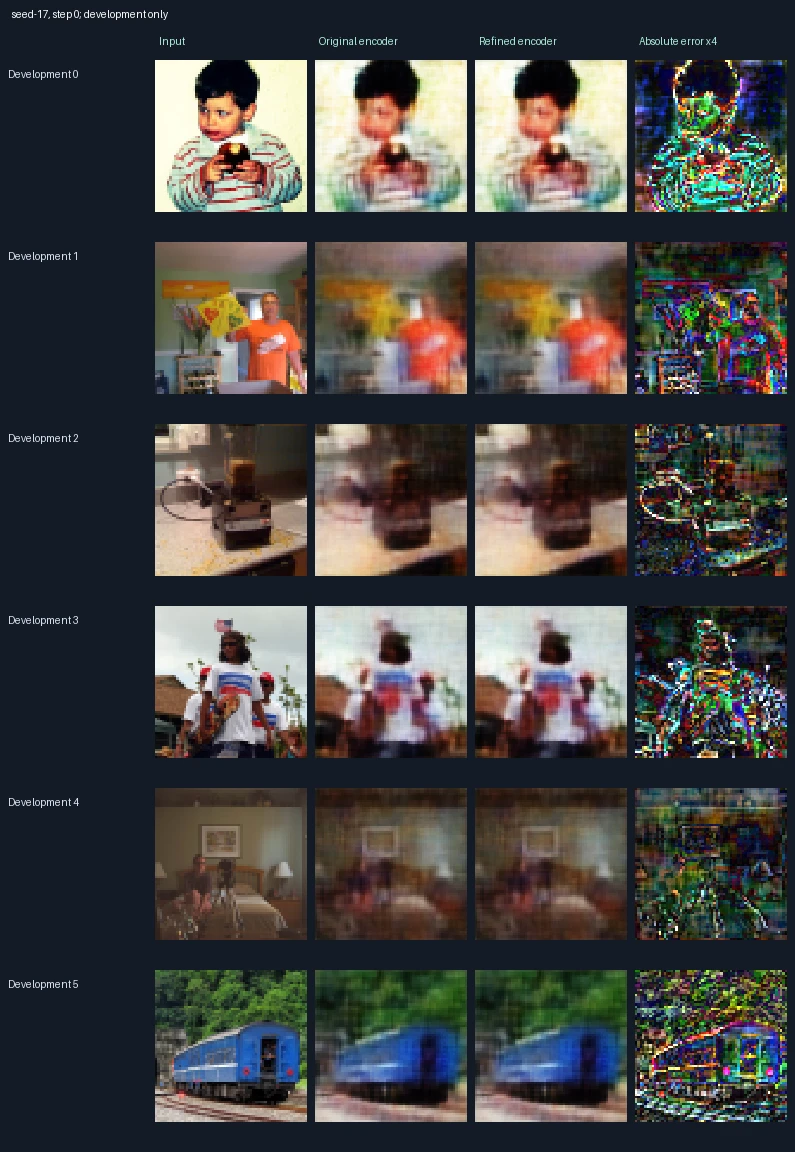
Six fixed development photographs, excluded from gradient updates and used to monitor model quality. Left to right: input pixels, reconstruction from the original encoder’s vector, reconstruction from the refined encoder’s vector, and the refined output’s error. The same fixed decoder reconstructs both vectors. This is training repetition 1; the image label “seed-17” identifies its randomization setting. The model receives a 64 × 64 RGB image; photographs are center-cropped and resized before encoding. Enlargement here adds no detail. Error panels show four times the absolute RGB difference from the reference, separately for each color channel, clipped at full brightness. Darker pixels mean smaller errors; black is zero or below the display’s precision. The scale is fixed across examples, not adjusted to make each image look better. This snapshot belongs to an interrupted attempt with no final test conclusion.
Encoder refinement, training repetition 1: 250 weight updates
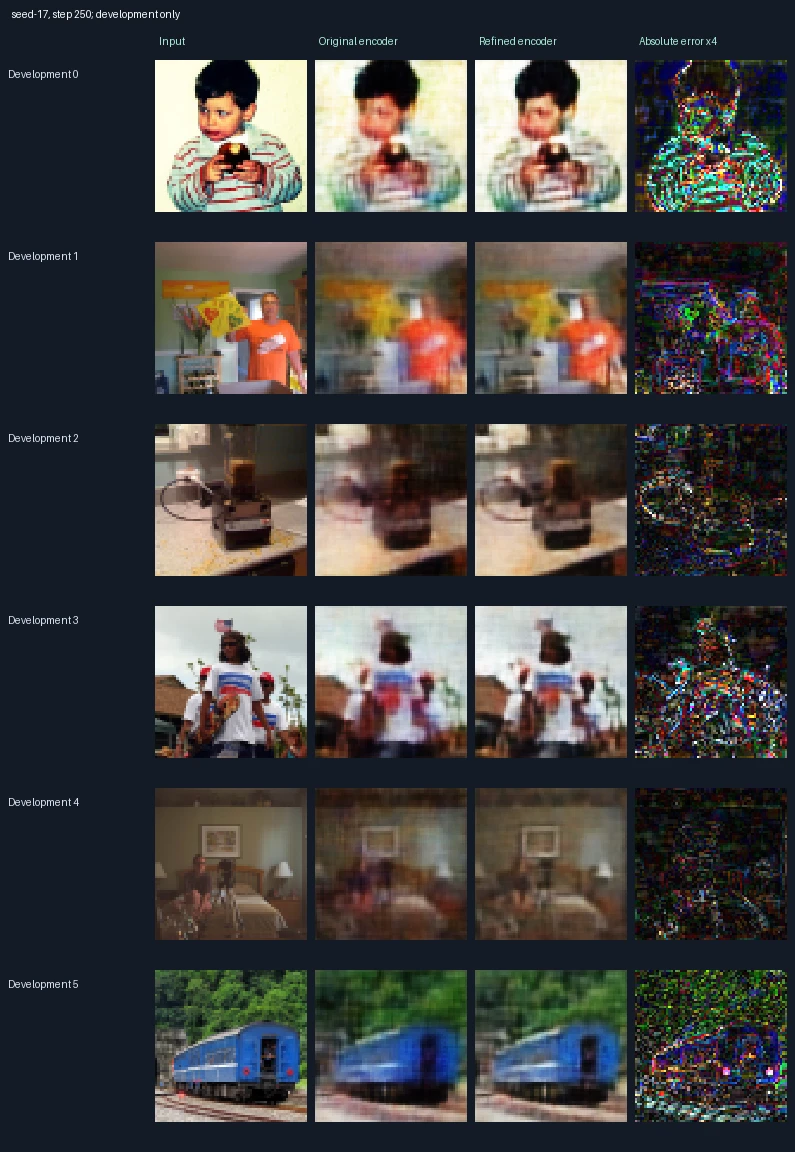
Six fixed development photographs, excluded from gradient updates and used to monitor model quality. Left to right: input pixels, reconstruction from the original encoder’s vector, reconstruction from the refined encoder’s vector, and the refined output’s error. The same fixed decoder reconstructs both vectors. This is training repetition 1; the image label “seed-17” identifies its randomization setting. The model receives a 64 × 64 RGB image; photographs are center-cropped and resized before encoding. Enlargement here adds no detail. Error panels show four times the absolute RGB difference from the reference, separately for each color channel, clipped at full brightness. Darker pixels mean smaller errors; black is zero or below the display’s precision. The scale is fixed across examples, not adjusted to make each image look better. This snapshot belongs to an interrupted attempt with no final test conclusion.
Encoder refinement, training repetition 1: 500 weight updates
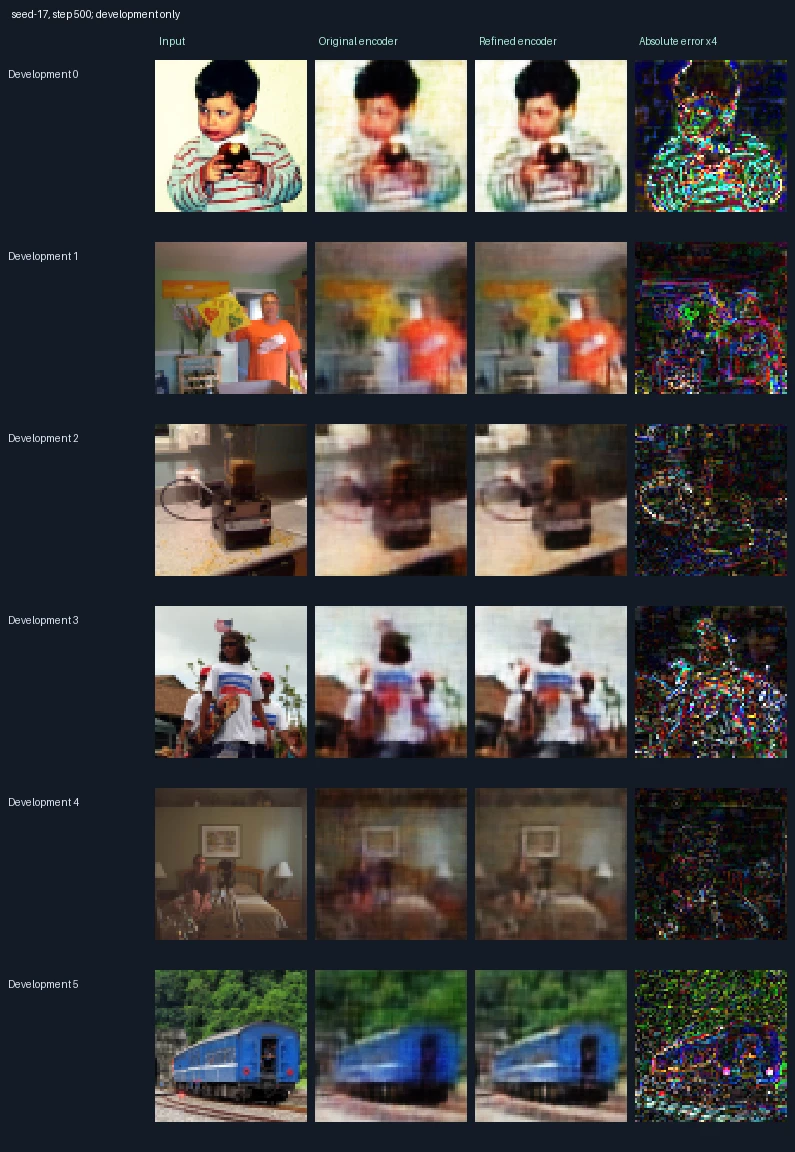
Six fixed development photographs, excluded from gradient updates and used to monitor model quality. Left to right: input pixels, reconstruction from the original encoder’s vector, reconstruction from the refined encoder’s vector, and the refined output’s error. The same fixed decoder reconstructs both vectors. This is training repetition 1; the image label “seed-17” identifies its randomization setting. The model receives a 64 × 64 RGB image; photographs are center-cropped and resized before encoding. Enlargement here adds no detail. Error panels show four times the absolute RGB difference from the reference, separately for each color channel, clipped at full brightness. Darker pixels mean smaller errors; black is zero or below the display’s precision. The scale is fixed across examples, not adjusted to make each image look better. This snapshot belongs to an interrupted attempt with no final test conclusion.

Limits and next question

One pretrained 64 by 64 PatchSum candidate and one registered training recipe. Reconstruction improvement does not establish a perfect encoder, acquired understanding or compositional usefulness. External transfer, writing retention and vector drift are reported separately; prior historical exposure and near-duplicates cannot be ruled out by exact hashing. No existing life is migrated or replaced.

Next question. Use the registered controls, independent evaluation, regressions and uncertainty to decide whether this encoder recipe improves the foundation and what needs refinement next.

Inspect the evidence

Download the methods and measurements for this experiment. Large training and saved-state files are not included.