Type a section name and press Enter. Use “help” for the list.
Cliste experiment
Testing learned visual patterns in a new composition
Registered 10 Oct 2026 · Snapshot 12 Oct 2026
The question
Can patterns recovered from a remembered VSA bundle support a new arrangement of its contents?
Why this experiment?
A nearby visual pattern is not necessarily the right replacement for a requested change. These comparisons test whether selection helps the resulting operation.
How it works
Supply two feature positions to exchange. Compare how candidate patterns are selected, then decode the edited bundle against an observer-only clean-feature exchange. This is a local feature operation, not a command to move a complete object.
Follow this part of the investigation: Similar parts are not necessarily the right parts for a change →Implementation and comparison details
The experiment supplied 32 requests to exchange two feature positions: four requests per photograph across eight already encountered photographs. The remembered life contained 135 encounters. The encoder and decoder stayed fixed, as did a bank of 512 feature patterns acquired from the first five photographs.
For each request, the worker recovered two noisy features from the retained bundle and proposed exchanges using either those raw estimates or their nearest learned patterns. It could not access the source photographs or expected answers. An observer separately used the original encoder features in the same exchange and decoder to form an exact-constituent control.
Forty-five acceptance rules were specified in advance. A rule had to make enough useful exchanges without exceeding the predefined harm limits before a separate confirmation panel could be evaluated.
What happened
Before acceptance filtering, exchanges using learned patterns had 48.6% lower mean regional squared RGB error than leaving memory unchanged: 0.000530 versus 0.001030 across all 32 requests. Error is measured against the exact-constituent decoder control, not the original photograph.
That lower average did not translate into reliable individual operations. Nine proposals improved, 20 worsened, and three made no change. All 20 losses exceeded 10%, and 17 proposals at least doubled the error. Large absolute improvements on a few requests outweighed smaller absolute losses in the overall mean; the criteria also measured each request relative to no change.
None of the 45 acceptance rules met the usefulness and harm criteria. The experiment stopped with a negative development result. Sixteen fresh photographs had been prepared for confirmation, but no confirmation admission or model inference took place. The existing memories were preserved.
A later audit of saved vectors found a bank pattern with at least 0.95 cosine similarity for 62 of 64 clean constituents. Recovery from the bundle selected the nearest clean-feature pattern only 20 times. This identifies recovery mistakes, but does not establish that the nearest available pattern in vector similarity would produce an adequate decoded exchange.
The independent numerical and preservation checks passed. The stored state, held memory and codec stayed exact, and decoded pixels outside the requested region were unchanged.
Measurements
| Recorded field | Value |
|---|---|
| Development requests evaluated | 32 |
| Confirmation requests evaluated | 0 |
| Selected cleanup acceptance rule | Not recorded |
| Confirmation result | Not recorded |
| Requests above the minimum reference-effect threshold | 27 |
| Requests where both positions chose the same learned pattern | 3 |
Results and visual artifacts
Open a figure for its input, comparison, and result. Click an image to enlarge it.
Lower average error, but unreliable individual exchanges
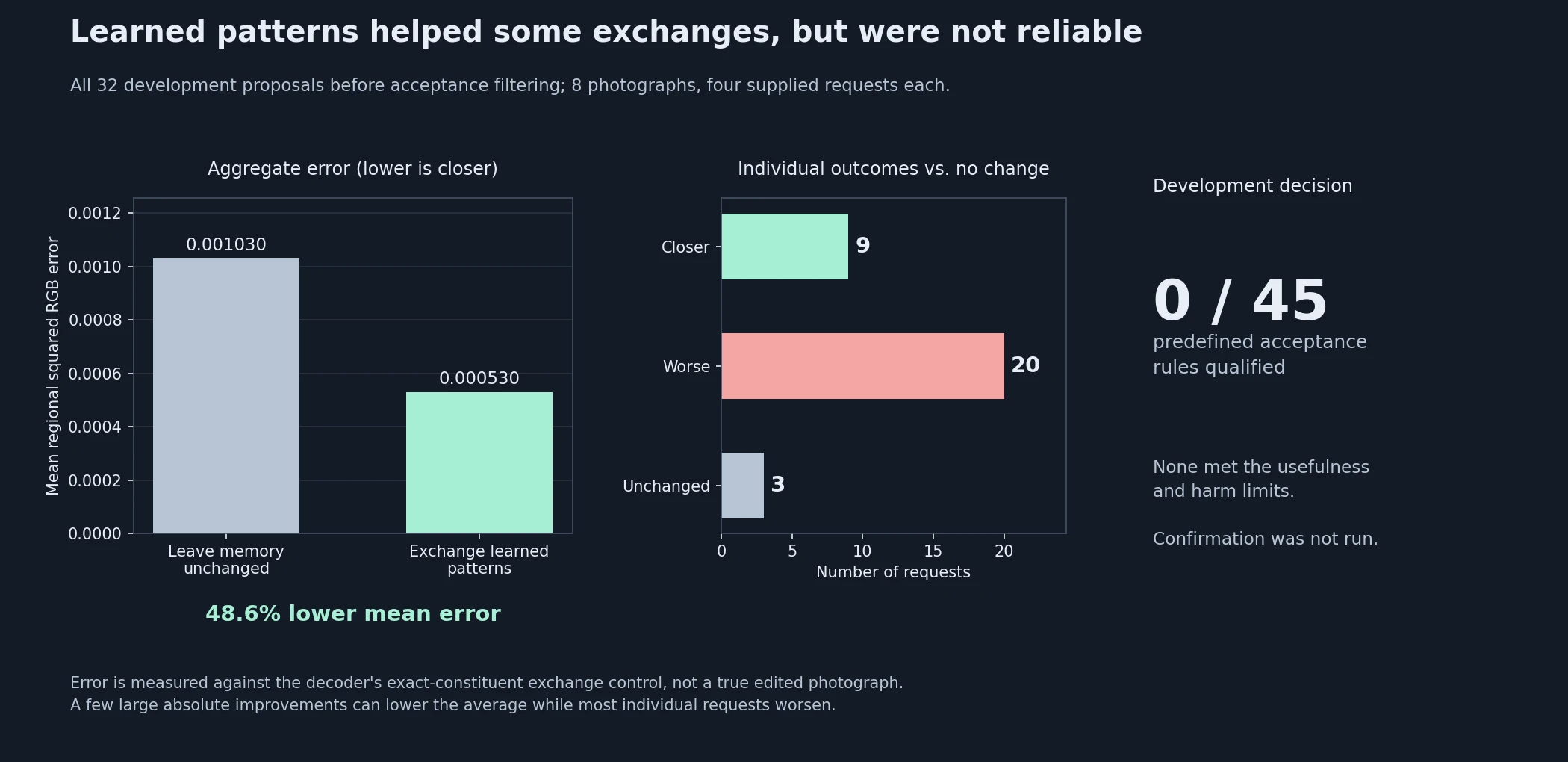
Display derivative: WebP quality 90; maximum edge 2400 px. Original scientific pixels remain in the source run; do not measure this preview.
Development: all source outcomes
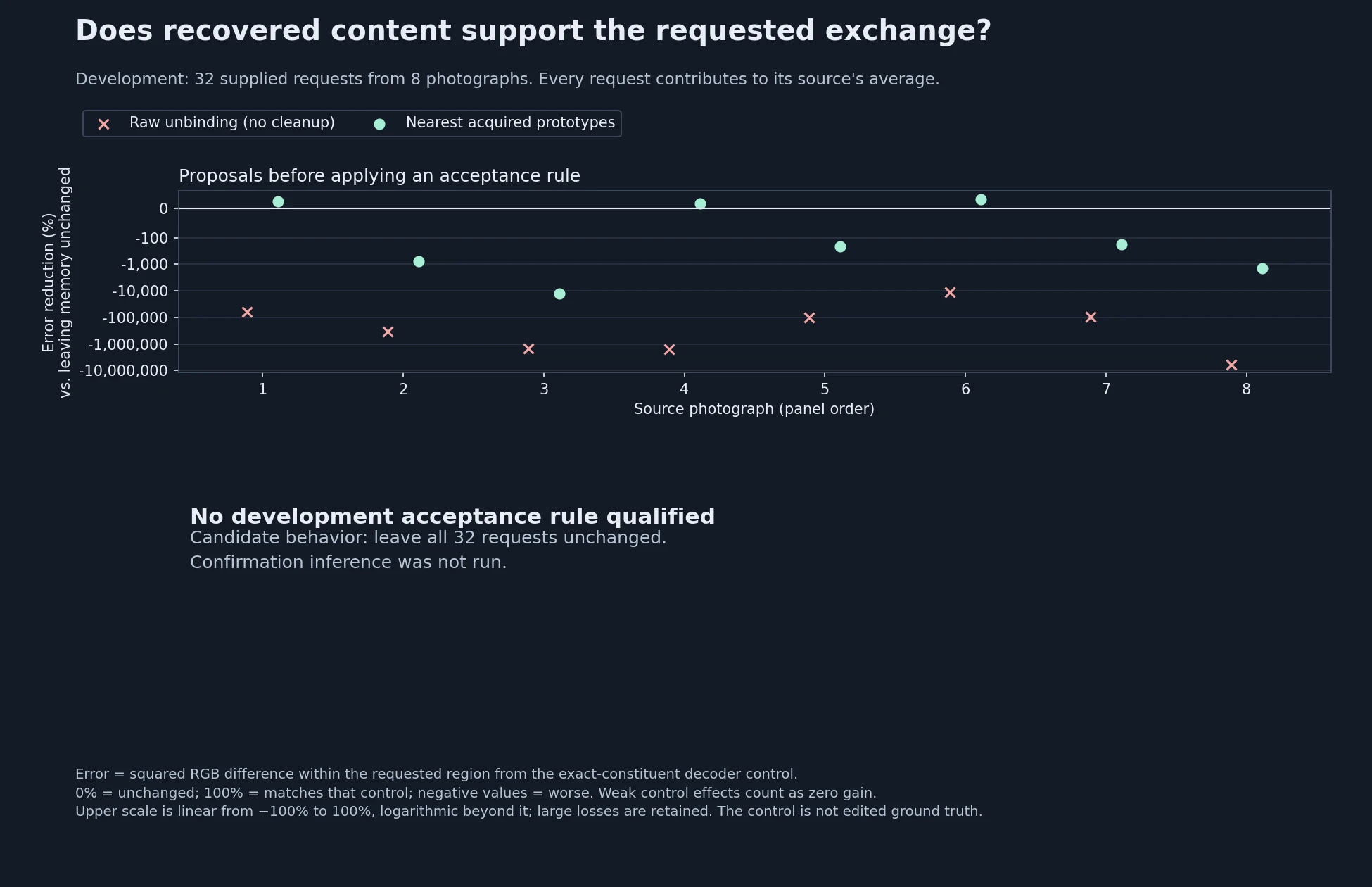
Display derivative: WebP quality 90; maximum edge 2400 px. Original scientific pixels remain in the source run; do not measure this preview.
Development: first supplied exchange
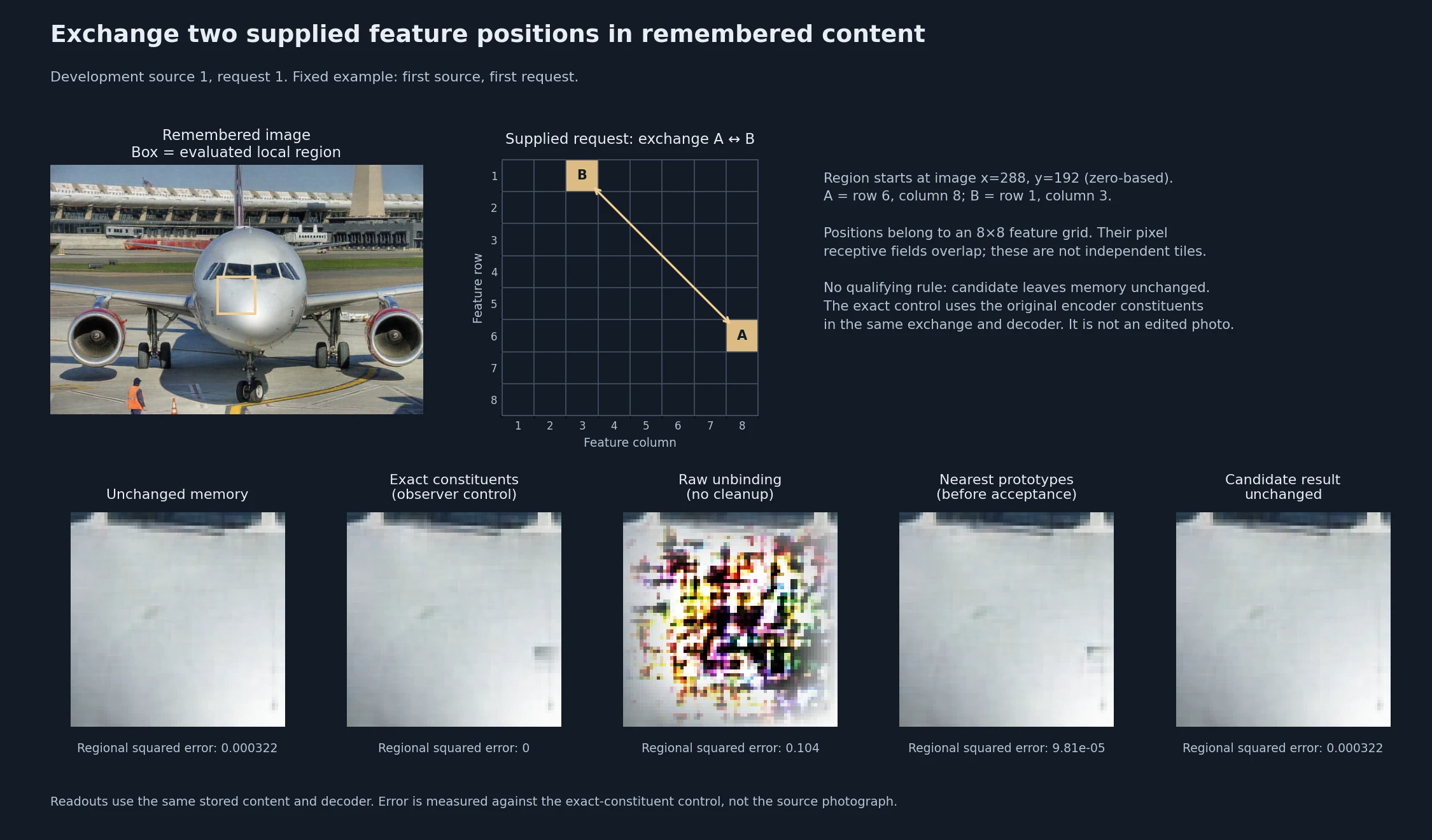
Display derivative: WebP quality 90; maximum edge 2400 px. Original scientific pixels remain in the source run; do not measure this preview.
Development: median prototype proposal
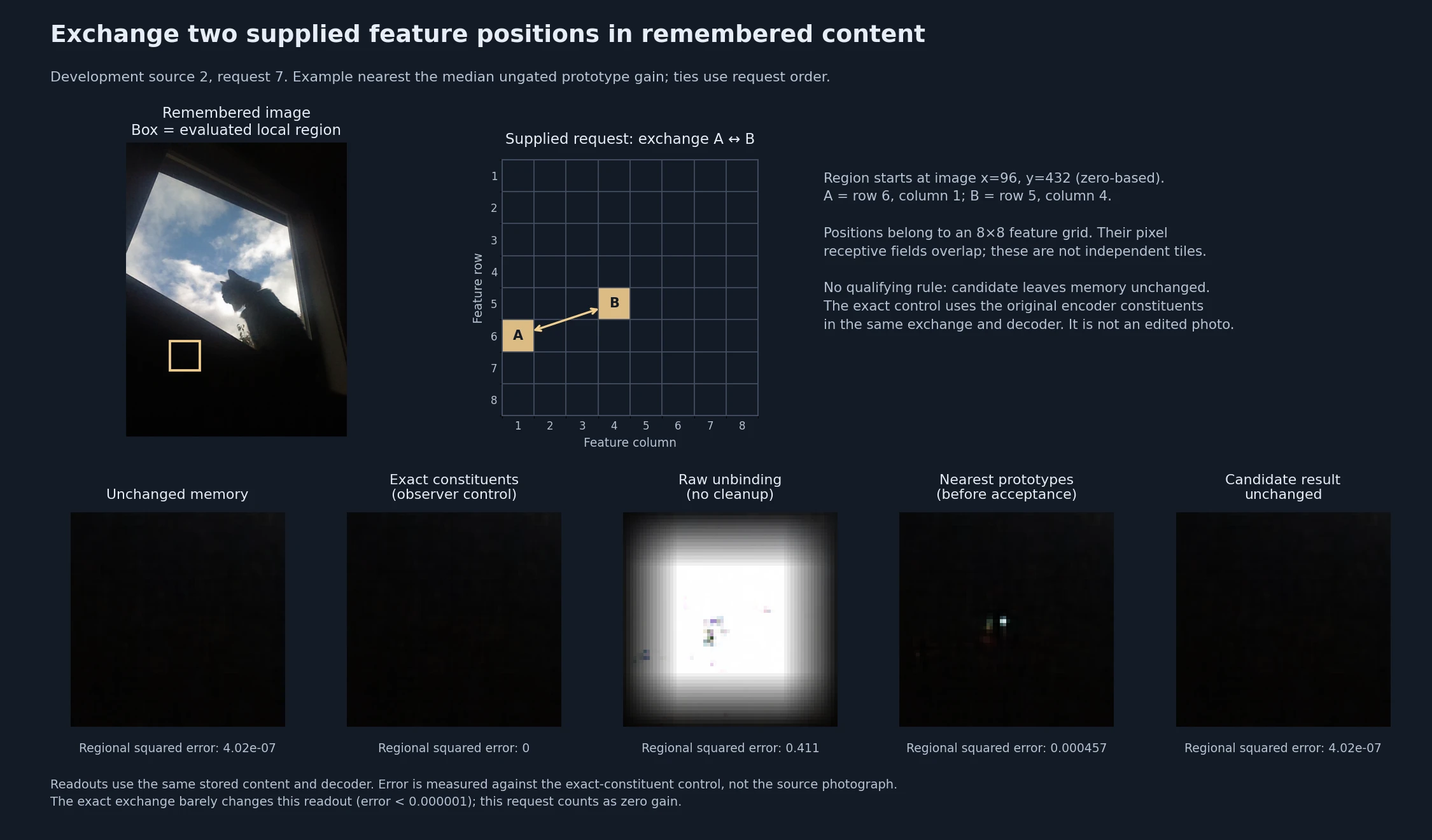
Display derivative: WebP quality 90; maximum edge 2400 px. Original scientific pixels remain in the source run; do not measure this preview.
Limits and next question
These are supplied feature-position exchanges, with overlapping pixel receptive fields. The exact-constituent control defines an operation within the representation; it is not a true edited photograph, object movement or autonomous choice of what to manipulate.
The panel contains eight exposed development photographs and four related operations per source. Five control exchanges had effects too small to count toward useful coverage; all requests remained in the denominators. No fresh confirmation result was obtained.
The saved-vector diagnosis is post-experiment evidence. It does not yet separate recovery errors caused by bundled content from approximation errors introduced by replacing a feature with a learned pattern. A large cosine match alone does not guarantee a useful substitution.
Next question. Measure how well the nearest learned pattern in vector similarity works when selected using a clean constituent, then test whether it can be recovered from a bundle without privileged information.
Inspect the evidence
Download the methods and measurements for this experiment. Large training and saved-state files are not included.
- Registration ↓
- Methods ↓
- Configuration ↓
- Execution ↓
- Results ↓
- Resource measurements ↓
- Result narrative ↓
- Completion receipt ↓
- Independent audit ↓
- Independent validation ↓
- Development rules and outcomes ↓
- Acceptance rule lock ↓
- Gallery record ↓
- Base manifest ↓
- Base audit ↓
- Dependency manifest ↓
- Environment ↓
- Execution started ↓