Type a section name and press Enter. Use “help” for the list.
Cliste experiment
Faster visual recall by retaining reconstructed vectors
Registered 10 Oct 2026 · Snapshot 12 Oct 2026
The question
Can reusing reconstructed VSA vectors reduce recall time without changing which memories are selected, what they contain, or what happens when new experiences arrive?
Why this experiment?
Once a recall path works, its repeated reconstruction and transfer costs can be measured without changing what counts as the right answer.
How it works
Repeat the same cue requests with and without a cache of reconstructed memory vectors. Check answers and rankings as well as latency and retained bytes.
Follow this part of the investigation: Make the same recall less expensive →Implementation and comparison details
The existing search reconstructs packed regional vectors and transfers them to the GPU for each query. This comparison adds an optional cache that retains those exact vectors for reuse, within a 4 GiB limit. The encoder, decoder, vector precision and acceptance rules stay fixed.
A separate copy of the remembered life grew from 127 to 135 encounters by admitting eight new photographs. Eight other photographs remained unstored. Two local views and two visibility levels per photograph supplied 64 cue fields. Each field was timed three times with caching disabled and enabled, alternating which ran first. The recall worker could not access the original photographs or expected answers.
What happened
Once populated, the cache reduced median search-and-recall-application time from 4.154 to 1.022 seconds: 75.4% lower. The 95th percentile fell from 4.679 to 1.109 seconds. Admitting a new photograph took a median 0.592 seconds without the cache and 0.590 seconds with it across eight paired admissions.
The tradeoff was 2.99 GiB of temporary GPU cache. The highest GPU tensor allocation measured across admission and query phases was 3.35 GiB, below the 6 GiB criterion. The cache is not saved with the memories and does not reduce durable storage.
All 384 paired decision comparisons agreed: 64 fields × three passes × two acceptance rules. Cached and uncached scores were exactly equal; checks of recalled content, remembered continuation, decoded images, new admissions and saved state also passed. These repeated comparisons come from 16 source photographs, not 384 independent inputs.
Every predefined correctness and resource criterion passed. This establishes a faster optional execution path on the tested history and hardware; it does not improve recall quality. The original unresolved queries and false match remained.
Measurements
| Recorded field | Value |
|---|---|
| Paired decision comparisons | 384 |
| Unchanged decisions | 384 |
| Largest cached-versus-disabled score difference | 0 |
| Selected-region score loss versus the uncached choice | 0 |
Results and visual artifacts
Open a figure for its input, comparison, and result. Click an image to enlarge it.
This experiment tests execution cost while preserving the same stored VSA memories and recall behavior. A warm cache reuses reconstructed region vectors; a cold cache must build them. The figures report time, temporary memory, and agreement with cache-disabled decisions.
What caching changes about recall time
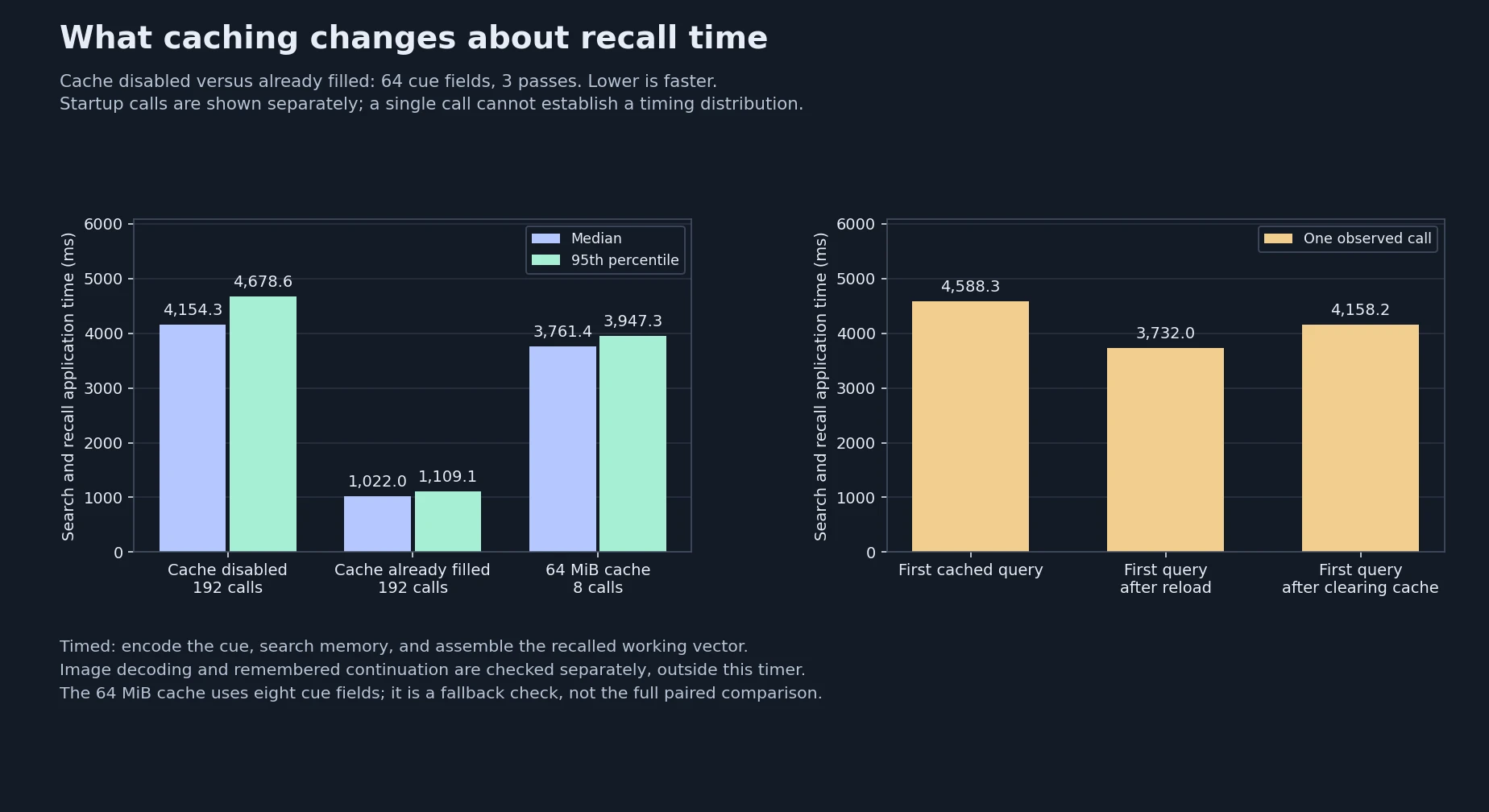
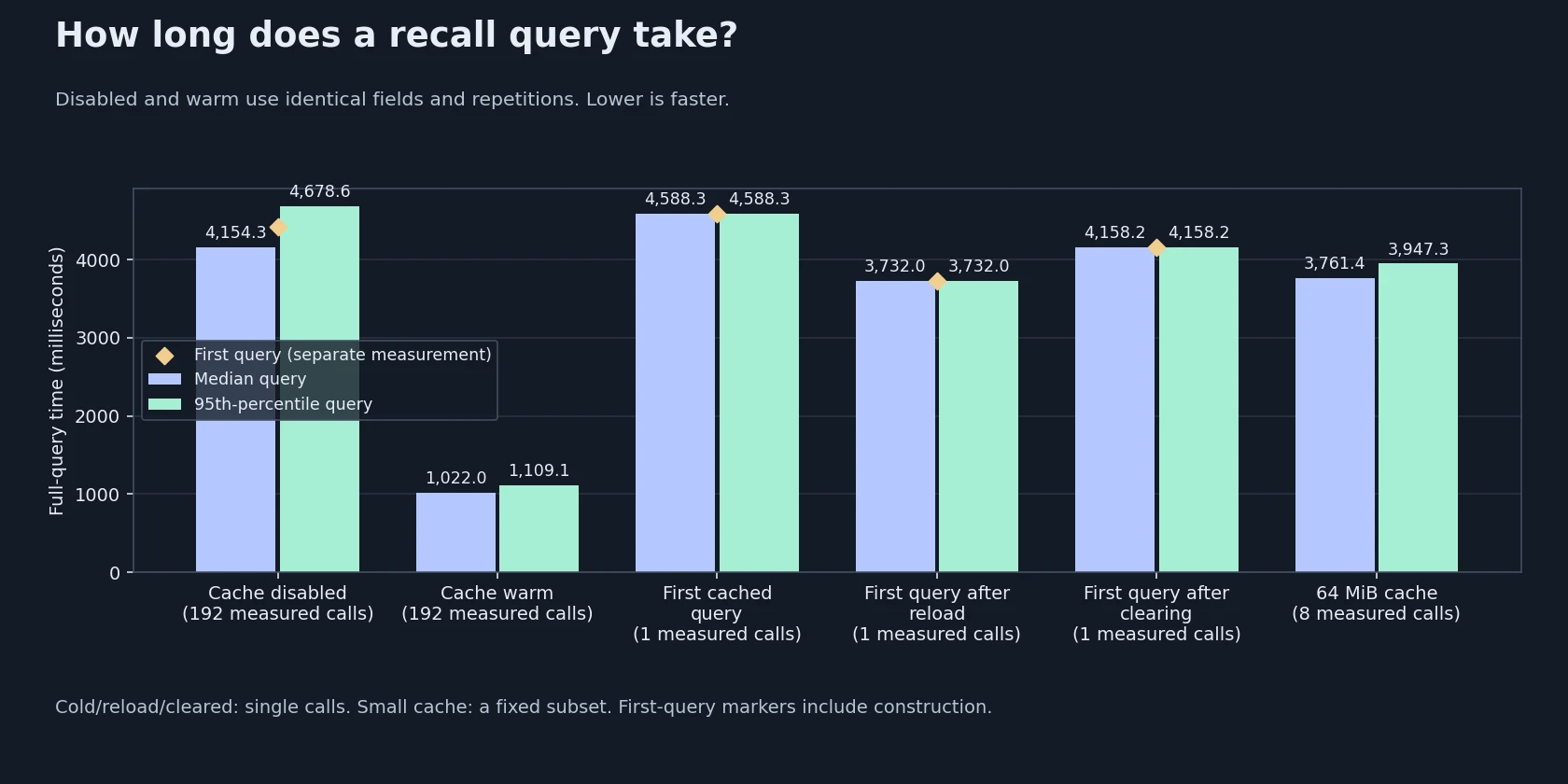
Replotted from saved outputs with clarified labels. The original recorded figure remains available.
The temporary memory cost of caching
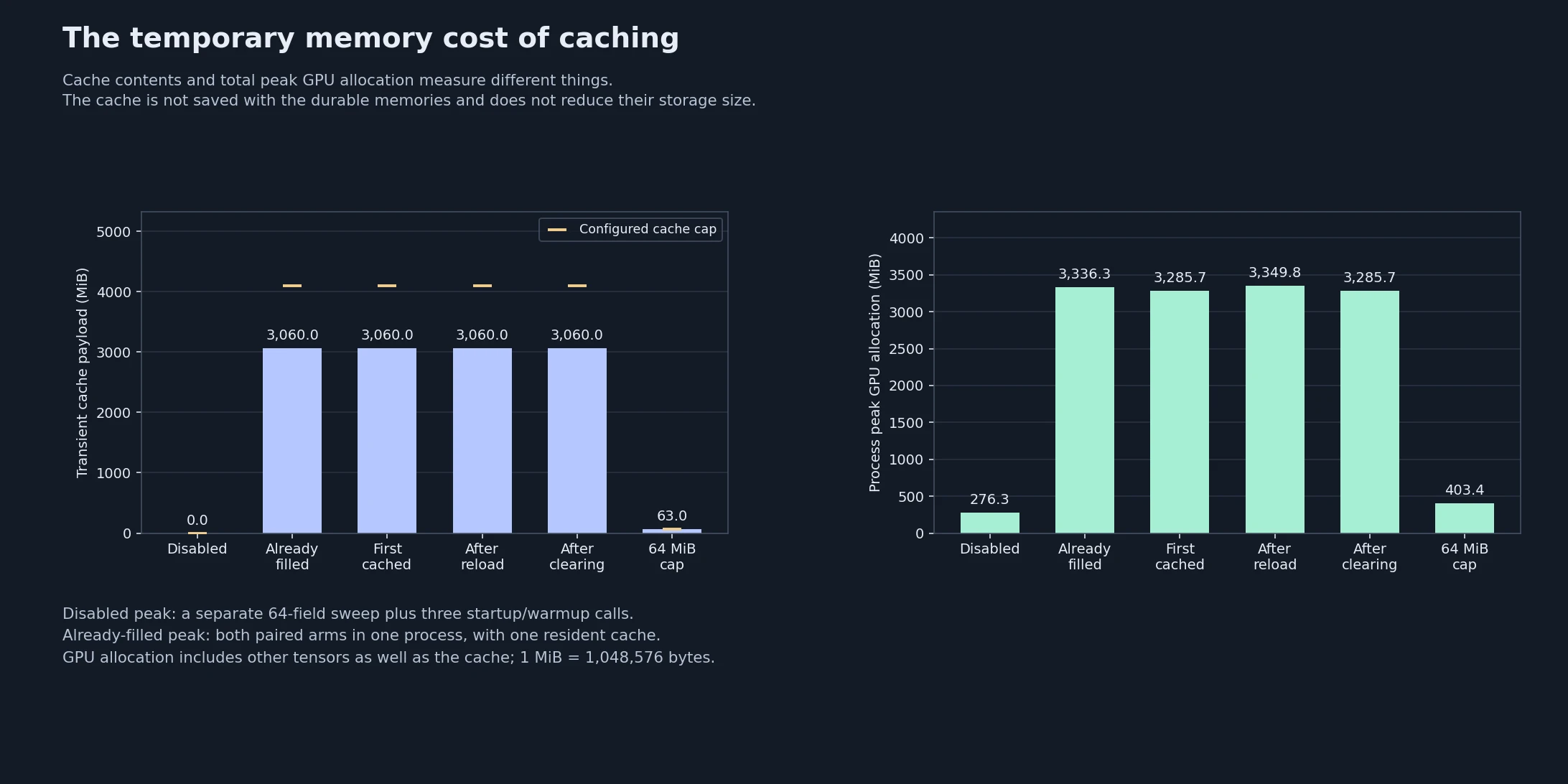

Replotted from saved outputs with clarified labels. The original recorded figure remains available.
Does caching change the recall decisions?
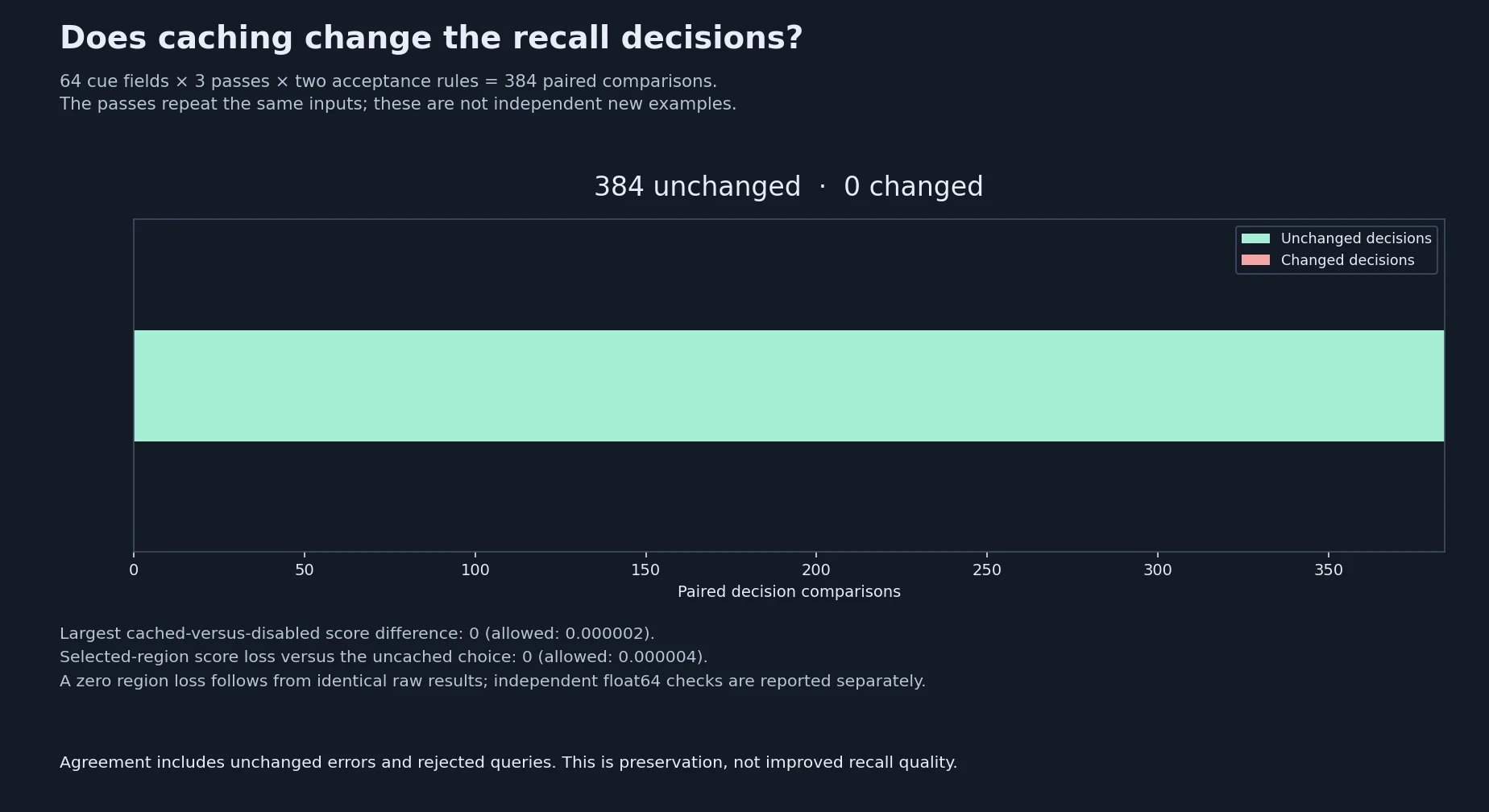
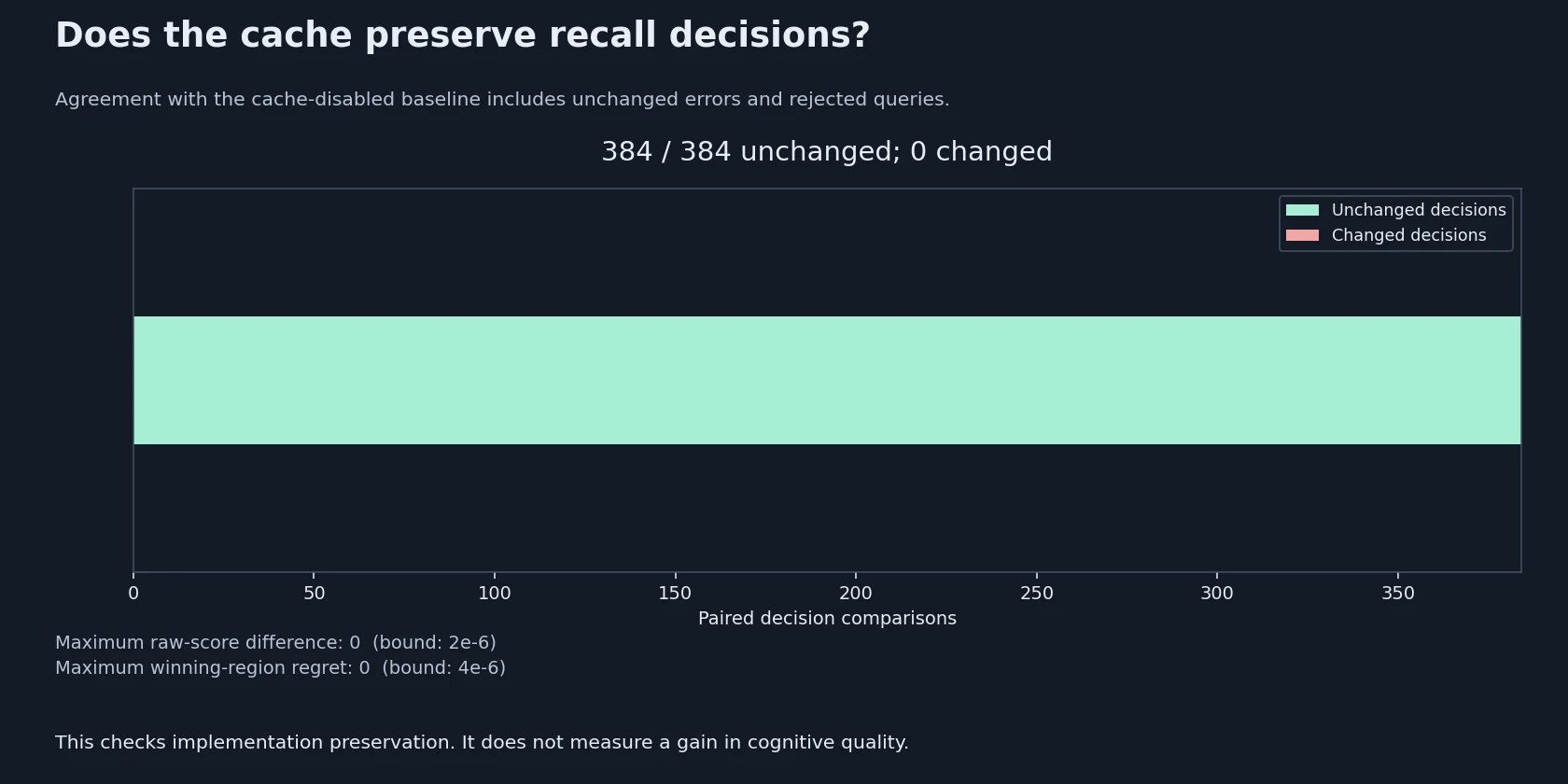
Replotted from saved outputs with clarified labels. The original recorded figure remains available.
Limits and next question
Timing includes cue encoding, memory search and application of the baseline recall rule. Image decoding, remembered continuation, the alternative acceptance rule and persistence were checked separately, outside the timer. The 75.4% reduction therefore describes this query path, not the complete cognitive loop or application startup.
The first empty-cache query took 4.588 seconds. First queries after reload and clearing took 3.732 and 4.158 seconds, respectively; each is a single observation. A 64 MiB fallback cache had a 3.761-second median on an eight-field subset, which does not establish a full-panel speedup.
This is one device, memory history and process comparison. Cues were related views of 16 photographs. An unfamiliar cue with 64 visible features still produced a false recall under both implementations and both acceptance rules. The cache remains optional and is not enabled by default.
Next question. Return to acquired visual patterns and cleanup: can reusable patterns improve recall after vector operations without erasing distinctions between different experiences?
Inspect the evidence
Download the methods and measurements for this experiment. Large training and saved-state files are not included.