Type a section name and press Enter. Use “help” for the list.
Cliste experiment
Learn visual completion while retaining full-dimensional values
Registered 11 Oct 2026 · Snapshot 12 Oct 2026
The question
Learn a bounded specialist that predicts missing regional VSA content from visible context, then decode its predictions through the existing perceptual interface.
Why this experiment?
The smaller linear output spaces lost too much detail. This follow-up retains full-dimensional VSA values and tests prediction of concealed content separately from noisy-target reconstruction.
How it works
Hide a rectangle in each photograph before encoding, including the coarse overview. Train a component to construct missing VSA content; compare every fixed sample with unchanged, shuffled and reduced-conditioning controls. At evaluation, complete originals are assessment references only.
Follow this part of the investigation: Keep full-dimensional values in the learned specialist →Implementation and comparison details
Reuse the same fixed source splits, masks and encoded packets. A new coordinate-wise denoiser uses compact attention queries and keys while combining full 16,384-dimensional complex values. Train one fixed-budget candidate, then evaluate all predetermined completion samples and controls.
What happened
Completed the fixed full-dimensional candidate: 2000 updates, 32 held-out photographs, 64 requests and all 960 outputs. Correct context reduced hidden-interior RGB MSE 19.2% versus unchanged masked decoding and 15.4% versus absent network context; photograph-bootstrap intervals favored context. Visible RGB MSE increased 80.0%, exceeding the registered allowance, with 63/64 requests over their visible-error allowance. Complete visual review found contextual colors and blurred patches, without convincing coherent completion. Privileged diagnostics showed that vector-error gains can accompany worse decoded imagery; this does not isolate the cause. Independent frozen audit passed first attempt with exact remeasurement of 960 completions and 72 saved diagnostic outputs; 504 diagnostics remain numeric-only. The codec, pattern bank and 363-encounter life remain unchanged; no generated content was admitted or candidate promoted. The model is 16.47 MiB; retained bulk evidence is 44.22 GiB logical, including 26.20 GiB of shared input packets. All samples, native detail views, controls, report and companion are local. Stop this candidate and propose a controlled frozen-decoder-aware component qualification before another fresh held-out completion test. Nothing published or pushed.
Results and visual artifacts
Open a figure for its input, comparison, and result. Click an image to enlarge it.
Missing-region detail pages show the concealed rectangle plus 16 pixels of visible boundary, at native pixel scale for every sample and control. Judge those details alongside full-scene context: most pixels in a full image were already visible. Each request page includes all four samples for meaningful, shuffled and absent learned context, plus the three fixed baselines. Every renderer uses the masked overview: the no-context control removes regional conditioning, not all visible information. Complete originals are observer-only references. Overview sheets use the first fixed sample, never the best sample; full request pages retain all outputs. Pages headed NOISY TARGET INPUT are a separate privileged development diagnostic. Their corrupted vectors contain concealed target information, so they are not completion or novelty evidence. This public record includes 4 of 162 saved figures: summary comparisons and fixed examples, including every figure referenced by the guide. Reported aggregates include every case; individual records and complete outputs remain in the research archive.
Hidden-region gains and visible-region damage
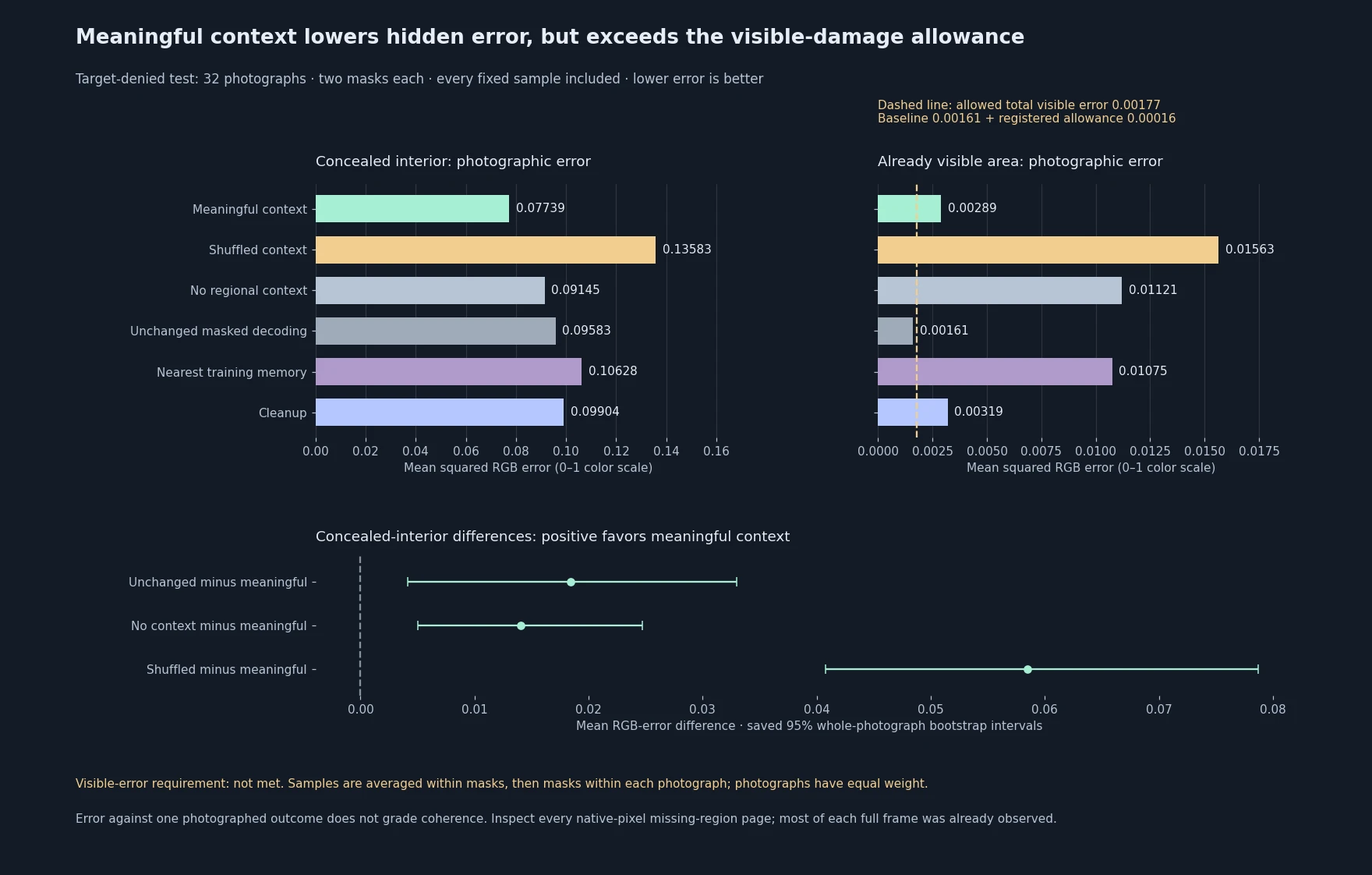
Display derivative: WebP quality 90; maximum edge 2400 px. Original scientific pixels remain in the source run; do not measure this preview.
Concealed-region detail · test photograph 1 · mask 1
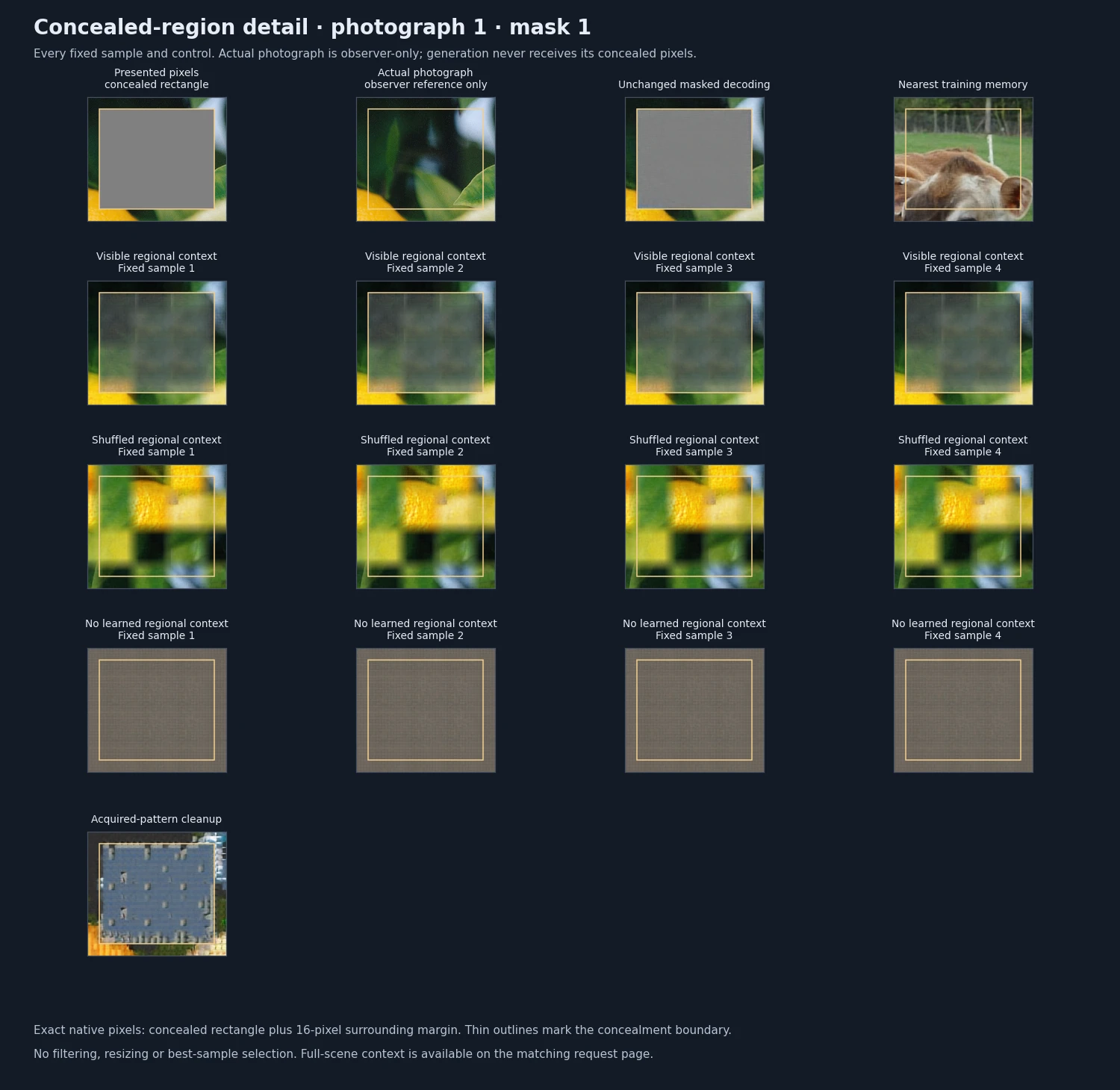
Display derivative: WebP quality 90; maximum edge 2400 px. Original scientific pixels remain in the source run; do not measure this preview.
Noisy-target detail · development photo 1 · level 16/64
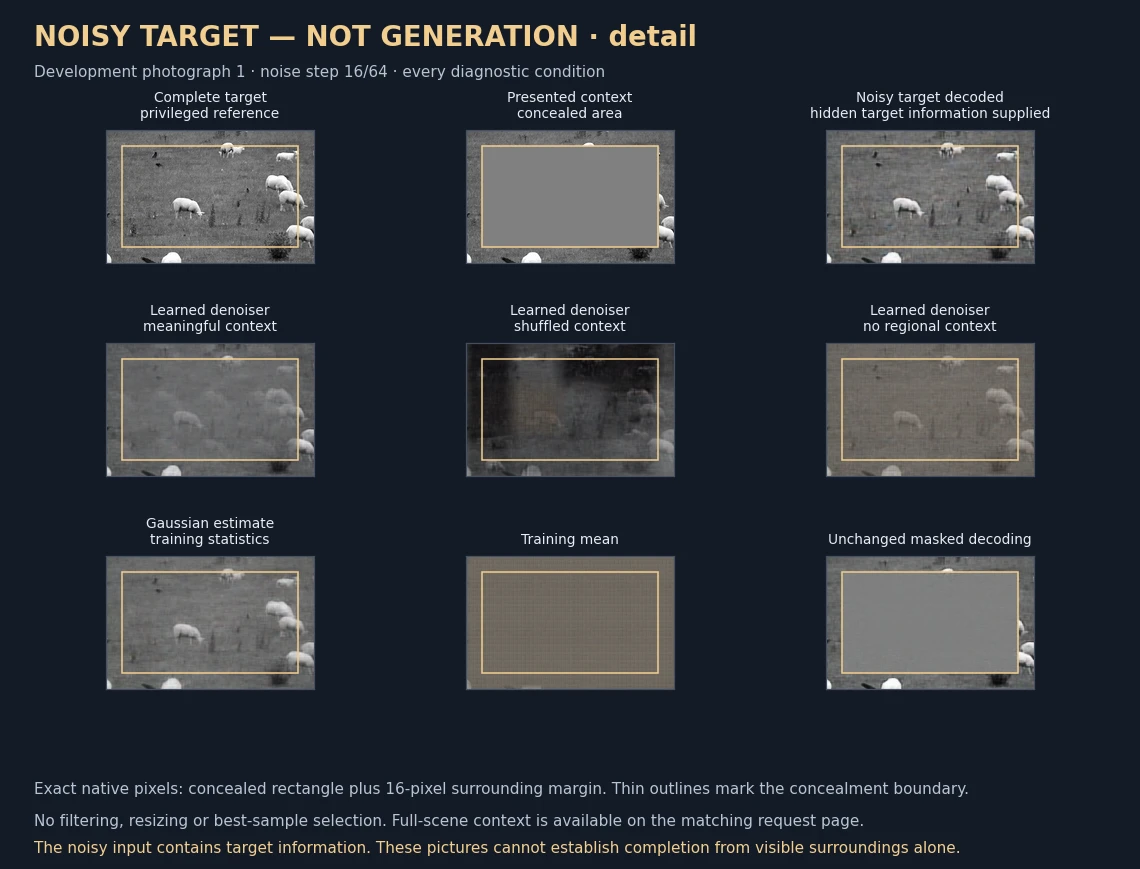
Display derivative: WebP quality 90; maximum edge 2400 px. Original scientific pixels remain in the source run; do not measure this preview.
The complete fixed-budget training record
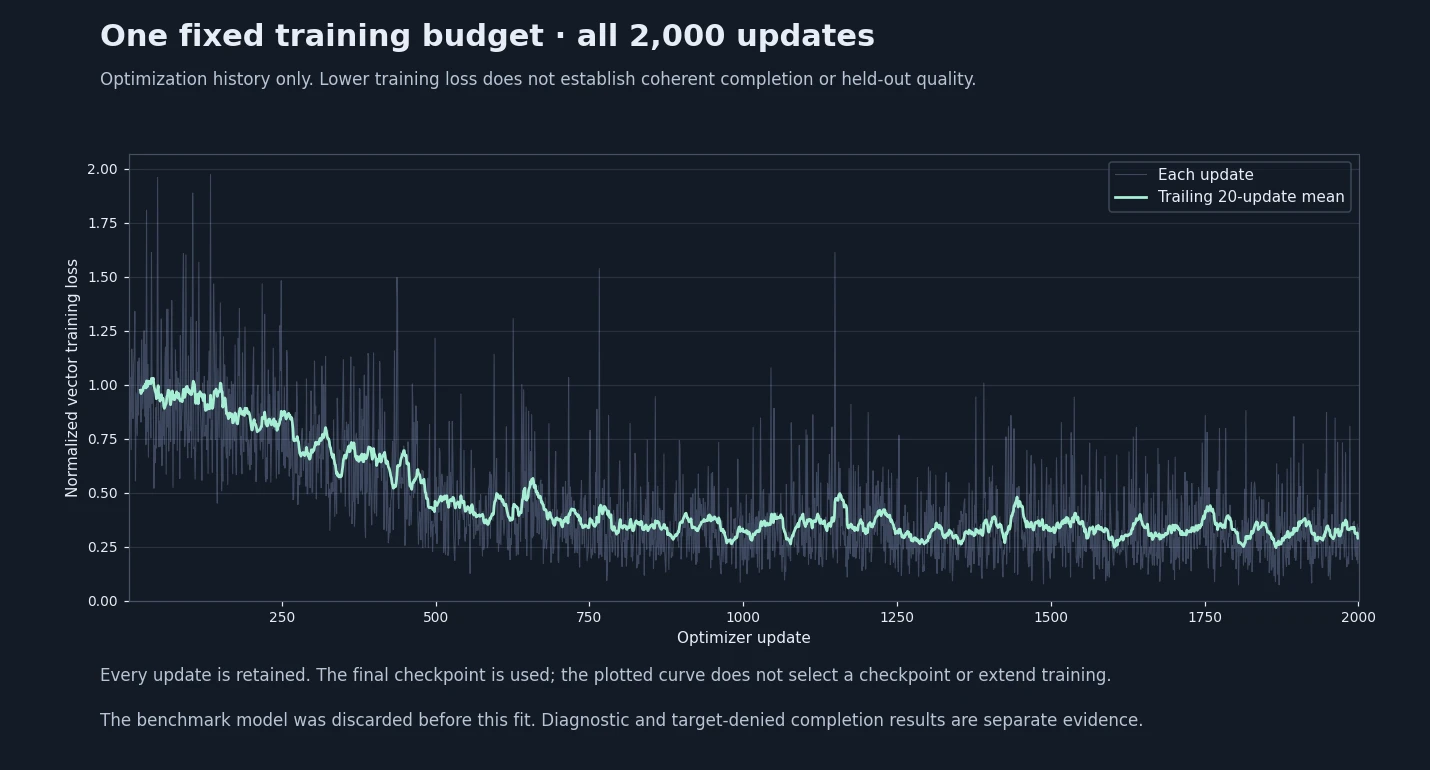
Display derivative: WebP quality 90; maximum edge 2400 px. Original scientific pixels remain in the source run; do not measure this preview.
Limits and next question
Full-dimensional value paths remove the previous fixed linear output-subspace restriction; they do not guarantee adequate coordination or coherent completion. The separate development denoising diagnostic receives noise-corrupted clean targets and is explicitly privileged. Only the independent test completion uses target-denied inputs. The codec and 363-encounter life remain fixed.
Next question. Measure actual nonzero-noise denoising and target-denied completion separately, then interpret this one fixed candidate's results. A privileged denoising improvement alone cannot establish completion from visible context.
Inspect the evidence
Download the methods and measurements for this experiment. Large training and saved-state files are not included.