Type a section name and press Enter. Use “help” for the list.
Cliste experiment
Can visible context guide learned completion of missing visual content?
Registered 11 Oct 2026 · Snapshot 12 Oct 2026
The question
Learn a bounded specialist that predicts missing regional VSA content from visible context, then decode its predictions through the existing perceptual interface.
Why this experiment?
Combining memories produced recognizable overlays, not an organized new scene. A learned specialist first needs enough output capacity to preserve a complete image.
How it works
Project complete development-image representations through the proposed 512- and 1,024-component output spaces, then decode them. Training and missing-content generation may begin only if added reconstruction error stays within the predefined allowance.
Follow this part of the investigation: Learn to complete missing visual content →Implementation and comparison details
Prepared and encoded the fixed 512/32/32 source split with both masks. Qualified two training-derived linear output spaces using complete development images. Both failed the predeclared quality bound, so the run stopped before training and test generation.
What happened
Both registered training-only PCA output spaces failed before denoiser training: mean development RGB error rose from 0.001384756 to 0.003934376 at width512 and 0.002807358 at width1024, increases184.1% and102.7% against a10% allowance. All32 development sources worsened; independent audit passed and all figures were reviewed. No training, generation or test evaluation occurred. This rejects the tested spaces, not VSA or every small nonlinear model. The codec and363-encounter life remain unchanged. A separate full-dimensional-value candidate is planned with a fixed budget.
Results and visual artifacts
Open a figure for its input, comparison, and result. Click an image to enlarge it.
The figures show complete development photographs, their existing codec reconstructions, and projections through 512- and 1,024-component output spaces. The original qualifier saved numbers; a post-run replay captured the pictures and reproduced every qualification measurement exactly. These are capacity checks, not generated completions. All 32 development photographs appear in fixed order, without brightness or contrast adjustment. This public record includes 2 of 9 saved figures: summary comparisons and fixed examples, including every figure referenced by the guide. Reported aggregates include every case; individual records and complete outputs remain in the research archive.
Why training stopped before completion
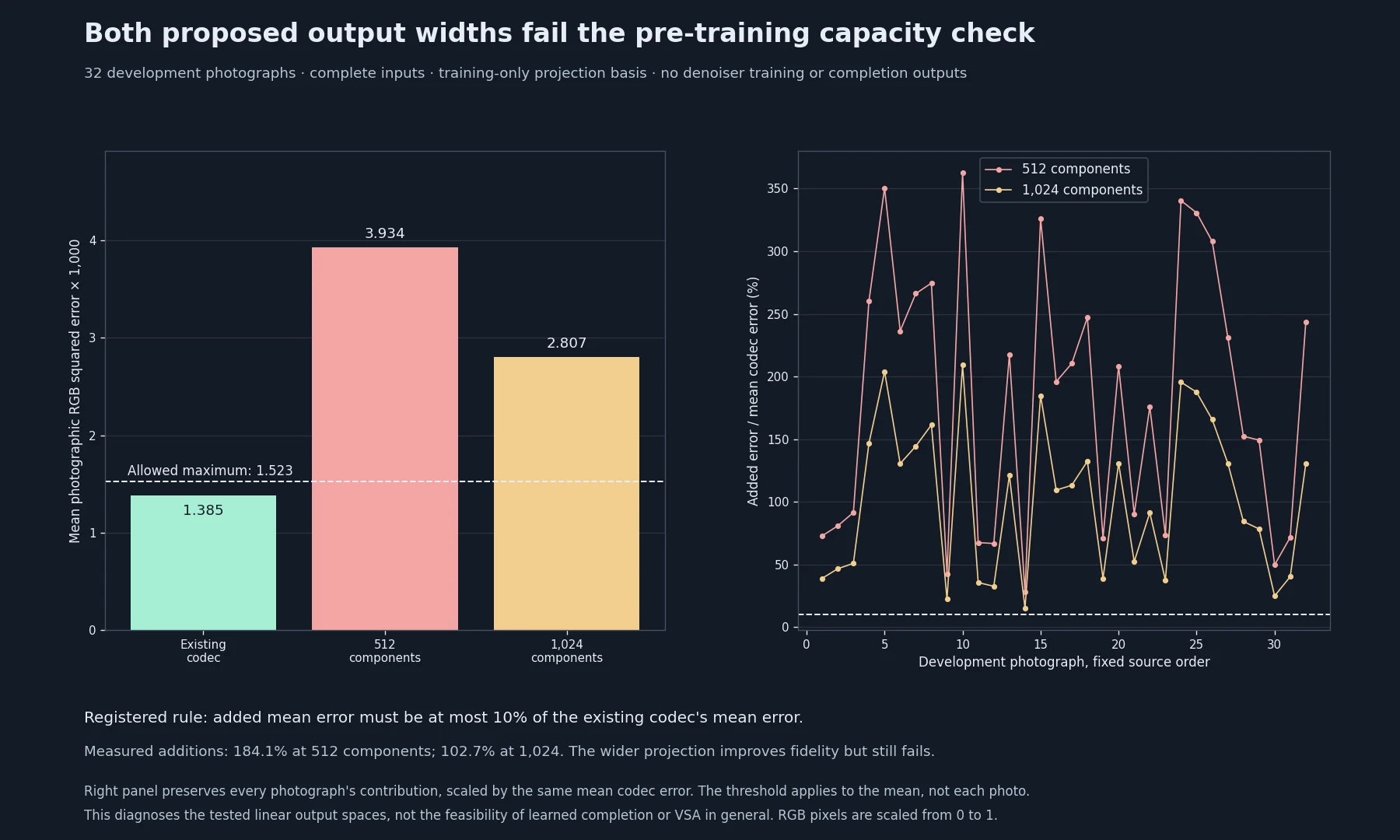
Display derivative: WebP quality 90; maximum edge 2400 px. Original scientific pixels remain in the source run; do not measure this preview.
Capacity checks · development photographs 1–4
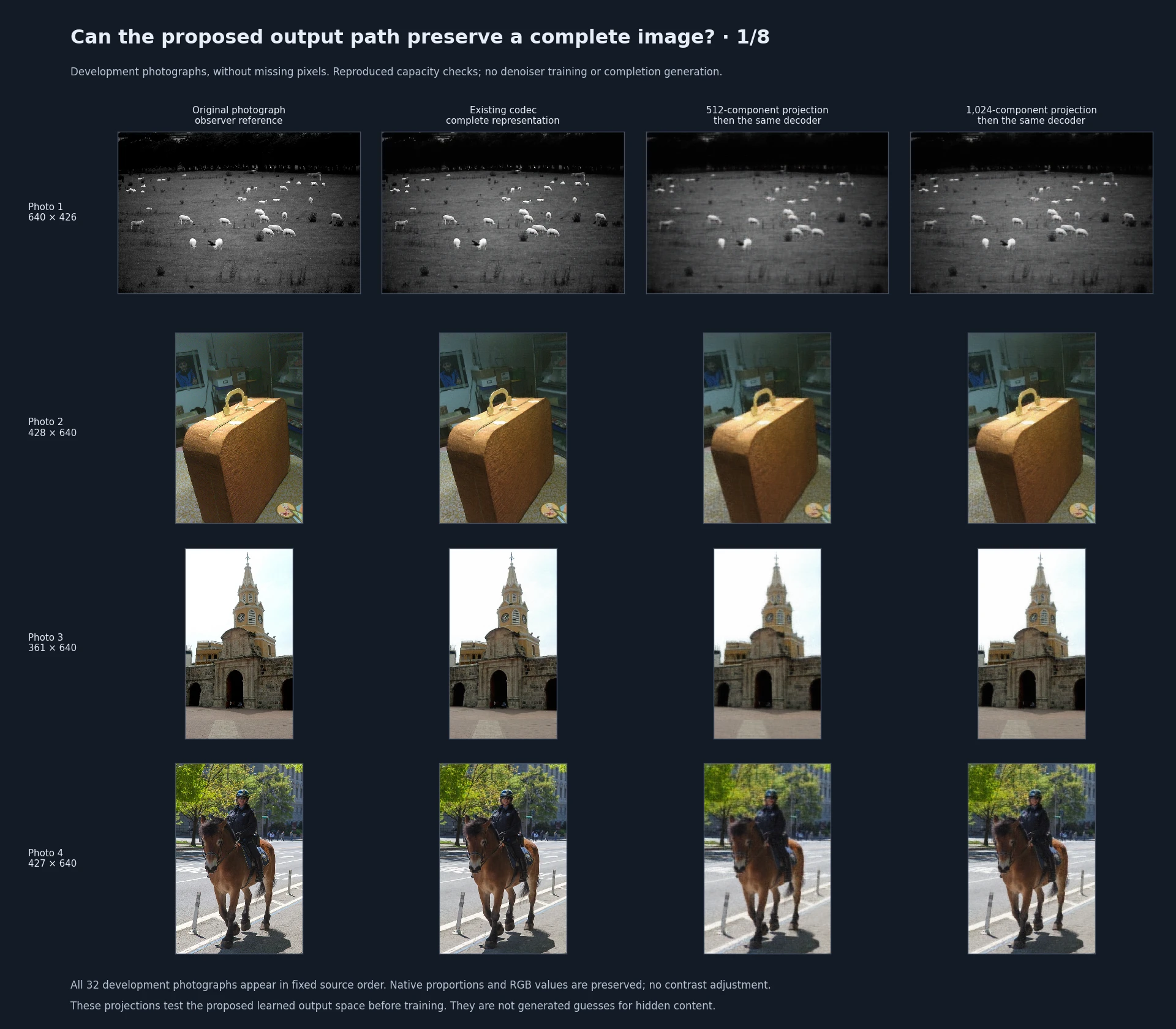
Display derivative: WebP quality 90; maximum edge 2400 px. Original scientific pixels remain in the source run; do not measure this preview.
Limits and next question
This diagnoses two proposed linear output spaces before denoising. It does not test whether a trained specialist can complete hidden content, or whether VSA can support that function. Development images were used for the capacity decision; the separate test photographs were encoded but received no generated completions. The existing codec and 363-encounter life remained unchanged.
Next question. Choose an output architecture that can express adequate detail before investing in learned completion. Keep the failed gate and its tolerances intact; any revised architecture requires its own prospective qualification.
Inspect the evidence
Download the methods and measurements for this experiment. Large training and saved-state files are not included.