Type a section name and press Enter. Use “help” for the list.
Cliste experiment
Can a change inferred from one image work on another?
Registered 12 Oct 2026 · Snapshot 12 Oct 2026
The question
Infer a relation from a visual demonstration, reuse it on different content, then compose another relation with the saved VSA result.
Why this experiment?
Construction needs changes that transfer to new content and survive a sequence. This experiment provides evidence for relation fitting and continuation through saved VSA, but its numerical pass did not establish correct rendered rotation. Missing, fragmented or incorrectly oriented structures require a qualification beyond blur.
How it works
Infer rotation, uniform scale and displacement from before-and-after VSA pairs, without the true values or text instructions. Store each relation as a VSA bundle, apply it to another photograph, then let a separate process use only the saved constructed state for a second relation. The family and sequence are supplied. Preserve that interface evidence separately from the failed qualification of the rendered rotation.
Follow this part of the investigation: Can a change inferred from one image work on another? →Implementation and comparison details
Two demonstrations per group; four separate query photographs. Frozen visual machinery, continuous geometric fitting, and separate processes for the two applications.
What happened
Qualification correction: accurate relation estimates and the recorded numerical pass did not establish correct rotation in the decoded scene. Structures can be missing, fragmented or incorrectly oriented, not merely blurred. Rendered rotation remains unqualified. The original verdict, measurements and downloadable records are retained as historical evidence.
Fifteen of sixteen demonstrated changes were accepted. Median geometric displacement error, including the refusal, was 0.93% of the image short side. The particular rotation, scale and displacement were inferred from image pairs; the possible geometric family was supplied.
A second operation used only the saved first-stage VSA and a second inferred relation. After two operations, RGB mean squared error was 0.018995 (pixel values scaled from 0 to 1; lower is better) versus 0.057015 for no geometric change through the same number of passes, and 0.048183 when the first change was skipped. Those are reductions of 66.7% and 60.6%; all 32 queries improved against the unchanged comparison.
All five predefined numerical criteria passed, and independent checks reproduced all 416 image comparisons. The first-step comparison against wrong demonstrations remains statistically uncertain.
Supplying the true geometry still produced mean RGB error of 0.011179, compared with 0.000570 for directly encoding and decoding the desired photograph. A subsequent component diagnostic found local rotation failure even with original encoder features and exact geometry. Recovery from source VSA is therefore not required for the failure; this does not isolate every contribution from feature transformation, composition and decoding.
Scientific criteria
| Recorded field | Value |
|---|---|
| geometry | Pass |
| stage 1 inferred utility | Pass |
| stage 1 known geometry utility | Pass |
| stage 2 inferred utility | Pass |
| stage 2 known geometry utility | Pass |
Results and visual artifacts
Open a figure for its input, comparison, and result. Click an image to enlarge it.
Each explanation sheet starts with two before/after demonstrations, then shows the different query, desired first result and constructed first result. The last row compares the desired second result, the constructed saved-VSA continuation and true geometry through the same path. A separate control sheet distinguishes codec loss, repeated conversion, wrong demonstrations and omission of the first change. The fixed first query from every group is pictured; every query is measured. This public record includes 16 of 16 saved figures.
Example 1: Infer a change, reuse it, then compose another
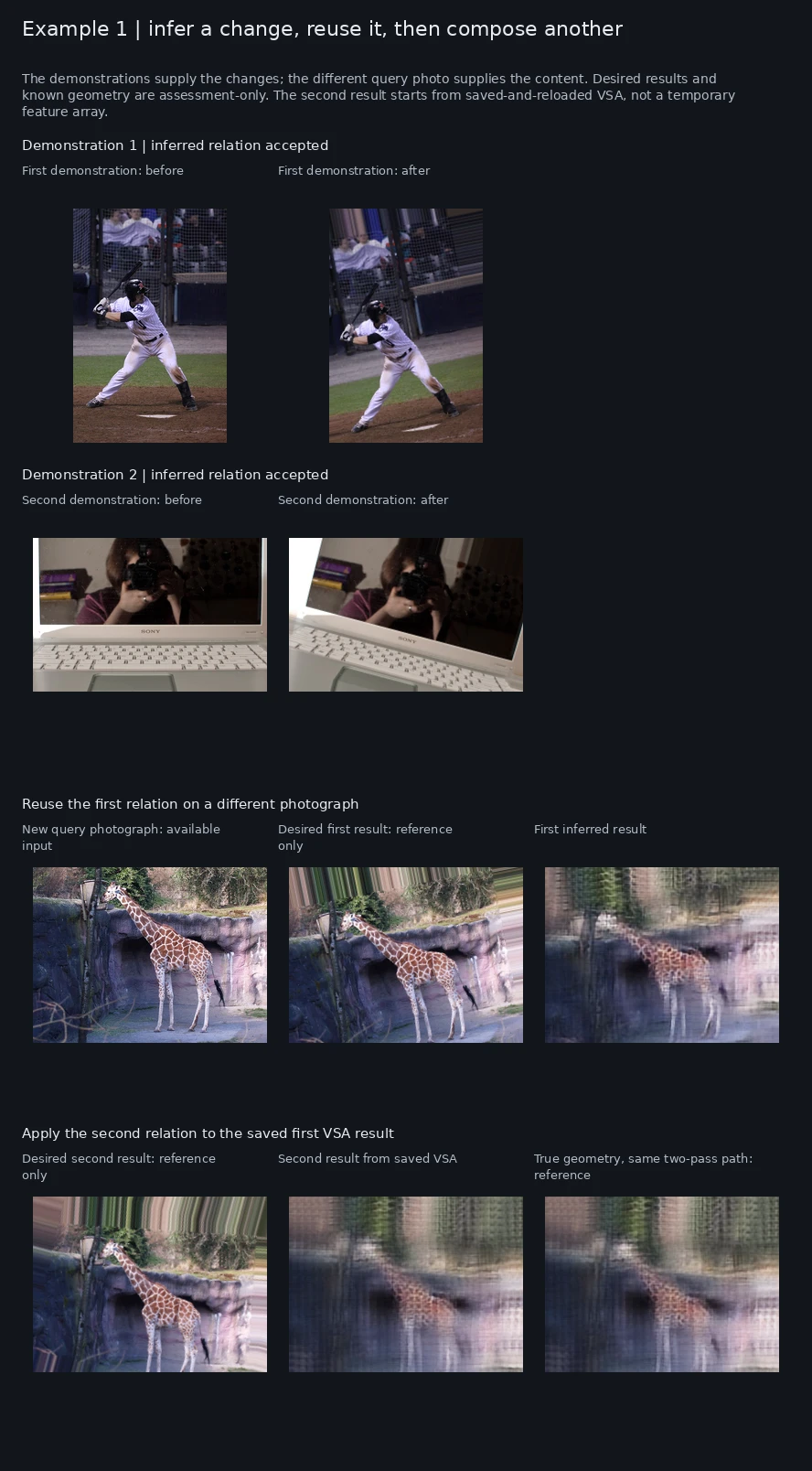
Display derivative: WebP quality 90; maximum edge 2400 px. Original scientific pixels remain in the source run; do not measure this preview.
Example 1: Separate inference from conversion loss
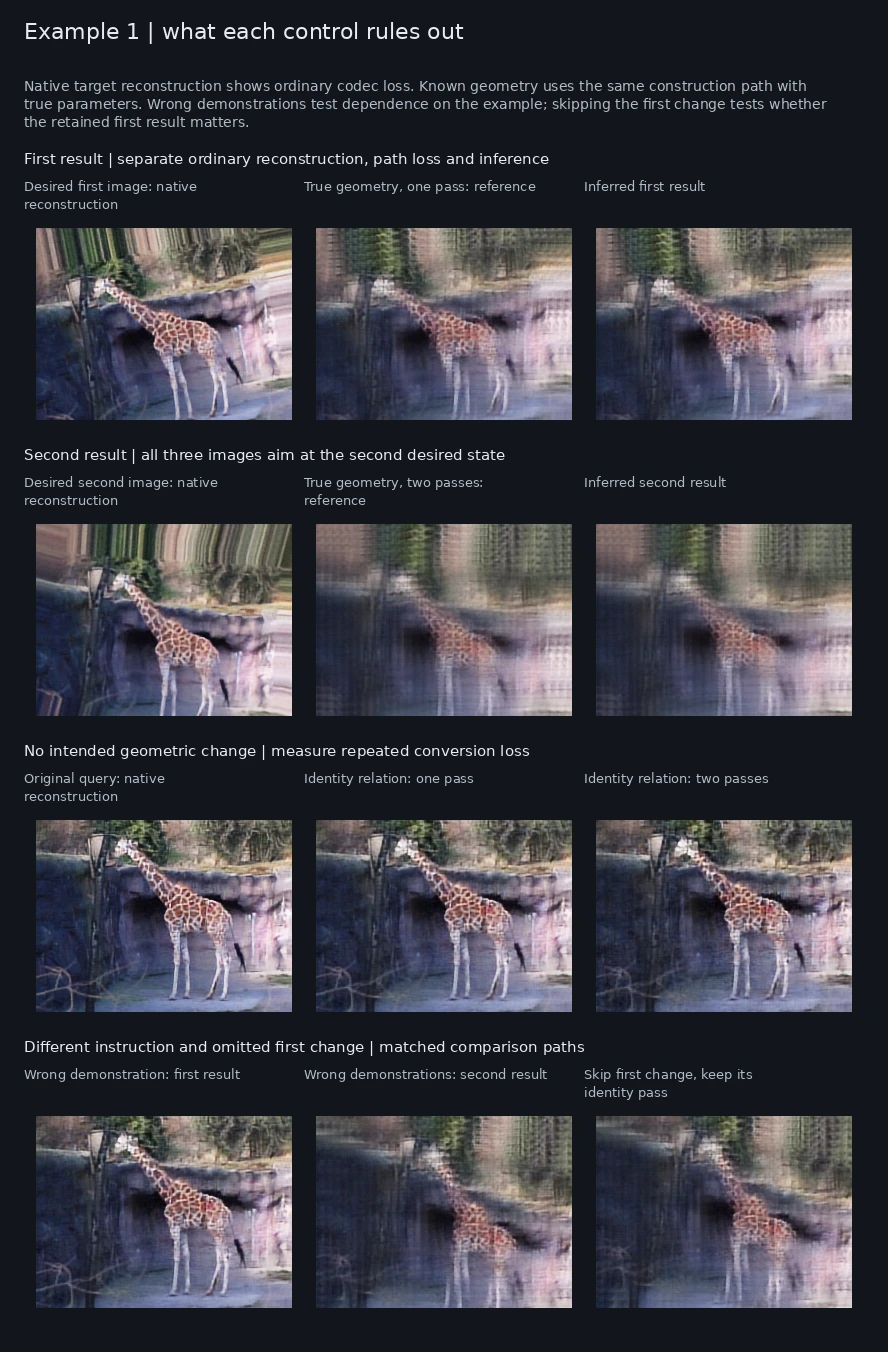
Display derivative: WebP quality 90; maximum edge 2400 px. Original scientific pixels remain in the source run; do not measure this preview.
Example 2: Infer a change, reuse it, then compose another
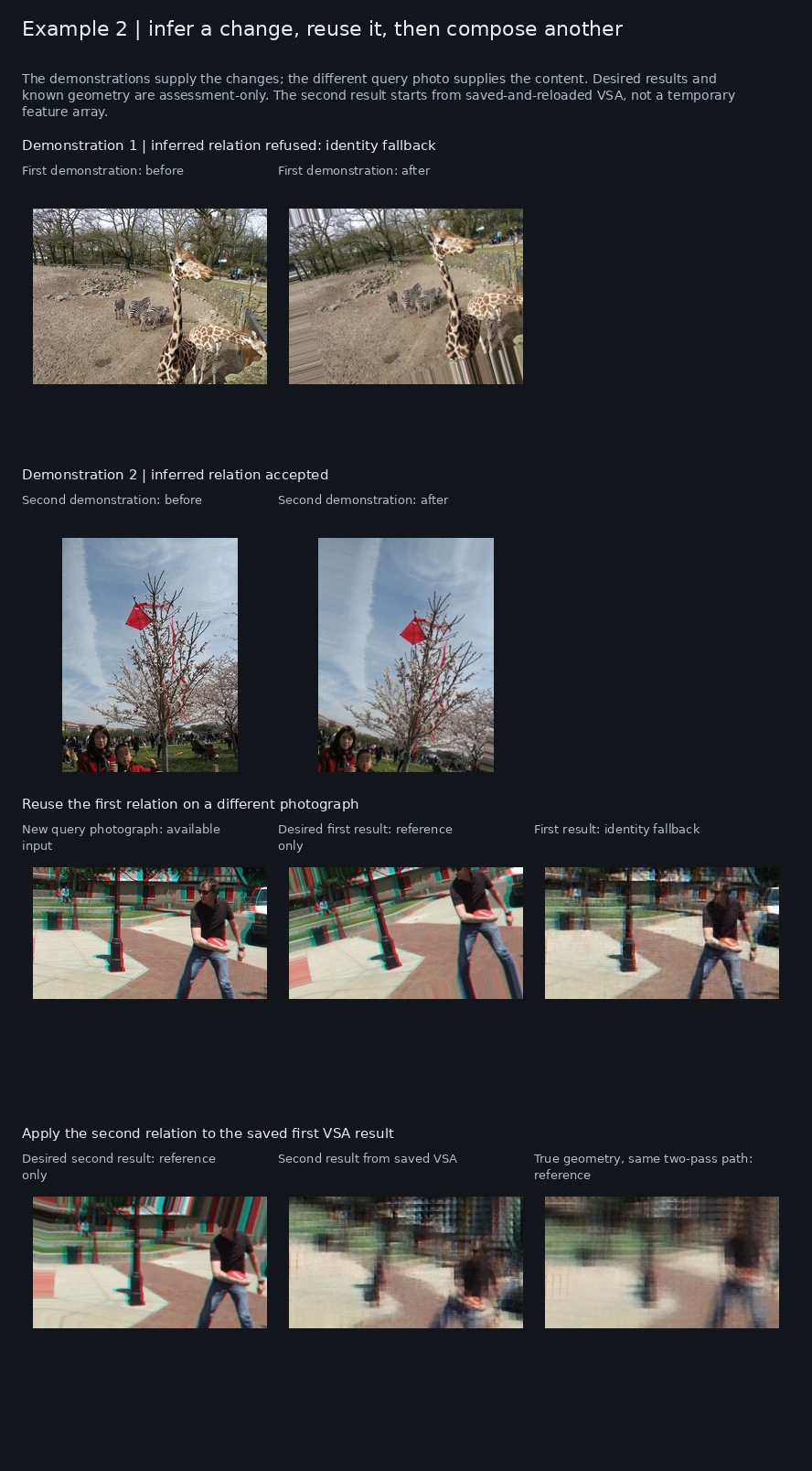
Display derivative: WebP quality 90; maximum edge 2400 px. Original scientific pixels remain in the source run; do not measure this preview.
Example 2: Separate inference from conversion loss
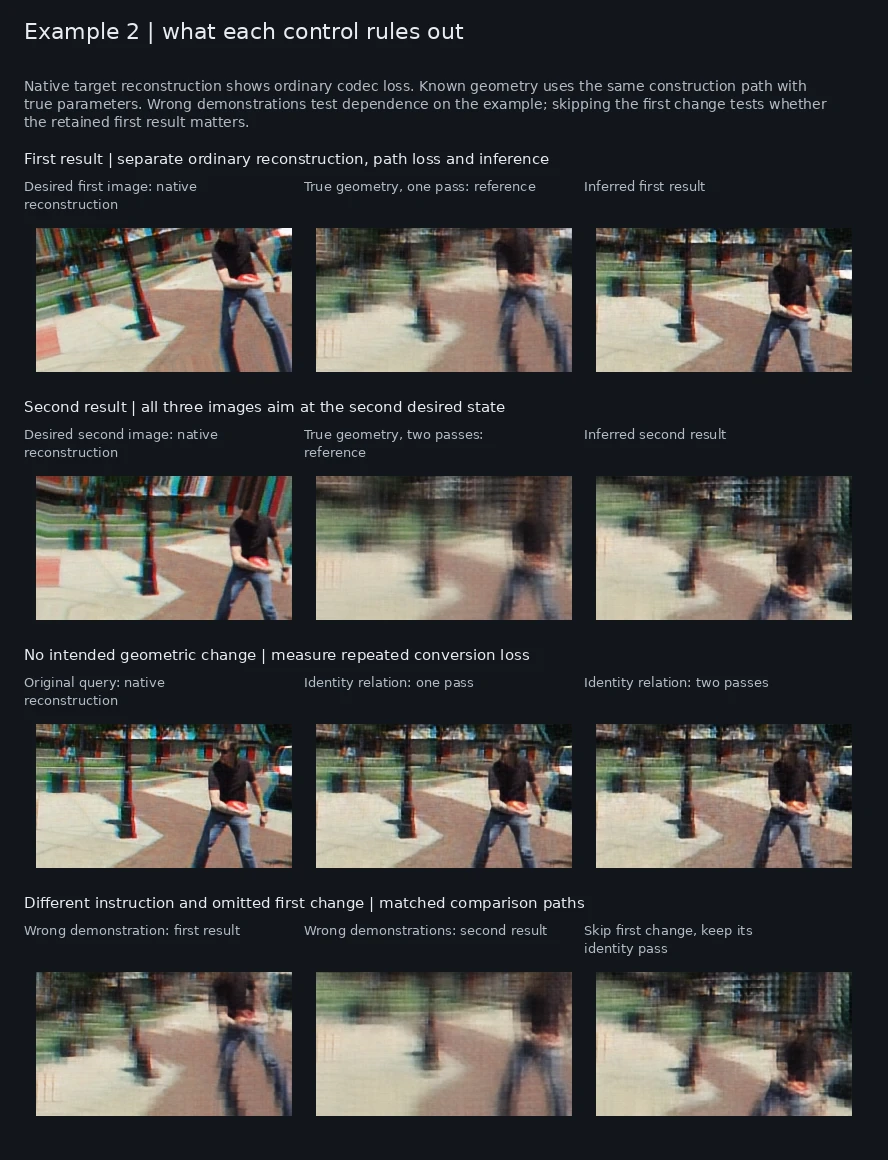
Display derivative: WebP quality 90; maximum edge 2400 px. Original scientific pixels remain in the source run; do not measure this preview.
Example 3: Infer a change, reuse it, then compose another
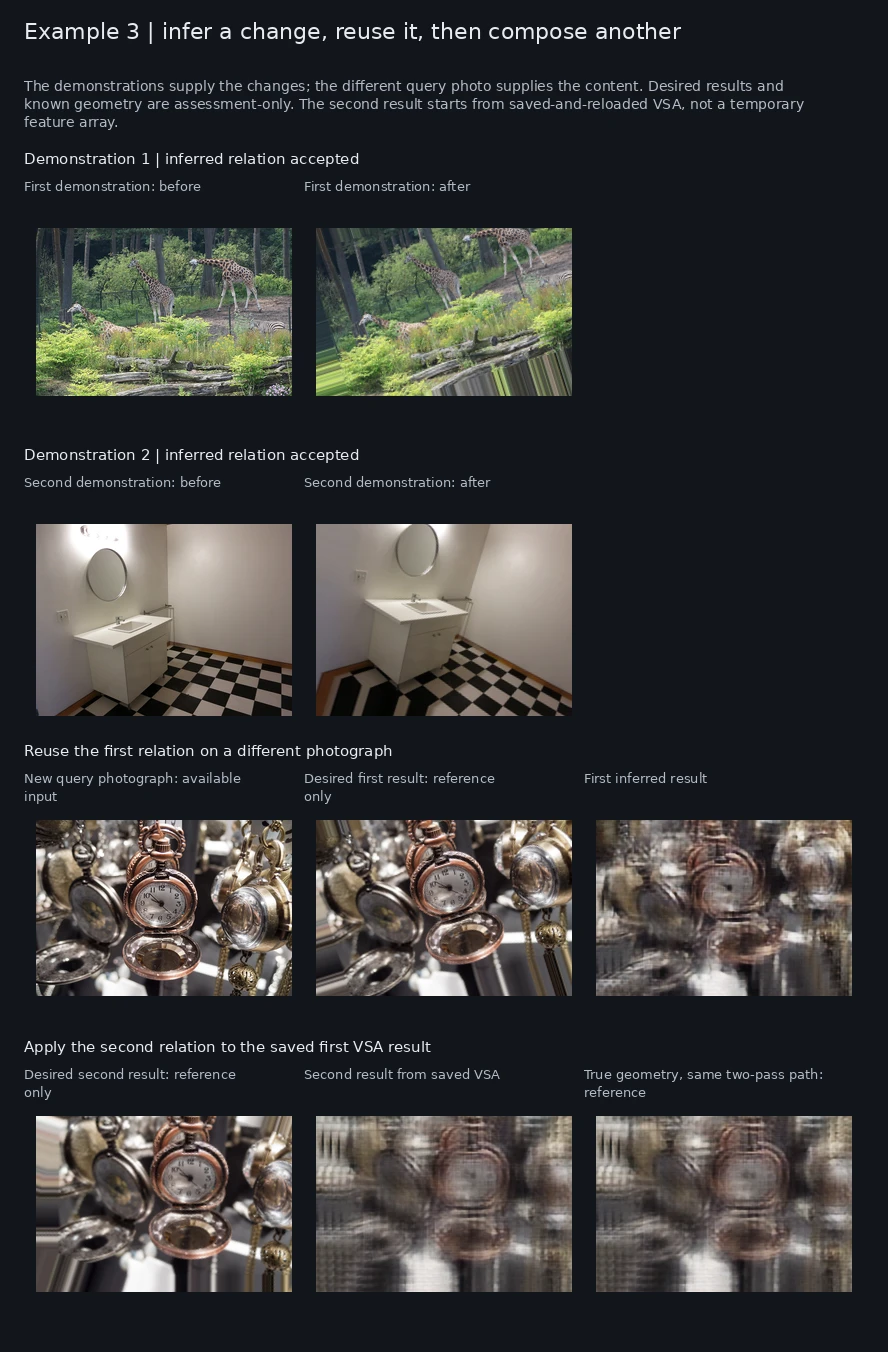
Display derivative: WebP quality 90; maximum edge 2400 px. Original scientific pixels remain in the source run; do not measure this preview.
Example 3: Separate inference from conversion loss
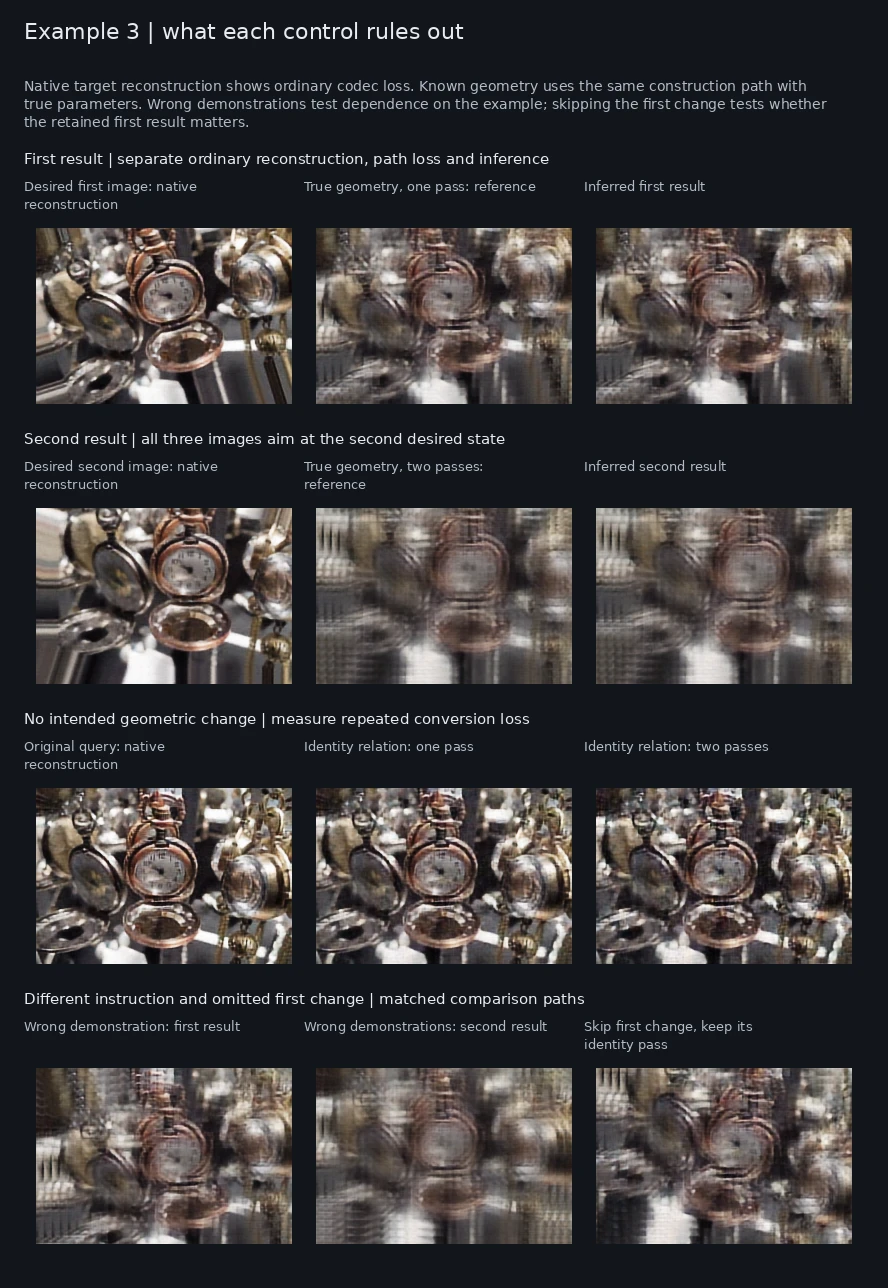
Display derivative: WebP quality 90; maximum edge 2400 px. Original scientific pixels remain in the source run; do not measure this preview.
Example 4: Infer a change, reuse it, then compose another
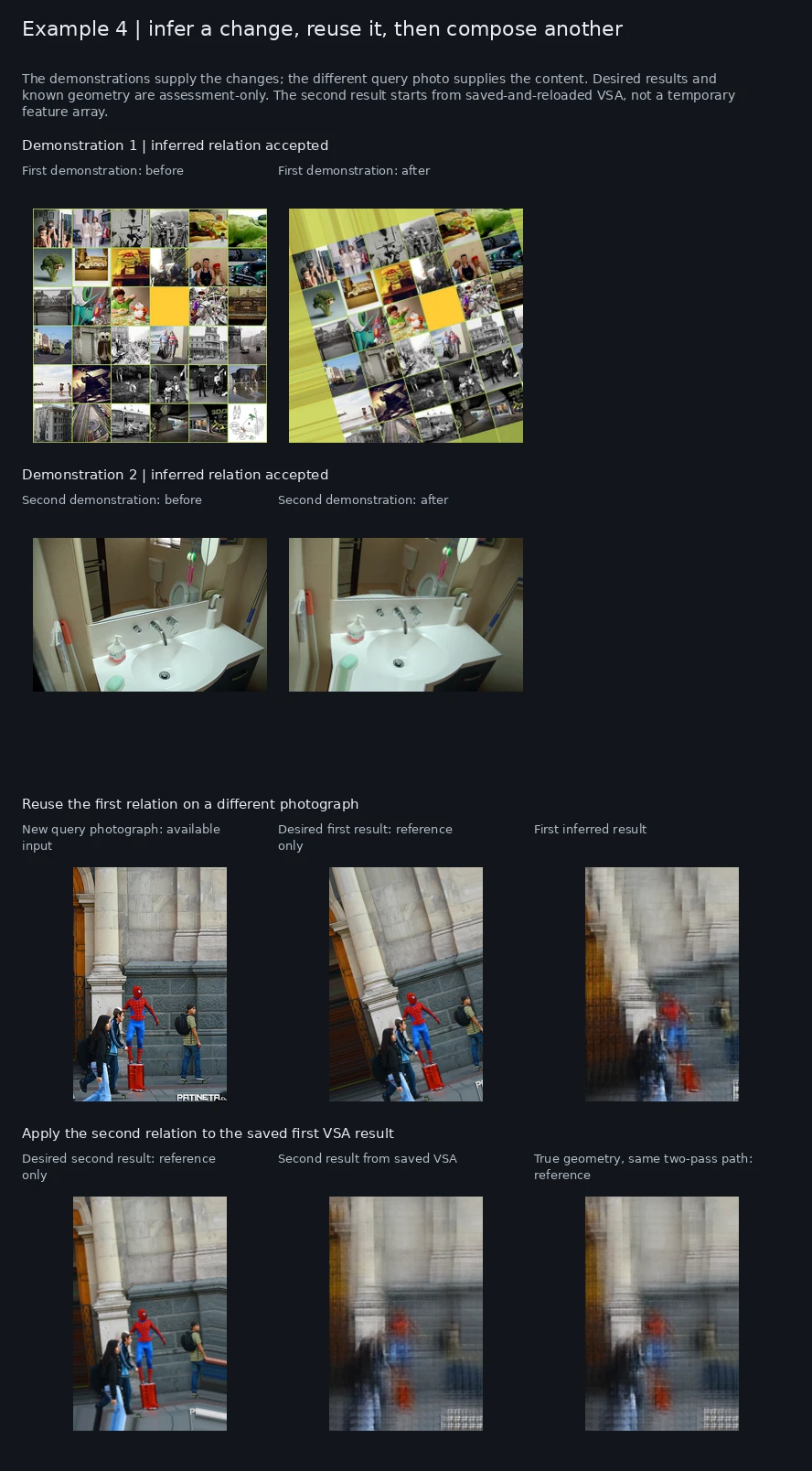
Display derivative: WebP quality 90; maximum edge 2400 px. Original scientific pixels remain in the source run; do not measure this preview.
Example 4: Separate inference from conversion loss
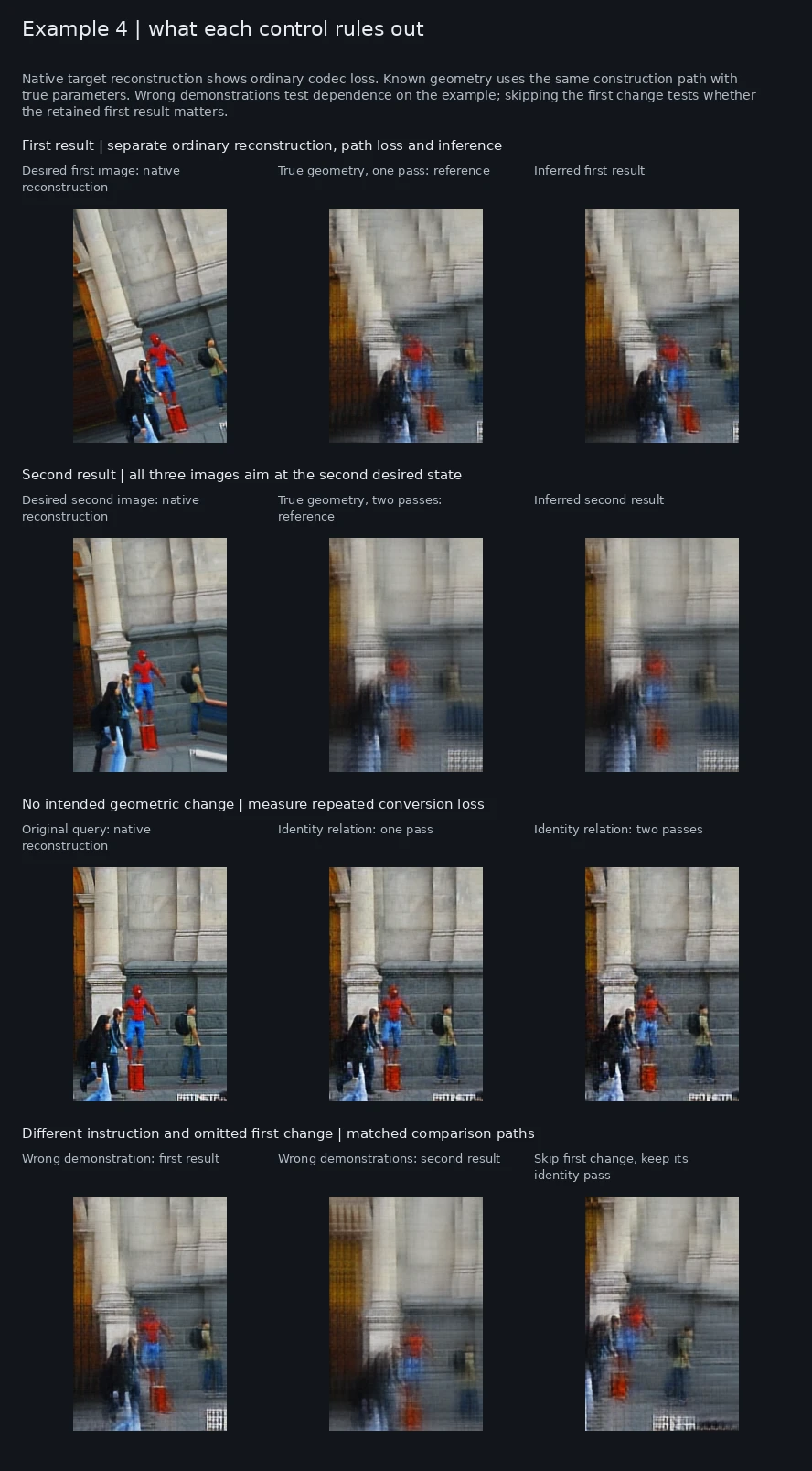
Display derivative: WebP quality 90; maximum edge 2400 px. Original scientific pixels remain in the source run; do not measure this preview.
Example 5: Infer a change, reuse it, then compose another
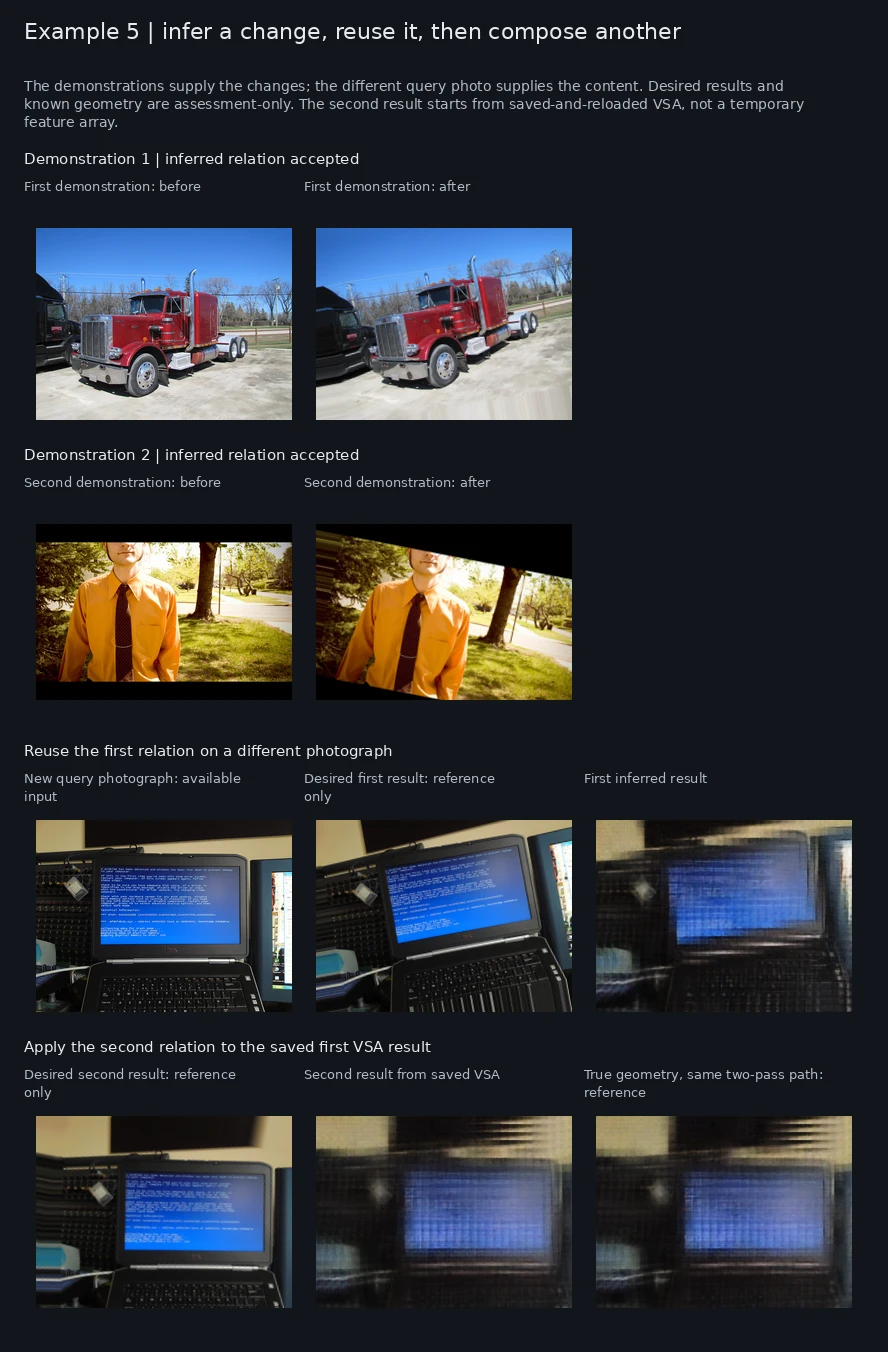
Display derivative: WebP quality 90; maximum edge 2400 px. Original scientific pixels remain in the source run; do not measure this preview.
Example 5: Separate inference from conversion loss
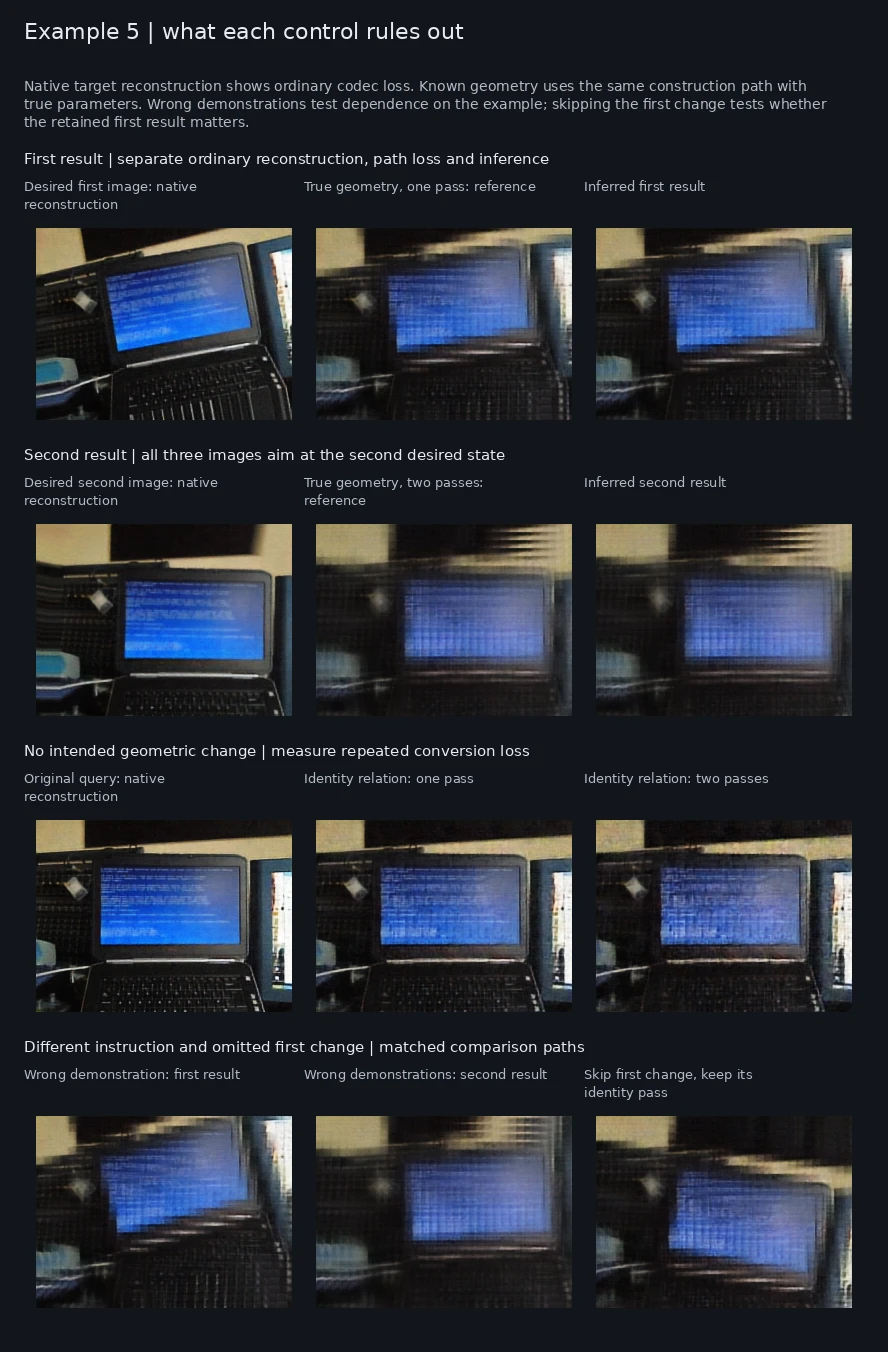
Display derivative: WebP quality 90; maximum edge 2400 px. Original scientific pixels remain in the source run; do not measure this preview.
Example 6: Infer a change, reuse it, then compose another
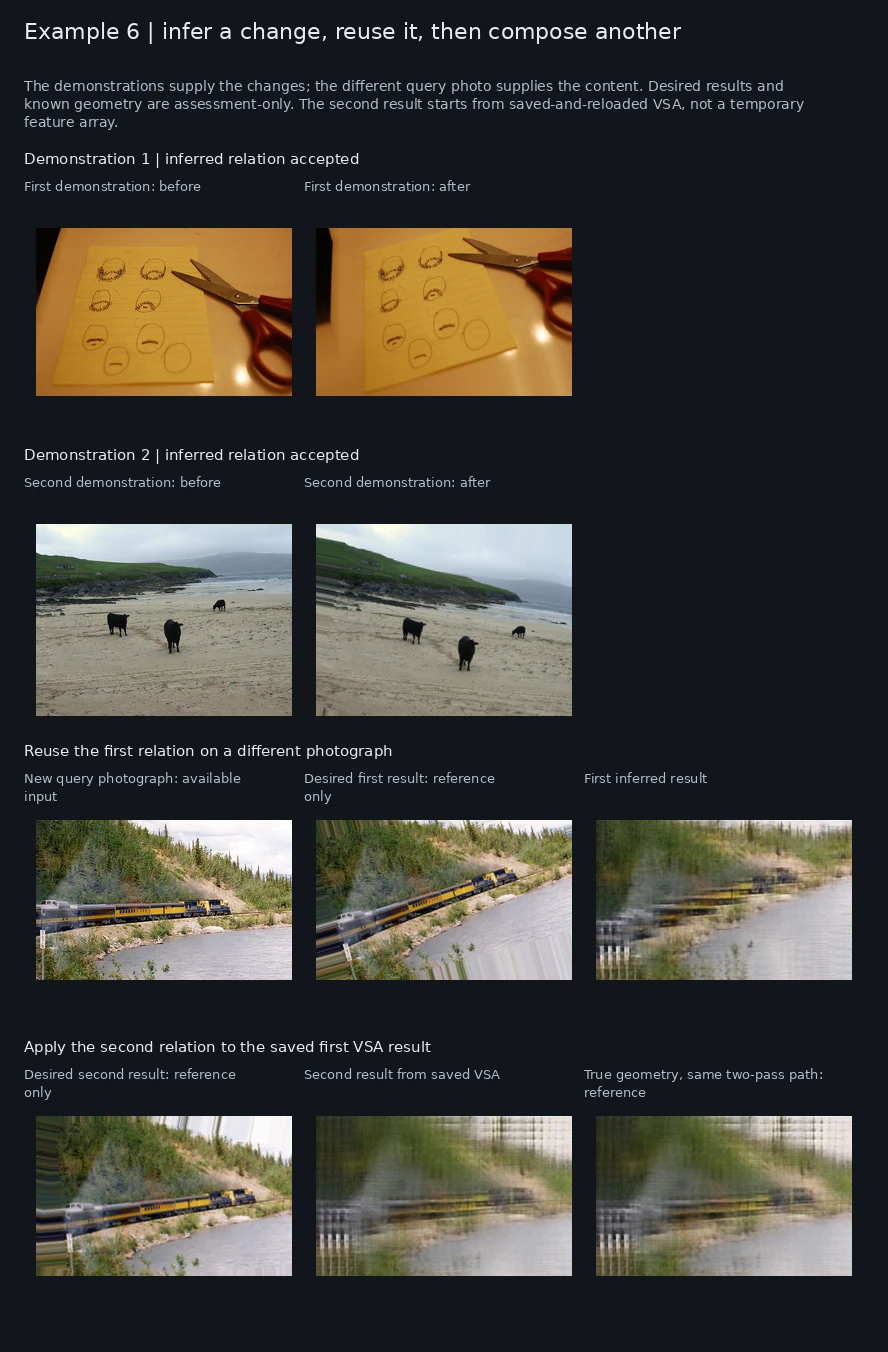
Display derivative: WebP quality 90; maximum edge 2400 px. Original scientific pixels remain in the source run; do not measure this preview.
Example 6: Separate inference from conversion loss
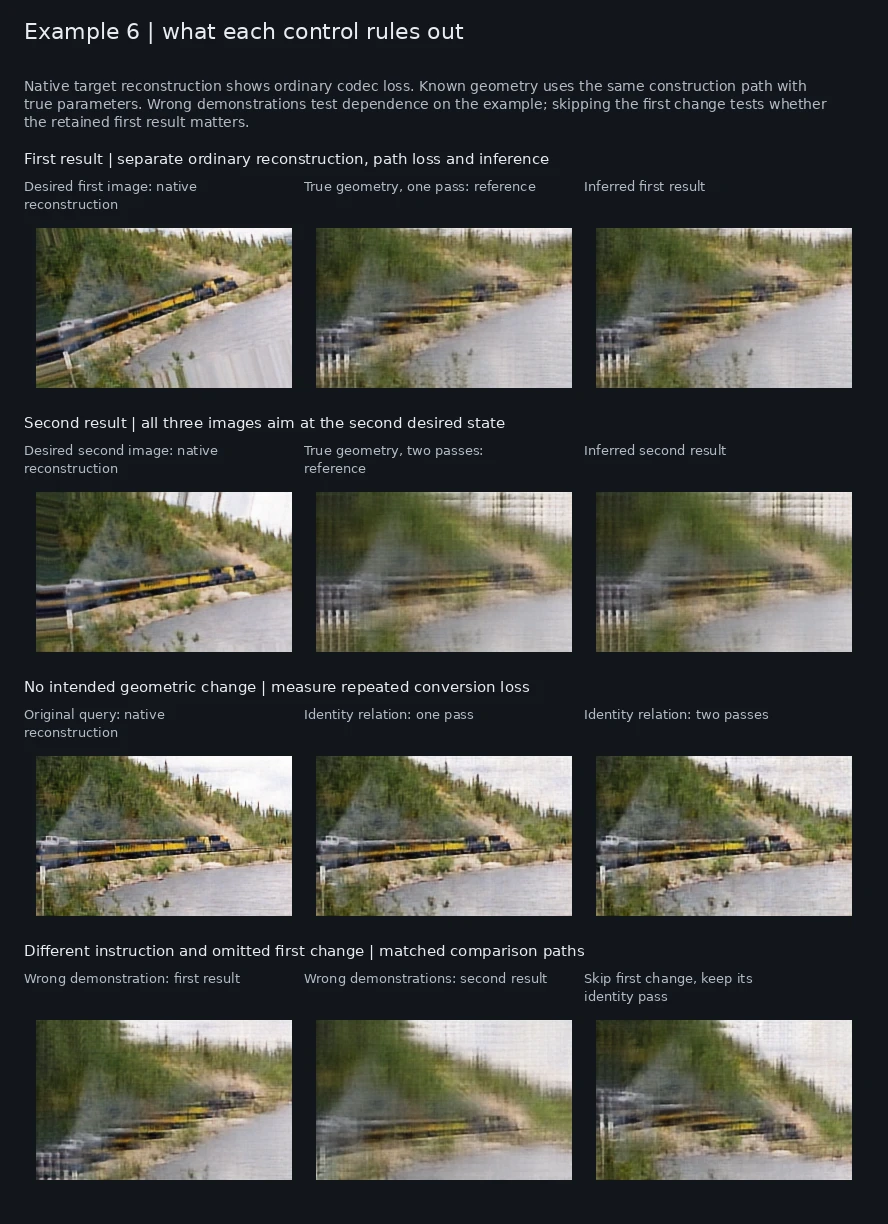
Display derivative: WebP quality 90; maximum edge 2400 px. Original scientific pixels remain in the source run; do not measure this preview.
Example 7: Infer a change, reuse it, then compose another
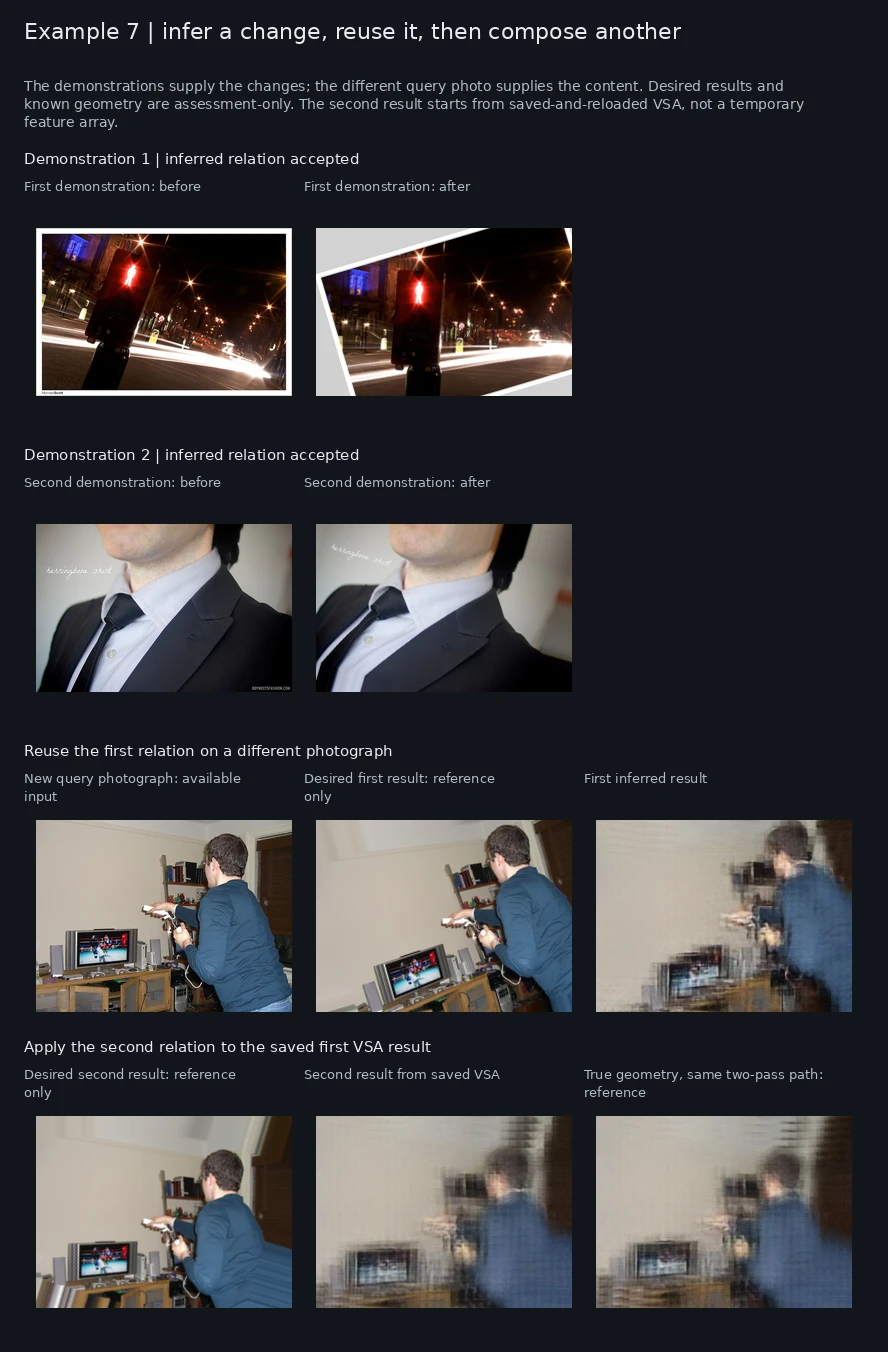
Display derivative: WebP quality 90; maximum edge 2400 px. Original scientific pixels remain in the source run; do not measure this preview.
Example 7: Separate inference from conversion loss
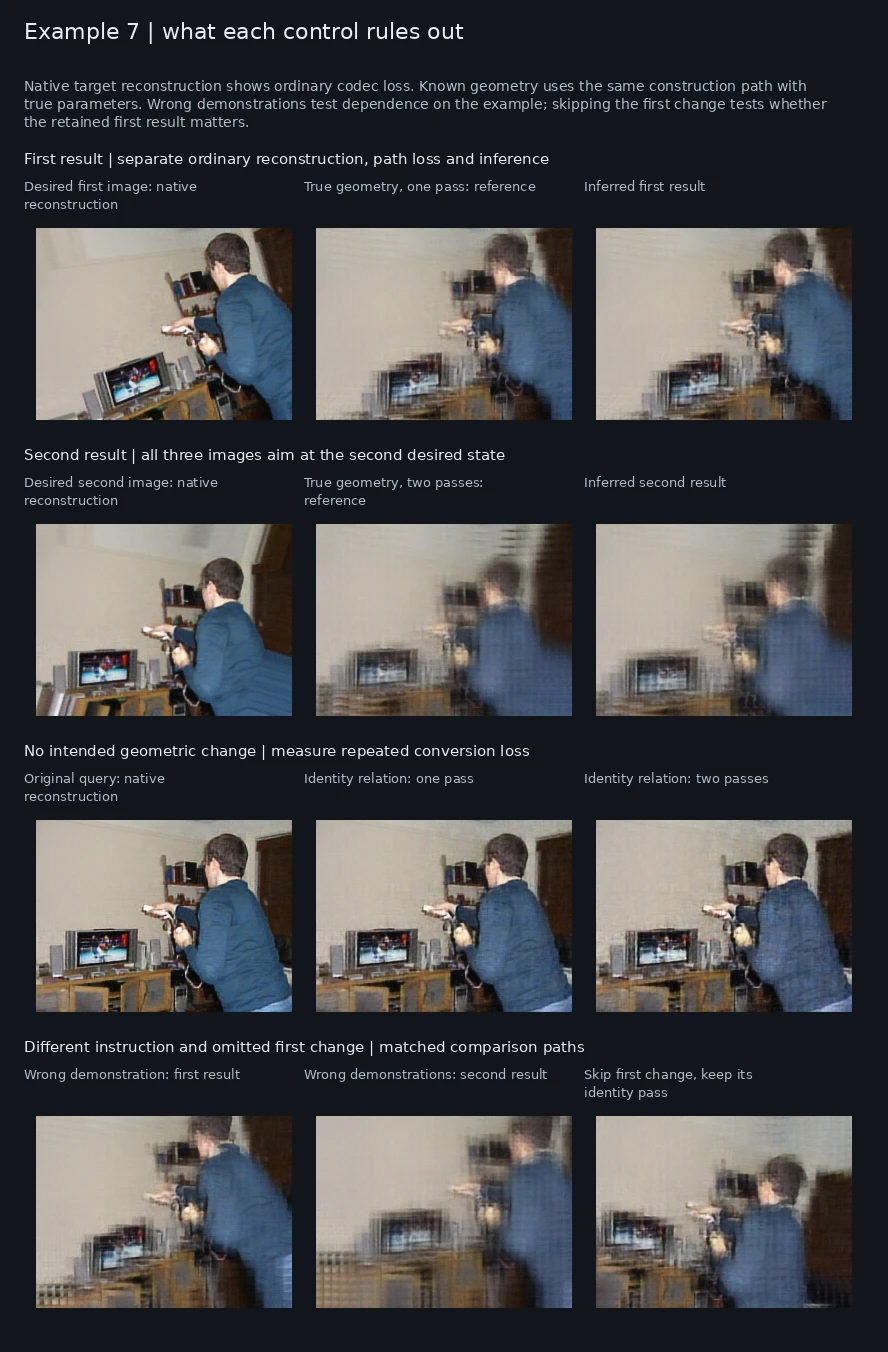
Display derivative: WebP quality 90; maximum edge 2400 px. Original scientific pixels remain in the source run; do not measure this preview.
Example 8: Infer a change, reuse it, then compose another
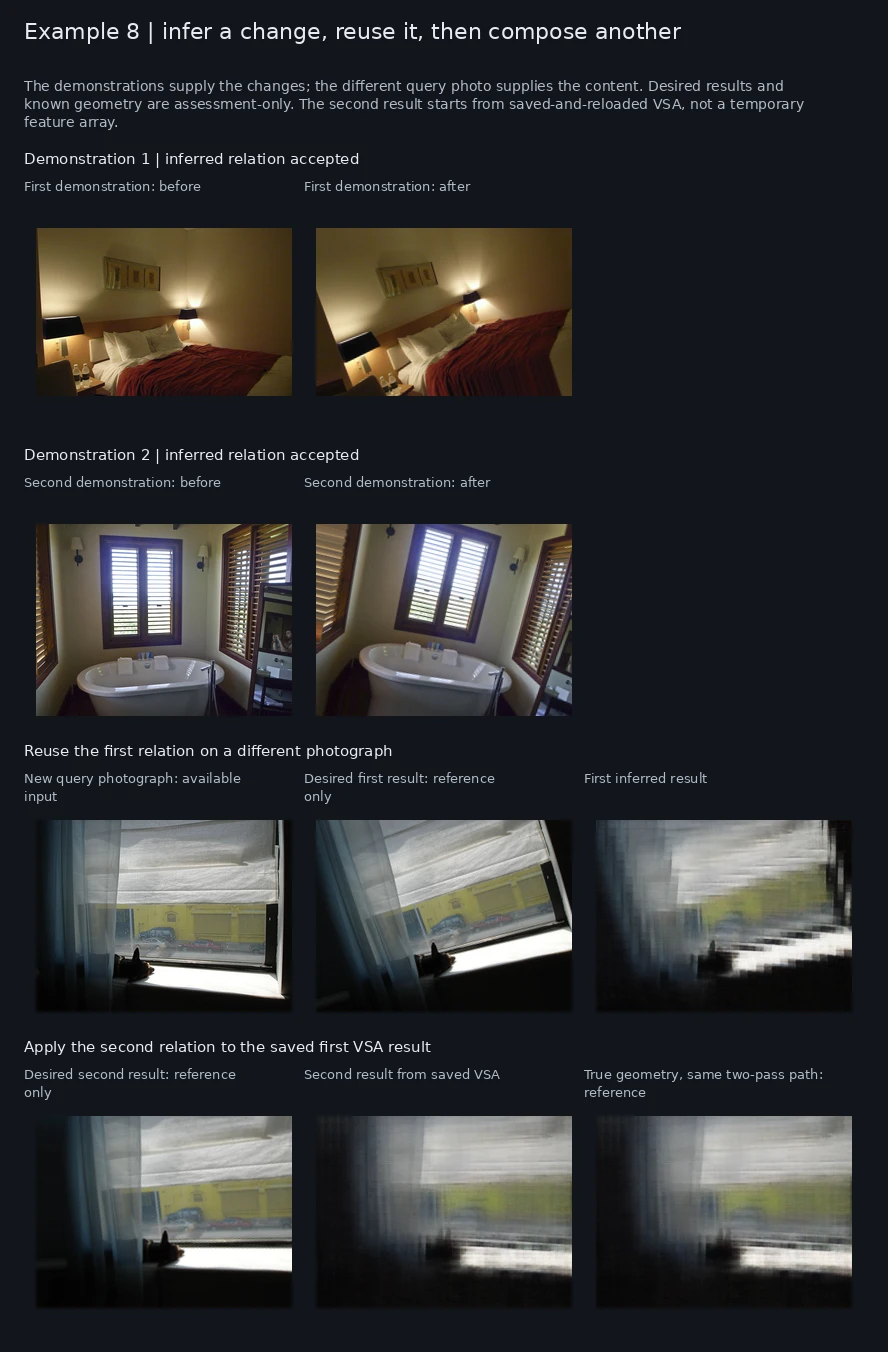
Display derivative: WebP quality 90; maximum edge 2400 px. Original scientific pixels remain in the source run; do not measure this preview.
Example 8: Separate inference from conversion loss
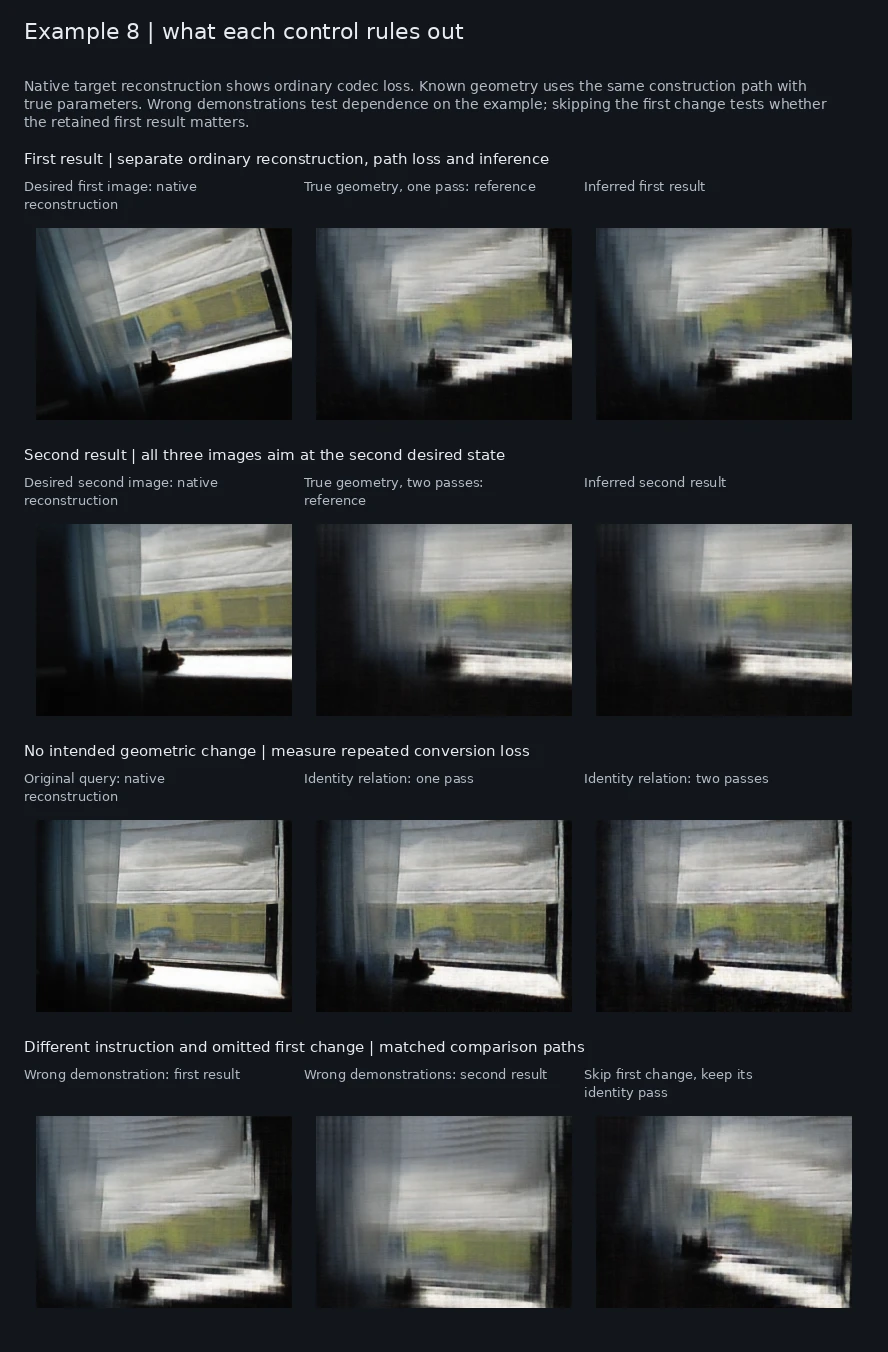
Display derivative: WebP quality 90; maximum edge 2400 px. Original scientific pixels remain in the source run; do not measure this preview.
Limits and next question
Rotation, uniform scaling and translation are a supplied family, and the two-step procedure is supplied. The system fits numeric relations without neural retraining or acquiring a new operation family. Refused fits use explicit identity fallbacks; the refused example remains in all totals. Desired query images and known geometry are observer-only references in this experiment.
The five historical numerical criteria passed and the first-stage wrong-demonstration confidence interval includes zero. Neither fact establishes intact geometry in the rendered result. Relation fitting and continuation through saved VSA remain separate evidence; the application path is not a qualified visual rotation mechanism. No semantic editing, invented detail, general imagination or runtime promotion is established. The continuing life is unchanged.
Next question. How must feature contents transform so that the rendered structure follows the estimated change? Preserve the relation-fitting and saved-state interfaces, but address the failed visual operation before treating it as a reusable rotation capability. No replacement architecture or additional experiment is selected by these results.
Inspect the evidence
Download the methods and measurements for this experiment. Large training and saved-state files are not included.