Type a section name and press Enter. Use “help” for the list.
Cliste experiment
Native continuing life: partial perception, recall and acquired cleanup
Registered 8 Oct 2026 · Snapshot 12 Oct 2026
The question
Connect ordinary native-image admission, retained VSA content, partial-cue recall, working use and restart in one durable life.
Why this experiment?
Remembered content needs a role in current activity and a relation to earlier and later events. Supplied controls let those mechanisms be tested separately.
How it works
Supply image fragments and visibility masks to recall, then test working-state hold/release and temporal replay. The addresses, clocks and control commands are supplied; encountered images provide the content.
Follow this part of the investigation: Recall something, hold it, then recover what followed →Implementation and comparison details
Ordinary native intake, dense eight-bit retained content, causal acquired cleanup, partial-input query, working use and exact continuation controls in a durable life.
What happened
Engineering controls passed. Final no-cleanup queries accepted 25/32 correctly, 0 wrongly and abstained on 7. Before admission, 0/8 absent cues were falsely accepted. Cleanup outcomes are recorded separately against no-cleanup; these results do not close milestone 1.3.
Measurements
| Recorded field | Value |
|---|---|
| verdict | bounded_integration_engineering_pass |
| engineering passed | Pass |
| no cleanup final | {
"stage": "final32",
"mode": "none",
"group": "all",
"queries": 32,
"accepted": 25,
"abstained": 7,
"accepted_correct": 25,
"accepted_wrong": 0,
"absent_false_accept": 0,
"candidate_correct": 32,
"statuses": {
"accepted": 25,
"ambiguous": 7
}
} |
| no cleanup absent | {
"stage": "acquisition16",
"mode": "none",
"group": "absent",
"queries": 8,
"accepted": 0,
"abstained": 8,
"accepted_correct": 0,
"accepted_wrong": 0,
"absent_false_accept": 0,
"candidate_correct": 0,
"statuses": {
"ambiguous": 8
}
} |
Results and visual artifacts
Open a figure for its input, comparison, and result. Click an image to enlarge it.
Cliste stores whole images as structured VSA memory, then receives a small local view as a recall cue. Each row compares the same cue with and without acquired cleanup. Cleanup replaces a noisy feature vector with a sufficiently close acquired prototype; it is a separate operation from selecting a whole remembered image. The source image at left is an answer reference for the evaluator, not an input to retrieval. A correct answer must select the source memory; an abstention means the acceptance rule declines to return any memory. Scores are similarities and gaps between competing candidates, not probabilities.
Recalling an image from a local view after 16 encounters — examples 1
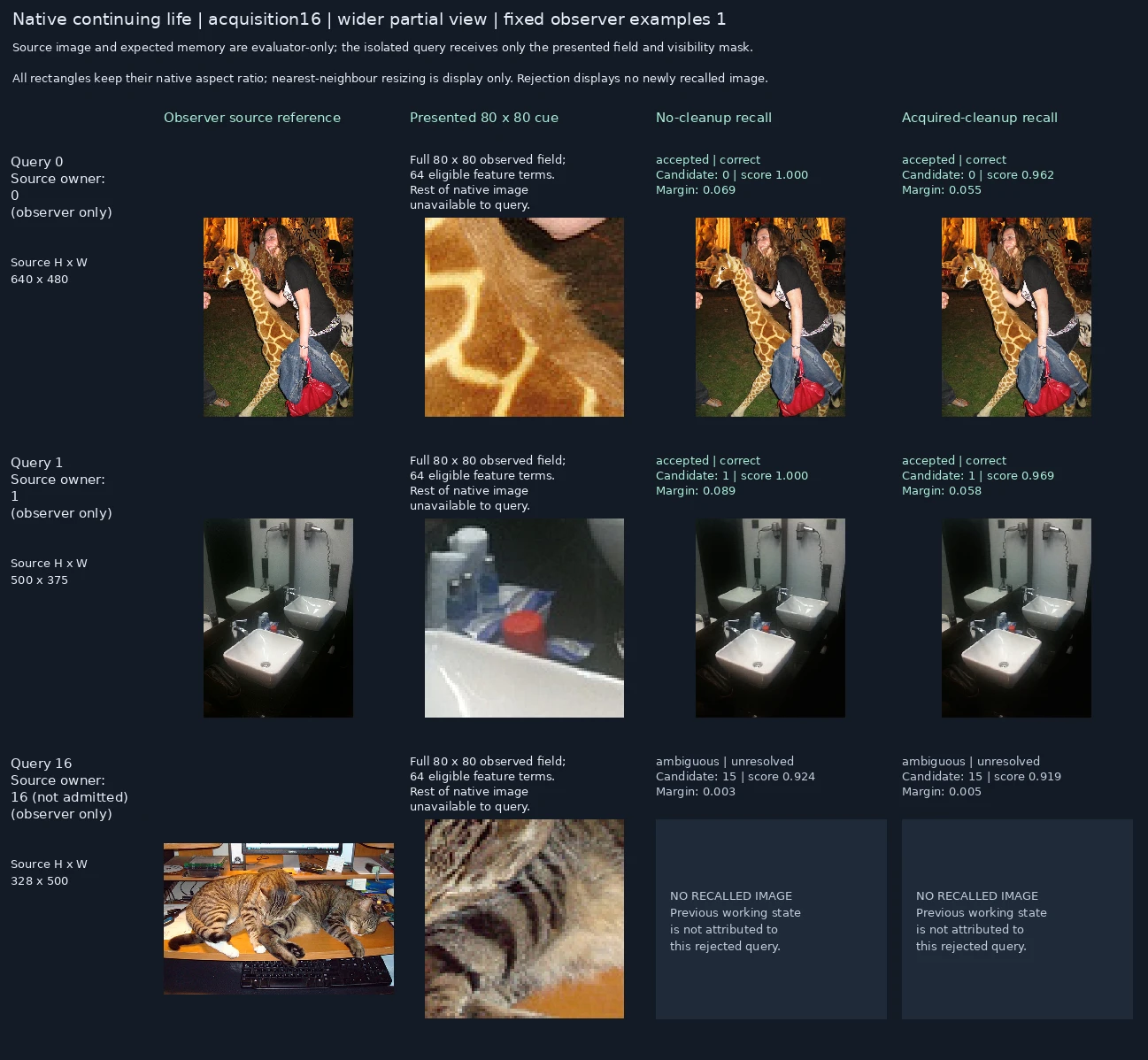
Display derivative: WebP quality 90; maximum edge 2400 px. Original scientific pixels remain in the source run; do not measure this preview.
Recalling an image from a local view after 16 encounters — examples 2
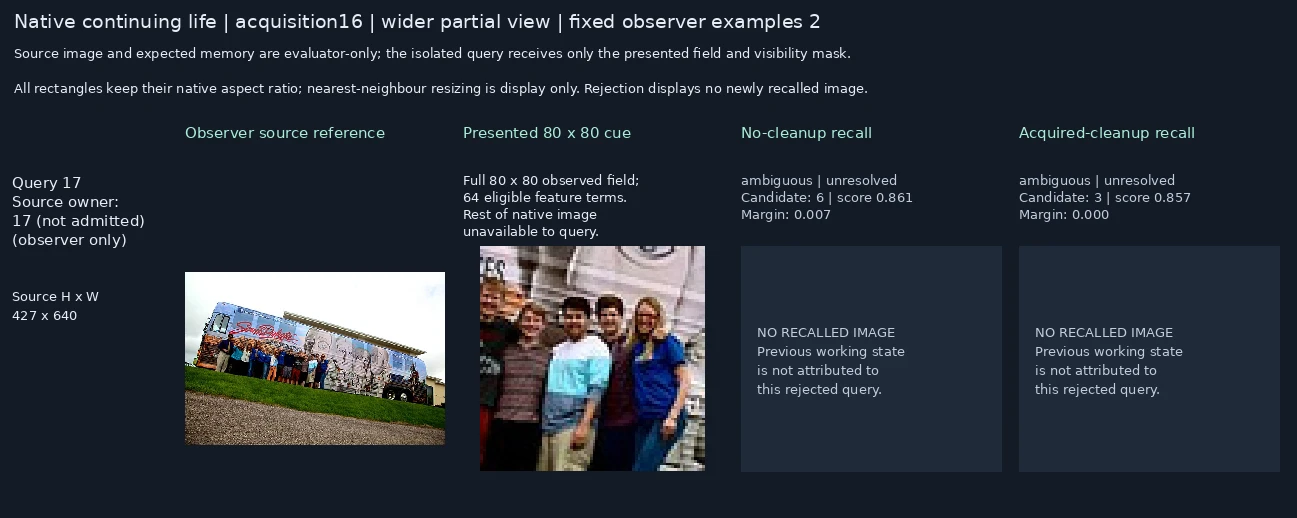
Display derivative: WebP quality 90; maximum edge 2400 px. Original scientific pixels remain in the source run; do not measure this preview.
Recalling an image from a local view after 32 encounters — examples 1
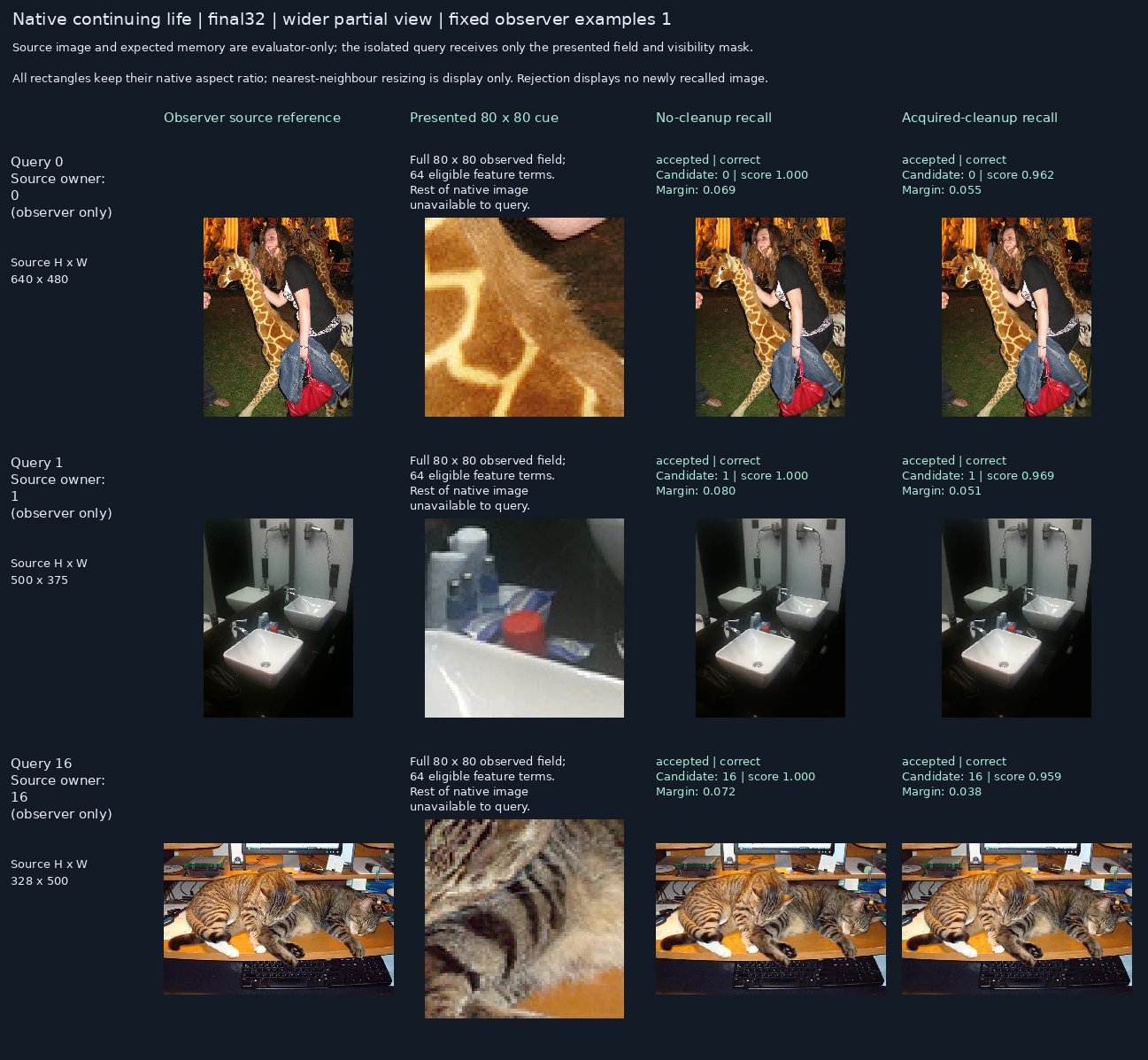
Display derivative: WebP quality 90; maximum edge 2400 px. Original scientific pixels remain in the source run; do not measure this preview.
Recalling an image from a local view after 32 encounters — examples 2
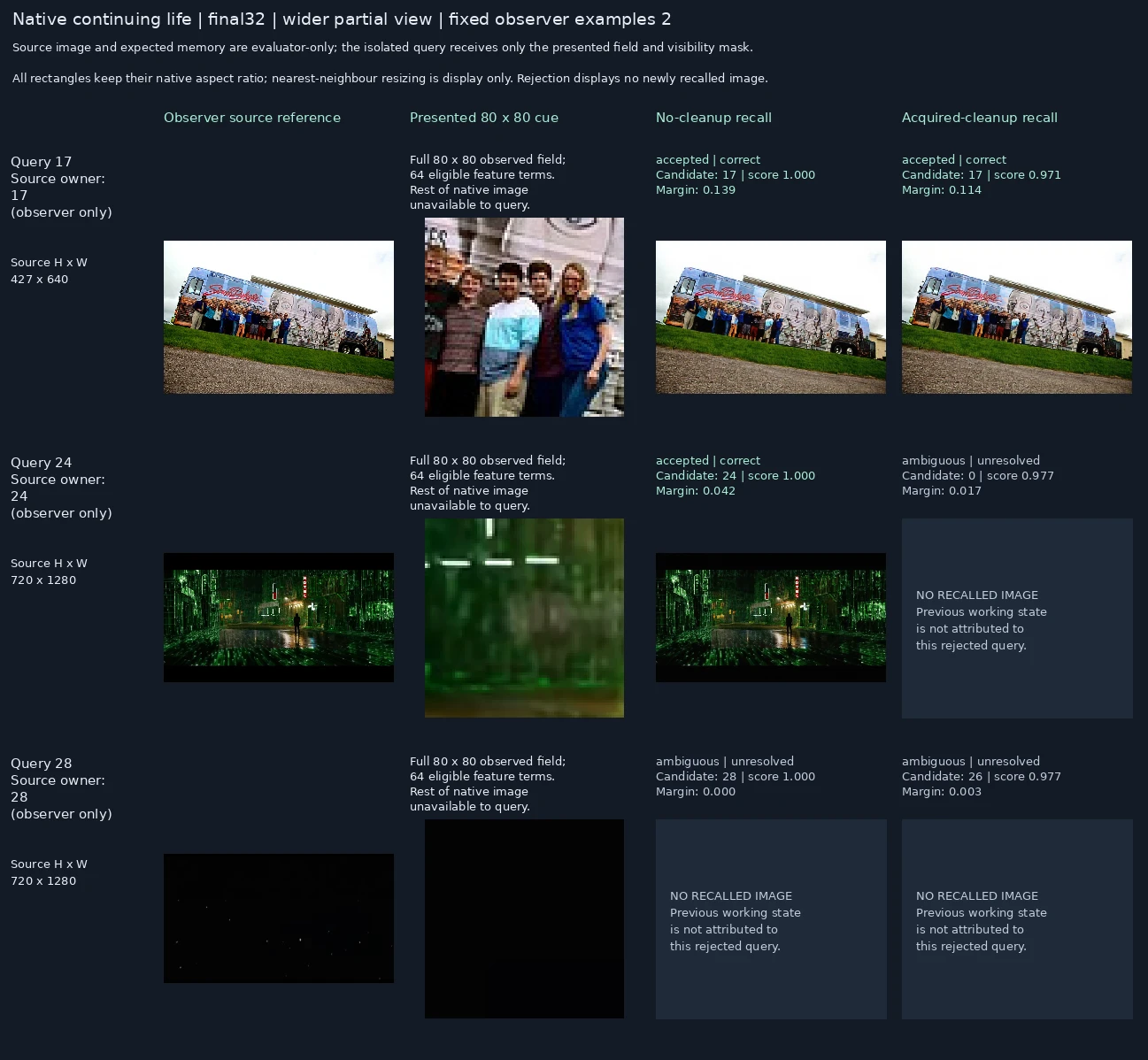
Display derivative: WebP quality 90; maximum edge 2400 px. Original scientific pixels remain in the source run; do not measure this preview.
Limits and next question
Previously examined natural inputs and supplied visibility; not a fresh generalization benchmark. Dense eight-bit storage and the immutable codec are provisional machinery. A 512-entry acquired bank is bounded. Engineering continuity and scientific cleanup/novelty outcomes are separate; no complete milestone 1.3 claim or unseen final-panel evaluation is assumed.
Next question. Use observed integrated failures to choose the next cognitive mechanism; no automatic codec optimization or complete 1.3 claim.
Inspect the evidence
Download the methods and measurements for this experiment. Large training and saved-state files are not included.