Type a section name and press Enter. Use “help” for the list.
Cliste experiment
Working content survives incoming experience
Registered 9 Oct 2026 · Snapshot 12 Oct 2026
The question
Hold and deliberately replace acquired VSA working content while the same life continues to observe, learn and restart.
Why this experiment?
Remembered content needs a role in current activity and a relation to earlier and later events. Supplied controls let those mechanisms be tested separately.
How it works
Supply image fragments and visibility masks to recall, then test working-state hold/release and temporal replay. The addresses, clocks and control commands are supplied; encountered images provide the content.
Follow this part of the investigation: Recall something, hold it, then recover what followed →Implementation and comparison details
Continue the frozen 32-encounter life through three held-content periods, explicit replacement, release, eight new observations and matched held/following branches.
What happened
Working hold controls passed across three content periods and eight new observations. The life retains 40 encounters. Exact restart match: True; acquisition and cursor agreement across all branches: True. Internal-query outcomes are reported separately; no autonomous selection or complete 1.3 claim.
Measurements
| Recorded field | Value |
|---|---|
| episodes | 40 |
| held periods | 3 |
| engineering passed | Pass |
| internal query statuses | [ "accepted", "accepted", "accepted", "accepted", "accepted", "ambiguous", "ambiguous", "ambiguous", "ambiguous", "ambiguous" ] |
Results and visual artifacts
Open a figure for its input, comparison, and result. Click an image to enlarge it.
Working memory is the visual content currently held for use. This experiment tests an explicit hold control while new images continue entering long-term memory. Read each four-panel figure from left to right: working content before, latest incoming image, working content after with holding enabled, and a comparison that always follows the latest observation. The incoming picture is a reference; the other pictures are decoded from actual working vectors. These are supplied control actions, not autonomous attention decisions.
Keeping a recalled image in mind during new observations
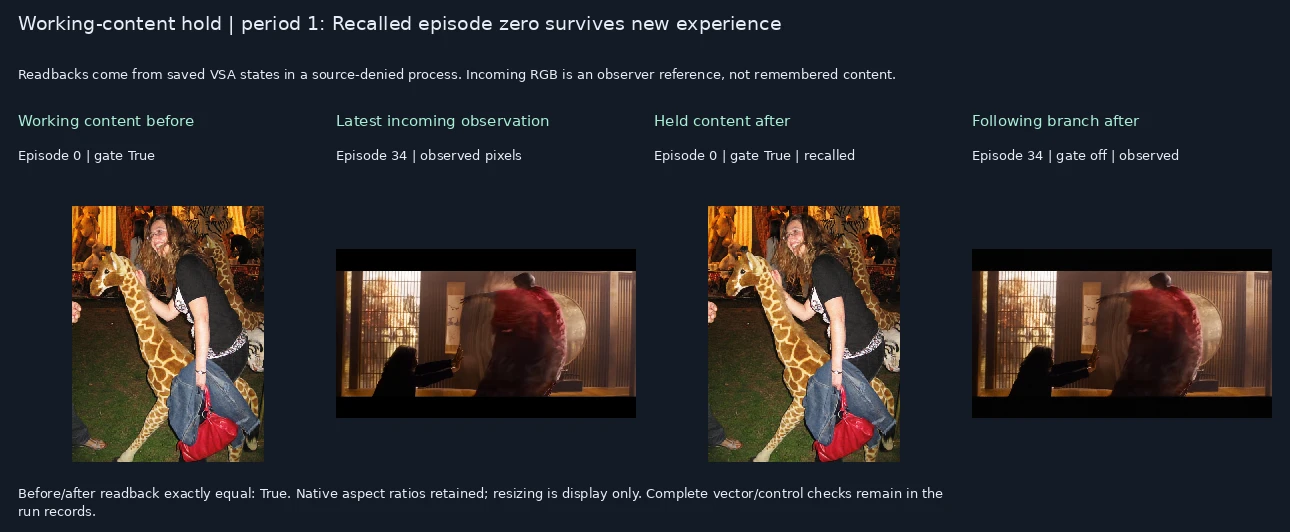
Display derivative: WebP quality 90; maximum edge 2400 px. Original scientific pixels remain in the source run; do not measure this preview.
Replacing a held memory, then retaining the replacement
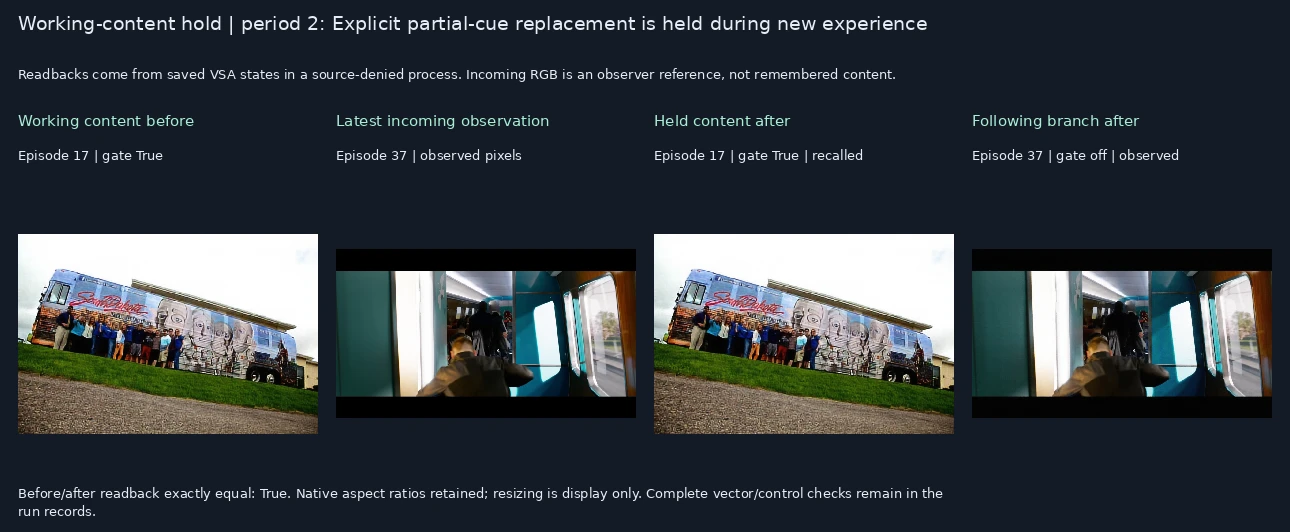
Display derivative: WebP quality 90; maximum edge 2400 px. Original scientific pixels remain in the source run; do not measure this preview.
Holding newly observed content instead of following the next input
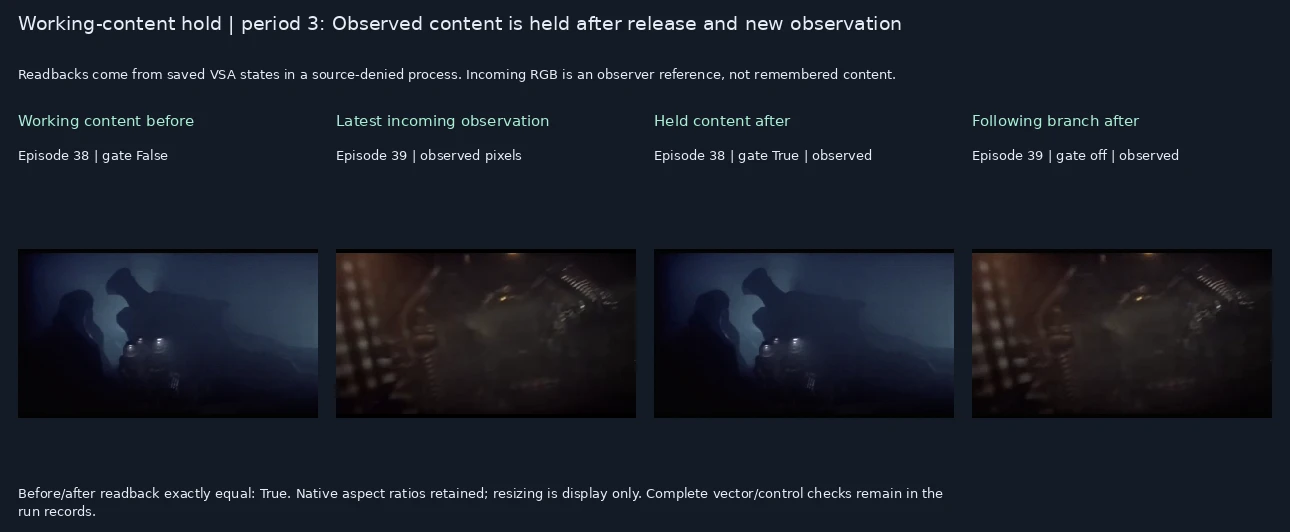
Display derivative: WebP quality 90; maximum edge 2400 px. Original scientific pixels remain in the source run; do not measure this preview.
Limits and next question
Supplied generic hold/release controls and a fixed replacement cue; no learned control policy, improved perception or complete milestone 1.3 claim. Four screened new photographs and four new-in-life frames extend an already acquired life. Final 32-image panel remains sealed.
Next question. Assess the held-content mechanism and its limits before planning temporal replay; full 1.3 requirements remain open.
Inspect the evidence
Download the methods and measurements for this experiment. Large training and saved-state files are not included.