Type a section name and press Enter. Use “help” for the list.
Cliste experiment
Shared vector composition and temporal replay
Registered 9 Oct 2026 · Snapshot 12 Oct 2026
The question
Use qualified acquired vectors and retained temporal context to retrieve and replay a continuing life independently of row order or observer timestamps.
Why this experiment?
Remembered content needs a role in current activity and a relation to earlier and later events. Supplied controls let those mechanisms be tested separately.
How it works
Supply image fragments and visibility masks to recall, then test working-state hold/release and temporal replay. The addresses, clocks and control commands are supplied; encountered images provide the content.
Follow this part of the investigation: Recall something, hold it, then recover what followed →Implementation and comparison details
Continue the frozen 40-encounter life through six irregularly timed observations, context-driven replay, row permutation and context-swap controls, restart and a matched repeated external observation.
What happened
Bounded 1.5 passed: all 276 temporal choices were correct across original, shuffled and context-swapped storage; all 1,263 independent audit checks passed. Seven forward and six backward steps decoded actual retained working content. Full and restarted replay matched exactly, and subsequent acquisition matched the no-replay control. Qualification changed decoded pixels by at most 2.98e-8. Noisy cleanup remained ambiguous (margin 0.0159 < 0.02), so no prototype was substituted. The verified continuation contains 47 encounters and holds recalled episode 45. Full 1.3 and native visual movement remain open.
Measurements
| Recorded field | Value |
|---|---|
| episodes | 47 |
| extended episodes | 46 |
| checks | {
"intake": true,
"source_denied": true,
"temporal_selection": true,
"replay_branches": true,
"split_replay_exact": true,
"split_post_observation_exact": true,
"post_acquisition_exact": true,
"post_cursor_exact": true
} |
Results and visual artifacts
Open a figure for its input, comparison, and result. Click an image to enlarge it.
This test asks whether stored temporal relationships can guide a sequence of recollections. Cliste starts from a held memory and is asked to move forward or backward through its own encounter order. The pictures are decoded from the selected stored vectors. Encounter numbers identify observations; they are not class labels. Replay requests and temporal coordinates are supplied, so successful recall does not demonstrate a learned decision about what to remember or predict what happens next.
Remembering 7 encounters after a held memory
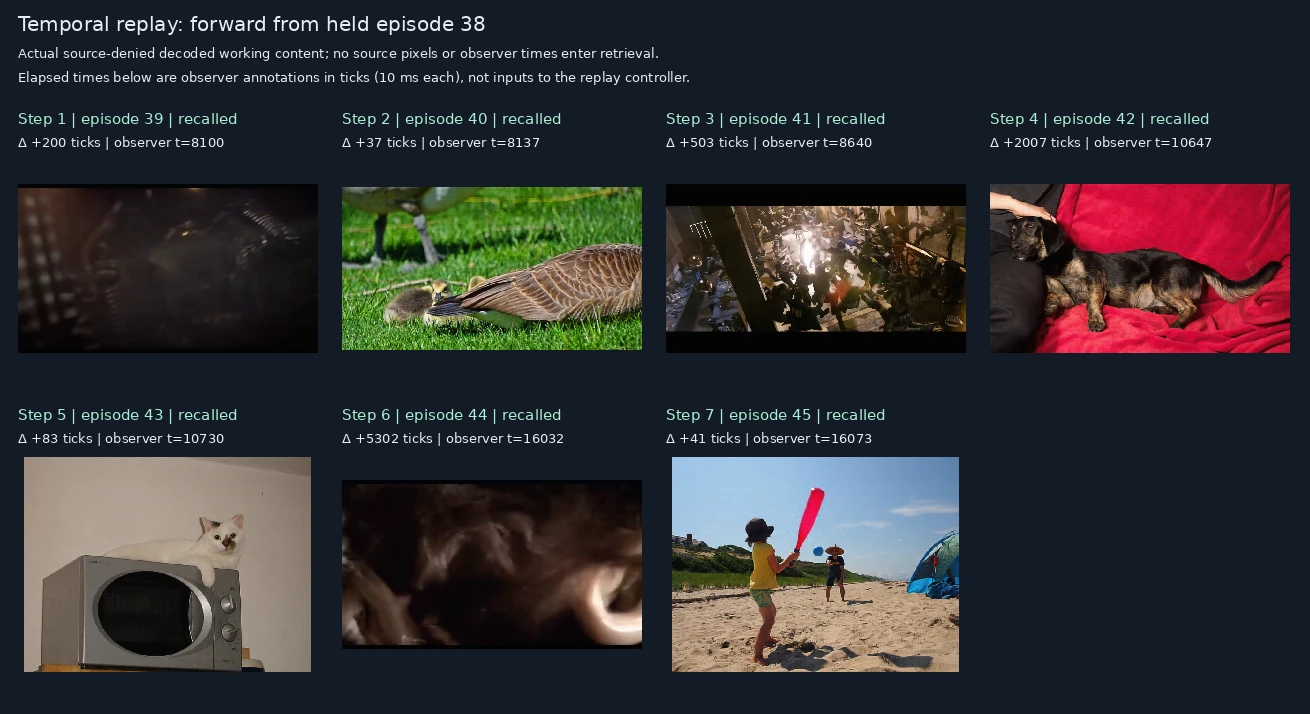
Display derivative: WebP quality 90; maximum edge 2400 px. Original scientific pixels remain in the source run; do not measure this preview.
Remembering 6 encounters before a held memory
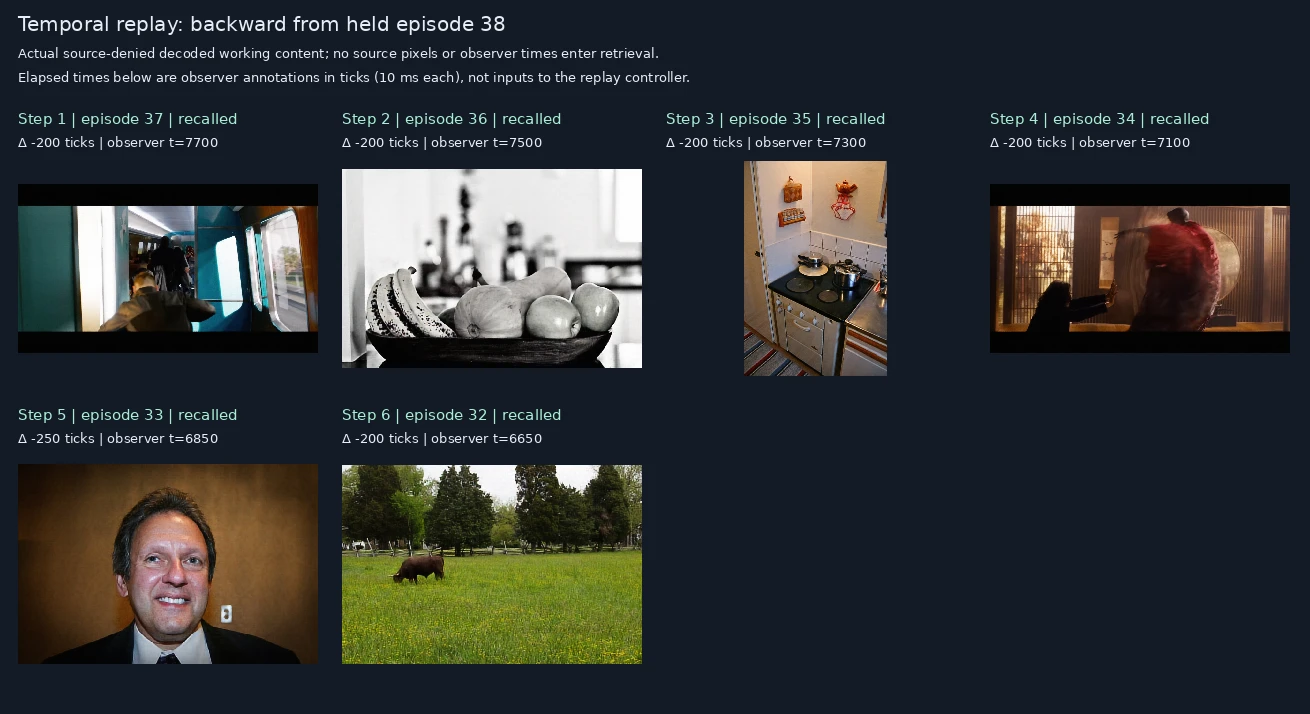
Display derivative: WebP quality 90; maximum edge 2400 px. Original scientific pixels remain in the source run; do not measure this preview.
Adding and removing vector context preserves the remembered image
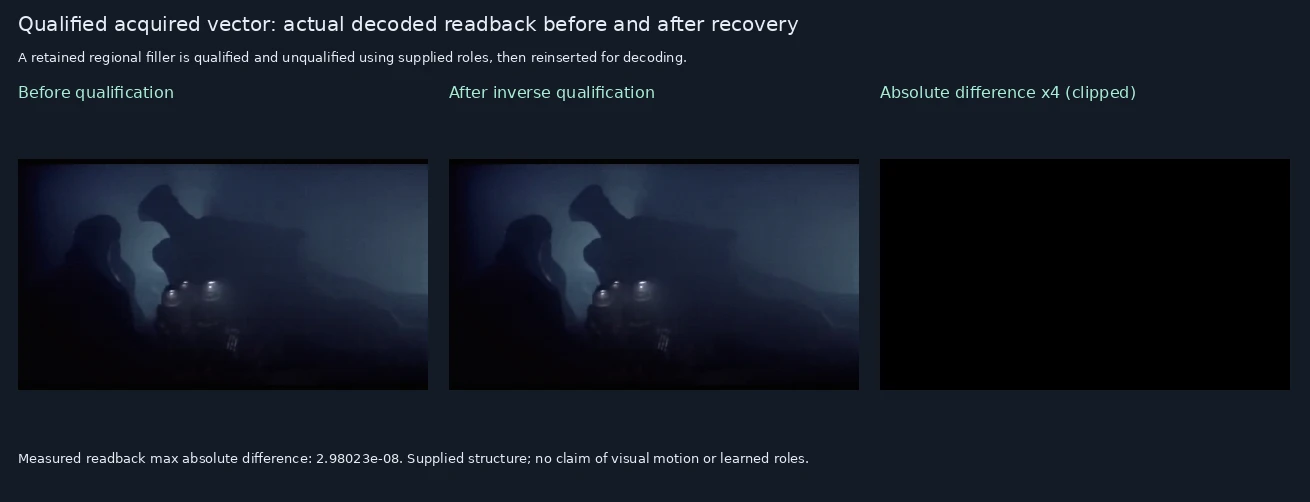
Display derivative: WebP quality 90; maximum edge 2400 px. Original scientific pixels remain in the source run; do not measure this preview.
Does recall follow stored time relationships or array position?
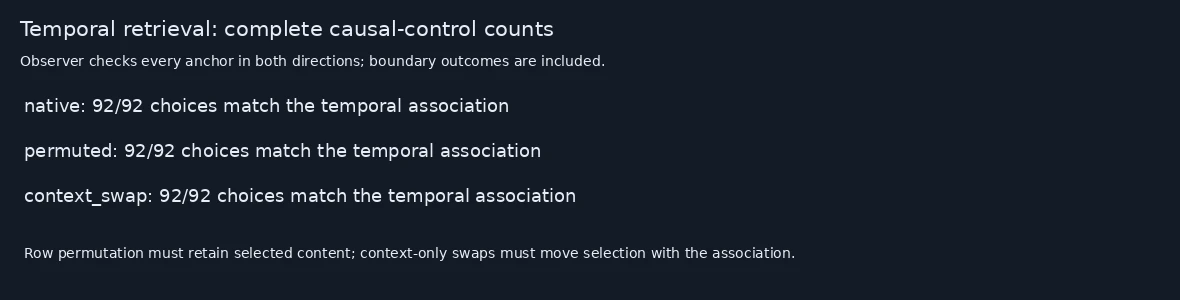
Display derivative: WebP quality 90; maximum edge 2400 px. Original scientific pixels remain in the source run; do not measure this preview.
Limits and next question
Supplied roles, coordinate bases, temporal horizon and replay requests; no autonomous selection, spatial perception or replay learning benefit. Six irregularly timed natural observations extend a retained life. Full 1.3 remains open; final 32-image panel remains sealed.
Next question. Assess temporal replay and shared composition before planning further continuing-life work; full 1.3 requirements remain open.
Inspect the evidence
Download the methods and measurements for this experiment. Large training and saved-state files are not included.