run record~/research/cliste/runsAll Cliste runs

Type a section name and press Enter. Use “help” for the list.

Figures: softened for dark viewingDisplay only; image files are unchanged.
← All Cliste runs

Cliste experiment

Acquired-pattern cleanup diagnostic

Execution: failedScientific verdict: No final scientific verdict

The question

Determine where acquired-pattern substitution destroys useful perceptual distinctions and where it recovers an observer-known constituent after uncertainty or VSA interference.

Why this experiment?

A partial cue can resemble the wrong memory. Recall needs to recover useful content while recognizing when the evidence is insufficient.

How it works

Compare partial-cue recall with familiar and unfamiliar inputs, retaining incorrect accepts and refusals. Cleanup and confidence rules are qualified before relying on them for a remembered continuation.

Follow this part of the investigation: More answers are useful only if the extra confidence is justified →
Implementation and comparison details

Reproduce the frozen 32-encounter failures; continue a separate 47-encounter life with sixteen new photographs; compare fixed cleanup arms on matched pristine, narrow and noisy cues; test known-target VSA interference separately.

What happened

Original run 001 remains failed: prototype-score error 2.5413459939782612e-6 exceeded its fixed 2.5e-6 limit. Separate run 003 confirms every selected prototype and recall decision but also fails its exact runner-up-order criterion; both failures remain. Fresh clean-field recall is 27/32 without cleanup versus 23/32 with acquired cleanup; known-target recovery works at interference weight 0.25 but rejects weight 0.5. A separate 47-to-63 encounter fork preserves old memory and held recalled episode 45. No cleanup policy is promoted.

Results and visual artifacts

Open a figure for its input, comparison, and result. Click an image to enlarge it.

Cleanup substitutes similar learned prototypes for local visual features before searching memory. No cleanup keeps those features unchanged; acquired uses the learned matches; disrupted deliberately substitutes the wrong prototype assignments as a control. Inputs are 80 × 80 regions. Clean80 shows the whole region, narrow reveals a strip, and Gaussian4/12 add pixel noise with standard deviation 4 or 12 on the 0–255 scale. This attempt failed a numerical audit tolerance, so its saved observations remain diagnostic rather than a fully qualified result.

Cleanup removes two previously successful recalls
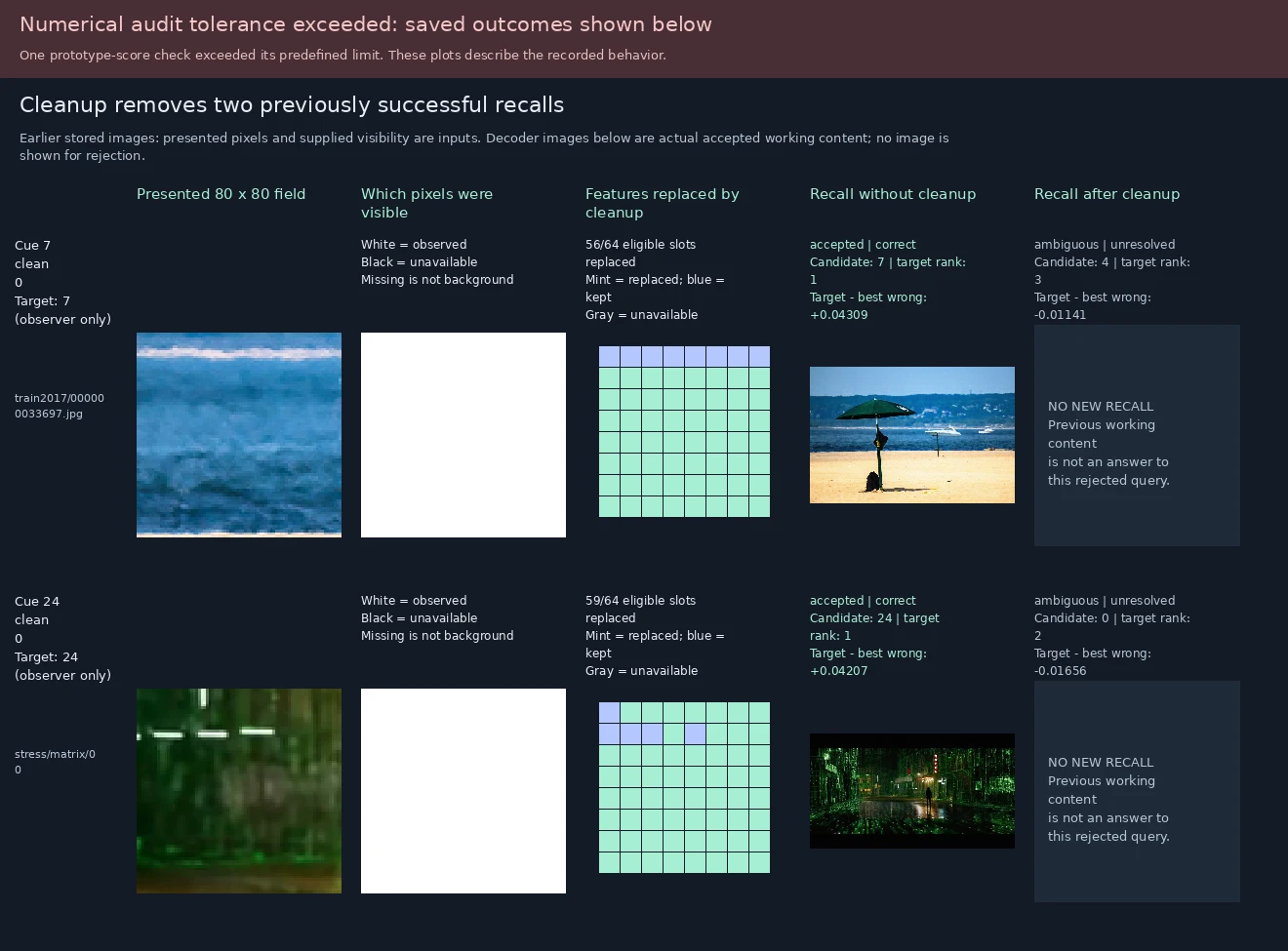
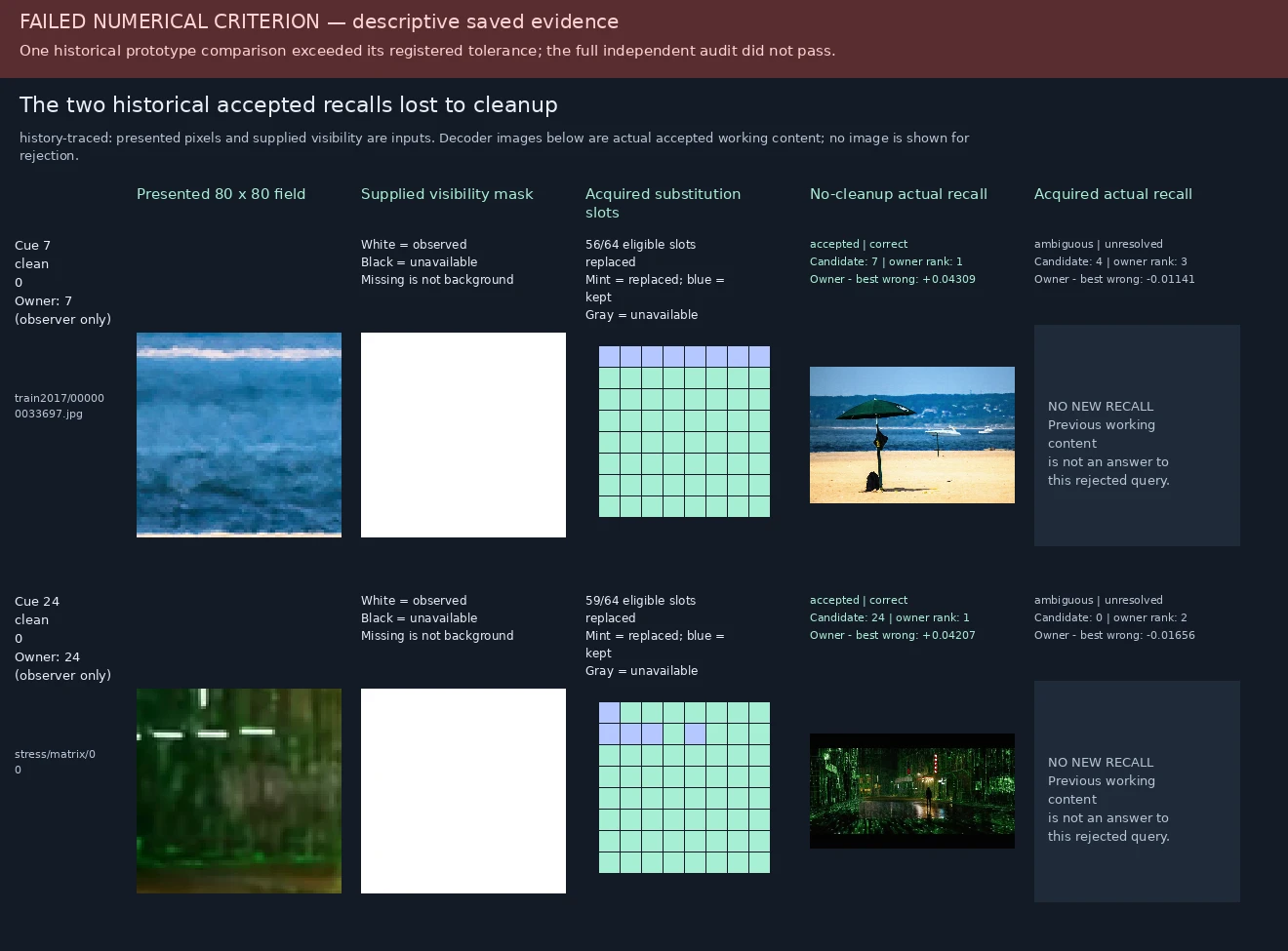
The ocean patch and green video-frame patch recall their source images without cleanup, but return no image after prototype substitution. Columns show the input, its visibility mask, replaced feature positions, and the two decoded recall outcomes. Mint grid cells were replaced, blue retained, and gray unavailable. Target is the intended stored image; target minus best wrong measures its score advantage over the strongest competing image. A negative value means the competitor ranks higher.

Original recorded figure ↗

Two different dark inputs become the same query vector
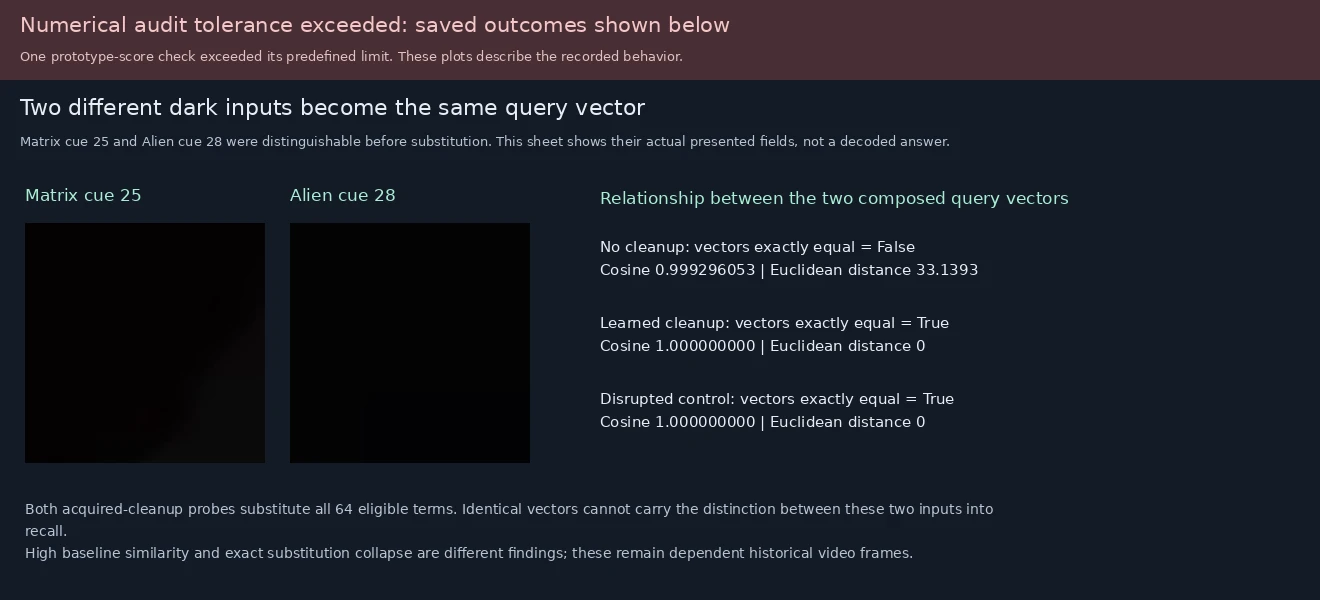
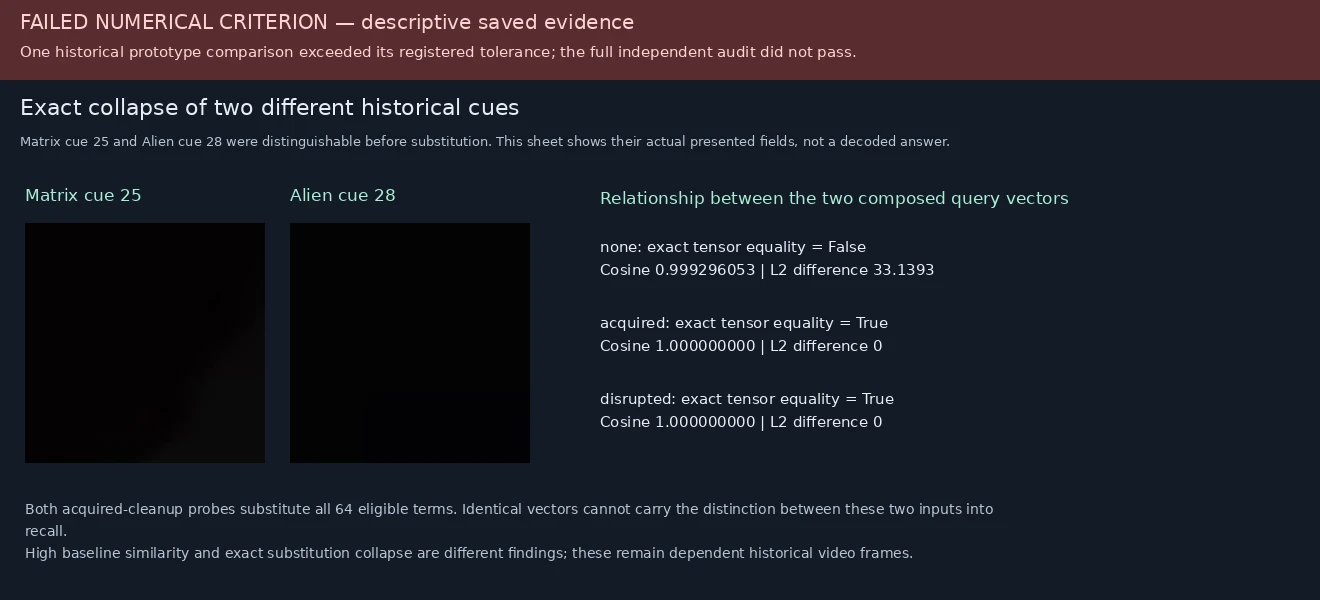
The displayed inputs come from different video frames and are both very dark. Without cleanup their vectors are close but distinct: cosine similarity 0.999296, Euclidean distance 33.14. Replacing their features with learned prototypes makes the query vectors exactly equal, as does the disrupted control. Once the vectors are identical, later recall cannot distinguish these inputs. These two examples establish a collision, not its frequency across ordinary images.

Original recorded figure ↗

Cleanup generally reduces recall on these newly stored photographs
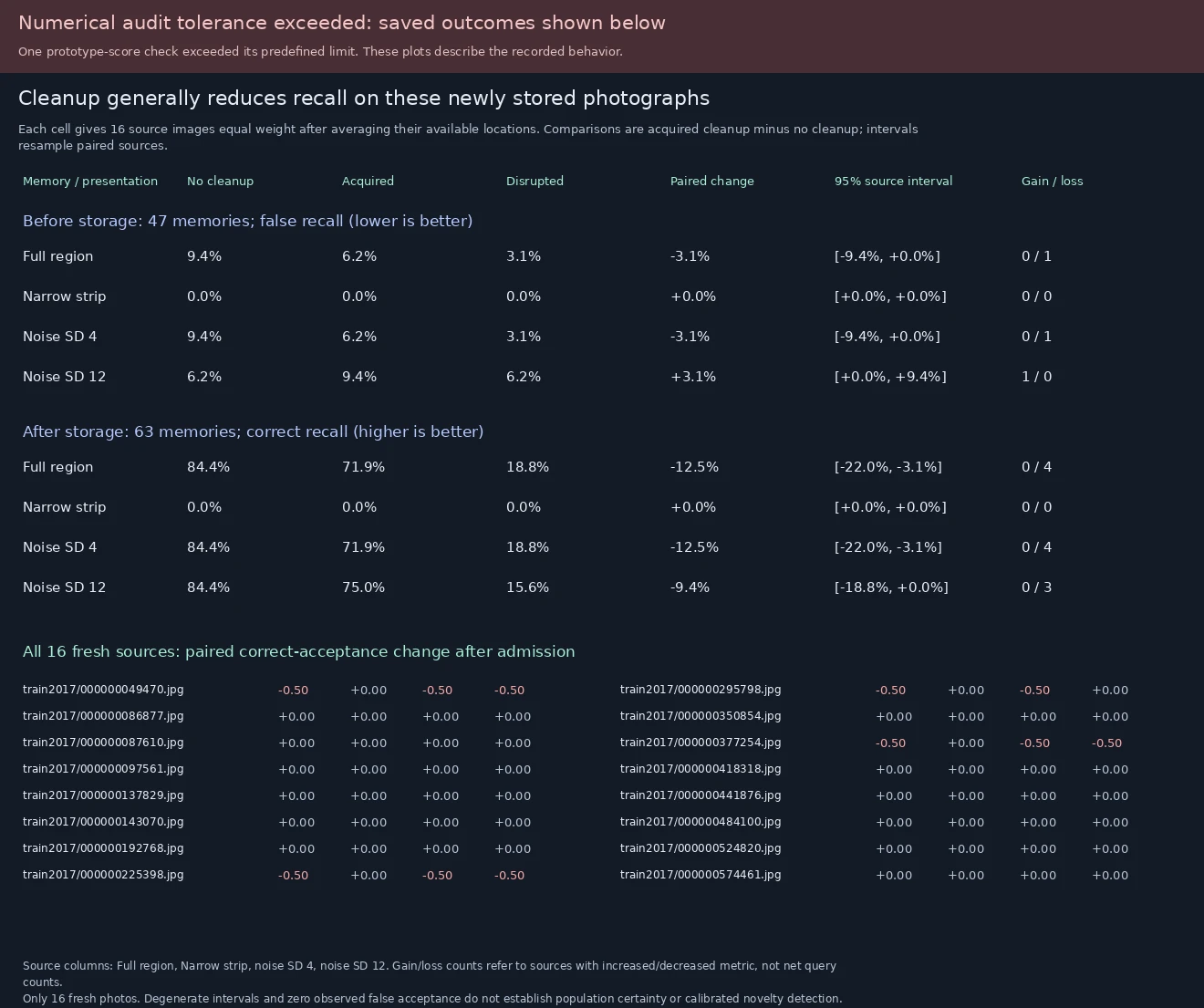
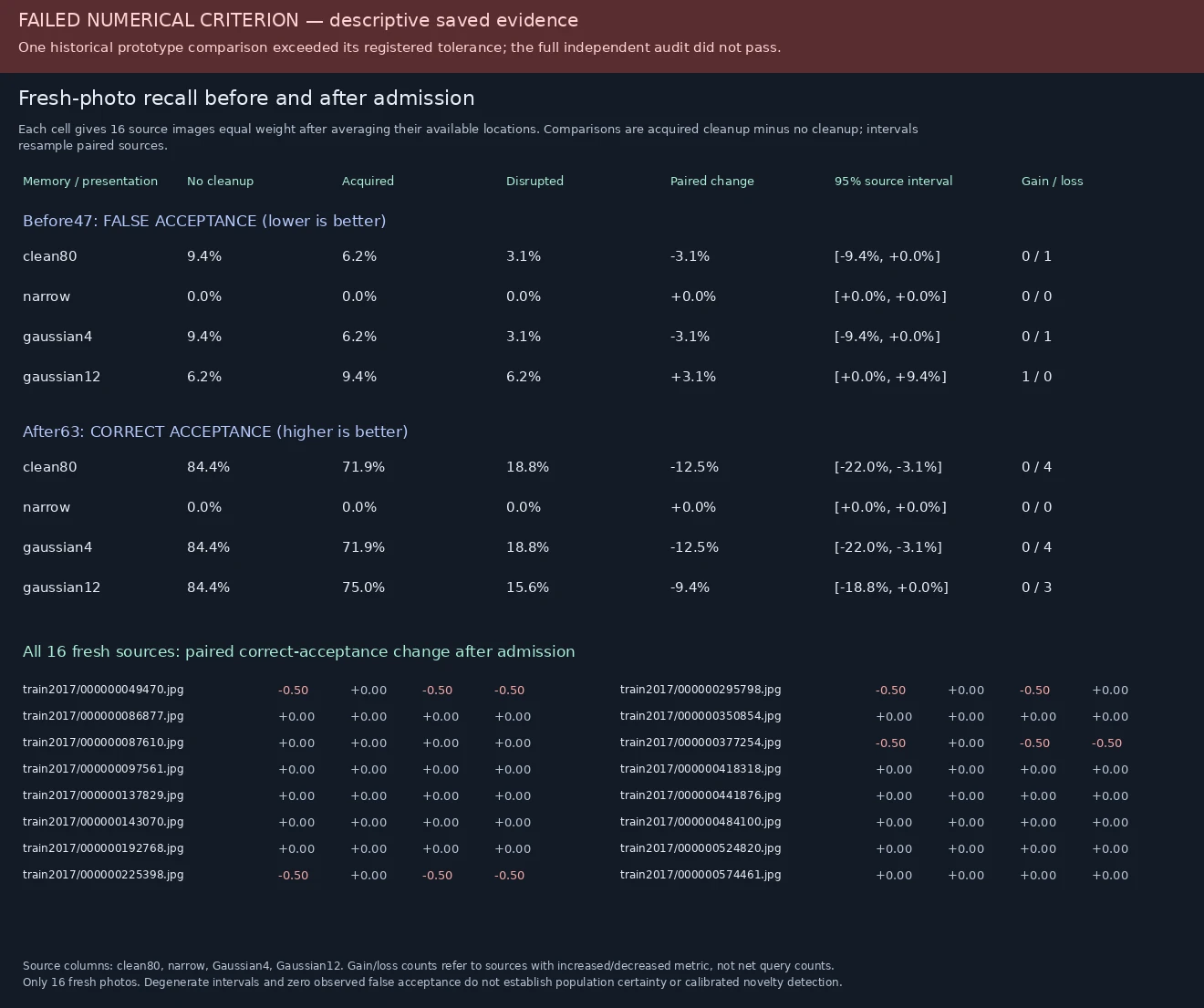
The upper block measures false acceptance before the 16 photographs were stored; lower is better. The next block measures correct recall after storage; higher is better. For clean regions, cleanup lowers correct recall from 84.4% to 71.9%, a 12.5-point decrease. Intervals resample photographs after averaging their two locations. Bottom rows show each photograph's change for clean, narrow, low-noise, and higher-noise inputs. Gain/loss counts refer to photographs whose measured rate increased/decreased.

Original recorded figure ↗

High prototype similarity does not guarantee useful replacement
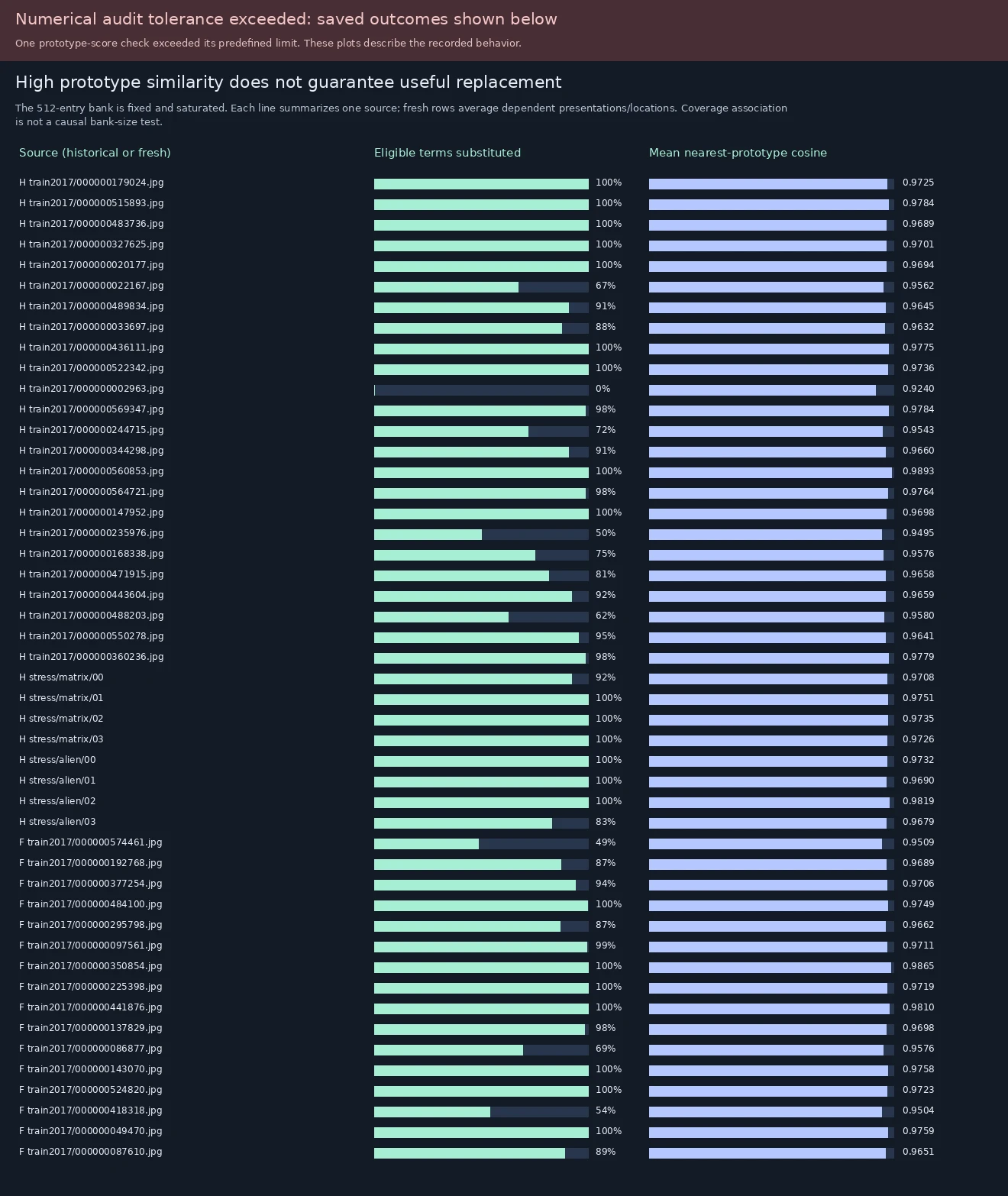
Each row is a source image: H marks the earlier test set and F the new photographs. The mint bar reports the fraction of usable features replaced by prototypes; the blue bar reports average similarity to the nearest prototype. The bank contains 512 learned prototypes. Many inputs undergo extensive replacement despite later recall losses. These are descriptive associations, not a comparison showing that a larger or smaller bank would fix the problem.

Original recorded figure ↗

Cleanup can recover known vectors from moderate VSA interference
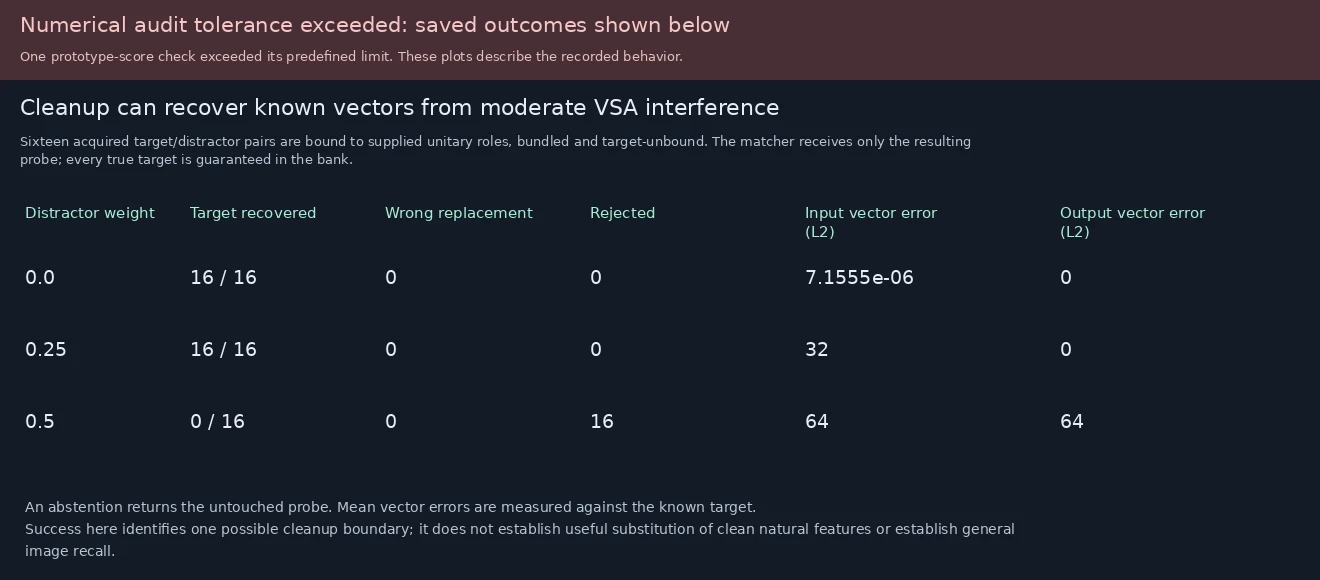
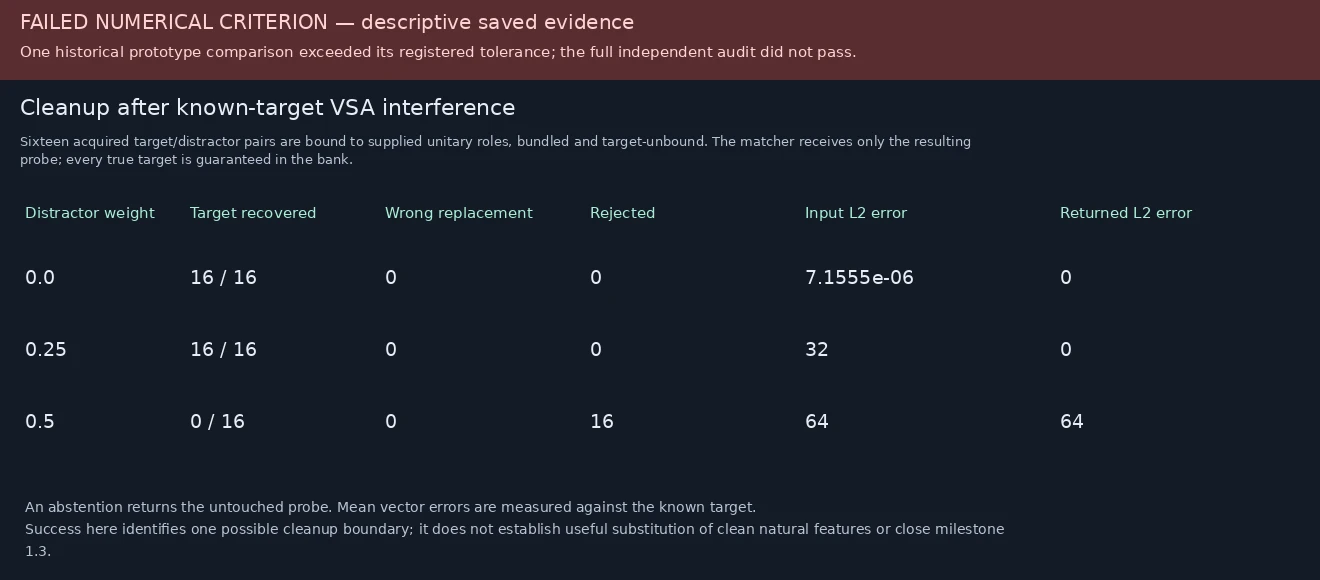
Sixteen stored target vectors are each mixed with a distractor using VSA binding and bundling, then recovered by unbinding the target role. At distractor weight 0.25, cleanup recovers all 16 exact prototypes and reduces mean Euclidean error from 32 to zero. At 0.5 it rejects all matches and leaves error at 64. The target is guaranteed to exist in the bank; this controlled recovery test is different from recognizing an unfamiliar natural image.

Original recorded figure ↗

Which feature replacements weaken the intended memory's lead?
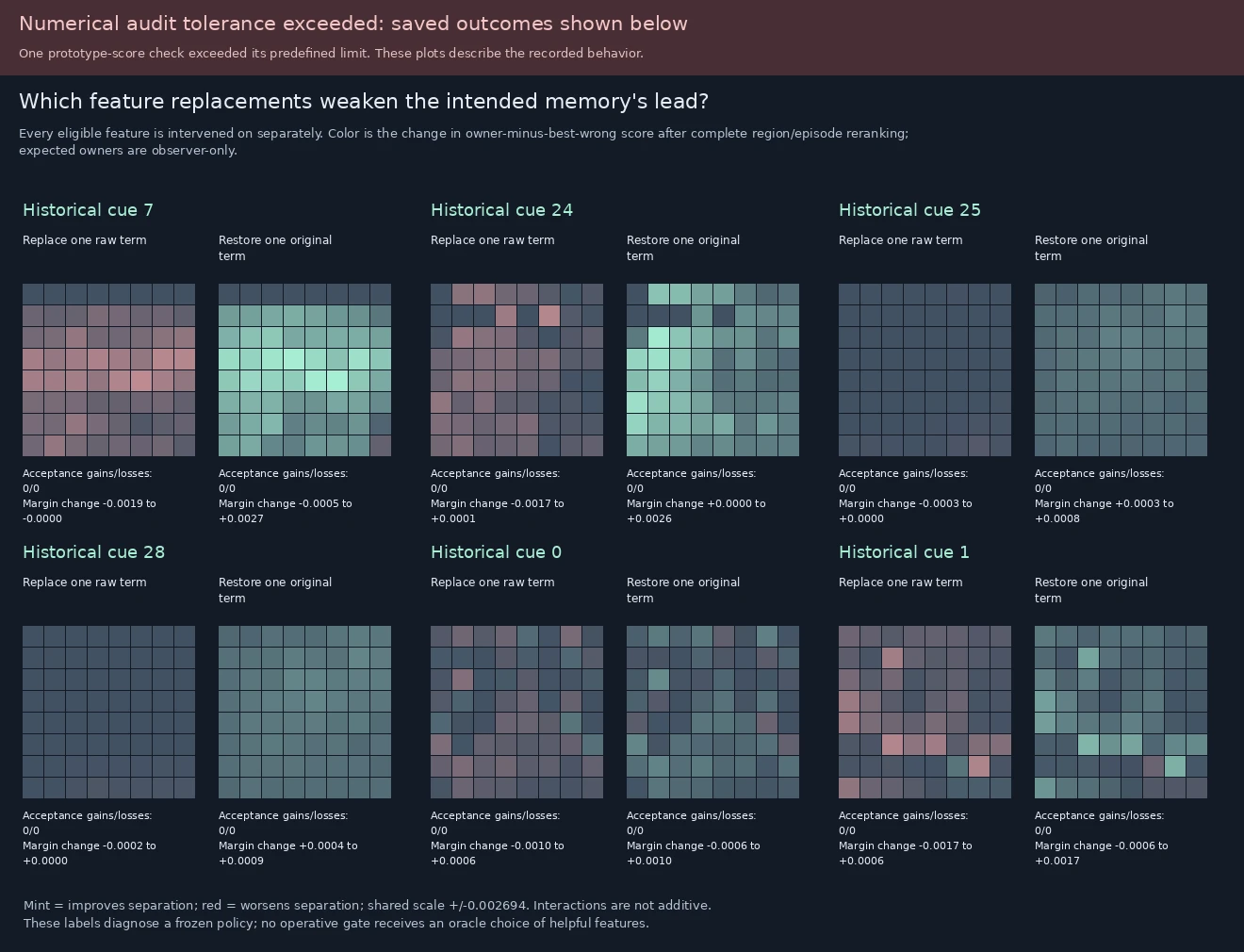
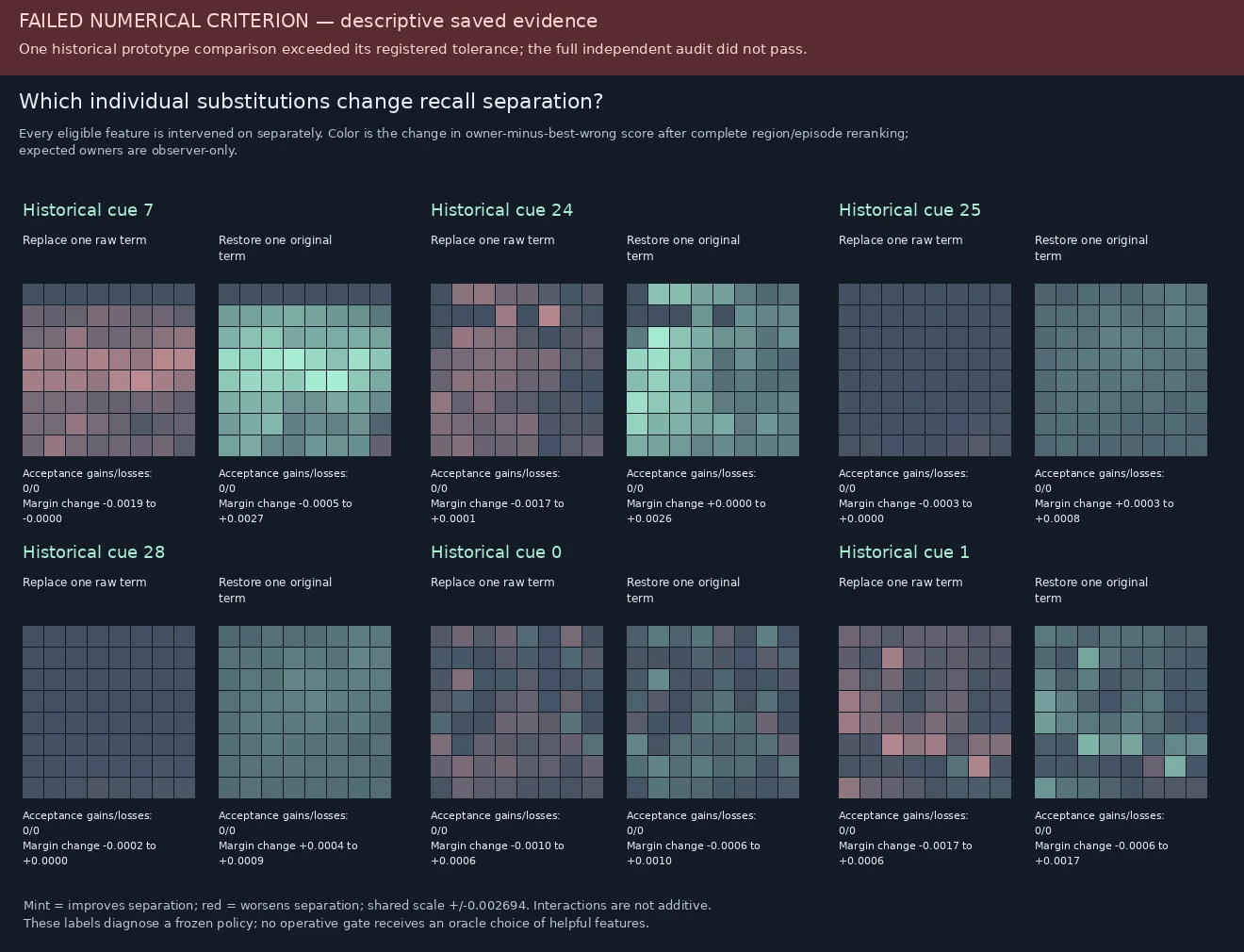
Each pair of 8 × 8 grids tests one input, changing one feature position at a time. Left: replace that original feature with its learned prototype. Right: restore one original feature after cleanup. Mint increases the intended image's score lead over the best wrong match; red decreases it, on a shared scale of ±0.002694. No single tested change flips acceptance. Combined substitutions can interact, so cell effects should not be added together.

Original recorded figure ↗

Unstored photograph: both rules correctly decline these views
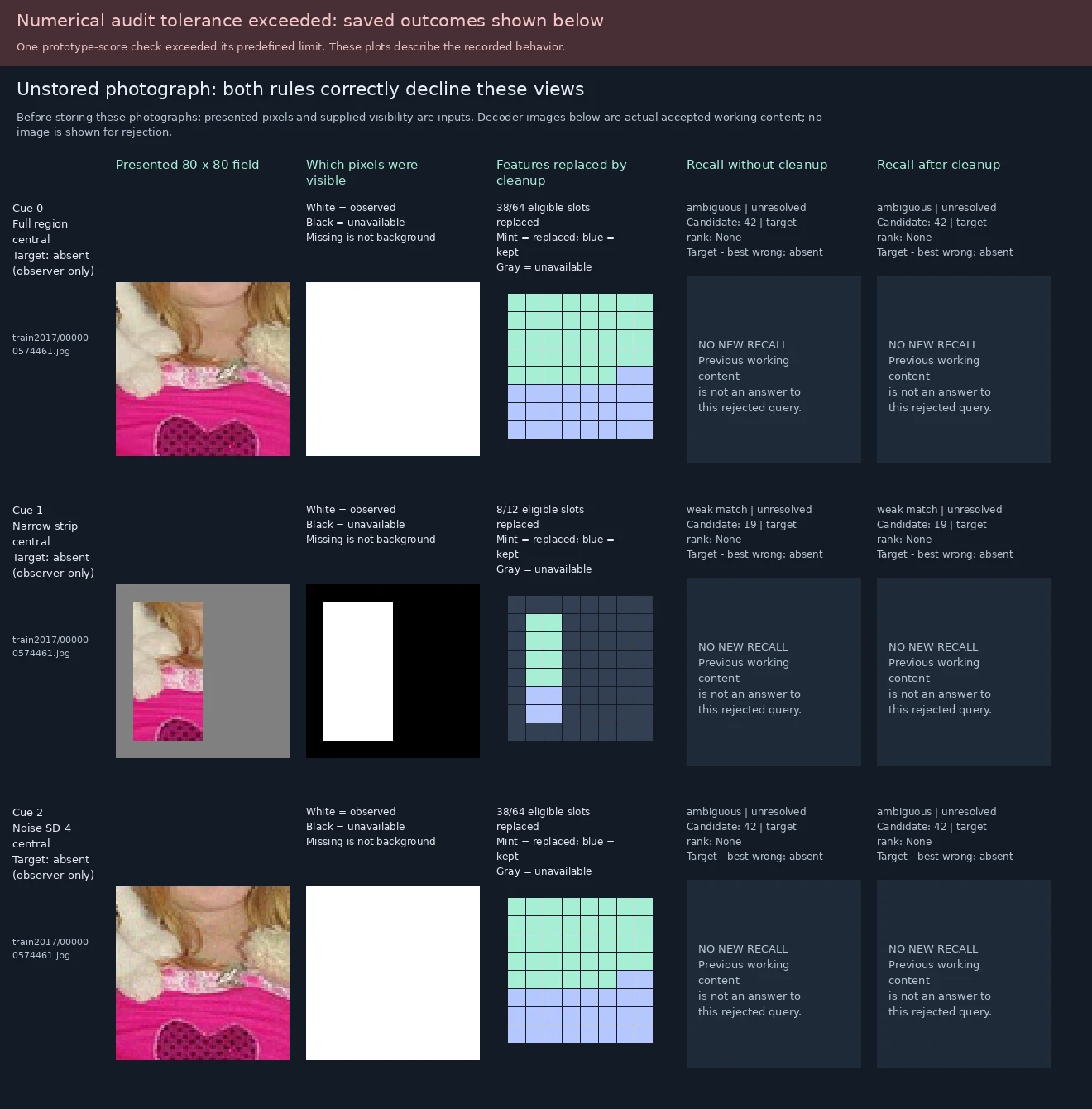
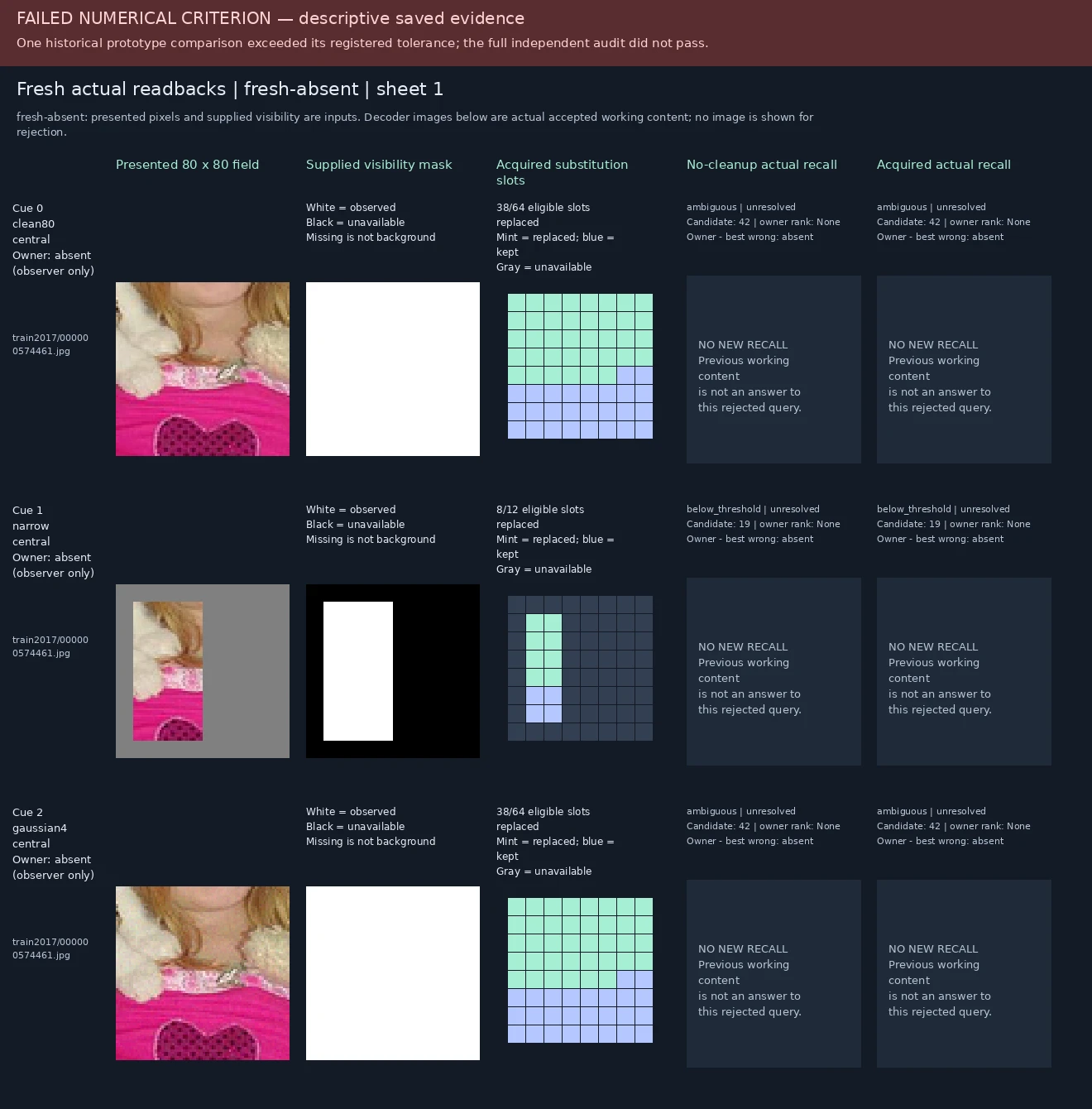
The first photograph has not yet been stored. Its clean, narrow-strip, and low-noise views all produce no recalled image, with or without cleanup. Columns show input pixels, observed pixels in white, prototype replacements, and the two recall outputs. Rejected queries display no image; candidate numbers identify a considered memory, not an accepted answer.

Original recorded figure ↗

Cleanup blocks two false recalls from an unstored photograph
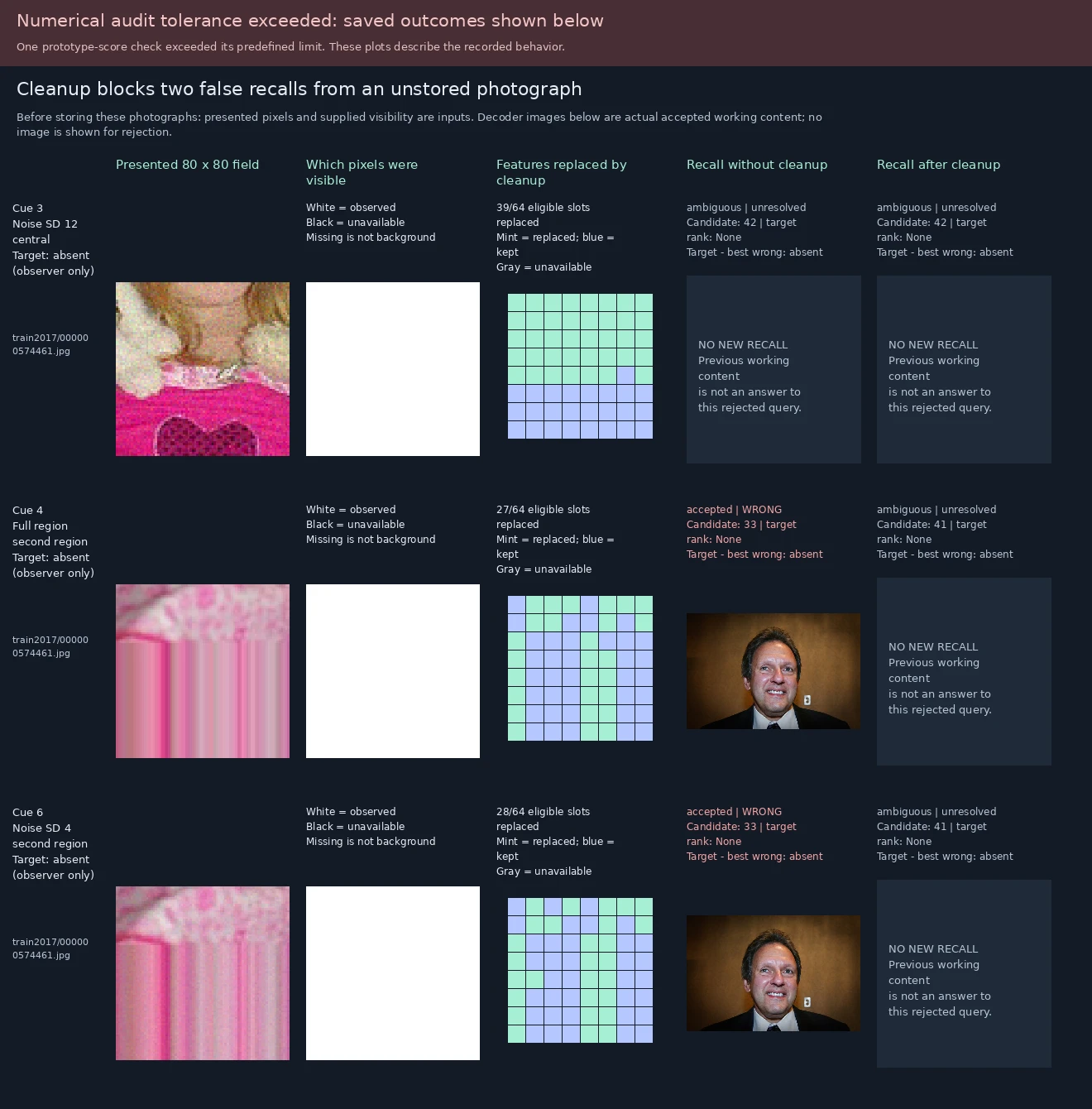
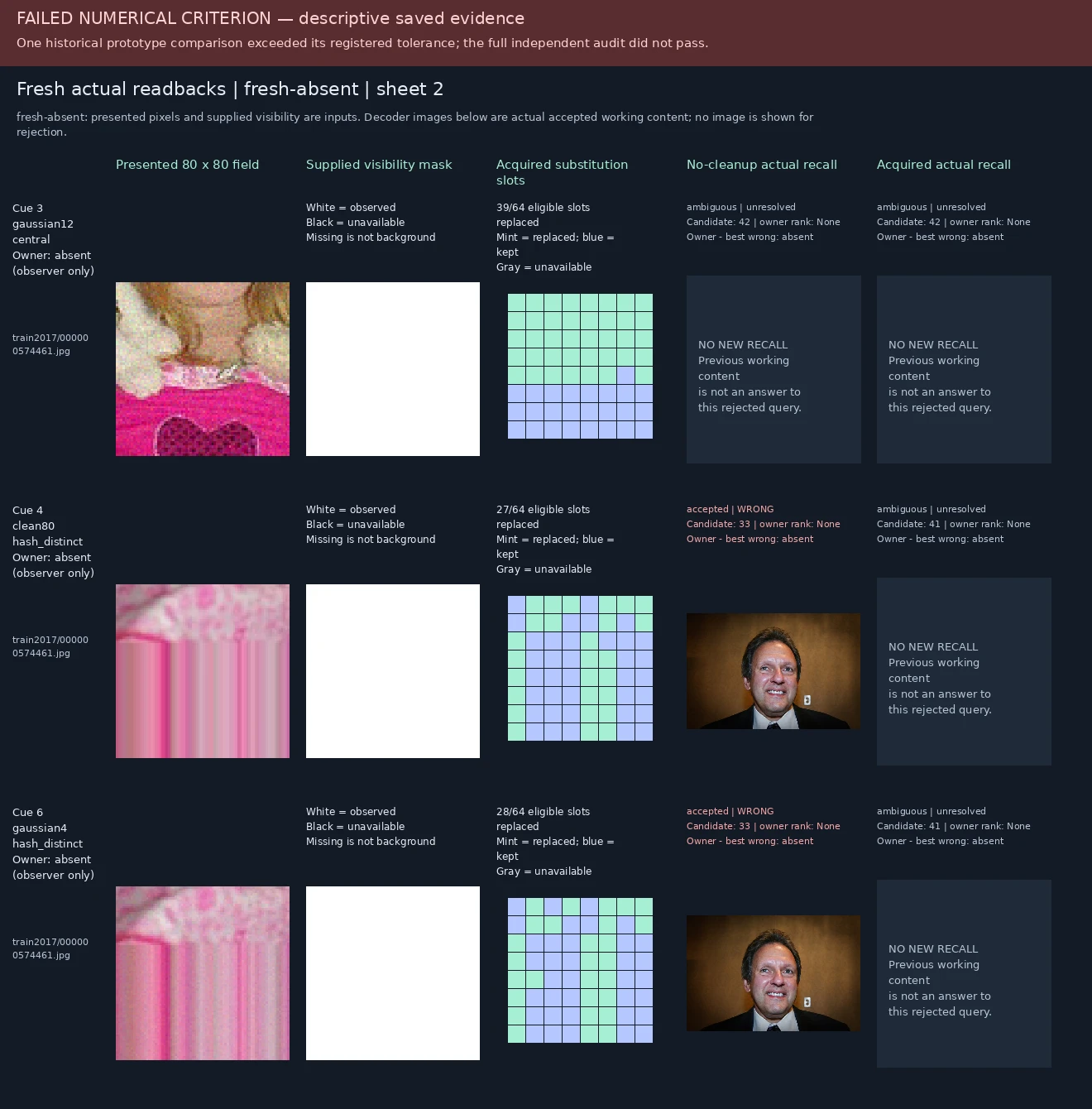
The higher-noise central view is rejected by both rules. For a second region of the same photograph, the unmodified features wrongly retrieve a man's portrait; cleanup rejects both the clean and low-noise versions. The photograph supplying the cues was absent from memory, so any accepted image would be a false response. The three rows are related views of one source, not three independent successes.

Original recorded figure ↗

Both rules mistake a new wall-like patch for a stored video frame
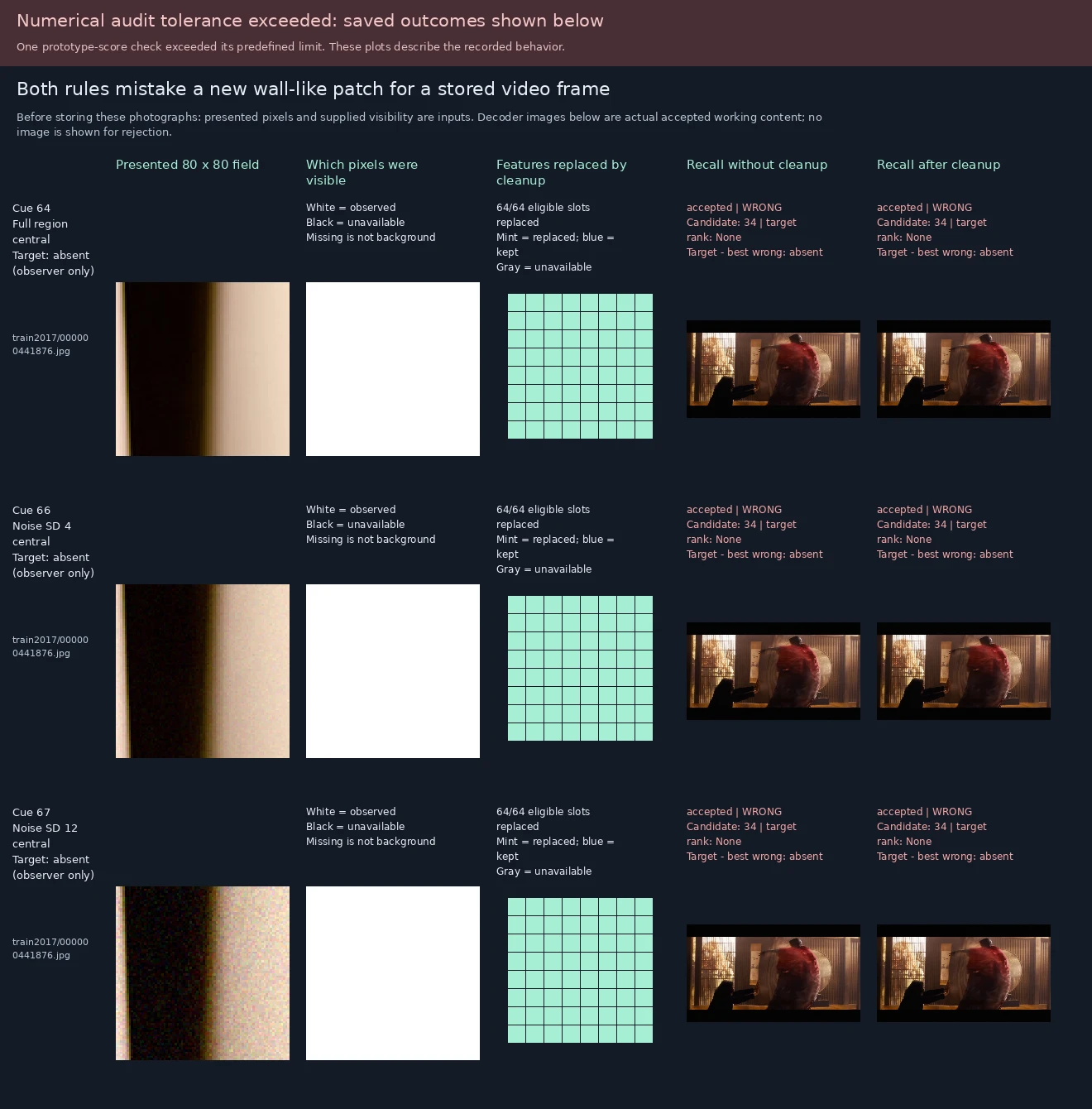
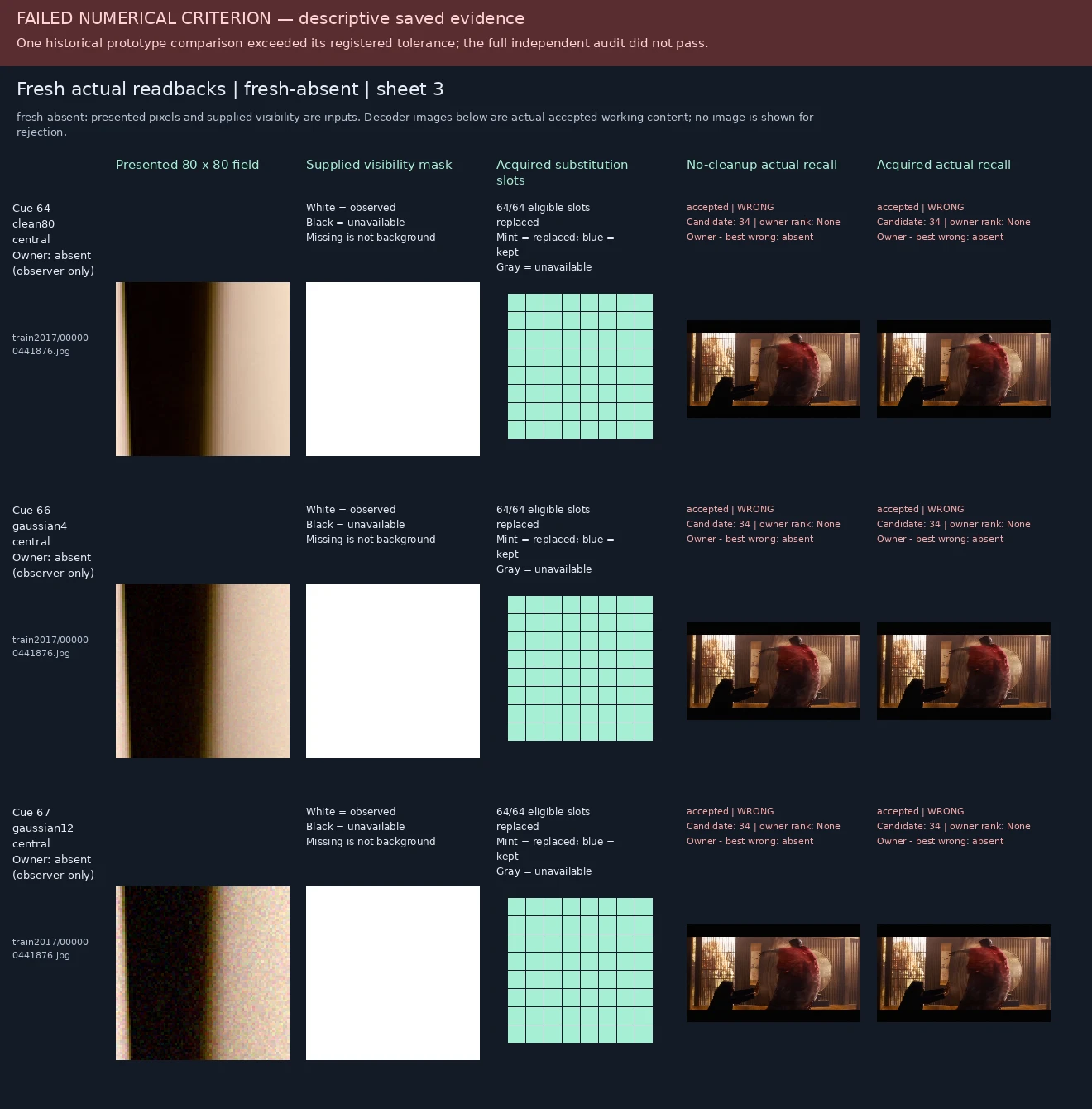
These clean, low-noise, and higher-noise views come from one never-stored photograph. Both rules return the same unrelated video-frame memory. Cleanup replaces all 64 feature positions and does not prevent the mistake. The output columns are decoded recalls, not reconstructions of the visible input; their mismatch is the evidence of false acceptance.

Original recorded figure ↗

A second region of the same unstored photograph causes the same error
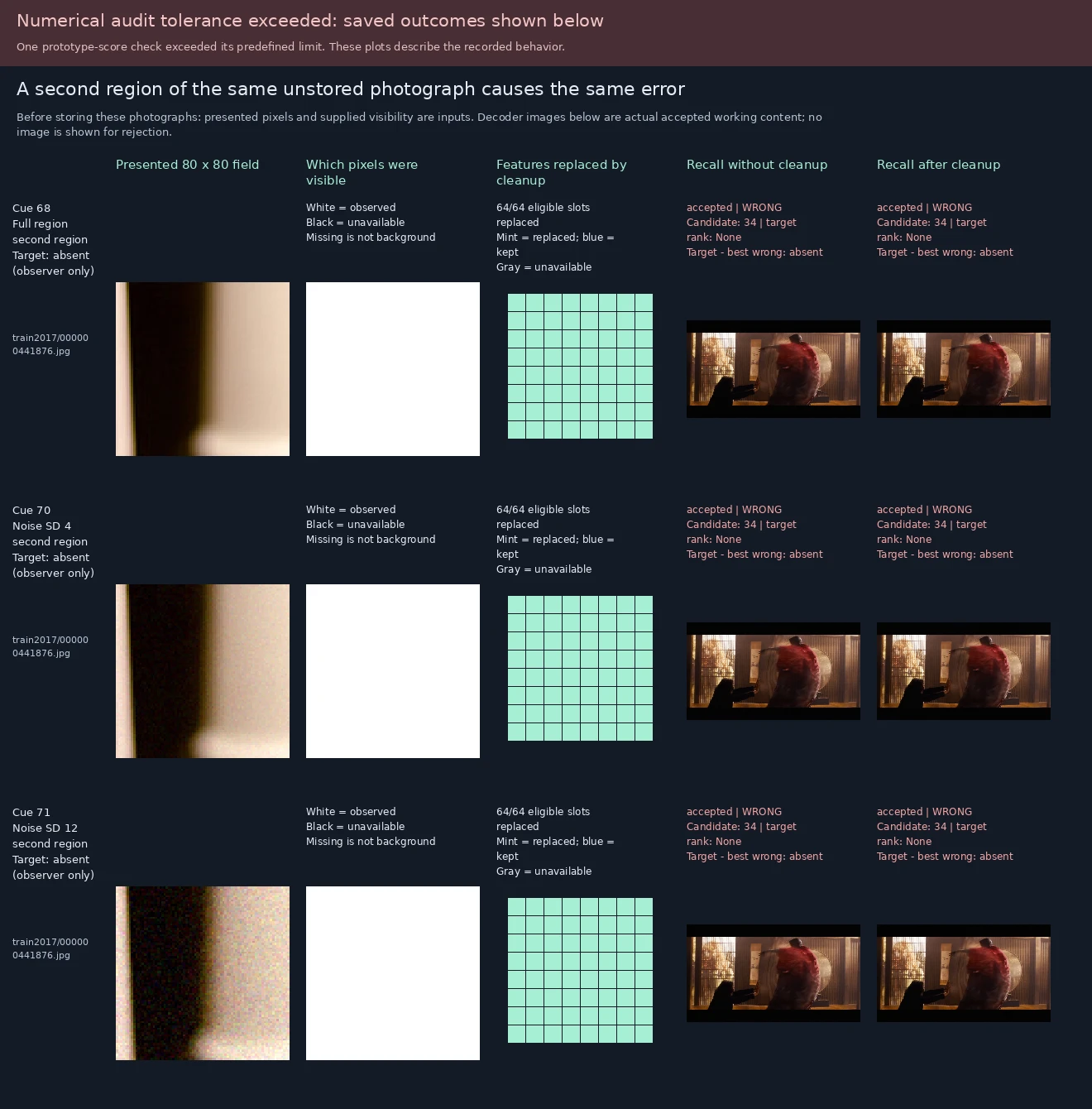
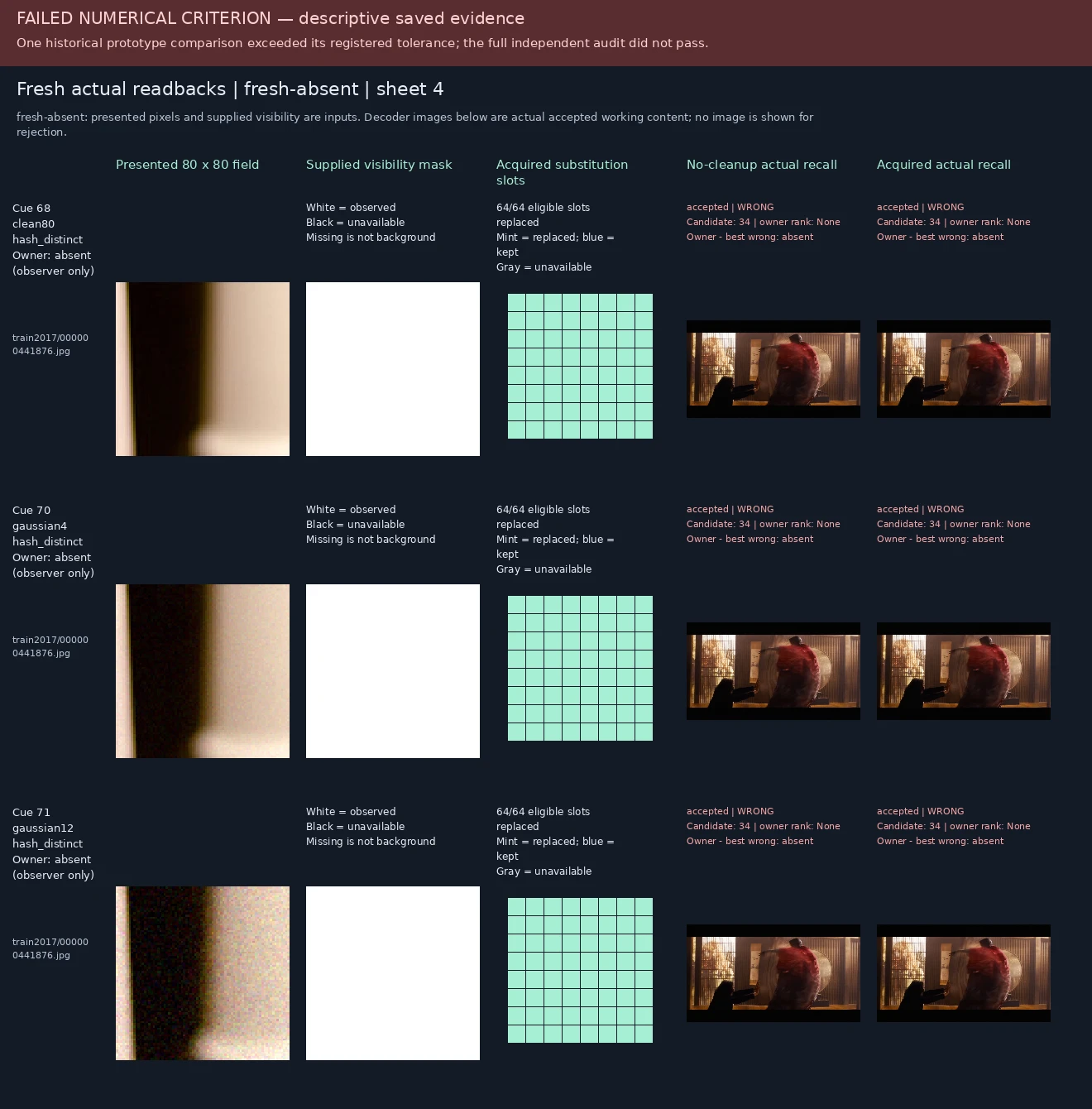
A second selected region of the photograph is tested without noise and with two noise levels. Both rules again return the unrelated video frame. These rows extend the preceding example across location and noise; they do not represent additional independent photographs. White visibility masks mean the entire 80 × 80 region is available, not the entire source photograph.

Original recorded figure ↗

Prototype substitution introduces a wrong recall
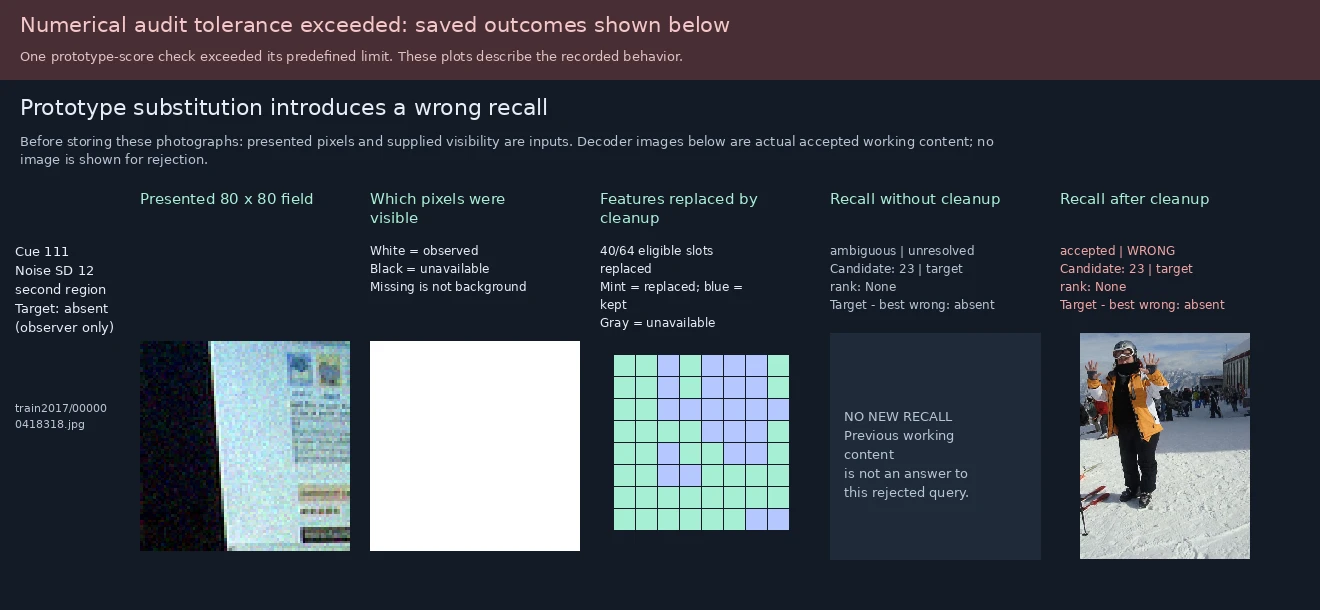
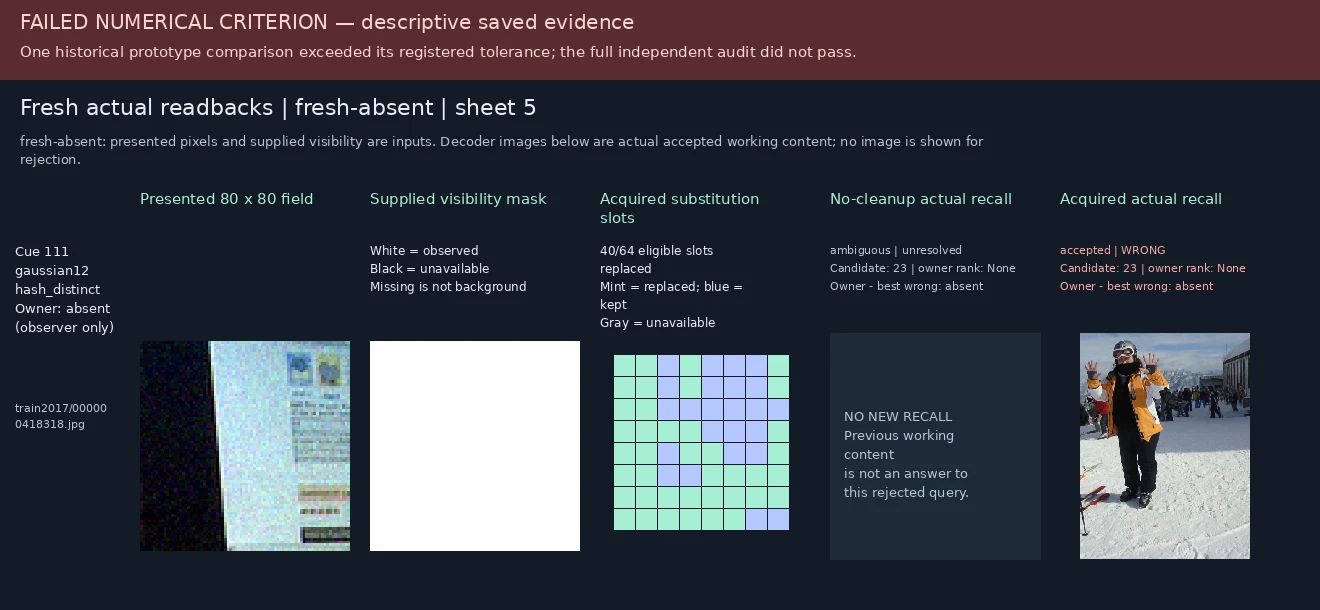
The noisy input comes from a photograph absent from memory. Without cleanup, competing matches remain too close and no image is returned. After replacing 40 of 64 feature positions, the rule accepts an unrelated photograph of a skier. This is one example where cleanup changes a rejection into a false response; the full outcome table reports how often that occurred.

Original recorded figure ↗

Once stored, the same photograph can be recalled from wider views
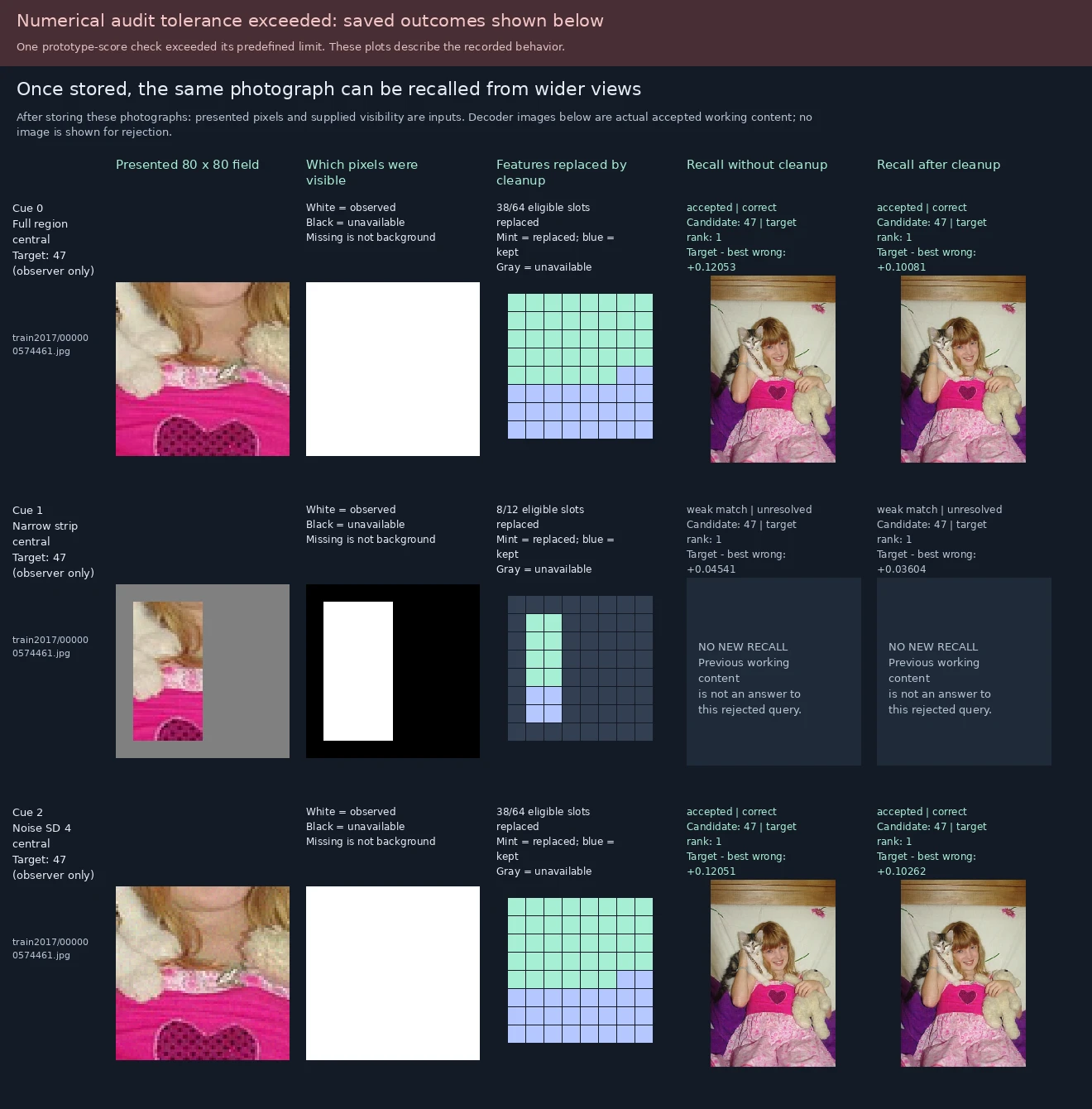
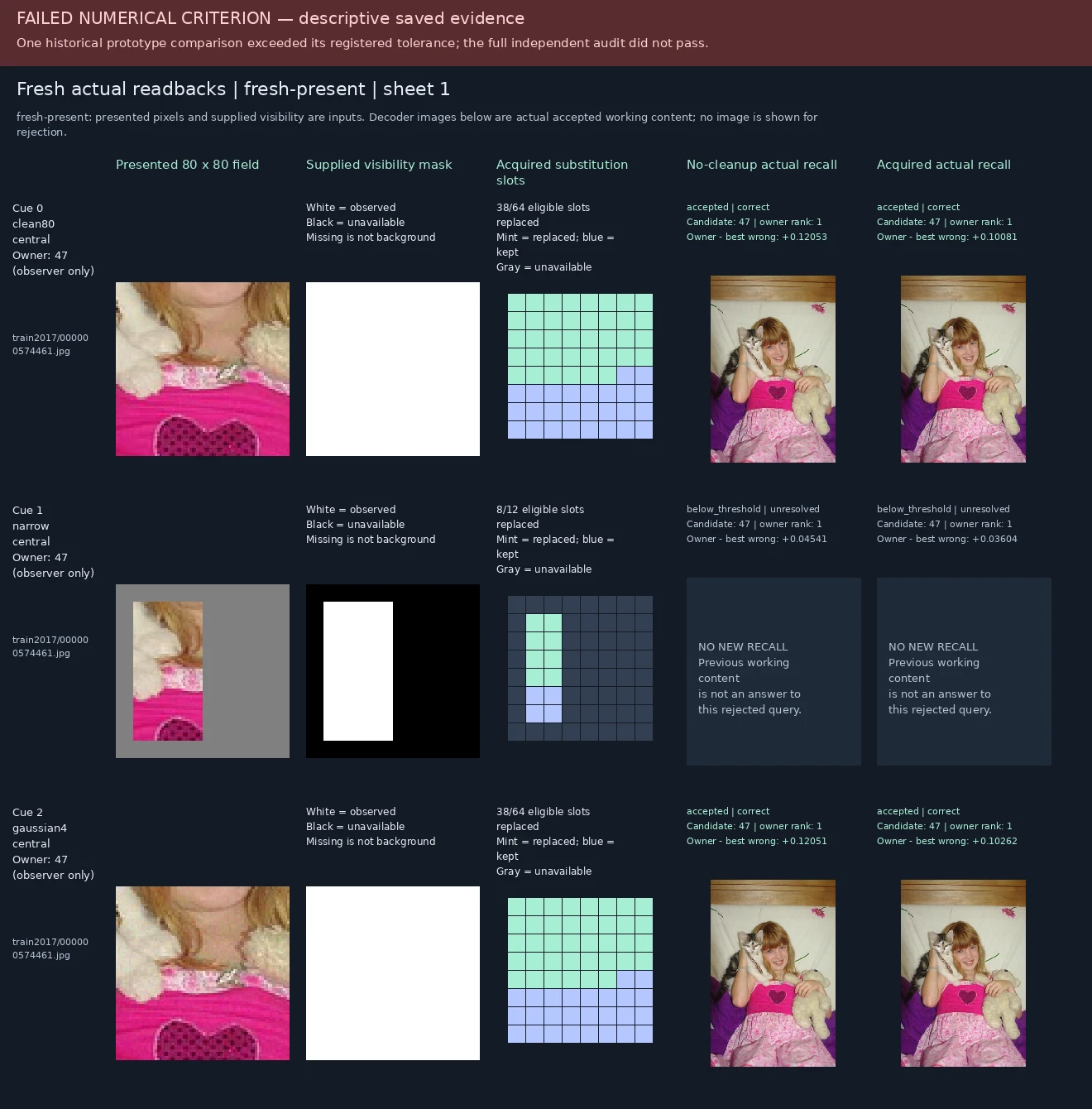
The photograph shown in the earlier no-memory examples has now been stored. Both rules correctly recall it from the clean and low-noise regions, but decline the narrow strip. Columns show the available input, visibility mask, replaced feature positions, and actual decoded memory outputs. The narrow cue ranks the intended image first, yet its match score remains below the acceptance threshold.

Original recorded figure ↗

Recall also succeeds for the higher-noise view
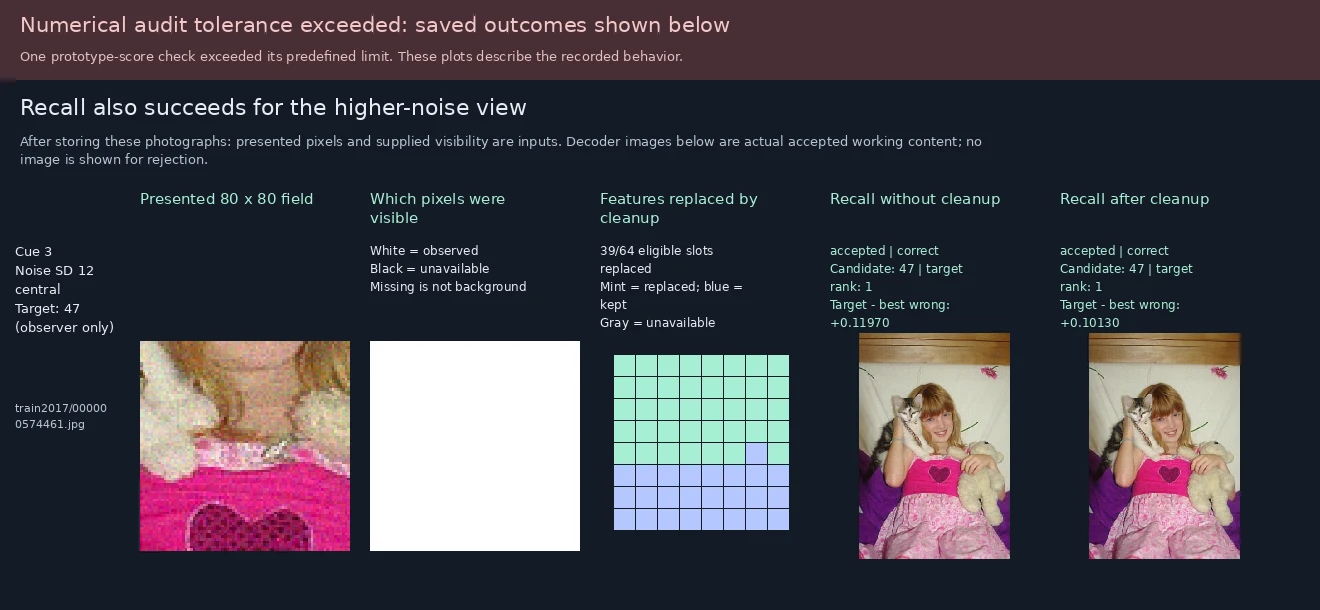
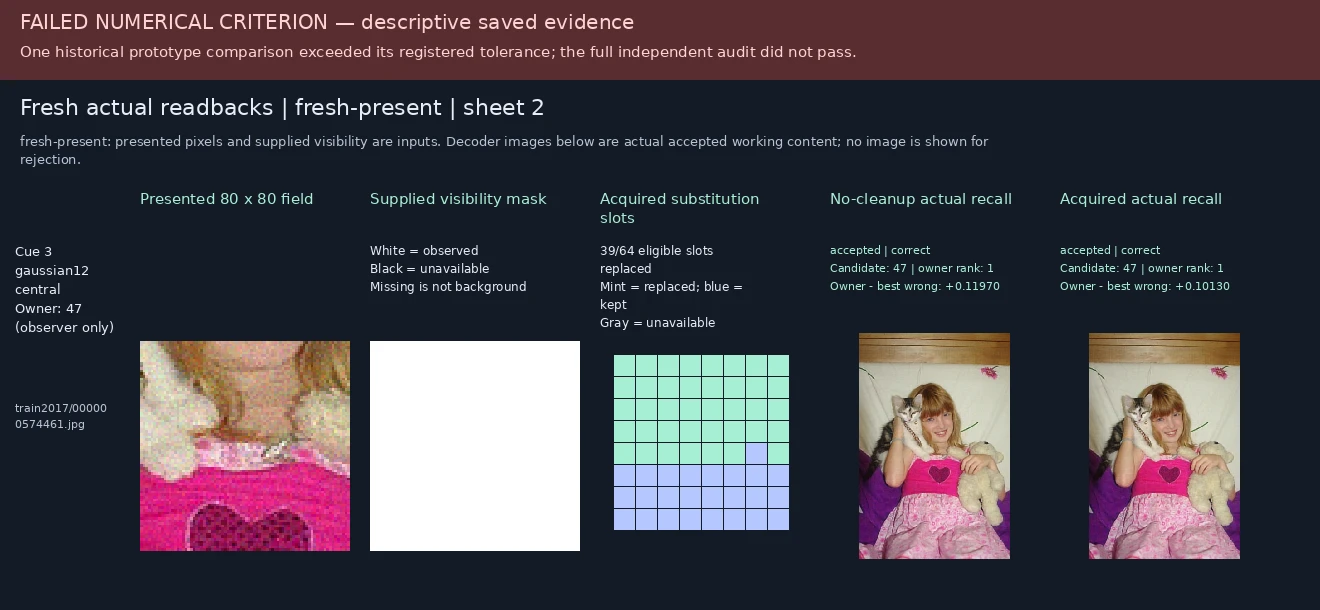
After this photograph is stored, both rules correctly recall it from the region with Gaussian pixel noise of standard deviation 12 on the 0–255 scale. Cleanup replaces 39 of 64 feature positions, but the selected memory is unchanged. This is another view of the preceding photograph, not a separate independent test image.

Original recorded figure ↗

Limits and next question

A diagnostic with fixed codec, exemplar bank and historical policy, not a selected remedy or completion of milestone 1.3. Sixteen fresh photographs bound generalization; known-target VSA controls are separate from natural recall. No cleanup remains the runtime default and the final 32-image panel remains sealed.

Next question. Selected-handle and recall subchecks pass in run 003; its exact runner-up-order gate fails. Next recommendation: cue-support-aware acceptance on independent present/absent sources, with an explicit numerical policy; no follow-on scientific experiment started.

Inspect the evidence

Download the methods and measurements for this experiment. Large training and saved-state files are not included.