Type a section name and press Enter. Use “help” for the list.
Cliste experiment
Image feedback helps noisy-target reconstruction, but not reliable hole filling
Registered 11 Oct 2026 · Snapshot 12 Oct 2026
The question
Hide a rectangle in a photograph, ask the trained component to fill it by constructing VSA vectors, then decode the result. Compare two ways of training that component: vector error alone, or vector error plus feedback from the decoded pixels.
Why this experiment?
Lower vector error did not guarantee better images. A matched training comparison asks whether feedback through the fixed decoder improves the actual missing-region task.
How it works
Hide a rectangle in a photograph, construct VSA vectors to fill it and decode the result. Fit two otherwise matched predictors, adding image-feedback loss to only one. Shuffling assigns encoded regions to wrong positions. The reduced-conditioning control removes photograph input from the predictor, while the decoder and preserved visible regions still use the photograph.
Follow this part of the investigation: Does image feedback improve filling a hidden rectangle? →Implementation and comparison details
Recovery of interrupted run003. Completed fixed fits, component diagnostics and vector-only completion are inherited unchanged. The entire decoder-aware completion panel repeats, requiring exact agreement with all 59 saved requests before observation.
What happened
Adding image-reconstruction feedback did not qualify the trained component for hole filling. Mean hidden-interior error rose by 10.9%, but the paired uncertainty interval includes both improvement and harm. Mean error in already visible pixels rose by 30.8%, with 31 of 32 photographs worsening. In the separate diagnostic that supplies corrupted clean-target information, hidden-pixel error fell by 19.9% to 29.8% against the matched model across the three tested noise levels. That denoising improvement did not transfer to reliable completion from a masked photograph. Complete visual review found no reliable coherent filling. Independent audit passed; the recovered comparison is closed.
Results and visual artifacts
Open a figure for its input, comparison, and result. Click an image to enlarge it.
The masked photograph is the input; the complete original is shown only as an evaluation reference. The trained predictor constructs VSA vectors to fill the missing rectangle. Meaningful context keeps encoded image regions at their correct positions; shuffled context assigns those encoded regions to wrong positions before prediction. The preserved 'No learned regional context' label removes photo input only from the predictor: the decoder still uses the masked photograph, so the overall system retains context. Every condition shows all four fixed samples, alongside unchanged decoding, cleanup and nearest-memory comparisons. Missing-region details expose local quality; full scenes show the surroundings. No best sample is selected. This public record includes 5 of 315 saved figures: summary comparisons and fixed examples, including every figure referenced by the guide. Reported aggregates include every case; individual records and complete outputs remain in the research archive.
Vector-only objective · photograph 1 · mask 1 · native-pixel missing region
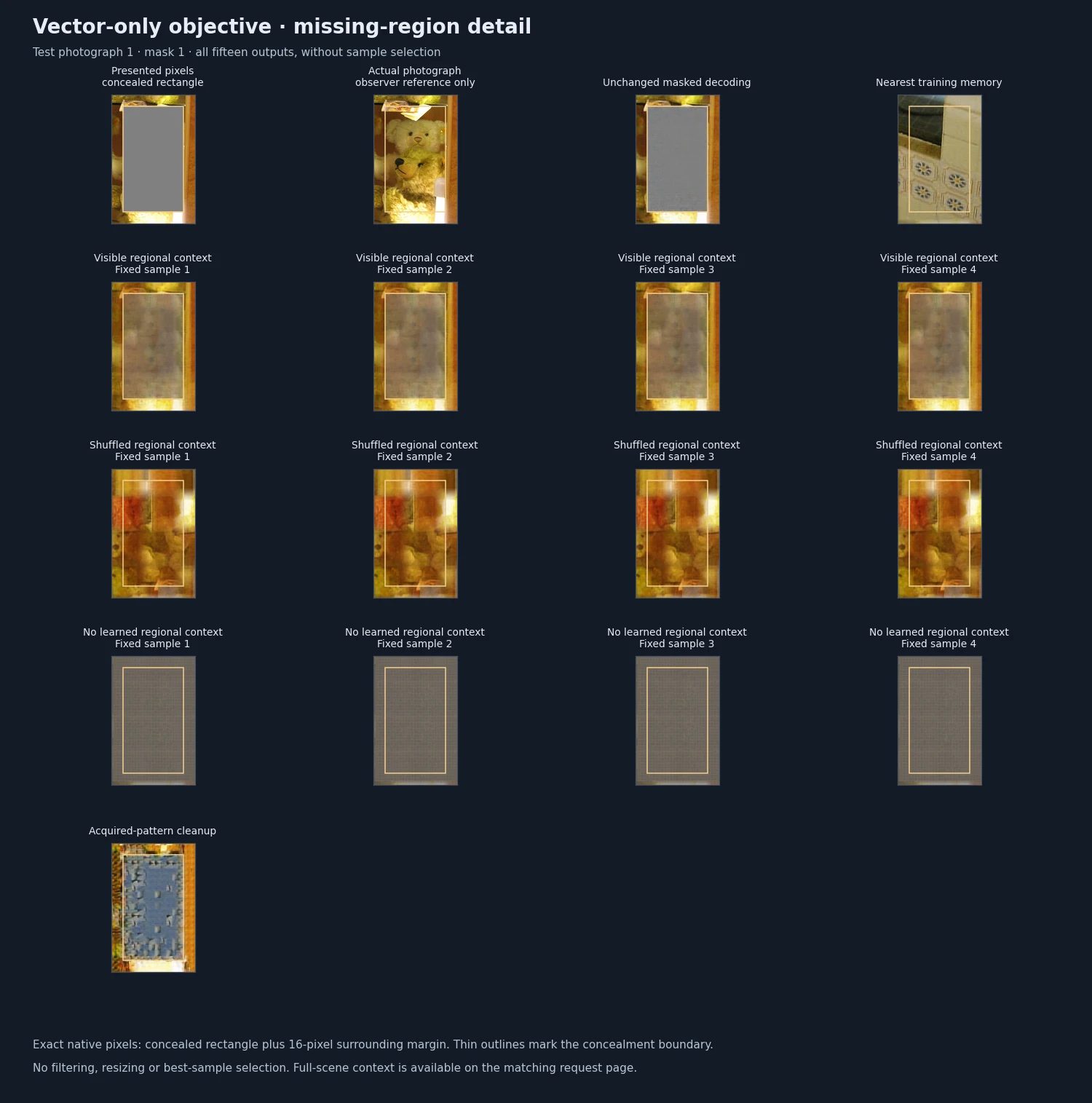
Display derivative: WebP quality 90; maximum edge 2400 px. Original scientific pixels remain in the source run; do not measure this preview.
Decoder-aware objective · photograph 1 · mask 1 · native-pixel missing region
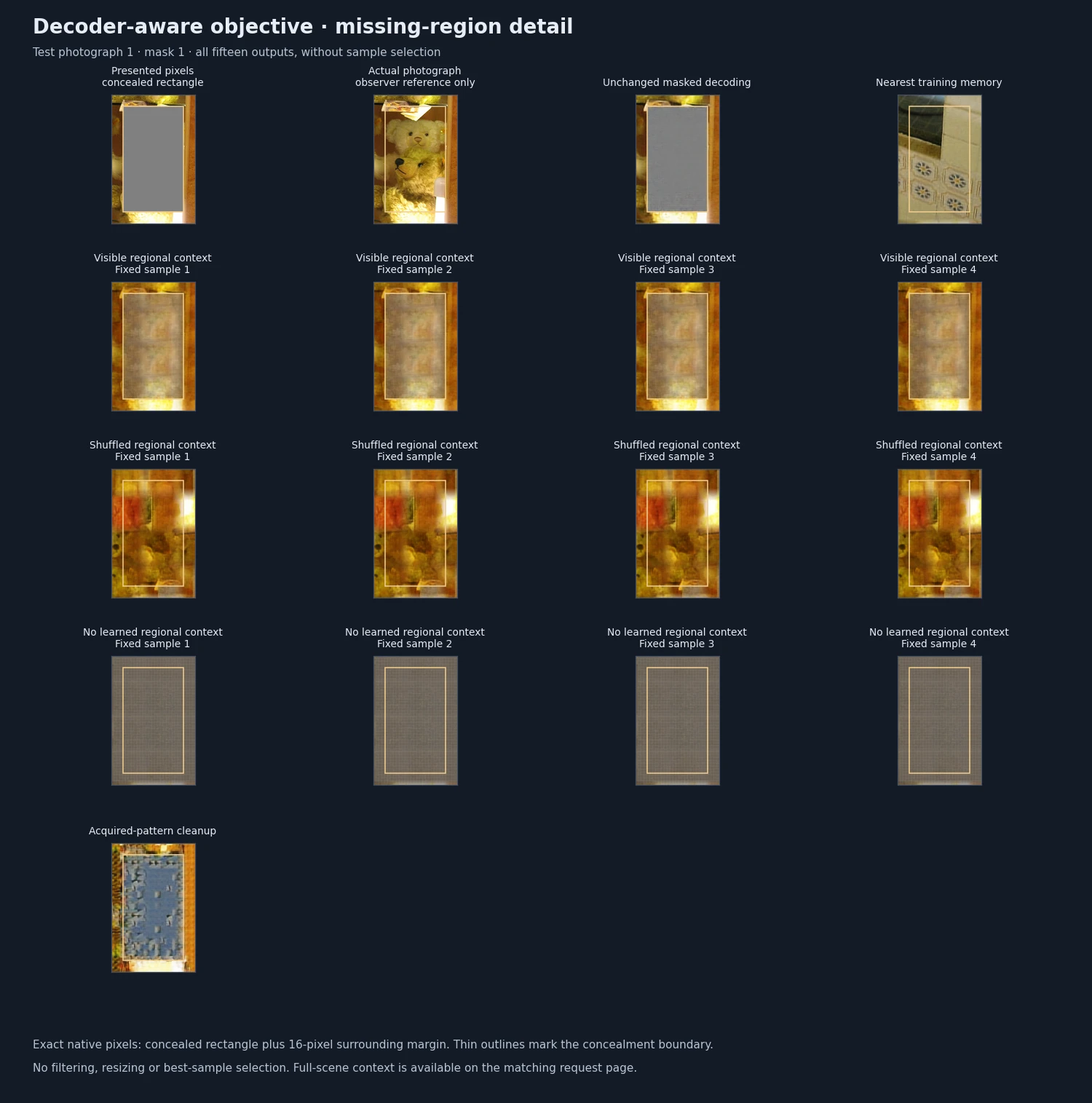
Display derivative: WebP quality 90; maximum edge 2400 px. Original scientific pixels remain in the source run; do not measure this preview.
Both objectives · fixed sample 1 · requests 1–8
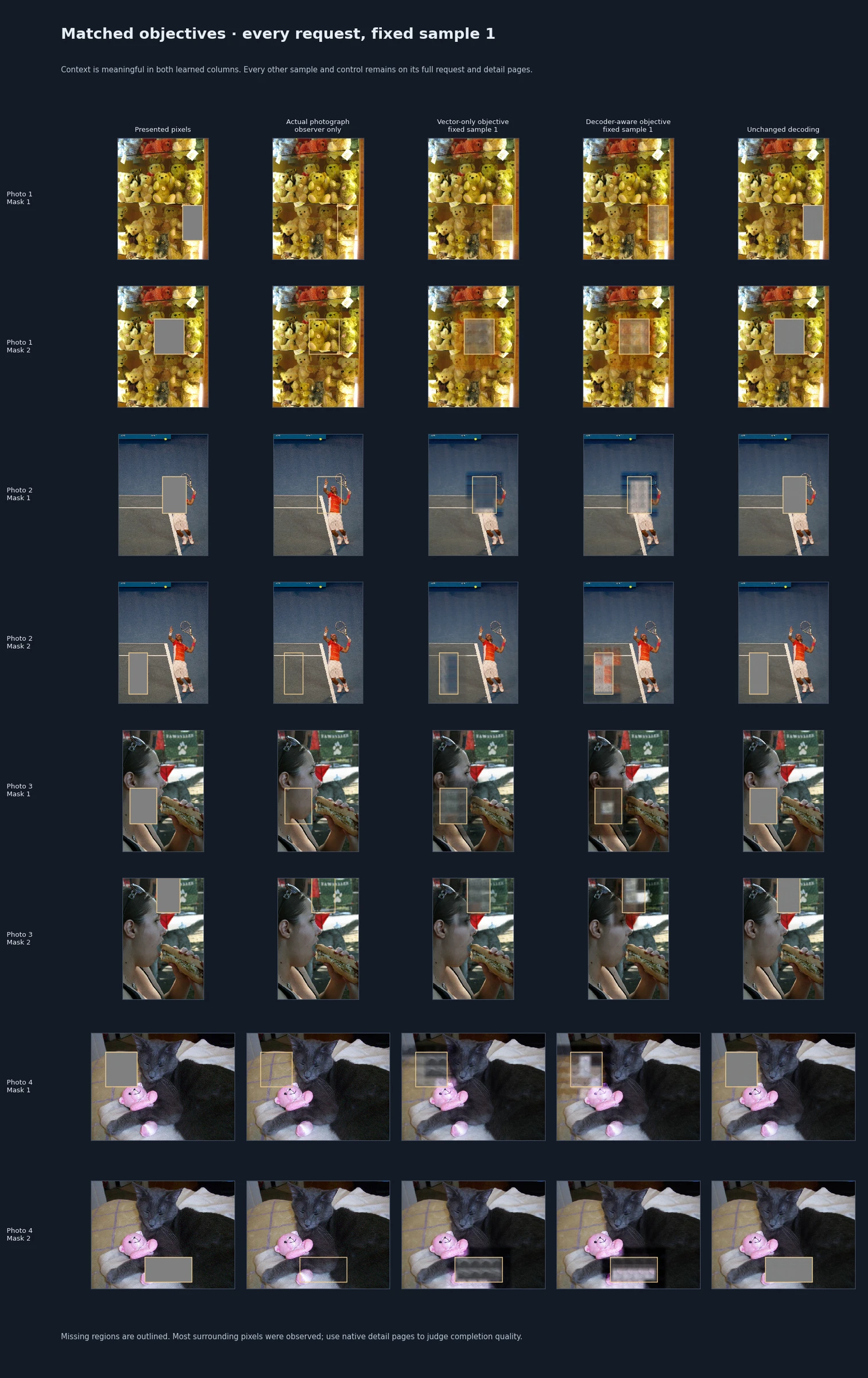
Display derivative: WebP quality 90; maximum edge 2400 px. Original scientific pixels remain in the source run; do not measure this preview.
Paired objective comparison and visible-error allowance
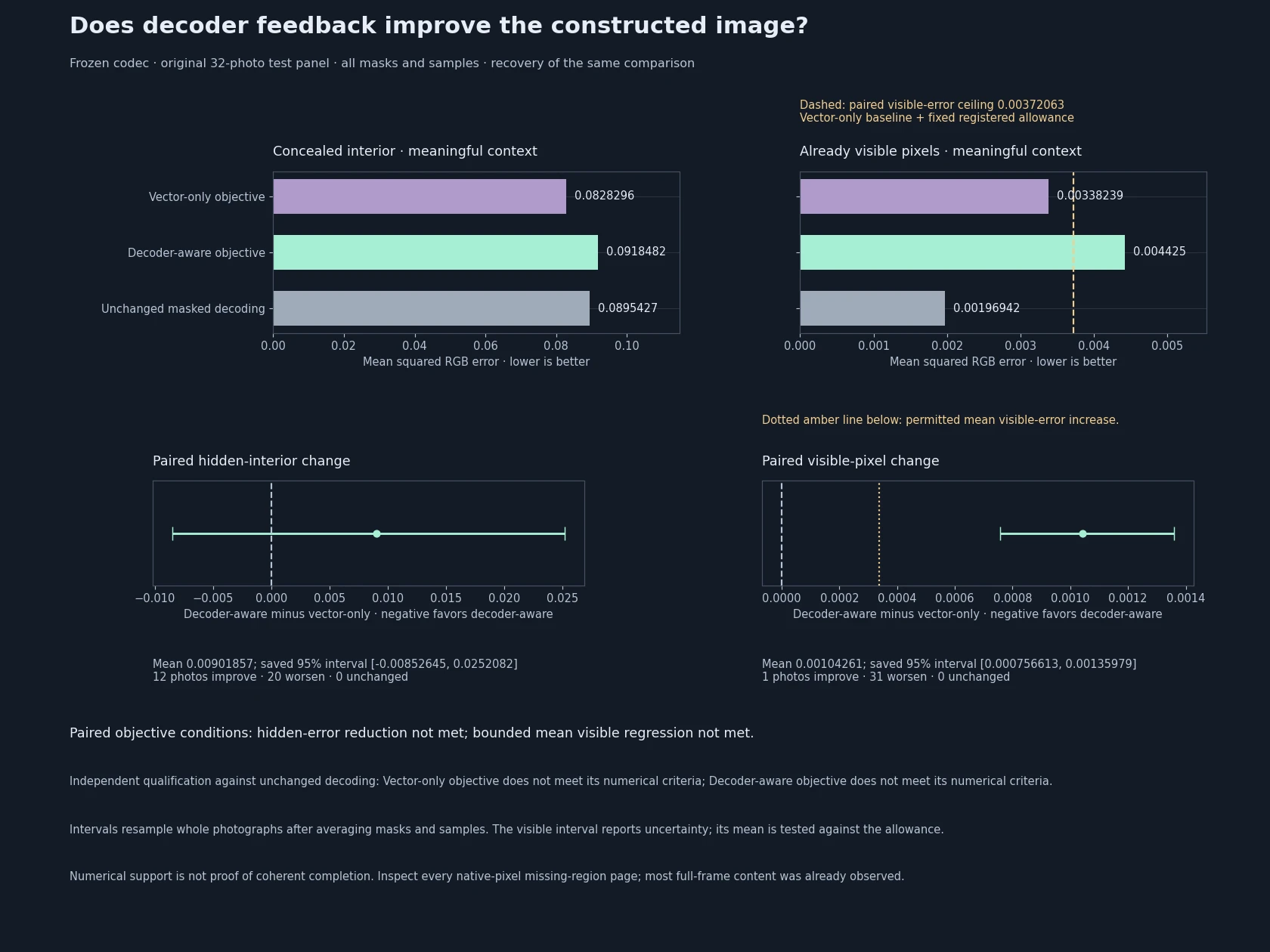
Display derivative: WebP quality 90; maximum edge 2400 px. Original scientific pixels remain in the source run; do not measure this preview.
Context controls and independent qualification bounds
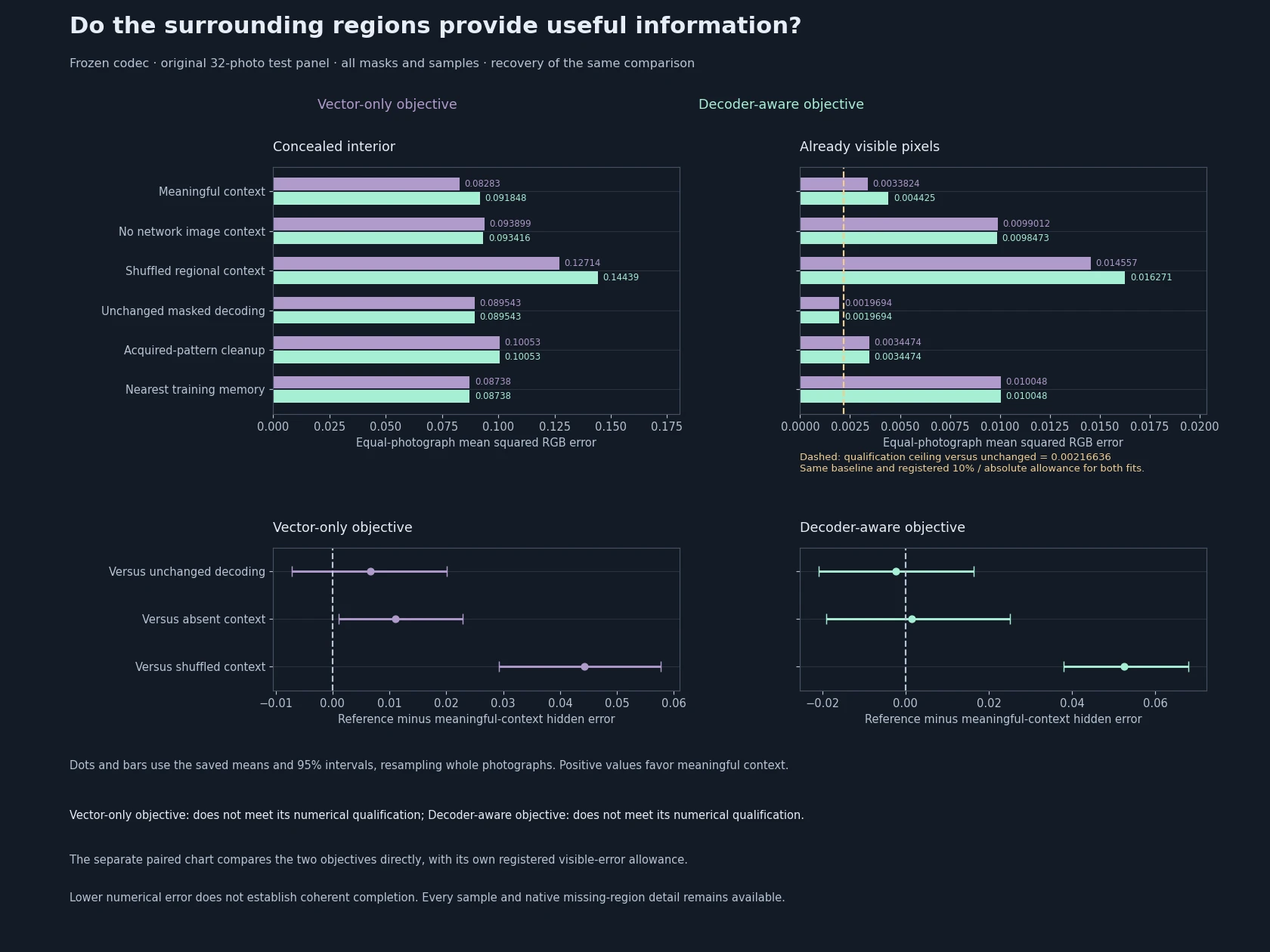
Display derivative: WebP quality 90; maximum edge 2400 px. Original scientific pixels remain in the source run; do not measure this preview.
Limits and next question
This is one fixed loss intervention, not a search for the best architecture or coefficient. The codec saw the training collection. Fresh development and test sources are outside recorded prior exposures. Privileged noisy-target denoising is separate from target-denied completion. Numerical improvement alone cannot establish coherent completion; the 363-encounter life remains fixed. This is an already exposed panel from the interrupted comparison, not a fresh independent test or a second replicate. On preserved figures, 'No learned regional context' means 'No image context supplied to predictor': the same trained network receives zeros for both regional image vectors and its coarse image overview. Its learned weights, geometry, visibility mask and noise remain. After prediction, wholly visible regions are restored, and the final renderer still receives the shared masked overview. The photograph therefore remains context for the overall system. The causal question is: Does supplying the photograph to the predictor help beyond the photographic information already supplied to the decoder? This is neither an untrained model nor a final image produced without any context.
Next question. Interpret the fixed objective comparison before selecting another task. Video interpolation is a proposal, not an additional authorized or completed experiment.
Inspect the evidence
Download the methods and measurements for this experiment. Large training and saved-state files are not included.