Type a section name and press Enter. Use “help” for the list.
Cliste experiment
Original features did not produce the required prediction gain
Registered 11 Oct 2026 · Snapshot 12 Oct 2026
The question
Test whether the limited temporal-construction result also occurs when endpoint features are supplied directly from the frozen encoder.
Why this experiment?
Missing-pixel prediction did not establish coherent construction. Video endpoints provide another concrete question: can a mechanism construct an intermediate scene while using the shared VSA interface?
How it works
Fit the same two constructors with original encoder features instead of recovered VSA features, then evaluate with matching endpoint features. Keep budgets, source order and seeds fixed, and include an untrained blend for each input condition.
Follow this part of the investigation: Which mechanism should construct new visual content? →Implementation and comparison details
Fit and evaluate constructors on original endpoint encoder fields, with an original-feature interpolation control; compare with unchanged recovered-feature predictions and their matching control.
What happened
Original encoder features improve the untrained blend by 2.91% on whole-image error and 4.26% on changing pixels. Against their own original-feature blend, transport changes changing-pixel error by −0.60% and synthesis by +0.19%, with different effects between the two videos. Neither reaches the required improvement on each source. Complete visual review finds no consistent learned repair of doubled moving contours.
Results and visual artifacts
Open a figure for its input, comparison, and result. Click an image to enlarge it.
Each sheet has recorded endpoints and the withheld middle, then three recovered-feature outputs and three privileged original-feature outputs. Each output row contains its own interpolation control, transport and synthesis. Original inputs contain no middle frame at evaluation. Image pixels are not brightened, dimmed or resized. Overviews include every case. This public record includes 1 of 40 saved figures: summary comparisons and fixed examples, including every figure referenced by the guide. Reported aggregates include every case; individual records and complete outputs remain in the research archive.
Video example 1: recovered and original features
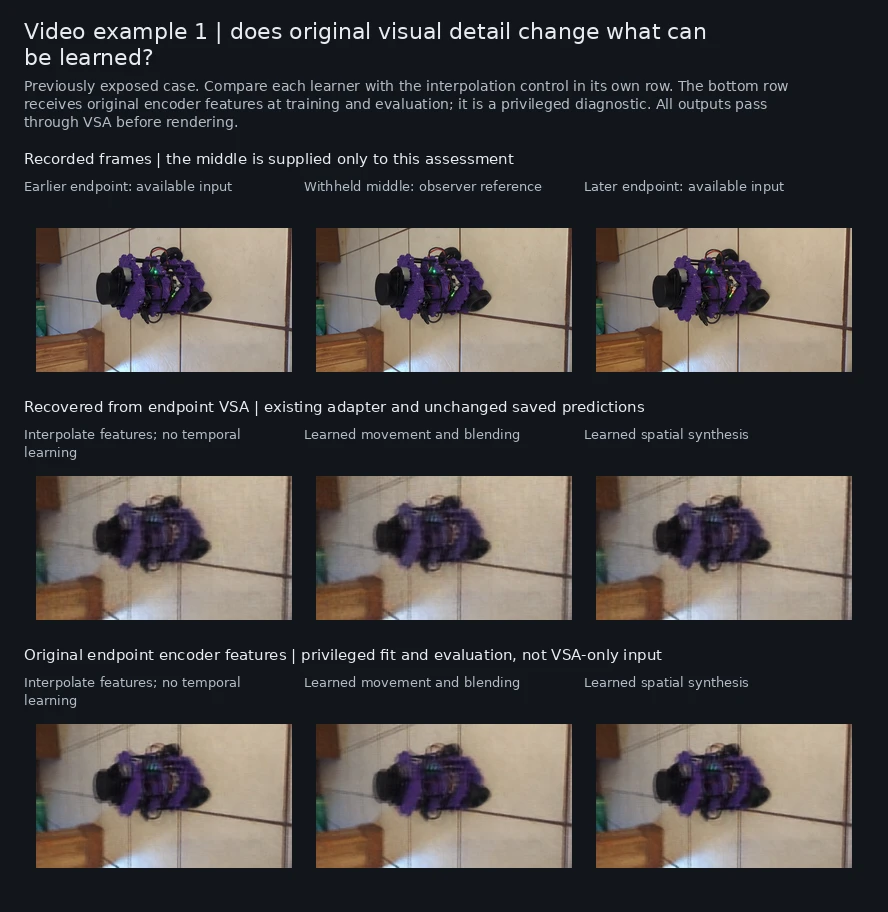
Display derivative: WebP quality 90; maximum edge 2400 px. Original scientific pixels remain in the source run; do not measure this preview.
Limits and next question
The same previously exposed test cases from two videos. Original encoder features are privileged inputs at fitting and evaluation; they do not qualify a VSA-only input architecture. All candidates still recompose VSA before the frozen renderer. This is a bounded diagnostic, not independent validation or a complete causal isolation of the learning limitation.
Next question. Use the existing weights on fixed training and development examples to distinguish weak learning of the examples, weak transfer between videos, and feature improvements that fail to help decoded images. No further fit is selected.
Inspect the evidence
Download the methods and measurements for this experiment. Large training and saved-state files are not included.