Type a section name and press Enter. Use “help” for the list.
Cliste experiment
Cleanup diagnostic: numerical decision verification
Registered 9 Oct 2026 · Snapshot 12 Oct 2026
The question
Check whether all saved cleanup and recall decisions agree with independent float64 arithmetic while preserving run 001's failed score tolerance.
Why this experiment?
A partial cue can resemble the wrong memory. Recall needs to recover useful content while recognizing when the evidence is insufficient.
How it works
Compare partial-cue recall with familiar and unfamiliar inputs, retaining incorrect accepts and refusals. Cleanup and confidence rules are qualified before relying on them for a remembered continuation.
Follow this part of the investigation: More answers are useful only if the extra confidence is justified →Implementation and comparison details
Recompute every saved prototype decision and all ordinary/counterfactual recall decisions in float64; preserve the parent failure and its exact tolerance.
What happened
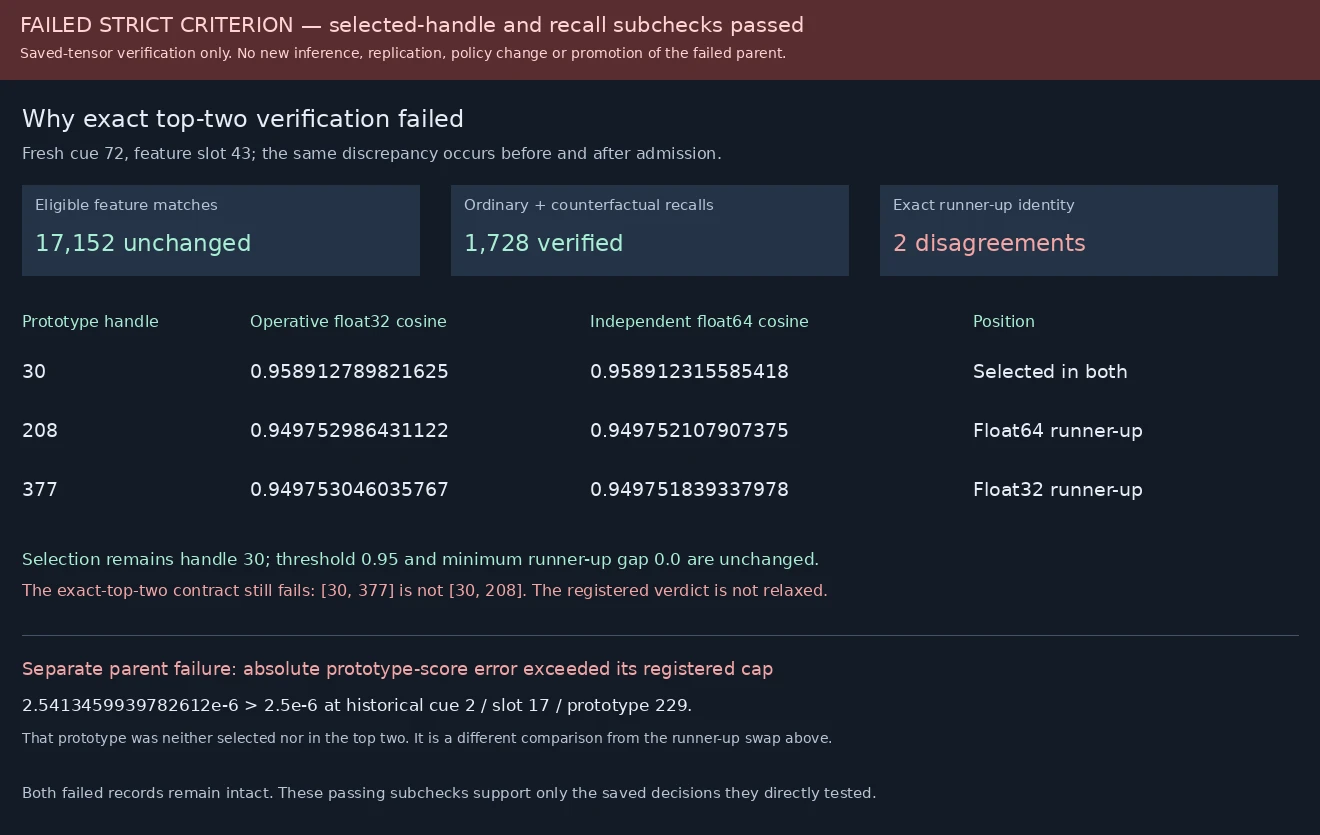
FAILED exact top-two criterion: runner-up handles 377/208 change order for cue 72/slot 43 before and after admission. Selected handle 30 stays unchanged. All 17,152 selected-prototype choices and 1,728 ordinary/counterfactual recall decisions agree, from 8,781,824 prototype comparisons. These are passing subchecks, not an overall audit pass. Original run 001 retains its score-cap failure. Full diagnostic figures are on the run 001 page.
Results and visual artifacts
Open a figure for its input, comparison, and result. Click an image to enlarge it.
Cleanup replaces an input feature with a sufficiently similar prototype learned from earlier experience. This check recomputes saved similarity scores in float64 and compares them with the original float32 calculation. It distinguishes changes in numerical ranking from changes in the actual memory selected.
A numerical tie changes the runner-up, not the chosen memory
Display derivative: WebP quality 90; maximum edge 2400 px. Original scientific pixels remain in the source run; do not measure this preview.
Limits and next question
Post-result verification of existing evidence, not new inference or independent replication. Original run 001 remains failed. No threshold, cleanup policy, acquired state or final-panel exposure changes; full milestone 1.3 remains open.
Next question. Keep the failed criteria and passing subchecks distinct. Before the next independent scientific comparison, explicitly define the operational numerical policy and error contract; do not revise these closed runs.
Inspect the evidence
Download the methods and measurements for this experiment. Large training and saved-state files are not included.