run record~/research/cliste/runsAll Cliste runs

Type a section name and press Enter. Use “help” for the list.

Figures: softened for dark viewingDisplay only; image files are unchanged.
← All Cliste runs

Cliste experiment

General visual fidelity

Execution: completedScientific verdict: useful magnitude gain

The question

Improve faithful visual recovery from operative hyperdimensional VSA representations by separating admission loss from recoverable downstream detail.

Why this experiment?

A memory can only preserve what its sensory interface encodes. These studies separate encoder quality, decoder quality and compatibility with earlier stored vectors.

How it works

Change one component or input representation at a time and evaluate immediate reconstruction on separate images. Keep old-vector readback visible so gains on new inputs do not hide compatibility losses.

Follow this part of the investigation: Sharper perception can also change the language of memory →
Implementation and comparison details

Separate 64/128-pixel admission losses against a declared 256-pixel crop from downstream reconstruction. Compare matched phase-only and globally scaled magnitude-preserving readouts of identical raw VSA bundles under mixed photograph-and-writing training. The encoder, place codes and normalization running state remain fixed for this comparison; twelve decoder parameter tensors learn in each arm. Actual old-vector readback is separate from newly encoded replay.

What happened

Retaining bundle magnitudes reduced reconstruction error by 14.38% on COCO and 13.63% on Flickr compared with equally trained phase-only readout; both writing conditions improved. Fine detail remains blurred. Actual old-vector error rose 15.26% against its unchanged baseline. The separate admission audit motivates higher-resolution perception, but no 128-pixel neural model was tested. All 25 validity checks and 406 independent artifact checks passed. Neither candidate was installed; earlier lives retain their original models.

Magnitude versus matched phase readout: useful_magnitude_gain; COCO MSE change 14.38% improvement,95% interval[14.05%,14.72%]. Admission, detail, writing and old-memory outcomes are separate.

Measurements
Measurements — values preserved from this run
Recorded fieldValue
primary relative gain0.1438122298475566
primary ci95
[
  0.1405090394132788,
  0.1471943884516387
]
external relative gain0.13631853219043122
useful gainPass
checks passed25
checks total25
training seeds3
Recorded checks
Recorded checks — values preserved from this run
Recorded fieldValue
frozen artifactsPass
selection locked before finalPass
optimization controlsPass
training cache exactPass
final cache exactPass
baseline vector dependencePass
phase-seed-101 fixed statePass
phase-seed-101 readout metadataPass
phase-seed-101 vector dependencePass
magnitude-seed-101 fixed statePass
magnitude-seed-101 readout metadataPass
magnitude-seed-101 vector dependencePass
phase-seed-202 fixed statePass
phase-seed-202 readout metadataPass
phase-seed-202 vector dependencePass
magnitude-seed-202 fixed statePass
magnitude-seed-202 readout metadataPass
magnitude-seed-202 vector dependencePass
phase-seed-303 fixed statePass
phase-seed-303 readout metadataPass
phase-seed-303 vector dependencePass
magnitude-seed-303 fixed statePass
magnitude-seed-303 readout metadataPass
magnitude-seed-303 vector dependencePass
prior evidence preservedPass

Results and visual artifacts

Open a figure for its input, comparison, and result. Click an image to enlarge it.

This comparison holds the encoder and stored VSA bundles fixed while training two kinds of decoder input. Phase-only readout keeps each complex coordinate’s angle; magnitude-preserving readout also keeps its amplitude, with one fixed scale learned from training data. “Replay” re-encodes earlier images using the current encoder; “stored replay” decodes their actual older memory vectors. These answer different questions: current image fidelity versus compatibility with existing memories. The model receives a 64 × 64 RGB image; photographs are center-cropped and resized before encoding. Enlargement here adds no detail. Error panels show four times the absolute RGB difference from the reference, separately for each color channel, clipped at full brightness. Darker pixels mean smaller errors; black is zero or below the display’s precision. The scale is fixed across examples, not adjusted to make each image look better.

COCO test photographs: phase-only versus magnitude-preserving readout
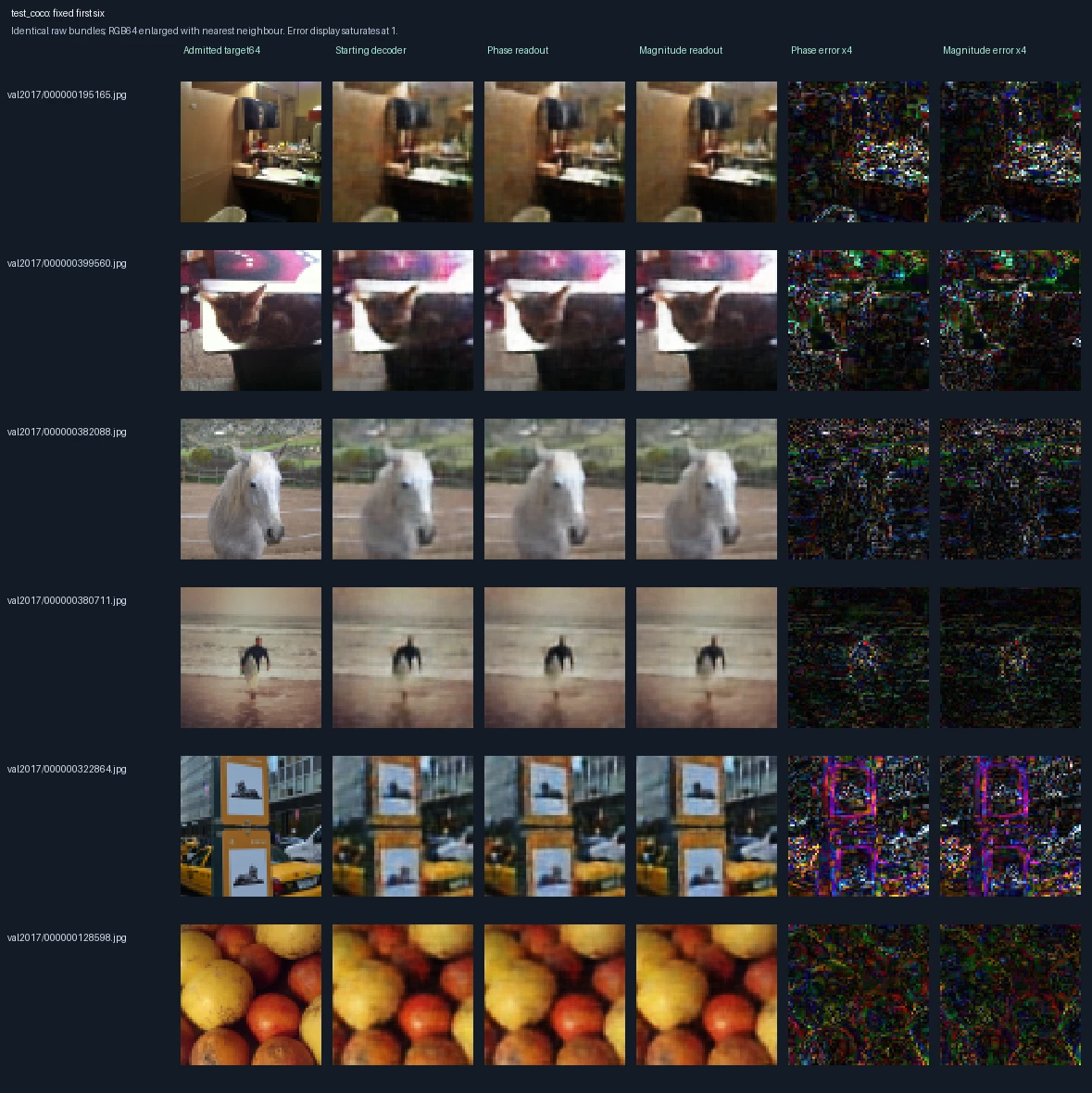
The first six test examples in predetermined order, not selected for visual quality. Left to right: target pixels, starting phase-only decoder, trained phase-only decoder, trained magnitude-preserving decoder, then the two trained decoders’ errors. All decoders in a row receive the same raw VSA bundle; only their readout and trained decoder differ. Phase-only readout keeps each complex coordinate’s angle; magnitude-preserving readout also keeps its amplitude, with one fixed scale learned from training data. Error panels show four times the absolute RGB difference from the reference, separately for each color channel, clipped at full brightness. Darker pixels mean smaller errors; black is zero or below the display’s precision. The scale is fixed across examples, not adjusted to make each image look better.
Magnitude-preserving readout: largest gains over phase-only readout
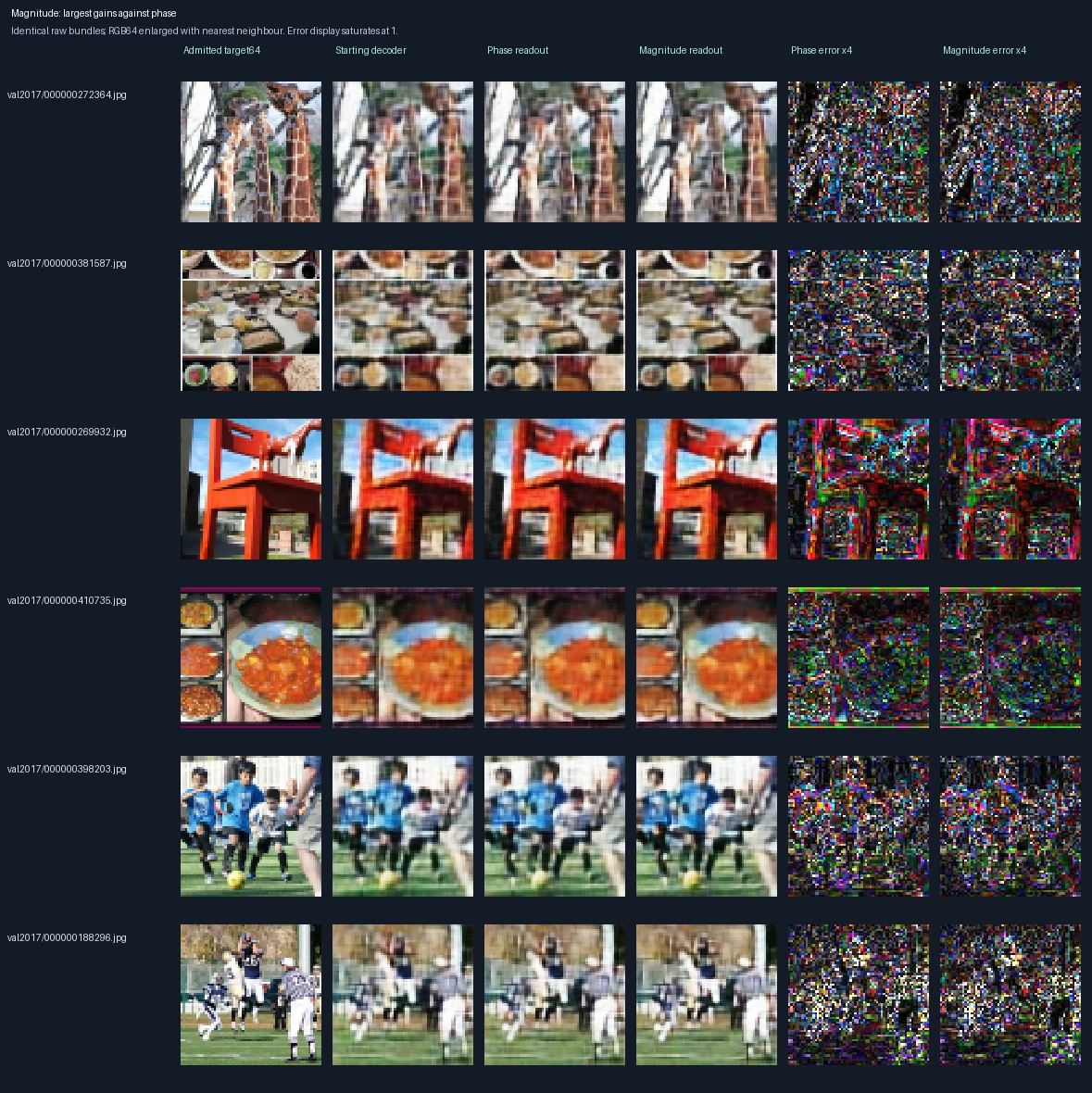
Six COCO test images selected after evaluation for the largest decrease in MSE relative to phase-only readout. Left to right: target pixels, starting phase-only decoder, trained phase-only decoder, trained magnitude-preserving decoder, then the two trained decoders’ errors. All decoders in a row receive the same raw VSA bundle; only their readout and trained decoder differ. Phase-only readout keeps each complex coordinate’s angle; magnitude-preserving readout also keeps its amplitude, with one fixed scale learned from training data. Error panels show four times the absolute RGB difference from the reference, separately for each color channel, clipped at full brightness. Darker pixels mean smaller errors; black is zero or below the display’s precision. The scale is fixed across examples, not adjusted to make each image look better.
Magnitude-preserving readout: smallest gains over phase-only readout
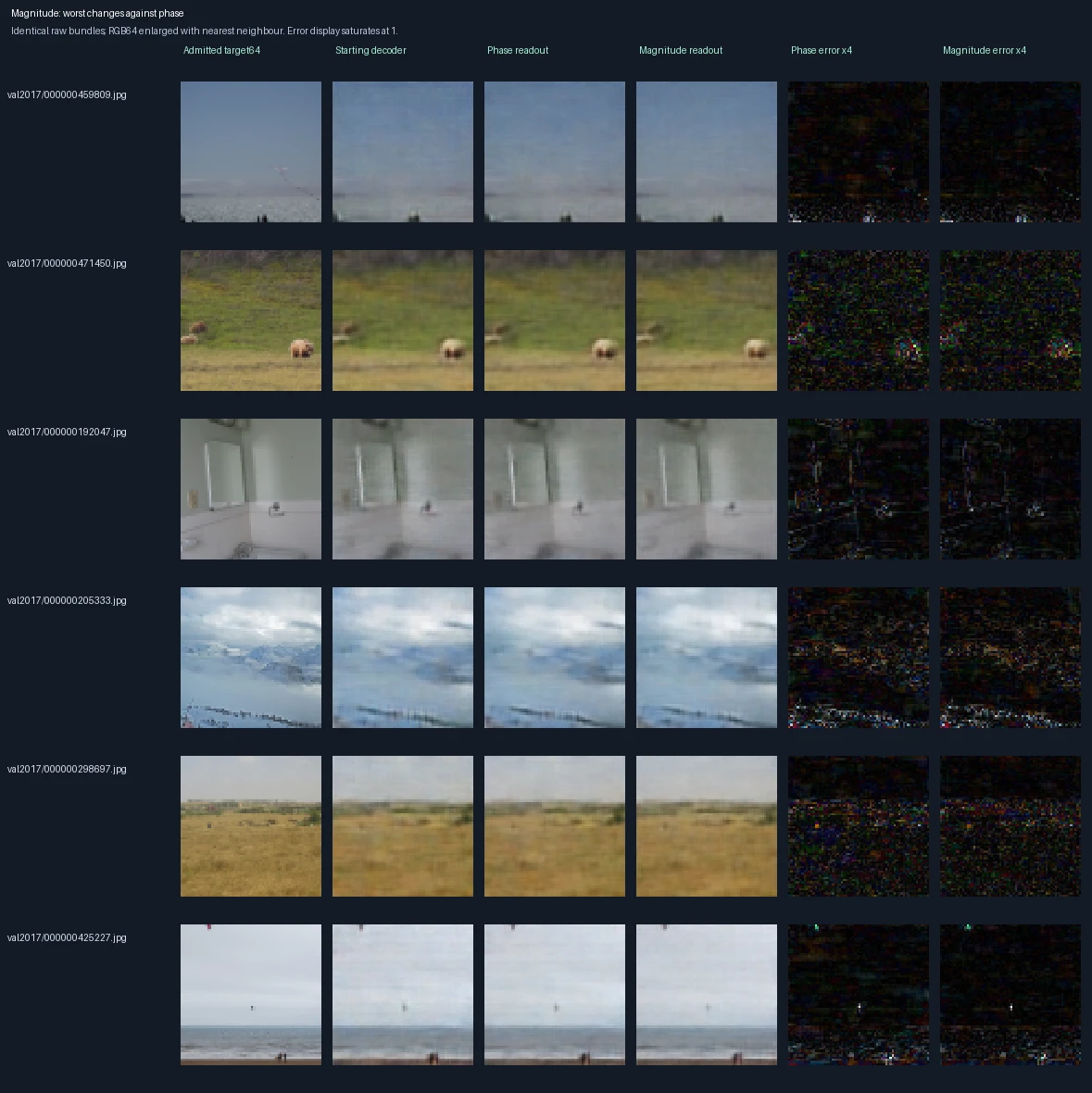
Six COCO test images selected after evaluation for the smallest decrease in MSE relative to phase-only readout. These are improvements, not regressions: the displayed magnitude model lowered MSE on every COCO test image. Left to right: target pixels, starting phase-only decoder, trained phase-only decoder, trained magnitude-preserving decoder, then the two trained decoders’ errors. All decoders in a row receive the same raw VSA bundle; only their readout and trained decoder differ. Phase-only readout keeps each complex coordinate’s angle; magnitude-preserving readout also keeps its amplitude, with one fixed scale learned from training data. Error panels show four times the absolute RGB difference from the reference, separately for each color channel, clipped at full brightness. Darker pixels mean smaller errors; black is zero or below the display’s precision. The scale is fixed across examples, not adjusted to make each image look better.
Flickr test photographs: phase-only versus magnitude-preserving readout
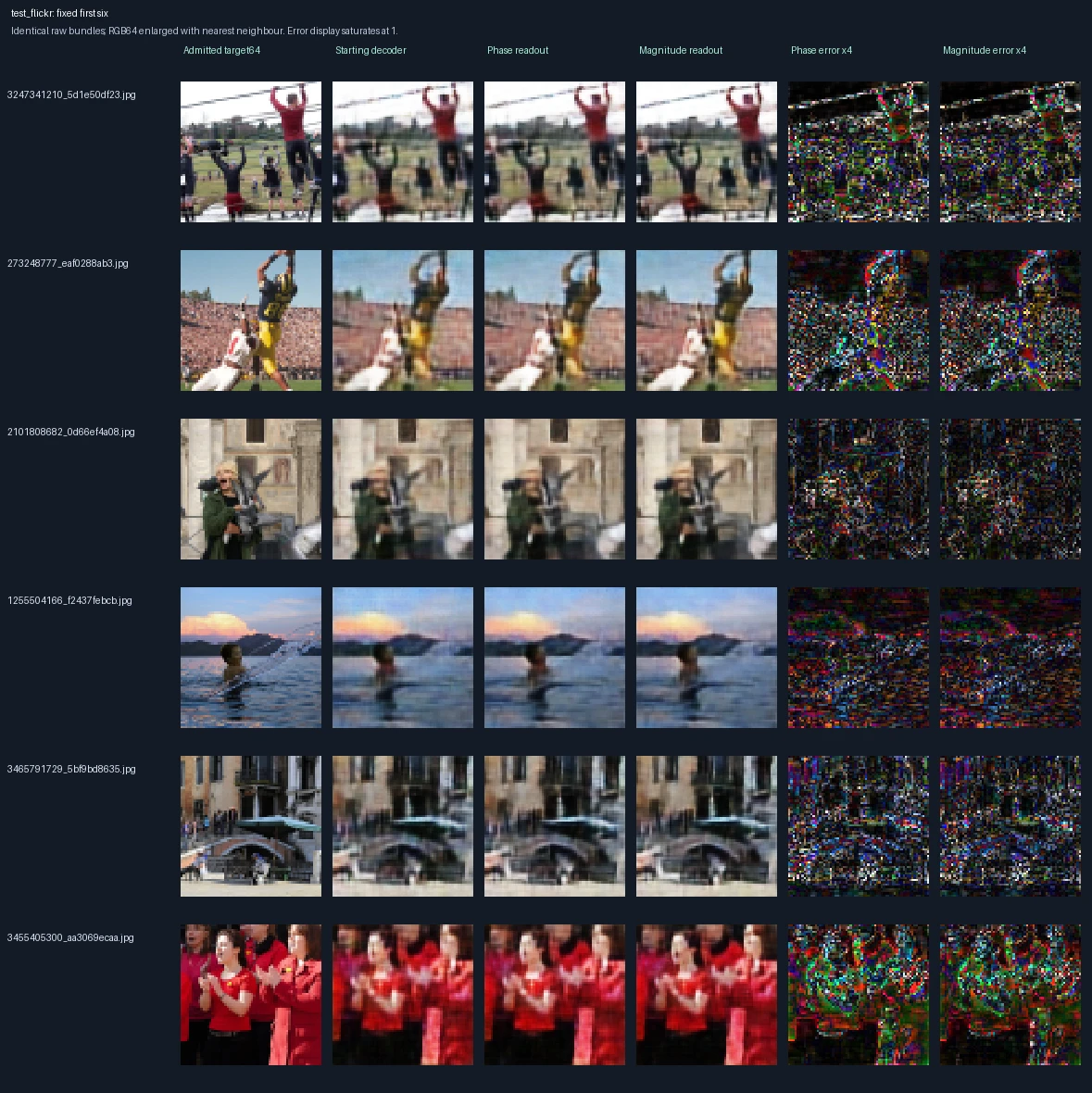
The first six test examples in predetermined order, not selected for visual quality. Left to right: target pixels, starting phase-only decoder, trained phase-only decoder, trained magnitude-preserving decoder, then the two trained decoders’ errors. All decoders in a row receive the same raw VSA bundle; only their readout and trained decoder differ. Phase-only readout keeps each complex coordinate’s angle; magnitude-preserving readout also keeps its amplitude, with one fixed scale learned from training data. Error panels show four times the absolute RGB difference from the reference, separately for each color channel, clipped at full brightness. Darker pixels mean smaller errors; black is zero or below the display’s precision. The scale is fixed across examples, not adjusted to make each image look better.
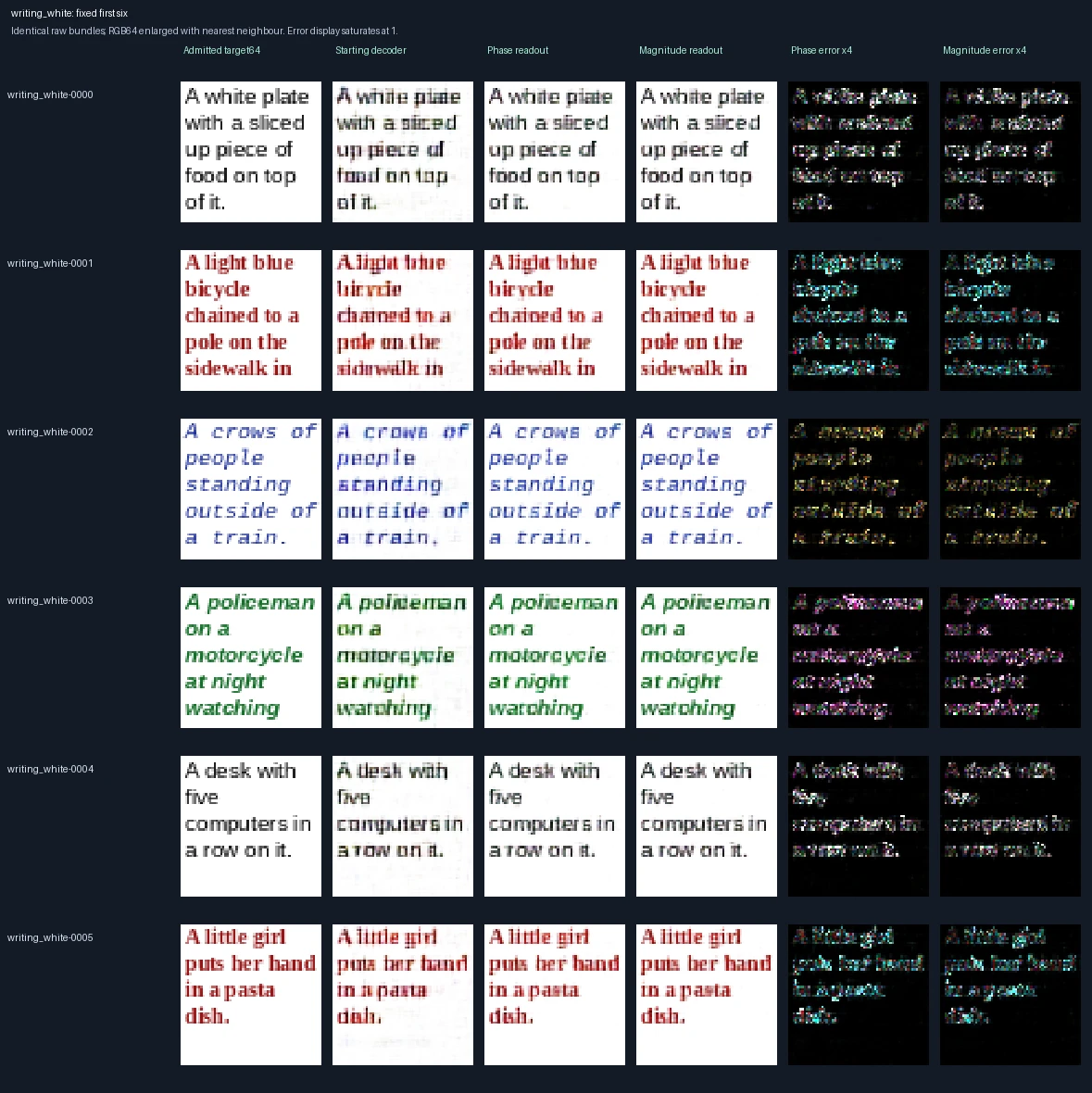
Rendered writing on white backgrounds: phase-only versus magnitude-preserving readout
The first six test examples in predetermined order, not selected for visual quality. Left to right: target pixels, starting phase-only decoder, trained phase-only decoder, trained magnitude-preserving decoder, then the two trained decoders’ errors. All decoders in a row receive the same raw VSA bundle; only their readout and trained decoder differ. Phase-only readout keeps each complex coordinate’s angle; magnitude-preserving readout also keeps its amplitude, with one fixed scale learned from training data. Error panels show four times the absolute RGB difference from the reference, separately for each color channel, clipped at full brightness. Darker pixels mean smaller errors; black is zero or below the display’s precision. The scale is fixed across examples, not adjusted to make each image look better. Writing is presented as pixels; this does not test whether the system reads or understands it.
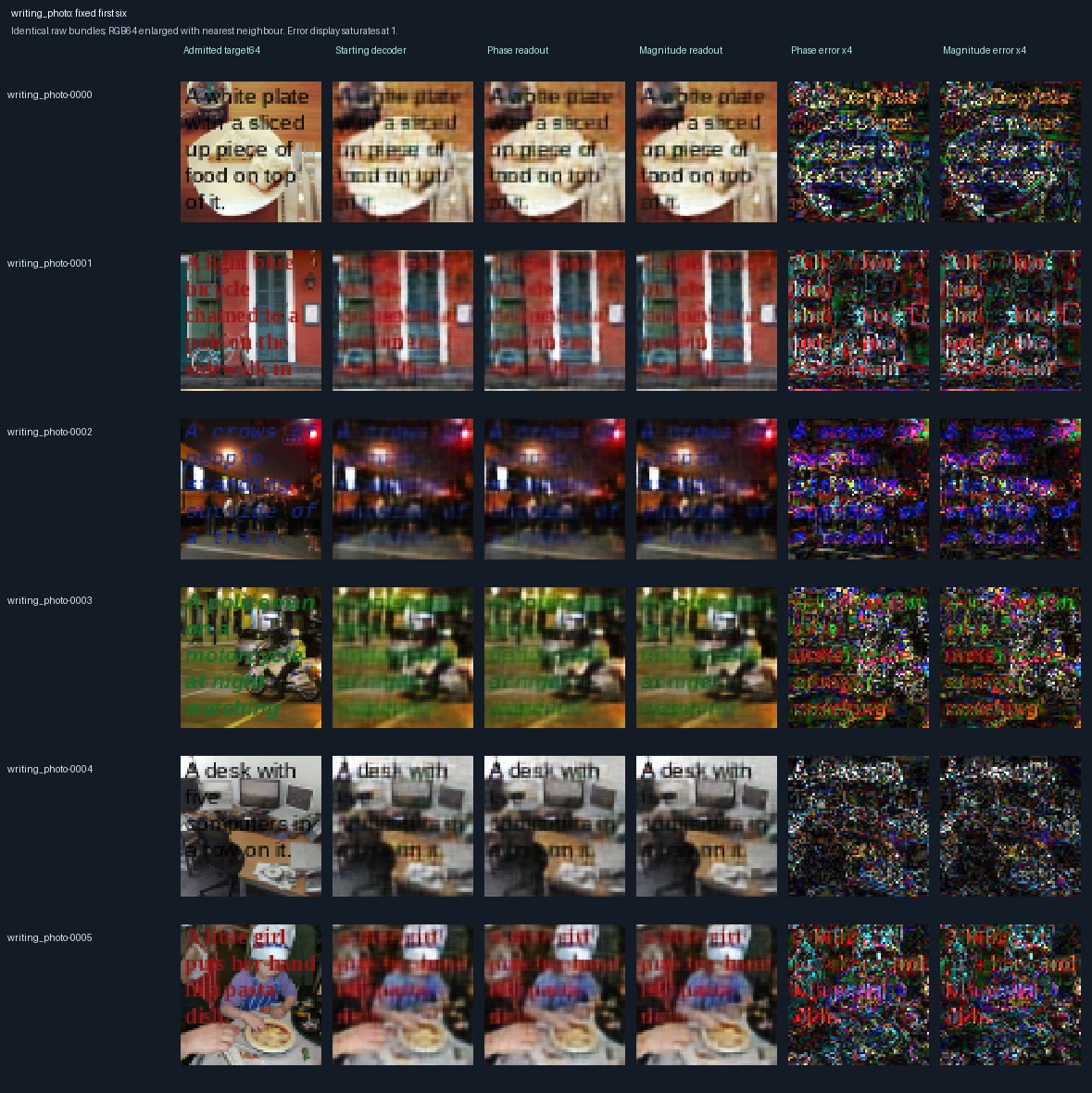
Rendered writing on photographs: phase-only versus magnitude-preserving readout
The first six test examples in predetermined order, not selected for visual quality. Left to right: target pixels, starting phase-only decoder, trained phase-only decoder, trained magnitude-preserving decoder, then the two trained decoders’ errors. All decoders in a row receive the same raw VSA bundle; only their readout and trained decoder differ. Phase-only readout keeps each complex coordinate’s angle; magnitude-preserving readout also keeps its amplitude, with one fixed scale learned from training data. Error panels show four times the absolute RGB difference from the reference, separately for each color channel, clipped at full brightness. Darker pixels mean smaller errors; black is zero or below the display’s precision. The scale is fixed across examples, not adjusted to make each image look better. Writing is presented as pixels; this does not test whether the system reads or understands it.
Encoding earlier images again: earlier photographs 0–5
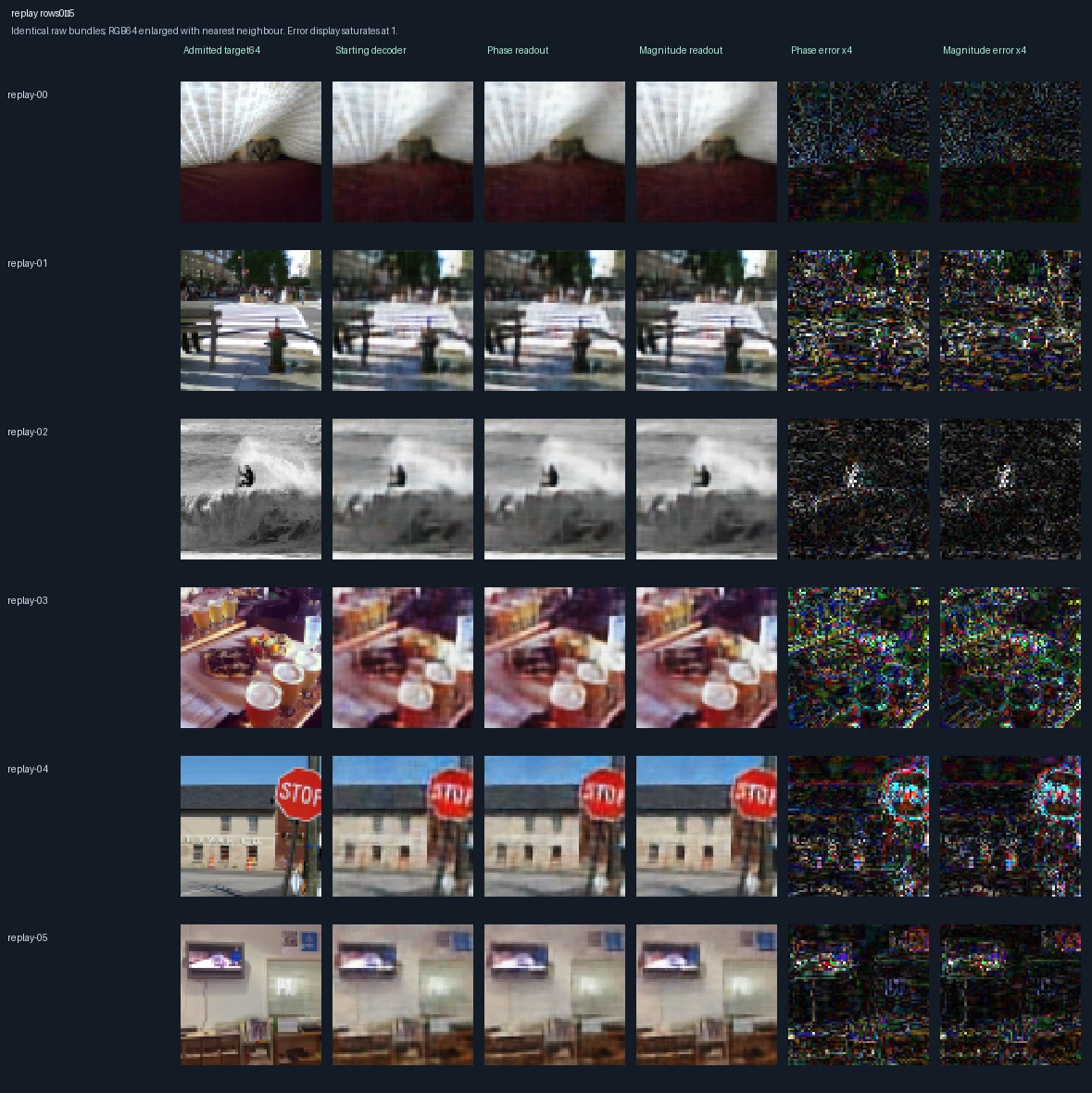
These earlier inputs are encoded again with the fixed current encoder, then decoded. This measures current fidelity on familiar content, not compatibility with untouched old memories. Left to right: target pixels, starting phase-only decoder, trained phase-only decoder, trained magnitude-preserving decoder, then the two trained decoders’ errors. All decoders in a row receive the same raw VSA bundle; only their readout and trained decoder differ. Phase-only readout keeps each complex coordinate’s angle; magnitude-preserving readout also keeps its amplitude, with one fixed scale learned from training data. Error panels show four times the absolute RGB difference from the reference, separately for each color channel, clipped at full brightness. Darker pixels mean smaller errors; black is zero or below the display’s precision. The scale is fixed across examples, not adjusted to make each image look better.
Encoding earlier images again: earlier photographs 6–11
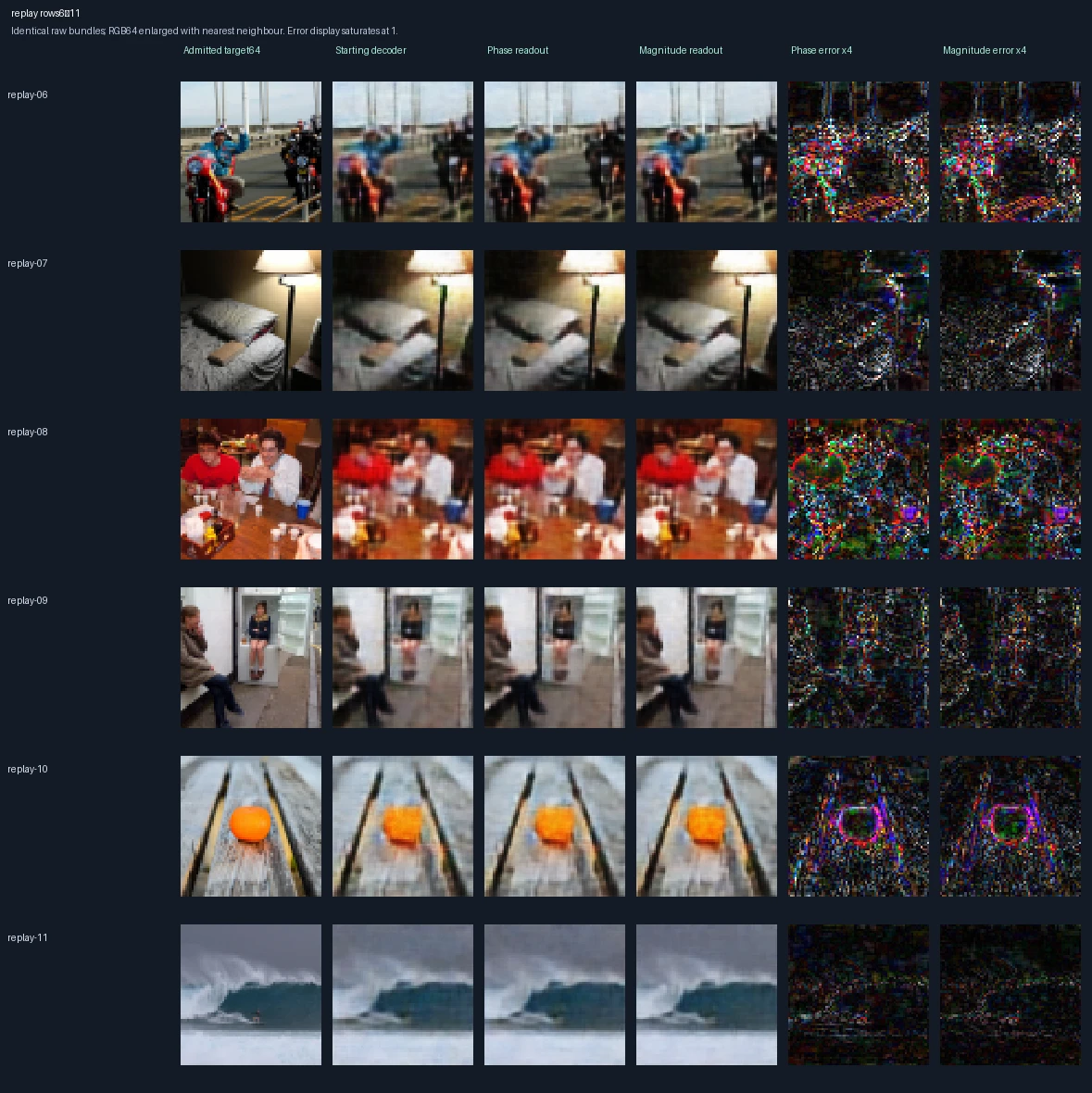
These earlier inputs are encoded again with the fixed current encoder, then decoded. This measures current fidelity on familiar content, not compatibility with untouched old memories. Left to right: target pixels, starting phase-only decoder, trained phase-only decoder, trained magnitude-preserving decoder, then the two trained decoders’ errors. All decoders in a row receive the same raw VSA bundle; only their readout and trained decoder differ. Phase-only readout keeps each complex coordinate’s angle; magnitude-preserving readout also keeps its amplitude, with one fixed scale learned from training data. Error panels show four times the absolute RGB difference from the reference, separately for each color channel, clipped at full brightness. Darker pixels mean smaller errors; black is zero or below the display’s precision. The scale is fixed across examples, not adjusted to make each image look better.
Encoding earlier images again: earlier photographs 12–17
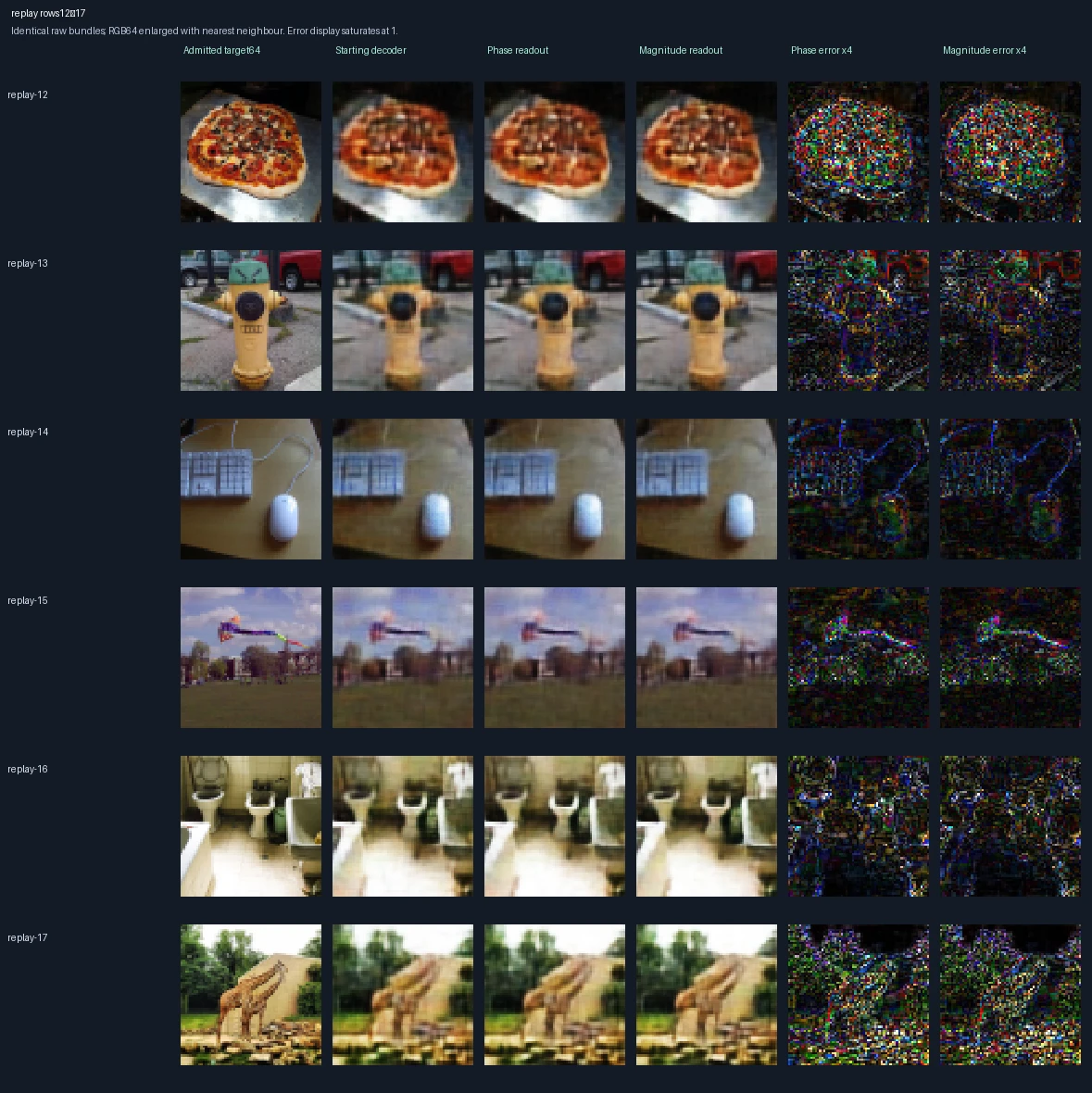
These earlier inputs are encoded again with the fixed current encoder, then decoded. This measures current fidelity on familiar content, not compatibility with untouched old memories. Left to right: target pixels, starting phase-only decoder, trained phase-only decoder, trained magnitude-preserving decoder, then the two trained decoders’ errors. All decoders in a row receive the same raw VSA bundle; only their readout and trained decoder differ. Phase-only readout keeps each complex coordinate’s angle; magnitude-preserving readout also keeps its amplitude, with one fixed scale learned from training data. Error panels show four times the absolute RGB difference from the reference, separately for each color channel, clipped at full brightness. Darker pixels mean smaller errors; black is zero or below the display’s precision. The scale is fixed across examples, not adjusted to make each image look better.
Encoding earlier images again: earlier photographs 18–23
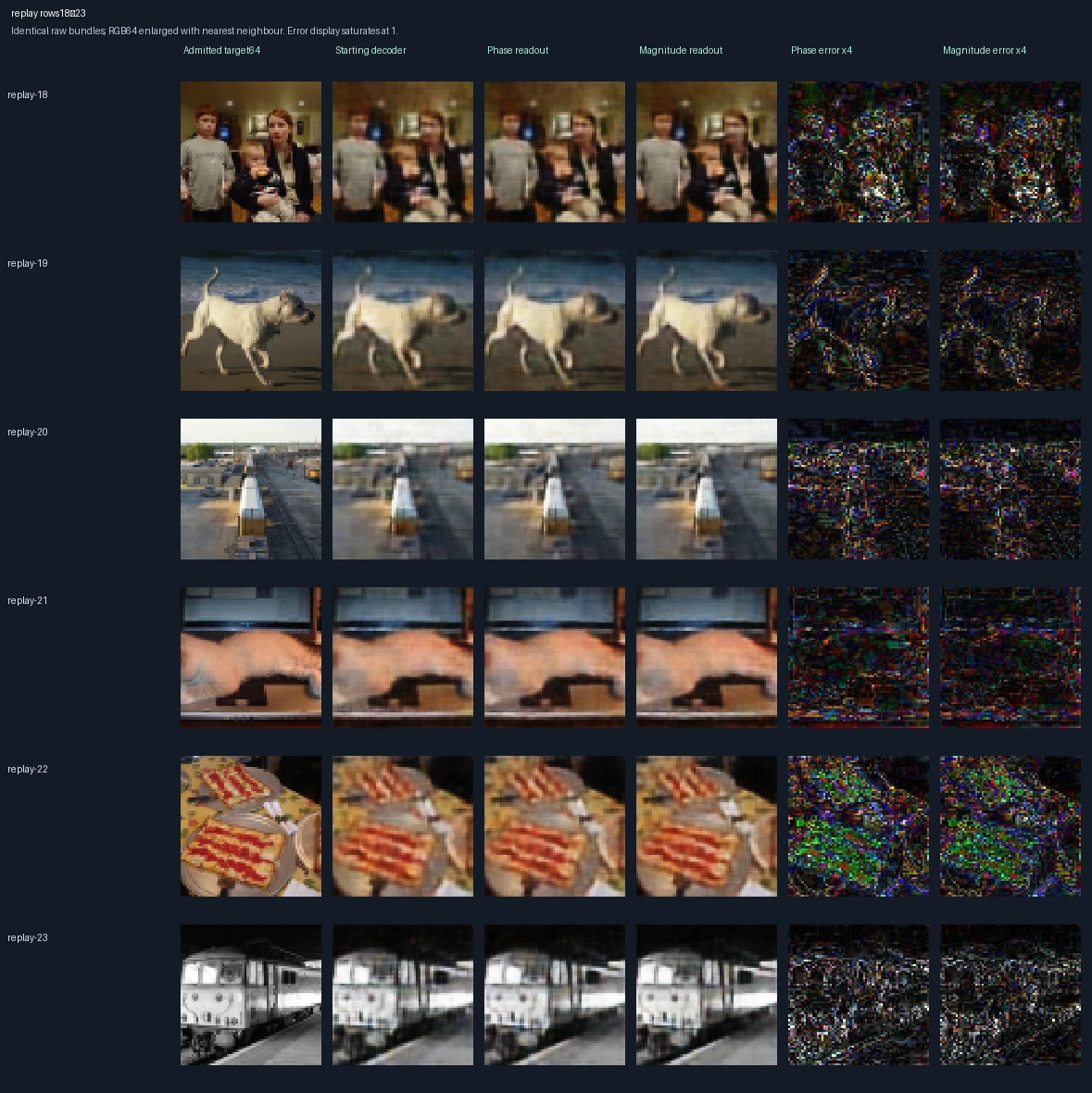
These earlier inputs are encoded again with the fixed current encoder, then decoded. This measures current fidelity on familiar content, not compatibility with untouched old memories. Left to right: target pixels, starting phase-only decoder, trained phase-only decoder, trained magnitude-preserving decoder, then the two trained decoders’ errors. All decoders in a row receive the same raw VSA bundle; only their readout and trained decoder differ. Phase-only readout keeps each complex coordinate’s angle; magnitude-preserving readout also keeps its amplitude, with one fixed scale learned from training data. Error panels show four times the absolute RGB difference from the reference, separately for each color channel, clipped at full brightness. Darker pixels mean smaller errors; black is zero or below the display’s precision. The scale is fixed across examples, not adjusted to make each image look better.
Encoding earlier images again: earlier Andor video frames 24–29
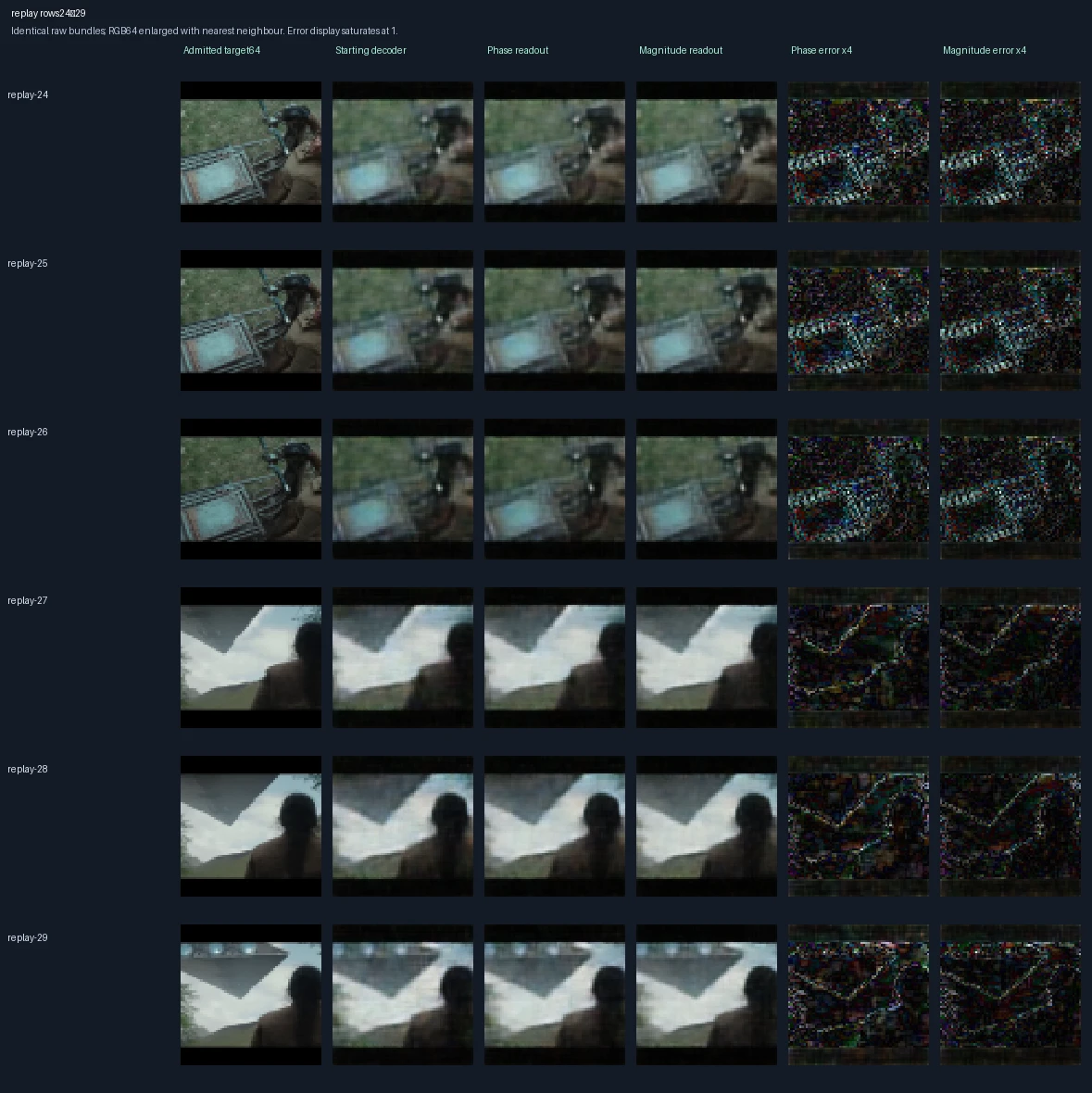
These earlier inputs are encoded again with the fixed current encoder, then decoded. This measures current fidelity on familiar content, not compatibility with untouched old memories. Left to right: target pixels, starting phase-only decoder, trained phase-only decoder, trained magnitude-preserving decoder, then the two trained decoders’ errors. All decoders in a row receive the same raw VSA bundle; only their readout and trained decoder differ. Phase-only readout keeps each complex coordinate’s angle; magnitude-preserving readout also keeps its amplitude, with one fixed scale learned from training data. Error panels show four times the absolute RGB difference from the reference, separately for each color channel, clipped at full brightness. Darker pixels mean smaller errors; black is zero or below the display’s precision. The scale is fixed across examples, not adjusted to make each image look better.
Encoding earlier images again: earlier Andor video frames 30–35
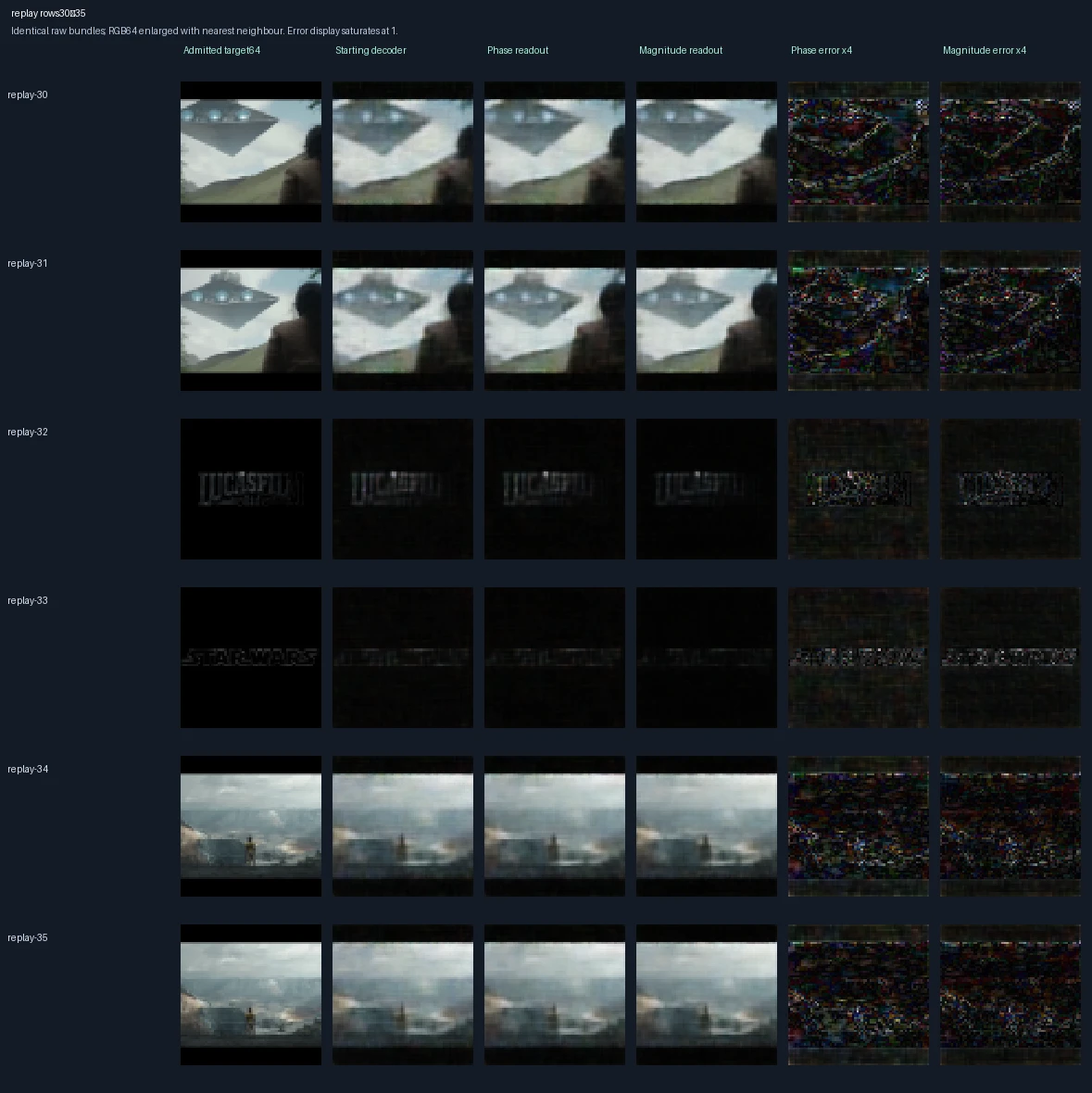
These earlier inputs are encoded again with the fixed current encoder, then decoded. This measures current fidelity on familiar content, not compatibility with untouched old memories. Left to right: target pixels, starting phase-only decoder, trained phase-only decoder, trained magnitude-preserving decoder, then the two trained decoders’ errors. All decoders in a row receive the same raw VSA bundle; only their readout and trained decoder differ. Phase-only readout keeps each complex coordinate’s angle; magnitude-preserving readout also keeps its amplitude, with one fixed scale learned from training data. Error panels show four times the absolute RGB difference from the reference, separately for each color channel, clipped at full brightness. Darker pixels mean smaller errors; black is zero or below the display’s precision. The scale is fixed across examples, not adjusted to make each image look better.
Encoding earlier images again: earlier Andor video frames 36–41
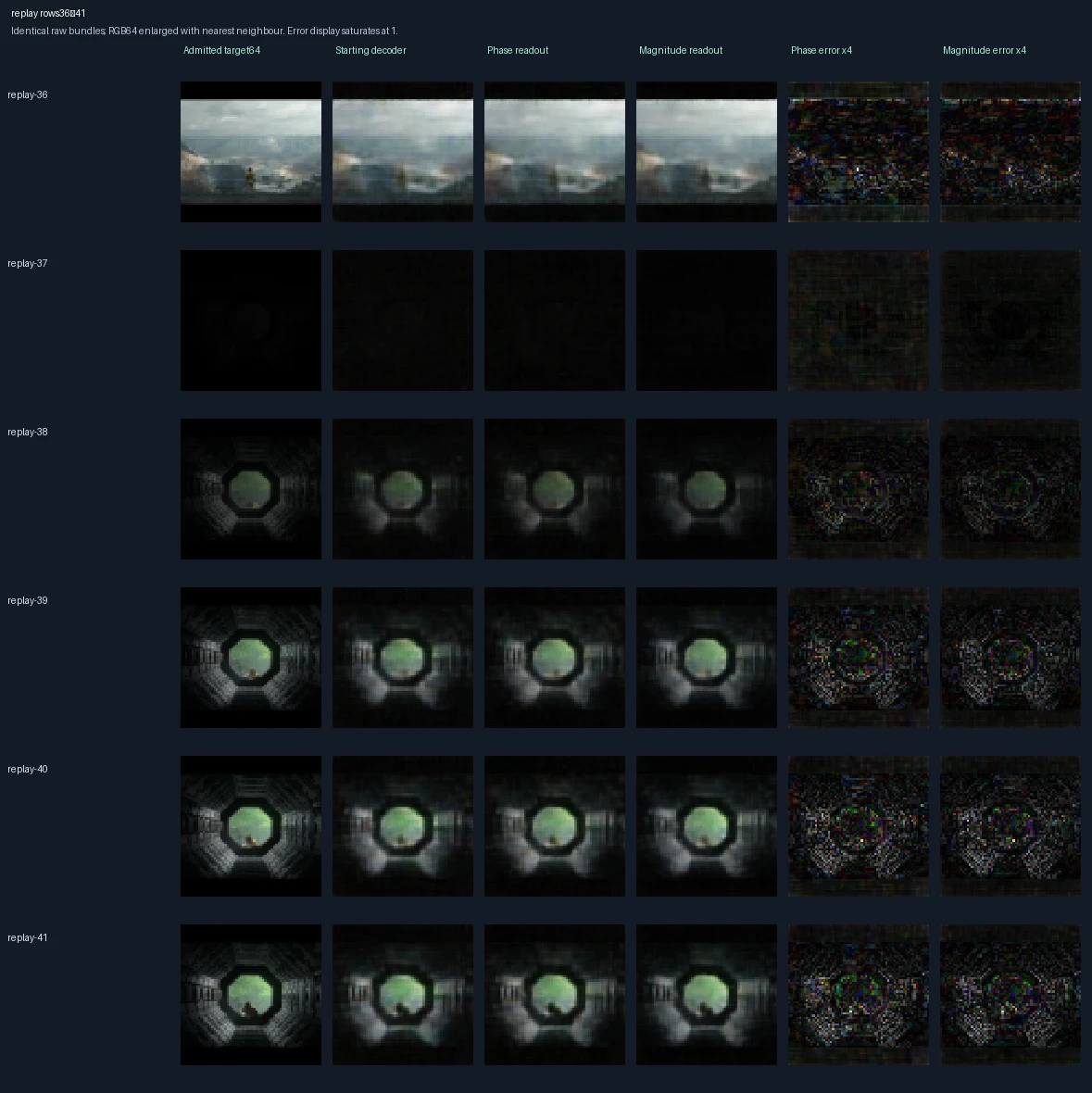
These earlier inputs are encoded again with the fixed current encoder, then decoded. This measures current fidelity on familiar content, not compatibility with untouched old memories. Left to right: target pixels, starting phase-only decoder, trained phase-only decoder, trained magnitude-preserving decoder, then the two trained decoders’ errors. All decoders in a row receive the same raw VSA bundle; only their readout and trained decoder differ. Phase-only readout keeps each complex coordinate’s angle; magnitude-preserving readout also keeps its amplitude, with one fixed scale learned from training data. Error panels show four times the absolute RGB difference from the reference, separately for each color channel, clipped at full brightness. Darker pixels mean smaller errors; black is zero or below the display’s precision. The scale is fixed across examples, not adjusted to make each image look better.
Encoding earlier images again: earlier Andor video frames 42–47
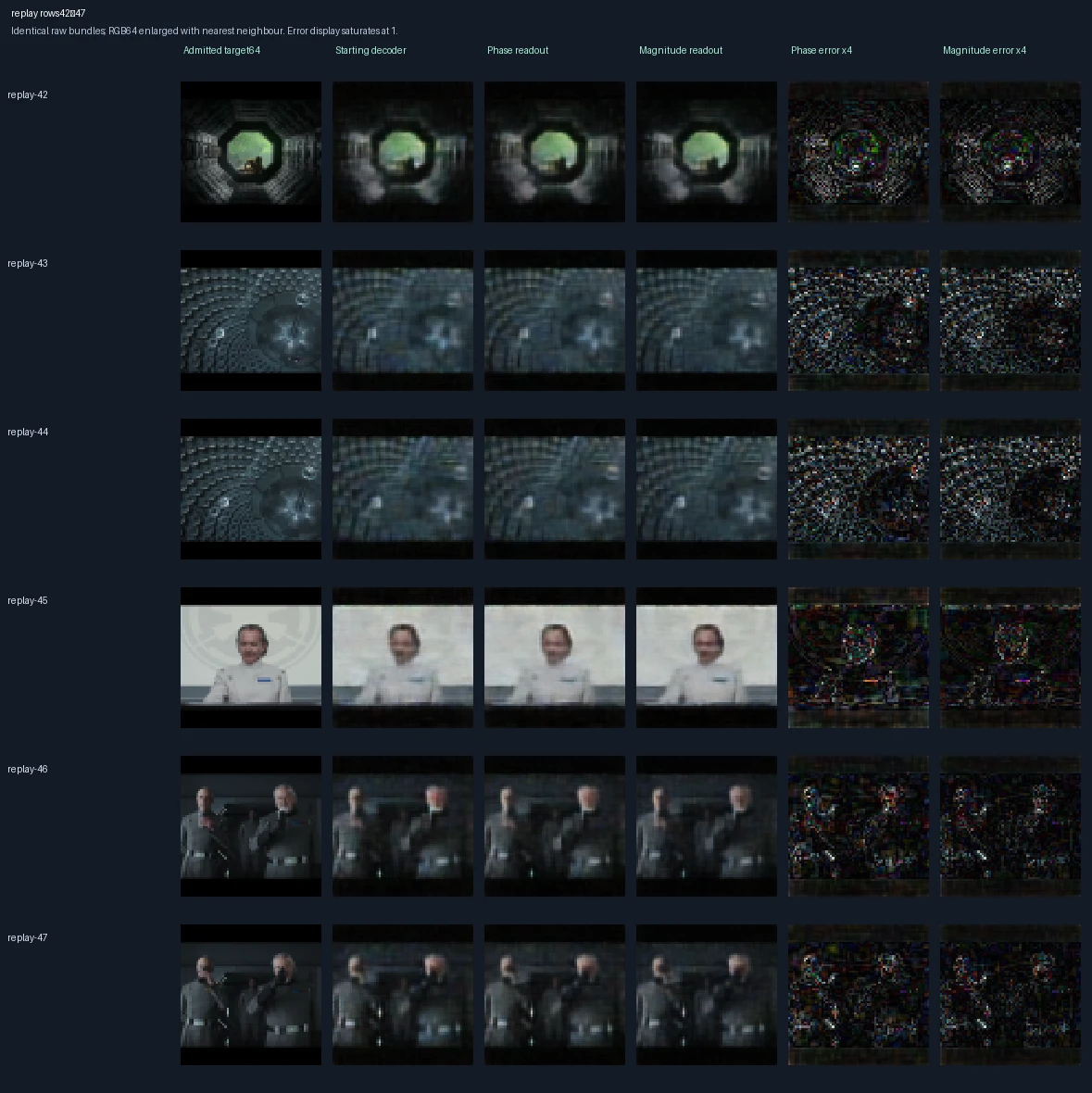
These earlier inputs are encoded again with the fixed current encoder, then decoded. This measures current fidelity on familiar content, not compatibility with untouched old memories. Left to right: target pixels, starting phase-only decoder, trained phase-only decoder, trained magnitude-preserving decoder, then the two trained decoders’ errors. All decoders in a row receive the same raw VSA bundle; only their readout and trained decoder differ. Phase-only readout keeps each complex coordinate’s angle; magnitude-preserving readout also keeps its amplitude, with one fixed scale learned from training data. Error panels show four times the absolute RGB difference from the reference, separately for each color channel, clipped at full brightness. Darker pixels mean smaller errors; black is zero or below the display’s precision. The scale is fixed across examples, not adjusted to make each image look better.
Encoding earlier images again: earlier Dune video frames 48–53
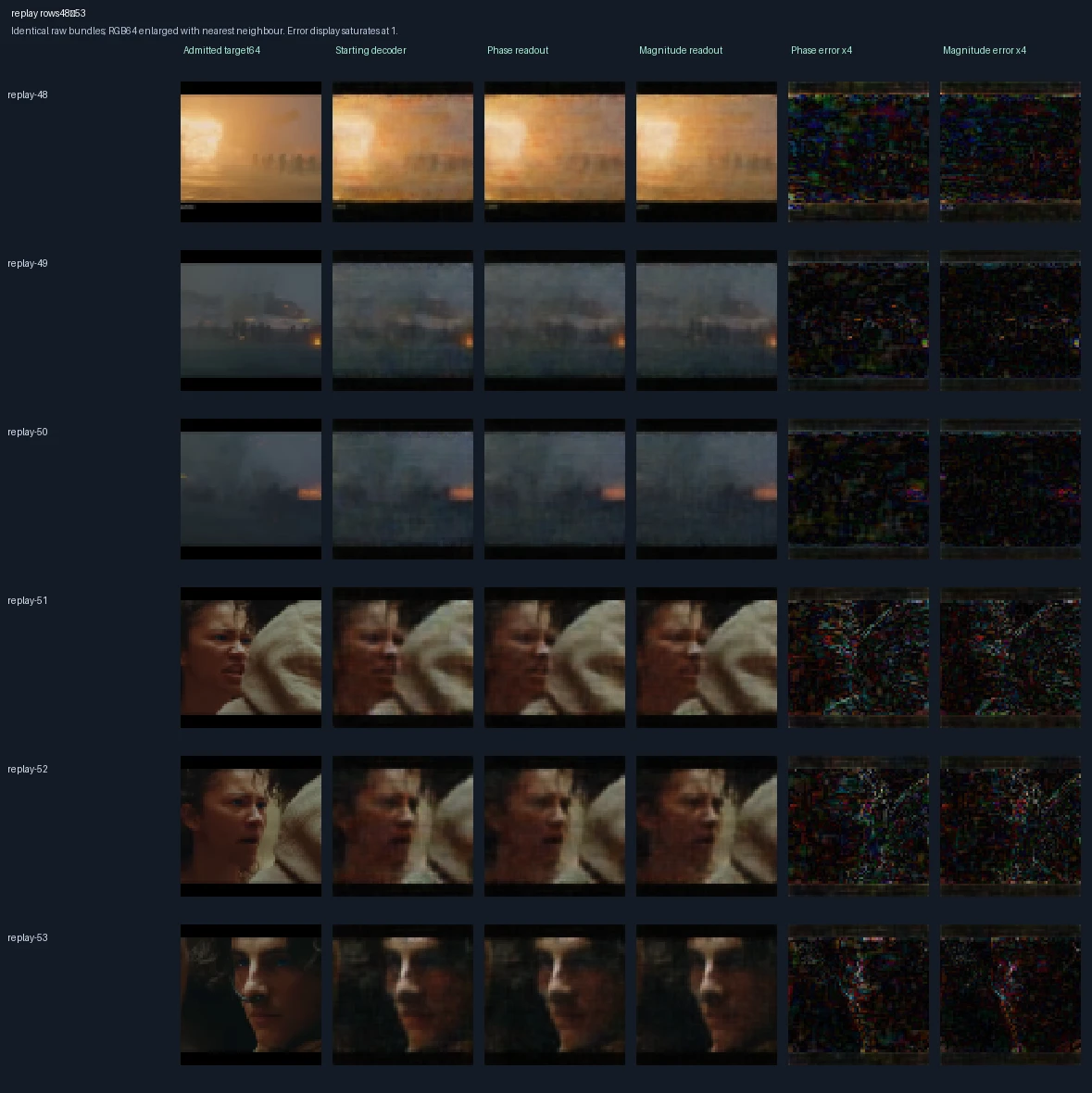
These earlier inputs are encoded again with the fixed current encoder, then decoded. This measures current fidelity on familiar content, not compatibility with untouched old memories. Left to right: target pixels, starting phase-only decoder, trained phase-only decoder, trained magnitude-preserving decoder, then the two trained decoders’ errors. All decoders in a row receive the same raw VSA bundle; only their readout and trained decoder differ. Phase-only readout keeps each complex coordinate’s angle; magnitude-preserving readout also keeps its amplitude, with one fixed scale learned from training data. Error panels show four times the absolute RGB difference from the reference, separately for each color channel, clipped at full brightness. Darker pixels mean smaller errors; black is zero or below the display’s precision. The scale is fixed across examples, not adjusted to make each image look better.
Encoding earlier images again: earlier Dune video frames 54–59
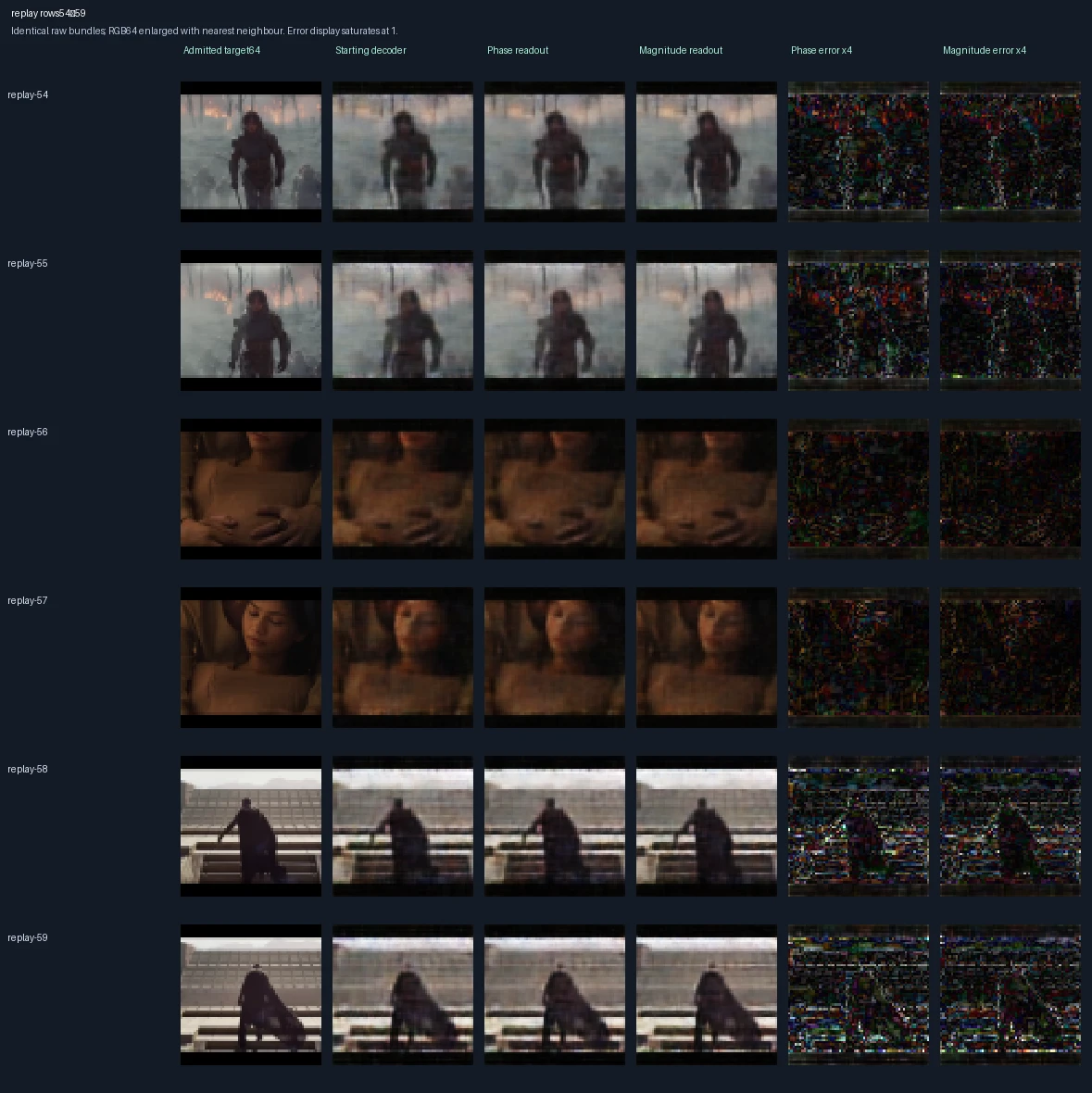
These earlier inputs are encoded again with the fixed current encoder, then decoded. This measures current fidelity on familiar content, not compatibility with untouched old memories. Left to right: target pixels, starting phase-only decoder, trained phase-only decoder, trained magnitude-preserving decoder, then the two trained decoders’ errors. All decoders in a row receive the same raw VSA bundle; only their readout and trained decoder differ. Phase-only readout keeps each complex coordinate’s angle; magnitude-preserving readout also keeps its amplitude, with one fixed scale learned from training data. Error panels show four times the absolute RGB difference from the reference, separately for each color channel, clipped at full brightness. Darker pixels mean smaller errors; black is zero or below the display’s precision. The scale is fixed across examples, not adjusted to make each image look better.
Encoding earlier images again: earlier Dune video frames 60–65
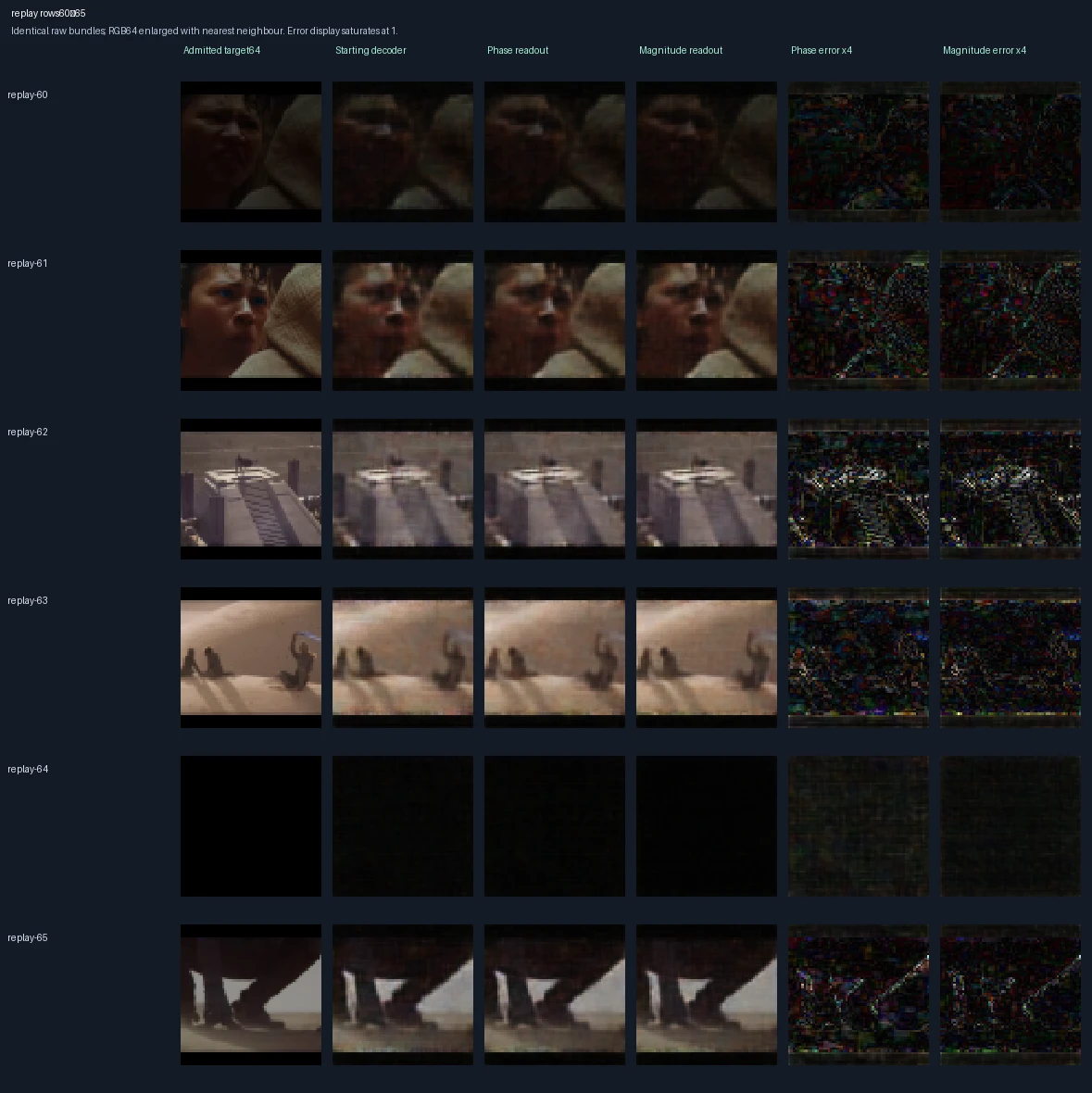
These earlier inputs are encoded again with the fixed current encoder, then decoded. This measures current fidelity on familiar content, not compatibility with untouched old memories. Left to right: target pixels, starting phase-only decoder, trained phase-only decoder, trained magnitude-preserving decoder, then the two trained decoders’ errors. All decoders in a row receive the same raw VSA bundle; only their readout and trained decoder differ. Phase-only readout keeps each complex coordinate’s angle; magnitude-preserving readout also keeps its amplitude, with one fixed scale learned from training data. Error panels show four times the absolute RGB difference from the reference, separately for each color channel, clipped at full brightness. Darker pixels mean smaller errors; black is zero or below the display’s precision. The scale is fixed across examples, not adjusted to make each image look better.
Encoding earlier images again: earlier Dune video frames 66–71
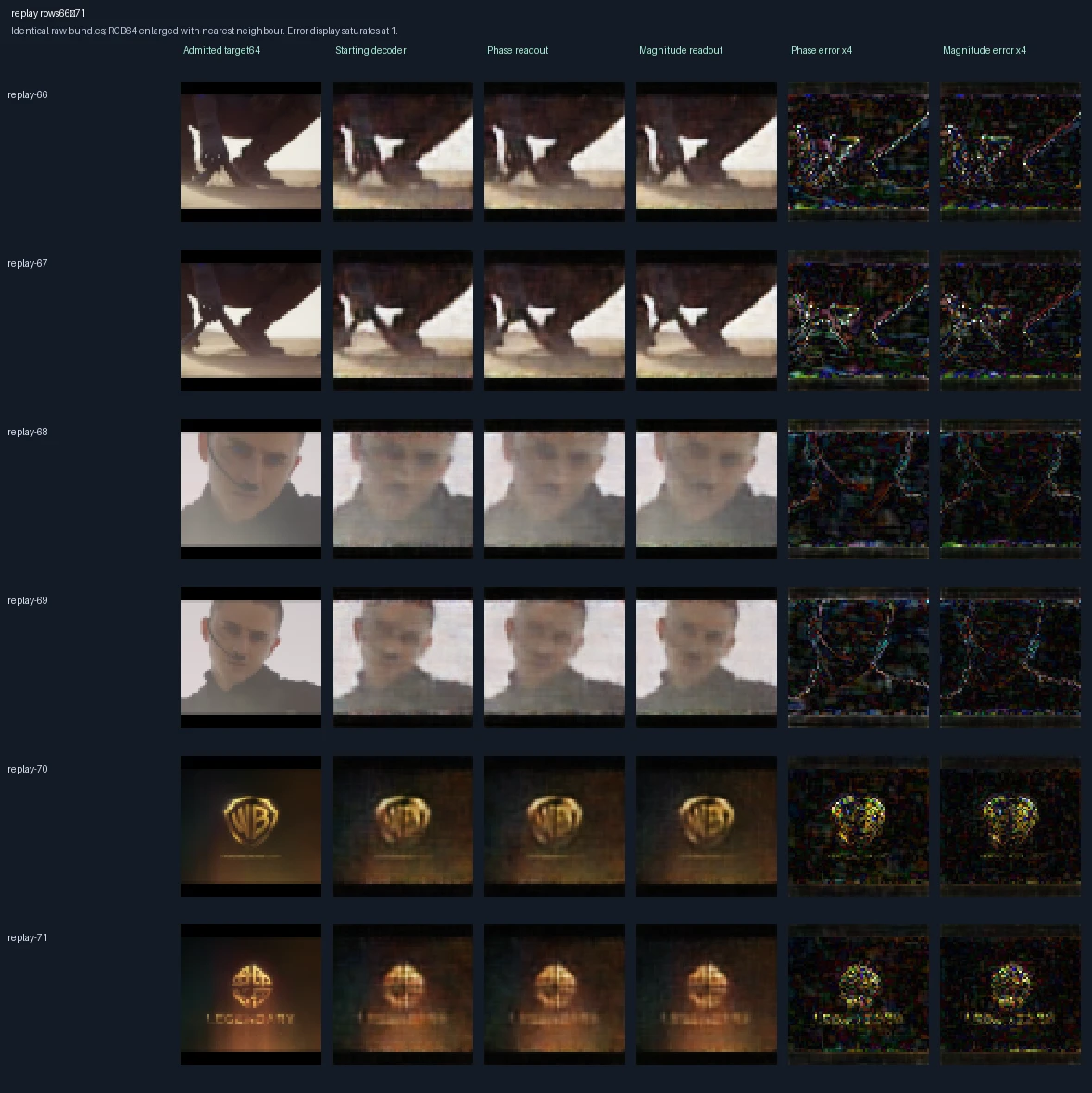
These earlier inputs are encoded again with the fixed current encoder, then decoded. This measures current fidelity on familiar content, not compatibility with untouched old memories. Left to right: target pixels, starting phase-only decoder, trained phase-only decoder, trained magnitude-preserving decoder, then the two trained decoders’ errors. All decoders in a row receive the same raw VSA bundle; only their readout and trained decoder differ. Phase-only readout keeps each complex coordinate’s angle; magnitude-preserving readout also keeps its amplitude, with one fixed scale learned from training data. Error panels show four times the absolute RGB difference from the reference, separately for each color channel, clipped at full brightness. Darker pixels mean smaller errors; black is zero or below the display’s precision. The scale is fixed across examples, not adjusted to make each image look better.
Reading stored vectors: earlier photographs 0–5
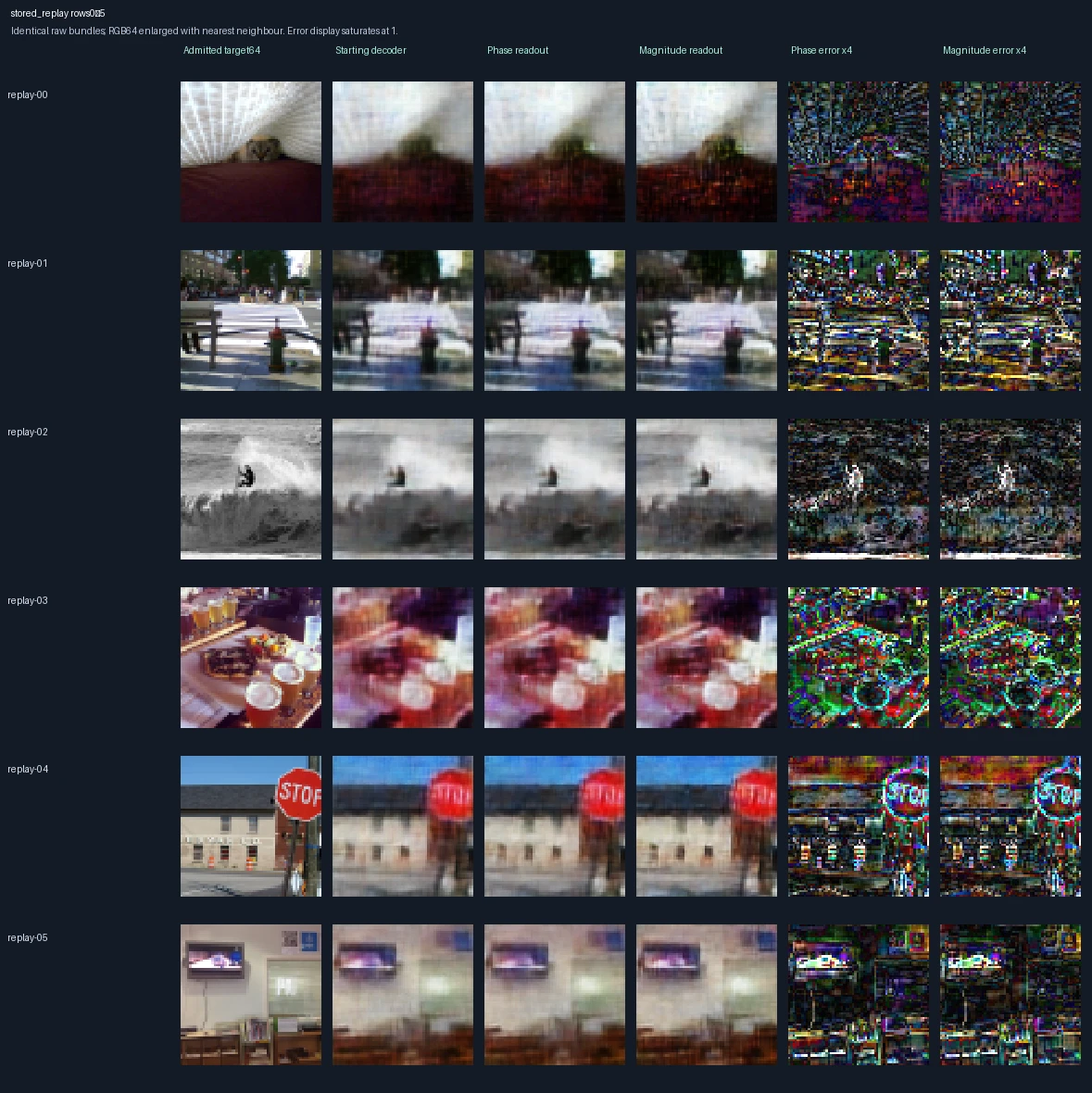
These reconstructions decode the actual vectors saved before encoder refinement; no fresh encoding replaces them. Left to right: target pixels, starting phase-only decoder, trained phase-only decoder, trained magnitude-preserving decoder, then the two trained decoders’ errors. All decoders in a row receive the same raw VSA bundle; only their readout and trained decoder differ. Phase-only readout keeps each complex coordinate’s angle; magnitude-preserving readout also keeps its amplitude, with one fixed scale learned from training data. Error panels show four times the absolute RGB difference from the reference, separately for each color channel, clipped at full brightness. Darker pixels mean smaller errors; black is zero or below the display’s precision. The scale is fixed across examples, not adjusted to make each image look better.
Reading stored vectors: earlier photographs 6–11
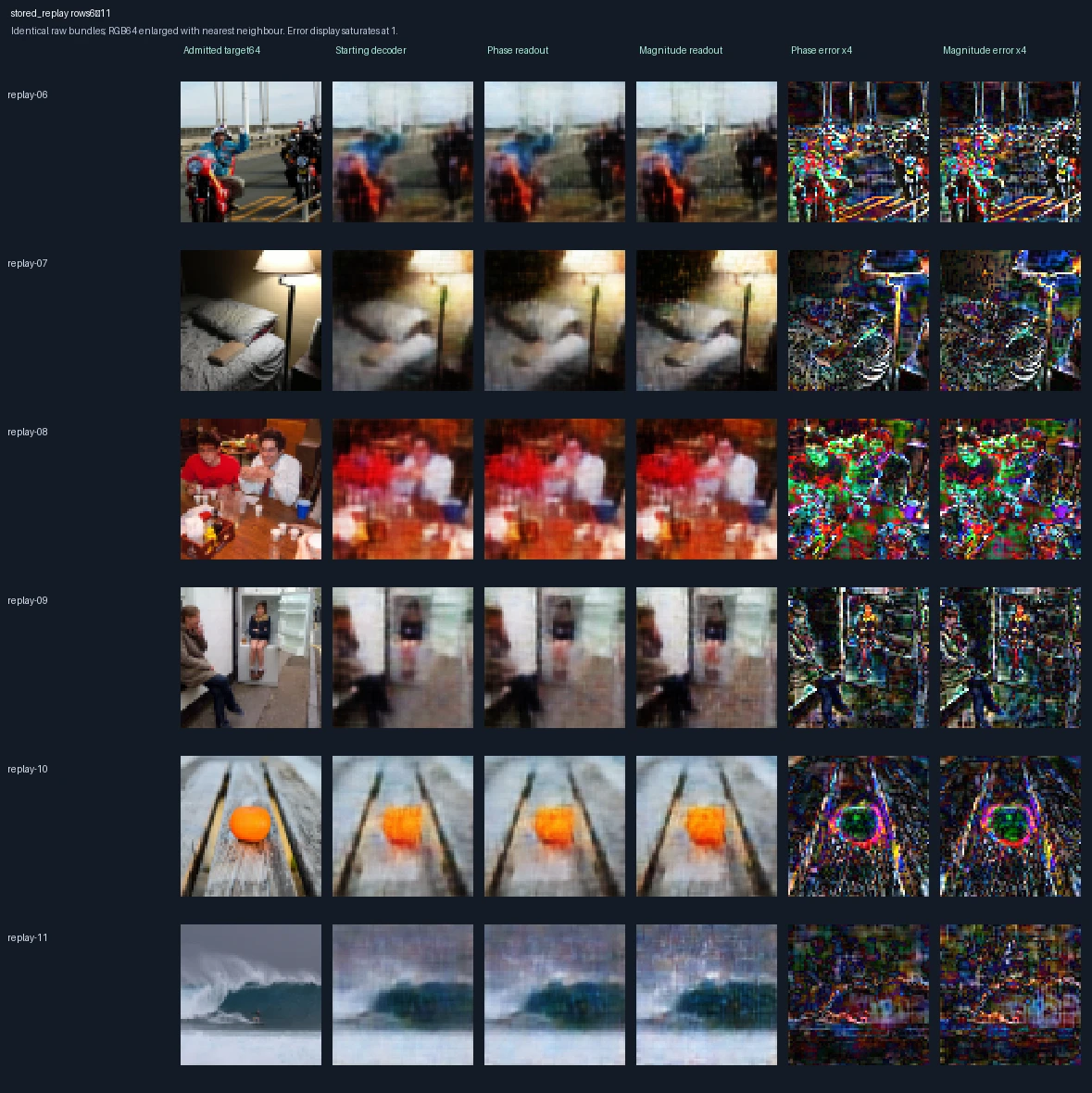
These reconstructions decode the actual vectors saved before encoder refinement; no fresh encoding replaces them. Left to right: target pixels, starting phase-only decoder, trained phase-only decoder, trained magnitude-preserving decoder, then the two trained decoders’ errors. All decoders in a row receive the same raw VSA bundle; only their readout and trained decoder differ. Phase-only readout keeps each complex coordinate’s angle; magnitude-preserving readout also keeps its amplitude, with one fixed scale learned from training data. Error panels show four times the absolute RGB difference from the reference, separately for each color channel, clipped at full brightness. Darker pixels mean smaller errors; black is zero or below the display’s precision. The scale is fixed across examples, not adjusted to make each image look better.
Reading stored vectors: earlier photographs 12–17
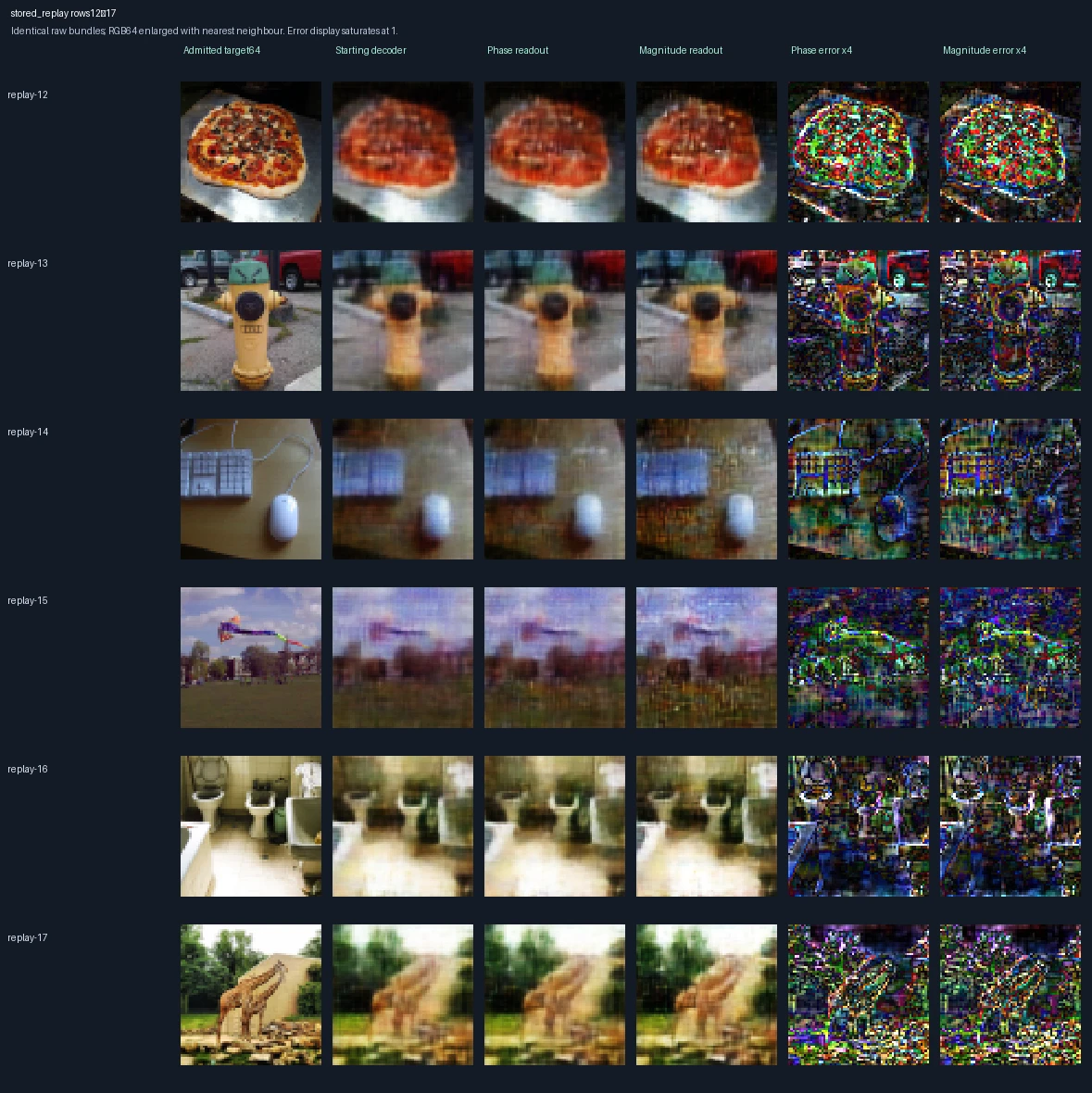
These reconstructions decode the actual vectors saved before encoder refinement; no fresh encoding replaces them. Left to right: target pixels, starting phase-only decoder, trained phase-only decoder, trained magnitude-preserving decoder, then the two trained decoders’ errors. All decoders in a row receive the same raw VSA bundle; only their readout and trained decoder differ. Phase-only readout keeps each complex coordinate’s angle; magnitude-preserving readout also keeps its amplitude, with one fixed scale learned from training data. Error panels show four times the absolute RGB difference from the reference, separately for each color channel, clipped at full brightness. Darker pixels mean smaller errors; black is zero or below the display’s precision. The scale is fixed across examples, not adjusted to make each image look better.
Reading stored vectors: earlier photographs 18–23
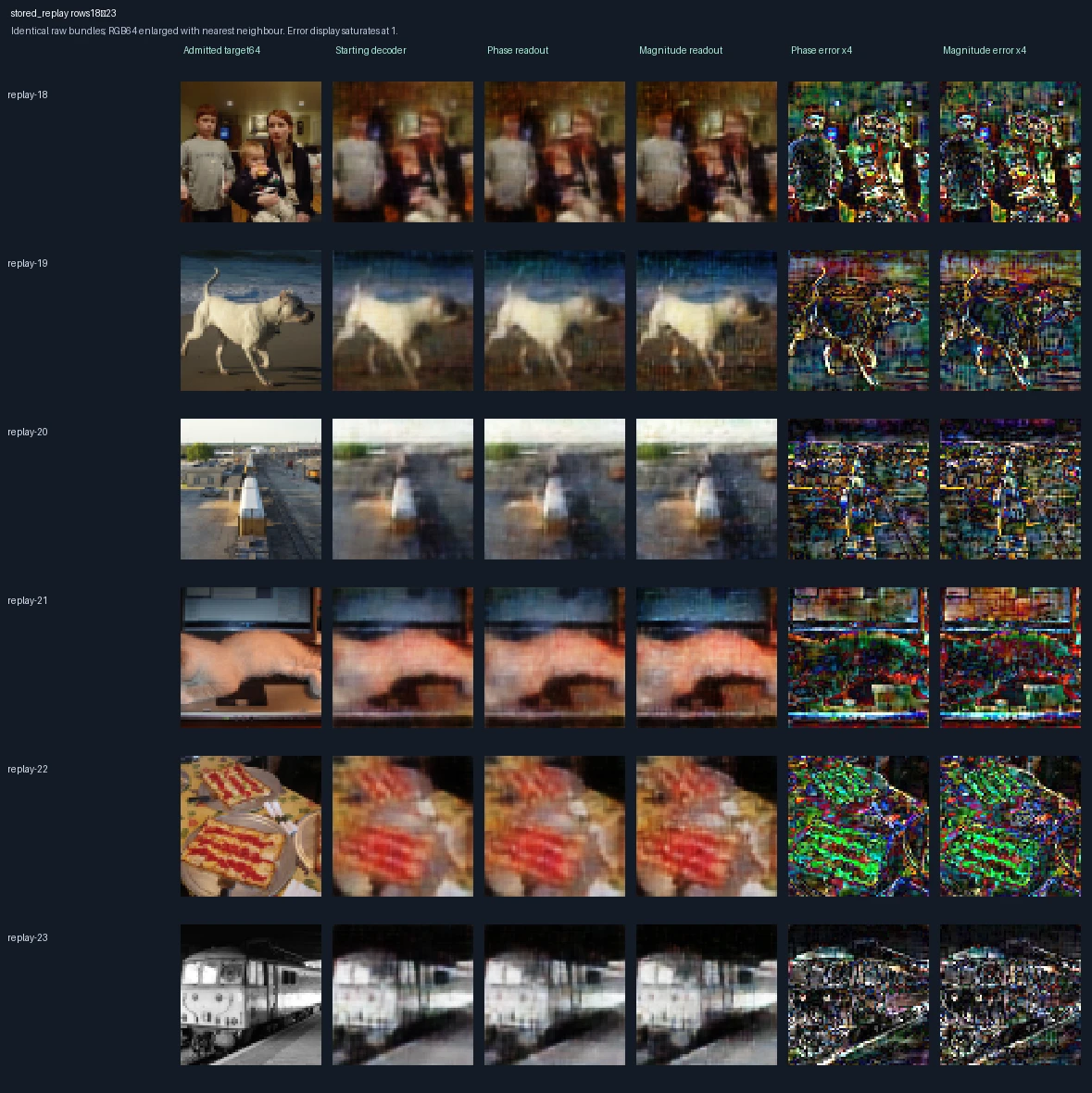
These reconstructions decode the actual vectors saved before encoder refinement; no fresh encoding replaces them. Left to right: target pixels, starting phase-only decoder, trained phase-only decoder, trained magnitude-preserving decoder, then the two trained decoders’ errors. All decoders in a row receive the same raw VSA bundle; only their readout and trained decoder differ. Phase-only readout keeps each complex coordinate’s angle; magnitude-preserving readout also keeps its amplitude, with one fixed scale learned from training data. Error panels show four times the absolute RGB difference from the reference, separately for each color channel, clipped at full brightness. Darker pixels mean smaller errors; black is zero or below the display’s precision. The scale is fixed across examples, not adjusted to make each image look better.
Reading stored vectors: earlier Andor video frames 24–29
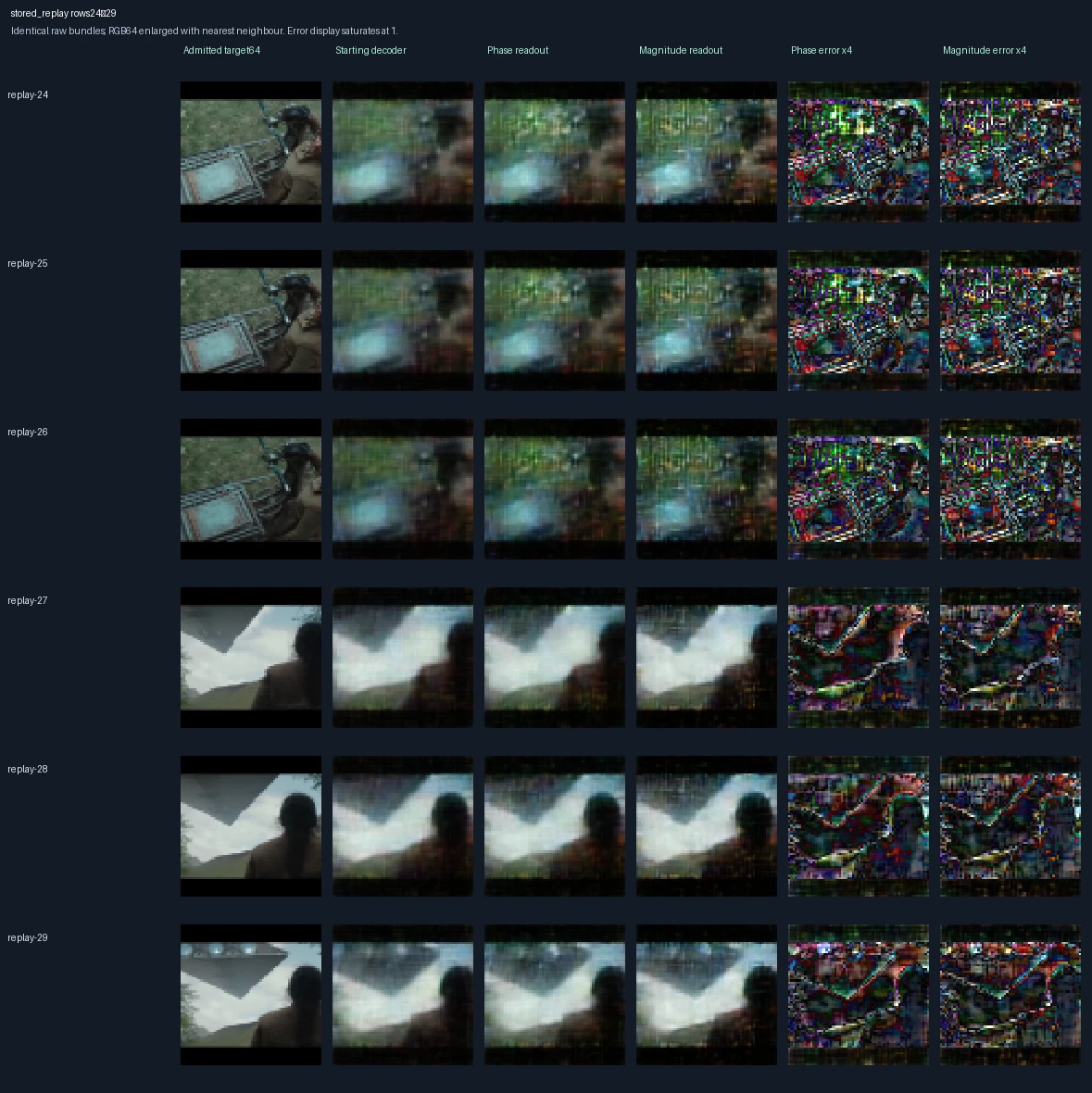
These reconstructions decode the actual vectors saved before encoder refinement; no fresh encoding replaces them. Left to right: target pixels, starting phase-only decoder, trained phase-only decoder, trained magnitude-preserving decoder, then the two trained decoders’ errors. All decoders in a row receive the same raw VSA bundle; only their readout and trained decoder differ. Phase-only readout keeps each complex coordinate’s angle; magnitude-preserving readout also keeps its amplitude, with one fixed scale learned from training data. Error panels show four times the absolute RGB difference from the reference, separately for each color channel, clipped at full brightness. Darker pixels mean smaller errors; black is zero or below the display’s precision. The scale is fixed across examples, not adjusted to make each image look better.
Reading stored vectors: earlier Andor video frames 30–35
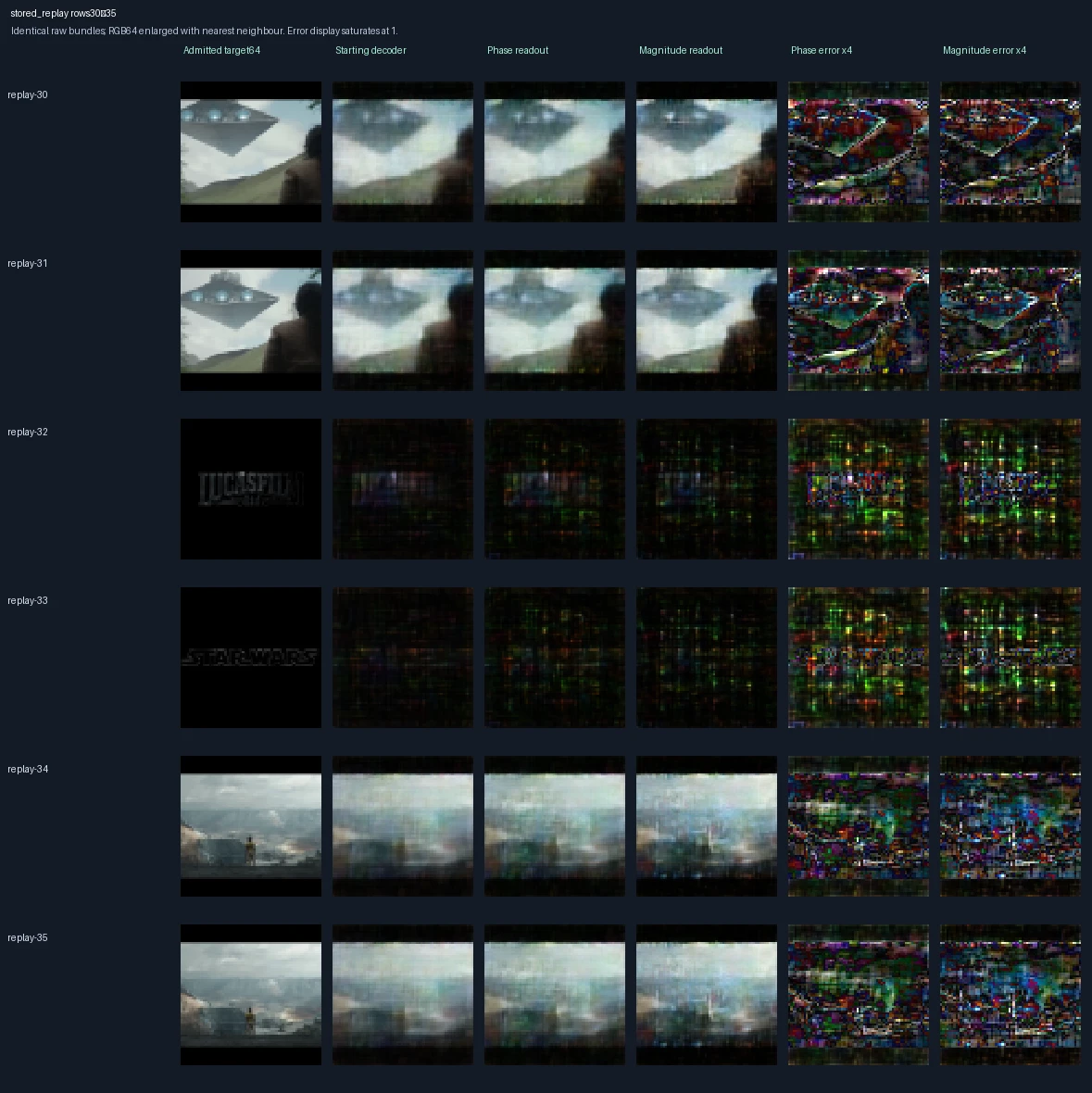
These reconstructions decode the actual vectors saved before encoder refinement; no fresh encoding replaces them. Left to right: target pixels, starting phase-only decoder, trained phase-only decoder, trained magnitude-preserving decoder, then the two trained decoders’ errors. All decoders in a row receive the same raw VSA bundle; only their readout and trained decoder differ. Phase-only readout keeps each complex coordinate’s angle; magnitude-preserving readout also keeps its amplitude, with one fixed scale learned from training data. Error panels show four times the absolute RGB difference from the reference, separately for each color channel, clipped at full brightness. Darker pixels mean smaller errors; black is zero or below the display’s precision. The scale is fixed across examples, not adjusted to make each image look better.
Reading stored vectors: earlier Andor video frames 36–41
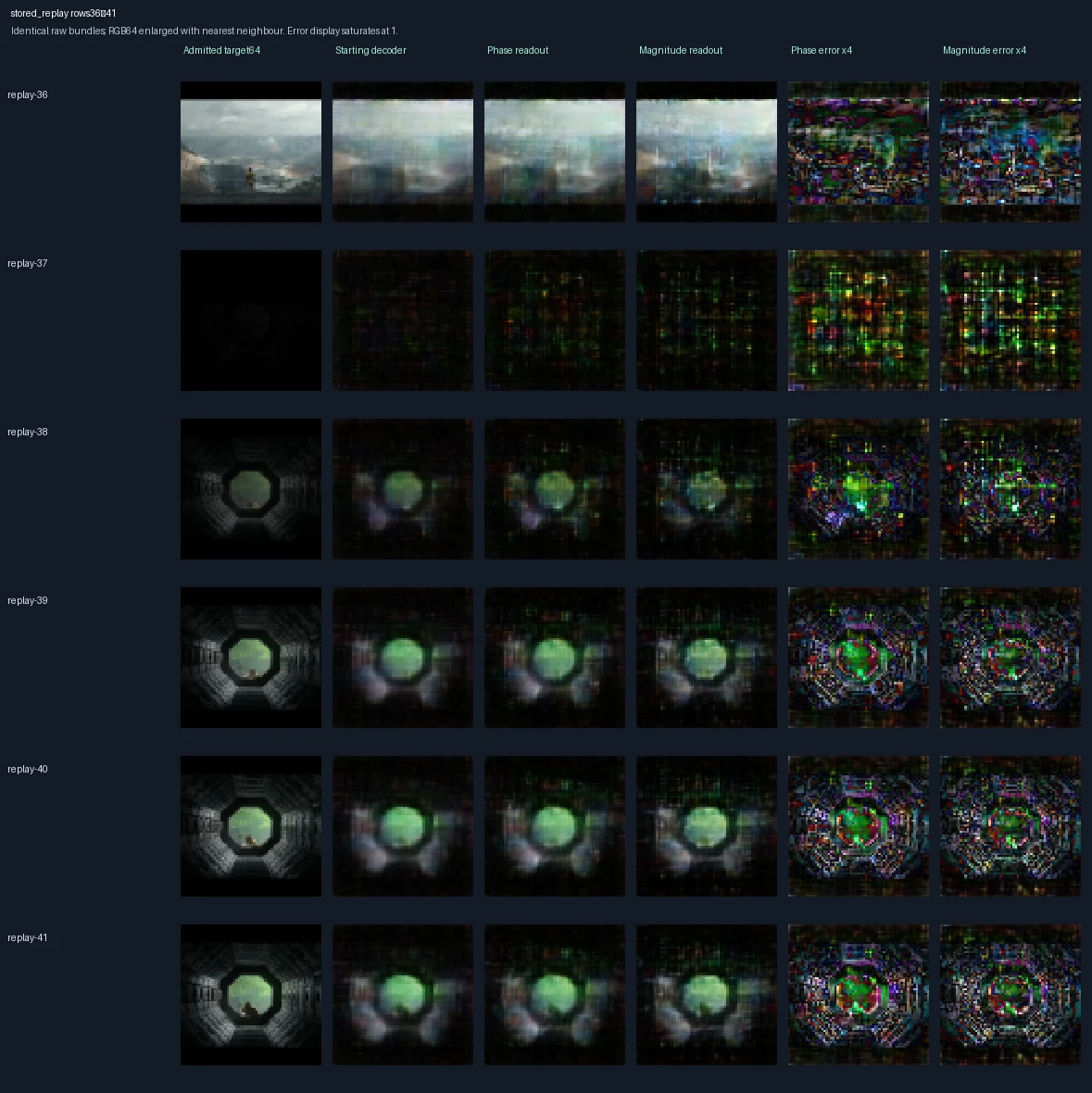
These reconstructions decode the actual vectors saved before encoder refinement; no fresh encoding replaces them. Left to right: target pixels, starting phase-only decoder, trained phase-only decoder, trained magnitude-preserving decoder, then the two trained decoders’ errors. All decoders in a row receive the same raw VSA bundle; only their readout and trained decoder differ. Phase-only readout keeps each complex coordinate’s angle; magnitude-preserving readout also keeps its amplitude, with one fixed scale learned from training data. Error panels show four times the absolute RGB difference from the reference, separately for each color channel, clipped at full brightness. Darker pixels mean smaller errors; black is zero or below the display’s precision. The scale is fixed across examples, not adjusted to make each image look better.
Reading stored vectors: earlier Andor video frames 42–47
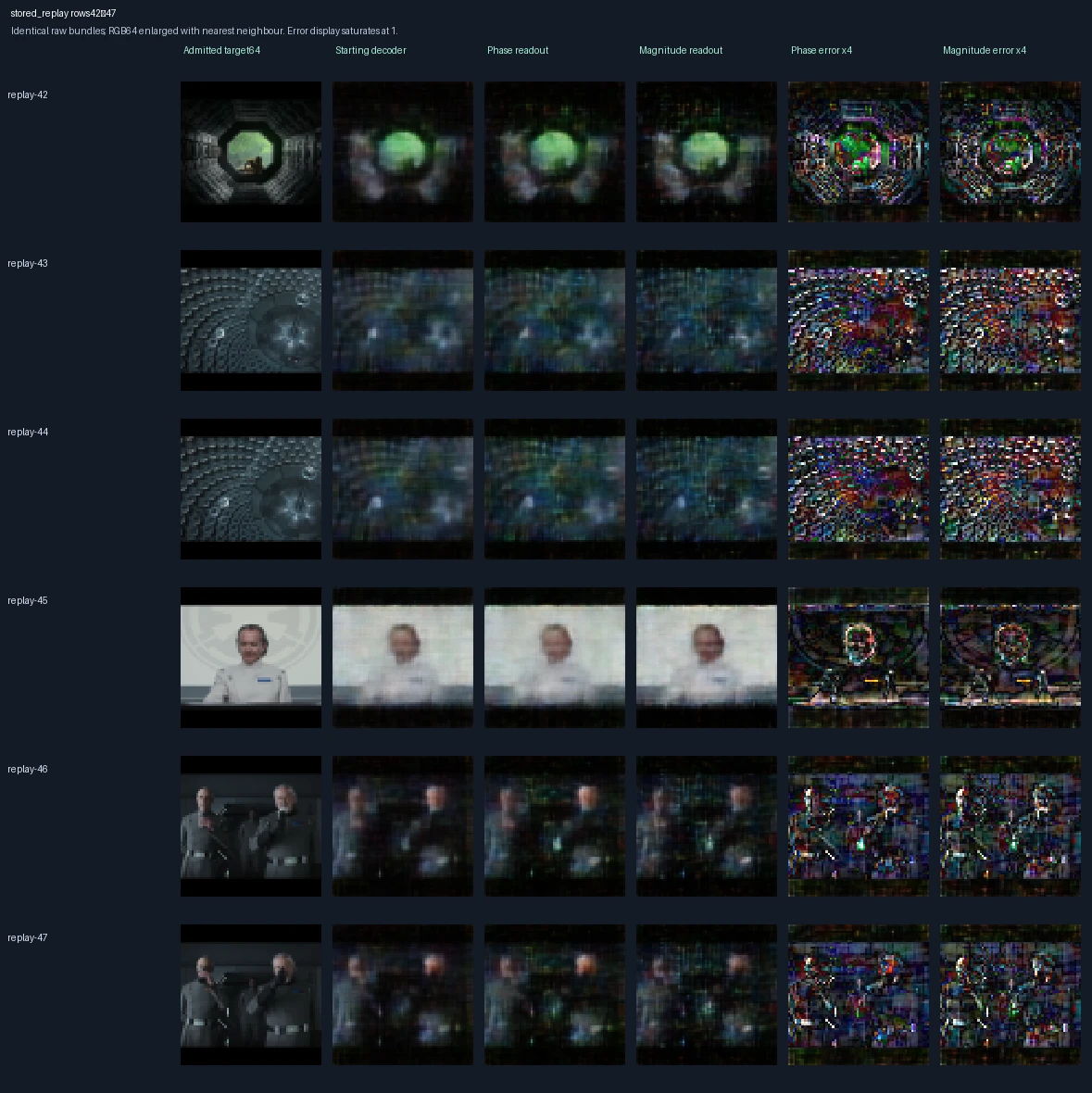
These reconstructions decode the actual vectors saved before encoder refinement; no fresh encoding replaces them. Left to right: target pixels, starting phase-only decoder, trained phase-only decoder, trained magnitude-preserving decoder, then the two trained decoders’ errors. All decoders in a row receive the same raw VSA bundle; only their readout and trained decoder differ. Phase-only readout keeps each complex coordinate’s angle; magnitude-preserving readout also keeps its amplitude, with one fixed scale learned from training data. Error panels show four times the absolute RGB difference from the reference, separately for each color channel, clipped at full brightness. Darker pixels mean smaller errors; black is zero or below the display’s precision. The scale is fixed across examples, not adjusted to make each image look better.
Reading stored vectors: earlier Dune video frames 48–53
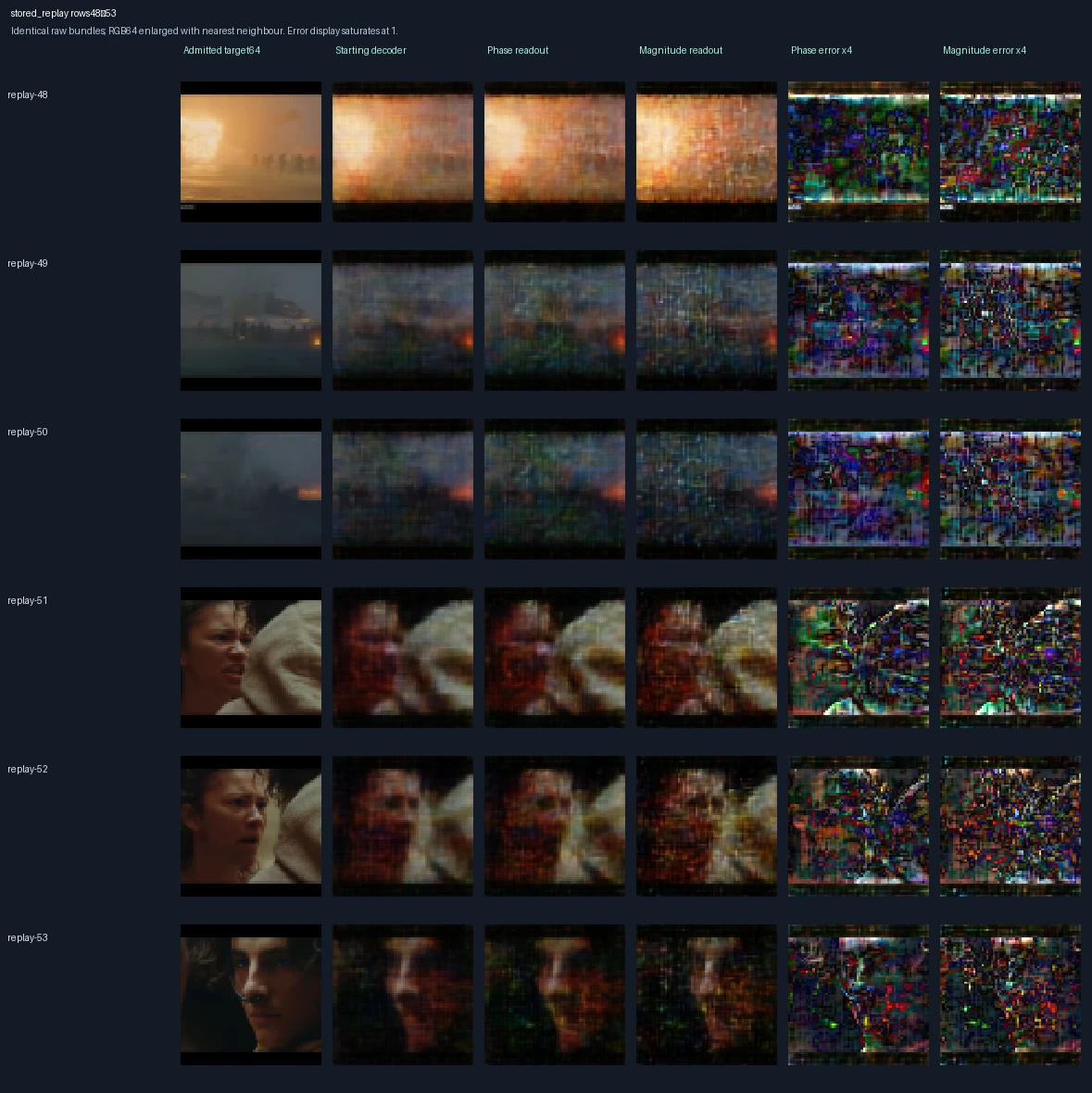
These reconstructions decode the actual vectors saved before encoder refinement; no fresh encoding replaces them. Left to right: target pixels, starting phase-only decoder, trained phase-only decoder, trained magnitude-preserving decoder, then the two trained decoders’ errors. All decoders in a row receive the same raw VSA bundle; only their readout and trained decoder differ. Phase-only readout keeps each complex coordinate’s angle; magnitude-preserving readout also keeps its amplitude, with one fixed scale learned from training data. Error panels show four times the absolute RGB difference from the reference, separately for each color channel, clipped at full brightness. Darker pixels mean smaller errors; black is zero or below the display’s precision. The scale is fixed across examples, not adjusted to make each image look better.
Reading stored vectors: earlier Dune video frames 54–59
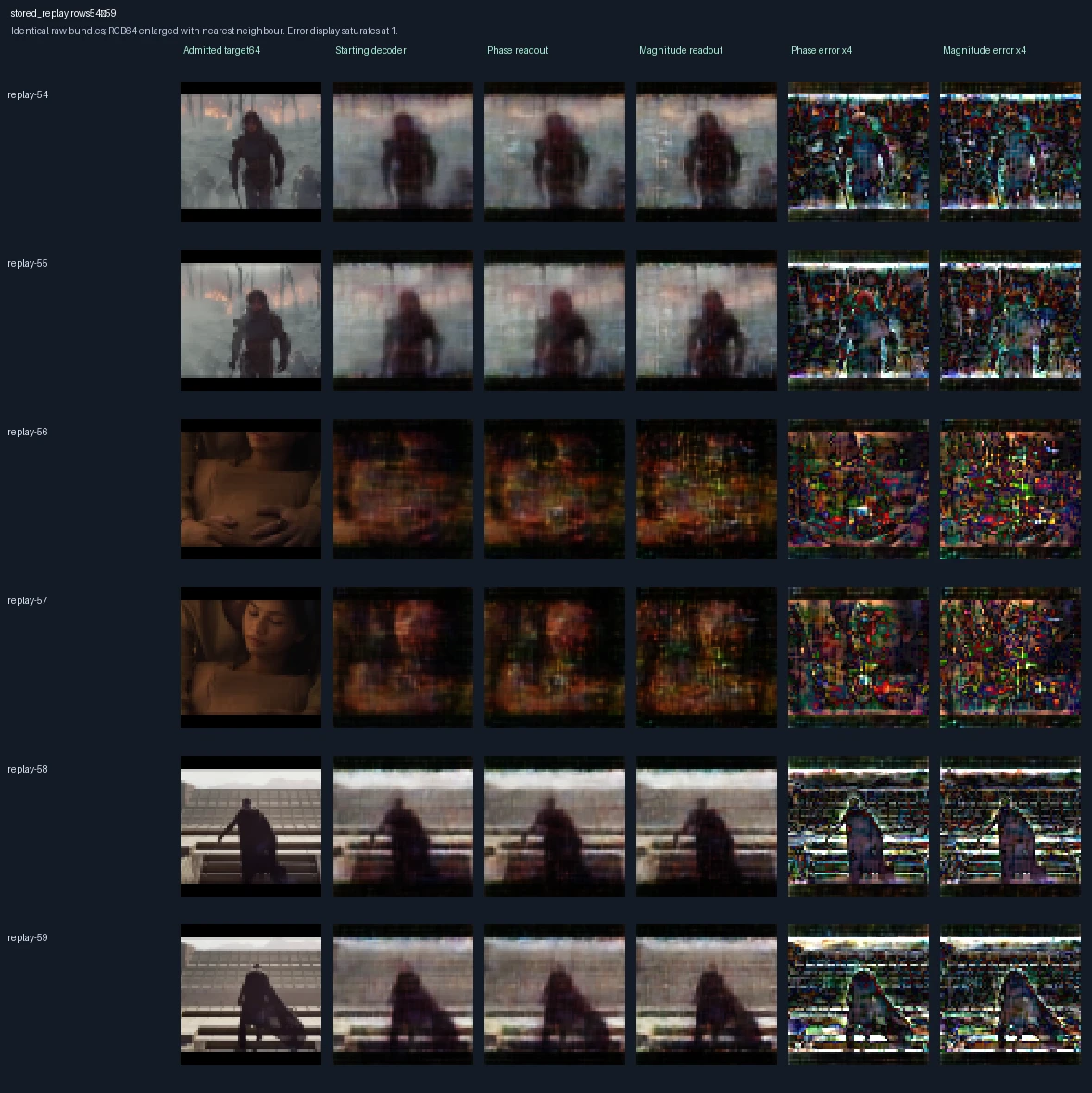
These reconstructions decode the actual vectors saved before encoder refinement; no fresh encoding replaces them. Left to right: target pixels, starting phase-only decoder, trained phase-only decoder, trained magnitude-preserving decoder, then the two trained decoders’ errors. All decoders in a row receive the same raw VSA bundle; only their readout and trained decoder differ. Phase-only readout keeps each complex coordinate’s angle; magnitude-preserving readout also keeps its amplitude, with one fixed scale learned from training data. Error panels show four times the absolute RGB difference from the reference, separately for each color channel, clipped at full brightness. Darker pixels mean smaller errors; black is zero or below the display’s precision. The scale is fixed across examples, not adjusted to make each image look better.
Reading stored vectors: earlier Dune video frames 60–65
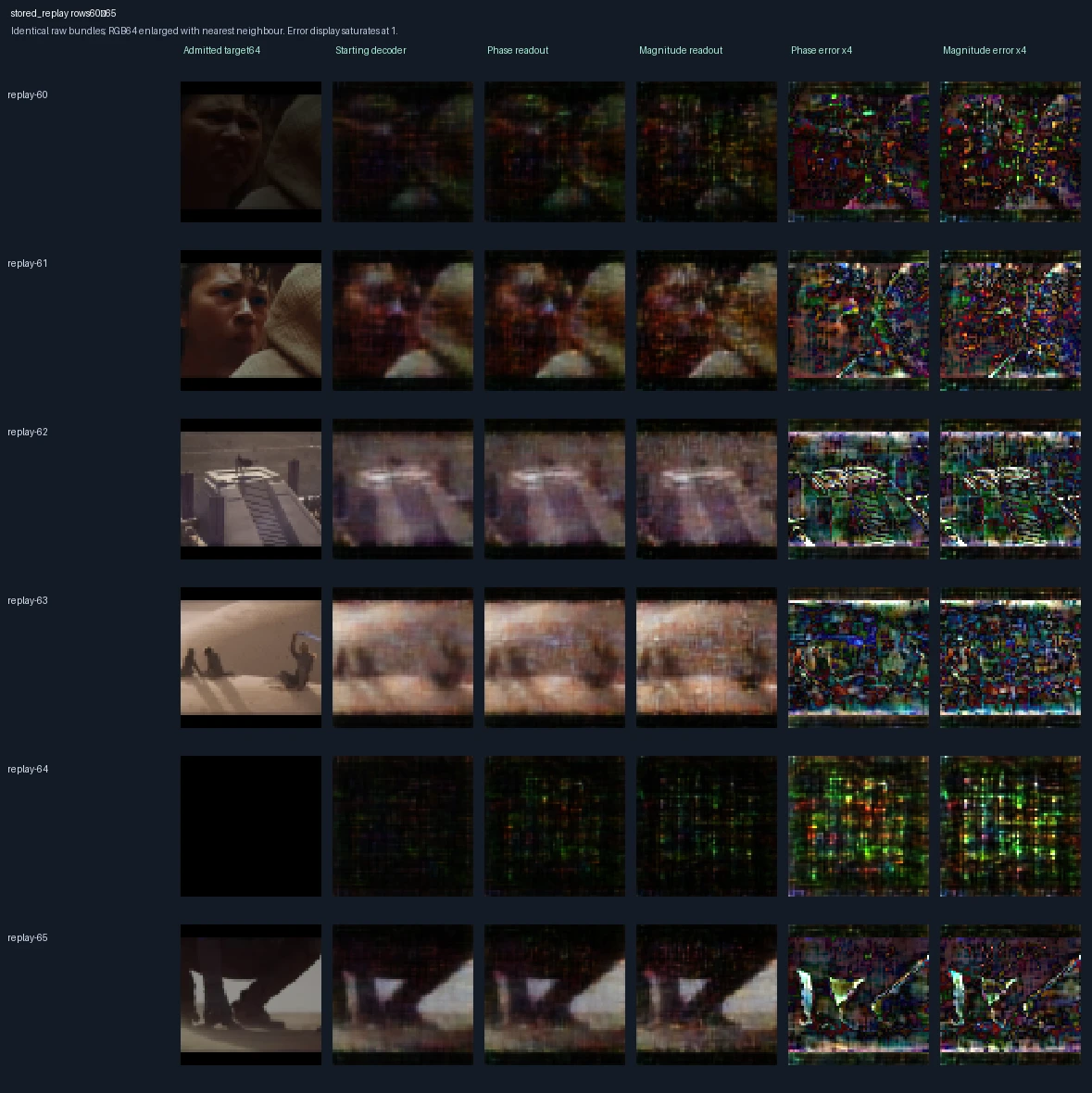
These reconstructions decode the actual vectors saved before encoder refinement; no fresh encoding replaces them. Left to right: target pixels, starting phase-only decoder, trained phase-only decoder, trained magnitude-preserving decoder, then the two trained decoders’ errors. All decoders in a row receive the same raw VSA bundle; only their readout and trained decoder differ. Phase-only readout keeps each complex coordinate’s angle; magnitude-preserving readout also keeps its amplitude, with one fixed scale learned from training data. Error panels show four times the absolute RGB difference from the reference, separately for each color channel, clipped at full brightness. Darker pixels mean smaller errors; black is zero or below the display’s precision. The scale is fixed across examples, not adjusted to make each image look better.
Reading stored vectors: earlier Dune video frames 66–71
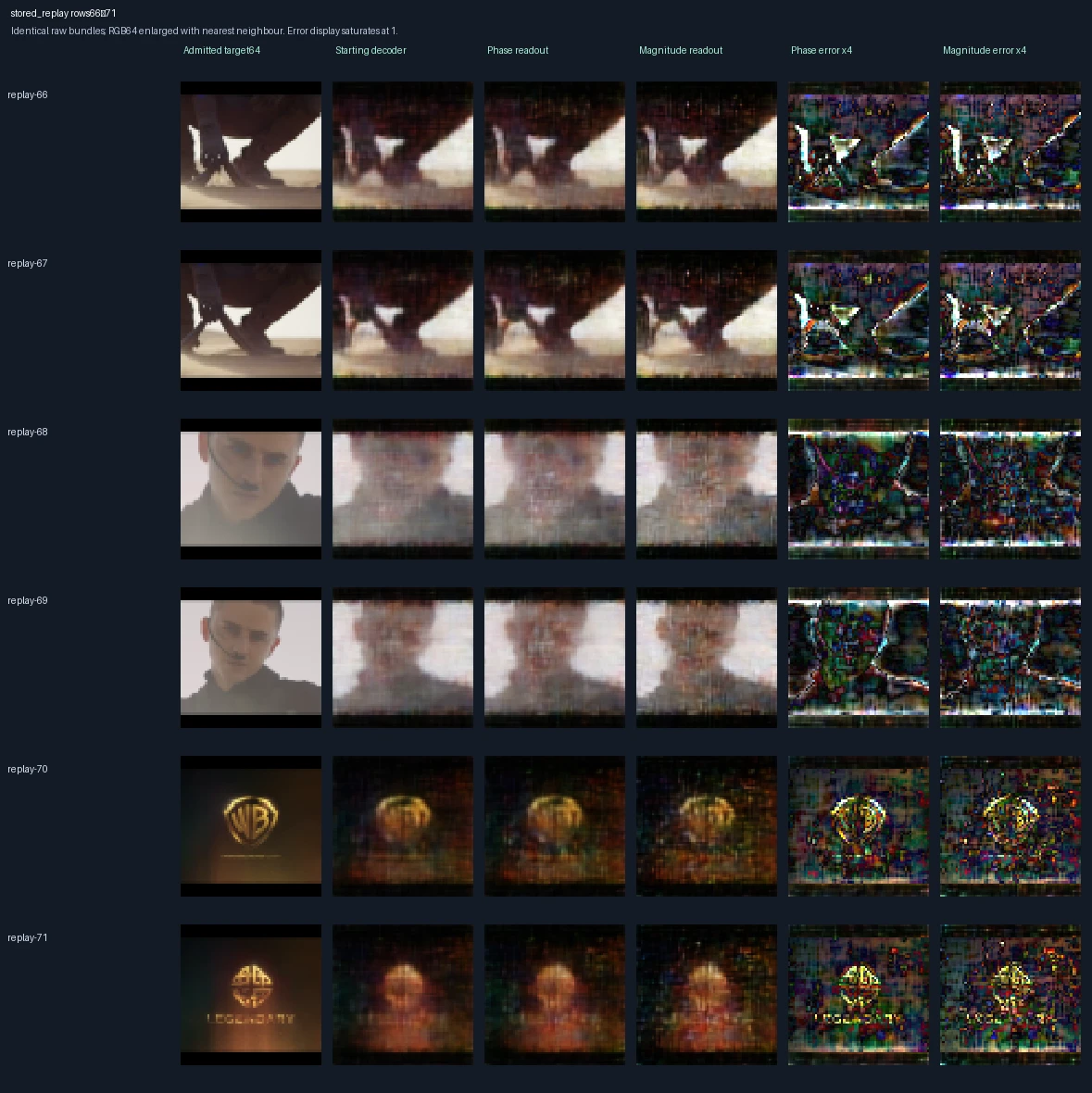
These reconstructions decode the actual vectors saved before encoder refinement; no fresh encoding replaces them. Left to right: target pixels, starting phase-only decoder, trained phase-only decoder, trained magnitude-preserving decoder, then the two trained decoders’ errors. All decoders in a row receive the same raw VSA bundle; only their readout and trained decoder differ. Phase-only readout keeps each complex coordinate’s angle; magnitude-preserving readout also keeps its amplitude, with one fixed scale learned from training data. Error panels show four times the absolute RGB difference from the reference, separately for each color channel, clipped at full brightness. Darker pixels mean smaller errors; black is zero or below the display’s precision. The scale is fixed across examples, not adjusted to make each image look better.
Phase-only versus magnitude-preserving readout during training
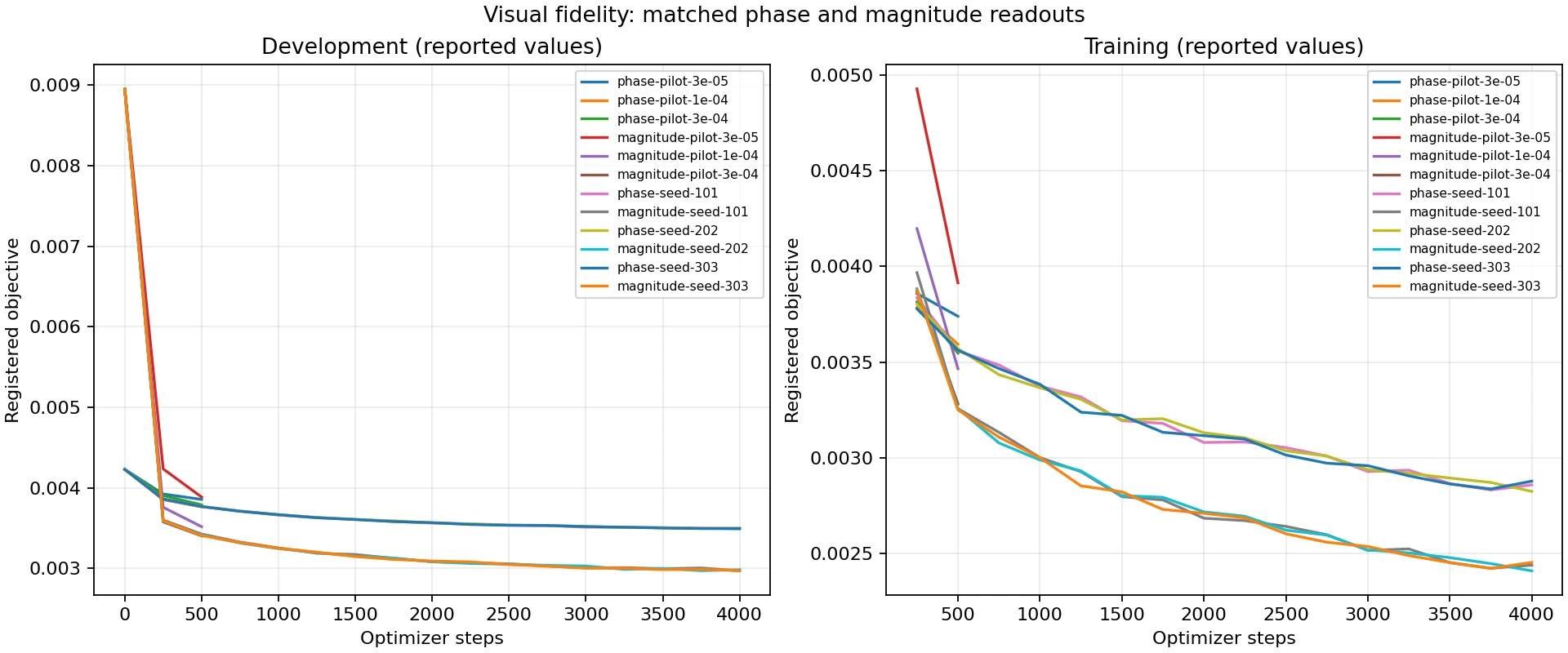
Horizontal axes count weight updates; lower values indicate less reconstruction error. Left: development MSE weighted 75% photographs, 12.5% writing on white, and 12.5% writing on photographs. Right: training minibatch MSE averaged over the preceding evaluation interval. Each line is a learning-rate trial or one of three repeated fits of the labeled readout method. Training points are not whole-training-set evaluations. Phase-only readout keeps each complex coordinate’s angle; magnitude-preserving readout also keeps its amplitude, with one fixed scale learned from training data.
Photographs used to monitor phase and magnitude readout
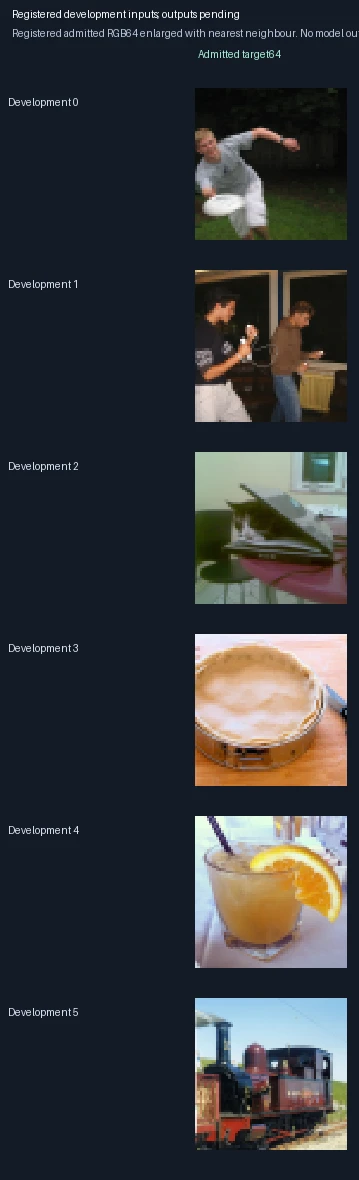
Six fixed development inputs, shown before any model output is added. They are the 64 × 64 center crops actually supplied to the encoder, enlarged for inspection. This figure is an input record, not a reconstruction result.
How much detail is lost before an image reaches the encoder?
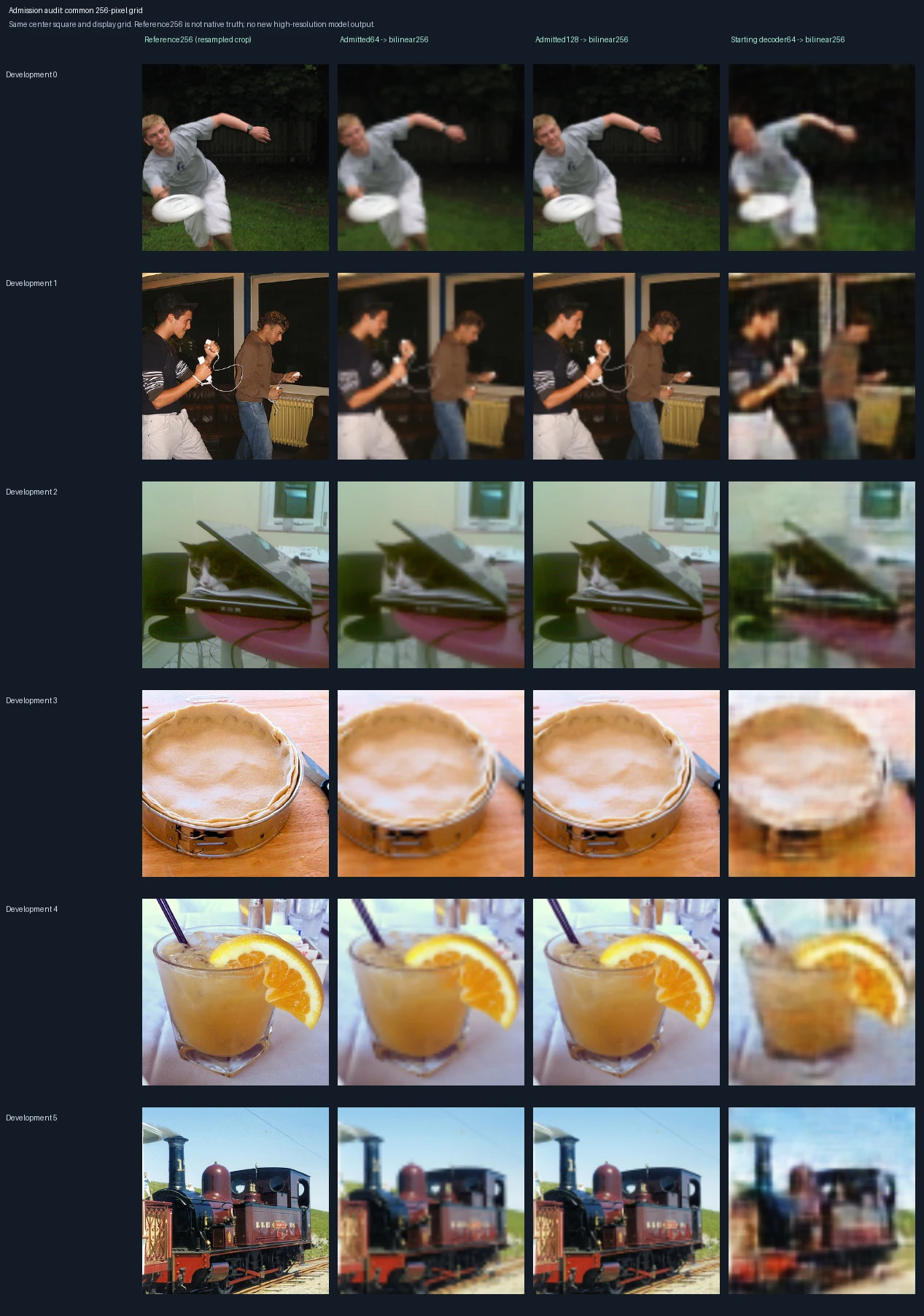
Each row uses the same central square from a development photograph. Left to right: a 256 × 256 reference crop; the crop reduced to 64 × 64 and enlarged back to 256; the crop reduced to 128 × 128 and enlarged back to 256; and the starting model’s 64 × 64 reconstruction enlarged to 256. The middle columns contain no neural reconstruction: they isolate loss from input resizing. The final column adds encoding and decoding loss. The 256-pixel reference is itself resampled, and no 128-pixel neural model was tested.
Phase-only readout: can the decoder fit eight training images?
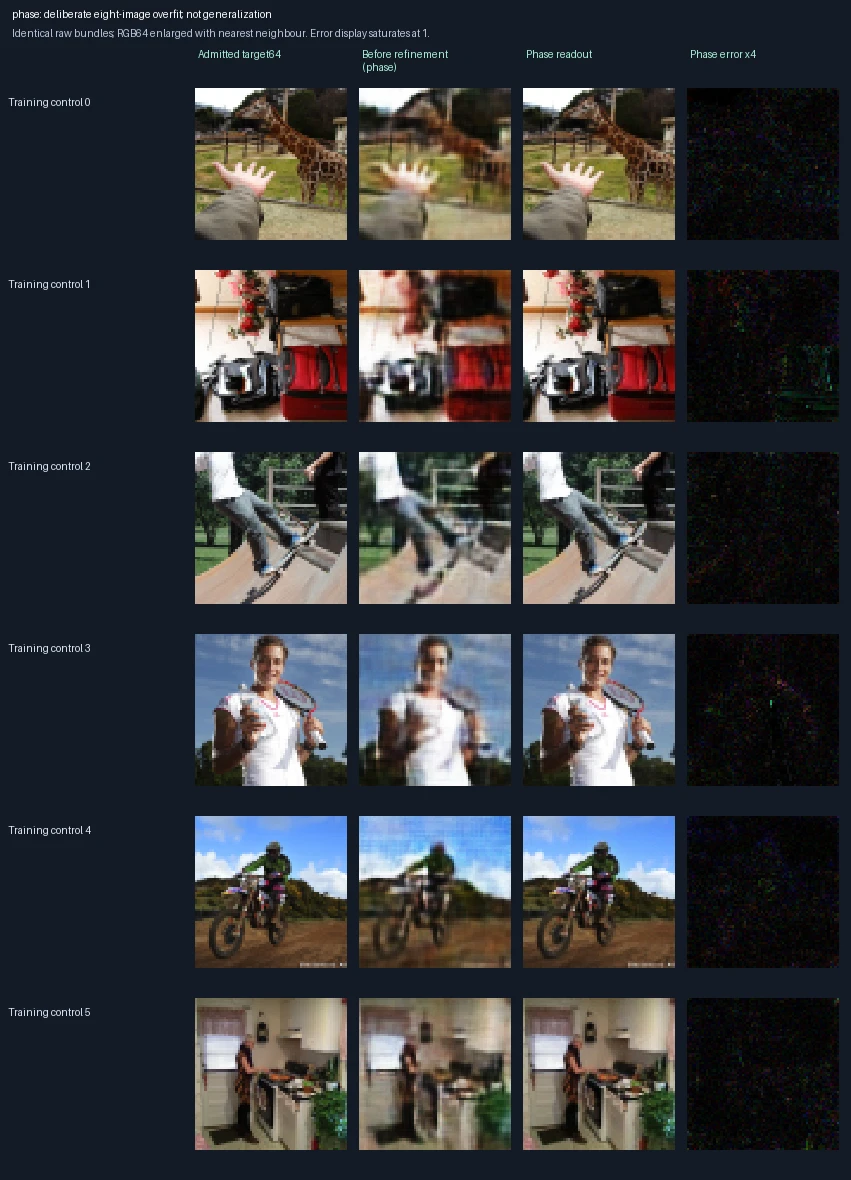
Six of eight deliberately fitted training photographs. Left to right: admitted 64 × 64 target, this readout before training, the same readout after 200 fitting steps, and its final pixel error. The before column already uses phase-only input; it is not a different method’s baseline. This checks whether optimization works, not generalization. Phase-only readout keeps each complex coordinate’s angle; magnitude-preserving readout also keeps its amplitude, with one fixed scale learned from training data. Error panels show four times the absolute RGB difference from the reference, separately for each color channel, clipped at full brightness. Darker pixels mean smaller errors; black is zero or below the display’s precision. The scale is fixed across examples, not adjusted to make each image look better.
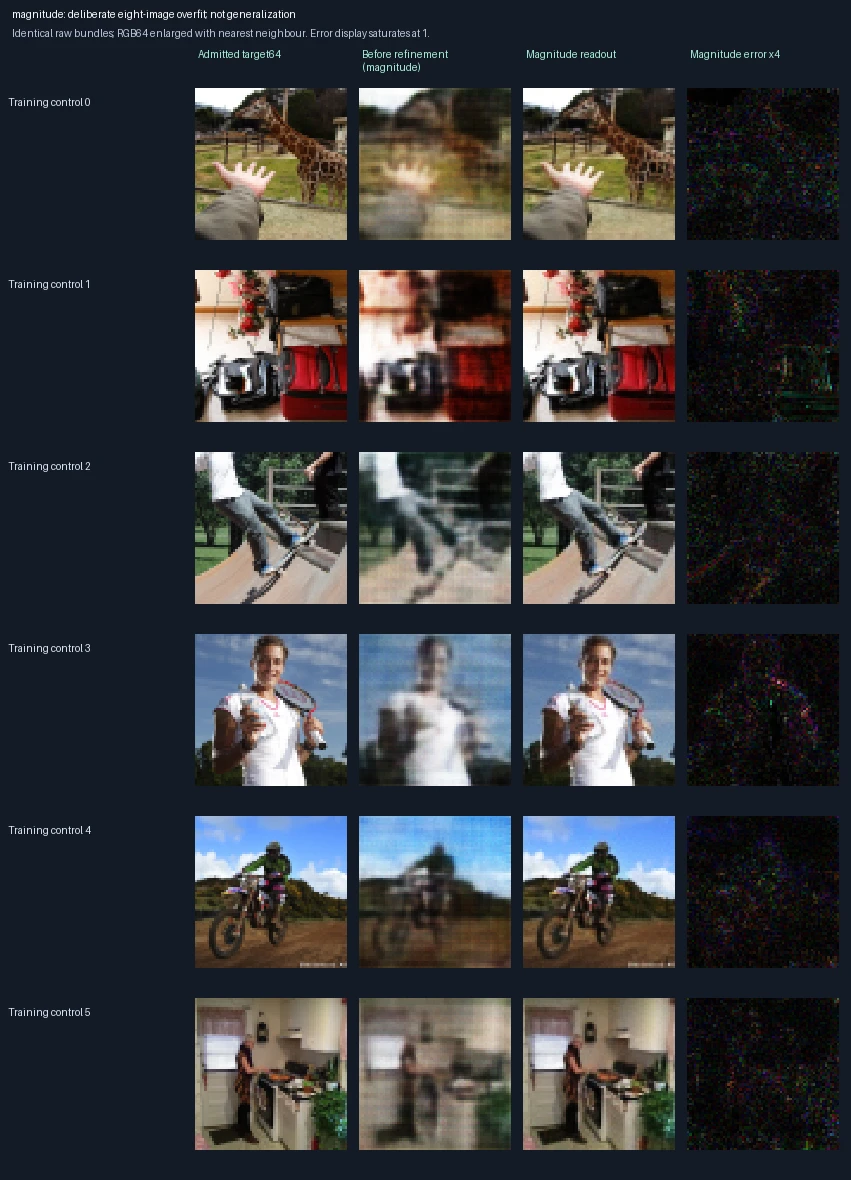
Magnitude-preserving readout: can the decoder fit eight training images?
Six of eight deliberately fitted training photographs. Left to right: admitted 64 × 64 target, this readout before training, the same readout after 200 fitting steps, and its final pixel error. The before column already uses magnitude-preserving input; it is not a different method’s baseline. This checks whether optimization works, not generalization. Phase-only readout keeps each complex coordinate’s angle; magnitude-preserving readout also keeps its amplitude, with one fixed scale learned from training data. Error panels show four times the absolute RGB difference from the reference, separately for each color channel, clipped at full brightness. Darker pixels mean smaller errors; black is zero or below the display’s precision. The scale is fixed across examples, not adjusted to make each image look better.
Phase-only readout, learning-rate trial (3e-05): 0 weight updates
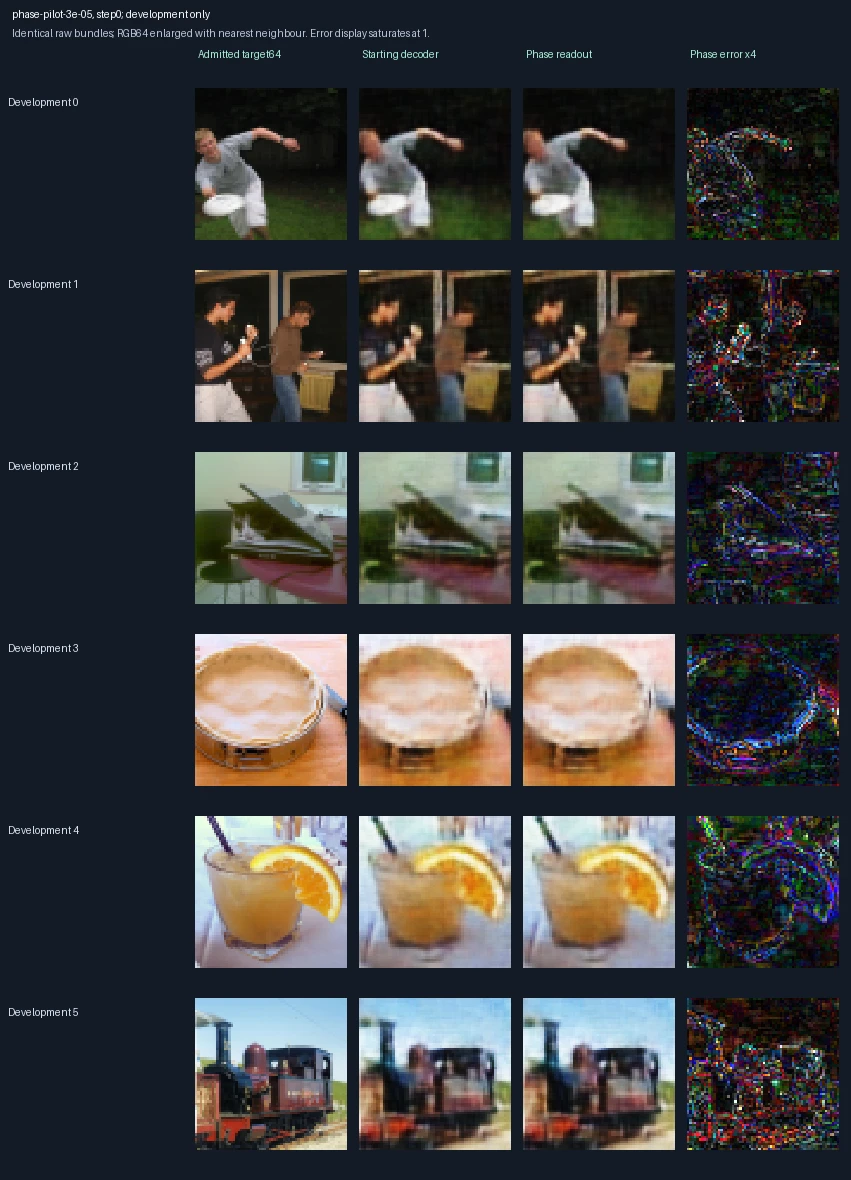
Six fixed development photographs. Left to right: the 64 × 64 input, the unchanged starting decoder using phase-only readout, this candidate’s reconstruction, and this candidate’s error. This short trial uses learning rate 3e-05, a setting that controls the size of weight updates. The encoder is fixed; only the decoder learns. These examples guide model selection, not final test claims. Phase-only readout keeps each complex coordinate’s angle; magnitude-preserving readout also keeps its amplitude, with one fixed scale learned from training data. Error panels show four times the absolute RGB difference from the reference, separately for each color channel, clipped at full brightness. Darker pixels mean smaller errors; black is zero or below the display’s precision. The scale is fixed across examples, not adjusted to make each image look better.
Phase-only readout, learning-rate trial (3e-05): 250 weight updates
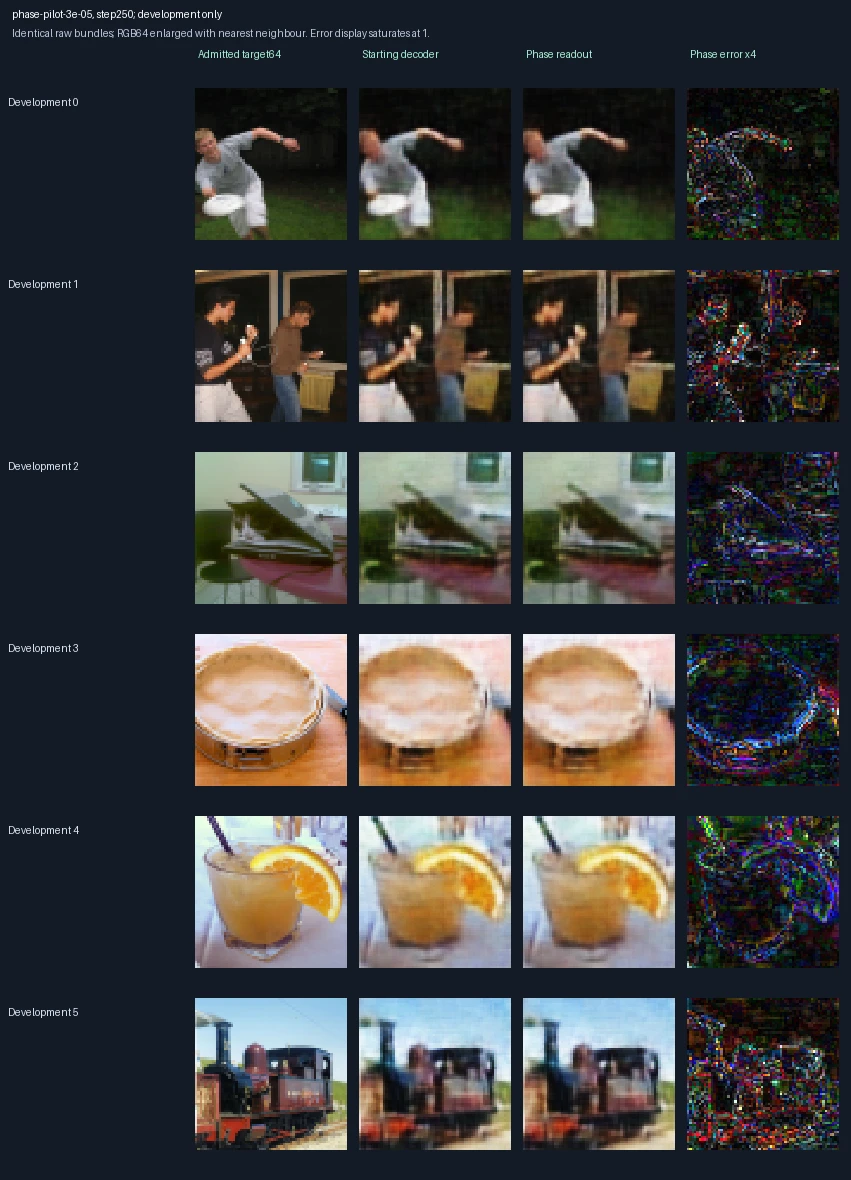
Six fixed development photographs. Left to right: the 64 × 64 input, the unchanged starting decoder using phase-only readout, this candidate’s reconstruction, and this candidate’s error. This short trial uses learning rate 3e-05, a setting that controls the size of weight updates. The encoder is fixed; only the decoder learns. These examples guide model selection, not final test claims. Phase-only readout keeps each complex coordinate’s angle; magnitude-preserving readout also keeps its amplitude, with one fixed scale learned from training data. Error panels show four times the absolute RGB difference from the reference, separately for each color channel, clipped at full brightness. Darker pixels mean smaller errors; black is zero or below the display’s precision. The scale is fixed across examples, not adjusted to make each image look better.
Phase-only readout, learning-rate trial (3e-05): 500 weight updates
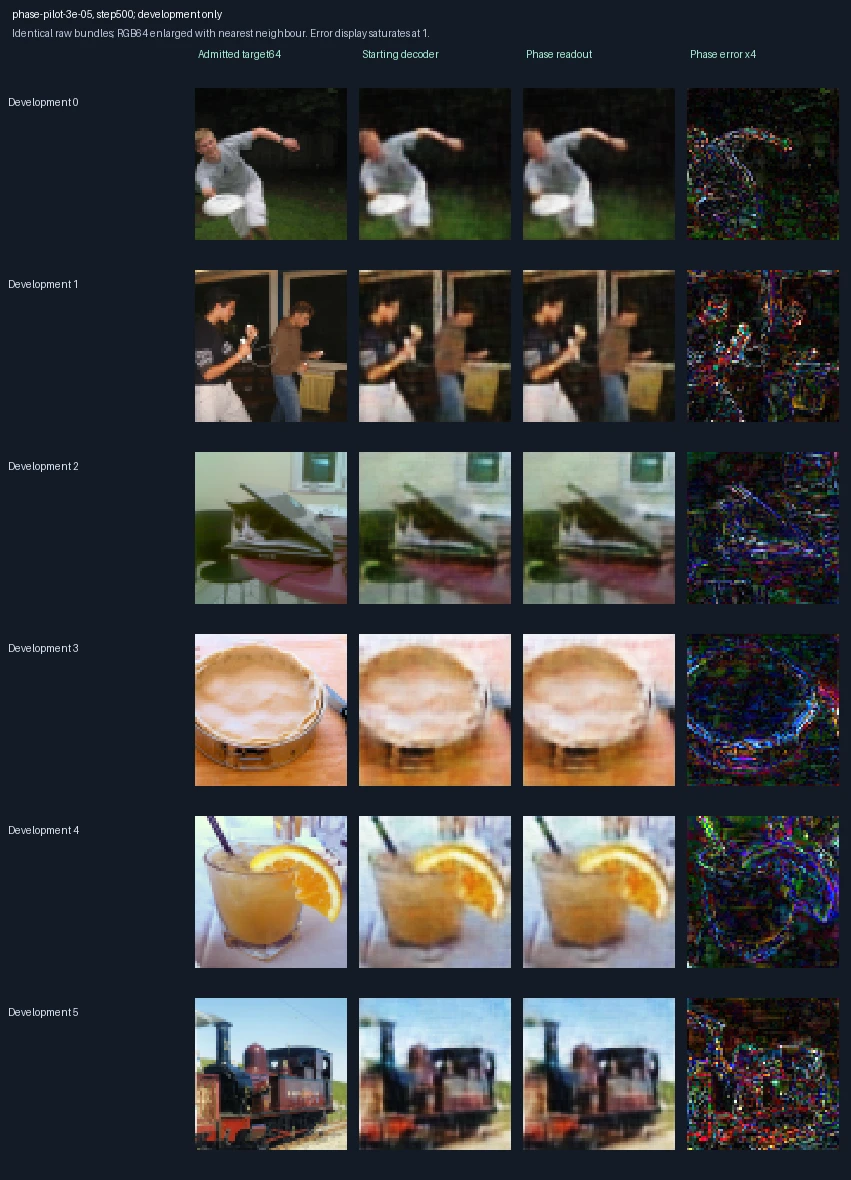
Six fixed development photographs. Left to right: the 64 × 64 input, the unchanged starting decoder using phase-only readout, this candidate’s reconstruction, and this candidate’s error. This short trial uses learning rate 3e-05, a setting that controls the size of weight updates. The encoder is fixed; only the decoder learns. These examples guide model selection, not final test claims. Phase-only readout keeps each complex coordinate’s angle; magnitude-preserving readout also keeps its amplitude, with one fixed scale learned from training data. Error panels show four times the absolute RGB difference from the reference, separately for each color channel, clipped at full brightness. Darker pixels mean smaller errors; black is zero or below the display’s precision. The scale is fixed across examples, not adjusted to make each image look better.
Phase-only readout, learning-rate trial (1e-04): 0 weight updates
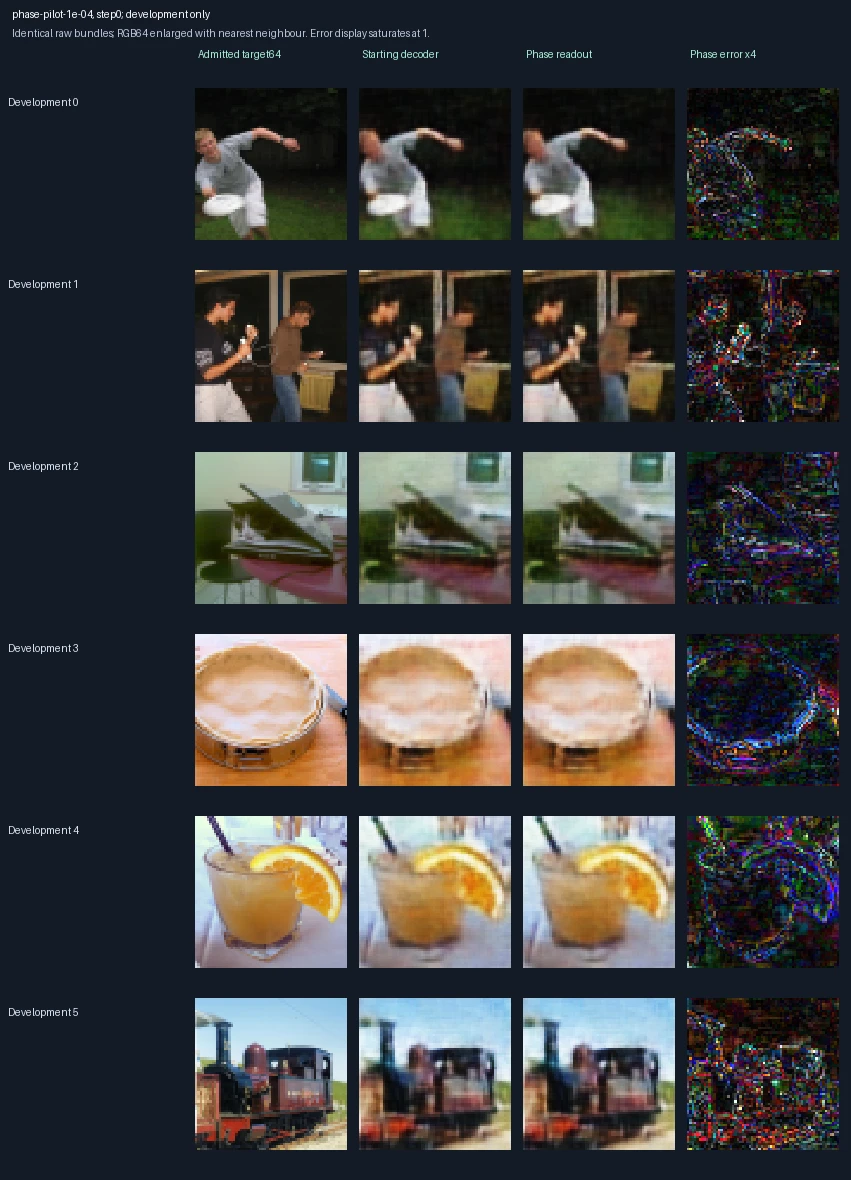
Six fixed development photographs. Left to right: the 64 × 64 input, the unchanged starting decoder using phase-only readout, this candidate’s reconstruction, and this candidate’s error. This short trial uses learning rate 1e-04, a setting that controls the size of weight updates. The encoder is fixed; only the decoder learns. These examples guide model selection, not final test claims. Phase-only readout keeps each complex coordinate’s angle; magnitude-preserving readout also keeps its amplitude, with one fixed scale learned from training data. Error panels show four times the absolute RGB difference from the reference, separately for each color channel, clipped at full brightness. Darker pixels mean smaller errors; black is zero or below the display’s precision. The scale is fixed across examples, not adjusted to make each image look better.
Phase-only readout, learning-rate trial (1e-04): 250 weight updates
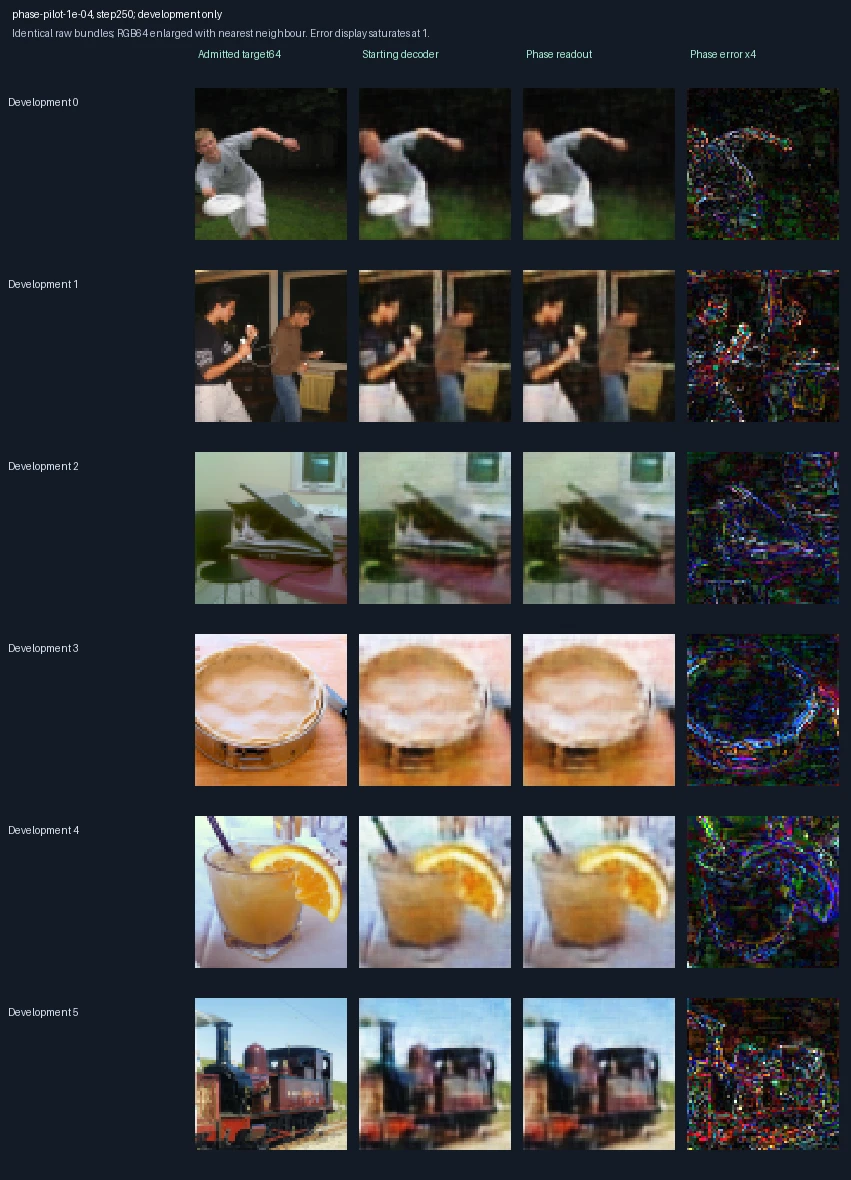
Six fixed development photographs. Left to right: the 64 × 64 input, the unchanged starting decoder using phase-only readout, this candidate’s reconstruction, and this candidate’s error. This short trial uses learning rate 1e-04, a setting that controls the size of weight updates. The encoder is fixed; only the decoder learns. These examples guide model selection, not final test claims. Phase-only readout keeps each complex coordinate’s angle; magnitude-preserving readout also keeps its amplitude, with one fixed scale learned from training data. Error panels show four times the absolute RGB difference from the reference, separately for each color channel, clipped at full brightness. Darker pixels mean smaller errors; black is zero or below the display’s precision. The scale is fixed across examples, not adjusted to make each image look better.
Phase-only readout, learning-rate trial (1e-04): 500 weight updates
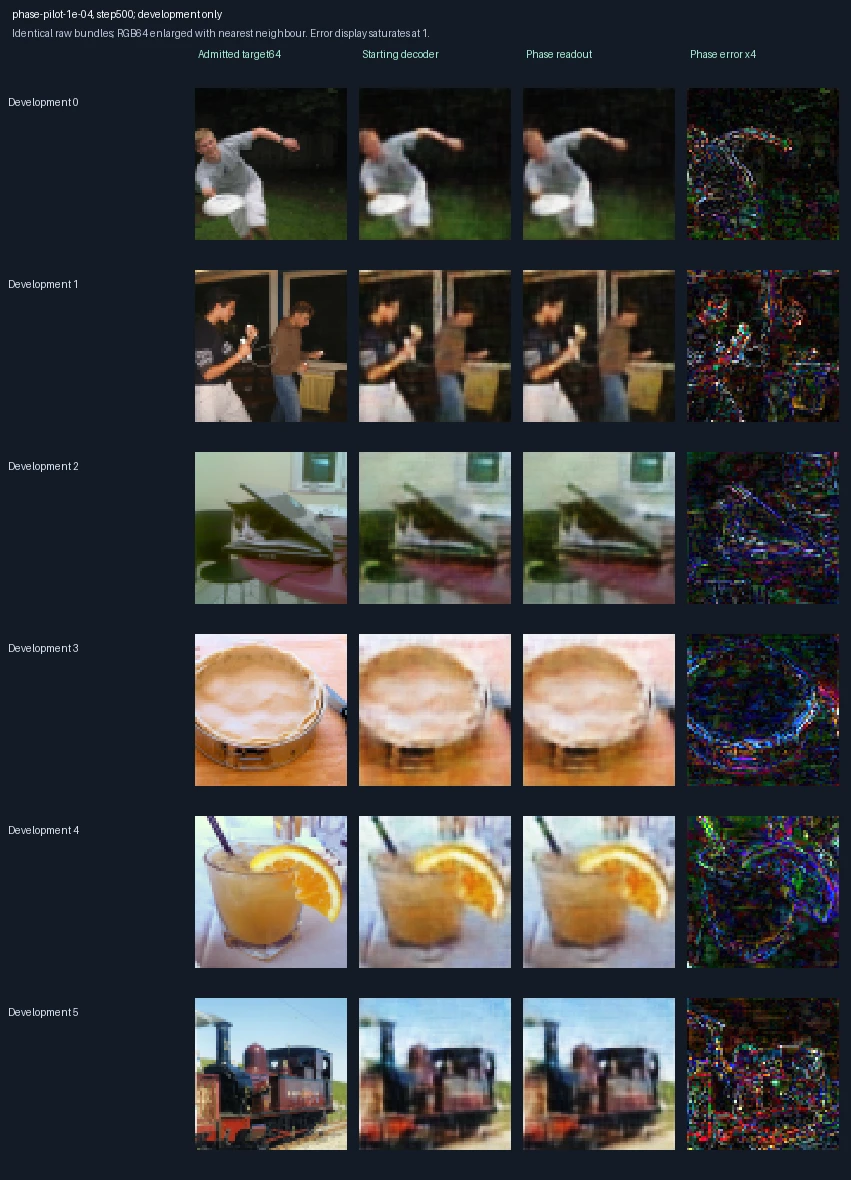
Six fixed development photographs. Left to right: the 64 × 64 input, the unchanged starting decoder using phase-only readout, this candidate’s reconstruction, and this candidate’s error. This short trial uses learning rate 1e-04, a setting that controls the size of weight updates. The encoder is fixed; only the decoder learns. These examples guide model selection, not final test claims. Phase-only readout keeps each complex coordinate’s angle; magnitude-preserving readout also keeps its amplitude, with one fixed scale learned from training data. Error panels show four times the absolute RGB difference from the reference, separately for each color channel, clipped at full brightness. Darker pixels mean smaller errors; black is zero or below the display’s precision. The scale is fixed across examples, not adjusted to make each image look better.
Phase-only readout, learning-rate trial (3e-04): 0 weight updates
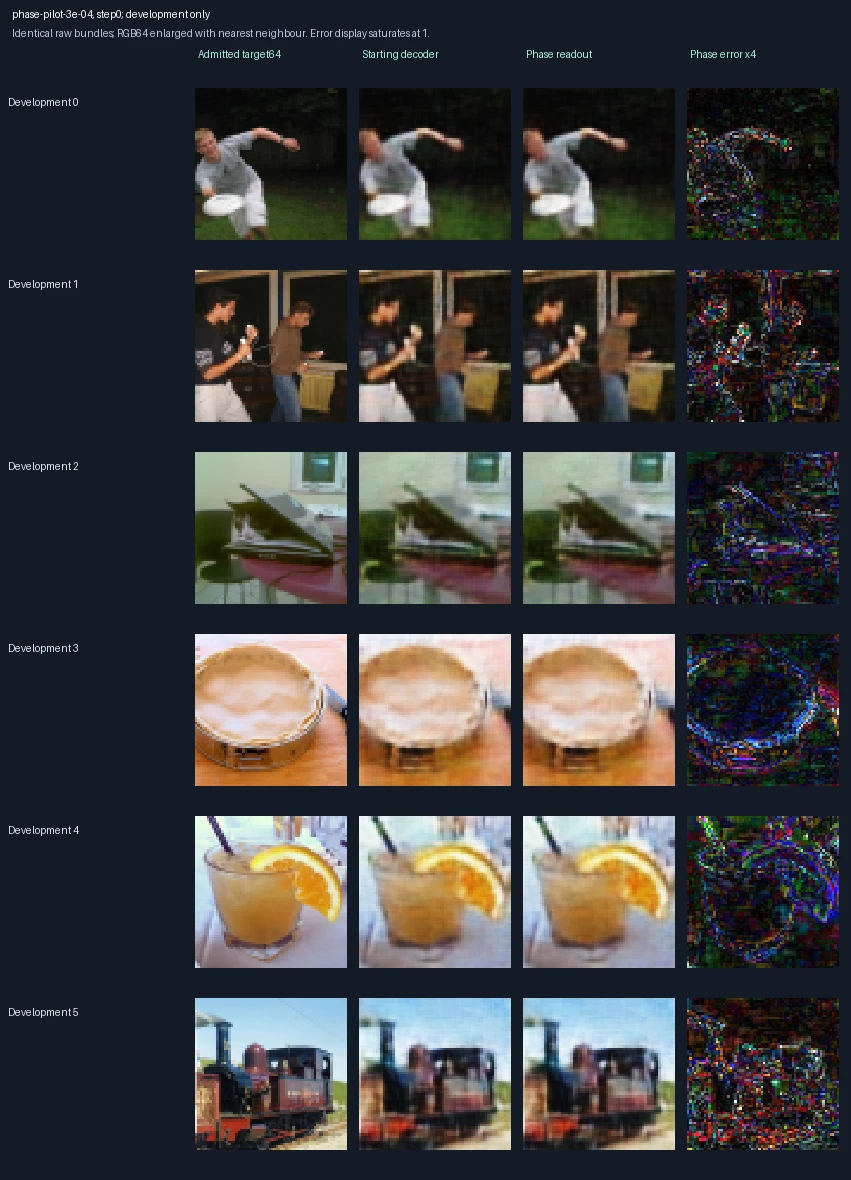
Six fixed development photographs. Left to right: the 64 × 64 input, the unchanged starting decoder using phase-only readout, this candidate’s reconstruction, and this candidate’s error. This short trial uses learning rate 3e-04, a setting that controls the size of weight updates. The encoder is fixed; only the decoder learns. These examples guide model selection, not final test claims. Phase-only readout keeps each complex coordinate’s angle; magnitude-preserving readout also keeps its amplitude, with one fixed scale learned from training data. Error panels show four times the absolute RGB difference from the reference, separately for each color channel, clipped at full brightness. Darker pixels mean smaller errors; black is zero or below the display’s precision. The scale is fixed across examples, not adjusted to make each image look better.
Phase-only readout, learning-rate trial (3e-04): 250 weight updates
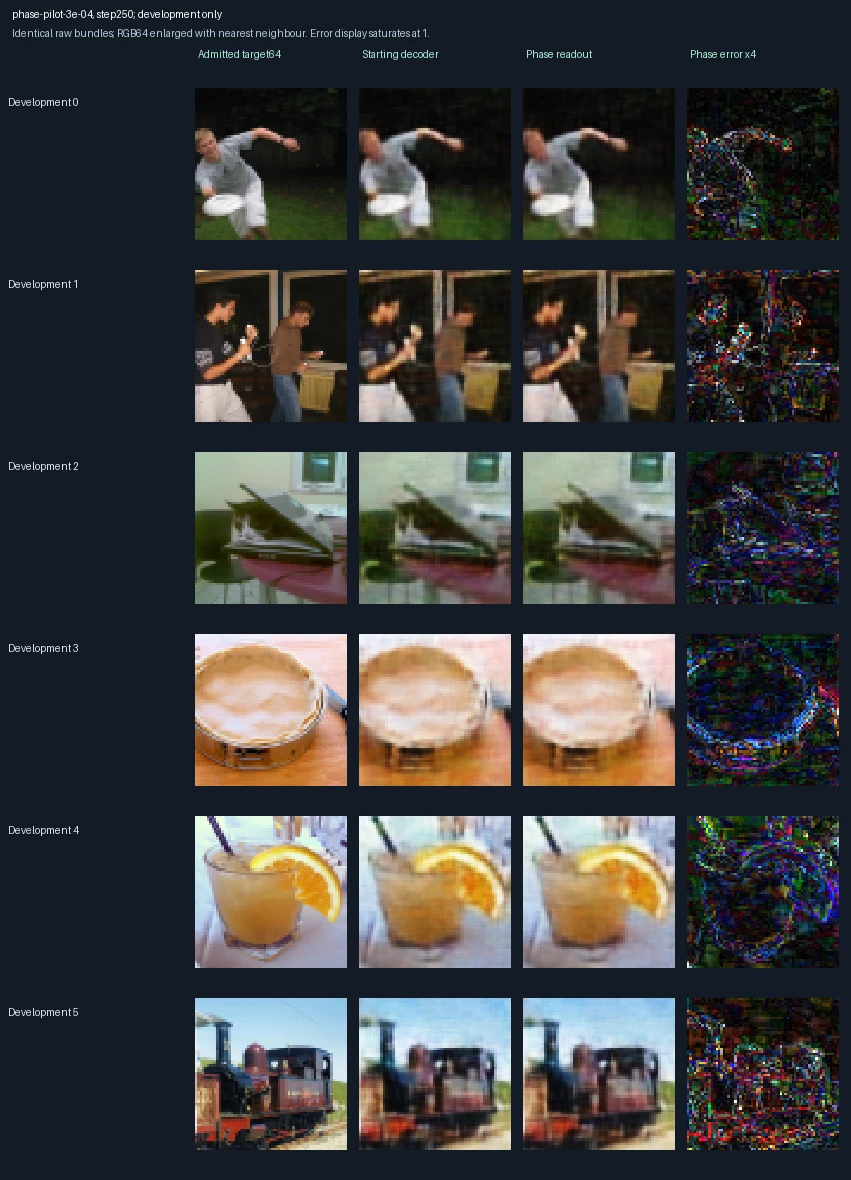
Six fixed development photographs. Left to right: the 64 × 64 input, the unchanged starting decoder using phase-only readout, this candidate’s reconstruction, and this candidate’s error. This short trial uses learning rate 3e-04, a setting that controls the size of weight updates. The encoder is fixed; only the decoder learns. These examples guide model selection, not final test claims. Phase-only readout keeps each complex coordinate’s angle; magnitude-preserving readout also keeps its amplitude, with one fixed scale learned from training data. Error panels show four times the absolute RGB difference from the reference, separately for each color channel, clipped at full brightness. Darker pixels mean smaller errors; black is zero or below the display’s precision. The scale is fixed across examples, not adjusted to make each image look better.
Phase-only readout, learning-rate trial (3e-04): 500 weight updates
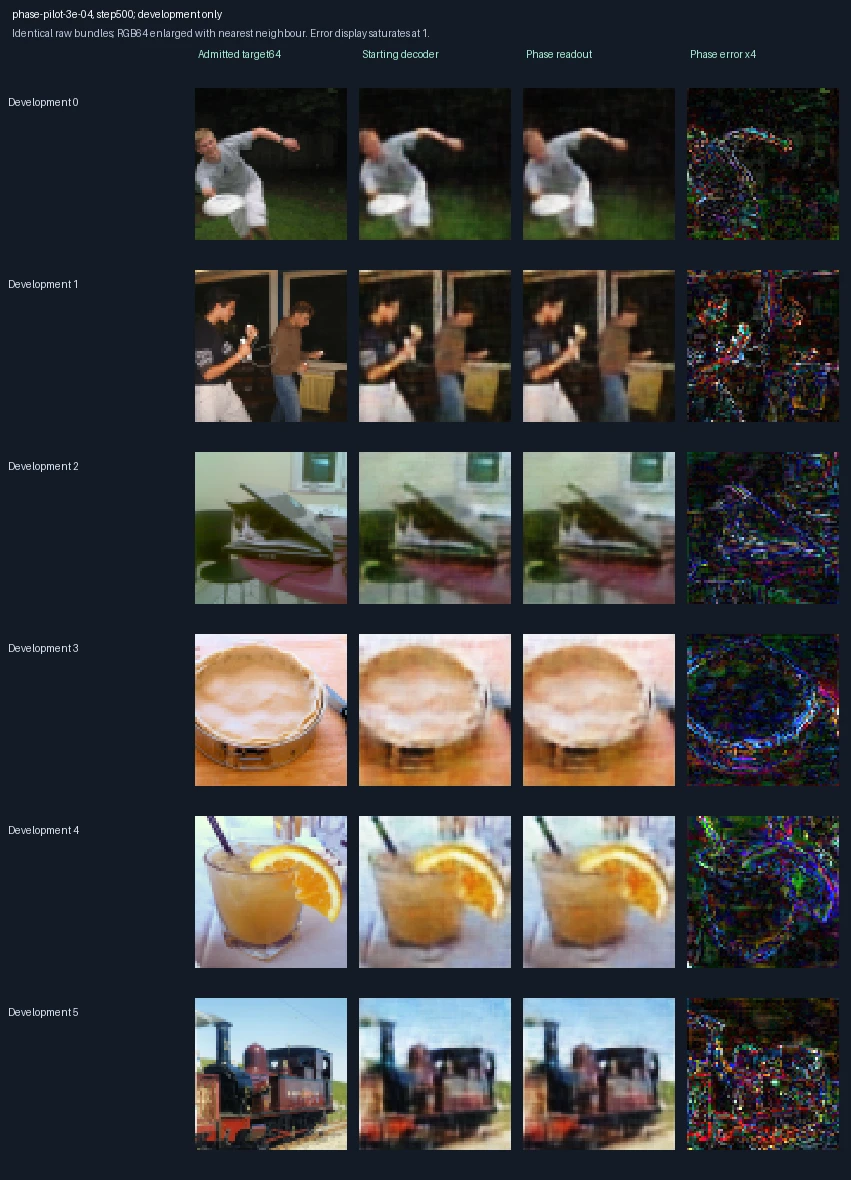
Six fixed development photographs. Left to right: the 64 × 64 input, the unchanged starting decoder using phase-only readout, this candidate’s reconstruction, and this candidate’s error. This short trial uses learning rate 3e-04, a setting that controls the size of weight updates. The encoder is fixed; only the decoder learns. These examples guide model selection, not final test claims. Phase-only readout keeps each complex coordinate’s angle; magnitude-preserving readout also keeps its amplitude, with one fixed scale learned from training data. Error panels show four times the absolute RGB difference from the reference, separately for each color channel, clipped at full brightness. Darker pixels mean smaller errors; black is zero or below the display’s precision. The scale is fixed across examples, not adjusted to make each image look better.
Magnitude-preserving readout, learning-rate trial (3e-05): 0 weight updates
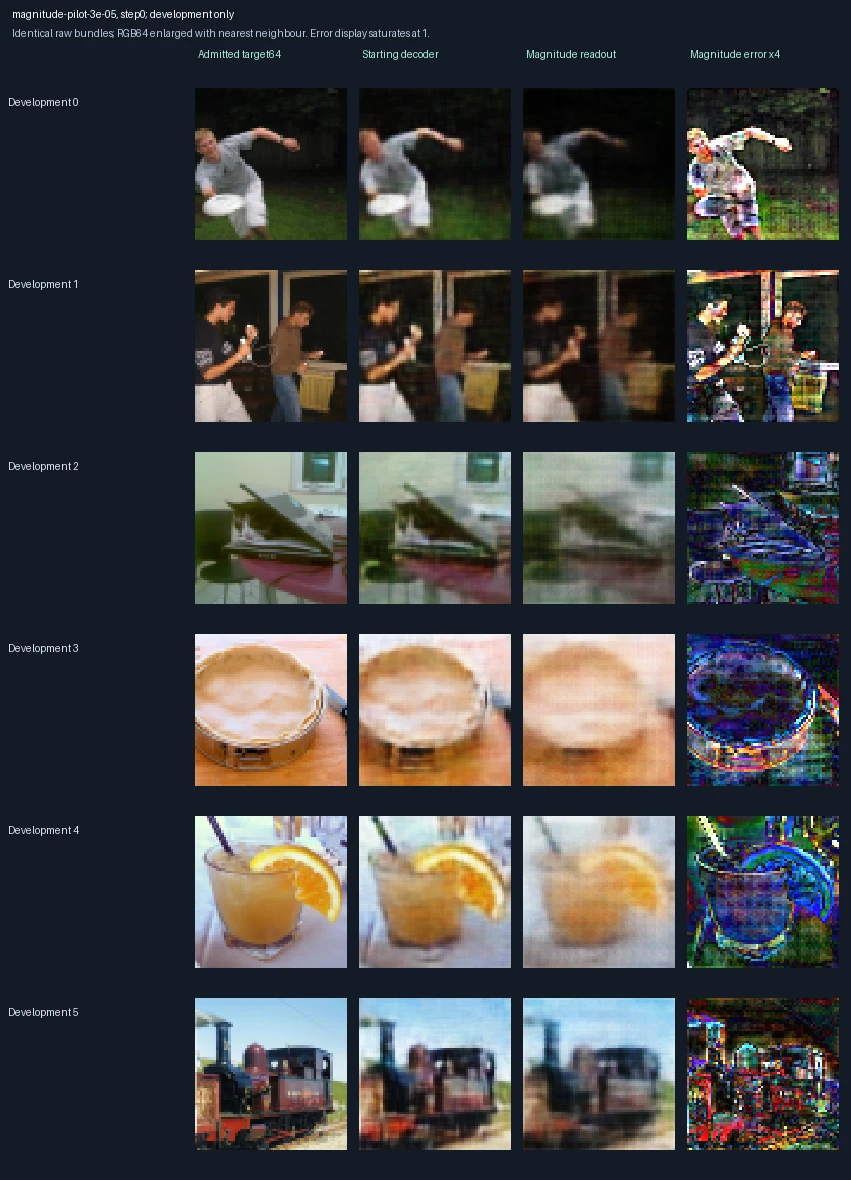
Six fixed development photographs. Left to right: the 64 × 64 input, the unchanged starting decoder using phase-only readout, this candidate’s reconstruction, and this candidate’s error. This short trial uses learning rate 3e-05, a setting that controls the size of weight updates. The encoder is fixed; only the decoder learns. These examples guide model selection, not final test claims. Phase-only readout keeps each complex coordinate’s angle; magnitude-preserving readout also keeps its amplitude, with one fixed scale learned from training data. Error panels show four times the absolute RGB difference from the reference, separately for each color channel, clipped at full brightness. Darker pixels mean smaller errors; black is zero or below the display’s precision. The scale is fixed across examples, not adjusted to make each image look better. At zero updates, changed brightness and error reflect switching the decoder’s input representation before it has adapted.
Magnitude-preserving readout, learning-rate trial (3e-05): 250 weight updates
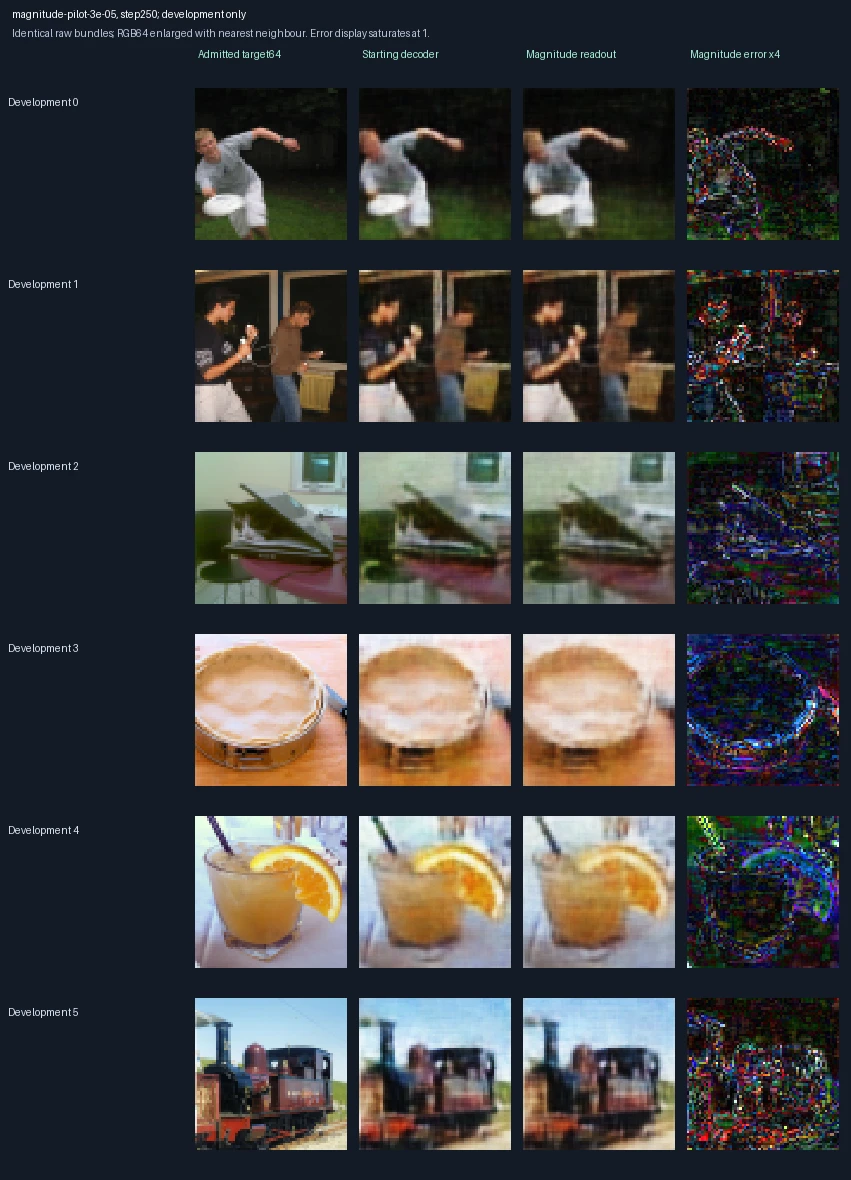
Six fixed development photographs. Left to right: the 64 × 64 input, the unchanged starting decoder using phase-only readout, this candidate’s reconstruction, and this candidate’s error. This short trial uses learning rate 3e-05, a setting that controls the size of weight updates. The encoder is fixed; only the decoder learns. These examples guide model selection, not final test claims. Phase-only readout keeps each complex coordinate’s angle; magnitude-preserving readout also keeps its amplitude, with one fixed scale learned from training data. Error panels show four times the absolute RGB difference from the reference, separately for each color channel, clipped at full brightness. Darker pixels mean smaller errors; black is zero or below the display’s precision. The scale is fixed across examples, not adjusted to make each image look better.
Magnitude-preserving readout, learning-rate trial (3e-05): 500 weight updates
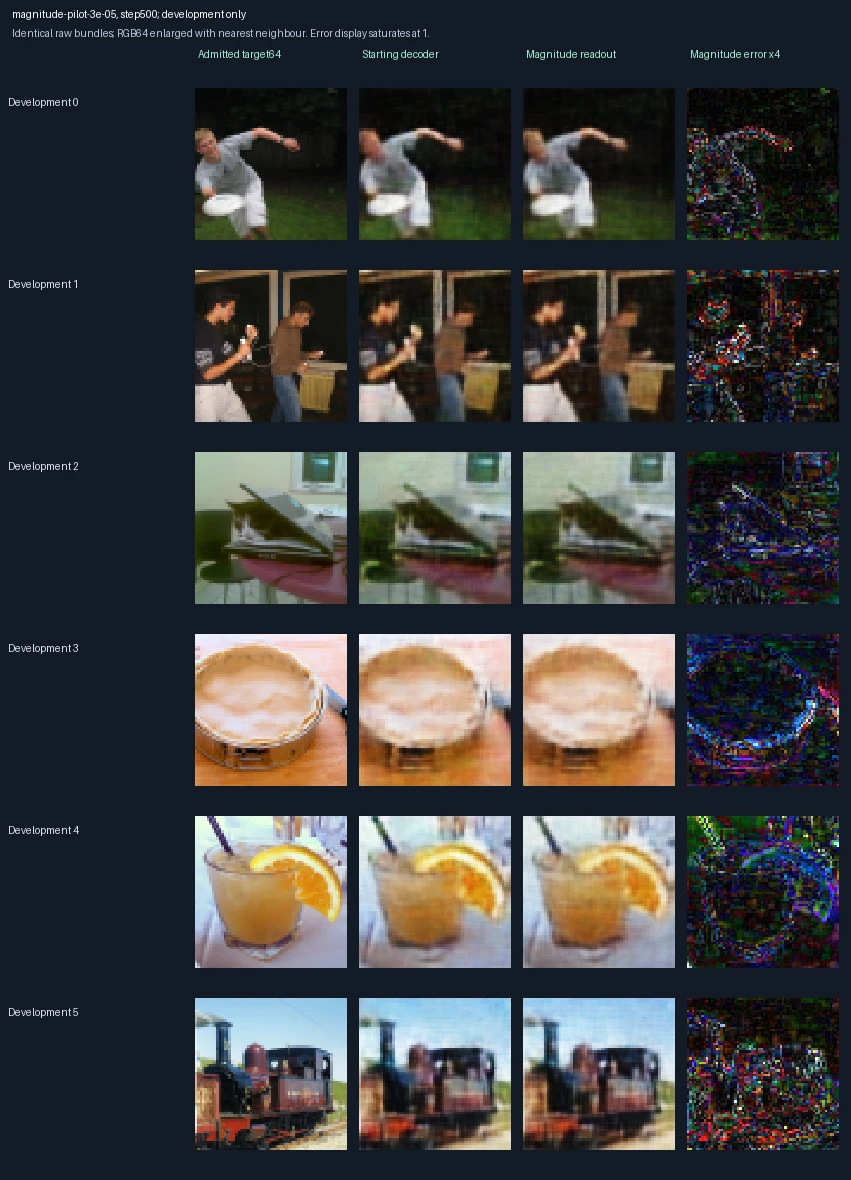
Six fixed development photographs. Left to right: the 64 × 64 input, the unchanged starting decoder using phase-only readout, this candidate’s reconstruction, and this candidate’s error. This short trial uses learning rate 3e-05, a setting that controls the size of weight updates. The encoder is fixed; only the decoder learns. These examples guide model selection, not final test claims. Phase-only readout keeps each complex coordinate’s angle; magnitude-preserving readout also keeps its amplitude, with one fixed scale learned from training data. Error panels show four times the absolute RGB difference from the reference, separately for each color channel, clipped at full brightness. Darker pixels mean smaller errors; black is zero or below the display’s precision. The scale is fixed across examples, not adjusted to make each image look better.
Magnitude-preserving readout, learning-rate trial (1e-04): 0 weight updates
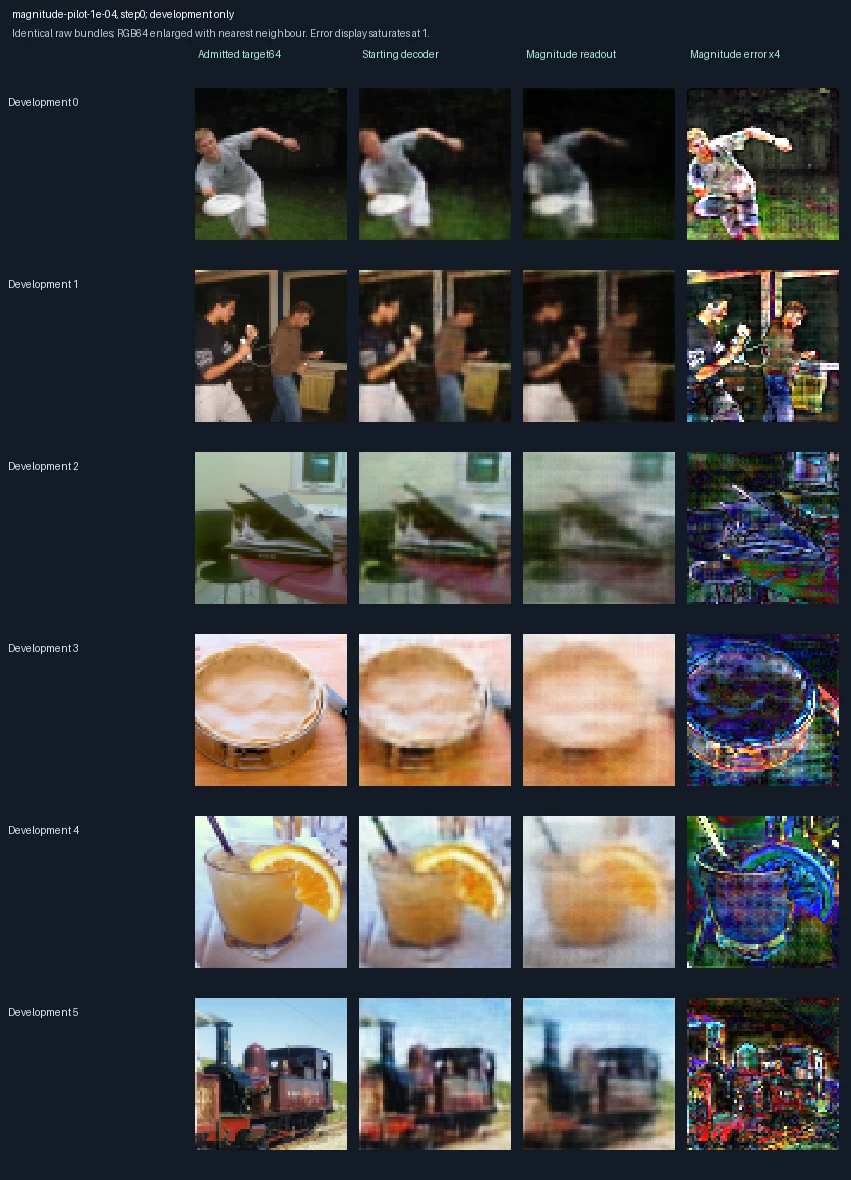
Six fixed development photographs. Left to right: the 64 × 64 input, the unchanged starting decoder using phase-only readout, this candidate’s reconstruction, and this candidate’s error. This short trial uses learning rate 1e-04, a setting that controls the size of weight updates. The encoder is fixed; only the decoder learns. These examples guide model selection, not final test claims. Phase-only readout keeps each complex coordinate’s angle; magnitude-preserving readout also keeps its amplitude, with one fixed scale learned from training data. Error panels show four times the absolute RGB difference from the reference, separately for each color channel, clipped at full brightness. Darker pixels mean smaller errors; black is zero or below the display’s precision. The scale is fixed across examples, not adjusted to make each image look better. At zero updates, changed brightness and error reflect switching the decoder’s input representation before it has adapted.
Magnitude-preserving readout, learning-rate trial (1e-04): 250 weight updates
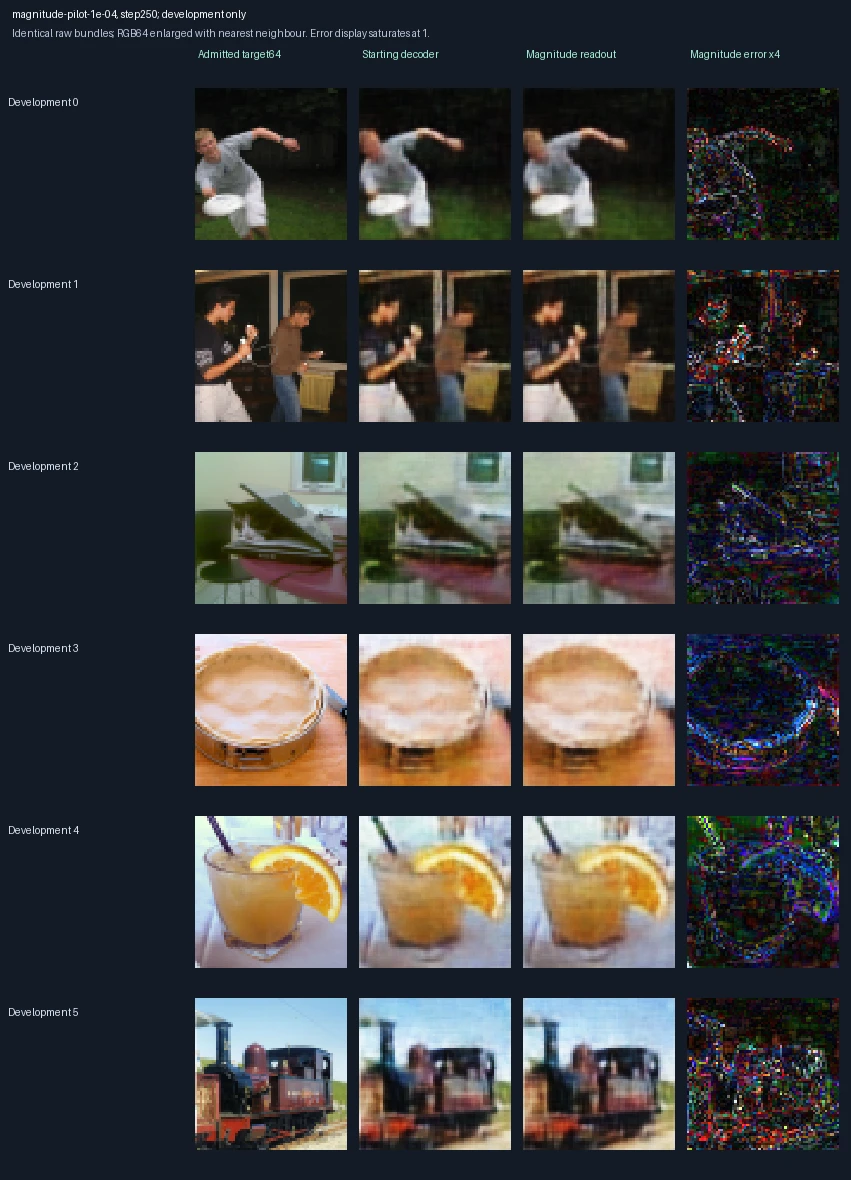
Six fixed development photographs. Left to right: the 64 × 64 input, the unchanged starting decoder using phase-only readout, this candidate’s reconstruction, and this candidate’s error. This short trial uses learning rate 1e-04, a setting that controls the size of weight updates. The encoder is fixed; only the decoder learns. These examples guide model selection, not final test claims. Phase-only readout keeps each complex coordinate’s angle; magnitude-preserving readout also keeps its amplitude, with one fixed scale learned from training data. Error panels show four times the absolute RGB difference from the reference, separately for each color channel, clipped at full brightness. Darker pixels mean smaller errors; black is zero or below the display’s precision. The scale is fixed across examples, not adjusted to make each image look better.
Magnitude-preserving readout, learning-rate trial (1e-04): 500 weight updates
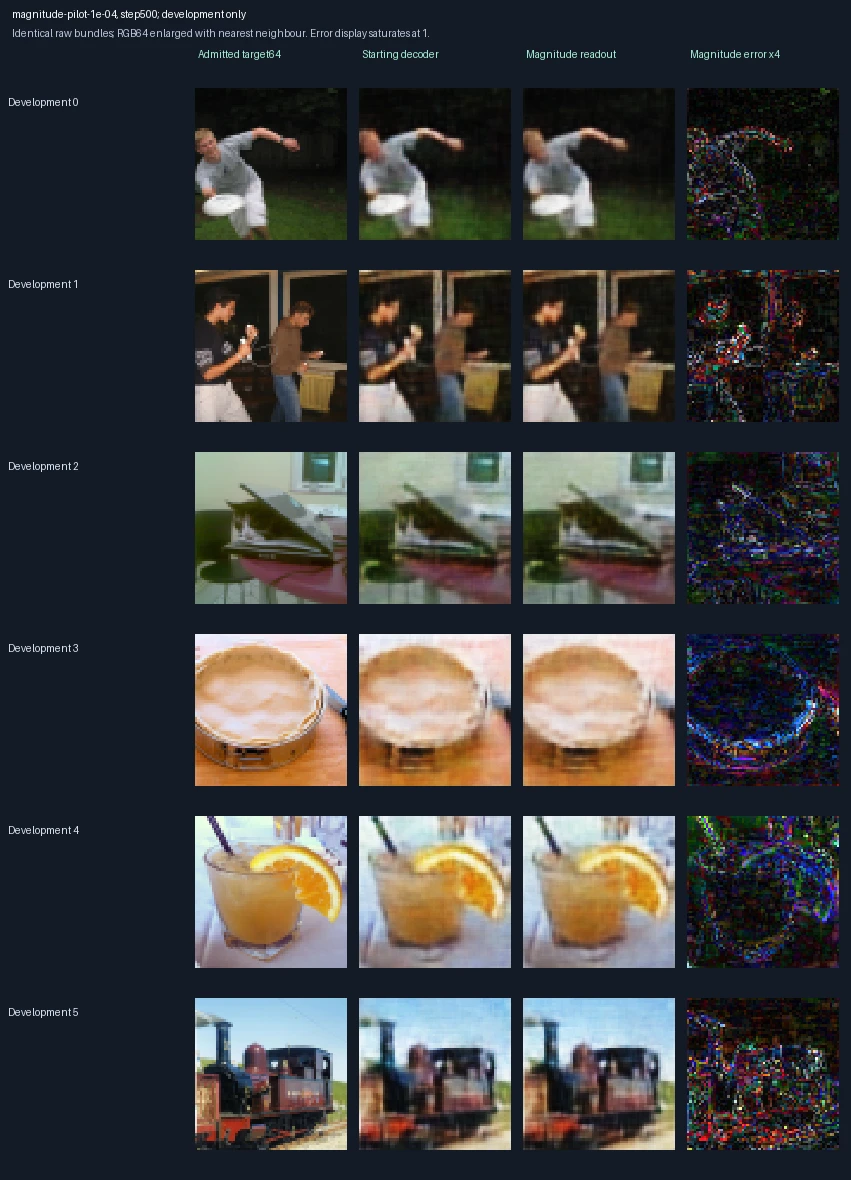
Six fixed development photographs. Left to right: the 64 × 64 input, the unchanged starting decoder using phase-only readout, this candidate’s reconstruction, and this candidate’s error. This short trial uses learning rate 1e-04, a setting that controls the size of weight updates. The encoder is fixed; only the decoder learns. These examples guide model selection, not final test claims. Phase-only readout keeps each complex coordinate’s angle; magnitude-preserving readout also keeps its amplitude, with one fixed scale learned from training data. Error panels show four times the absolute RGB difference from the reference, separately for each color channel, clipped at full brightness. Darker pixels mean smaller errors; black is zero or below the display’s precision. The scale is fixed across examples, not adjusted to make each image look better.
Magnitude-preserving readout, learning-rate trial (3e-04): 0 weight updates
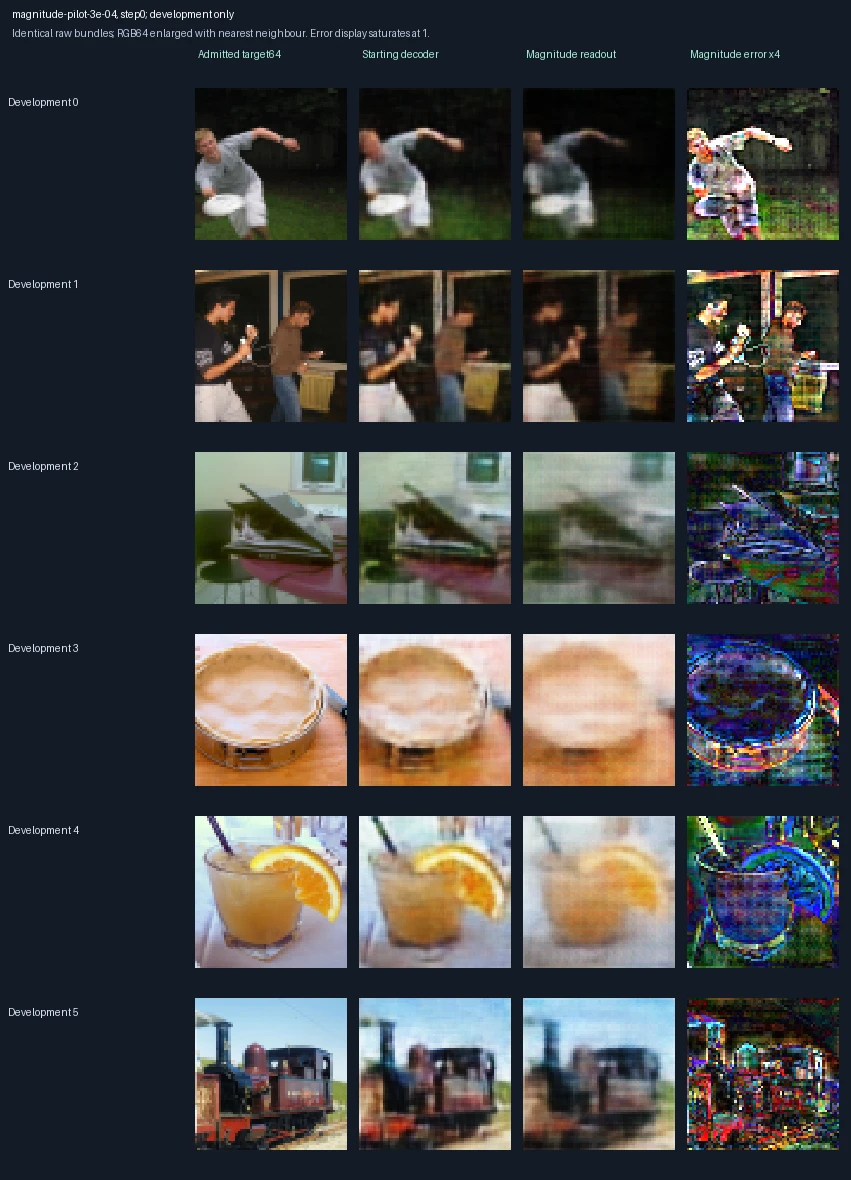
Six fixed development photographs. Left to right: the 64 × 64 input, the unchanged starting decoder using phase-only readout, this candidate’s reconstruction, and this candidate’s error. This short trial uses learning rate 3e-04, a setting that controls the size of weight updates. The encoder is fixed; only the decoder learns. These examples guide model selection, not final test claims. Phase-only readout keeps each complex coordinate’s angle; magnitude-preserving readout also keeps its amplitude, with one fixed scale learned from training data. Error panels show four times the absolute RGB difference from the reference, separately for each color channel, clipped at full brightness. Darker pixels mean smaller errors; black is zero or below the display’s precision. The scale is fixed across examples, not adjusted to make each image look better. At zero updates, changed brightness and error reflect switching the decoder’s input representation before it has adapted.
Magnitude-preserving readout, learning-rate trial (3e-04): 250 weight updates
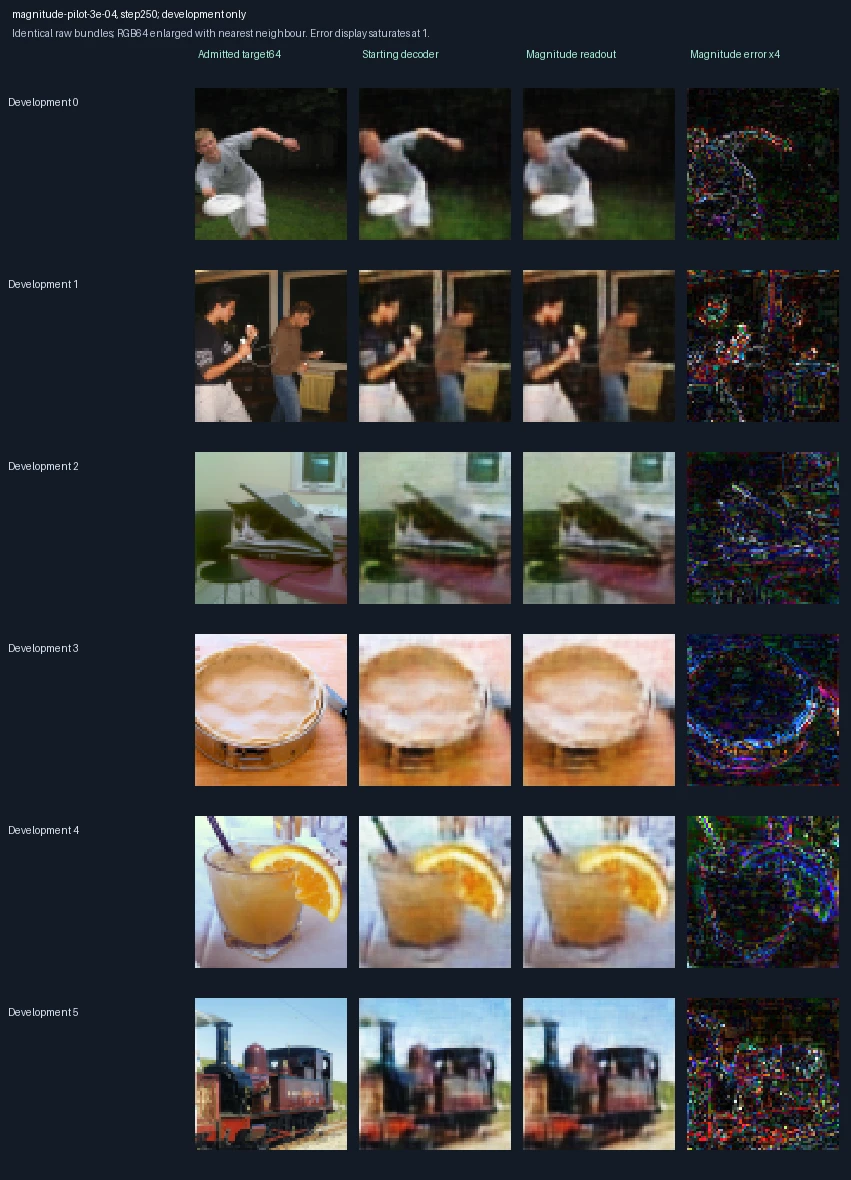
Six fixed development photographs. Left to right: the 64 × 64 input, the unchanged starting decoder using phase-only readout, this candidate’s reconstruction, and this candidate’s error. This short trial uses learning rate 3e-04, a setting that controls the size of weight updates. The encoder is fixed; only the decoder learns. These examples guide model selection, not final test claims. Phase-only readout keeps each complex coordinate’s angle; magnitude-preserving readout also keeps its amplitude, with one fixed scale learned from training data. Error panels show four times the absolute RGB difference from the reference, separately for each color channel, clipped at full brightness. Darker pixels mean smaller errors; black is zero or below the display’s precision. The scale is fixed across examples, not adjusted to make each image look better.
Magnitude-preserving readout, learning-rate trial (3e-04): 500 weight updates
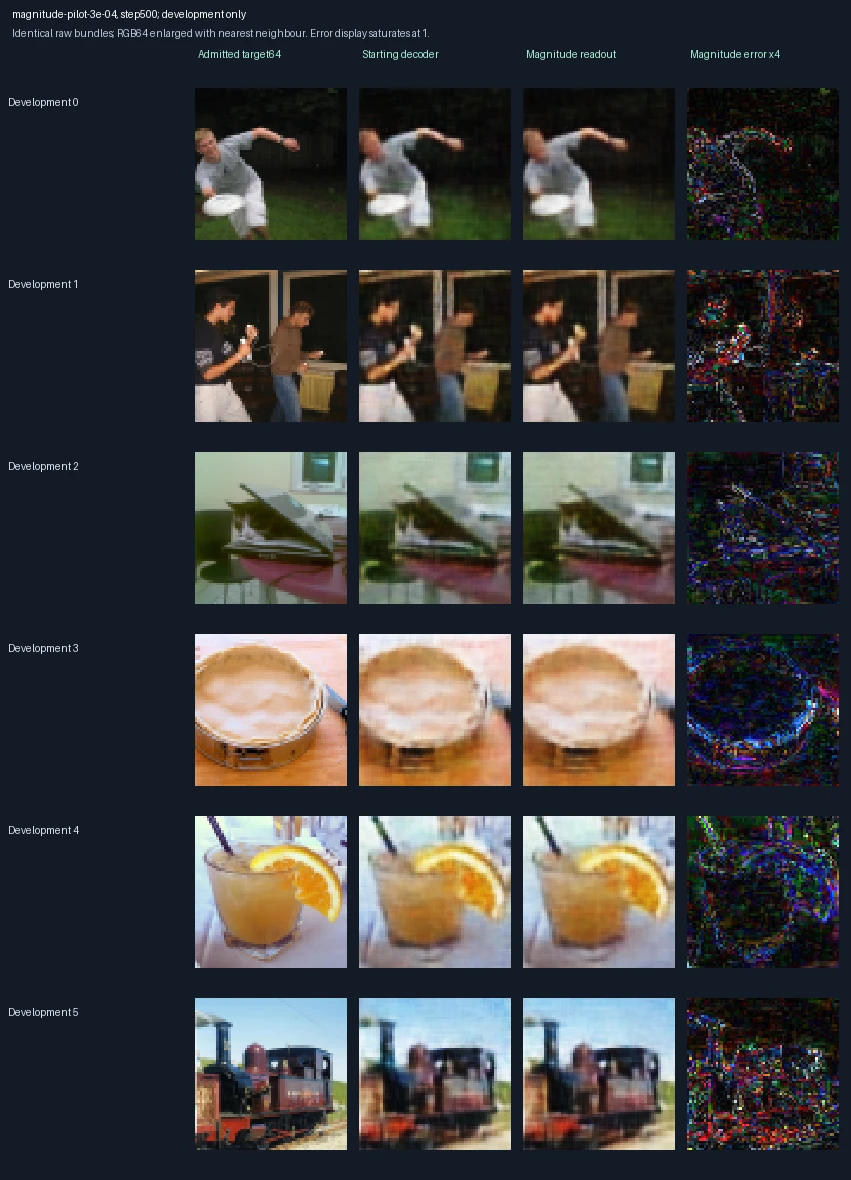
Six fixed development photographs. Left to right: the 64 × 64 input, the unchanged starting decoder using phase-only readout, this candidate’s reconstruction, and this candidate’s error. This short trial uses learning rate 3e-04, a setting that controls the size of weight updates. The encoder is fixed; only the decoder learns. These examples guide model selection, not final test claims. Phase-only readout keeps each complex coordinate’s angle; magnitude-preserving readout also keeps its amplitude, with one fixed scale learned from training data. Error panels show four times the absolute RGB difference from the reference, separately for each color channel, clipped at full brightness. Darker pixels mean smaller errors; black is zero or below the display’s precision. The scale is fixed across examples, not adjusted to make each image look better.
Phase-only readout, training repetition 1: 0 weight updates
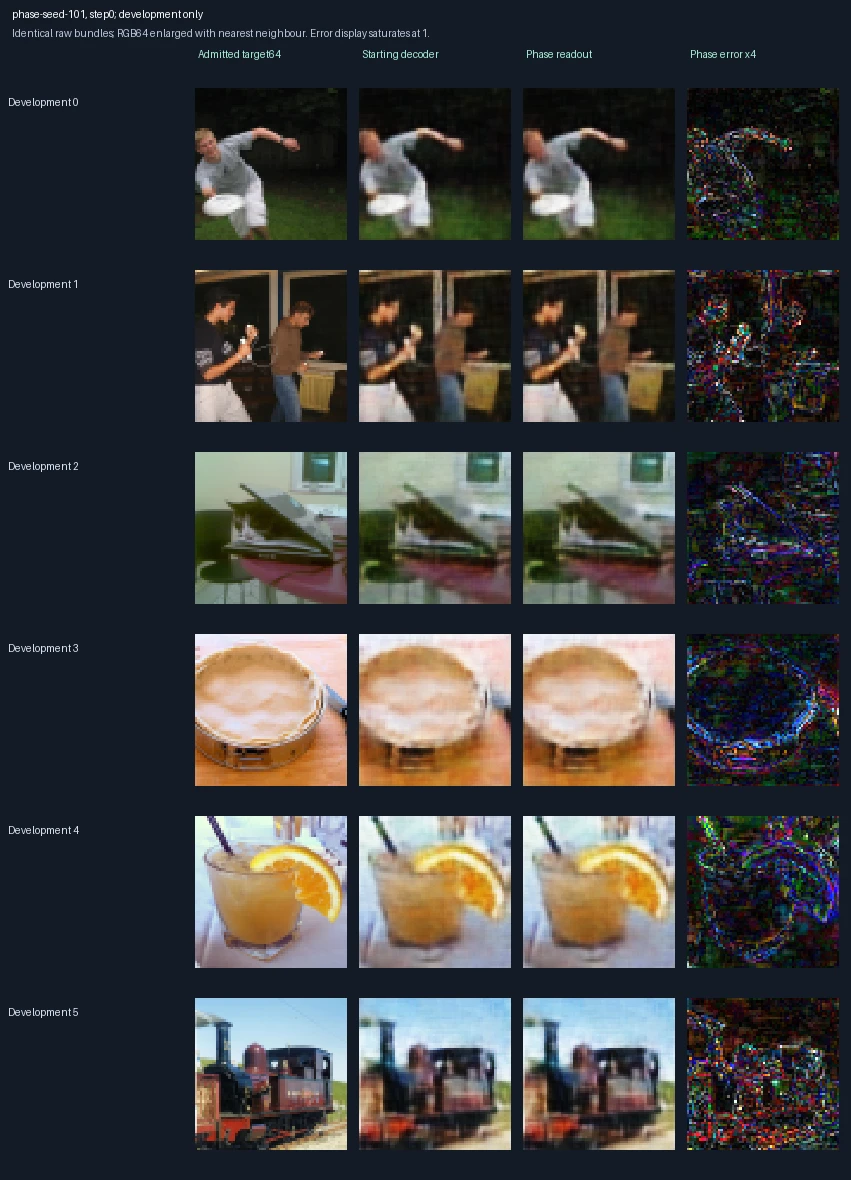
Six fixed development photographs. Left to right: the 64 × 64 input, the unchanged starting decoder using phase-only readout, this candidate’s reconstruction, and this candidate’s error. This is training repetition 1; the image label “seed-101” identifies its randomization setting. The encoder is fixed; only the decoder learns. These examples guide model selection, not final test claims. Phase-only readout keeps each complex coordinate’s angle; magnitude-preserving readout also keeps its amplitude, with one fixed scale learned from training data. Error panels show four times the absolute RGB difference from the reference, separately for each color channel, clipped at full brightness. Darker pixels mean smaller errors; black is zero or below the display’s precision. The scale is fixed across examples, not adjusted to make each image look better.
Phase-only readout, training repetition 1: 250 weight updates
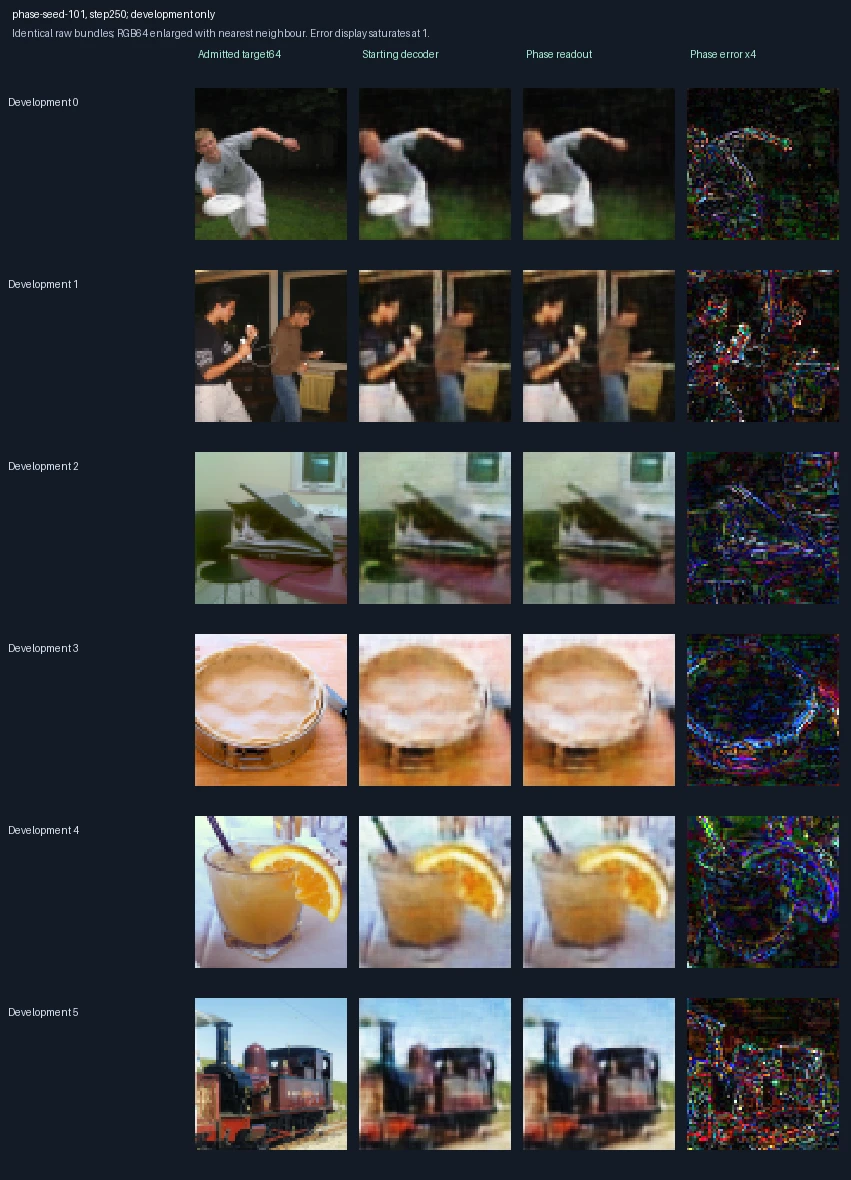
Six fixed development photographs. Left to right: the 64 × 64 input, the unchanged starting decoder using phase-only readout, this candidate’s reconstruction, and this candidate’s error. This is training repetition 1; the image label “seed-101” identifies its randomization setting. The encoder is fixed; only the decoder learns. These examples guide model selection, not final test claims. Phase-only readout keeps each complex coordinate’s angle; magnitude-preserving readout also keeps its amplitude, with one fixed scale learned from training data. Error panels show four times the absolute RGB difference from the reference, separately for each color channel, clipped at full brightness. Darker pixels mean smaller errors; black is zero or below the display’s precision. The scale is fixed across examples, not adjusted to make each image look better.
Phase-only readout, training repetition 1: 500 weight updates
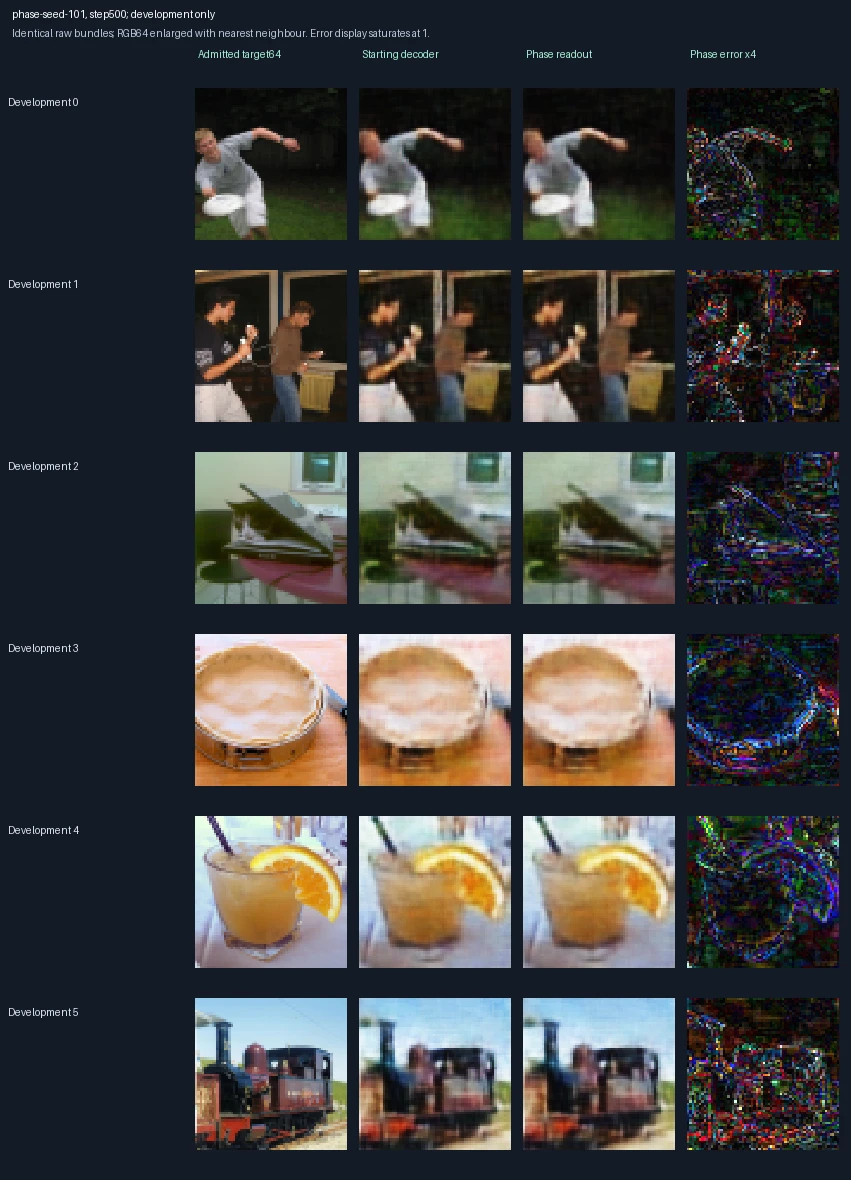
Six fixed development photographs. Left to right: the 64 × 64 input, the unchanged starting decoder using phase-only readout, this candidate’s reconstruction, and this candidate’s error. This is training repetition 1; the image label “seed-101” identifies its randomization setting. The encoder is fixed; only the decoder learns. These examples guide model selection, not final test claims. Phase-only readout keeps each complex coordinate’s angle; magnitude-preserving readout also keeps its amplitude, with one fixed scale learned from training data. Error panels show four times the absolute RGB difference from the reference, separately for each color channel, clipped at full brightness. Darker pixels mean smaller errors; black is zero or below the display’s precision. The scale is fixed across examples, not adjusted to make each image look better.
Phase-only readout, training repetition 1: 750 weight updates
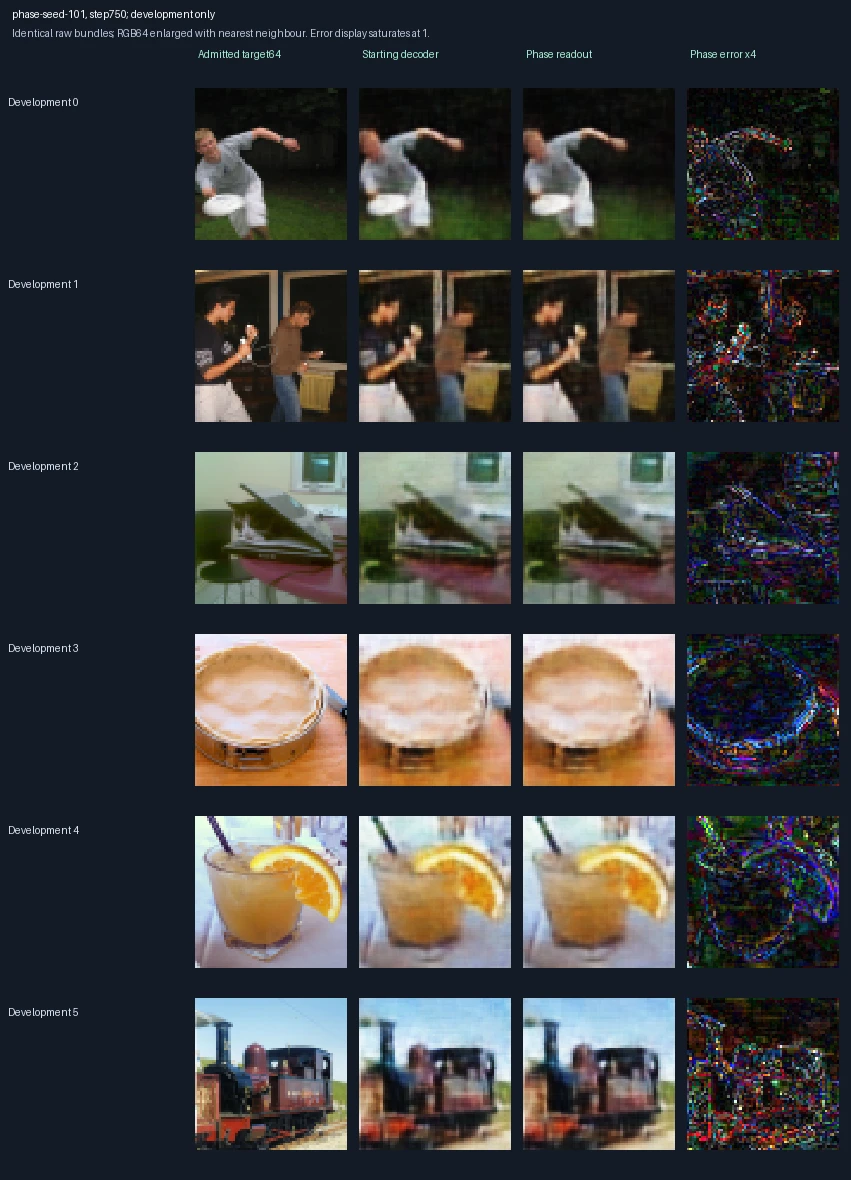
Six fixed development photographs. Left to right: the 64 × 64 input, the unchanged starting decoder using phase-only readout, this candidate’s reconstruction, and this candidate’s error. This is training repetition 1; the image label “seed-101” identifies its randomization setting. The encoder is fixed; only the decoder learns. These examples guide model selection, not final test claims. Phase-only readout keeps each complex coordinate’s angle; magnitude-preserving readout also keeps its amplitude, with one fixed scale learned from training data. Error panels show four times the absolute RGB difference from the reference, separately for each color channel, clipped at full brightness. Darker pixels mean smaller errors; black is zero or below the display’s precision. The scale is fixed across examples, not adjusted to make each image look better.
Phase-only readout, training repetition 1: 1,000 weight updates
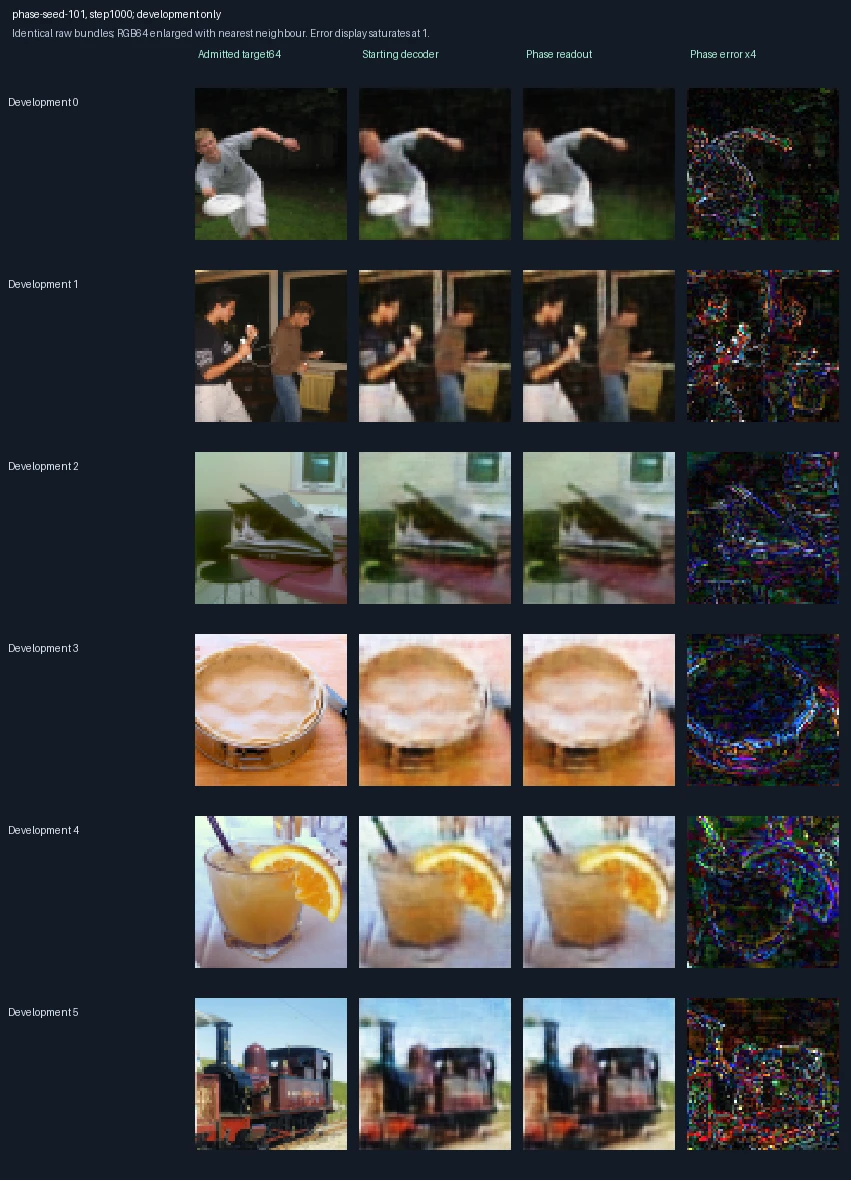
Six fixed development photographs. Left to right: the 64 × 64 input, the unchanged starting decoder using phase-only readout, this candidate’s reconstruction, and this candidate’s error. This is training repetition 1; the image label “seed-101” identifies its randomization setting. The encoder is fixed; only the decoder learns. These examples guide model selection, not final test claims. Phase-only readout keeps each complex coordinate’s angle; magnitude-preserving readout also keeps its amplitude, with one fixed scale learned from training data. Error panels show four times the absolute RGB difference from the reference, separately for each color channel, clipped at full brightness. Darker pixels mean smaller errors; black is zero or below the display’s precision. The scale is fixed across examples, not adjusted to make each image look better.
Phase-only readout, training repetition 1: 1,250 weight updates
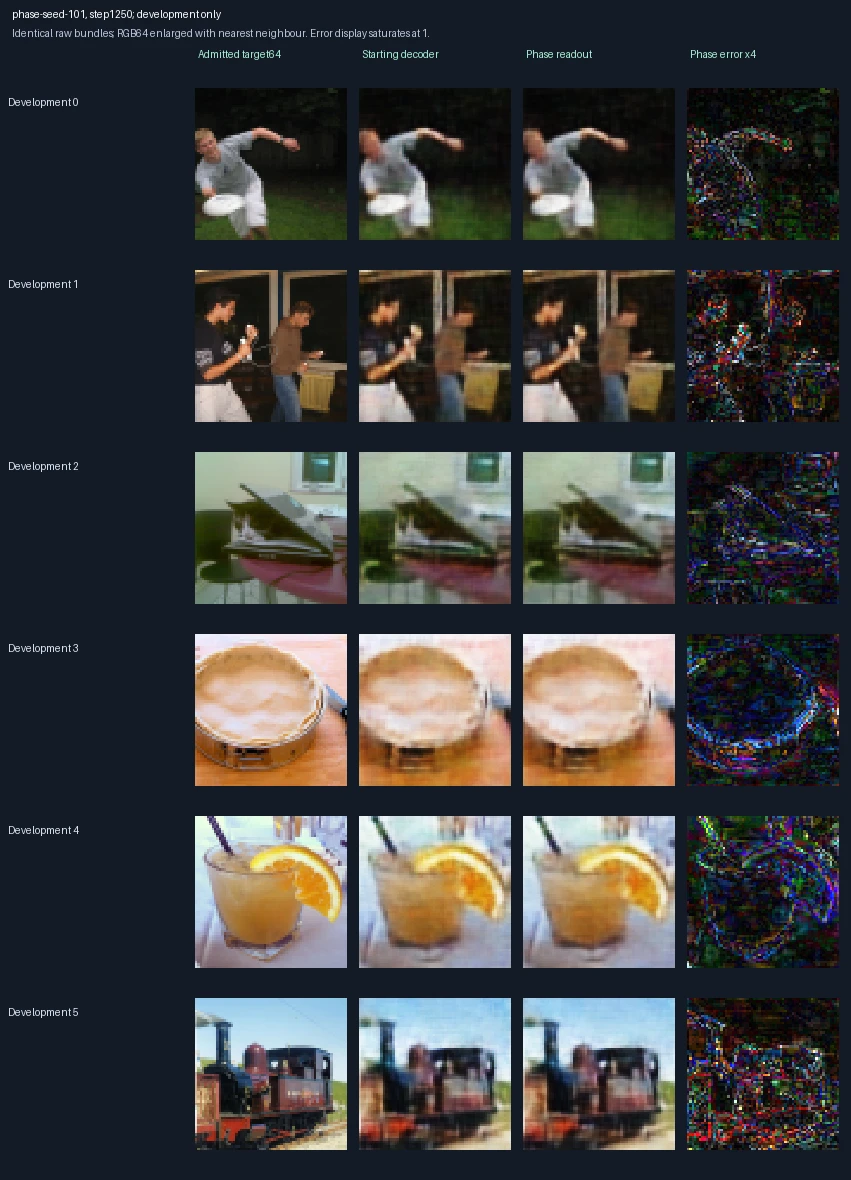
Six fixed development photographs. Left to right: the 64 × 64 input, the unchanged starting decoder using phase-only readout, this candidate’s reconstruction, and this candidate’s error. This is training repetition 1; the image label “seed-101” identifies its randomization setting. The encoder is fixed; only the decoder learns. These examples guide model selection, not final test claims. Phase-only readout keeps each complex coordinate’s angle; magnitude-preserving readout also keeps its amplitude, with one fixed scale learned from training data. Error panels show four times the absolute RGB difference from the reference, separately for each color channel, clipped at full brightness. Darker pixels mean smaller errors; black is zero or below the display’s precision. The scale is fixed across examples, not adjusted to make each image look better.
Phase-only readout, training repetition 1: 1,500 weight updates
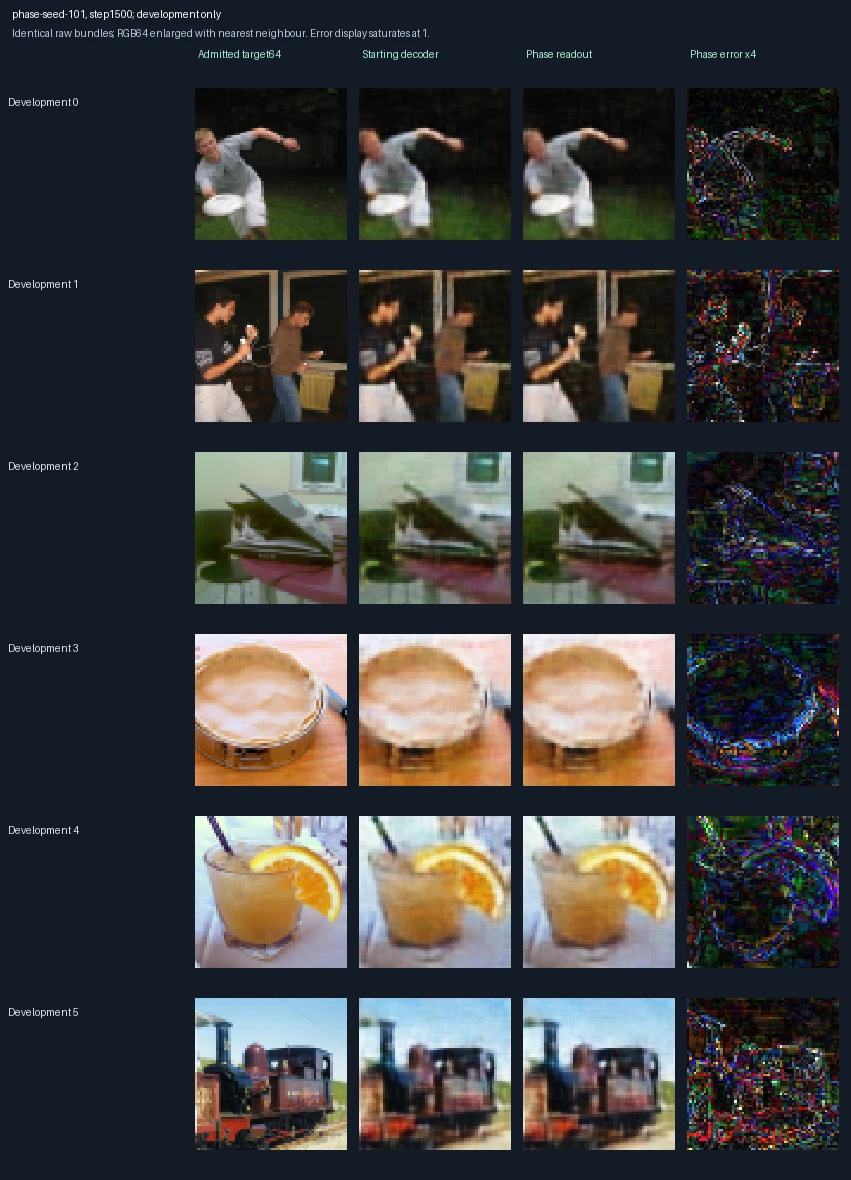
Six fixed development photographs. Left to right: the 64 × 64 input, the unchanged starting decoder using phase-only readout, this candidate’s reconstruction, and this candidate’s error. This is training repetition 1; the image label “seed-101” identifies its randomization setting. The encoder is fixed; only the decoder learns. These examples guide model selection, not final test claims. Phase-only readout keeps each complex coordinate’s angle; magnitude-preserving readout also keeps its amplitude, with one fixed scale learned from training data. Error panels show four times the absolute RGB difference from the reference, separately for each color channel, clipped at full brightness. Darker pixels mean smaller errors; black is zero or below the display’s precision. The scale is fixed across examples, not adjusted to make each image look better.
Phase-only readout, training repetition 1: 1,750 weight updates
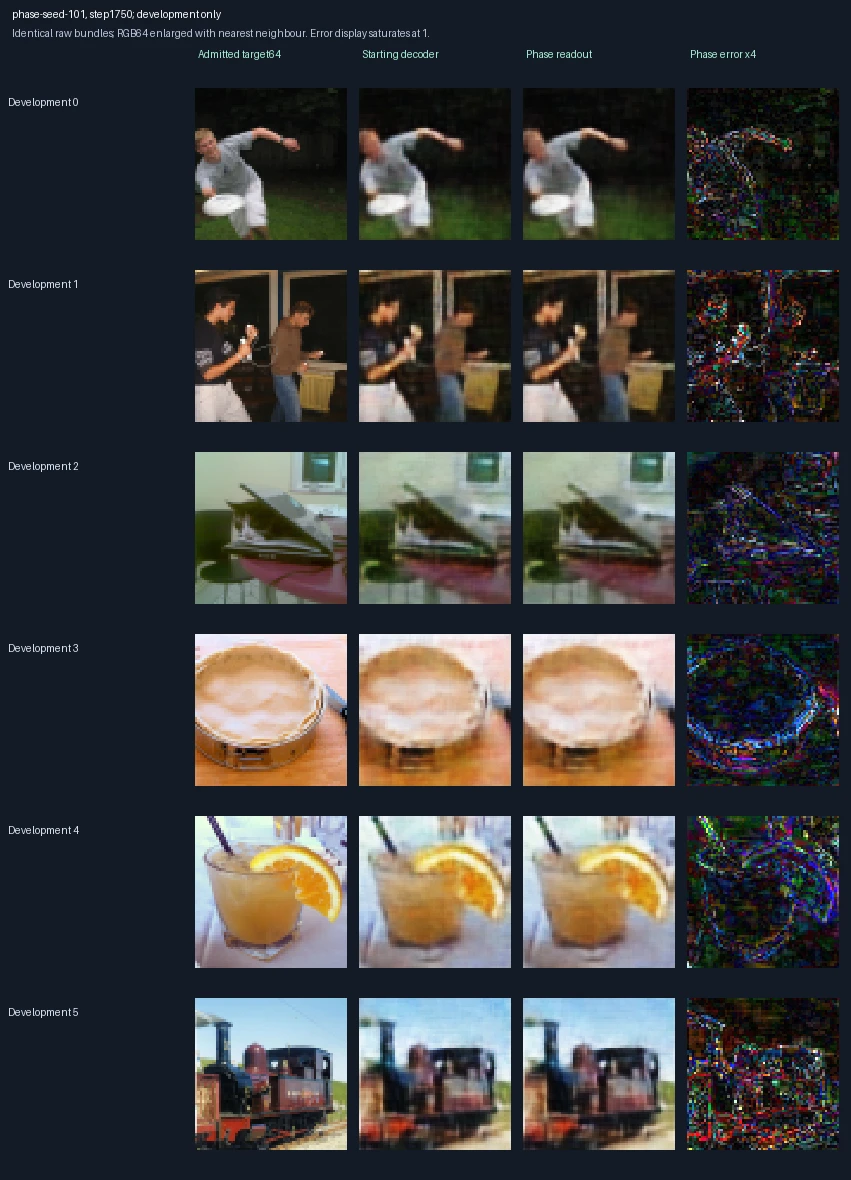
Six fixed development photographs. Left to right: the 64 × 64 input, the unchanged starting decoder using phase-only readout, this candidate’s reconstruction, and this candidate’s error. This is training repetition 1; the image label “seed-101” identifies its randomization setting. The encoder is fixed; only the decoder learns. These examples guide model selection, not final test claims. Phase-only readout keeps each complex coordinate’s angle; magnitude-preserving readout also keeps its amplitude, with one fixed scale learned from training data. Error panels show four times the absolute RGB difference from the reference, separately for each color channel, clipped at full brightness. Darker pixels mean smaller errors; black is zero or below the display’s precision. The scale is fixed across examples, not adjusted to make each image look better.
Phase-only readout, training repetition 1: 2,000 weight updates
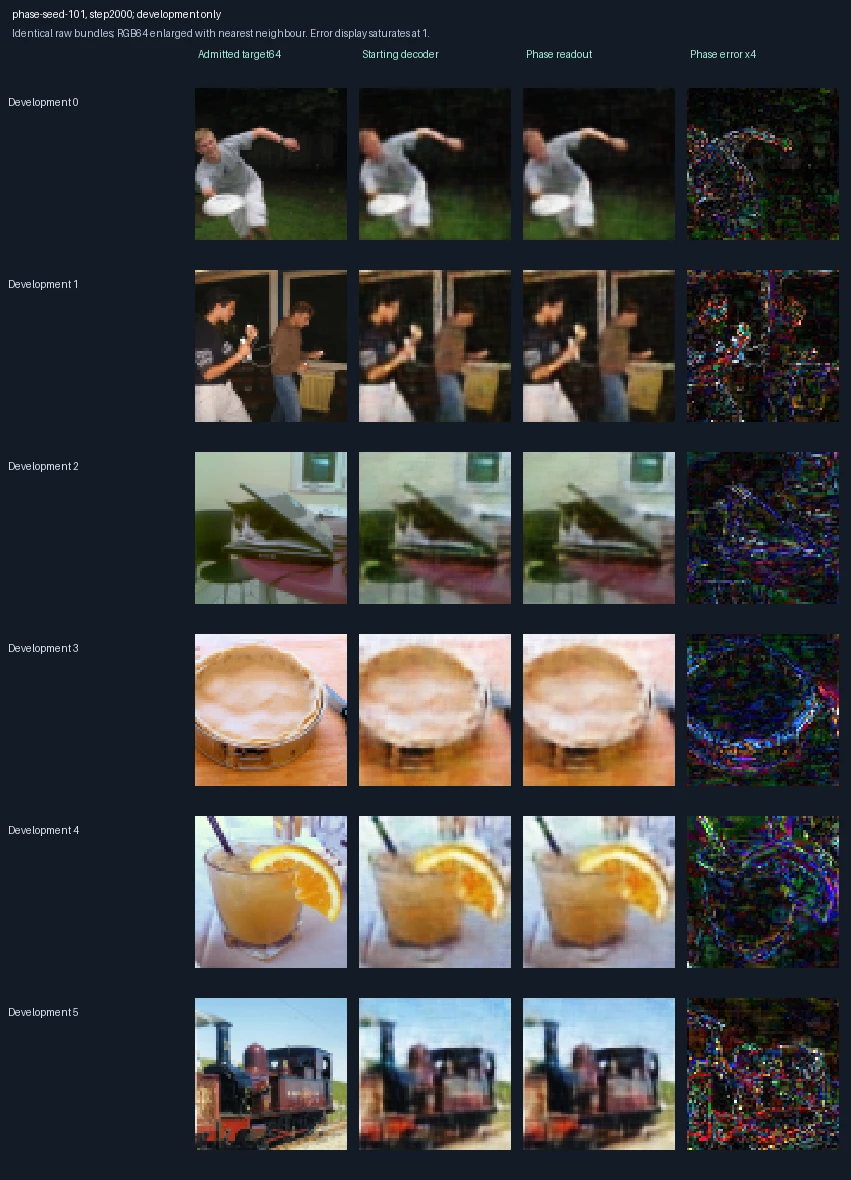
Six fixed development photographs. Left to right: the 64 × 64 input, the unchanged starting decoder using phase-only readout, this candidate’s reconstruction, and this candidate’s error. This is training repetition 1; the image label “seed-101” identifies its randomization setting. The encoder is fixed; only the decoder learns. These examples guide model selection, not final test claims. Phase-only readout keeps each complex coordinate’s angle; magnitude-preserving readout also keeps its amplitude, with one fixed scale learned from training data. Error panels show four times the absolute RGB difference from the reference, separately for each color channel, clipped at full brightness. Darker pixels mean smaller errors; black is zero or below the display’s precision. The scale is fixed across examples, not adjusted to make each image look better.
Phase-only readout, training repetition 1: 2,250 weight updates
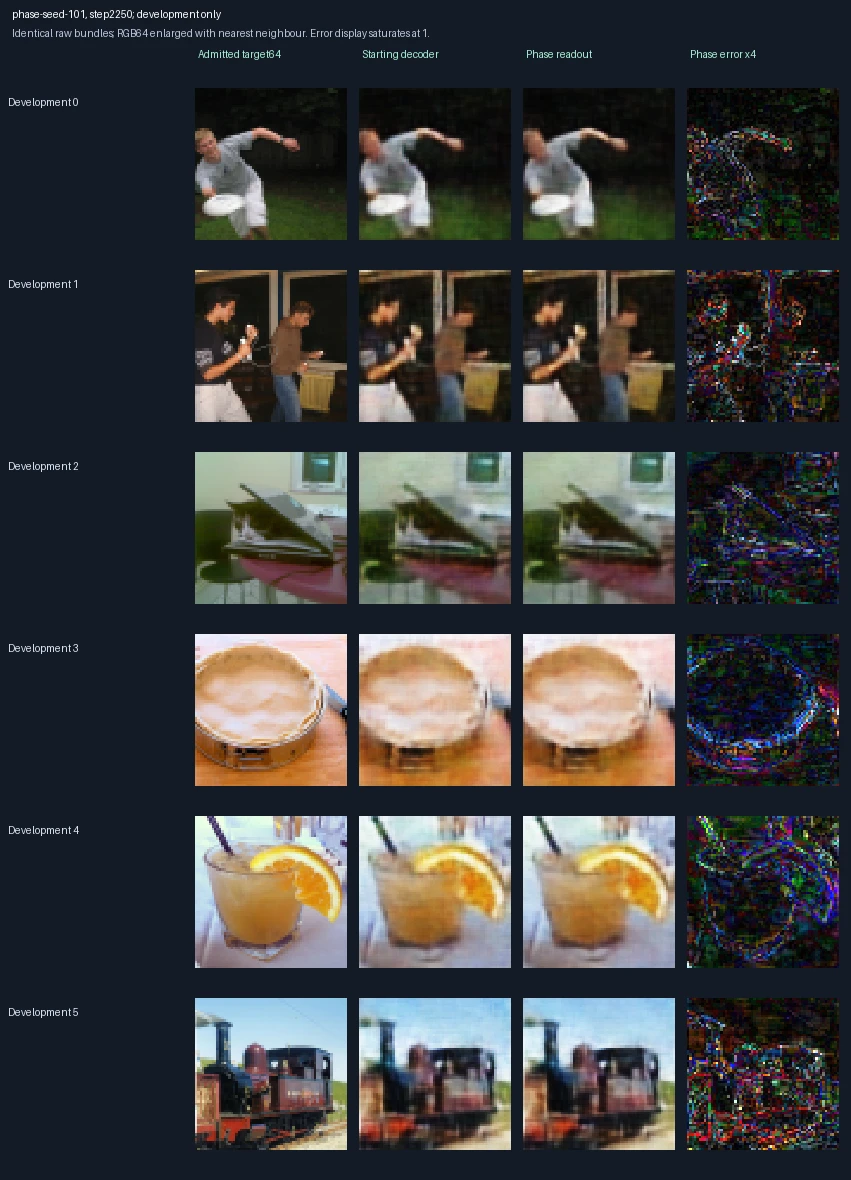
Six fixed development photographs. Left to right: the 64 × 64 input, the unchanged starting decoder using phase-only readout, this candidate’s reconstruction, and this candidate’s error. This is training repetition 1; the image label “seed-101” identifies its randomization setting. The encoder is fixed; only the decoder learns. These examples guide model selection, not final test claims. Phase-only readout keeps each complex coordinate’s angle; magnitude-preserving readout also keeps its amplitude, with one fixed scale learned from training data. Error panels show four times the absolute RGB difference from the reference, separately for each color channel, clipped at full brightness. Darker pixels mean smaller errors; black is zero or below the display’s precision. The scale is fixed across examples, not adjusted to make each image look better.
Phase-only readout, training repetition 1: 2,500 weight updates
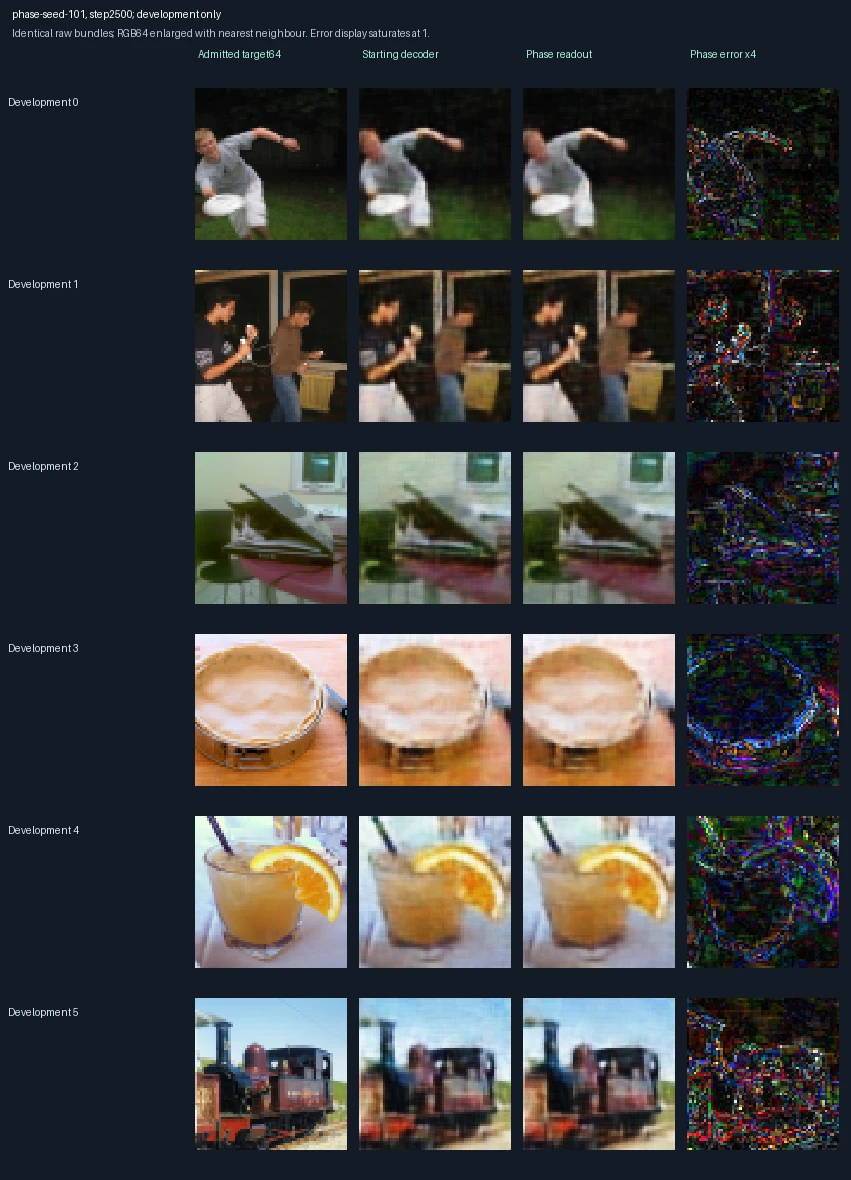
Six fixed development photographs. Left to right: the 64 × 64 input, the unchanged starting decoder using phase-only readout, this candidate’s reconstruction, and this candidate’s error. This is training repetition 1; the image label “seed-101” identifies its randomization setting. The encoder is fixed; only the decoder learns. These examples guide model selection, not final test claims. Phase-only readout keeps each complex coordinate’s angle; magnitude-preserving readout also keeps its amplitude, with one fixed scale learned from training data. Error panels show four times the absolute RGB difference from the reference, separately for each color channel, clipped at full brightness. Darker pixels mean smaller errors; black is zero or below the display’s precision. The scale is fixed across examples, not adjusted to make each image look better.
Phase-only readout, training repetition 1: 2,750 weight updates
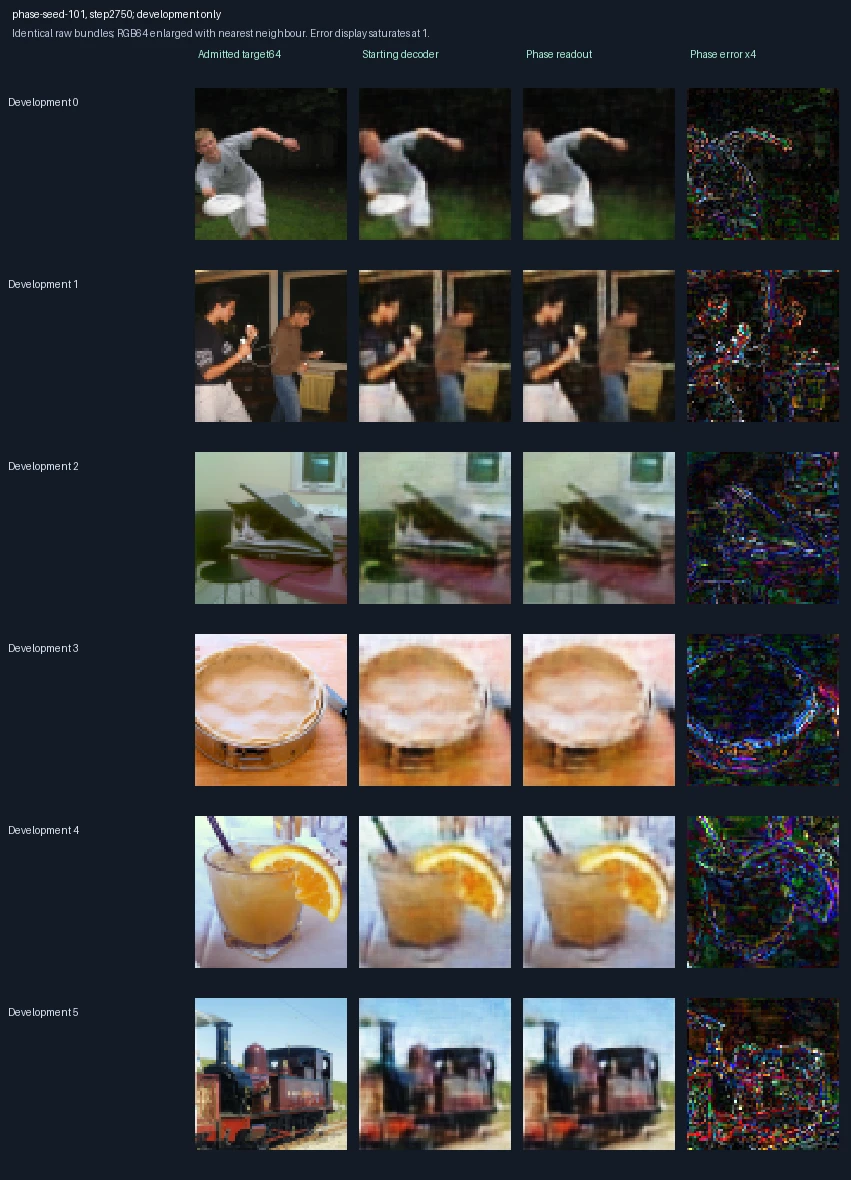
Six fixed development photographs. Left to right: the 64 × 64 input, the unchanged starting decoder using phase-only readout, this candidate’s reconstruction, and this candidate’s error. This is training repetition 1; the image label “seed-101” identifies its randomization setting. The encoder is fixed; only the decoder learns. These examples guide model selection, not final test claims. Phase-only readout keeps each complex coordinate’s angle; magnitude-preserving readout also keeps its amplitude, with one fixed scale learned from training data. Error panels show four times the absolute RGB difference from the reference, separately for each color channel, clipped at full brightness. Darker pixels mean smaller errors; black is zero or below the display’s precision. The scale is fixed across examples, not adjusted to make each image look better.
Phase-only readout, training repetition 1: 3,000 weight updates
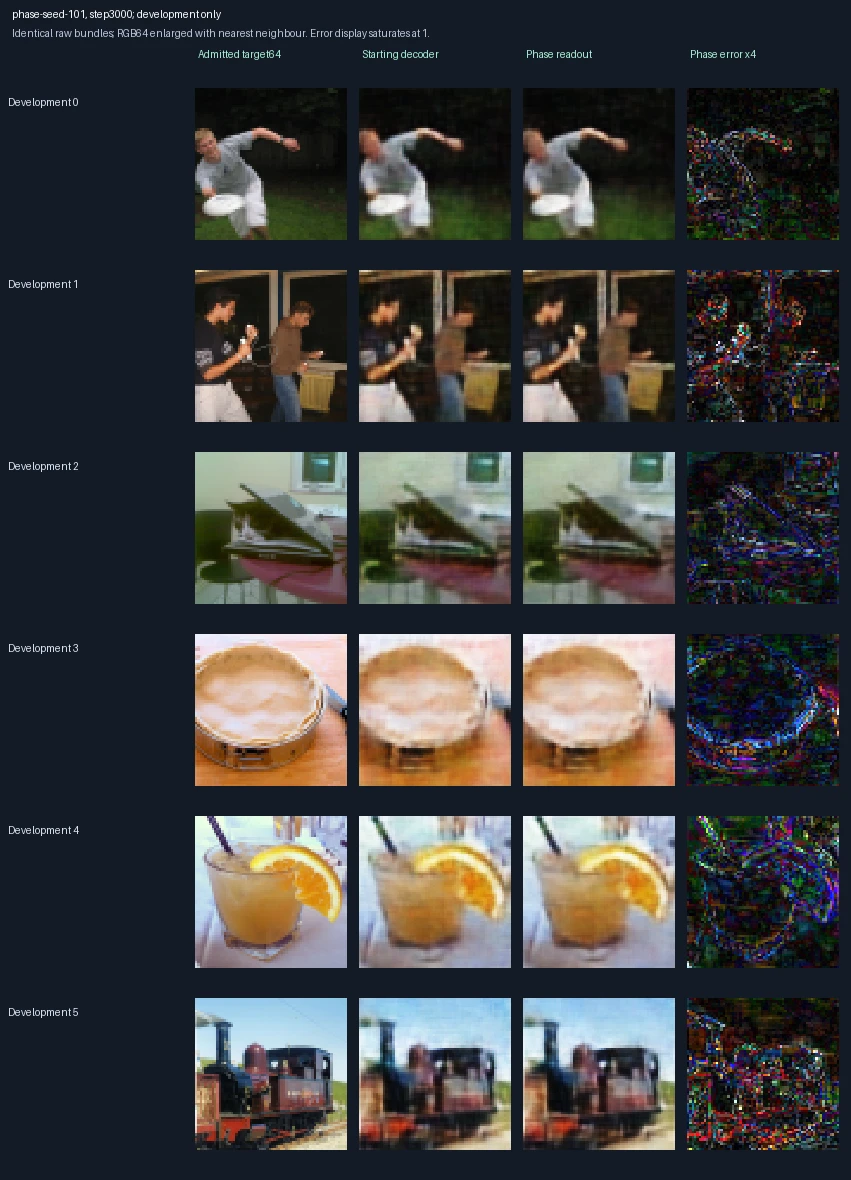
Six fixed development photographs. Left to right: the 64 × 64 input, the unchanged starting decoder using phase-only readout, this candidate’s reconstruction, and this candidate’s error. This is training repetition 1; the image label “seed-101” identifies its randomization setting. The encoder is fixed; only the decoder learns. These examples guide model selection, not final test claims. Phase-only readout keeps each complex coordinate’s angle; magnitude-preserving readout also keeps its amplitude, with one fixed scale learned from training data. Error panels show four times the absolute RGB difference from the reference, separately for each color channel, clipped at full brightness. Darker pixels mean smaller errors; black is zero or below the display’s precision. The scale is fixed across examples, not adjusted to make each image look better.
Phase-only readout, training repetition 1: 3,250 weight updates
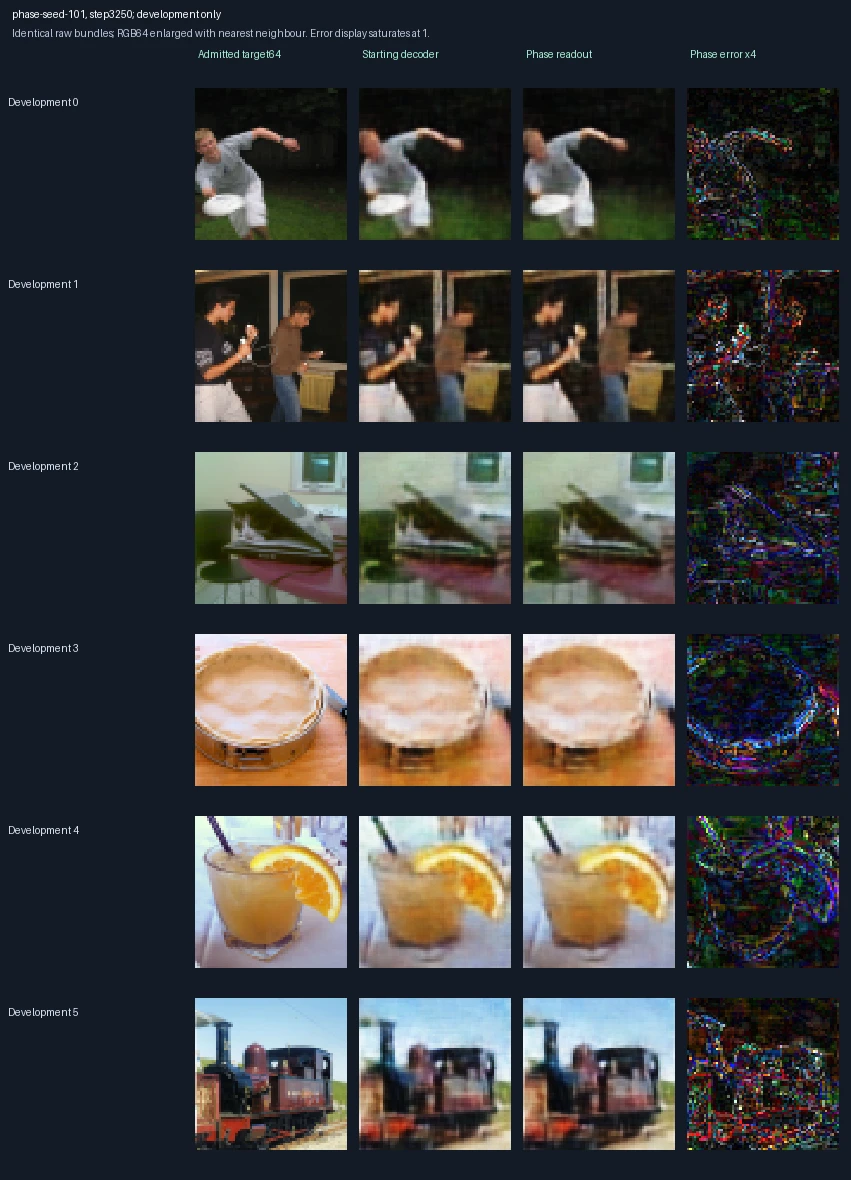
Six fixed development photographs. Left to right: the 64 × 64 input, the unchanged starting decoder using phase-only readout, this candidate’s reconstruction, and this candidate’s error. This is training repetition 1; the image label “seed-101” identifies its randomization setting. The encoder is fixed; only the decoder learns. These examples guide model selection, not final test claims. Phase-only readout keeps each complex coordinate’s angle; magnitude-preserving readout also keeps its amplitude, with one fixed scale learned from training data. Error panels show four times the absolute RGB difference from the reference, separately for each color channel, clipped at full brightness. Darker pixels mean smaller errors; black is zero or below the display’s precision. The scale is fixed across examples, not adjusted to make each image look better.
Phase-only readout, training repetition 1: 3,500 weight updates
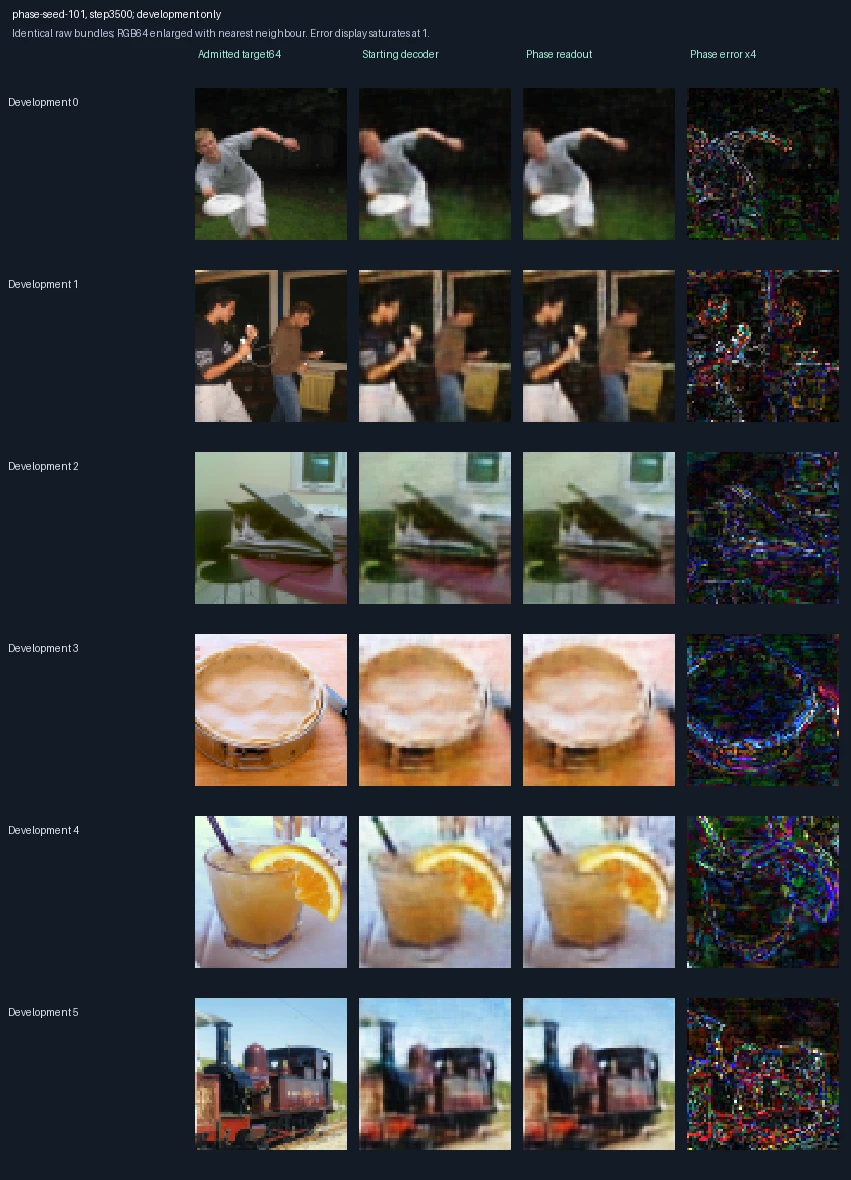
Six fixed development photographs. Left to right: the 64 × 64 input, the unchanged starting decoder using phase-only readout, this candidate’s reconstruction, and this candidate’s error. This is training repetition 1; the image label “seed-101” identifies its randomization setting. The encoder is fixed; only the decoder learns. These examples guide model selection, not final test claims. Phase-only readout keeps each complex coordinate’s angle; magnitude-preserving readout also keeps its amplitude, with one fixed scale learned from training data. Error panels show four times the absolute RGB difference from the reference, separately for each color channel, clipped at full brightness. Darker pixels mean smaller errors; black is zero or below the display’s precision. The scale is fixed across examples, not adjusted to make each image look better.
Phase-only readout, training repetition 1: 3,750 weight updates
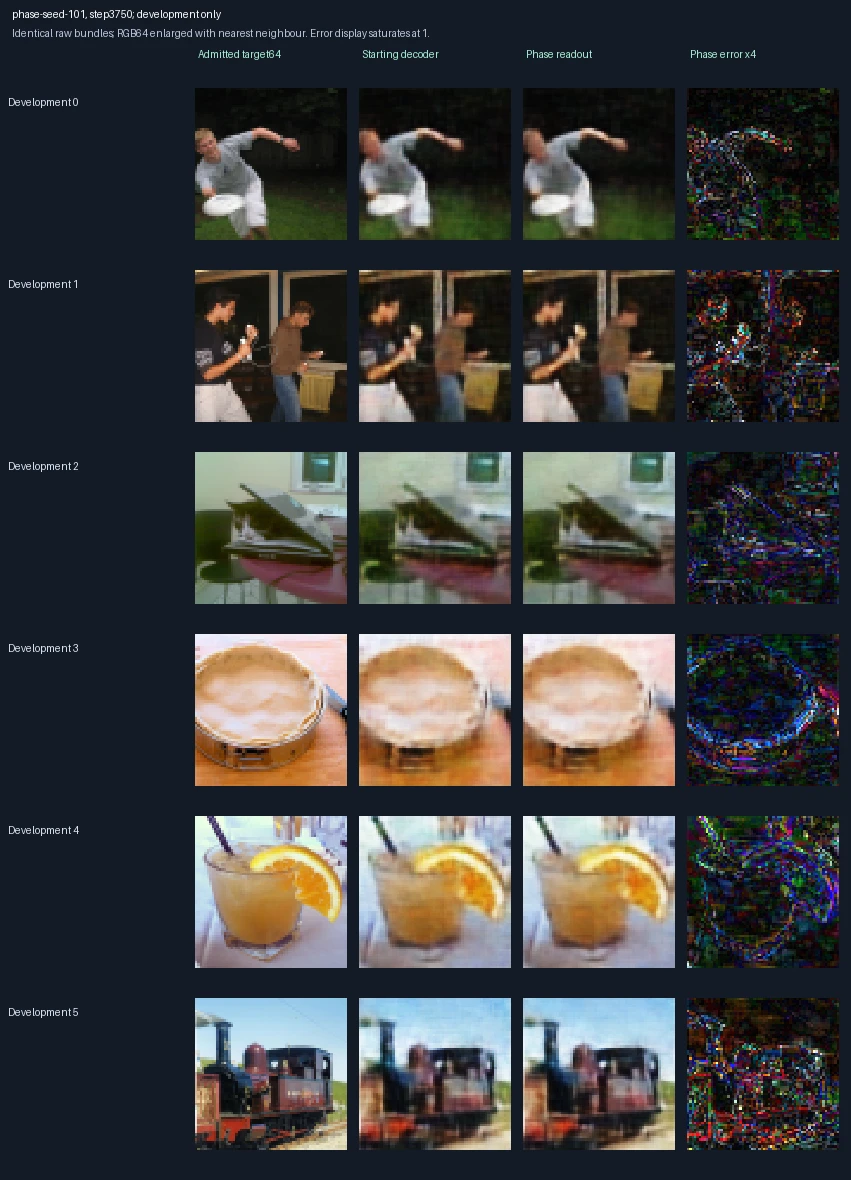
Six fixed development photographs. Left to right: the 64 × 64 input, the unchanged starting decoder using phase-only readout, this candidate’s reconstruction, and this candidate’s error. This is training repetition 1; the image label “seed-101” identifies its randomization setting. The encoder is fixed; only the decoder learns. These examples guide model selection, not final test claims. Phase-only readout keeps each complex coordinate’s angle; magnitude-preserving readout also keeps its amplitude, with one fixed scale learned from training data. Error panels show four times the absolute RGB difference from the reference, separately for each color channel, clipped at full brightness. Darker pixels mean smaller errors; black is zero or below the display’s precision. The scale is fixed across examples, not adjusted to make each image look better.
Phase-only readout, training repetition 1: 4,000 weight updates
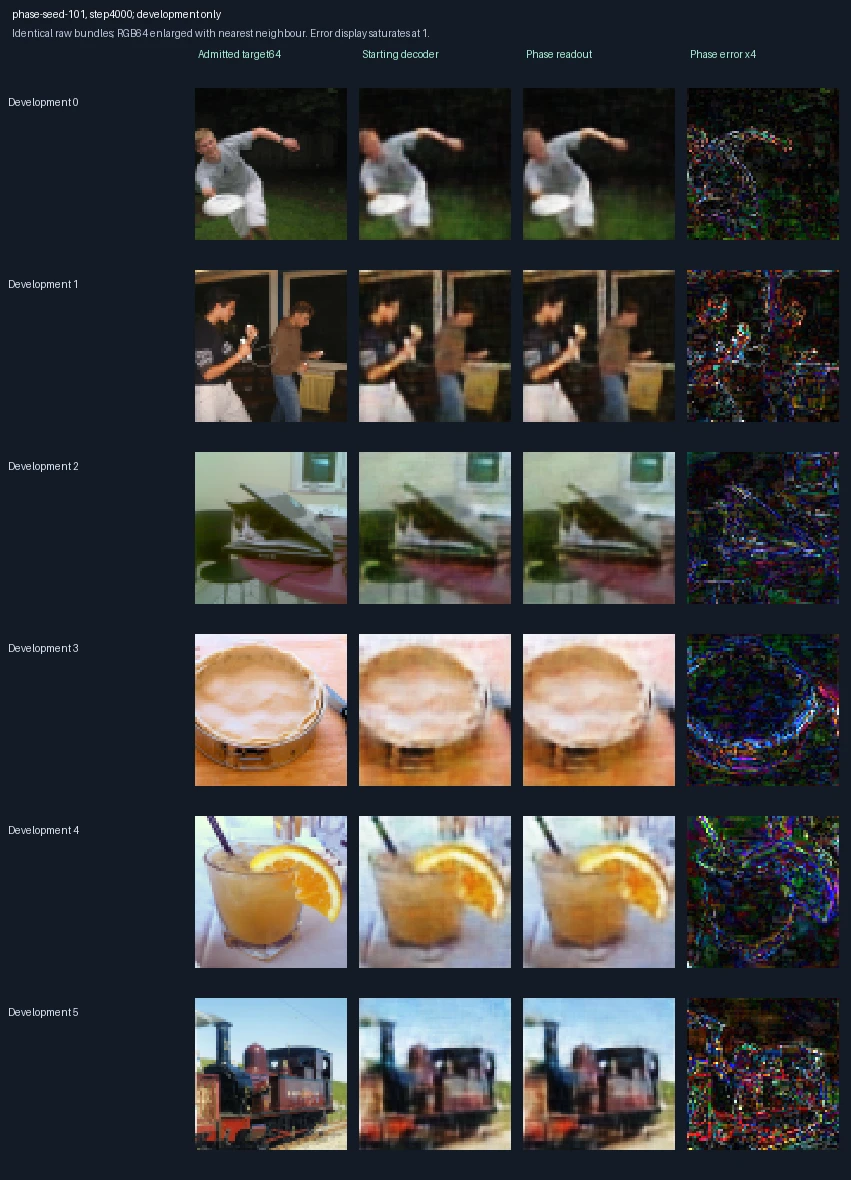
Six fixed development photographs. Left to right: the 64 × 64 input, the unchanged starting decoder using phase-only readout, this candidate’s reconstruction, and this candidate’s error. This is training repetition 1; the image label “seed-101” identifies its randomization setting. The encoder is fixed; only the decoder learns. These examples guide model selection, not final test claims. Phase-only readout keeps each complex coordinate’s angle; magnitude-preserving readout also keeps its amplitude, with one fixed scale learned from training data. Error panels show four times the absolute RGB difference from the reference, separately for each color channel, clipped at full brightness. Darker pixels mean smaller errors; black is zero or below the display’s precision. The scale is fixed across examples, not adjusted to make each image look better.
Magnitude-preserving readout, training repetition 1: 0 weight updates
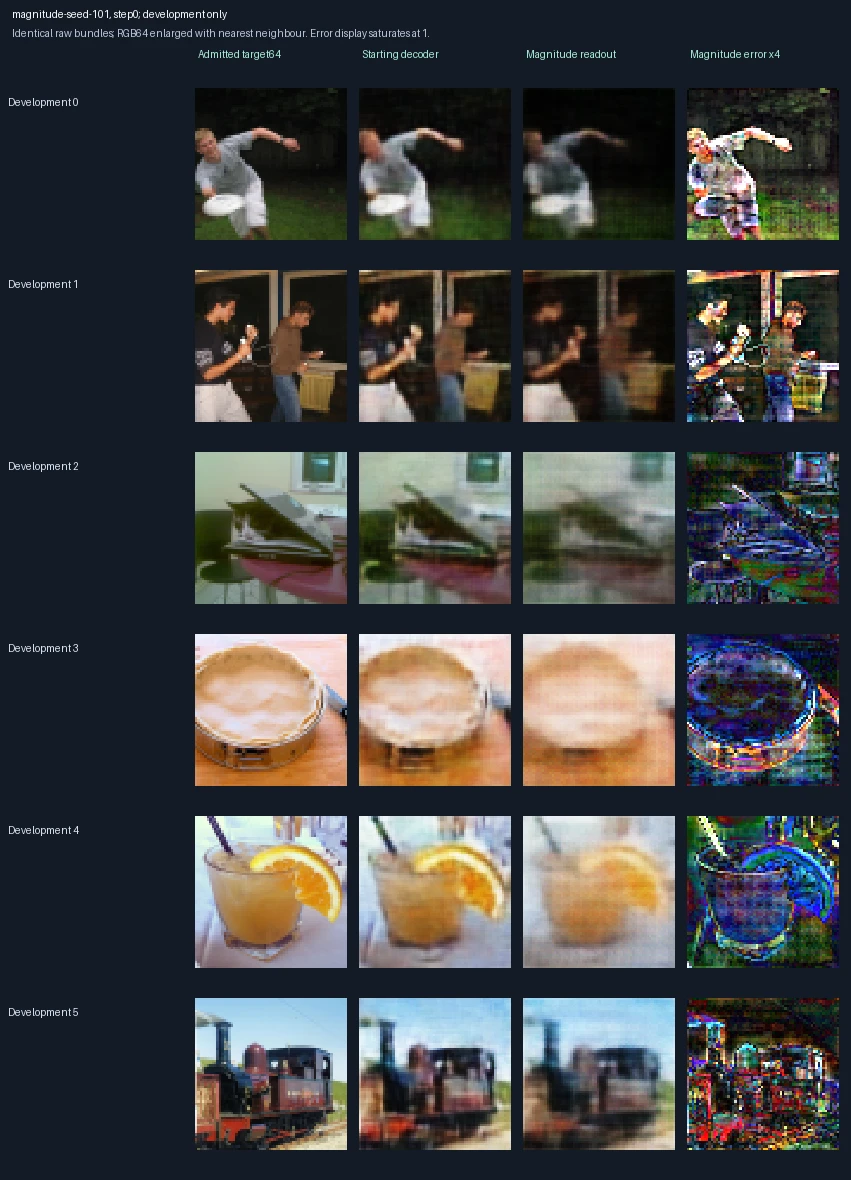
Six fixed development photographs. Left to right: the 64 × 64 input, the unchanged starting decoder using phase-only readout, this candidate’s reconstruction, and this candidate’s error. This is training repetition 1; the image label “seed-101” identifies its randomization setting. The encoder is fixed; only the decoder learns. These examples guide model selection, not final test claims. Phase-only readout keeps each complex coordinate’s angle; magnitude-preserving readout also keeps its amplitude, with one fixed scale learned from training data. Error panels show four times the absolute RGB difference from the reference, separately for each color channel, clipped at full brightness. Darker pixels mean smaller errors; black is zero or below the display’s precision. The scale is fixed across examples, not adjusted to make each image look better. At zero updates, changed brightness and error reflect switching the decoder’s input representation before it has adapted.
Magnitude-preserving readout, training repetition 1: 250 weight updates
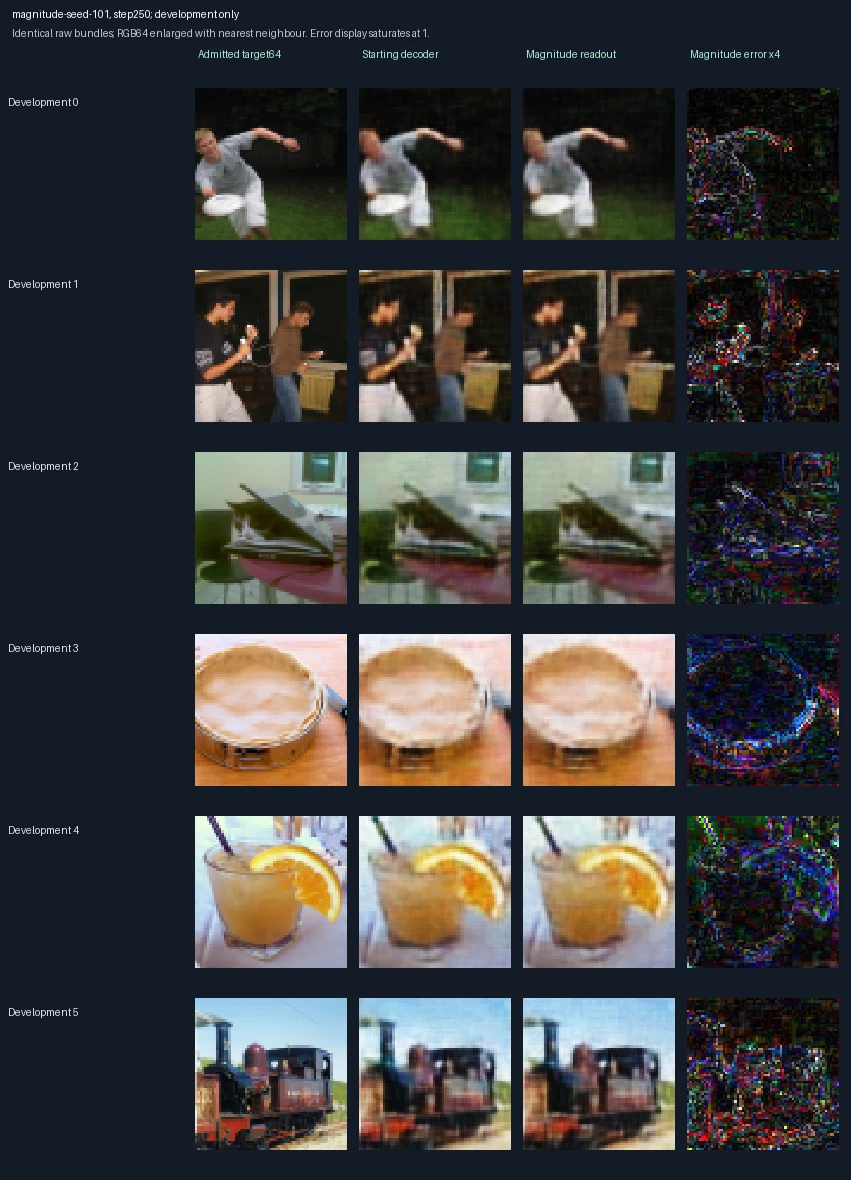
Six fixed development photographs. Left to right: the 64 × 64 input, the unchanged starting decoder using phase-only readout, this candidate’s reconstruction, and this candidate’s error. This is training repetition 1; the image label “seed-101” identifies its randomization setting. The encoder is fixed; only the decoder learns. These examples guide model selection, not final test claims. Phase-only readout keeps each complex coordinate’s angle; magnitude-preserving readout also keeps its amplitude, with one fixed scale learned from training data. Error panels show four times the absolute RGB difference from the reference, separately for each color channel, clipped at full brightness. Darker pixels mean smaller errors; black is zero or below the display’s precision. The scale is fixed across examples, not adjusted to make each image look better.
Magnitude-preserving readout, training repetition 1: 500 weight updates
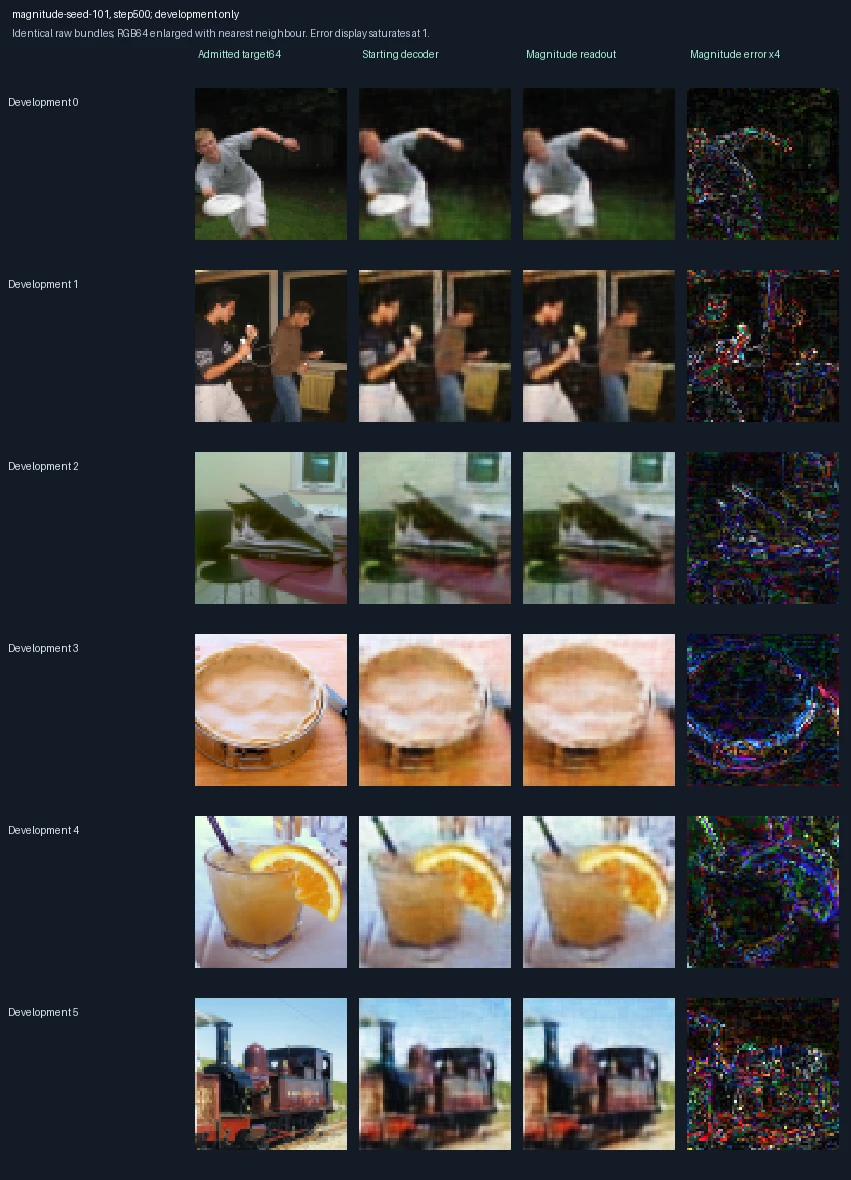
Six fixed development photographs. Left to right: the 64 × 64 input, the unchanged starting decoder using phase-only readout, this candidate’s reconstruction, and this candidate’s error. This is training repetition 1; the image label “seed-101” identifies its randomization setting. The encoder is fixed; only the decoder learns. These examples guide model selection, not final test claims. Phase-only readout keeps each complex coordinate’s angle; magnitude-preserving readout also keeps its amplitude, with one fixed scale learned from training data. Error panels show four times the absolute RGB difference from the reference, separately for each color channel, clipped at full brightness. Darker pixels mean smaller errors; black is zero or below the display’s precision. The scale is fixed across examples, not adjusted to make each image look better.
Magnitude-preserving readout, training repetition 1: 750 weight updates
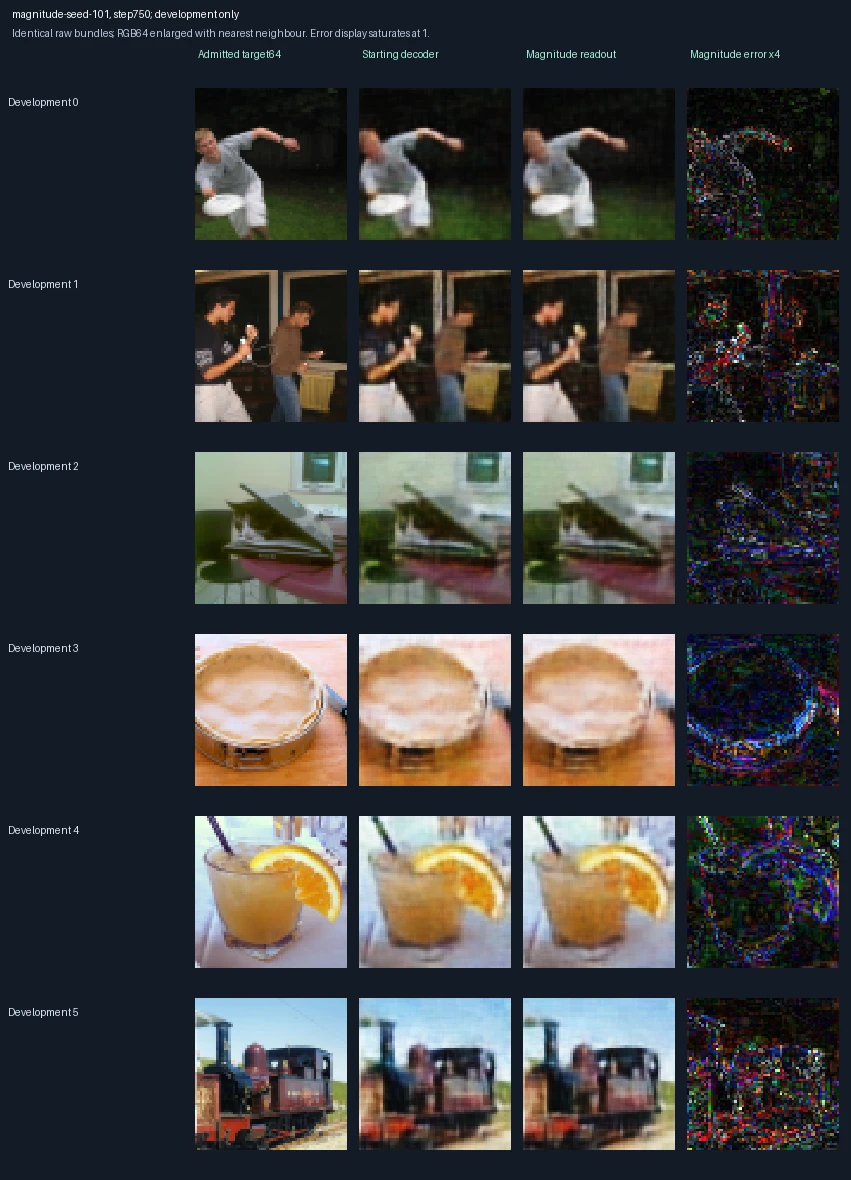
Six fixed development photographs. Left to right: the 64 × 64 input, the unchanged starting decoder using phase-only readout, this candidate’s reconstruction, and this candidate’s error. This is training repetition 1; the image label “seed-101” identifies its randomization setting. The encoder is fixed; only the decoder learns. These examples guide model selection, not final test claims. Phase-only readout keeps each complex coordinate’s angle; magnitude-preserving readout also keeps its amplitude, with one fixed scale learned from training data. Error panels show four times the absolute RGB difference from the reference, separately for each color channel, clipped at full brightness. Darker pixels mean smaller errors; black is zero or below the display’s precision. The scale is fixed across examples, not adjusted to make each image look better.
Magnitude-preserving readout, training repetition 1: 1,000 weight updates
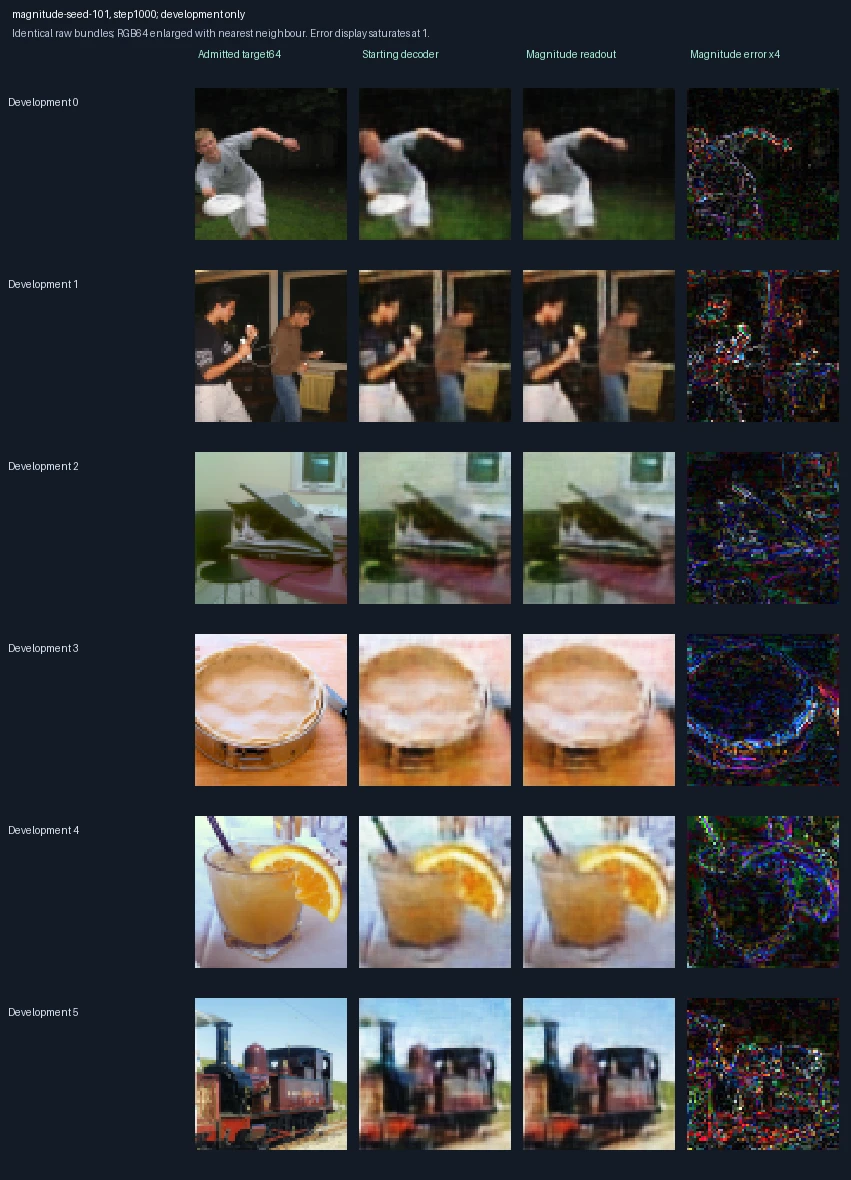
Six fixed development photographs. Left to right: the 64 × 64 input, the unchanged starting decoder using phase-only readout, this candidate’s reconstruction, and this candidate’s error. This is training repetition 1; the image label “seed-101” identifies its randomization setting. The encoder is fixed; only the decoder learns. These examples guide model selection, not final test claims. Phase-only readout keeps each complex coordinate’s angle; magnitude-preserving readout also keeps its amplitude, with one fixed scale learned from training data. Error panels show four times the absolute RGB difference from the reference, separately for each color channel, clipped at full brightness. Darker pixels mean smaller errors; black is zero or below the display’s precision. The scale is fixed across examples, not adjusted to make each image look better.
Magnitude-preserving readout, training repetition 1: 1,250 weight updates
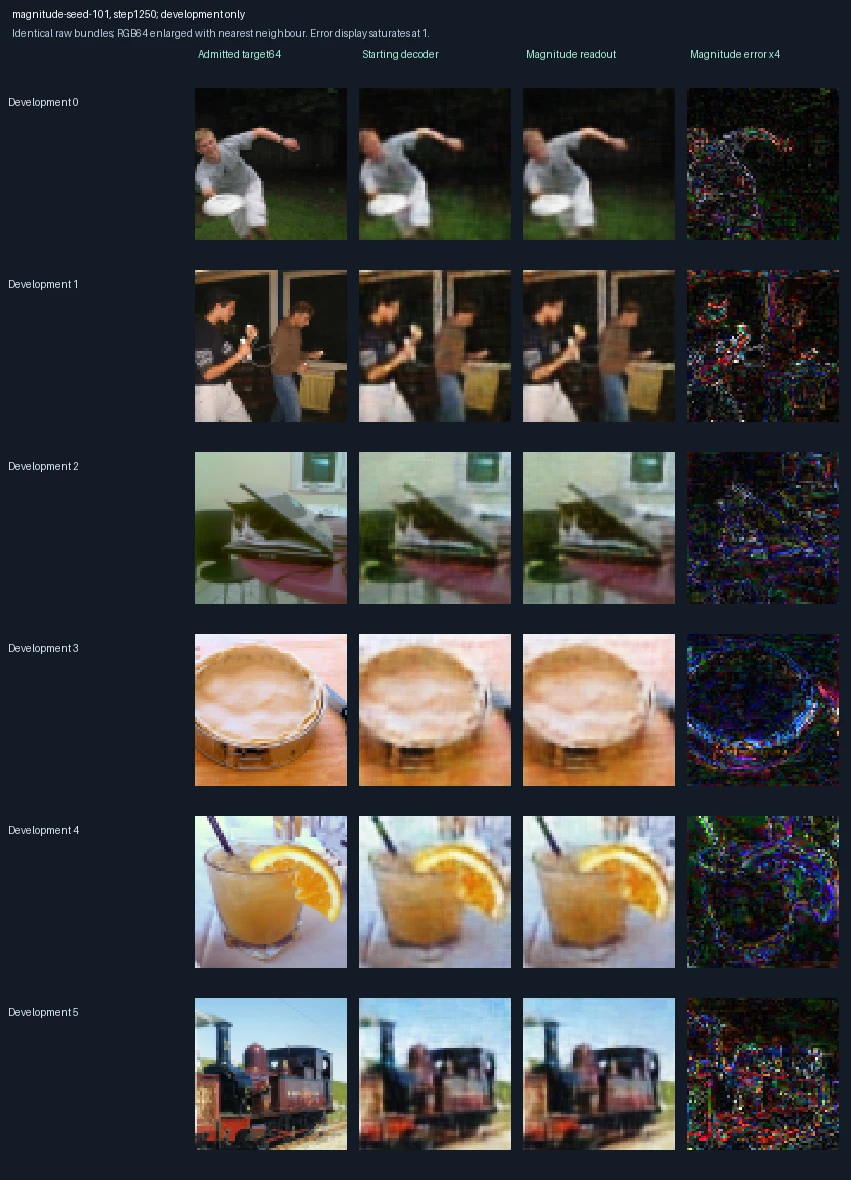
Six fixed development photographs. Left to right: the 64 × 64 input, the unchanged starting decoder using phase-only readout, this candidate’s reconstruction, and this candidate’s error. This is training repetition 1; the image label “seed-101” identifies its randomization setting. The encoder is fixed; only the decoder learns. These examples guide model selection, not final test claims. Phase-only readout keeps each complex coordinate’s angle; magnitude-preserving readout also keeps its amplitude, with one fixed scale learned from training data. Error panels show four times the absolute RGB difference from the reference, separately for each color channel, clipped at full brightness. Darker pixels mean smaller errors; black is zero or below the display’s precision. The scale is fixed across examples, not adjusted to make each image look better.
Magnitude-preserving readout, training repetition 1: 1,500 weight updates
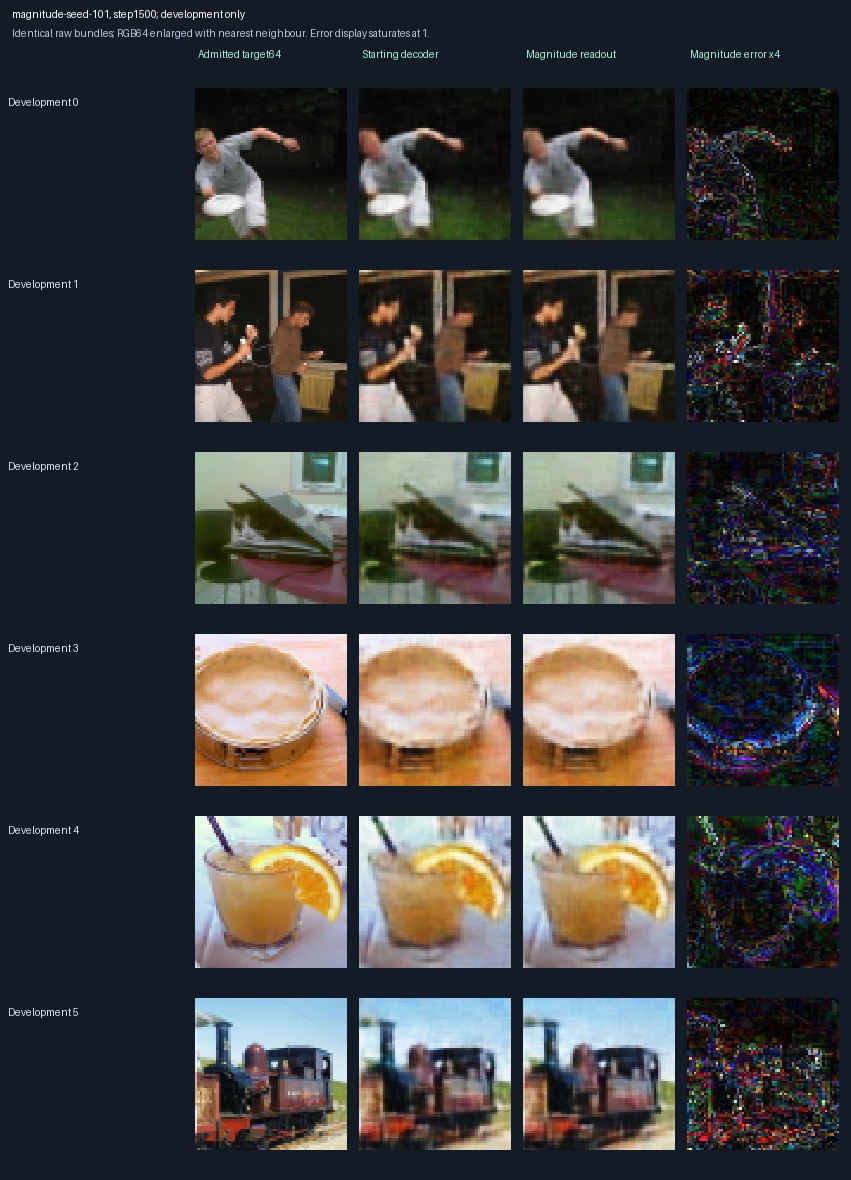
Six fixed development photographs. Left to right: the 64 × 64 input, the unchanged starting decoder using phase-only readout, this candidate’s reconstruction, and this candidate’s error. This is training repetition 1; the image label “seed-101” identifies its randomization setting. The encoder is fixed; only the decoder learns. These examples guide model selection, not final test claims. Phase-only readout keeps each complex coordinate’s angle; magnitude-preserving readout also keeps its amplitude, with one fixed scale learned from training data. Error panels show four times the absolute RGB difference from the reference, separately for each color channel, clipped at full brightness. Darker pixels mean smaller errors; black is zero or below the display’s precision. The scale is fixed across examples, not adjusted to make each image look better.
Magnitude-preserving readout, training repetition 1: 1,750 weight updates
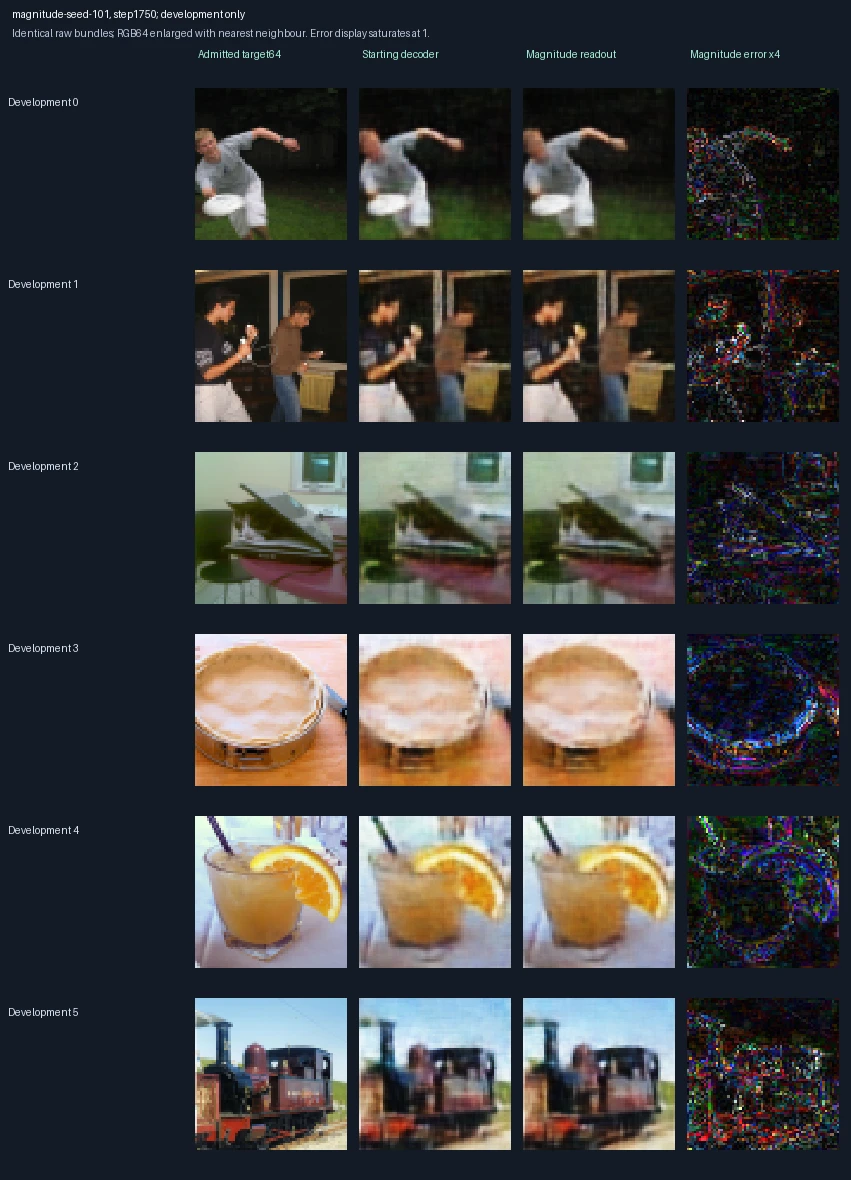
Six fixed development photographs. Left to right: the 64 × 64 input, the unchanged starting decoder using phase-only readout, this candidate’s reconstruction, and this candidate’s error. This is training repetition 1; the image label “seed-101” identifies its randomization setting. The encoder is fixed; only the decoder learns. These examples guide model selection, not final test claims. Phase-only readout keeps each complex coordinate’s angle; magnitude-preserving readout also keeps its amplitude, with one fixed scale learned from training data. Error panels show four times the absolute RGB difference from the reference, separately for each color channel, clipped at full brightness. Darker pixels mean smaller errors; black is zero or below the display’s precision. The scale is fixed across examples, not adjusted to make each image look better.
Magnitude-preserving readout, training repetition 1: 2,000 weight updates
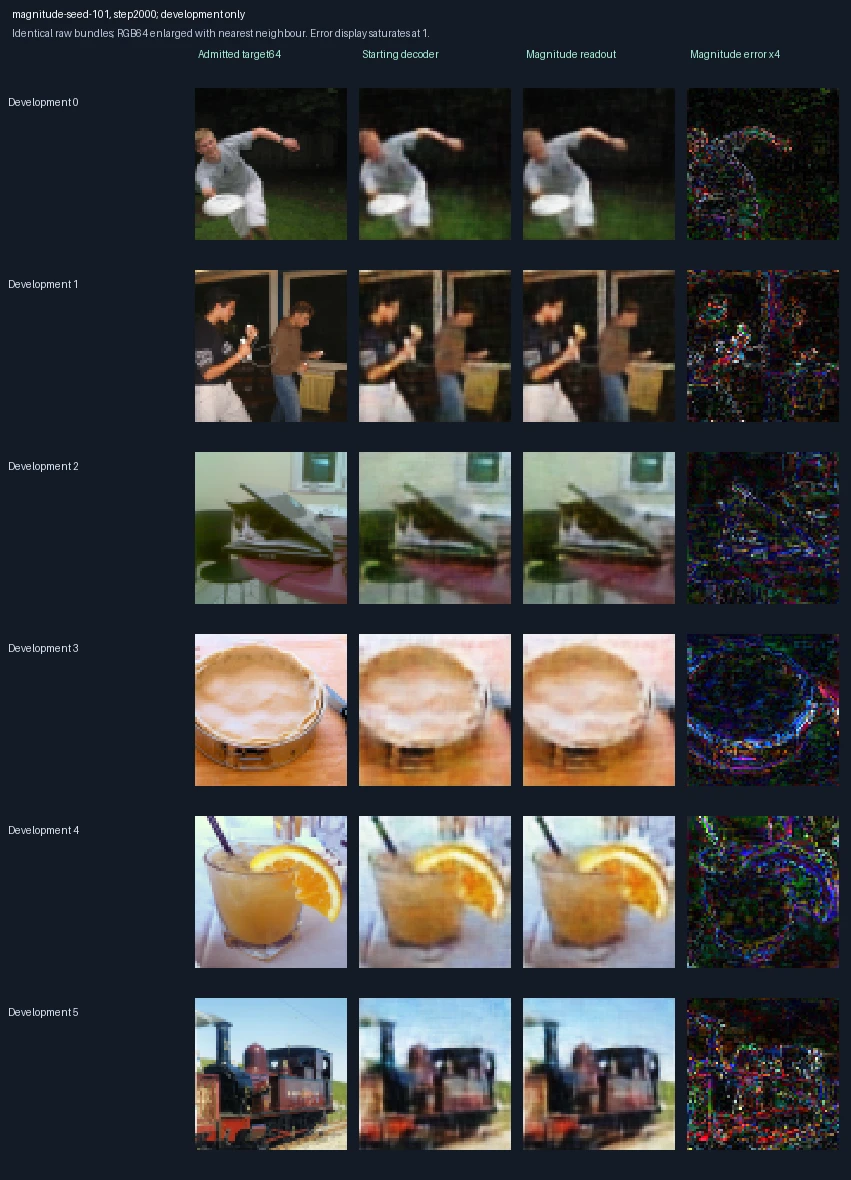
Six fixed development photographs. Left to right: the 64 × 64 input, the unchanged starting decoder using phase-only readout, this candidate’s reconstruction, and this candidate’s error. This is training repetition 1; the image label “seed-101” identifies its randomization setting. The encoder is fixed; only the decoder learns. These examples guide model selection, not final test claims. Phase-only readout keeps each complex coordinate’s angle; magnitude-preserving readout also keeps its amplitude, with one fixed scale learned from training data. Error panels show four times the absolute RGB difference from the reference, separately for each color channel, clipped at full brightness. Darker pixels mean smaller errors; black is zero or below the display’s precision. The scale is fixed across examples, not adjusted to make each image look better.
Magnitude-preserving readout, training repetition 1: 2,250 weight updates
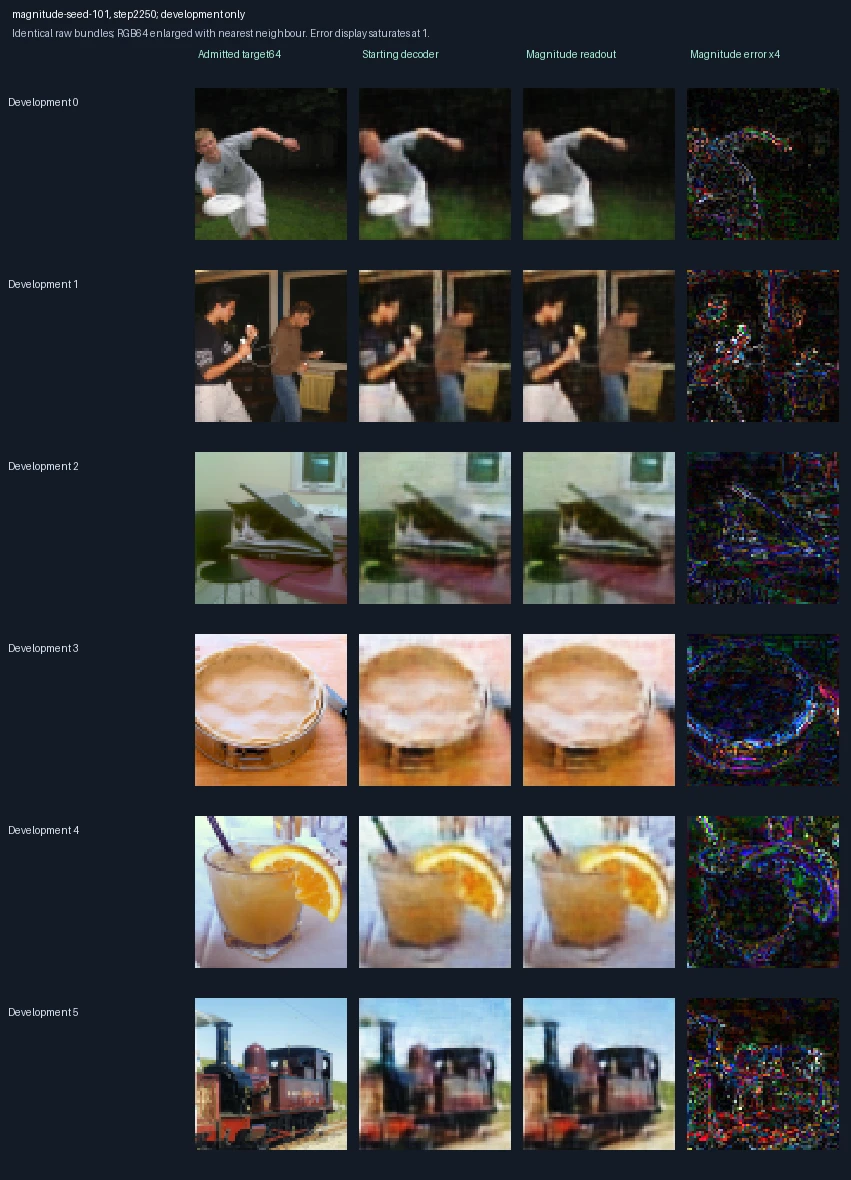
Six fixed development photographs. Left to right: the 64 × 64 input, the unchanged starting decoder using phase-only readout, this candidate’s reconstruction, and this candidate’s error. This is training repetition 1; the image label “seed-101” identifies its randomization setting. The encoder is fixed; only the decoder learns. These examples guide model selection, not final test claims. Phase-only readout keeps each complex coordinate’s angle; magnitude-preserving readout also keeps its amplitude, with one fixed scale learned from training data. Error panels show four times the absolute RGB difference from the reference, separately for each color channel, clipped at full brightness. Darker pixels mean smaller errors; black is zero or below the display’s precision. The scale is fixed across examples, not adjusted to make each image look better.
Magnitude-preserving readout, training repetition 1: 2,500 weight updates
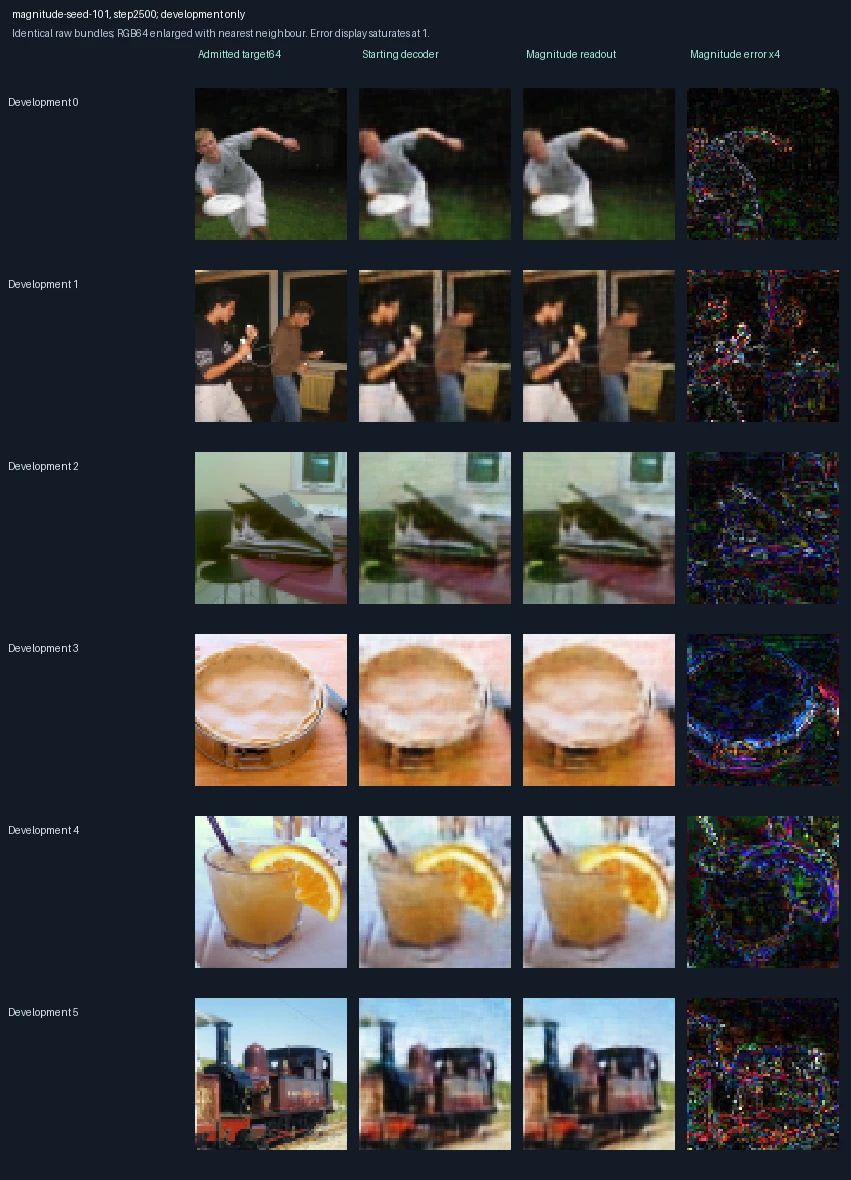
Six fixed development photographs. Left to right: the 64 × 64 input, the unchanged starting decoder using phase-only readout, this candidate’s reconstruction, and this candidate’s error. This is training repetition 1; the image label “seed-101” identifies its randomization setting. The encoder is fixed; only the decoder learns. These examples guide model selection, not final test claims. Phase-only readout keeps each complex coordinate’s angle; magnitude-preserving readout also keeps its amplitude, with one fixed scale learned from training data. Error panels show four times the absolute RGB difference from the reference, separately for each color channel, clipped at full brightness. Darker pixels mean smaller errors; black is zero or below the display’s precision. The scale is fixed across examples, not adjusted to make each image look better.
Magnitude-preserving readout, training repetition 1: 2,750 weight updates
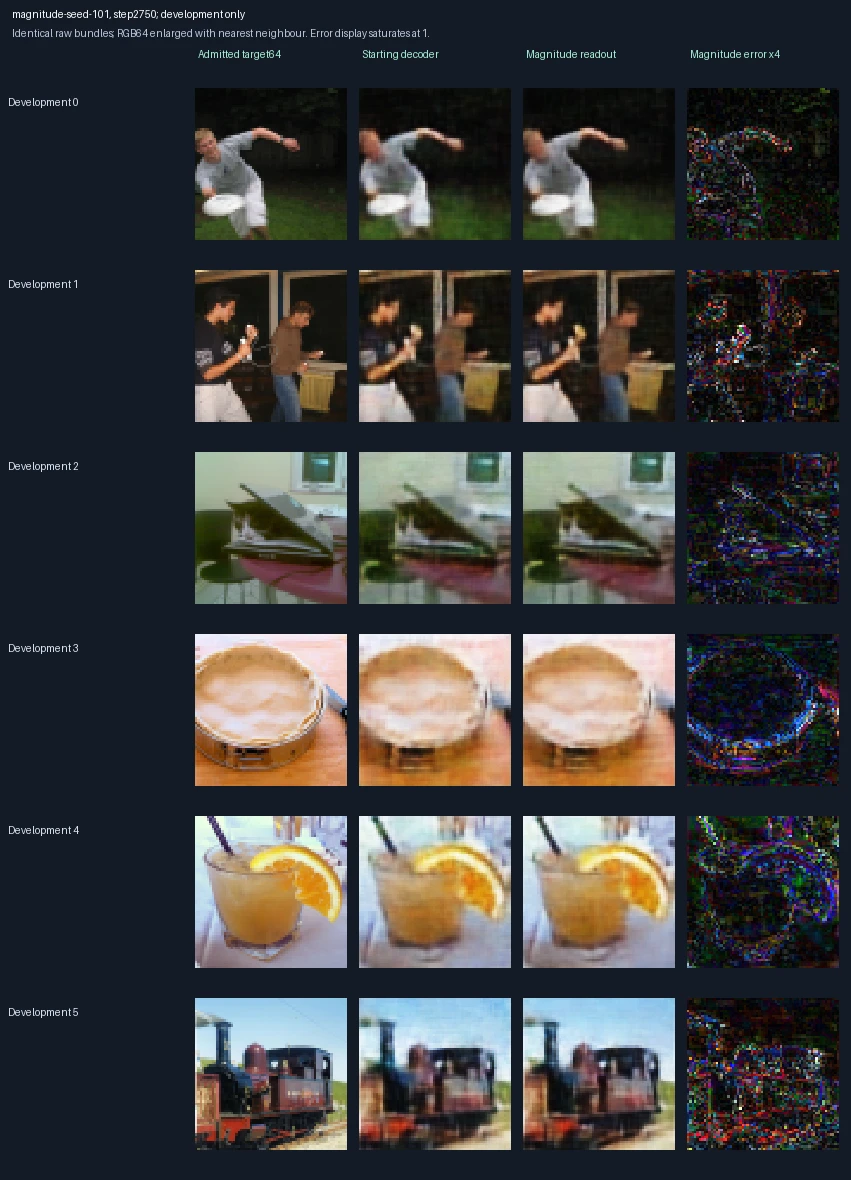
Six fixed development photographs. Left to right: the 64 × 64 input, the unchanged starting decoder using phase-only readout, this candidate’s reconstruction, and this candidate’s error. This is training repetition 1; the image label “seed-101” identifies its randomization setting. The encoder is fixed; only the decoder learns. These examples guide model selection, not final test claims. Phase-only readout keeps each complex coordinate’s angle; magnitude-preserving readout also keeps its amplitude, with one fixed scale learned from training data. Error panels show four times the absolute RGB difference from the reference, separately for each color channel, clipped at full brightness. Darker pixels mean smaller errors; black is zero or below the display’s precision. The scale is fixed across examples, not adjusted to make each image look better.
Magnitude-preserving readout, training repetition 1: 3,000 weight updates
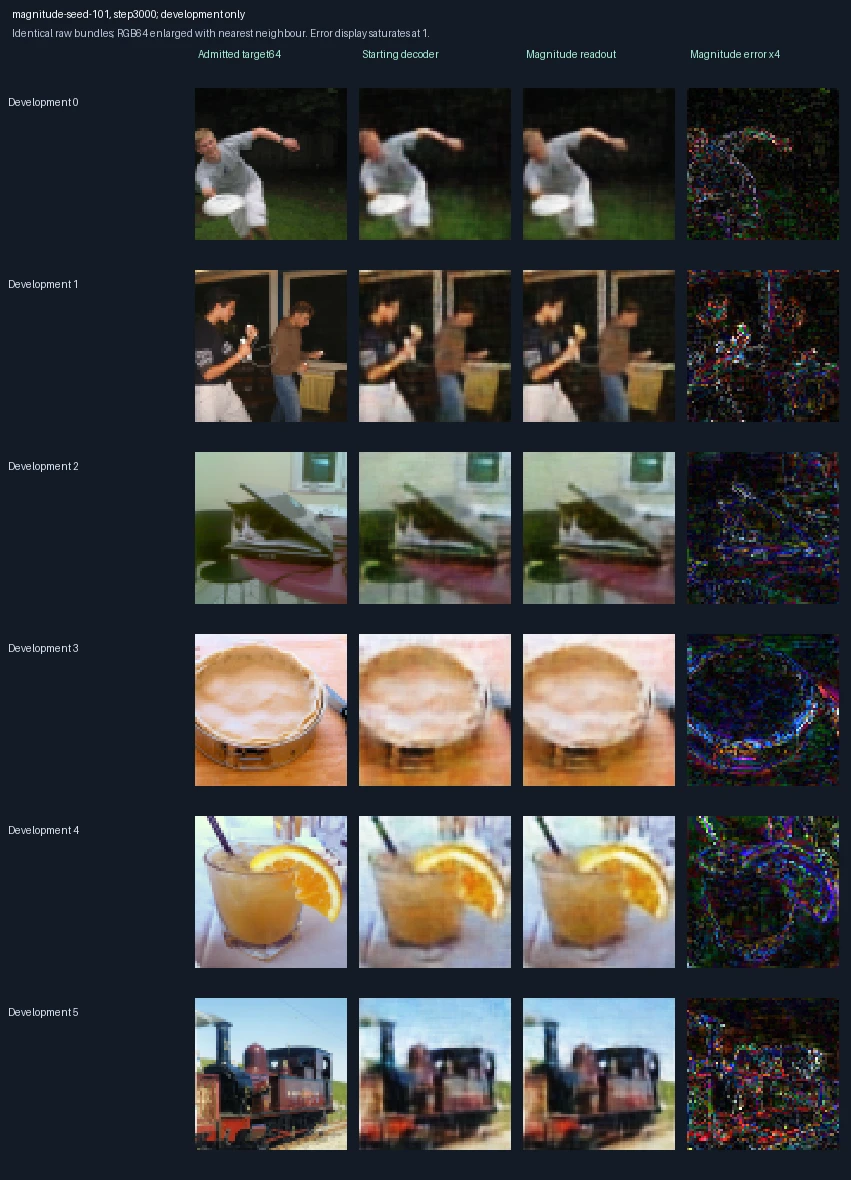
Six fixed development photographs. Left to right: the 64 × 64 input, the unchanged starting decoder using phase-only readout, this candidate’s reconstruction, and this candidate’s error. This is training repetition 1; the image label “seed-101” identifies its randomization setting. The encoder is fixed; only the decoder learns. These examples guide model selection, not final test claims. Phase-only readout keeps each complex coordinate’s angle; magnitude-preserving readout also keeps its amplitude, with one fixed scale learned from training data. Error panels show four times the absolute RGB difference from the reference, separately for each color channel, clipped at full brightness. Darker pixels mean smaller errors; black is zero or below the display’s precision. The scale is fixed across examples, not adjusted to make each image look better.
Magnitude-preserving readout, training repetition 1: 3,250 weight updates
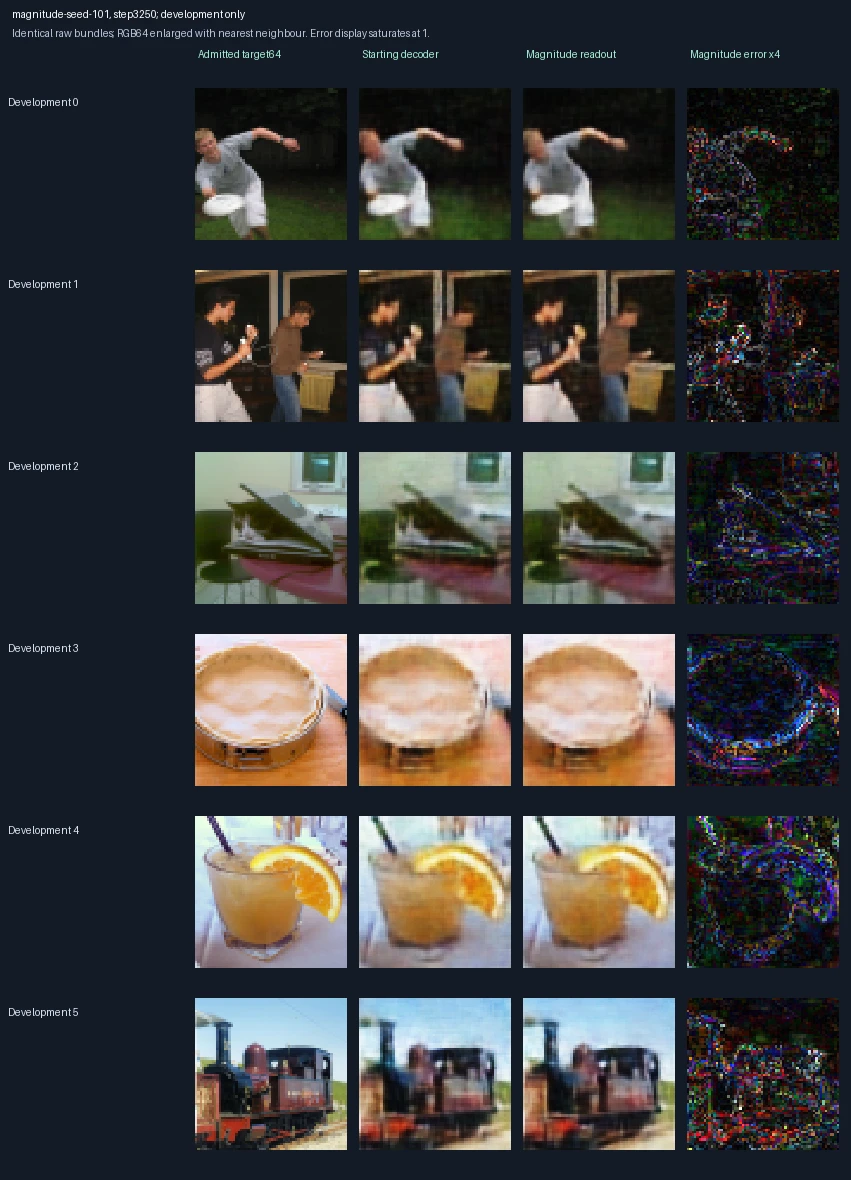
Six fixed development photographs. Left to right: the 64 × 64 input, the unchanged starting decoder using phase-only readout, this candidate’s reconstruction, and this candidate’s error. This is training repetition 1; the image label “seed-101” identifies its randomization setting. The encoder is fixed; only the decoder learns. These examples guide model selection, not final test claims. Phase-only readout keeps each complex coordinate’s angle; magnitude-preserving readout also keeps its amplitude, with one fixed scale learned from training data. Error panels show four times the absolute RGB difference from the reference, separately for each color channel, clipped at full brightness. Darker pixels mean smaller errors; black is zero or below the display’s precision. The scale is fixed across examples, not adjusted to make each image look better.
Magnitude-preserving readout, training repetition 1: 3,500 weight updates
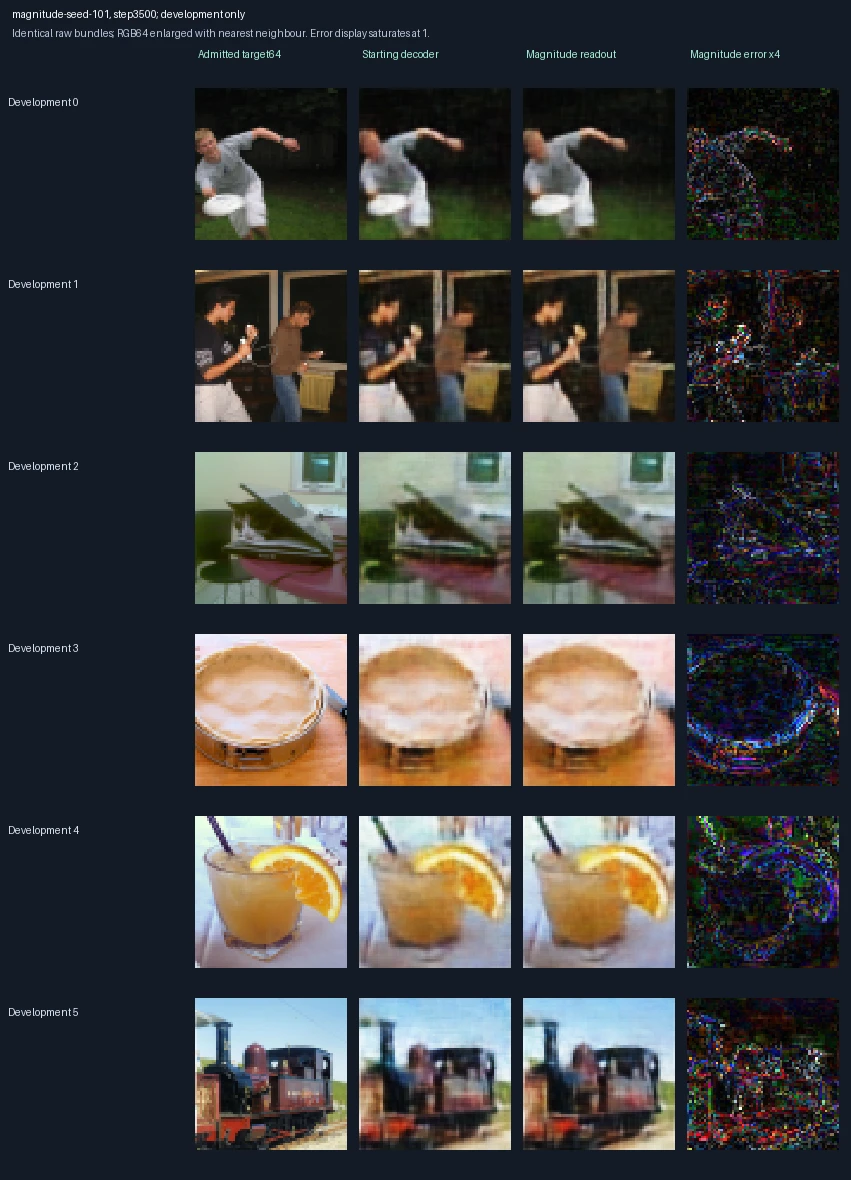
Six fixed development photographs. Left to right: the 64 × 64 input, the unchanged starting decoder using phase-only readout, this candidate’s reconstruction, and this candidate’s error. This is training repetition 1; the image label “seed-101” identifies its randomization setting. The encoder is fixed; only the decoder learns. These examples guide model selection, not final test claims. Phase-only readout keeps each complex coordinate’s angle; magnitude-preserving readout also keeps its amplitude, with one fixed scale learned from training data. Error panels show four times the absolute RGB difference from the reference, separately for each color channel, clipped at full brightness. Darker pixels mean smaller errors; black is zero or below the display’s precision. The scale is fixed across examples, not adjusted to make each image look better.
Magnitude-preserving readout, training repetition 1: 3,750 weight updates
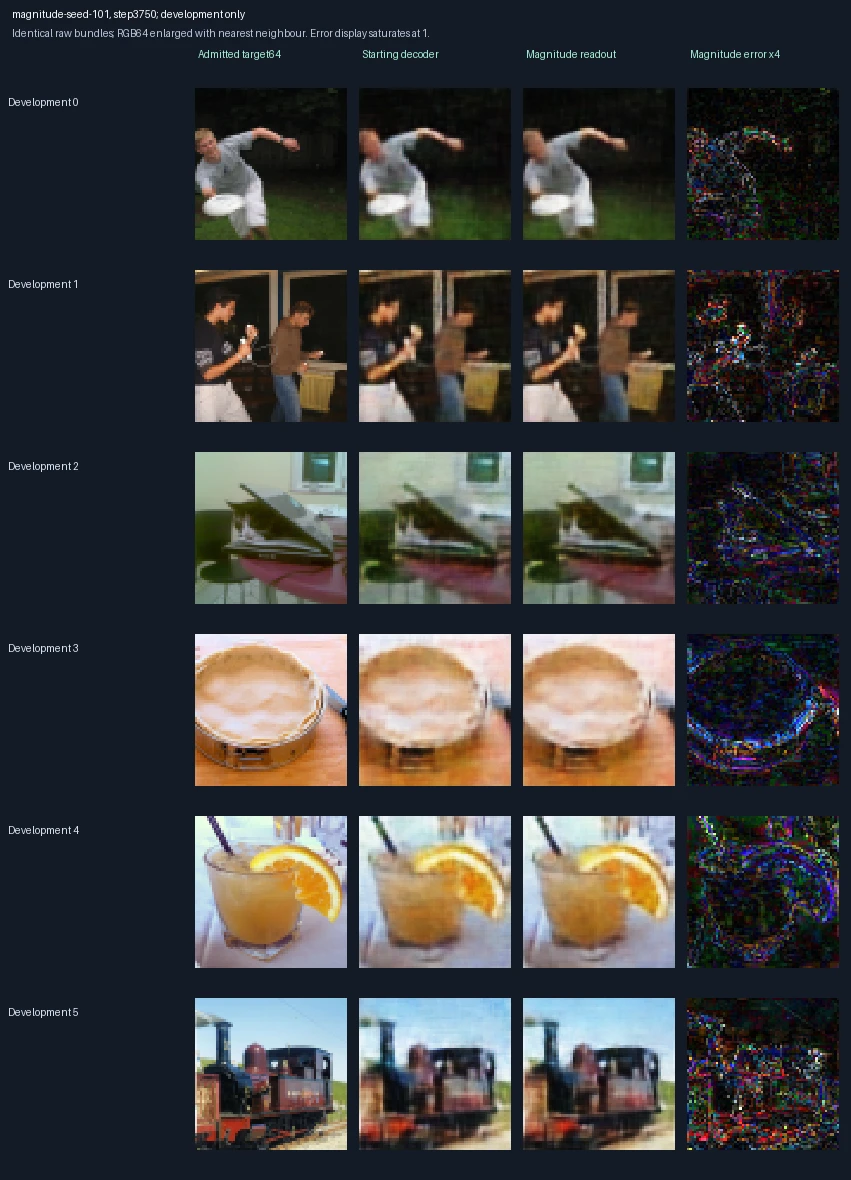
Six fixed development photographs. Left to right: the 64 × 64 input, the unchanged starting decoder using phase-only readout, this candidate’s reconstruction, and this candidate’s error. This is training repetition 1; the image label “seed-101” identifies its randomization setting. The encoder is fixed; only the decoder learns. These examples guide model selection, not final test claims. Phase-only readout keeps each complex coordinate’s angle; magnitude-preserving readout also keeps its amplitude, with one fixed scale learned from training data. Error panels show four times the absolute RGB difference from the reference, separately for each color channel, clipped at full brightness. Darker pixels mean smaller errors; black is zero or below the display’s precision. The scale is fixed across examples, not adjusted to make each image look better.
Magnitude-preserving readout, training repetition 1: 4,000 weight updates
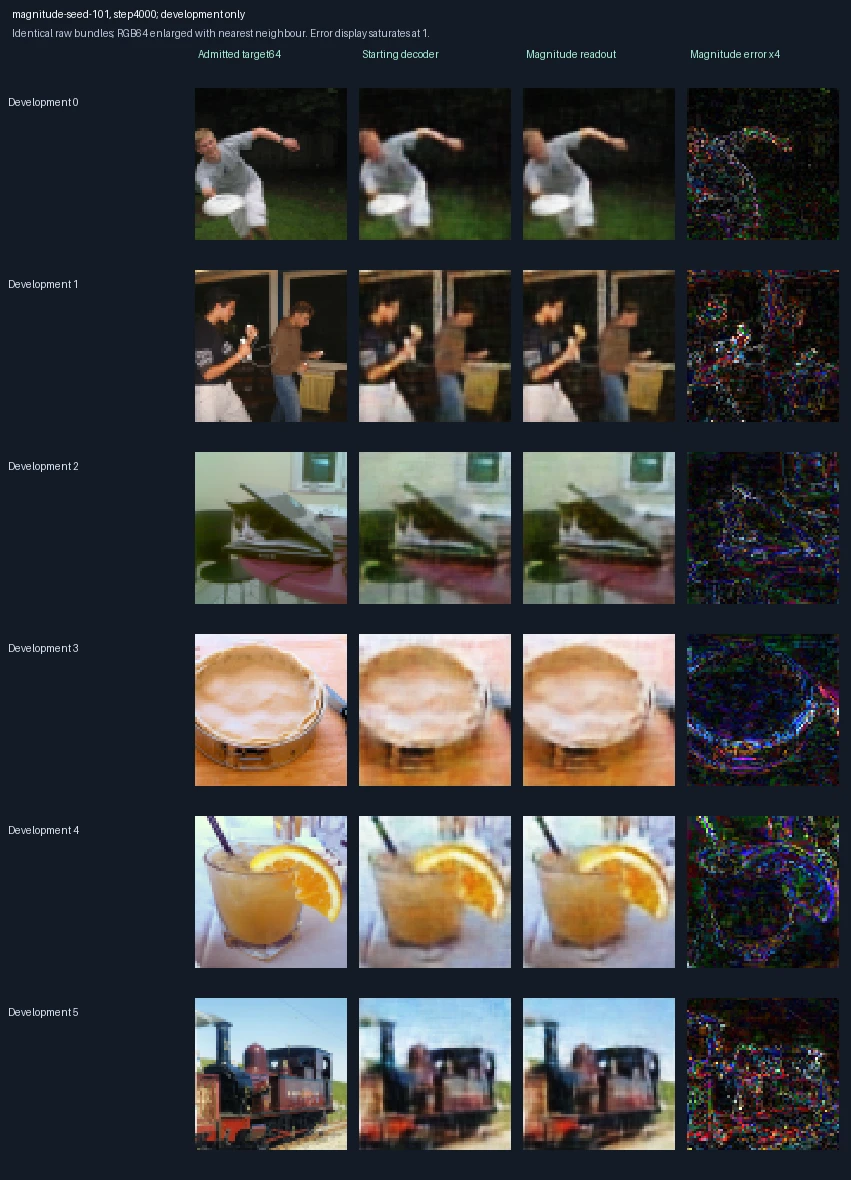
Six fixed development photographs. Left to right: the 64 × 64 input, the unchanged starting decoder using phase-only readout, this candidate’s reconstruction, and this candidate’s error. This is training repetition 1; the image label “seed-101” identifies its randomization setting. The encoder is fixed; only the decoder learns. These examples guide model selection, not final test claims. Phase-only readout keeps each complex coordinate’s angle; magnitude-preserving readout also keeps its amplitude, with one fixed scale learned from training data. Error panels show four times the absolute RGB difference from the reference, separately for each color channel, clipped at full brightness. Darker pixels mean smaller errors; black is zero or below the display’s precision. The scale is fixed across examples, not adjusted to make each image look better.
Phase-only readout, training repetition 2: 0 weight updates
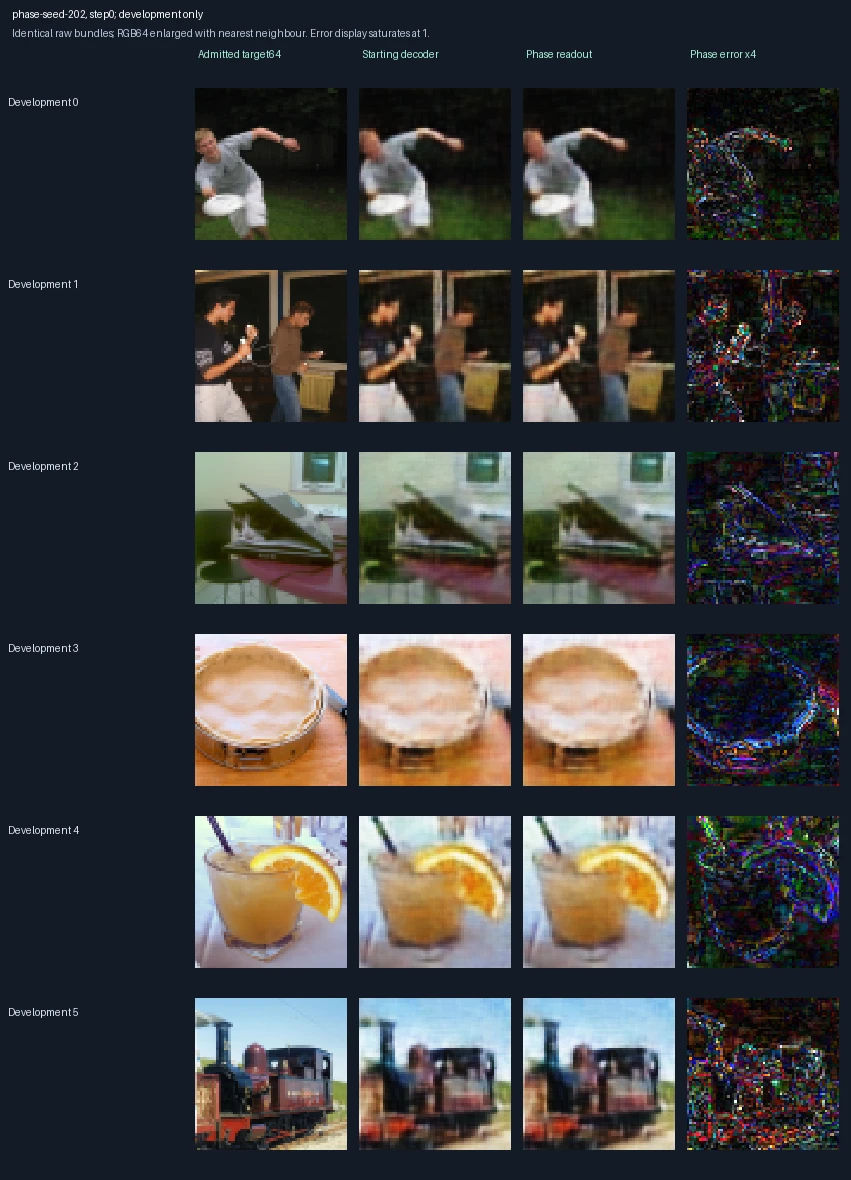
Six fixed development photographs. Left to right: the 64 × 64 input, the unchanged starting decoder using phase-only readout, this candidate’s reconstruction, and this candidate’s error. This is training repetition 2; the image label “seed-202” identifies its randomization setting. The encoder is fixed; only the decoder learns. These examples guide model selection, not final test claims. Phase-only readout keeps each complex coordinate’s angle; magnitude-preserving readout also keeps its amplitude, with one fixed scale learned from training data. Error panels show four times the absolute RGB difference from the reference, separately for each color channel, clipped at full brightness. Darker pixels mean smaller errors; black is zero or below the display’s precision. The scale is fixed across examples, not adjusted to make each image look better.
Phase-only readout, training repetition 2: 250 weight updates
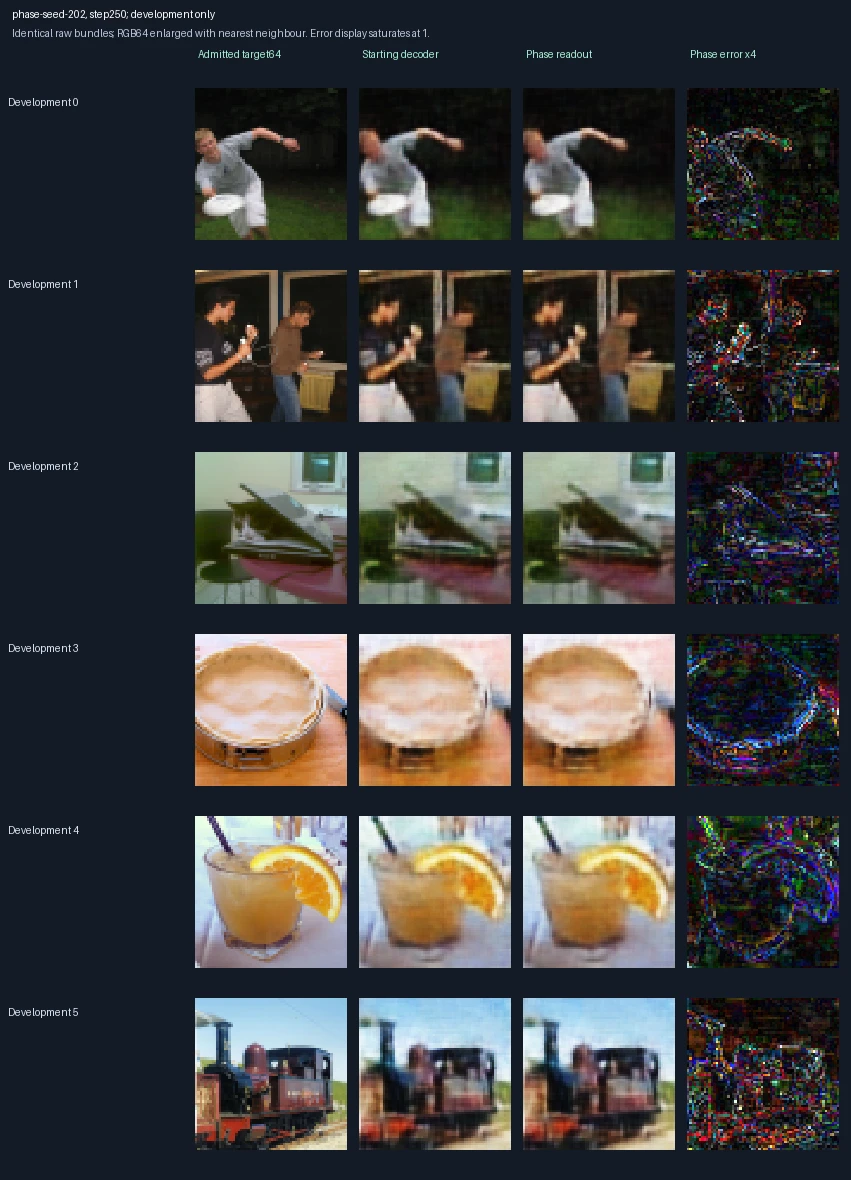
Six fixed development photographs. Left to right: the 64 × 64 input, the unchanged starting decoder using phase-only readout, this candidate’s reconstruction, and this candidate’s error. This is training repetition 2; the image label “seed-202” identifies its randomization setting. The encoder is fixed; only the decoder learns. These examples guide model selection, not final test claims. Phase-only readout keeps each complex coordinate’s angle; magnitude-preserving readout also keeps its amplitude, with one fixed scale learned from training data. Error panels show four times the absolute RGB difference from the reference, separately for each color channel, clipped at full brightness. Darker pixels mean smaller errors; black is zero or below the display’s precision. The scale is fixed across examples, not adjusted to make each image look better.
Phase-only readout, training repetition 2: 500 weight updates
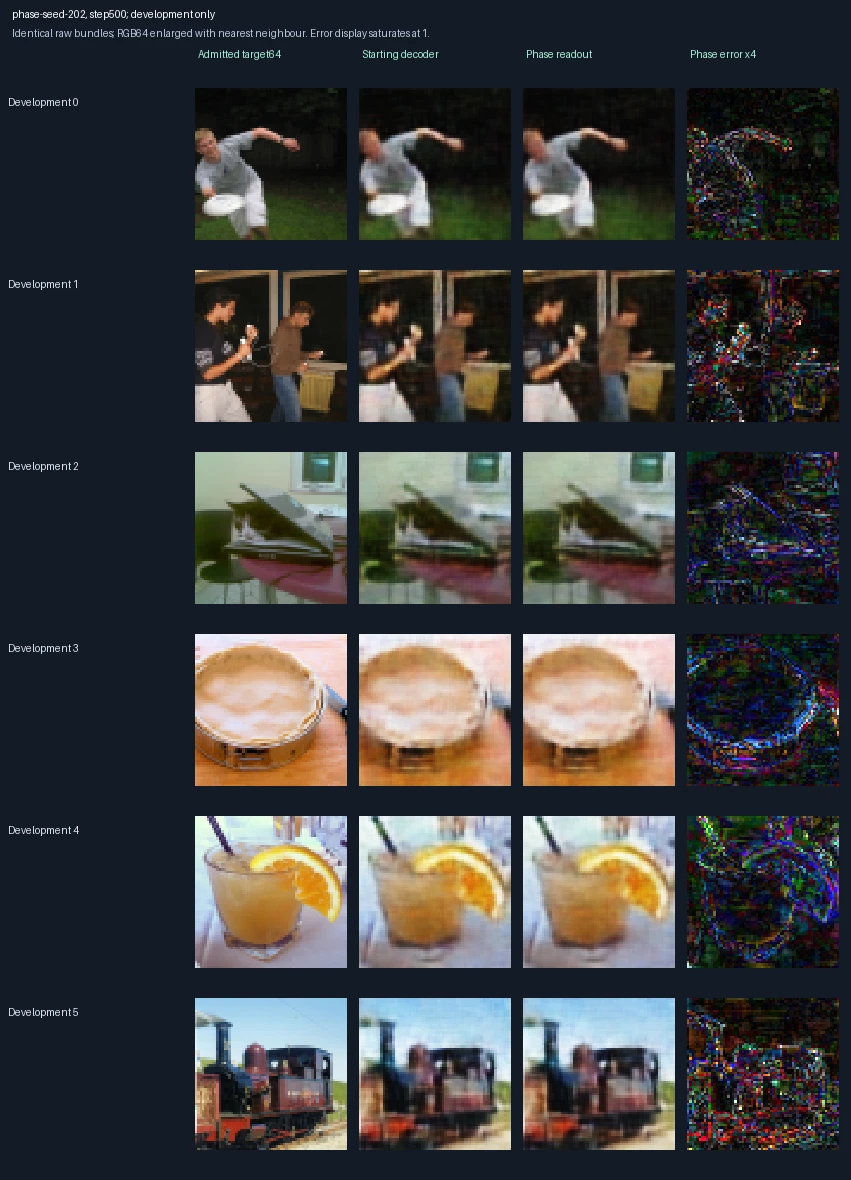
Six fixed development photographs. Left to right: the 64 × 64 input, the unchanged starting decoder using phase-only readout, this candidate’s reconstruction, and this candidate’s error. This is training repetition 2; the image label “seed-202” identifies its randomization setting. The encoder is fixed; only the decoder learns. These examples guide model selection, not final test claims. Phase-only readout keeps each complex coordinate’s angle; magnitude-preserving readout also keeps its amplitude, with one fixed scale learned from training data. Error panels show four times the absolute RGB difference from the reference, separately for each color channel, clipped at full brightness. Darker pixels mean smaller errors; black is zero or below the display’s precision. The scale is fixed across examples, not adjusted to make each image look better.
Phase-only readout, training repetition 2: 750 weight updates
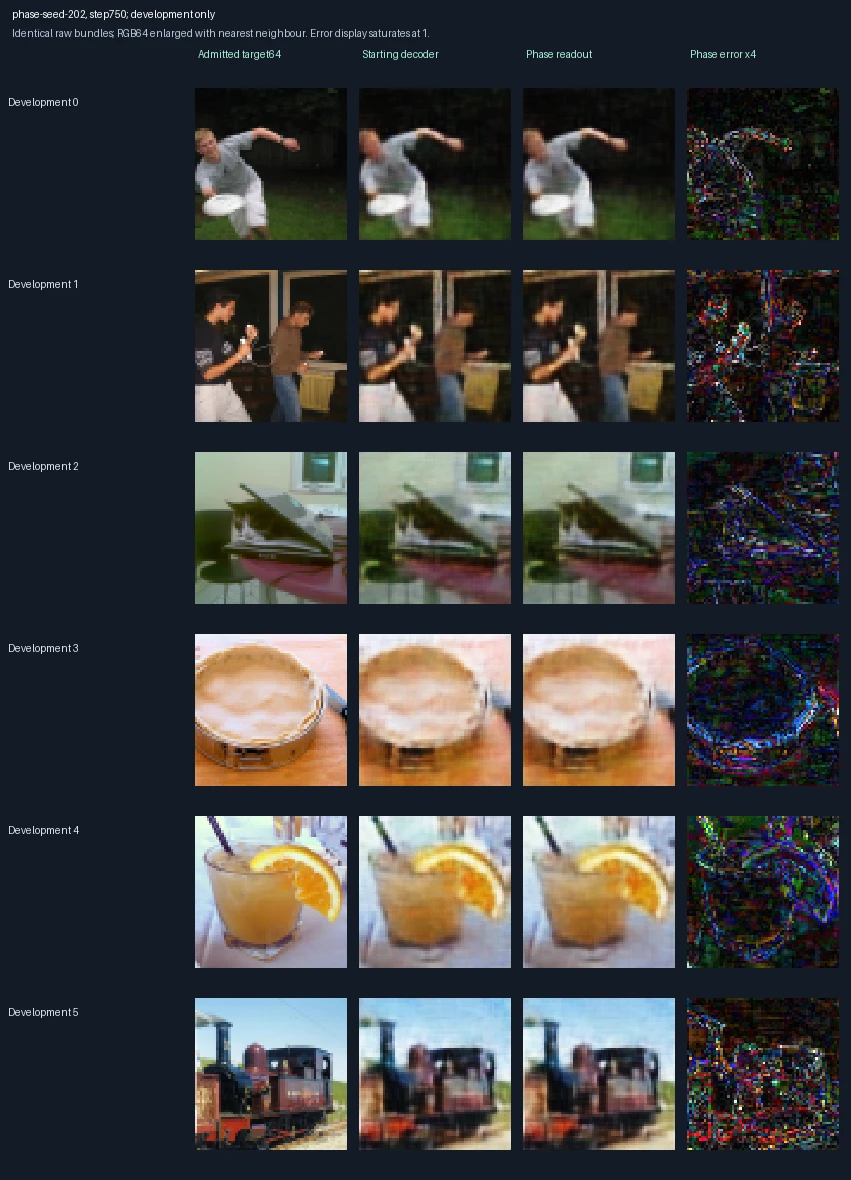
Six fixed development photographs. Left to right: the 64 × 64 input, the unchanged starting decoder using phase-only readout, this candidate’s reconstruction, and this candidate’s error. This is training repetition 2; the image label “seed-202” identifies its randomization setting. The encoder is fixed; only the decoder learns. These examples guide model selection, not final test claims. Phase-only readout keeps each complex coordinate’s angle; magnitude-preserving readout also keeps its amplitude, with one fixed scale learned from training data. Error panels show four times the absolute RGB difference from the reference, separately for each color channel, clipped at full brightness. Darker pixels mean smaller errors; black is zero or below the display’s precision. The scale is fixed across examples, not adjusted to make each image look better.
Phase-only readout, training repetition 2: 1,000 weight updates
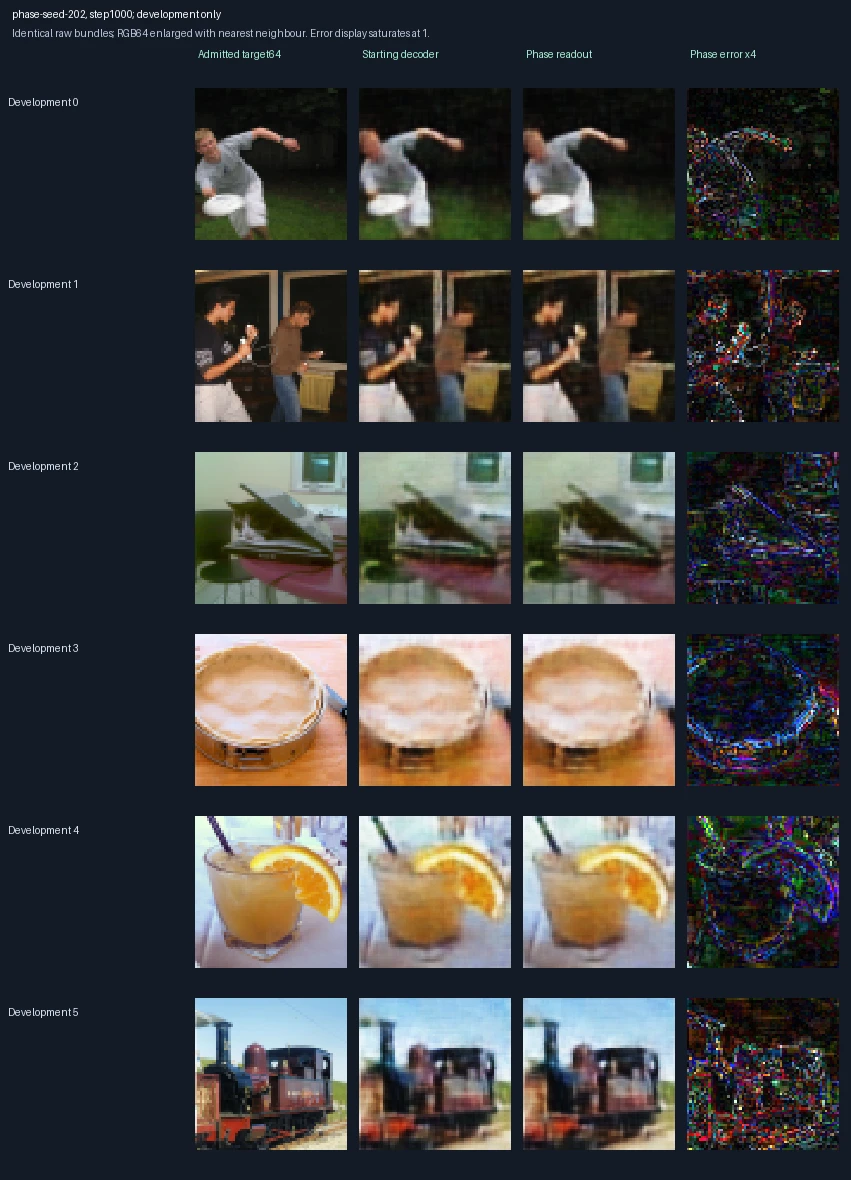
Six fixed development photographs. Left to right: the 64 × 64 input, the unchanged starting decoder using phase-only readout, this candidate’s reconstruction, and this candidate’s error. This is training repetition 2; the image label “seed-202” identifies its randomization setting. The encoder is fixed; only the decoder learns. These examples guide model selection, not final test claims. Phase-only readout keeps each complex coordinate’s angle; magnitude-preserving readout also keeps its amplitude, with one fixed scale learned from training data. Error panels show four times the absolute RGB difference from the reference, separately for each color channel, clipped at full brightness. Darker pixels mean smaller errors; black is zero or below the display’s precision. The scale is fixed across examples, not adjusted to make each image look better.
Phase-only readout, training repetition 2: 1,250 weight updates
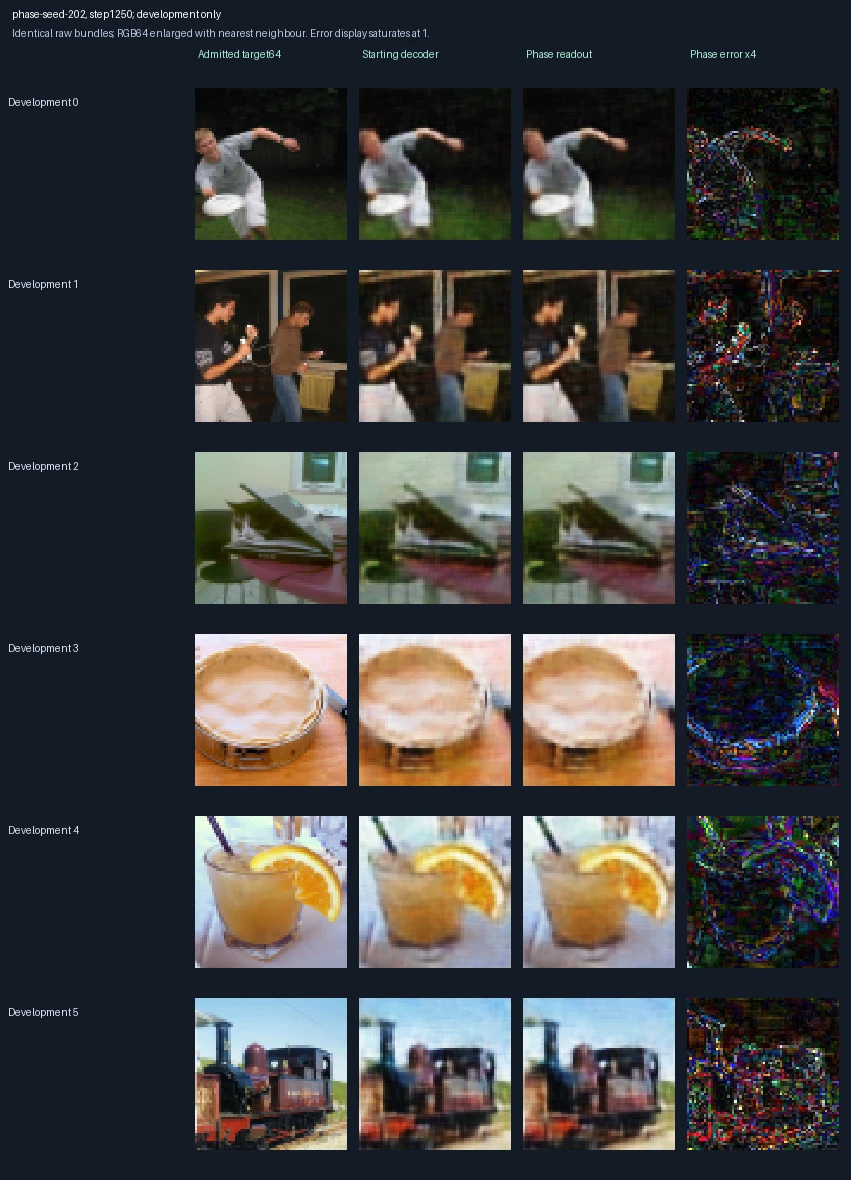
Six fixed development photographs. Left to right: the 64 × 64 input, the unchanged starting decoder using phase-only readout, this candidate’s reconstruction, and this candidate’s error. This is training repetition 2; the image label “seed-202” identifies its randomization setting. The encoder is fixed; only the decoder learns. These examples guide model selection, not final test claims. Phase-only readout keeps each complex coordinate’s angle; magnitude-preserving readout also keeps its amplitude, with one fixed scale learned from training data. Error panels show four times the absolute RGB difference from the reference, separately for each color channel, clipped at full brightness. Darker pixels mean smaller errors; black is zero or below the display’s precision. The scale is fixed across examples, not adjusted to make each image look better.
Phase-only readout, training repetition 2: 1,500 weight updates
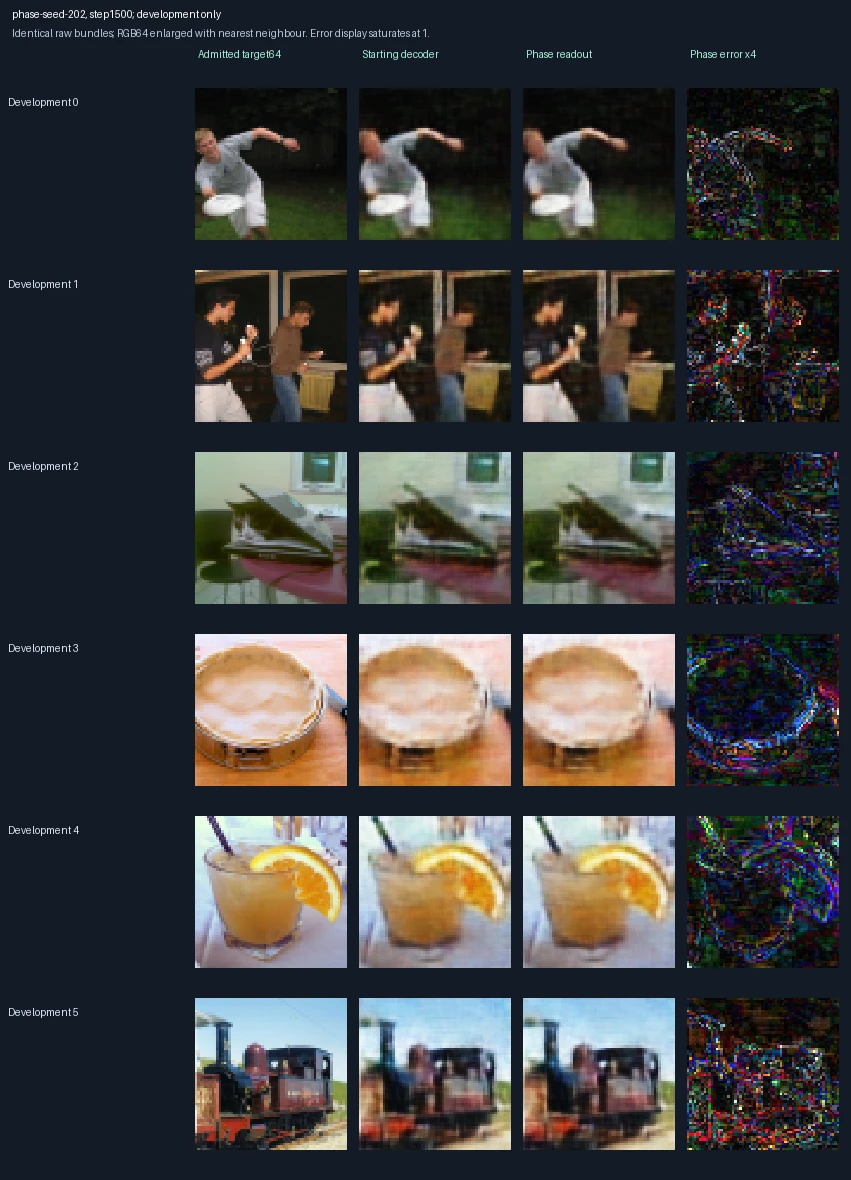
Six fixed development photographs. Left to right: the 64 × 64 input, the unchanged starting decoder using phase-only readout, this candidate’s reconstruction, and this candidate’s error. This is training repetition 2; the image label “seed-202” identifies its randomization setting. The encoder is fixed; only the decoder learns. These examples guide model selection, not final test claims. Phase-only readout keeps each complex coordinate’s angle; magnitude-preserving readout also keeps its amplitude, with one fixed scale learned from training data. Error panels show four times the absolute RGB difference from the reference, separately for each color channel, clipped at full brightness. Darker pixels mean smaller errors; black is zero or below the display’s precision. The scale is fixed across examples, not adjusted to make each image look better.
Phase-only readout, training repetition 2: 1,750 weight updates
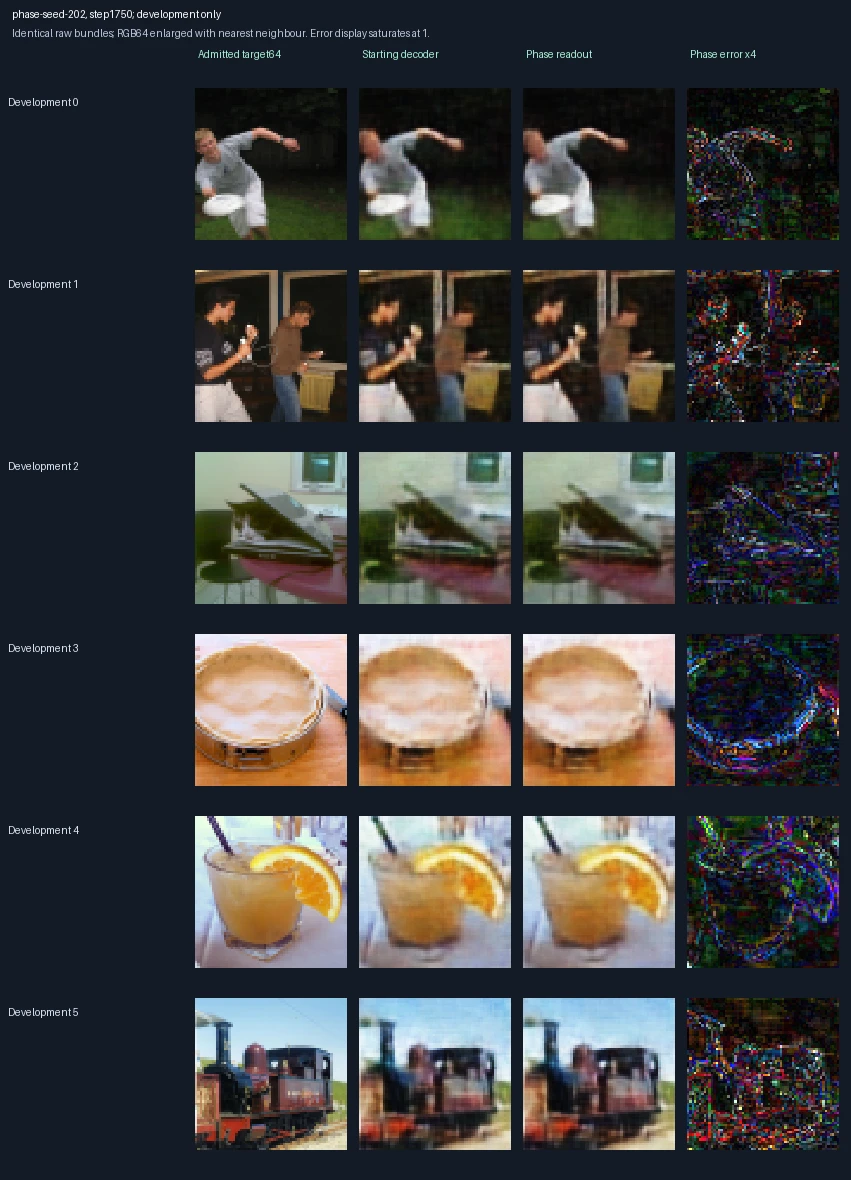
Six fixed development photographs. Left to right: the 64 × 64 input, the unchanged starting decoder using phase-only readout, this candidate’s reconstruction, and this candidate’s error. This is training repetition 2; the image label “seed-202” identifies its randomization setting. The encoder is fixed; only the decoder learns. These examples guide model selection, not final test claims. Phase-only readout keeps each complex coordinate’s angle; magnitude-preserving readout also keeps its amplitude, with one fixed scale learned from training data. Error panels show four times the absolute RGB difference from the reference, separately for each color channel, clipped at full brightness. Darker pixels mean smaller errors; black is zero or below the display’s precision. The scale is fixed across examples, not adjusted to make each image look better.
Phase-only readout, training repetition 2: 2,000 weight updates
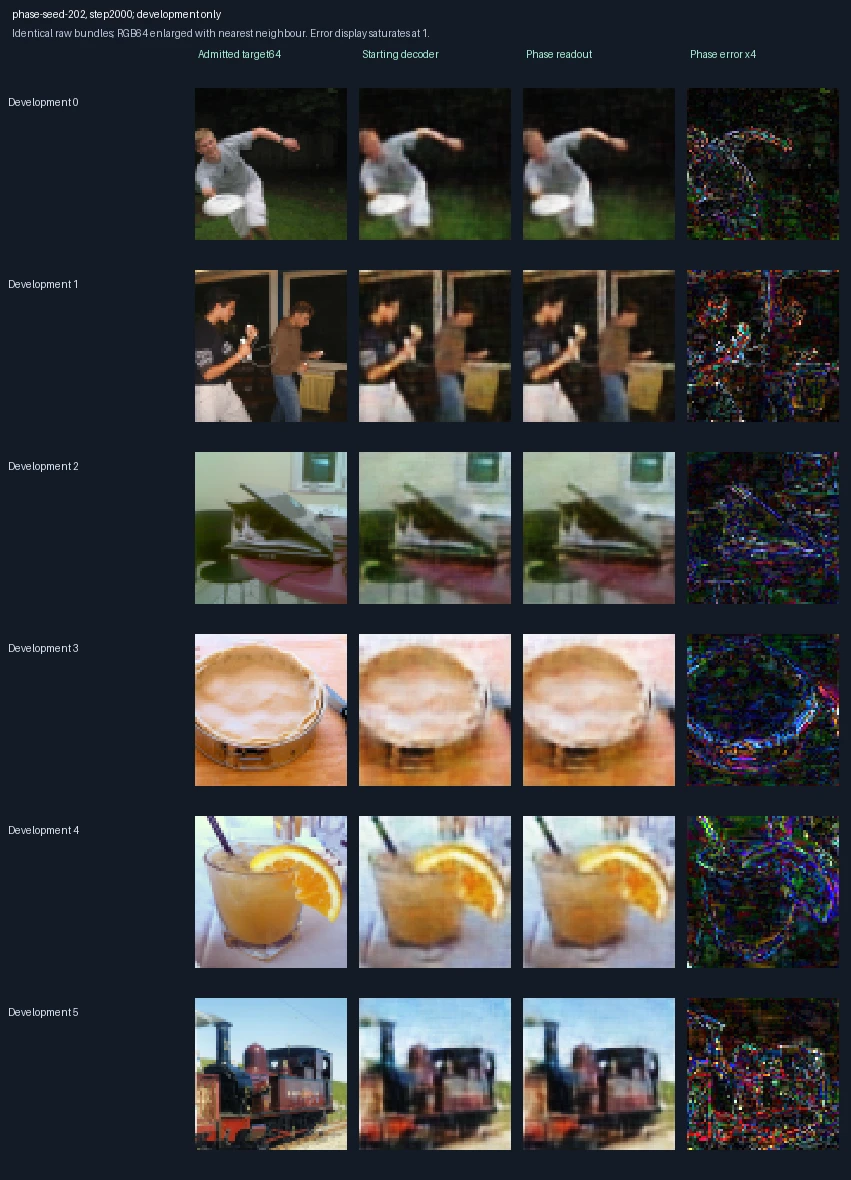
Six fixed development photographs. Left to right: the 64 × 64 input, the unchanged starting decoder using phase-only readout, this candidate’s reconstruction, and this candidate’s error. This is training repetition 2; the image label “seed-202” identifies its randomization setting. The encoder is fixed; only the decoder learns. These examples guide model selection, not final test claims. Phase-only readout keeps each complex coordinate’s angle; magnitude-preserving readout also keeps its amplitude, with one fixed scale learned from training data. Error panels show four times the absolute RGB difference from the reference, separately for each color channel, clipped at full brightness. Darker pixels mean smaller errors; black is zero or below the display’s precision. The scale is fixed across examples, not adjusted to make each image look better.
Phase-only readout, training repetition 2: 2,250 weight updates
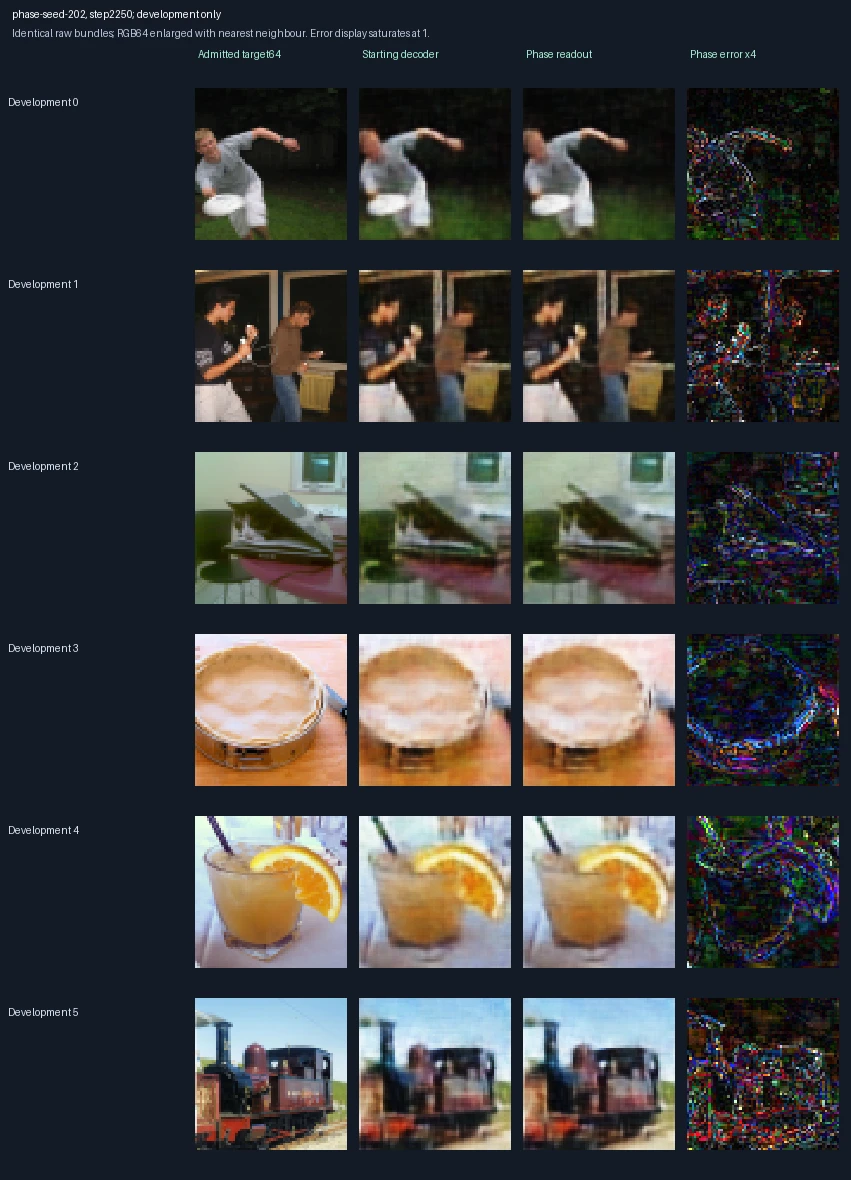
Six fixed development photographs. Left to right: the 64 × 64 input, the unchanged starting decoder using phase-only readout, this candidate’s reconstruction, and this candidate’s error. This is training repetition 2; the image label “seed-202” identifies its randomization setting. The encoder is fixed; only the decoder learns. These examples guide model selection, not final test claims. Phase-only readout keeps each complex coordinate’s angle; magnitude-preserving readout also keeps its amplitude, with one fixed scale learned from training data. Error panels show four times the absolute RGB difference from the reference, separately for each color channel, clipped at full brightness. Darker pixels mean smaller errors; black is zero or below the display’s precision. The scale is fixed across examples, not adjusted to make each image look better.
Phase-only readout, training repetition 2: 2,500 weight updates
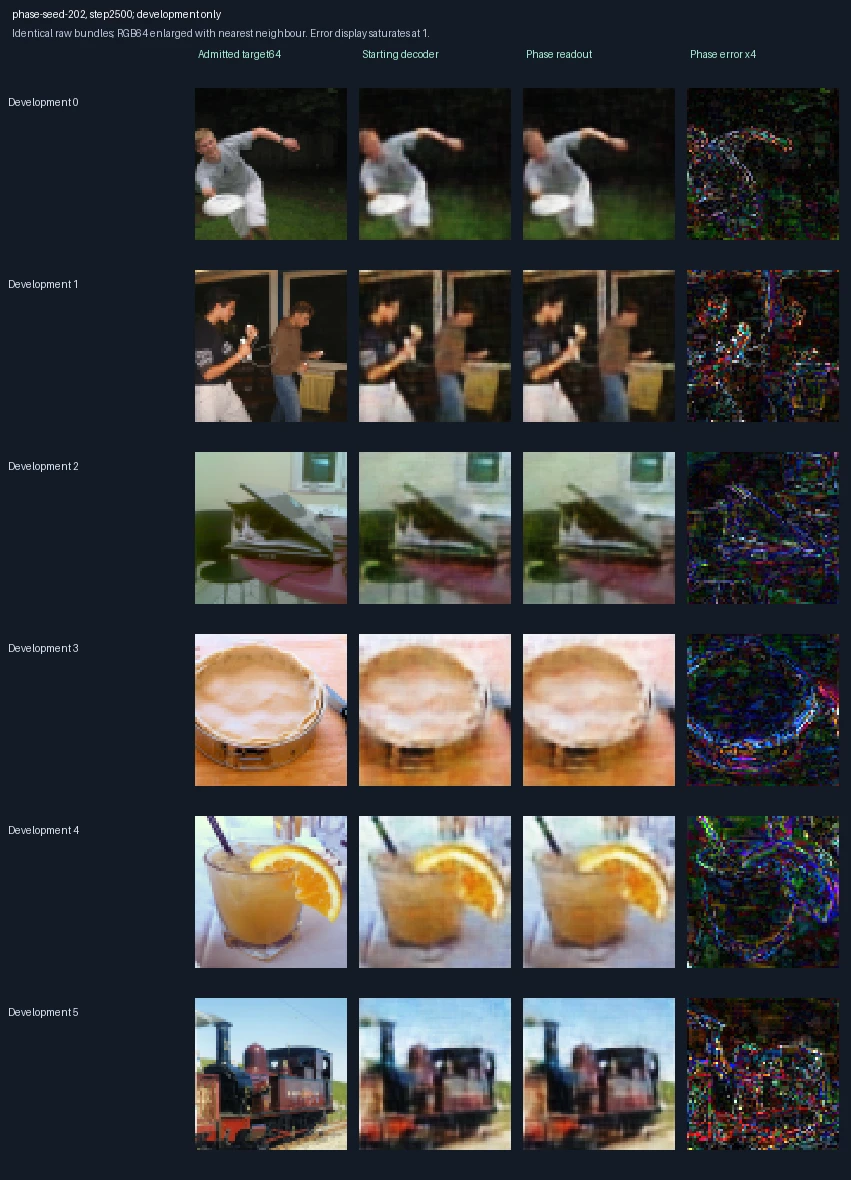
Six fixed development photographs. Left to right: the 64 × 64 input, the unchanged starting decoder using phase-only readout, this candidate’s reconstruction, and this candidate’s error. This is training repetition 2; the image label “seed-202” identifies its randomization setting. The encoder is fixed; only the decoder learns. These examples guide model selection, not final test claims. Phase-only readout keeps each complex coordinate’s angle; magnitude-preserving readout also keeps its amplitude, with one fixed scale learned from training data. Error panels show four times the absolute RGB difference from the reference, separately for each color channel, clipped at full brightness. Darker pixels mean smaller errors; black is zero or below the display’s precision. The scale is fixed across examples, not adjusted to make each image look better.
Phase-only readout, training repetition 2: 2,750 weight updates
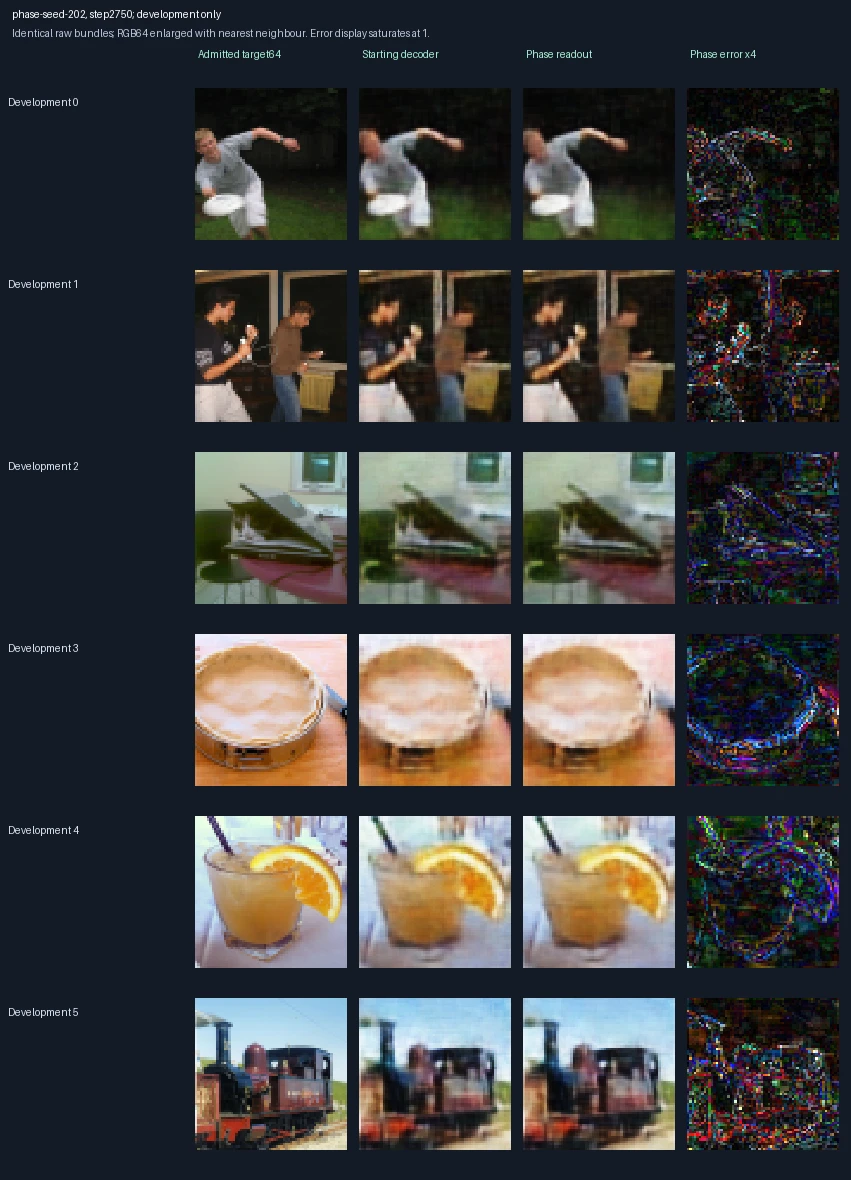
Six fixed development photographs. Left to right: the 64 × 64 input, the unchanged starting decoder using phase-only readout, this candidate’s reconstruction, and this candidate’s error. This is training repetition 2; the image label “seed-202” identifies its randomization setting. The encoder is fixed; only the decoder learns. These examples guide model selection, not final test claims. Phase-only readout keeps each complex coordinate’s angle; magnitude-preserving readout also keeps its amplitude, with one fixed scale learned from training data. Error panels show four times the absolute RGB difference from the reference, separately for each color channel, clipped at full brightness. Darker pixels mean smaller errors; black is zero or below the display’s precision. The scale is fixed across examples, not adjusted to make each image look better.
Phase-only readout, training repetition 2: 3,000 weight updates
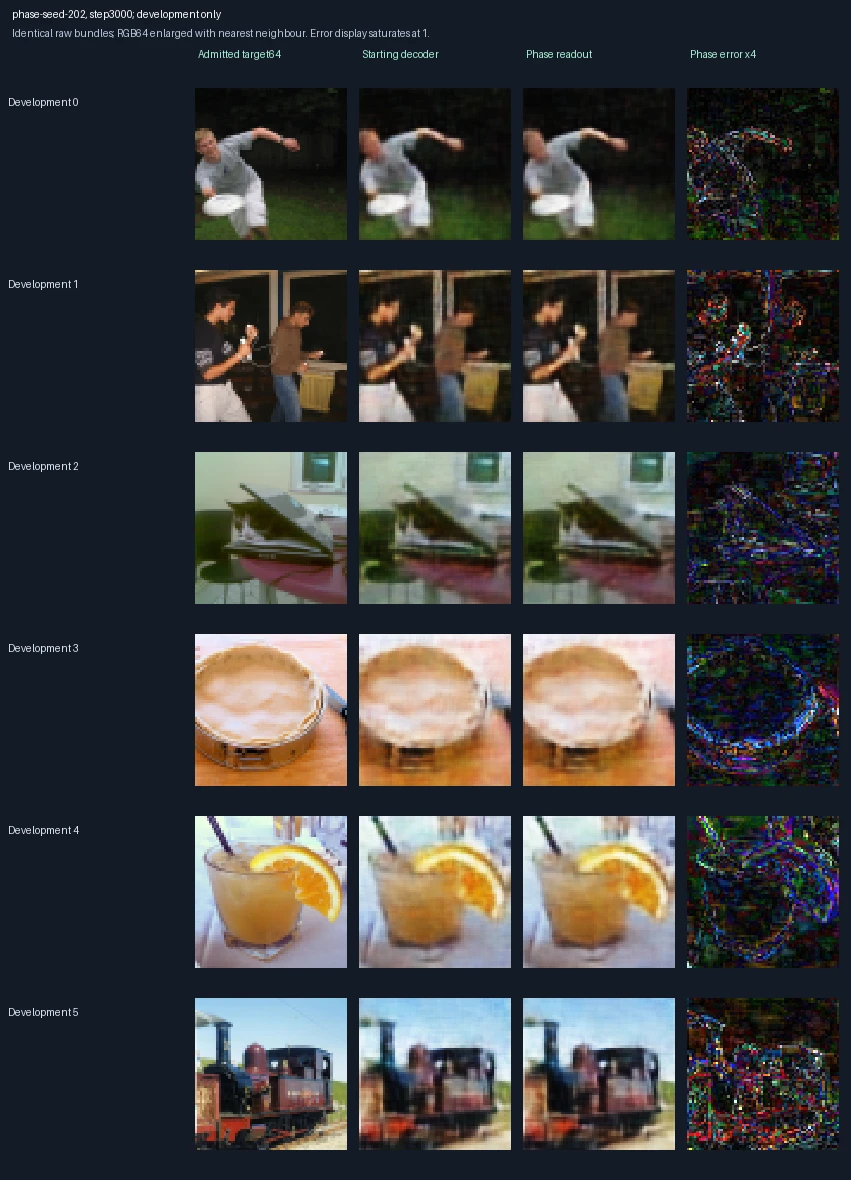
Six fixed development photographs. Left to right: the 64 × 64 input, the unchanged starting decoder using phase-only readout, this candidate’s reconstruction, and this candidate’s error. This is training repetition 2; the image label “seed-202” identifies its randomization setting. The encoder is fixed; only the decoder learns. These examples guide model selection, not final test claims. Phase-only readout keeps each complex coordinate’s angle; magnitude-preserving readout also keeps its amplitude, with one fixed scale learned from training data. Error panels show four times the absolute RGB difference from the reference, separately for each color channel, clipped at full brightness. Darker pixels mean smaller errors; black is zero or below the display’s precision. The scale is fixed across examples, not adjusted to make each image look better.
Phase-only readout, training repetition 2: 3,250 weight updates
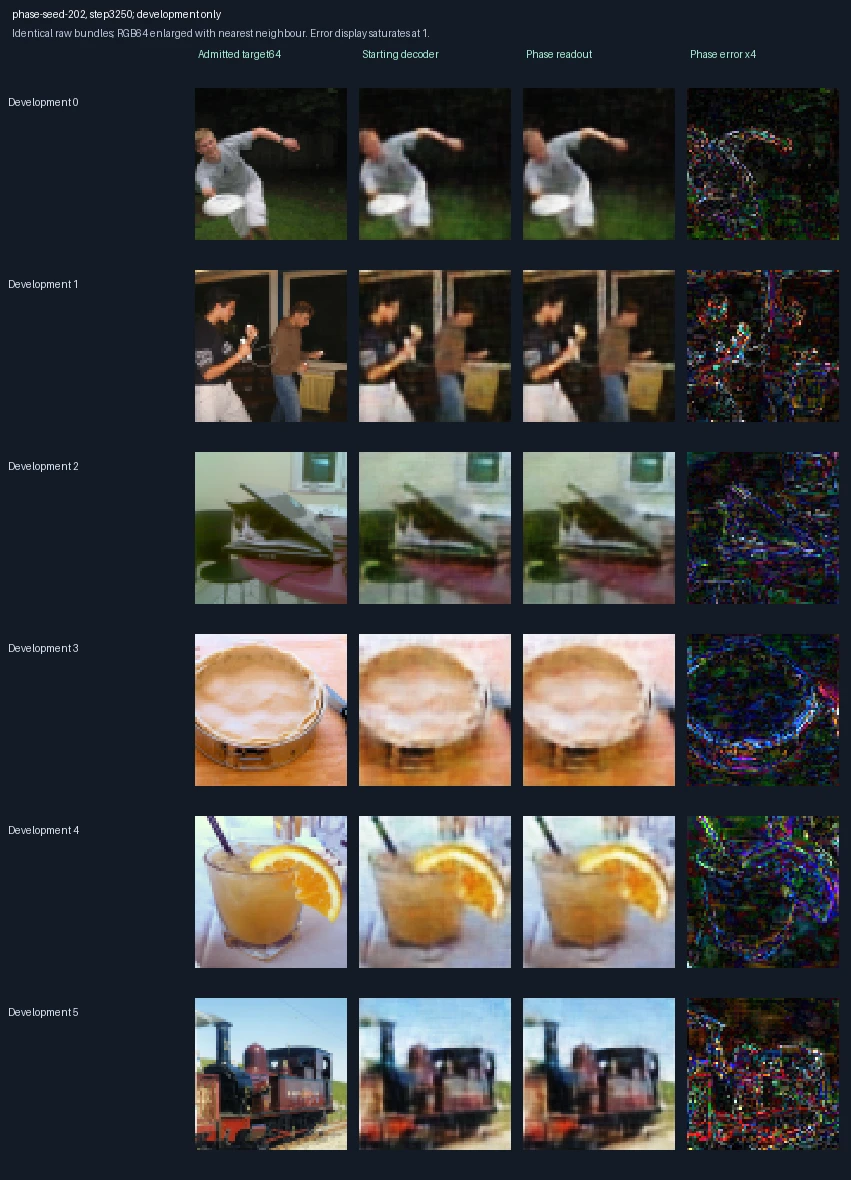
Six fixed development photographs. Left to right: the 64 × 64 input, the unchanged starting decoder using phase-only readout, this candidate’s reconstruction, and this candidate’s error. This is training repetition 2; the image label “seed-202” identifies its randomization setting. The encoder is fixed; only the decoder learns. These examples guide model selection, not final test claims. Phase-only readout keeps each complex coordinate’s angle; magnitude-preserving readout also keeps its amplitude, with one fixed scale learned from training data. Error panels show four times the absolute RGB difference from the reference, separately for each color channel, clipped at full brightness. Darker pixels mean smaller errors; black is zero or below the display’s precision. The scale is fixed across examples, not adjusted to make each image look better.
Phase-only readout, training repetition 2: 3,500 weight updates
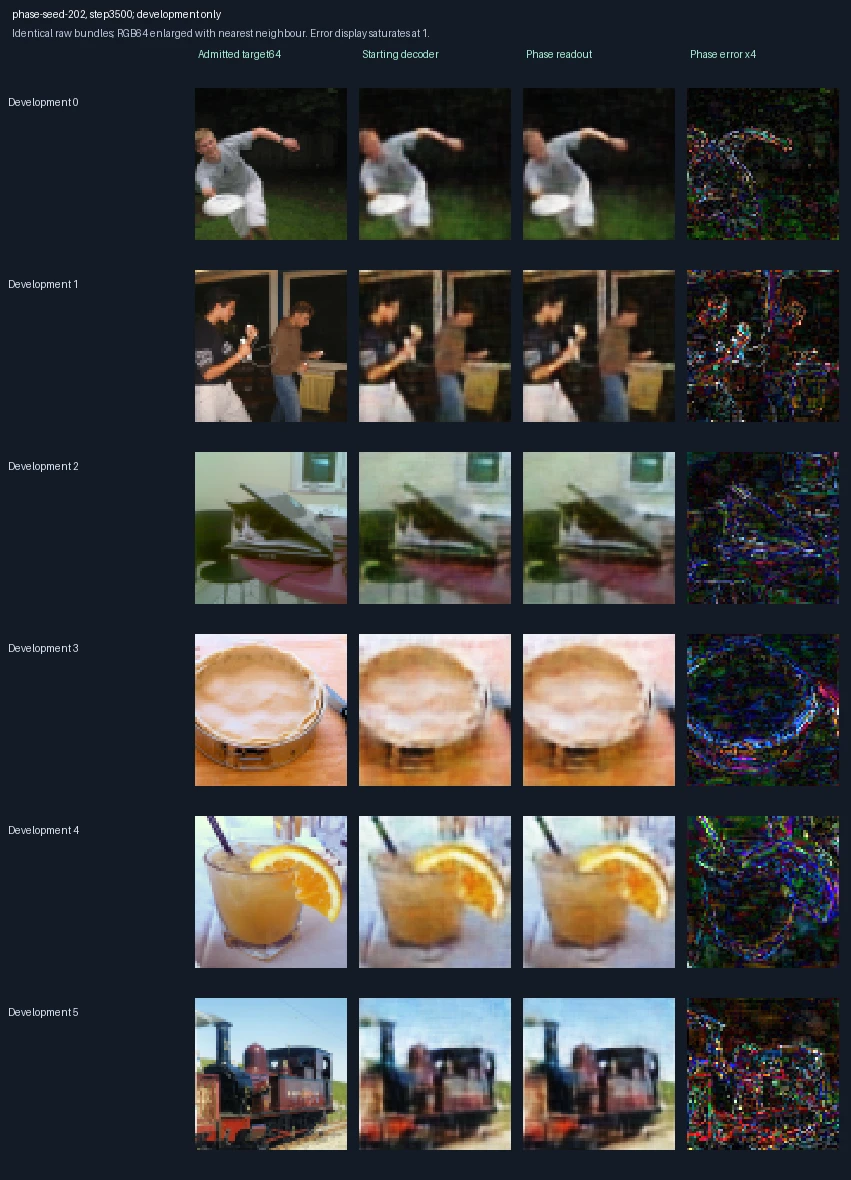
Six fixed development photographs. Left to right: the 64 × 64 input, the unchanged starting decoder using phase-only readout, this candidate’s reconstruction, and this candidate’s error. This is training repetition 2; the image label “seed-202” identifies its randomization setting. The encoder is fixed; only the decoder learns. These examples guide model selection, not final test claims. Phase-only readout keeps each complex coordinate’s angle; magnitude-preserving readout also keeps its amplitude, with one fixed scale learned from training data. Error panels show four times the absolute RGB difference from the reference, separately for each color channel, clipped at full brightness. Darker pixels mean smaller errors; black is zero or below the display’s precision. The scale is fixed across examples, not adjusted to make each image look better.
Phase-only readout, training repetition 2: 3,750 weight updates
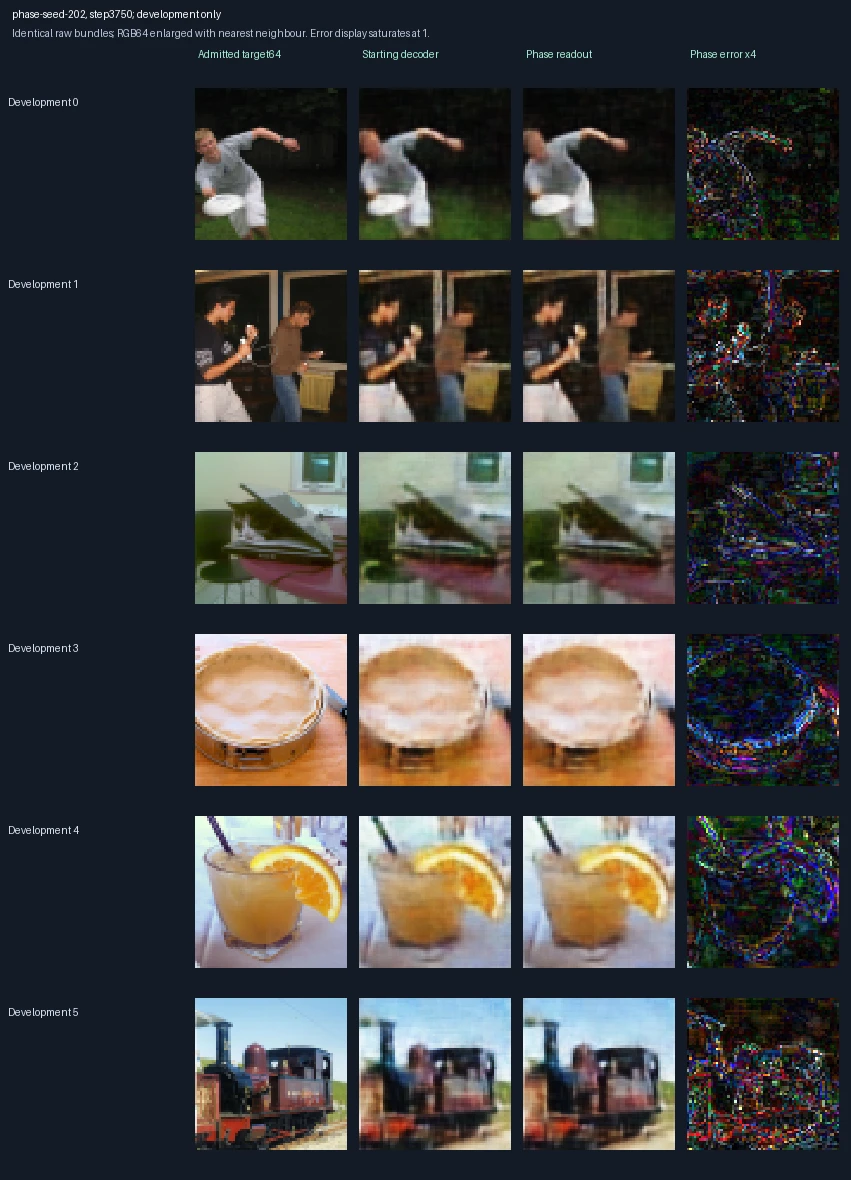
Six fixed development photographs. Left to right: the 64 × 64 input, the unchanged starting decoder using phase-only readout, this candidate’s reconstruction, and this candidate’s error. This is training repetition 2; the image label “seed-202” identifies its randomization setting. The encoder is fixed; only the decoder learns. These examples guide model selection, not final test claims. Phase-only readout keeps each complex coordinate’s angle; magnitude-preserving readout also keeps its amplitude, with one fixed scale learned from training data. Error panels show four times the absolute RGB difference from the reference, separately for each color channel, clipped at full brightness. Darker pixels mean smaller errors; black is zero or below the display’s precision. The scale is fixed across examples, not adjusted to make each image look better.
Phase-only readout, training repetition 2: 4,000 weight updates
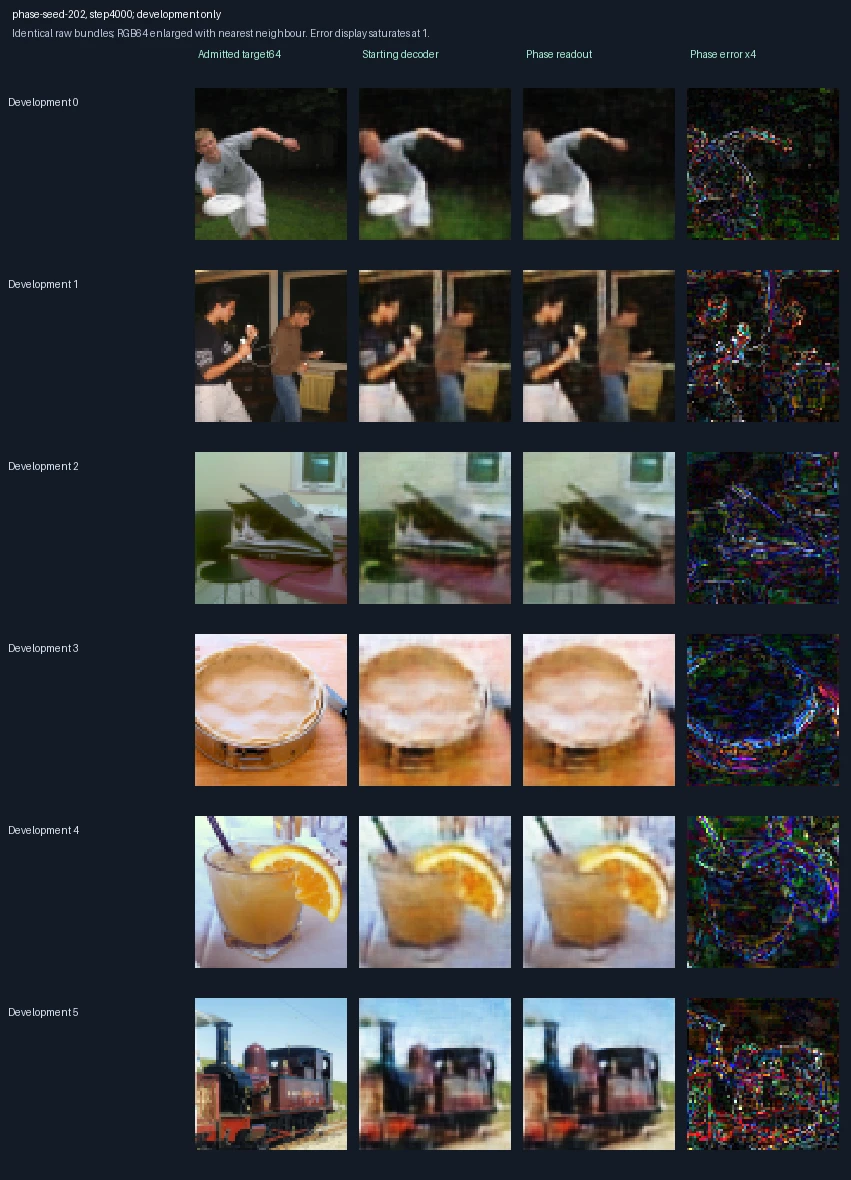
Six fixed development photographs. Left to right: the 64 × 64 input, the unchanged starting decoder using phase-only readout, this candidate’s reconstruction, and this candidate’s error. This is training repetition 2; the image label “seed-202” identifies its randomization setting. The encoder is fixed; only the decoder learns. These examples guide model selection, not final test claims. Phase-only readout keeps each complex coordinate’s angle; magnitude-preserving readout also keeps its amplitude, with one fixed scale learned from training data. Error panels show four times the absolute RGB difference from the reference, separately for each color channel, clipped at full brightness. Darker pixels mean smaller errors; black is zero or below the display’s precision. The scale is fixed across examples, not adjusted to make each image look better.
Magnitude-preserving readout, training repetition 2: 0 weight updates
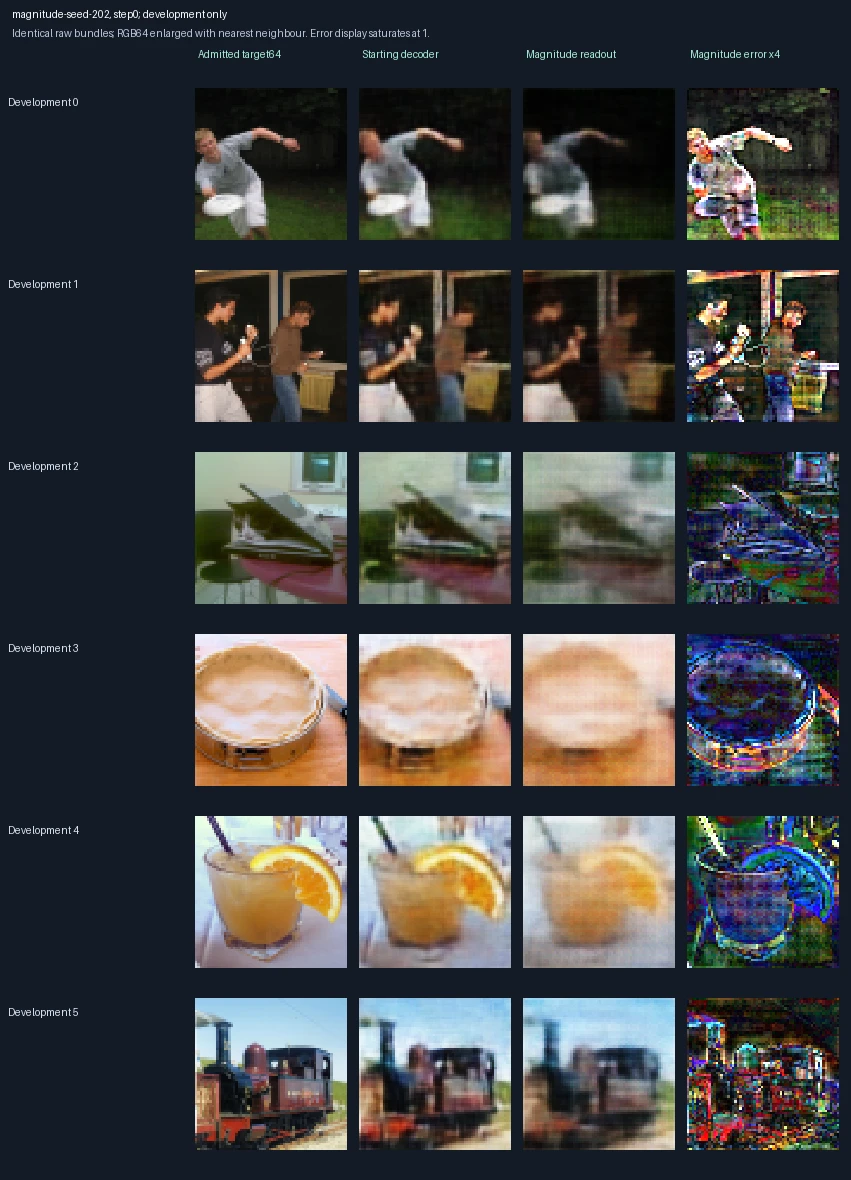
Six fixed development photographs. Left to right: the 64 × 64 input, the unchanged starting decoder using phase-only readout, this candidate’s reconstruction, and this candidate’s error. This is training repetition 2; the image label “seed-202” identifies its randomization setting. The encoder is fixed; only the decoder learns. These examples guide model selection, not final test claims. Phase-only readout keeps each complex coordinate’s angle; magnitude-preserving readout also keeps its amplitude, with one fixed scale learned from training data. Error panels show four times the absolute RGB difference from the reference, separately for each color channel, clipped at full brightness. Darker pixels mean smaller errors; black is zero or below the display’s precision. The scale is fixed across examples, not adjusted to make each image look better. At zero updates, changed brightness and error reflect switching the decoder’s input representation before it has adapted.
Magnitude-preserving readout, training repetition 2: 250 weight updates
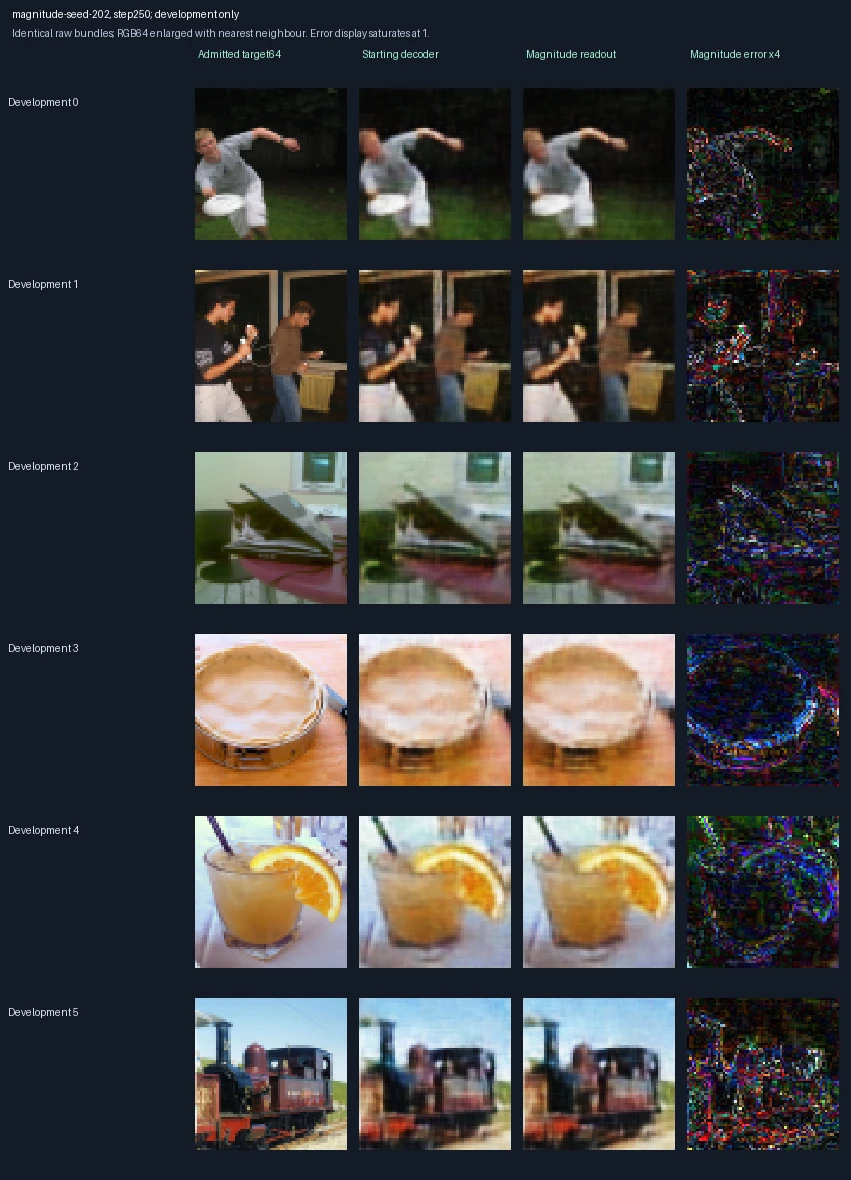
Six fixed development photographs. Left to right: the 64 × 64 input, the unchanged starting decoder using phase-only readout, this candidate’s reconstruction, and this candidate’s error. This is training repetition 2; the image label “seed-202” identifies its randomization setting. The encoder is fixed; only the decoder learns. These examples guide model selection, not final test claims. Phase-only readout keeps each complex coordinate’s angle; magnitude-preserving readout also keeps its amplitude, with one fixed scale learned from training data. Error panels show four times the absolute RGB difference from the reference, separately for each color channel, clipped at full brightness. Darker pixels mean smaller errors; black is zero or below the display’s precision. The scale is fixed across examples, not adjusted to make each image look better.
Magnitude-preserving readout, training repetition 2: 500 weight updates
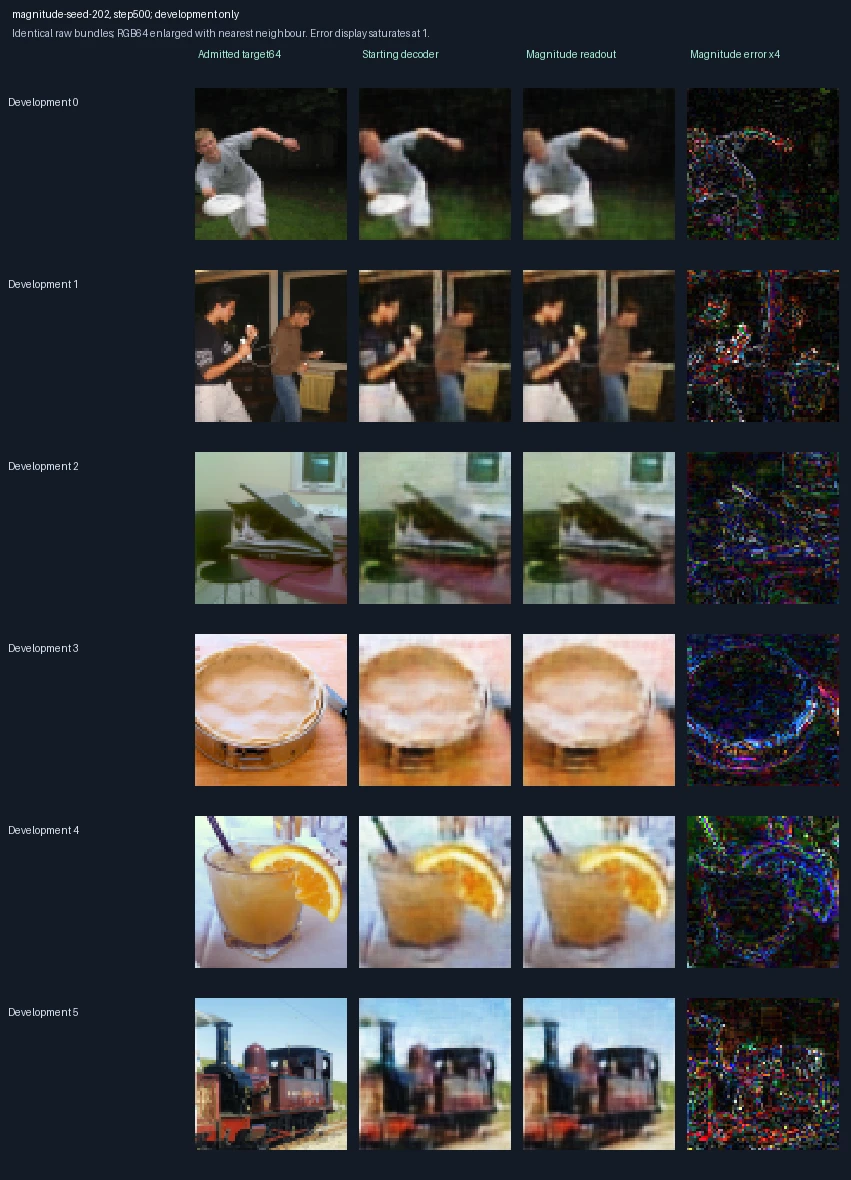
Six fixed development photographs. Left to right: the 64 × 64 input, the unchanged starting decoder using phase-only readout, this candidate’s reconstruction, and this candidate’s error. This is training repetition 2; the image label “seed-202” identifies its randomization setting. The encoder is fixed; only the decoder learns. These examples guide model selection, not final test claims. Phase-only readout keeps each complex coordinate’s angle; magnitude-preserving readout also keeps its amplitude, with one fixed scale learned from training data. Error panels show four times the absolute RGB difference from the reference, separately for each color channel, clipped at full brightness. Darker pixels mean smaller errors; black is zero or below the display’s precision. The scale is fixed across examples, not adjusted to make each image look better.
Magnitude-preserving readout, training repetition 2: 750 weight updates
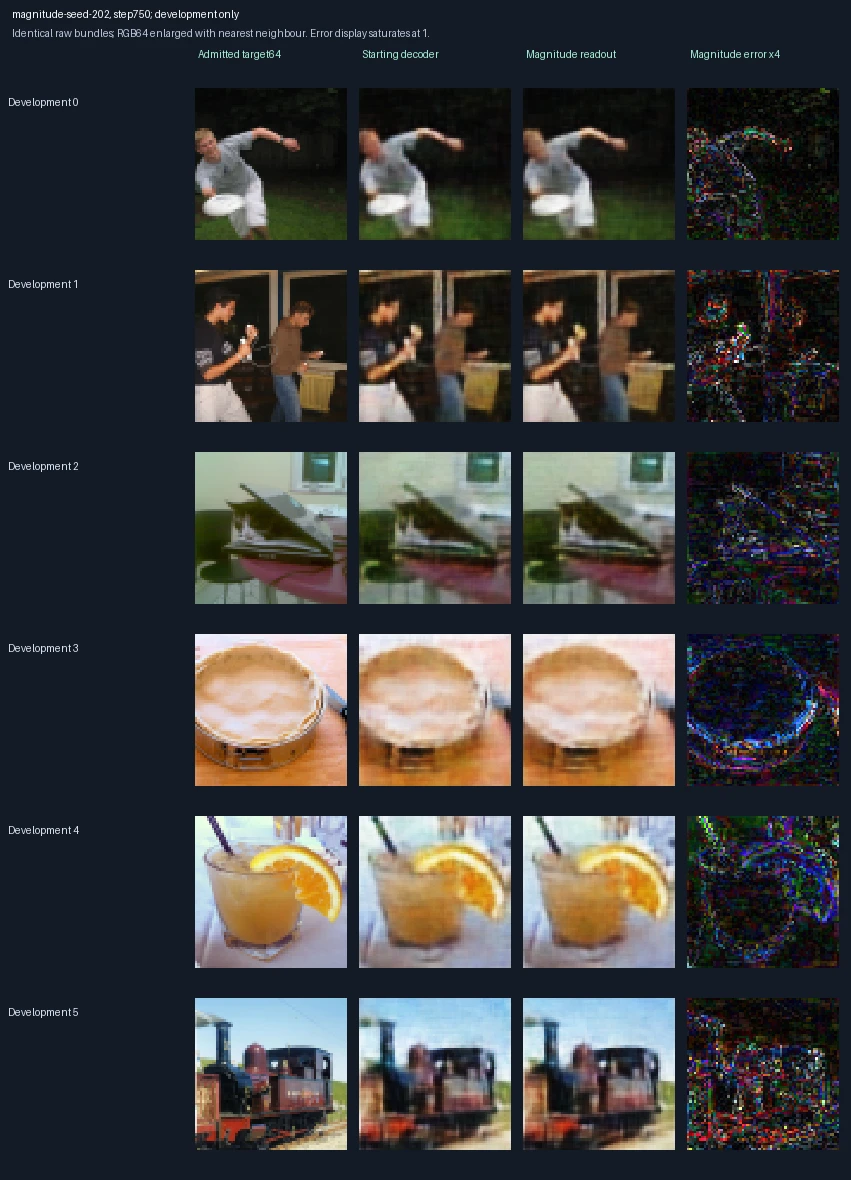
Six fixed development photographs. Left to right: the 64 × 64 input, the unchanged starting decoder using phase-only readout, this candidate’s reconstruction, and this candidate’s error. This is training repetition 2; the image label “seed-202” identifies its randomization setting. The encoder is fixed; only the decoder learns. These examples guide model selection, not final test claims. Phase-only readout keeps each complex coordinate’s angle; magnitude-preserving readout also keeps its amplitude, with one fixed scale learned from training data. Error panels show four times the absolute RGB difference from the reference, separately for each color channel, clipped at full brightness. Darker pixels mean smaller errors; black is zero or below the display’s precision. The scale is fixed across examples, not adjusted to make each image look better.
Magnitude-preserving readout, training repetition 2: 1,000 weight updates
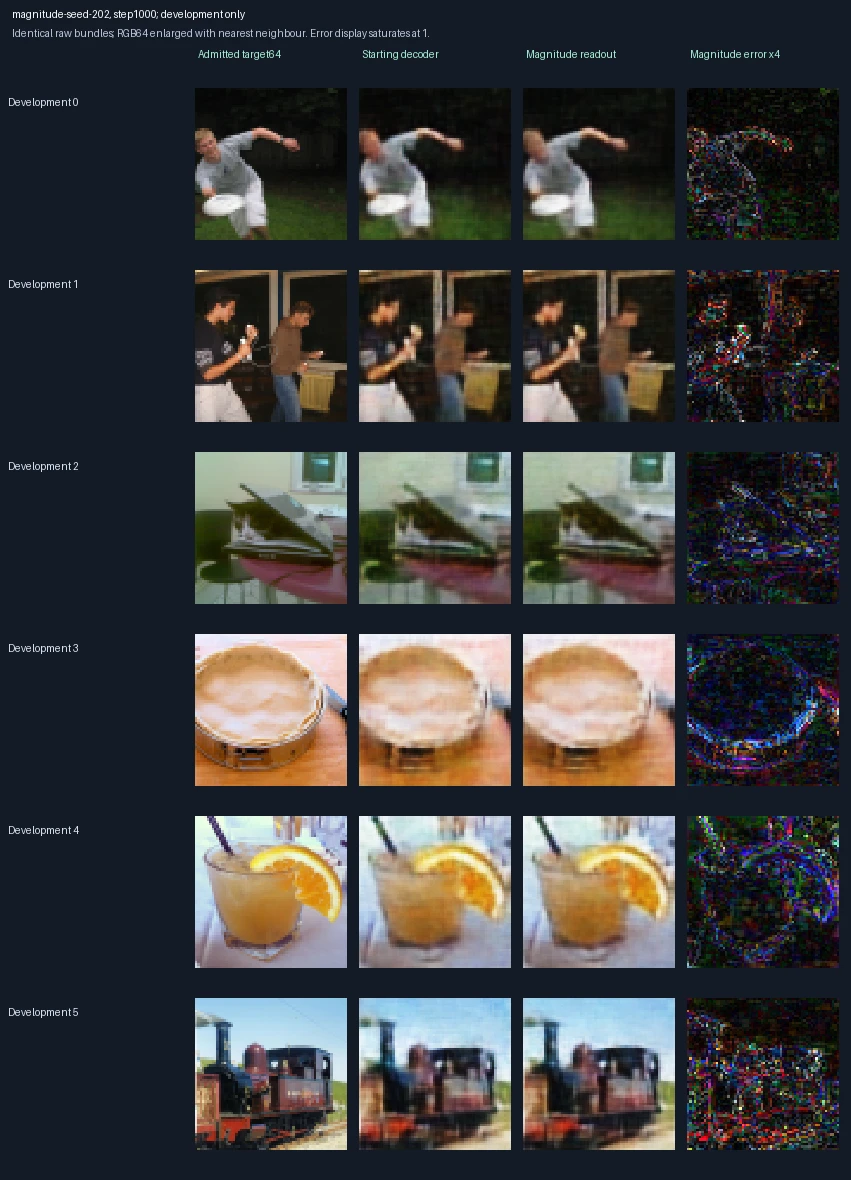
Six fixed development photographs. Left to right: the 64 × 64 input, the unchanged starting decoder using phase-only readout, this candidate’s reconstruction, and this candidate’s error. This is training repetition 2; the image label “seed-202” identifies its randomization setting. The encoder is fixed; only the decoder learns. These examples guide model selection, not final test claims. Phase-only readout keeps each complex coordinate’s angle; magnitude-preserving readout also keeps its amplitude, with one fixed scale learned from training data. Error panels show four times the absolute RGB difference from the reference, separately for each color channel, clipped at full brightness. Darker pixels mean smaller errors; black is zero or below the display’s precision. The scale is fixed across examples, not adjusted to make each image look better.
Magnitude-preserving readout, training repetition 2: 1,250 weight updates
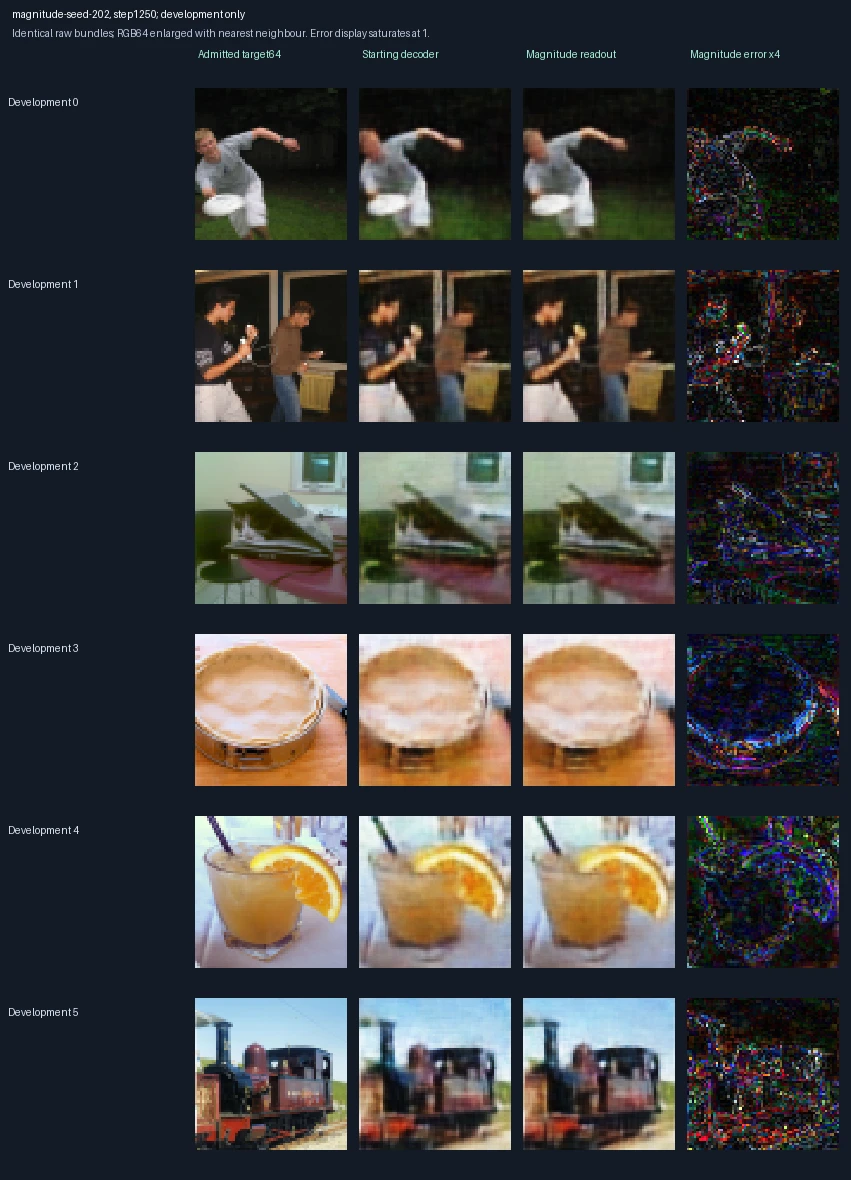
Six fixed development photographs. Left to right: the 64 × 64 input, the unchanged starting decoder using phase-only readout, this candidate’s reconstruction, and this candidate’s error. This is training repetition 2; the image label “seed-202” identifies its randomization setting. The encoder is fixed; only the decoder learns. These examples guide model selection, not final test claims. Phase-only readout keeps each complex coordinate’s angle; magnitude-preserving readout also keeps its amplitude, with one fixed scale learned from training data. Error panels show four times the absolute RGB difference from the reference, separately for each color channel, clipped at full brightness. Darker pixels mean smaller errors; black is zero or below the display’s precision. The scale is fixed across examples, not adjusted to make each image look better.
Magnitude-preserving readout, training repetition 2: 1,500 weight updates
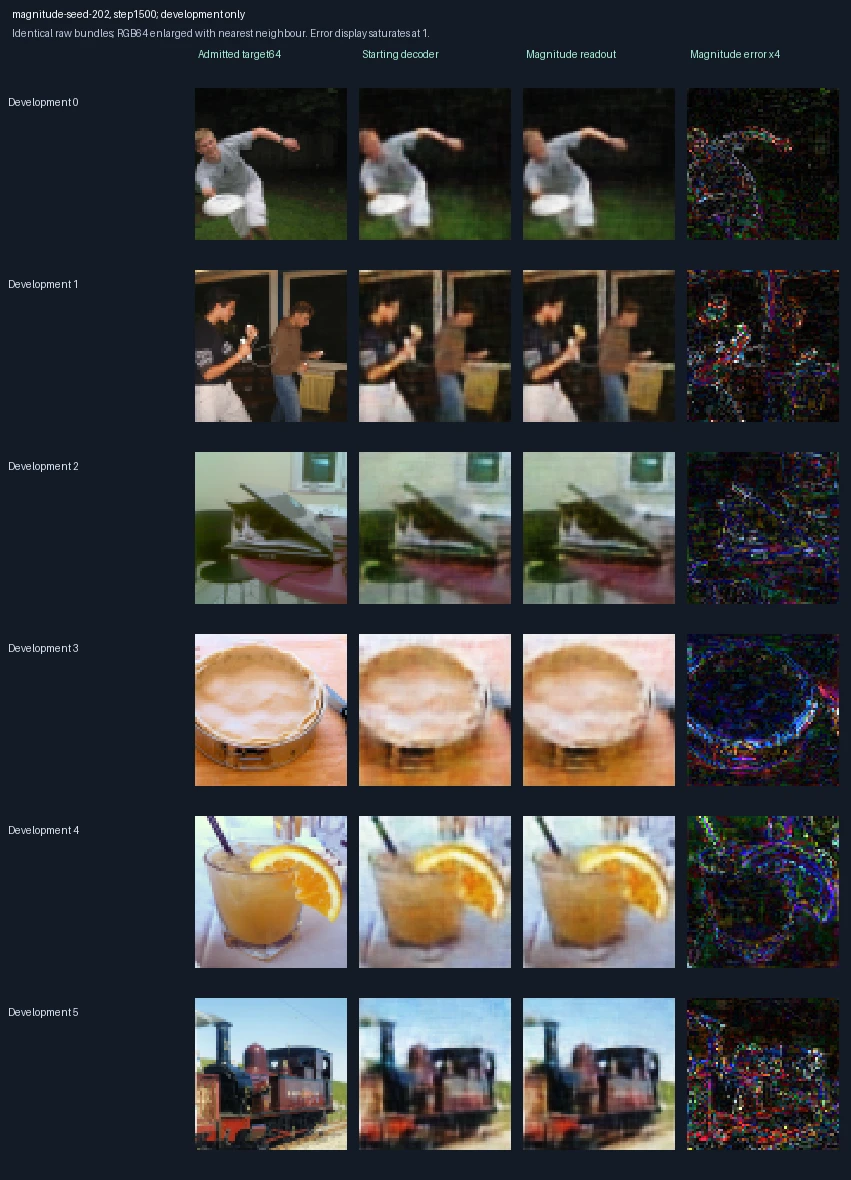
Six fixed development photographs. Left to right: the 64 × 64 input, the unchanged starting decoder using phase-only readout, this candidate’s reconstruction, and this candidate’s error. This is training repetition 2; the image label “seed-202” identifies its randomization setting. The encoder is fixed; only the decoder learns. These examples guide model selection, not final test claims. Phase-only readout keeps each complex coordinate’s angle; magnitude-preserving readout also keeps its amplitude, with one fixed scale learned from training data. Error panels show four times the absolute RGB difference from the reference, separately for each color channel, clipped at full brightness. Darker pixels mean smaller errors; black is zero or below the display’s precision. The scale is fixed across examples, not adjusted to make each image look better.
Magnitude-preserving readout, training repetition 2: 1,750 weight updates
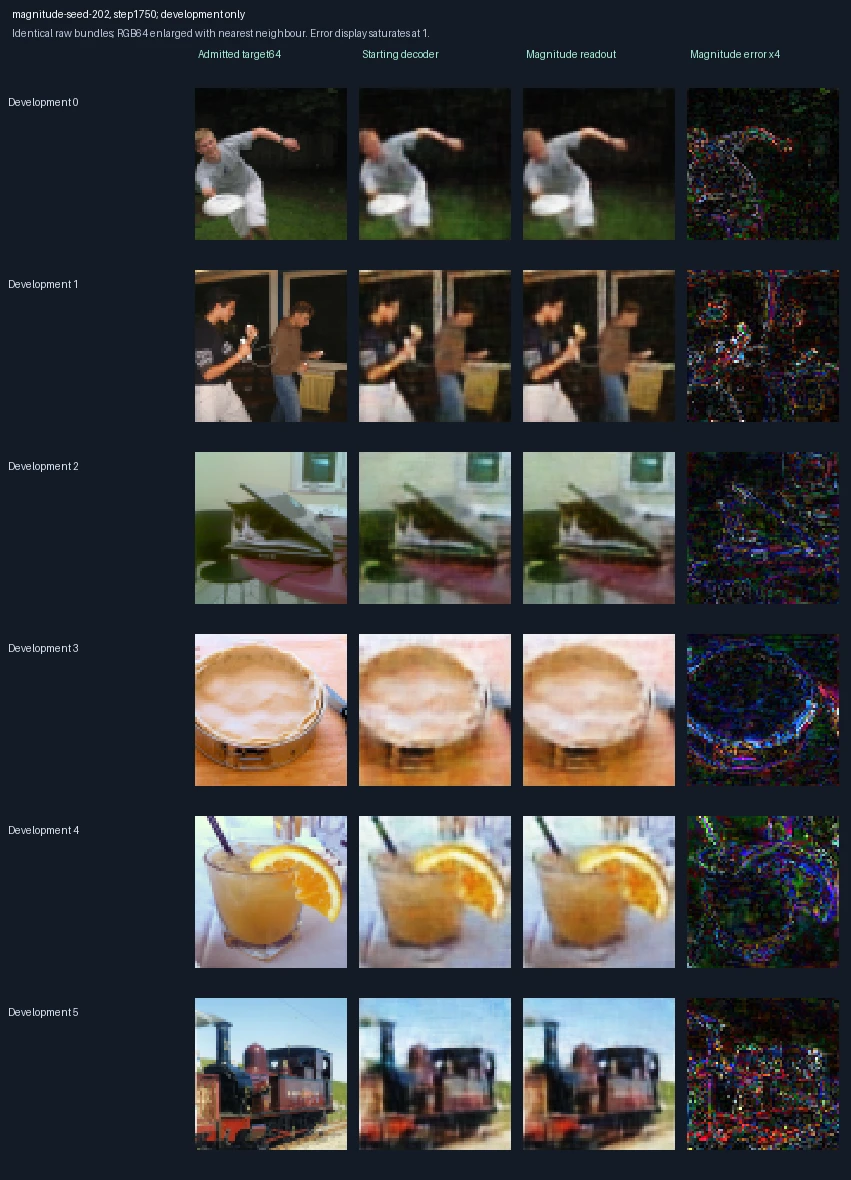
Six fixed development photographs. Left to right: the 64 × 64 input, the unchanged starting decoder using phase-only readout, this candidate’s reconstruction, and this candidate’s error. This is training repetition 2; the image label “seed-202” identifies its randomization setting. The encoder is fixed; only the decoder learns. These examples guide model selection, not final test claims. Phase-only readout keeps each complex coordinate’s angle; magnitude-preserving readout also keeps its amplitude, with one fixed scale learned from training data. Error panels show four times the absolute RGB difference from the reference, separately for each color channel, clipped at full brightness. Darker pixels mean smaller errors; black is zero or below the display’s precision. The scale is fixed across examples, not adjusted to make each image look better.
Magnitude-preserving readout, training repetition 2: 2,000 weight updates
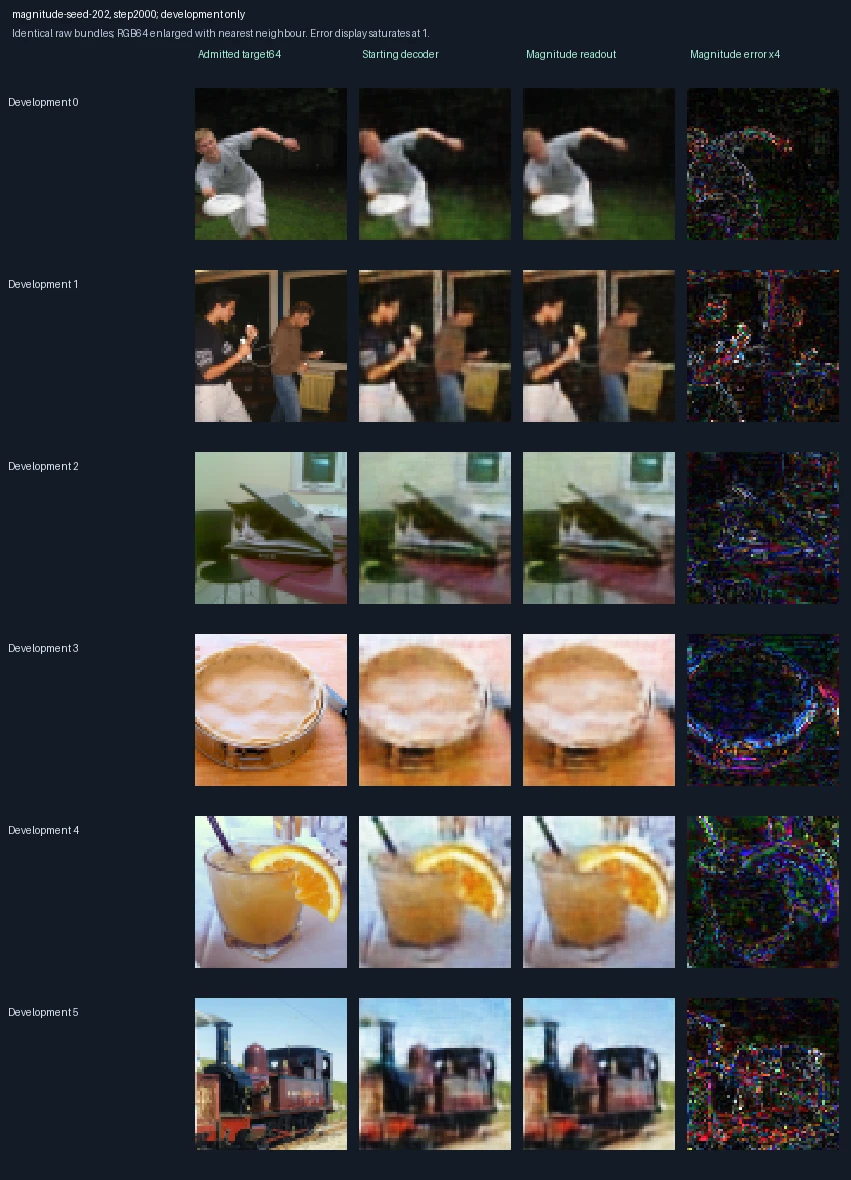
Six fixed development photographs. Left to right: the 64 × 64 input, the unchanged starting decoder using phase-only readout, this candidate’s reconstruction, and this candidate’s error. This is training repetition 2; the image label “seed-202” identifies its randomization setting. The encoder is fixed; only the decoder learns. These examples guide model selection, not final test claims. Phase-only readout keeps each complex coordinate’s angle; magnitude-preserving readout also keeps its amplitude, with one fixed scale learned from training data. Error panels show four times the absolute RGB difference from the reference, separately for each color channel, clipped at full brightness. Darker pixels mean smaller errors; black is zero or below the display’s precision. The scale is fixed across examples, not adjusted to make each image look better.
Magnitude-preserving readout, training repetition 2: 2,250 weight updates
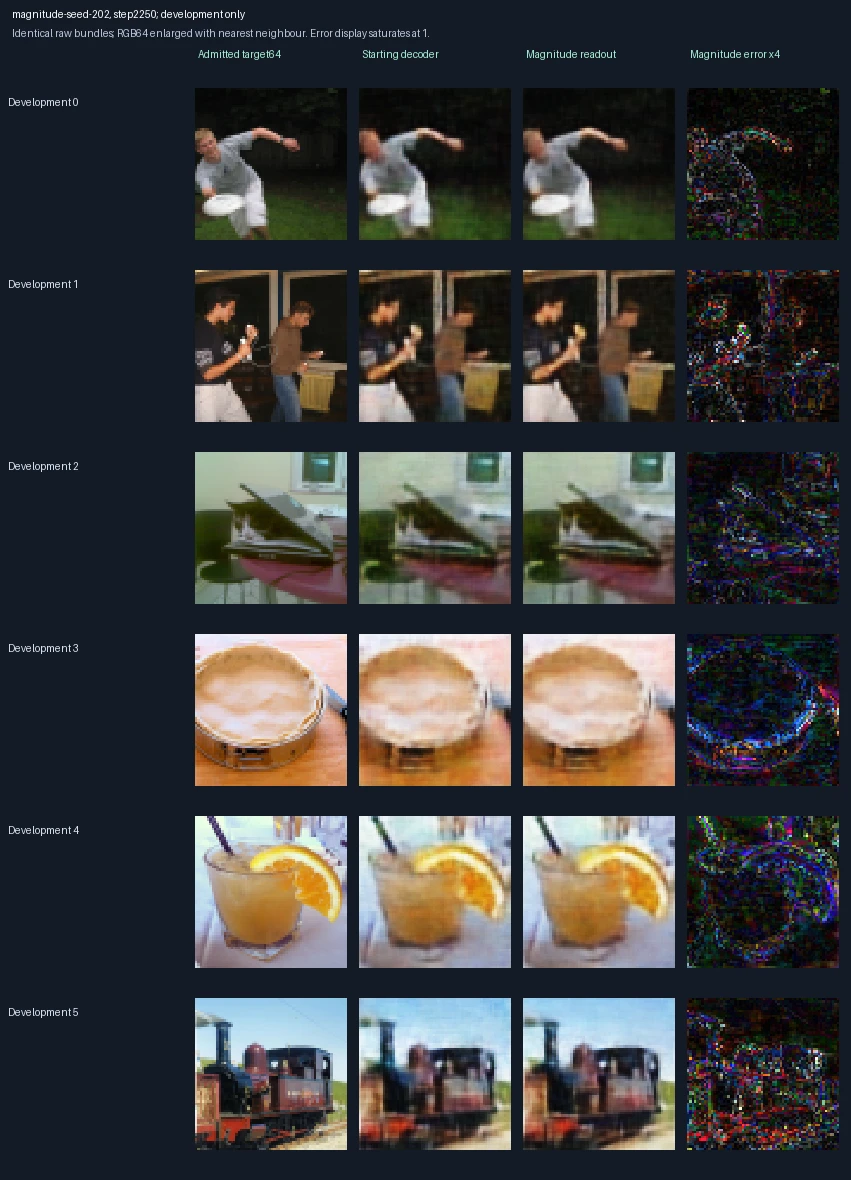
Six fixed development photographs. Left to right: the 64 × 64 input, the unchanged starting decoder using phase-only readout, this candidate’s reconstruction, and this candidate’s error. This is training repetition 2; the image label “seed-202” identifies its randomization setting. The encoder is fixed; only the decoder learns. These examples guide model selection, not final test claims. Phase-only readout keeps each complex coordinate’s angle; magnitude-preserving readout also keeps its amplitude, with one fixed scale learned from training data. Error panels show four times the absolute RGB difference from the reference, separately for each color channel, clipped at full brightness. Darker pixels mean smaller errors; black is zero or below the display’s precision. The scale is fixed across examples, not adjusted to make each image look better.
Magnitude-preserving readout, training repetition 2: 2,500 weight updates
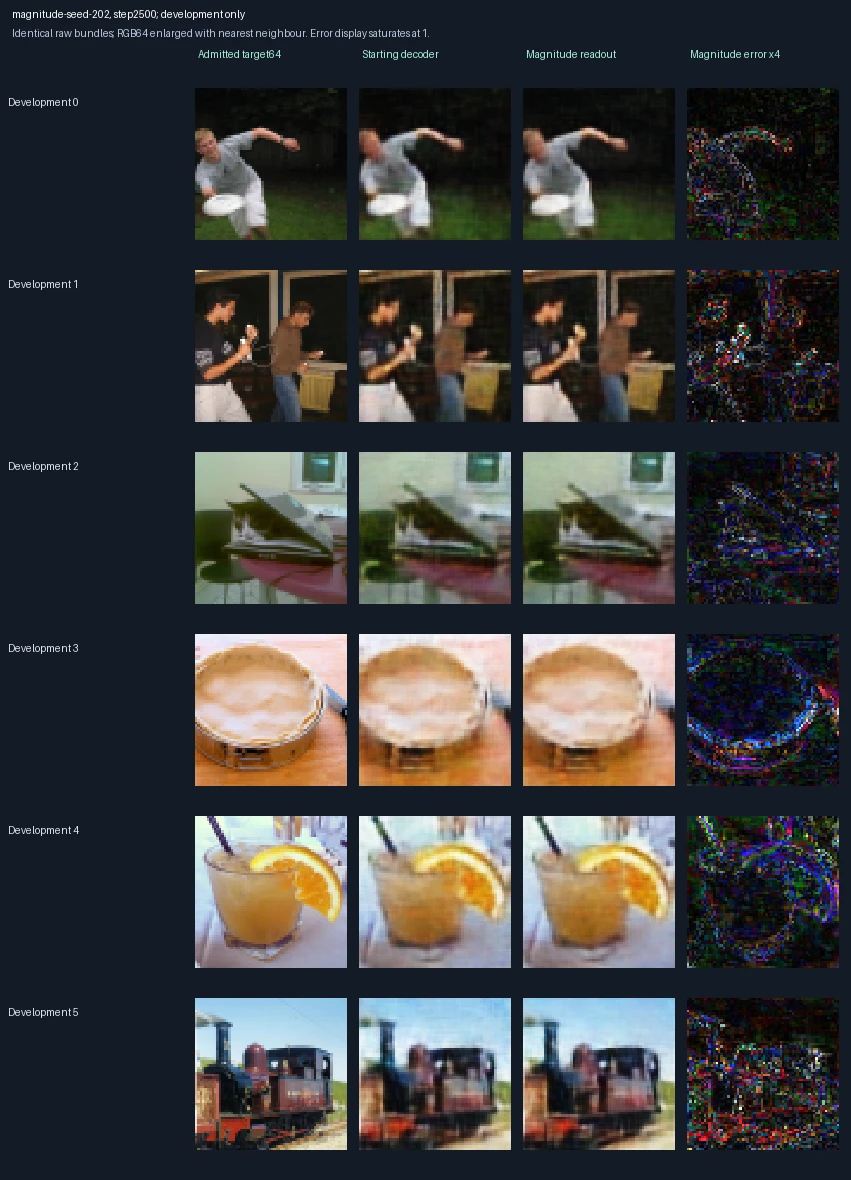
Six fixed development photographs. Left to right: the 64 × 64 input, the unchanged starting decoder using phase-only readout, this candidate’s reconstruction, and this candidate’s error. This is training repetition 2; the image label “seed-202” identifies its randomization setting. The encoder is fixed; only the decoder learns. These examples guide model selection, not final test claims. Phase-only readout keeps each complex coordinate’s angle; magnitude-preserving readout also keeps its amplitude, with one fixed scale learned from training data. Error panels show four times the absolute RGB difference from the reference, separately for each color channel, clipped at full brightness. Darker pixels mean smaller errors; black is zero or below the display’s precision. The scale is fixed across examples, not adjusted to make each image look better.
Magnitude-preserving readout, training repetition 2: 2,750 weight updates
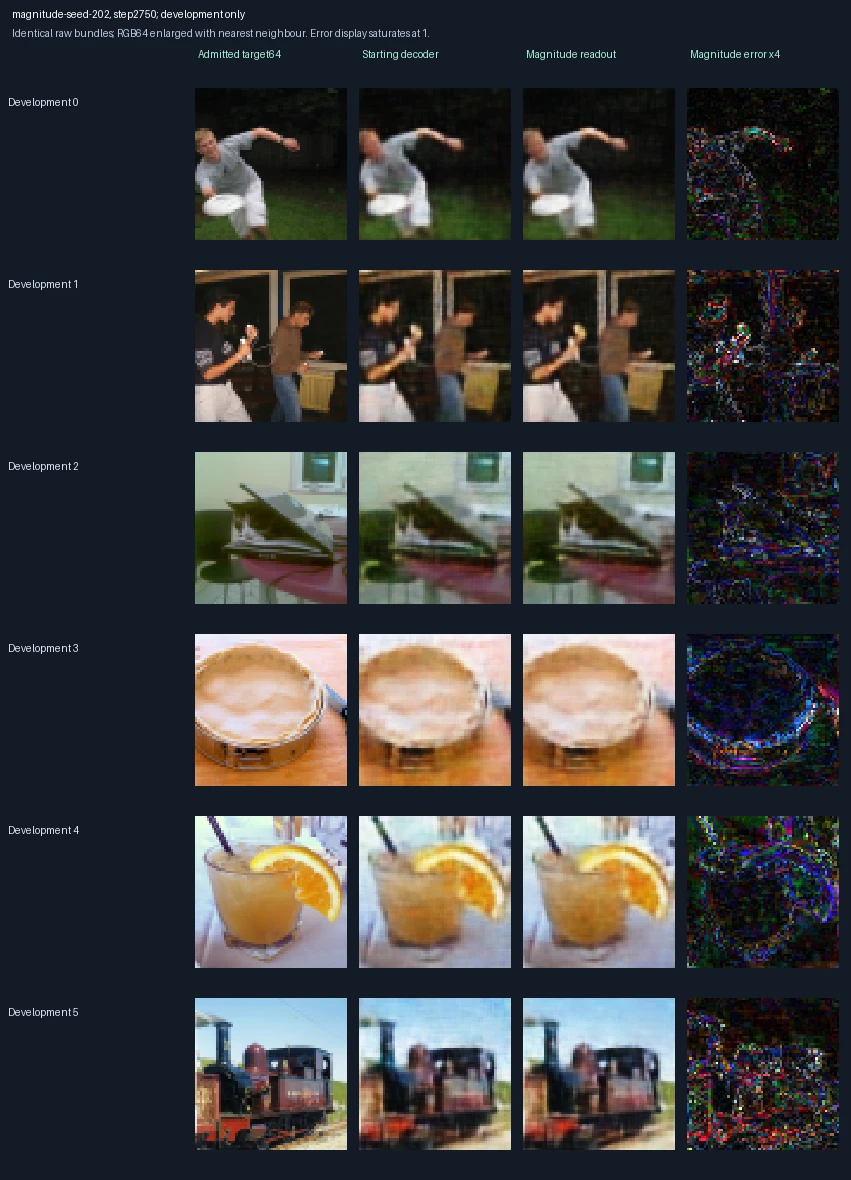
Six fixed development photographs. Left to right: the 64 × 64 input, the unchanged starting decoder using phase-only readout, this candidate’s reconstruction, and this candidate’s error. This is training repetition 2; the image label “seed-202” identifies its randomization setting. The encoder is fixed; only the decoder learns. These examples guide model selection, not final test claims. Phase-only readout keeps each complex coordinate’s angle; magnitude-preserving readout also keeps its amplitude, with one fixed scale learned from training data. Error panels show four times the absolute RGB difference from the reference, separately for each color channel, clipped at full brightness. Darker pixels mean smaller errors; black is zero or below the display’s precision. The scale is fixed across examples, not adjusted to make each image look better.
Magnitude-preserving readout, training repetition 2: 3,000 weight updates
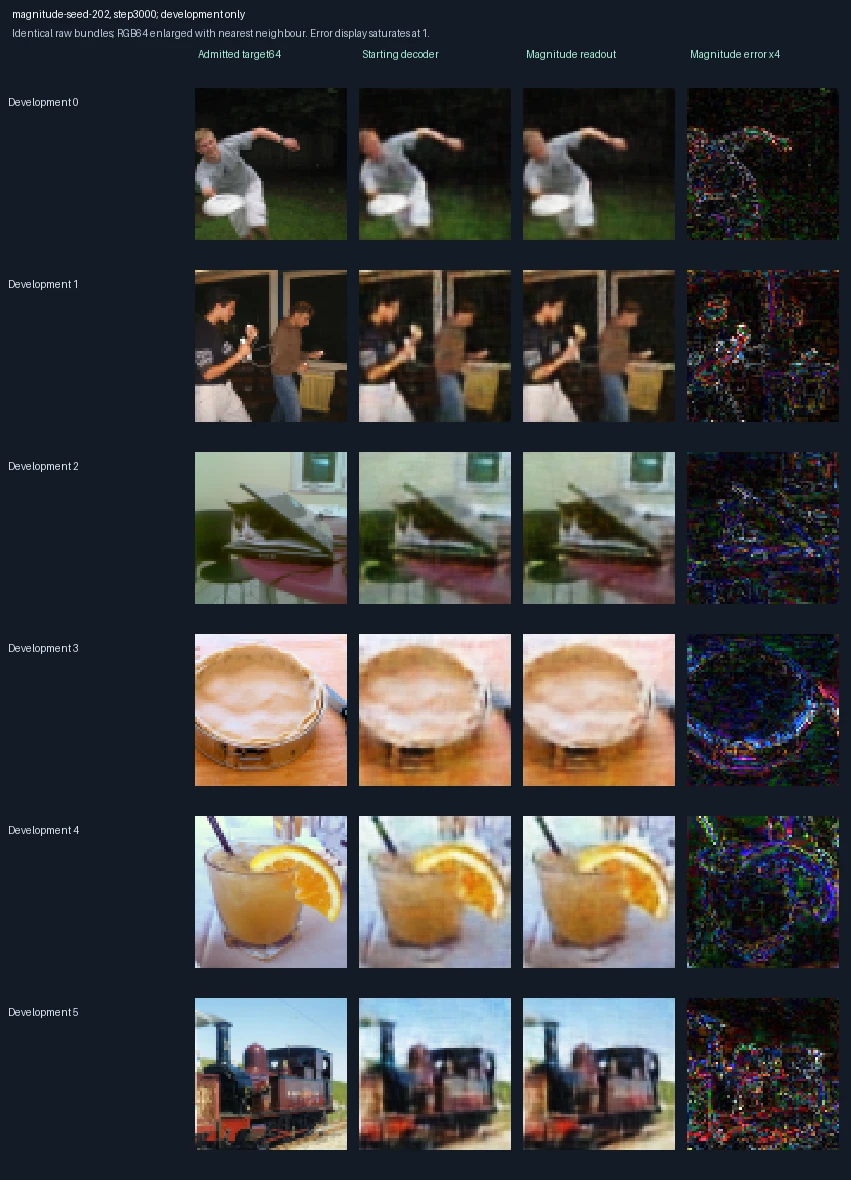
Six fixed development photographs. Left to right: the 64 × 64 input, the unchanged starting decoder using phase-only readout, this candidate’s reconstruction, and this candidate’s error. This is training repetition 2; the image label “seed-202” identifies its randomization setting. The encoder is fixed; only the decoder learns. These examples guide model selection, not final test claims. Phase-only readout keeps each complex coordinate’s angle; magnitude-preserving readout also keeps its amplitude, with one fixed scale learned from training data. Error panels show four times the absolute RGB difference from the reference, separately for each color channel, clipped at full brightness. Darker pixels mean smaller errors; black is zero or below the display’s precision. The scale is fixed across examples, not adjusted to make each image look better.
Magnitude-preserving readout, training repetition 2: 3,250 weight updates
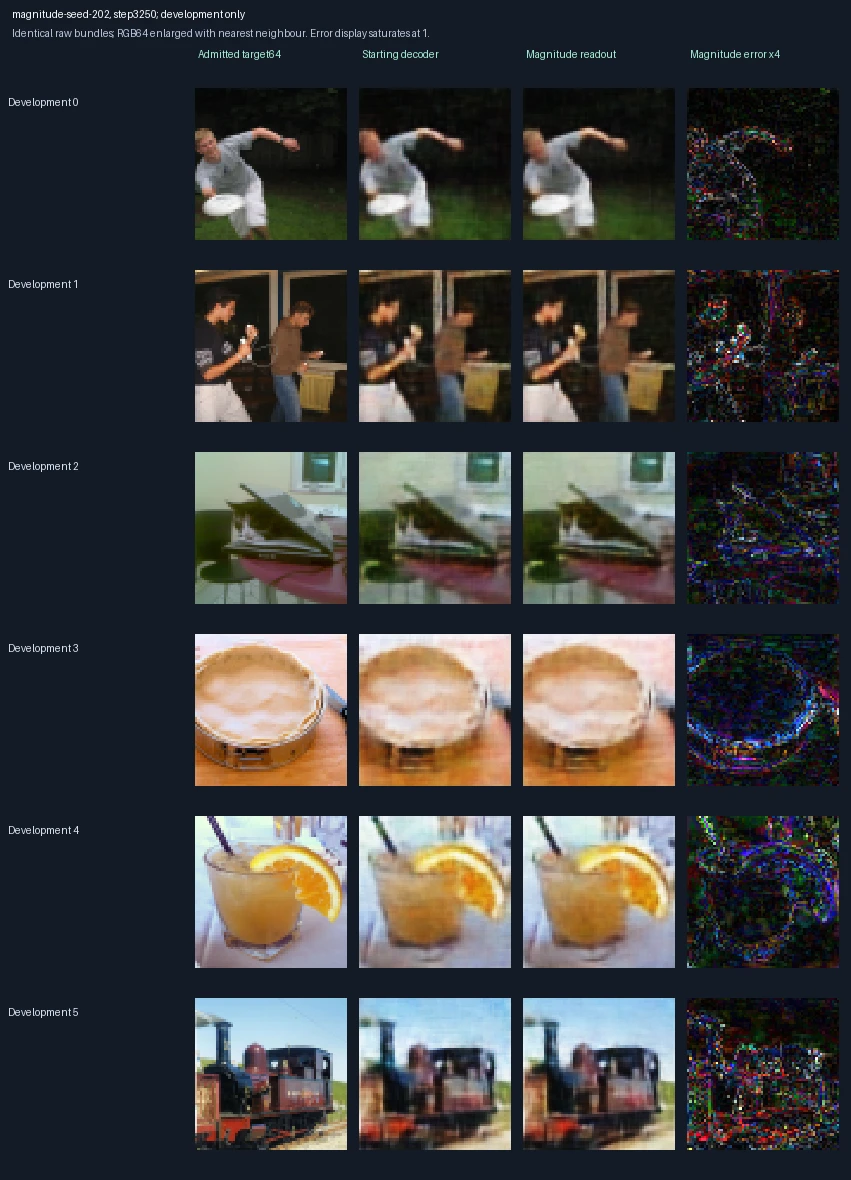
Six fixed development photographs. Left to right: the 64 × 64 input, the unchanged starting decoder using phase-only readout, this candidate’s reconstruction, and this candidate’s error. This is training repetition 2; the image label “seed-202” identifies its randomization setting. The encoder is fixed; only the decoder learns. These examples guide model selection, not final test claims. Phase-only readout keeps each complex coordinate’s angle; magnitude-preserving readout also keeps its amplitude, with one fixed scale learned from training data. Error panels show four times the absolute RGB difference from the reference, separately for each color channel, clipped at full brightness. Darker pixels mean smaller errors; black is zero or below the display’s precision. The scale is fixed across examples, not adjusted to make each image look better.
Magnitude-preserving readout, training repetition 2: 3,500 weight updates
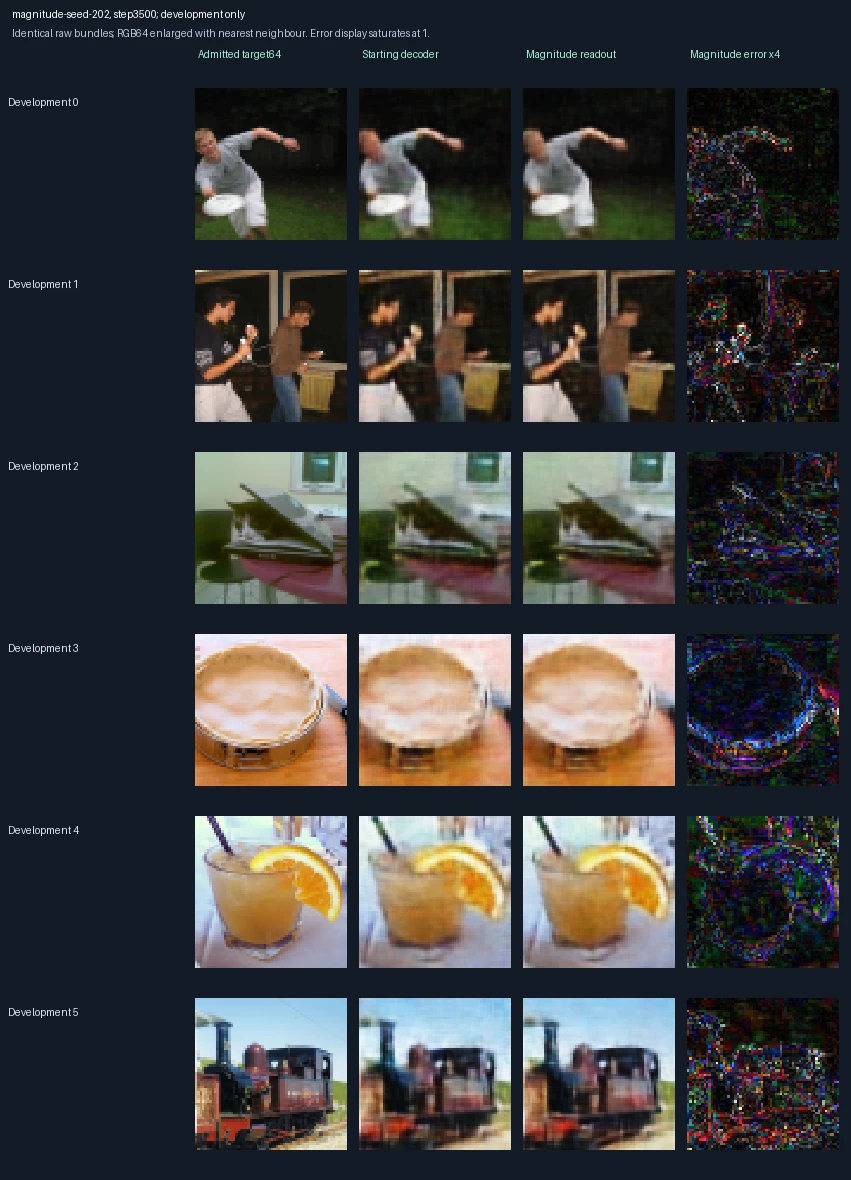
Six fixed development photographs. Left to right: the 64 × 64 input, the unchanged starting decoder using phase-only readout, this candidate’s reconstruction, and this candidate’s error. This is training repetition 2; the image label “seed-202” identifies its randomization setting. The encoder is fixed; only the decoder learns. These examples guide model selection, not final test claims. Phase-only readout keeps each complex coordinate’s angle; magnitude-preserving readout also keeps its amplitude, with one fixed scale learned from training data. Error panels show four times the absolute RGB difference from the reference, separately for each color channel, clipped at full brightness. Darker pixels mean smaller errors; black is zero or below the display’s precision. The scale is fixed across examples, not adjusted to make each image look better.
Magnitude-preserving readout, training repetition 2: 3,750 weight updates
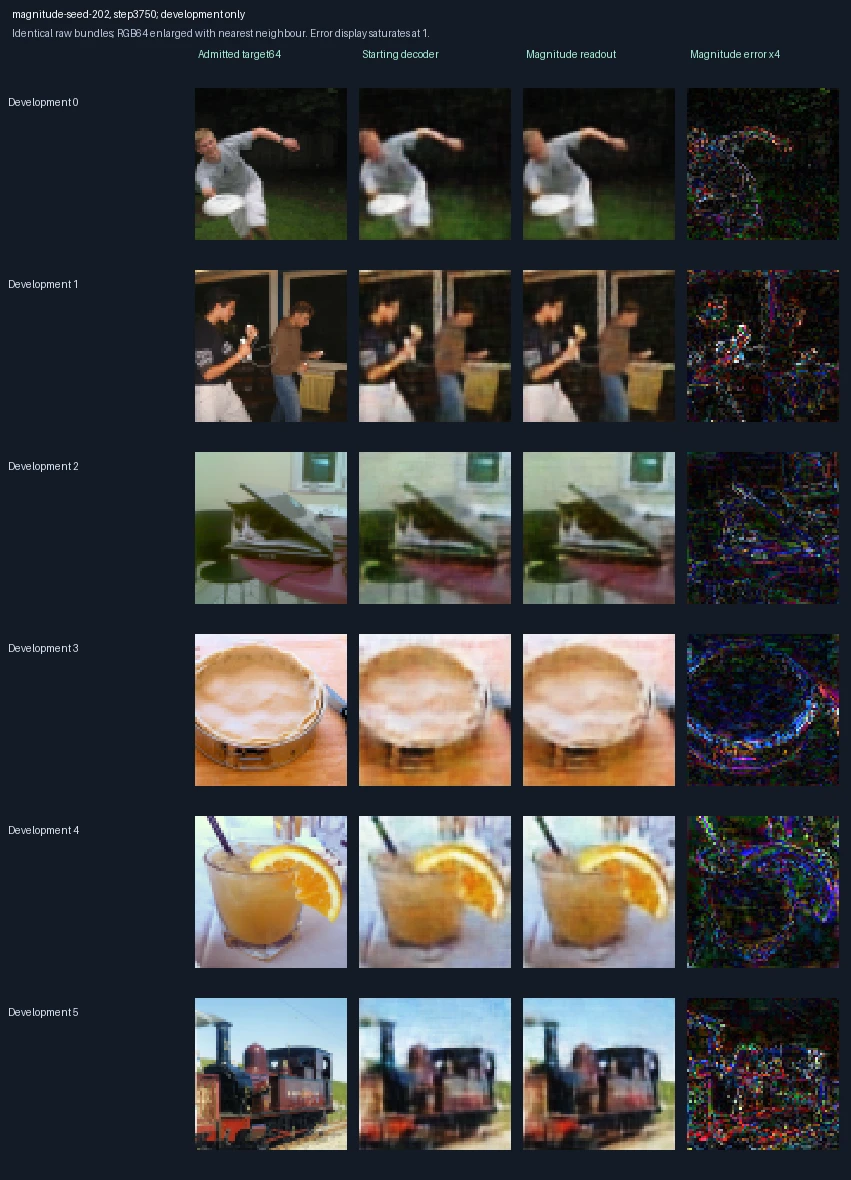
Six fixed development photographs. Left to right: the 64 × 64 input, the unchanged starting decoder using phase-only readout, this candidate’s reconstruction, and this candidate’s error. This is training repetition 2; the image label “seed-202” identifies its randomization setting. The encoder is fixed; only the decoder learns. These examples guide model selection, not final test claims. Phase-only readout keeps each complex coordinate’s angle; magnitude-preserving readout also keeps its amplitude, with one fixed scale learned from training data. Error panels show four times the absolute RGB difference from the reference, separately for each color channel, clipped at full brightness. Darker pixels mean smaller errors; black is zero or below the display’s precision. The scale is fixed across examples, not adjusted to make each image look better.
Magnitude-preserving readout, training repetition 2: 4,000 weight updates
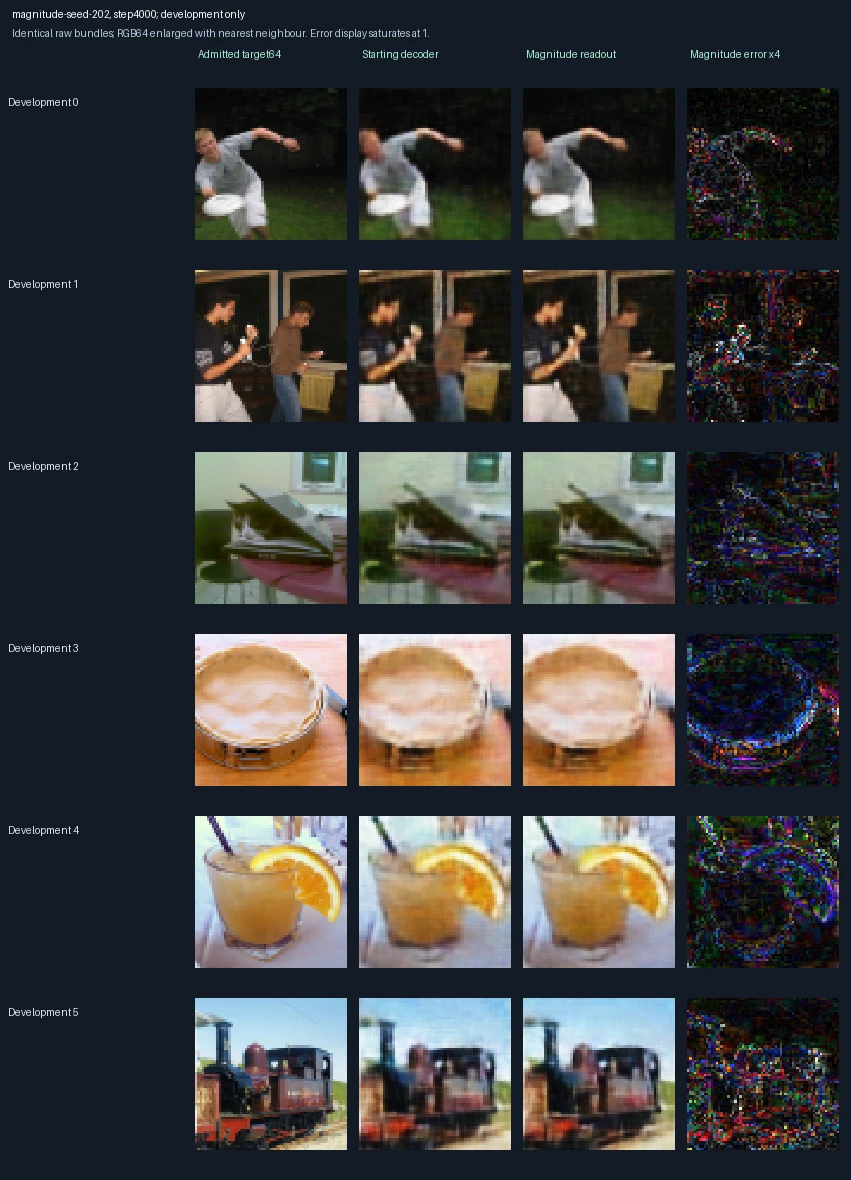
Six fixed development photographs. Left to right: the 64 × 64 input, the unchanged starting decoder using phase-only readout, this candidate’s reconstruction, and this candidate’s error. This is training repetition 2; the image label “seed-202” identifies its randomization setting. The encoder is fixed; only the decoder learns. These examples guide model selection, not final test claims. Phase-only readout keeps each complex coordinate’s angle; magnitude-preserving readout also keeps its amplitude, with one fixed scale learned from training data. Error panels show four times the absolute RGB difference from the reference, separately for each color channel, clipped at full brightness. Darker pixels mean smaller errors; black is zero or below the display’s precision. The scale is fixed across examples, not adjusted to make each image look better.
Phase-only readout, training repetition 3: 0 weight updates
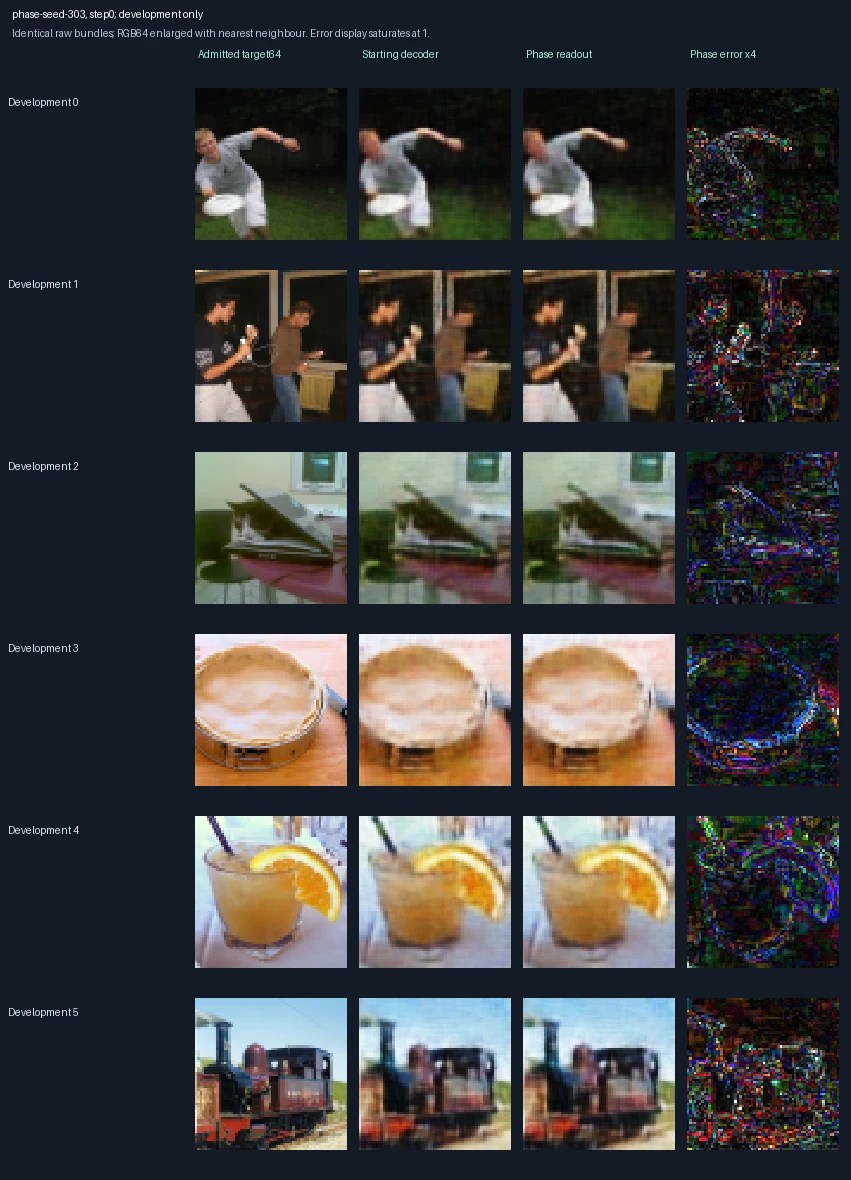
Six fixed development photographs. Left to right: the 64 × 64 input, the unchanged starting decoder using phase-only readout, this candidate’s reconstruction, and this candidate’s error. This is training repetition 3; the image label “seed-303” identifies its randomization setting. The encoder is fixed; only the decoder learns. These examples guide model selection, not final test claims. Phase-only readout keeps each complex coordinate’s angle; magnitude-preserving readout also keeps its amplitude, with one fixed scale learned from training data. Error panels show four times the absolute RGB difference from the reference, separately for each color channel, clipped at full brightness. Darker pixels mean smaller errors; black is zero or below the display’s precision. The scale is fixed across examples, not adjusted to make each image look better.
Phase-only readout, training repetition 3: 250 weight updates
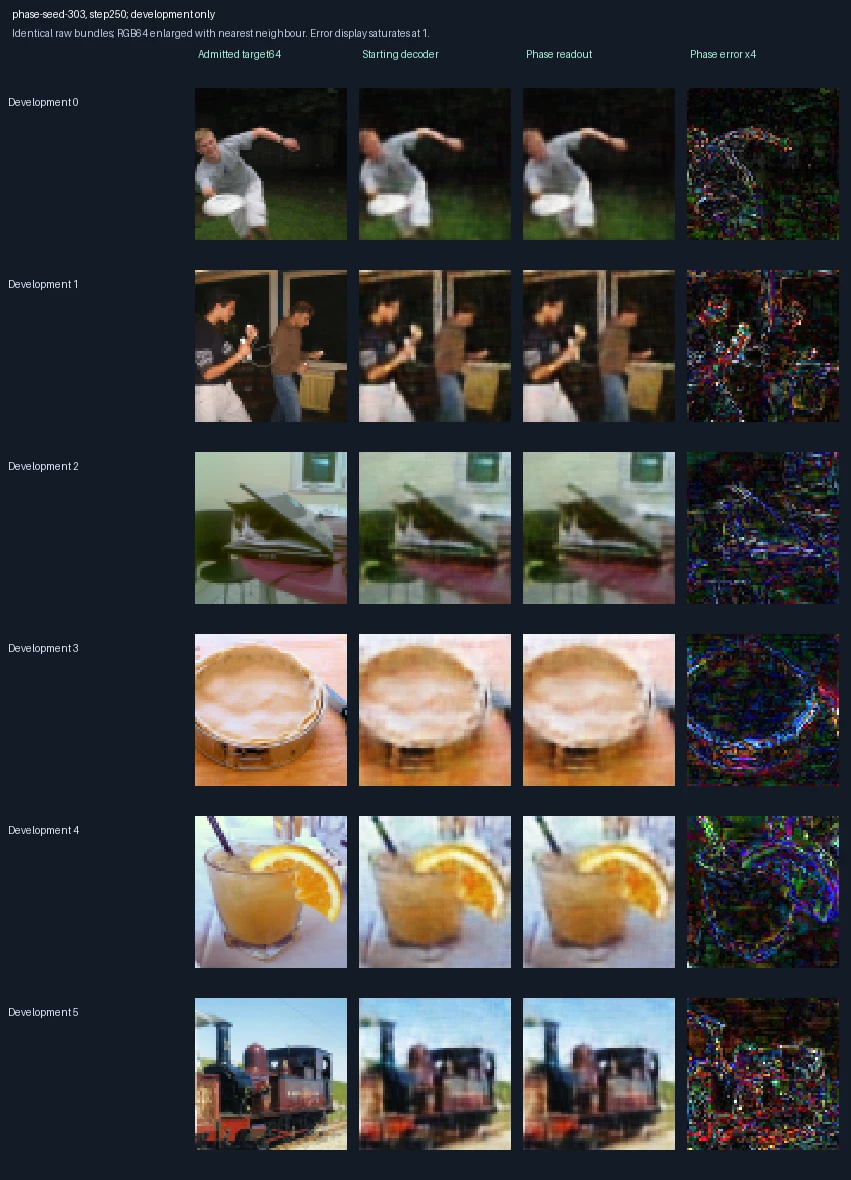
Six fixed development photographs. Left to right: the 64 × 64 input, the unchanged starting decoder using phase-only readout, this candidate’s reconstruction, and this candidate’s error. This is training repetition 3; the image label “seed-303” identifies its randomization setting. The encoder is fixed; only the decoder learns. These examples guide model selection, not final test claims. Phase-only readout keeps each complex coordinate’s angle; magnitude-preserving readout also keeps its amplitude, with one fixed scale learned from training data. Error panels show four times the absolute RGB difference from the reference, separately for each color channel, clipped at full brightness. Darker pixels mean smaller errors; black is zero or below the display’s precision. The scale is fixed across examples, not adjusted to make each image look better.
Phase-only readout, training repetition 3: 500 weight updates
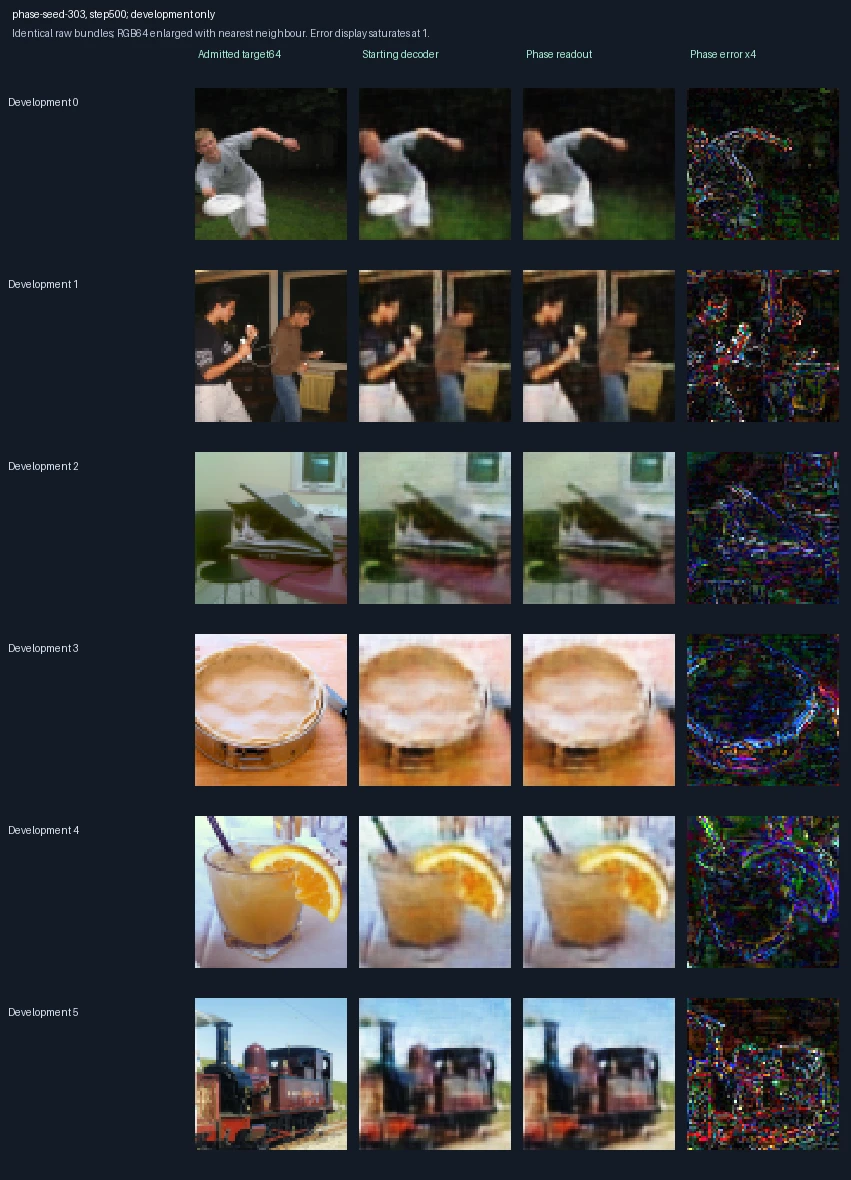
Six fixed development photographs. Left to right: the 64 × 64 input, the unchanged starting decoder using phase-only readout, this candidate’s reconstruction, and this candidate’s error. This is training repetition 3; the image label “seed-303” identifies its randomization setting. The encoder is fixed; only the decoder learns. These examples guide model selection, not final test claims. Phase-only readout keeps each complex coordinate’s angle; magnitude-preserving readout also keeps its amplitude, with one fixed scale learned from training data. Error panels show four times the absolute RGB difference from the reference, separately for each color channel, clipped at full brightness. Darker pixels mean smaller errors; black is zero or below the display’s precision. The scale is fixed across examples, not adjusted to make each image look better.
Phase-only readout, training repetition 3: 750 weight updates
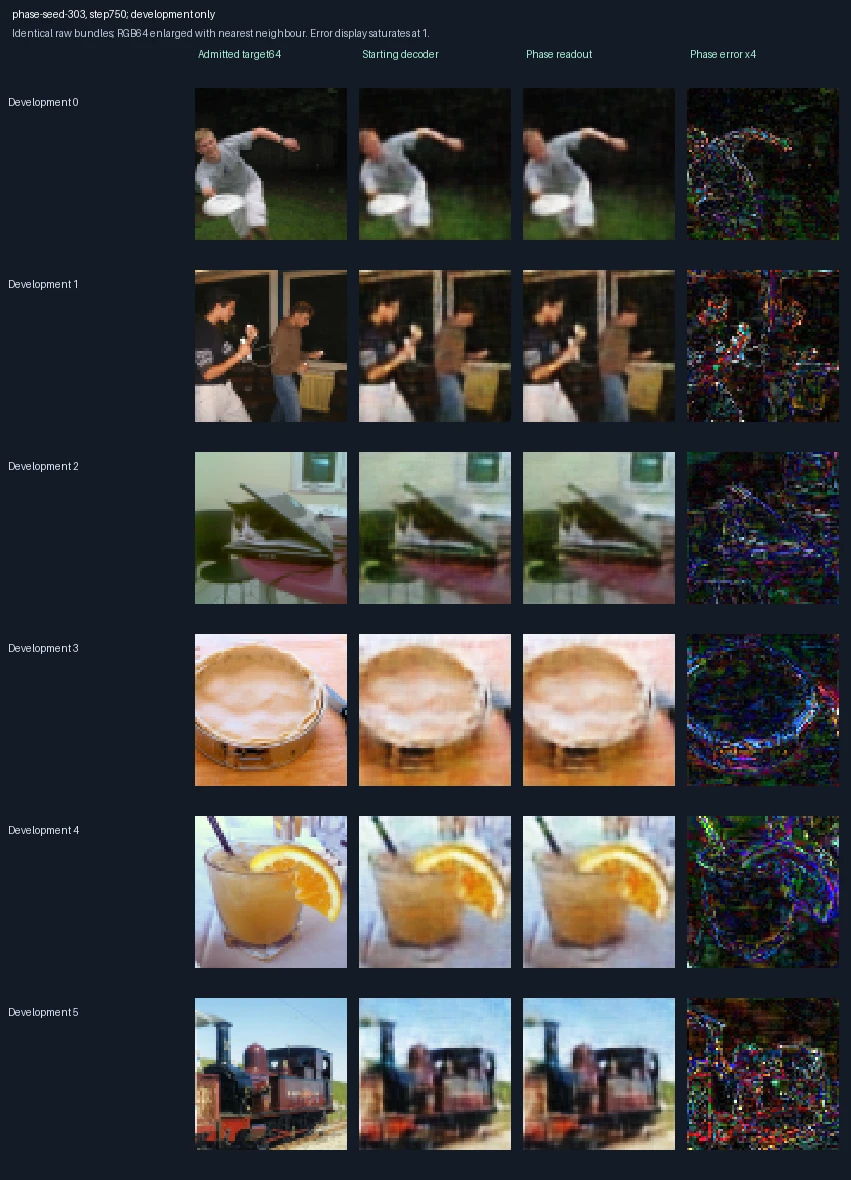
Six fixed development photographs. Left to right: the 64 × 64 input, the unchanged starting decoder using phase-only readout, this candidate’s reconstruction, and this candidate’s error. This is training repetition 3; the image label “seed-303” identifies its randomization setting. The encoder is fixed; only the decoder learns. These examples guide model selection, not final test claims. Phase-only readout keeps each complex coordinate’s angle; magnitude-preserving readout also keeps its amplitude, with one fixed scale learned from training data. Error panels show four times the absolute RGB difference from the reference, separately for each color channel, clipped at full brightness. Darker pixels mean smaller errors; black is zero or below the display’s precision. The scale is fixed across examples, not adjusted to make each image look better.
Phase-only readout, training repetition 3: 1,000 weight updates
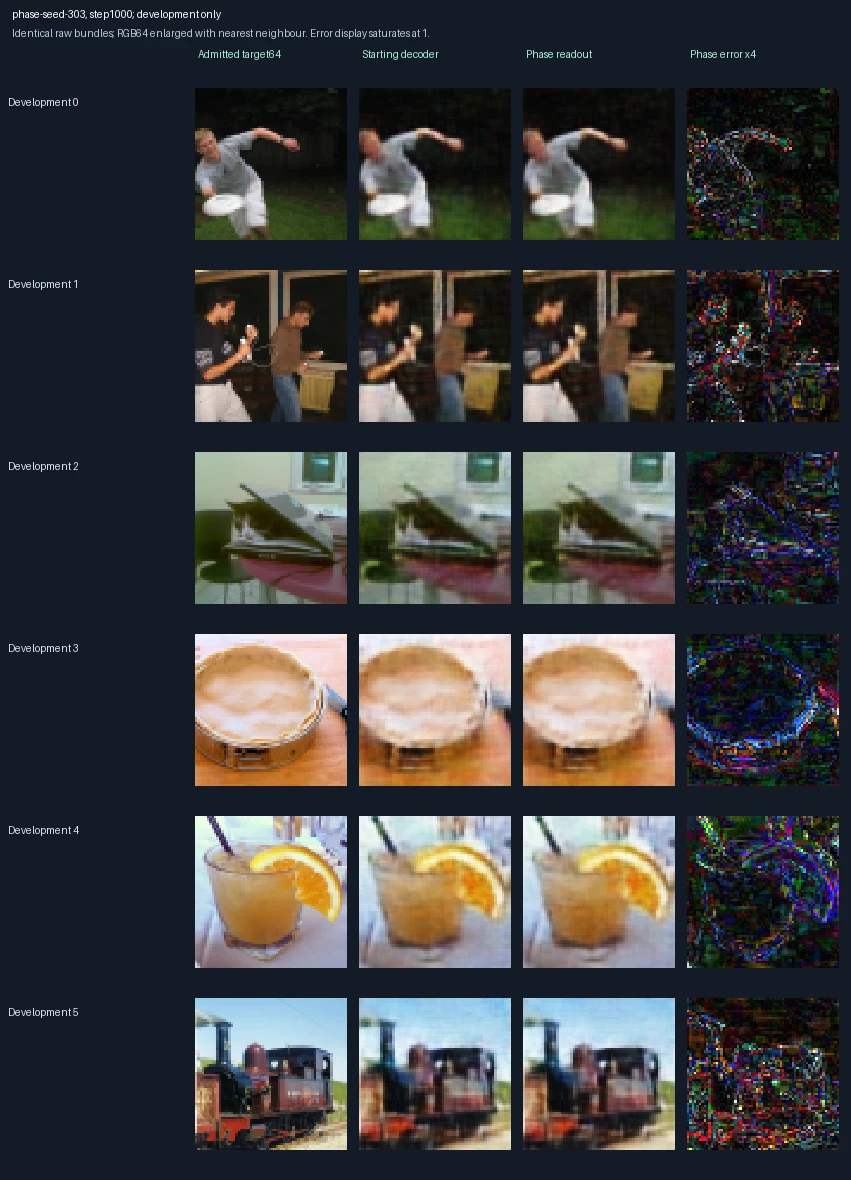
Six fixed development photographs. Left to right: the 64 × 64 input, the unchanged starting decoder using phase-only readout, this candidate’s reconstruction, and this candidate’s error. This is training repetition 3; the image label “seed-303” identifies its randomization setting. The encoder is fixed; only the decoder learns. These examples guide model selection, not final test claims. Phase-only readout keeps each complex coordinate’s angle; magnitude-preserving readout also keeps its amplitude, with one fixed scale learned from training data. Error panels show four times the absolute RGB difference from the reference, separately for each color channel, clipped at full brightness. Darker pixels mean smaller errors; black is zero or below the display’s precision. The scale is fixed across examples, not adjusted to make each image look better.
Phase-only readout, training repetition 3: 1,250 weight updates
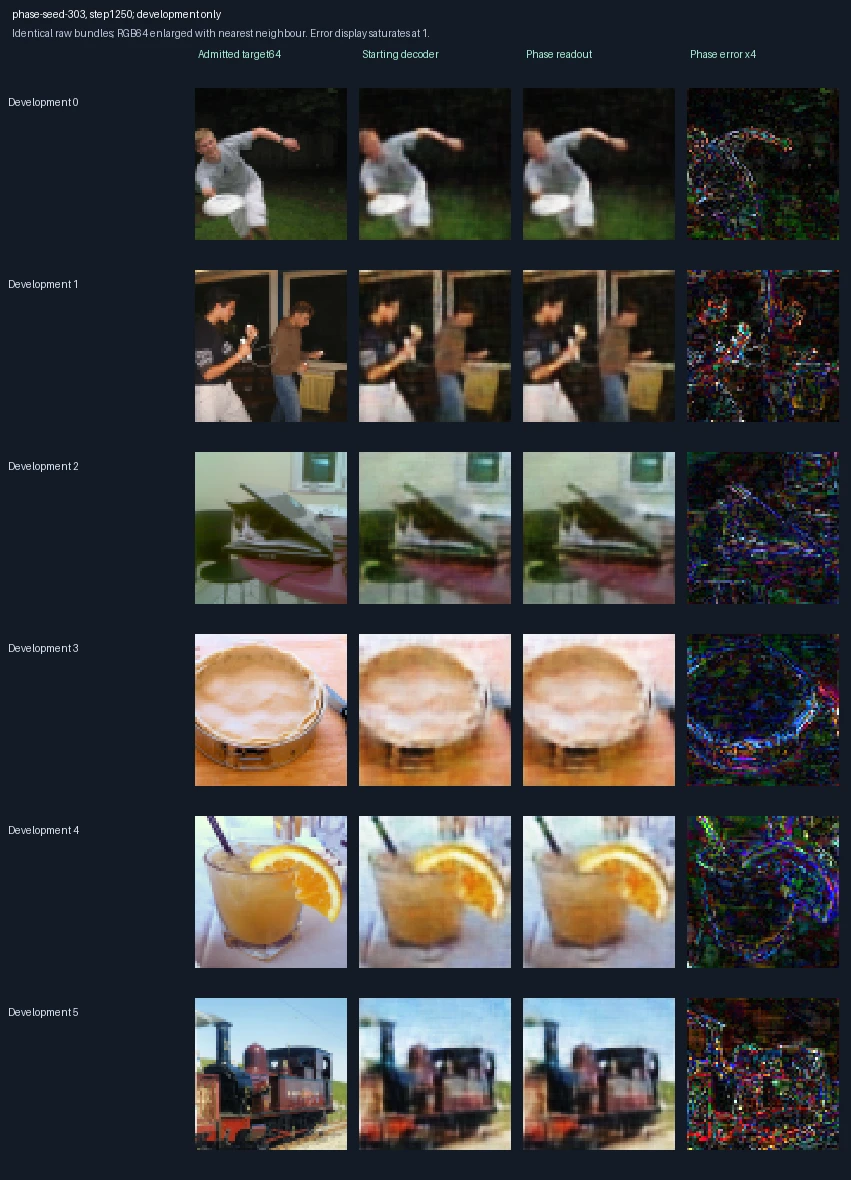
Six fixed development photographs. Left to right: the 64 × 64 input, the unchanged starting decoder using phase-only readout, this candidate’s reconstruction, and this candidate’s error. This is training repetition 3; the image label “seed-303” identifies its randomization setting. The encoder is fixed; only the decoder learns. These examples guide model selection, not final test claims. Phase-only readout keeps each complex coordinate’s angle; magnitude-preserving readout also keeps its amplitude, with one fixed scale learned from training data. Error panels show four times the absolute RGB difference from the reference, separately for each color channel, clipped at full brightness. Darker pixels mean smaller errors; black is zero or below the display’s precision. The scale is fixed across examples, not adjusted to make each image look better.
Phase-only readout, training repetition 3: 1,500 weight updates
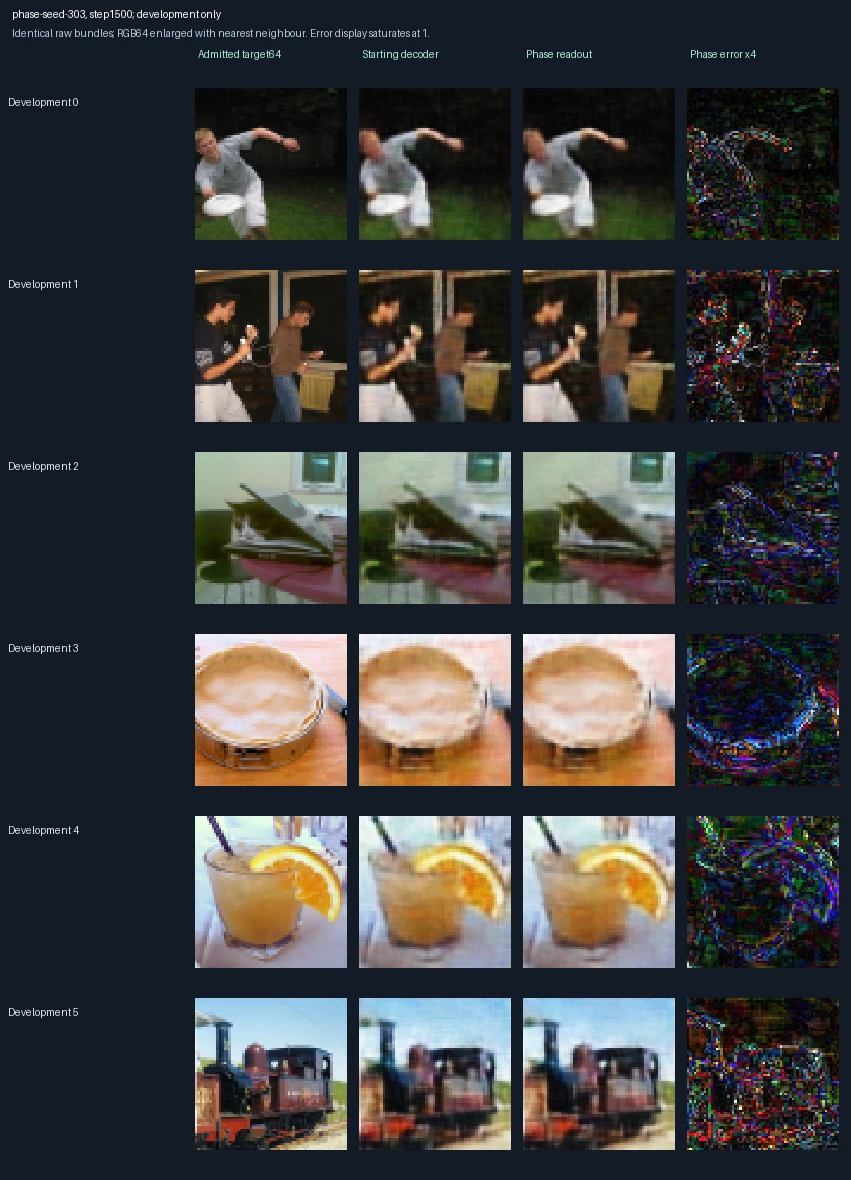
Six fixed development photographs. Left to right: the 64 × 64 input, the unchanged starting decoder using phase-only readout, this candidate’s reconstruction, and this candidate’s error. This is training repetition 3; the image label “seed-303” identifies its randomization setting. The encoder is fixed; only the decoder learns. These examples guide model selection, not final test claims. Phase-only readout keeps each complex coordinate’s angle; magnitude-preserving readout also keeps its amplitude, with one fixed scale learned from training data. Error panels show four times the absolute RGB difference from the reference, separately for each color channel, clipped at full brightness. Darker pixels mean smaller errors; black is zero or below the display’s precision. The scale is fixed across examples, not adjusted to make each image look better.
Phase-only readout, training repetition 3: 1,750 weight updates
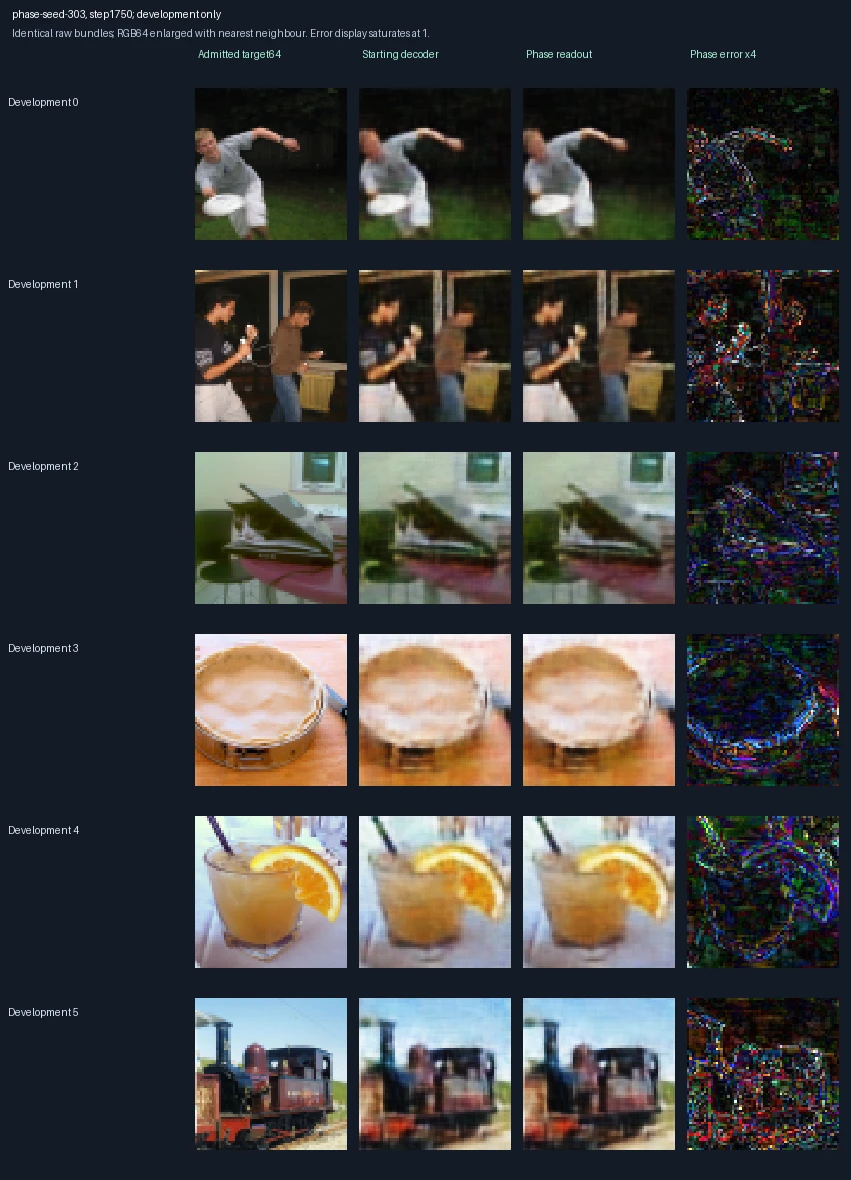
Six fixed development photographs. Left to right: the 64 × 64 input, the unchanged starting decoder using phase-only readout, this candidate’s reconstruction, and this candidate’s error. This is training repetition 3; the image label “seed-303” identifies its randomization setting. The encoder is fixed; only the decoder learns. These examples guide model selection, not final test claims. Phase-only readout keeps each complex coordinate’s angle; magnitude-preserving readout also keeps its amplitude, with one fixed scale learned from training data. Error panels show four times the absolute RGB difference from the reference, separately for each color channel, clipped at full brightness. Darker pixels mean smaller errors; black is zero or below the display’s precision. The scale is fixed across examples, not adjusted to make each image look better.
Phase-only readout, training repetition 3: 2,000 weight updates
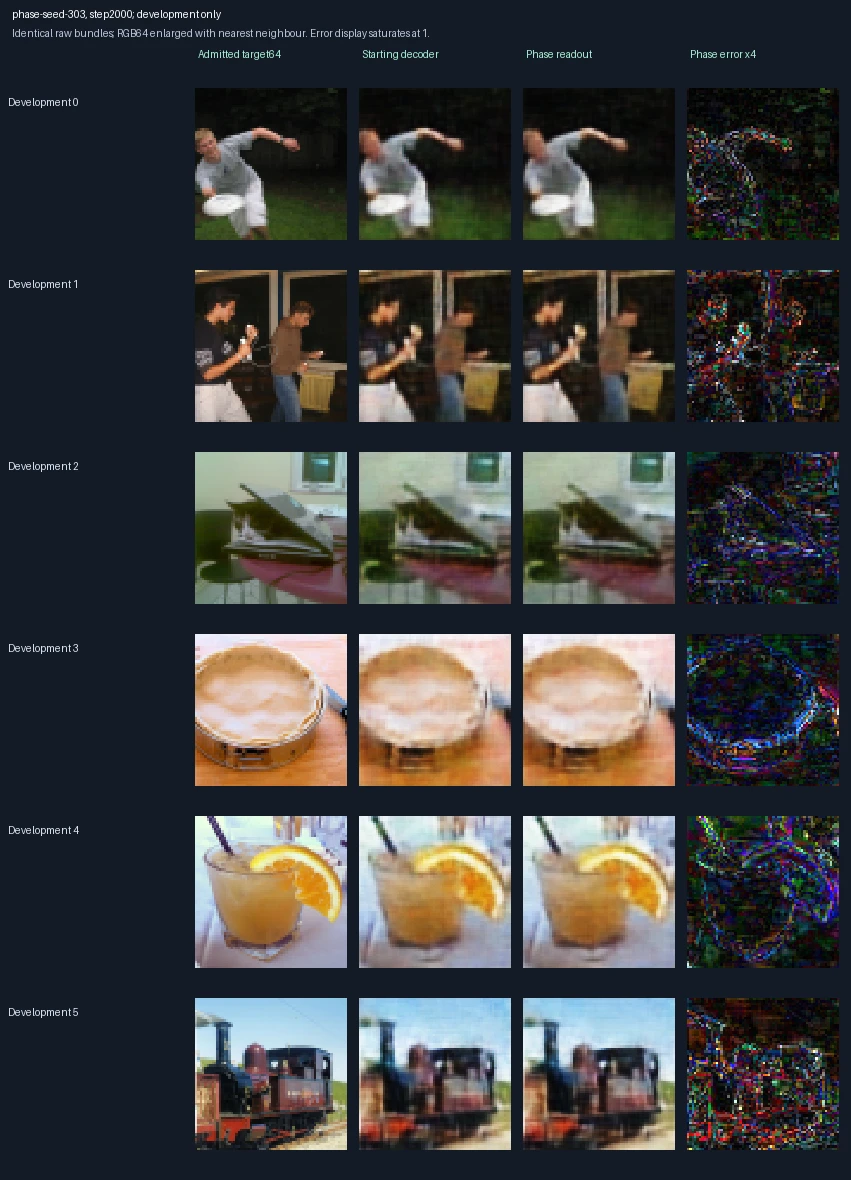
Six fixed development photographs. Left to right: the 64 × 64 input, the unchanged starting decoder using phase-only readout, this candidate’s reconstruction, and this candidate’s error. This is training repetition 3; the image label “seed-303” identifies its randomization setting. The encoder is fixed; only the decoder learns. These examples guide model selection, not final test claims. Phase-only readout keeps each complex coordinate’s angle; magnitude-preserving readout also keeps its amplitude, with one fixed scale learned from training data. Error panels show four times the absolute RGB difference from the reference, separately for each color channel, clipped at full brightness. Darker pixels mean smaller errors; black is zero or below the display’s precision. The scale is fixed across examples, not adjusted to make each image look better.
Phase-only readout, training repetition 3: 2,250 weight updates
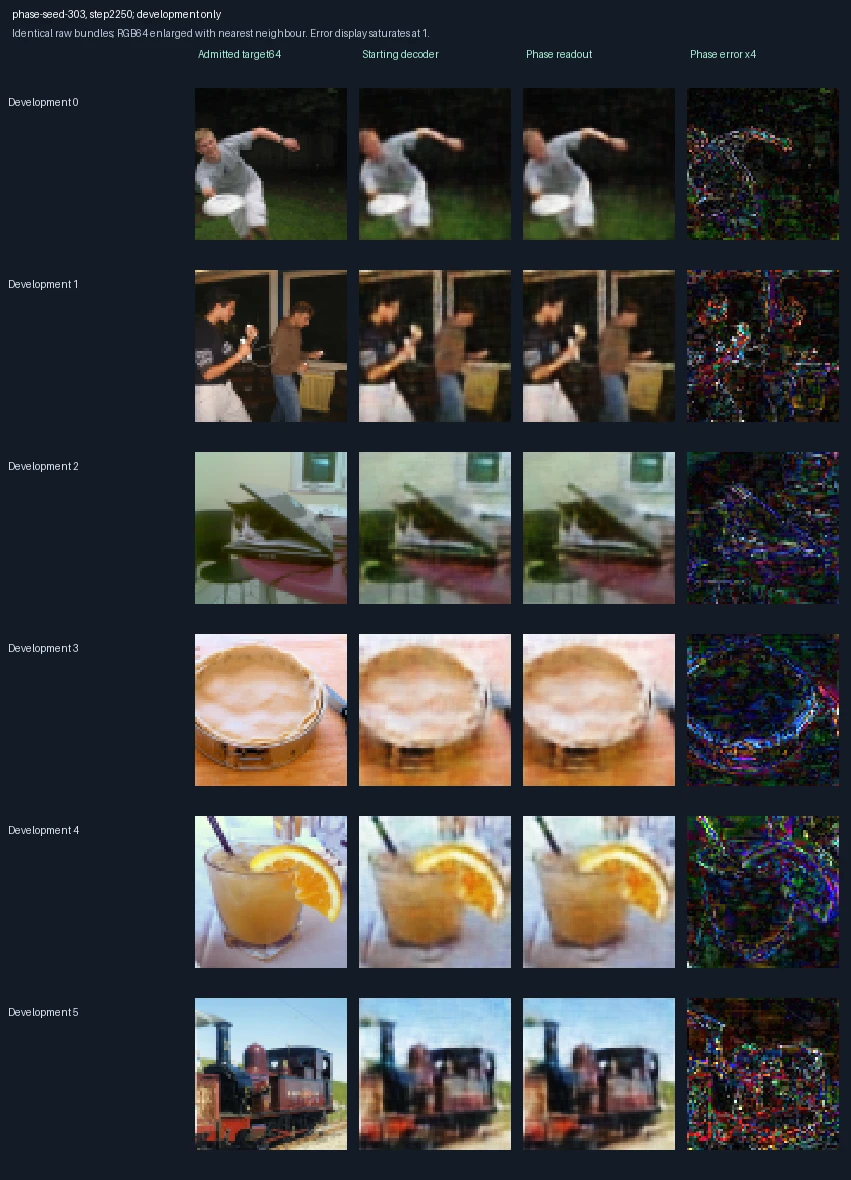
Six fixed development photographs. Left to right: the 64 × 64 input, the unchanged starting decoder using phase-only readout, this candidate’s reconstruction, and this candidate’s error. This is training repetition 3; the image label “seed-303” identifies its randomization setting. The encoder is fixed; only the decoder learns. These examples guide model selection, not final test claims. Phase-only readout keeps each complex coordinate’s angle; magnitude-preserving readout also keeps its amplitude, with one fixed scale learned from training data. Error panels show four times the absolute RGB difference from the reference, separately for each color channel, clipped at full brightness. Darker pixels mean smaller errors; black is zero or below the display’s precision. The scale is fixed across examples, not adjusted to make each image look better.
Phase-only readout, training repetition 3: 2,500 weight updates
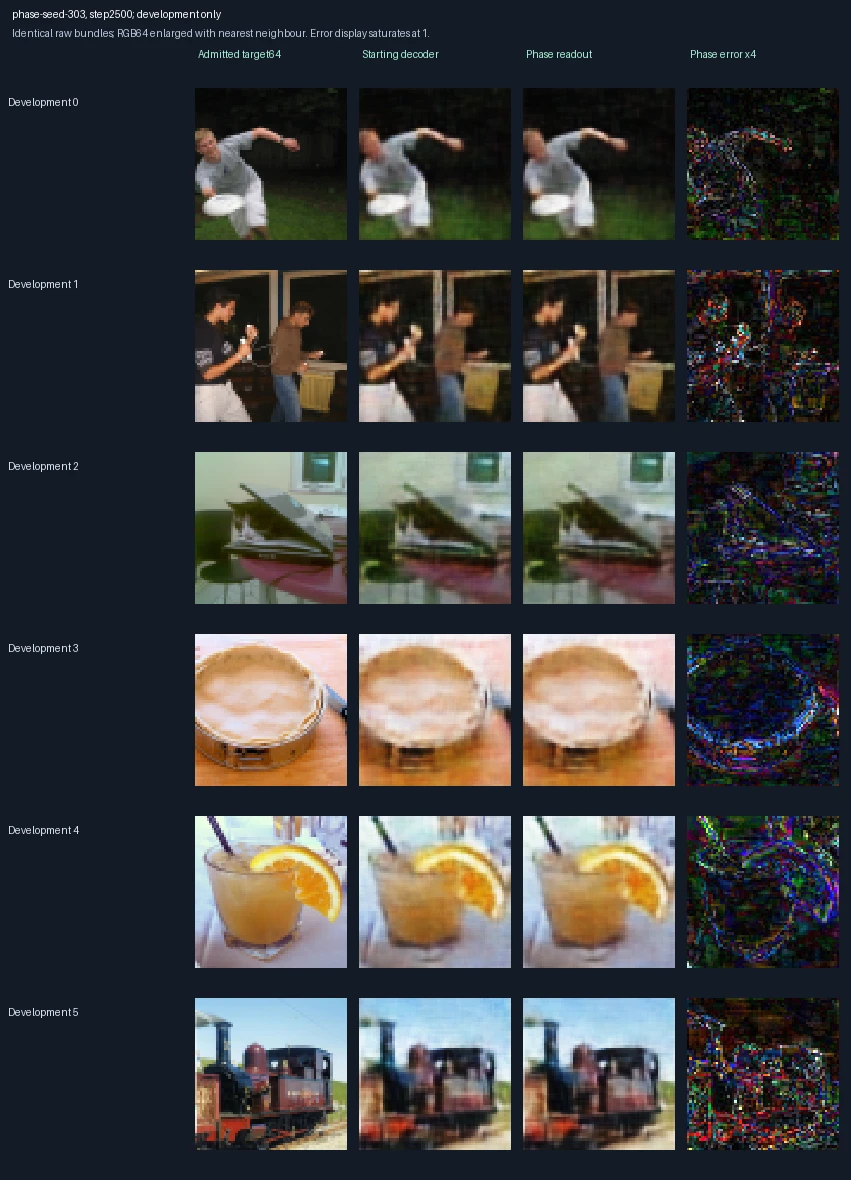
Six fixed development photographs. Left to right: the 64 × 64 input, the unchanged starting decoder using phase-only readout, this candidate’s reconstruction, and this candidate’s error. This is training repetition 3; the image label “seed-303” identifies its randomization setting. The encoder is fixed; only the decoder learns. These examples guide model selection, not final test claims. Phase-only readout keeps each complex coordinate’s angle; magnitude-preserving readout also keeps its amplitude, with one fixed scale learned from training data. Error panels show four times the absolute RGB difference from the reference, separately for each color channel, clipped at full brightness. Darker pixels mean smaller errors; black is zero or below the display’s precision. The scale is fixed across examples, not adjusted to make each image look better.
Phase-only readout, training repetition 3: 2,750 weight updates
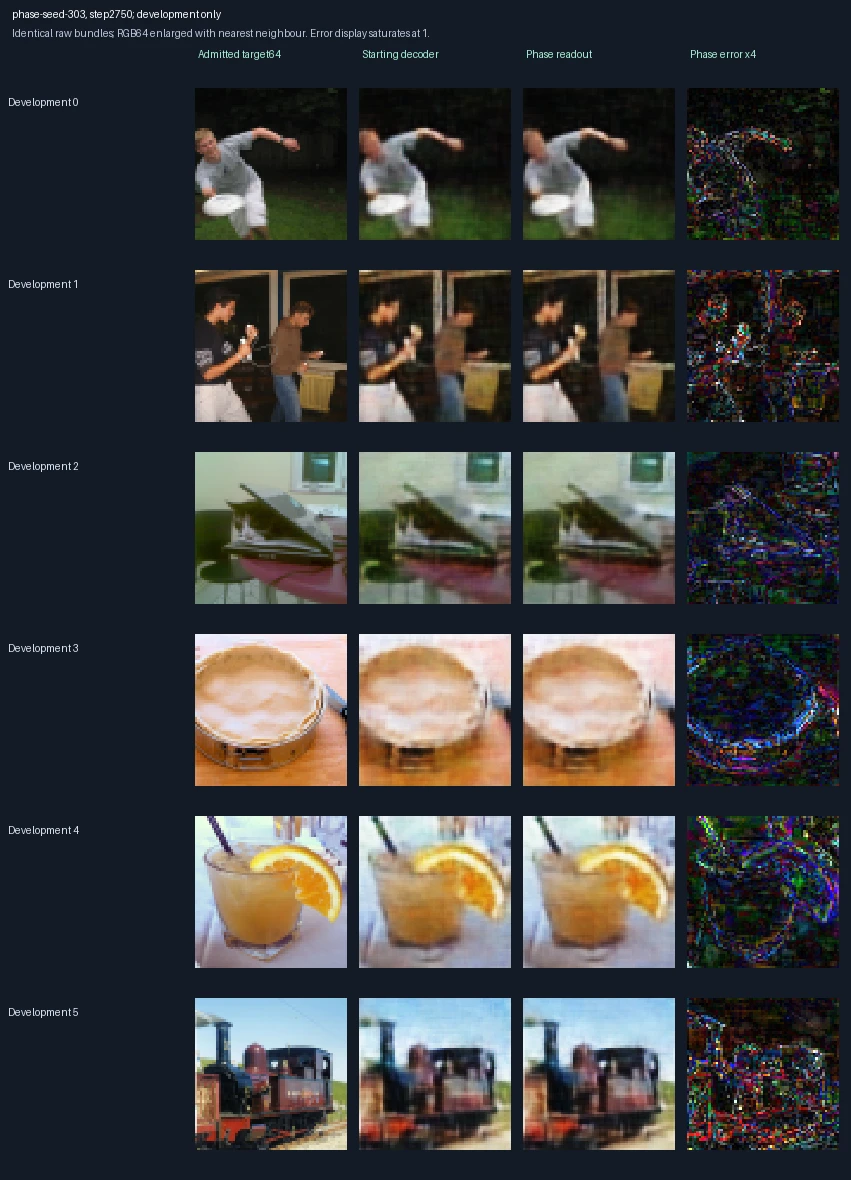
Six fixed development photographs. Left to right: the 64 × 64 input, the unchanged starting decoder using phase-only readout, this candidate’s reconstruction, and this candidate’s error. This is training repetition 3; the image label “seed-303” identifies its randomization setting. The encoder is fixed; only the decoder learns. These examples guide model selection, not final test claims. Phase-only readout keeps each complex coordinate’s angle; magnitude-preserving readout also keeps its amplitude, with one fixed scale learned from training data. Error panels show four times the absolute RGB difference from the reference, separately for each color channel, clipped at full brightness. Darker pixels mean smaller errors; black is zero or below the display’s precision. The scale is fixed across examples, not adjusted to make each image look better.
Phase-only readout, training repetition 3: 3,000 weight updates
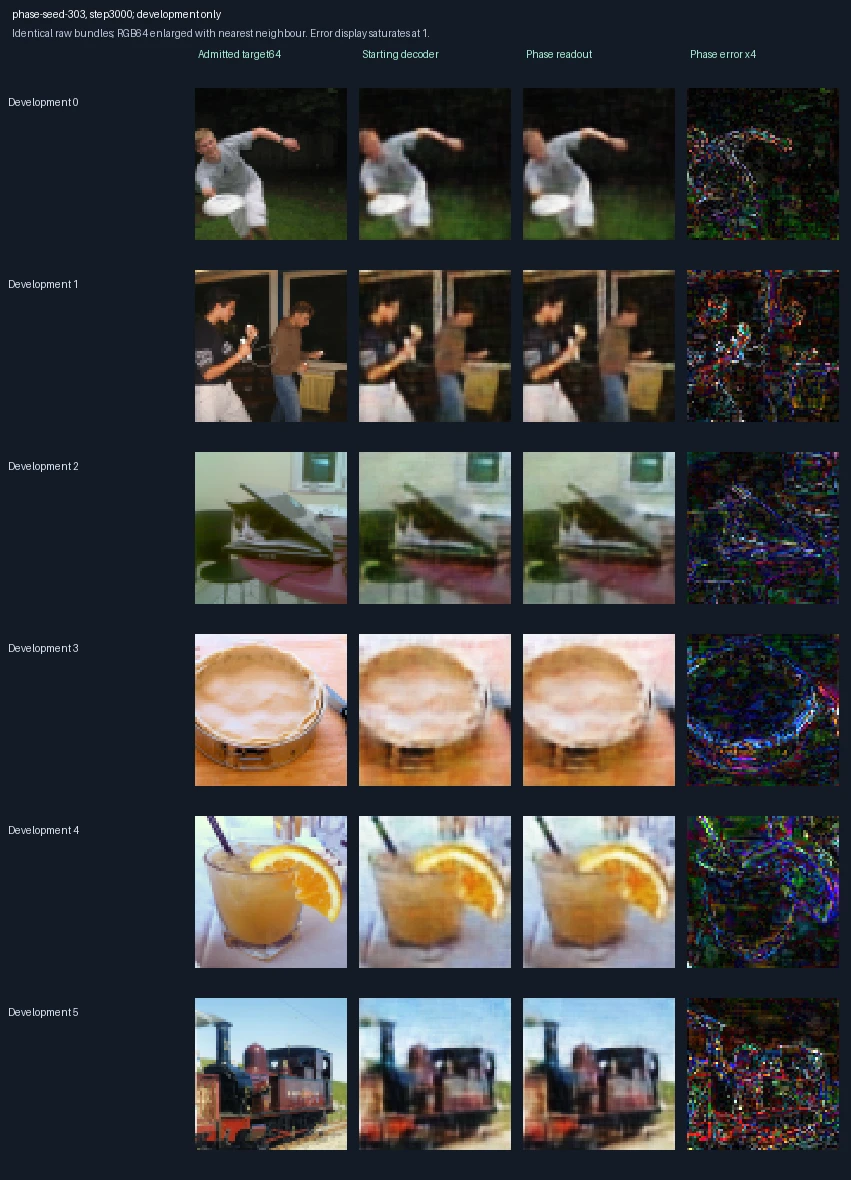
Six fixed development photographs. Left to right: the 64 × 64 input, the unchanged starting decoder using phase-only readout, this candidate’s reconstruction, and this candidate’s error. This is training repetition 3; the image label “seed-303” identifies its randomization setting. The encoder is fixed; only the decoder learns. These examples guide model selection, not final test claims. Phase-only readout keeps each complex coordinate’s angle; magnitude-preserving readout also keeps its amplitude, with one fixed scale learned from training data. Error panels show four times the absolute RGB difference from the reference, separately for each color channel, clipped at full brightness. Darker pixels mean smaller errors; black is zero or below the display’s precision. The scale is fixed across examples, not adjusted to make each image look better.
Phase-only readout, training repetition 3: 3,250 weight updates
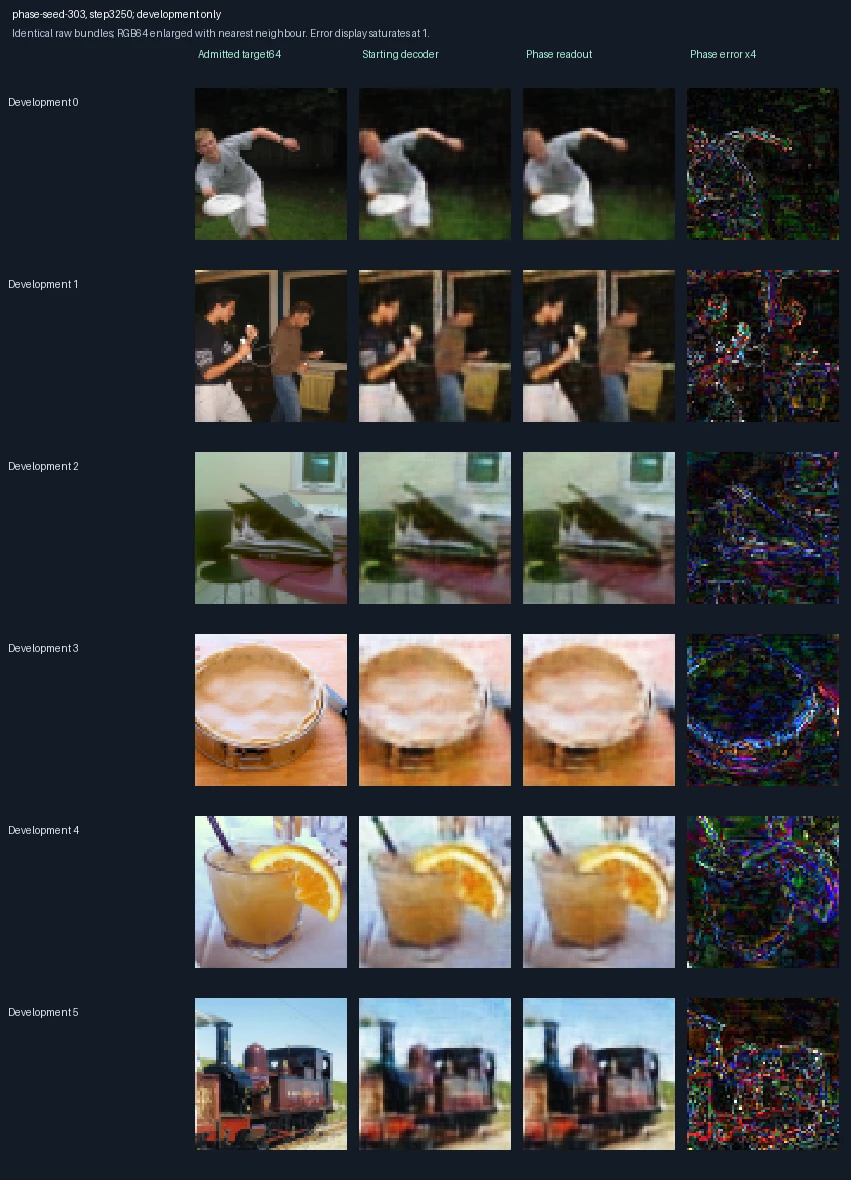
Six fixed development photographs. Left to right: the 64 × 64 input, the unchanged starting decoder using phase-only readout, this candidate’s reconstruction, and this candidate’s error. This is training repetition 3; the image label “seed-303” identifies its randomization setting. The encoder is fixed; only the decoder learns. These examples guide model selection, not final test claims. Phase-only readout keeps each complex coordinate’s angle; magnitude-preserving readout also keeps its amplitude, with one fixed scale learned from training data. Error panels show four times the absolute RGB difference from the reference, separately for each color channel, clipped at full brightness. Darker pixels mean smaller errors; black is zero or below the display’s precision. The scale is fixed across examples, not adjusted to make each image look better.
Phase-only readout, training repetition 3: 3,500 weight updates
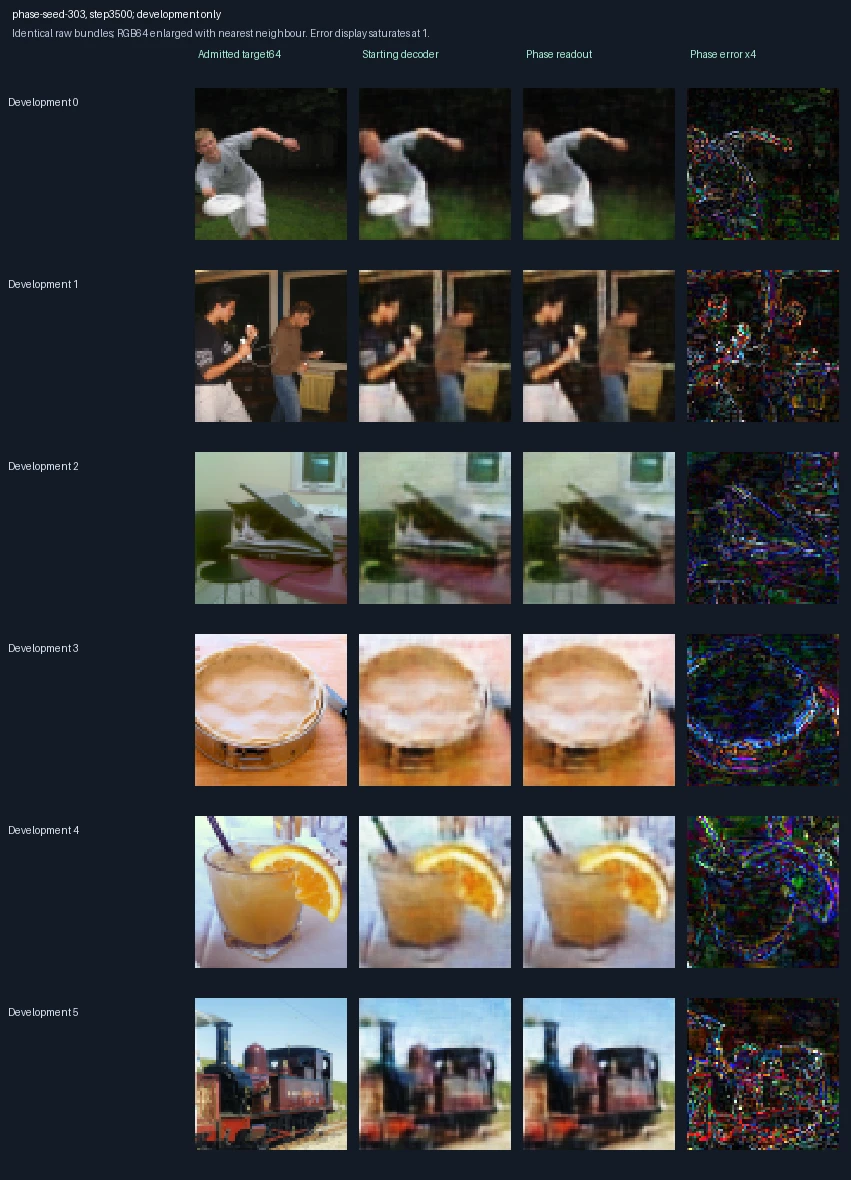
Six fixed development photographs. Left to right: the 64 × 64 input, the unchanged starting decoder using phase-only readout, this candidate’s reconstruction, and this candidate’s error. This is training repetition 3; the image label “seed-303” identifies its randomization setting. The encoder is fixed; only the decoder learns. These examples guide model selection, not final test claims. Phase-only readout keeps each complex coordinate’s angle; magnitude-preserving readout also keeps its amplitude, with one fixed scale learned from training data. Error panels show four times the absolute RGB difference from the reference, separately for each color channel, clipped at full brightness. Darker pixels mean smaller errors; black is zero or below the display’s precision. The scale is fixed across examples, not adjusted to make each image look better.
Phase-only readout, training repetition 3: 3,750 weight updates
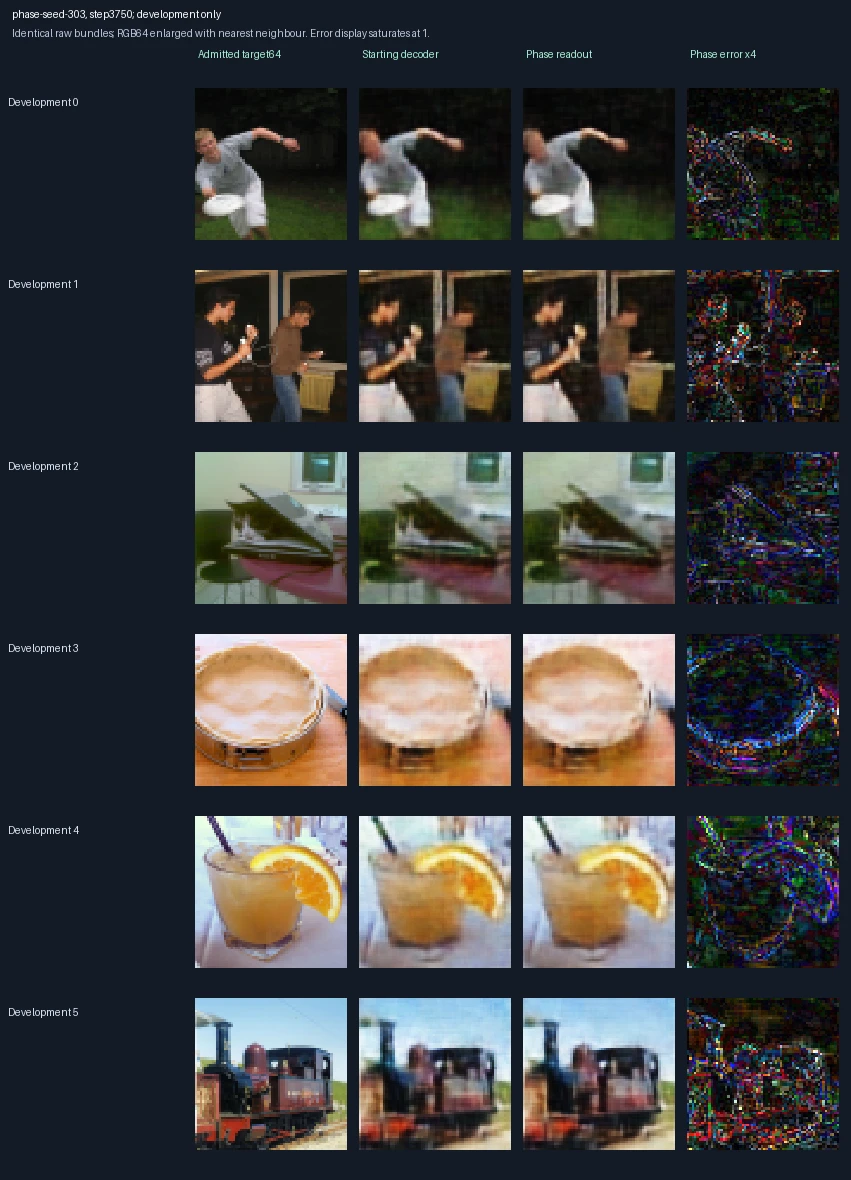
Six fixed development photographs. Left to right: the 64 × 64 input, the unchanged starting decoder using phase-only readout, this candidate’s reconstruction, and this candidate’s error. This is training repetition 3; the image label “seed-303” identifies its randomization setting. The encoder is fixed; only the decoder learns. These examples guide model selection, not final test claims. Phase-only readout keeps each complex coordinate’s angle; magnitude-preserving readout also keeps its amplitude, with one fixed scale learned from training data. Error panels show four times the absolute RGB difference from the reference, separately for each color channel, clipped at full brightness. Darker pixels mean smaller errors; black is zero or below the display’s precision. The scale is fixed across examples, not adjusted to make each image look better.
Phase-only readout, training repetition 3: 4,000 weight updates
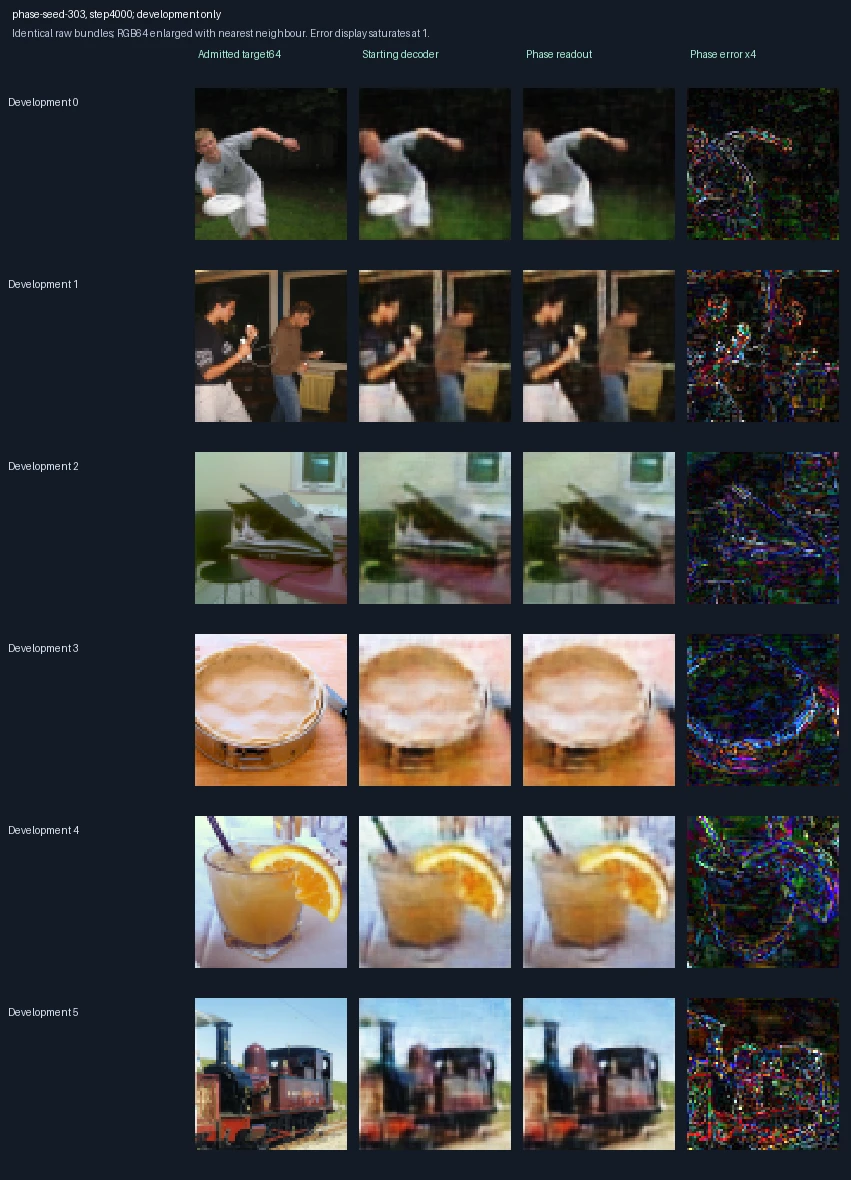
Six fixed development photographs. Left to right: the 64 × 64 input, the unchanged starting decoder using phase-only readout, this candidate’s reconstruction, and this candidate’s error. This is training repetition 3; the image label “seed-303” identifies its randomization setting. The encoder is fixed; only the decoder learns. These examples guide model selection, not final test claims. Phase-only readout keeps each complex coordinate’s angle; magnitude-preserving readout also keeps its amplitude, with one fixed scale learned from training data. Error panels show four times the absolute RGB difference from the reference, separately for each color channel, clipped at full brightness. Darker pixels mean smaller errors; black is zero or below the display’s precision. The scale is fixed across examples, not adjusted to make each image look better.
Magnitude-preserving readout, training repetition 3: 0 weight updates
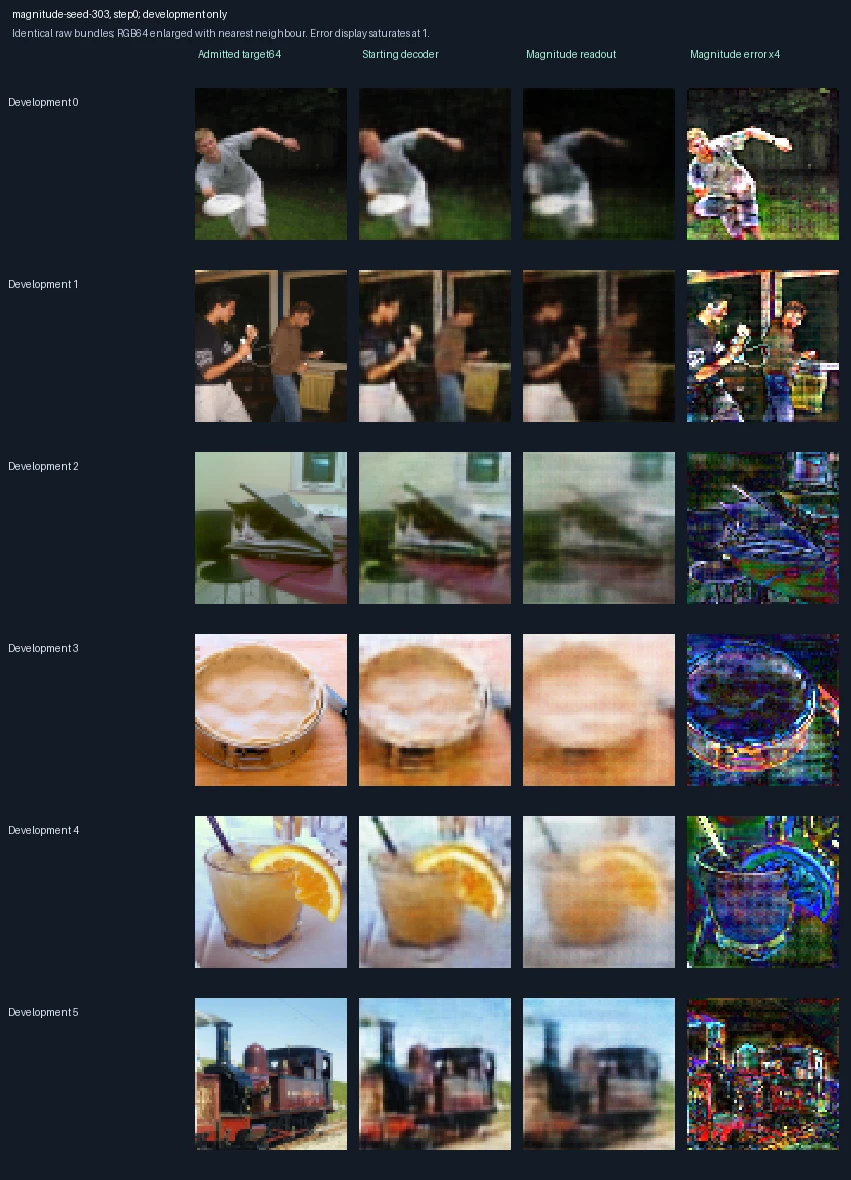
Six fixed development photographs. Left to right: the 64 × 64 input, the unchanged starting decoder using phase-only readout, this candidate’s reconstruction, and this candidate’s error. This is training repetition 3; the image label “seed-303” identifies its randomization setting. The encoder is fixed; only the decoder learns. These examples guide model selection, not final test claims. Phase-only readout keeps each complex coordinate’s angle; magnitude-preserving readout also keeps its amplitude, with one fixed scale learned from training data. Error panels show four times the absolute RGB difference from the reference, separately for each color channel, clipped at full brightness. Darker pixels mean smaller errors; black is zero or below the display’s precision. The scale is fixed across examples, not adjusted to make each image look better. At zero updates, changed brightness and error reflect switching the decoder’s input representation before it has adapted.
Magnitude-preserving readout, training repetition 3: 250 weight updates
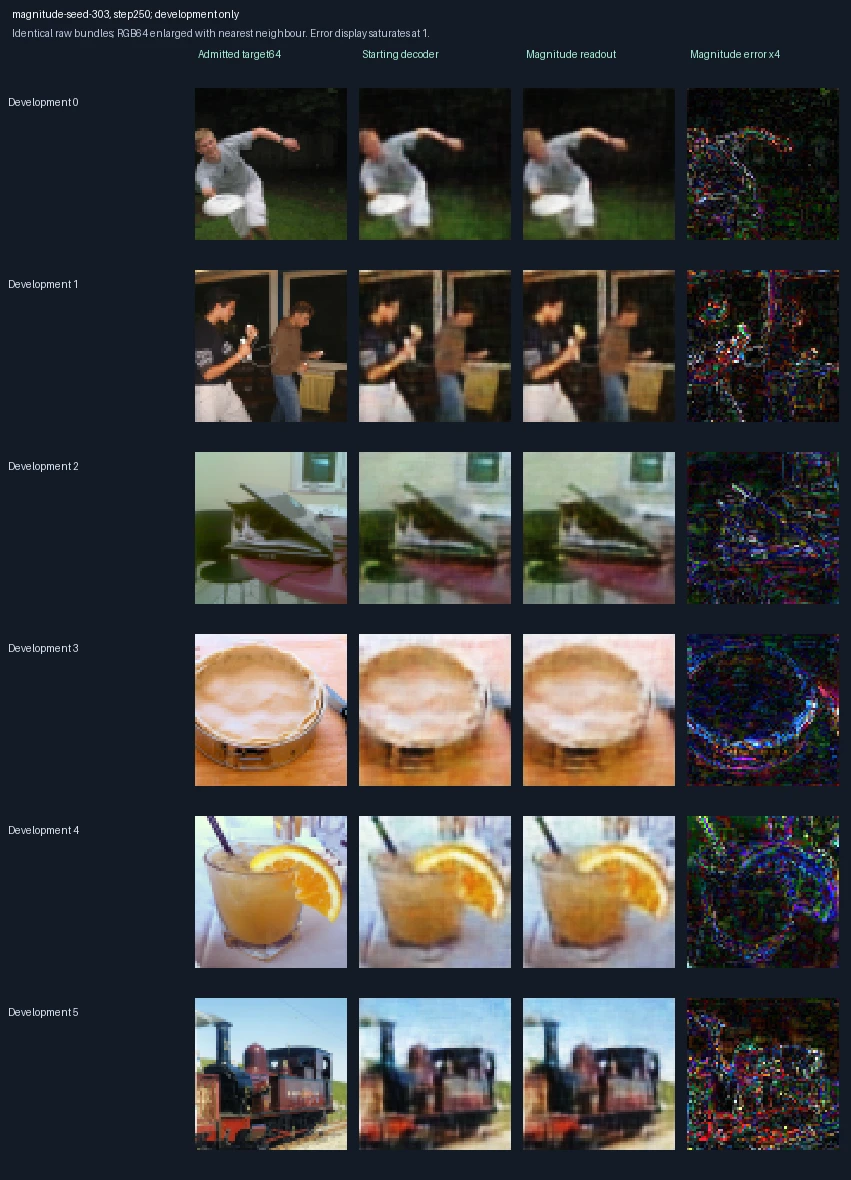
Six fixed development photographs. Left to right: the 64 × 64 input, the unchanged starting decoder using phase-only readout, this candidate’s reconstruction, and this candidate’s error. This is training repetition 3; the image label “seed-303” identifies its randomization setting. The encoder is fixed; only the decoder learns. These examples guide model selection, not final test claims. Phase-only readout keeps each complex coordinate’s angle; magnitude-preserving readout also keeps its amplitude, with one fixed scale learned from training data. Error panels show four times the absolute RGB difference from the reference, separately for each color channel, clipped at full brightness. Darker pixels mean smaller errors; black is zero or below the display’s precision. The scale is fixed across examples, not adjusted to make each image look better.
Magnitude-preserving readout, training repetition 3: 500 weight updates
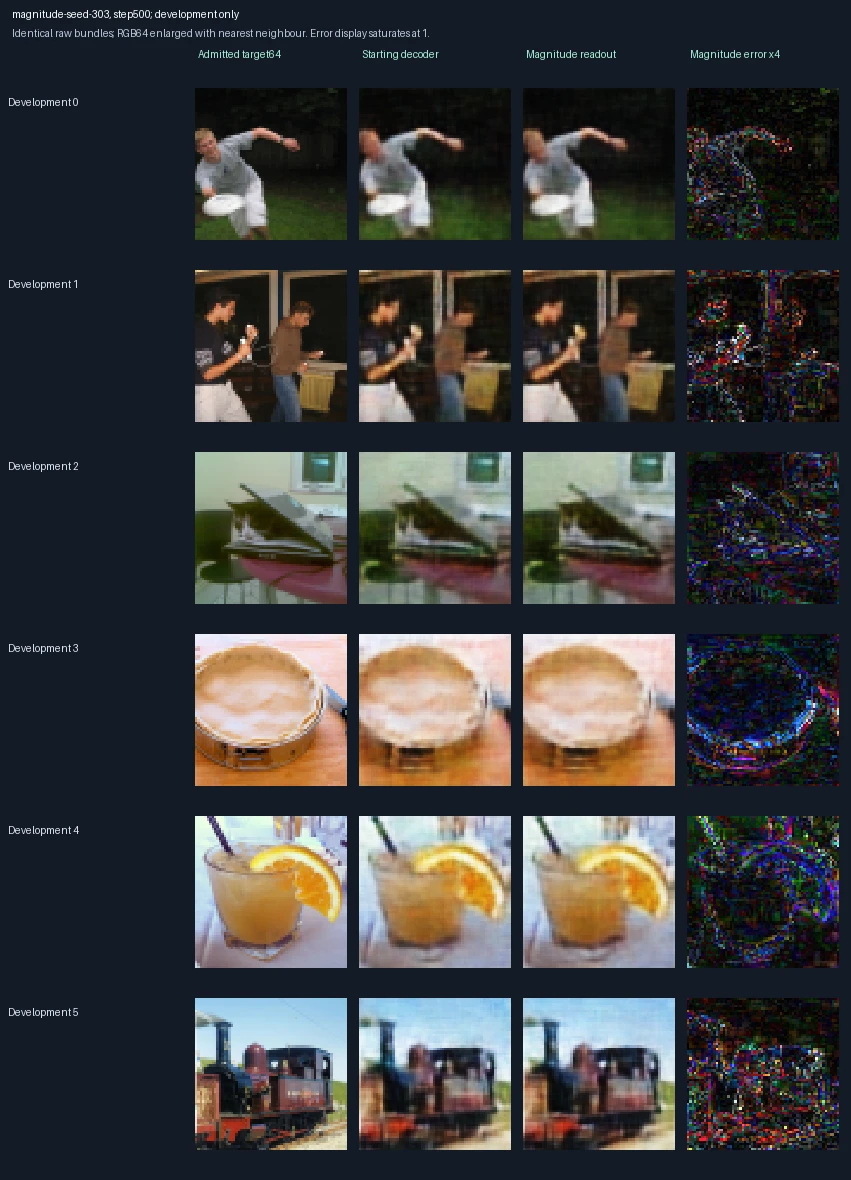
Six fixed development photographs. Left to right: the 64 × 64 input, the unchanged starting decoder using phase-only readout, this candidate’s reconstruction, and this candidate’s error. This is training repetition 3; the image label “seed-303” identifies its randomization setting. The encoder is fixed; only the decoder learns. These examples guide model selection, not final test claims. Phase-only readout keeps each complex coordinate’s angle; magnitude-preserving readout also keeps its amplitude, with one fixed scale learned from training data. Error panels show four times the absolute RGB difference from the reference, separately for each color channel, clipped at full brightness. Darker pixels mean smaller errors; black is zero or below the display’s precision. The scale is fixed across examples, not adjusted to make each image look better.
Magnitude-preserving readout, training repetition 3: 750 weight updates
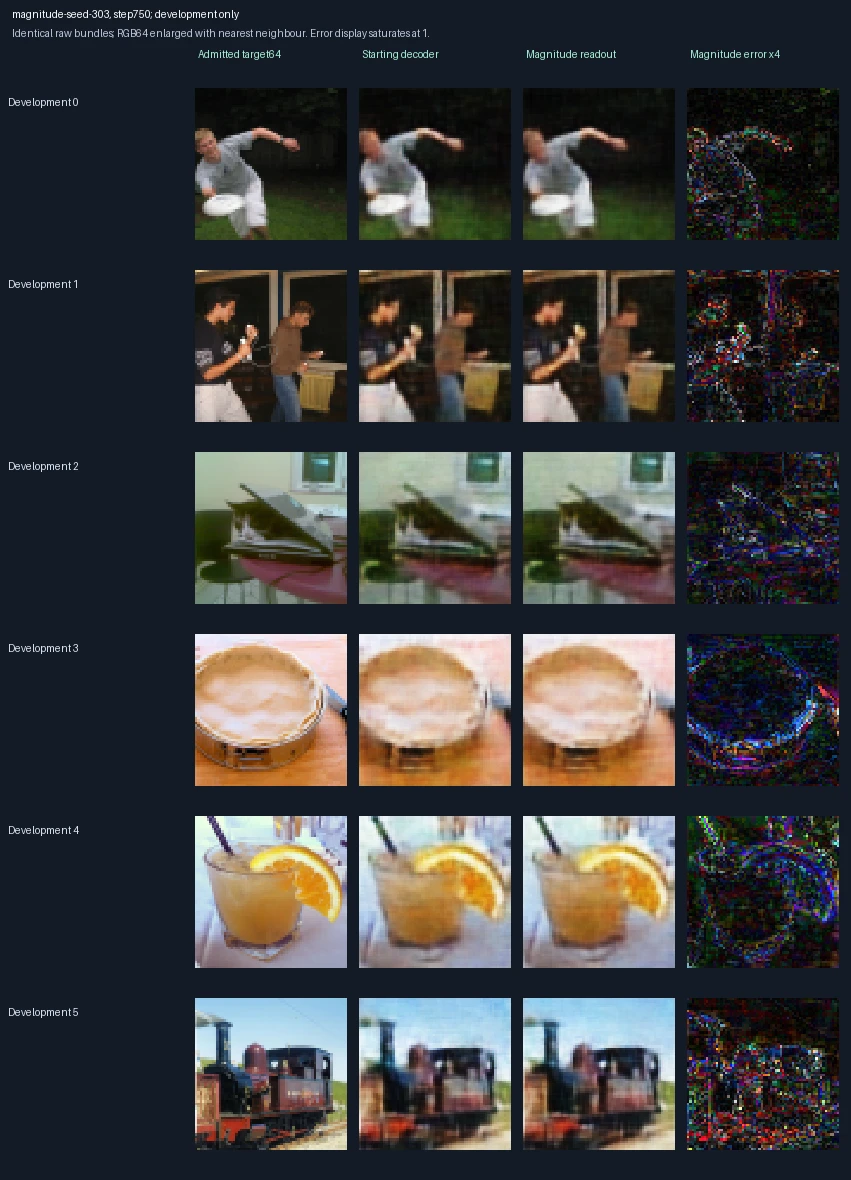
Six fixed development photographs. Left to right: the 64 × 64 input, the unchanged starting decoder using phase-only readout, this candidate’s reconstruction, and this candidate’s error. This is training repetition 3; the image label “seed-303” identifies its randomization setting. The encoder is fixed; only the decoder learns. These examples guide model selection, not final test claims. Phase-only readout keeps each complex coordinate’s angle; magnitude-preserving readout also keeps its amplitude, with one fixed scale learned from training data. Error panels show four times the absolute RGB difference from the reference, separately for each color channel, clipped at full brightness. Darker pixels mean smaller errors; black is zero or below the display’s precision. The scale is fixed across examples, not adjusted to make each image look better.
Magnitude-preserving readout, training repetition 3: 1,000 weight updates
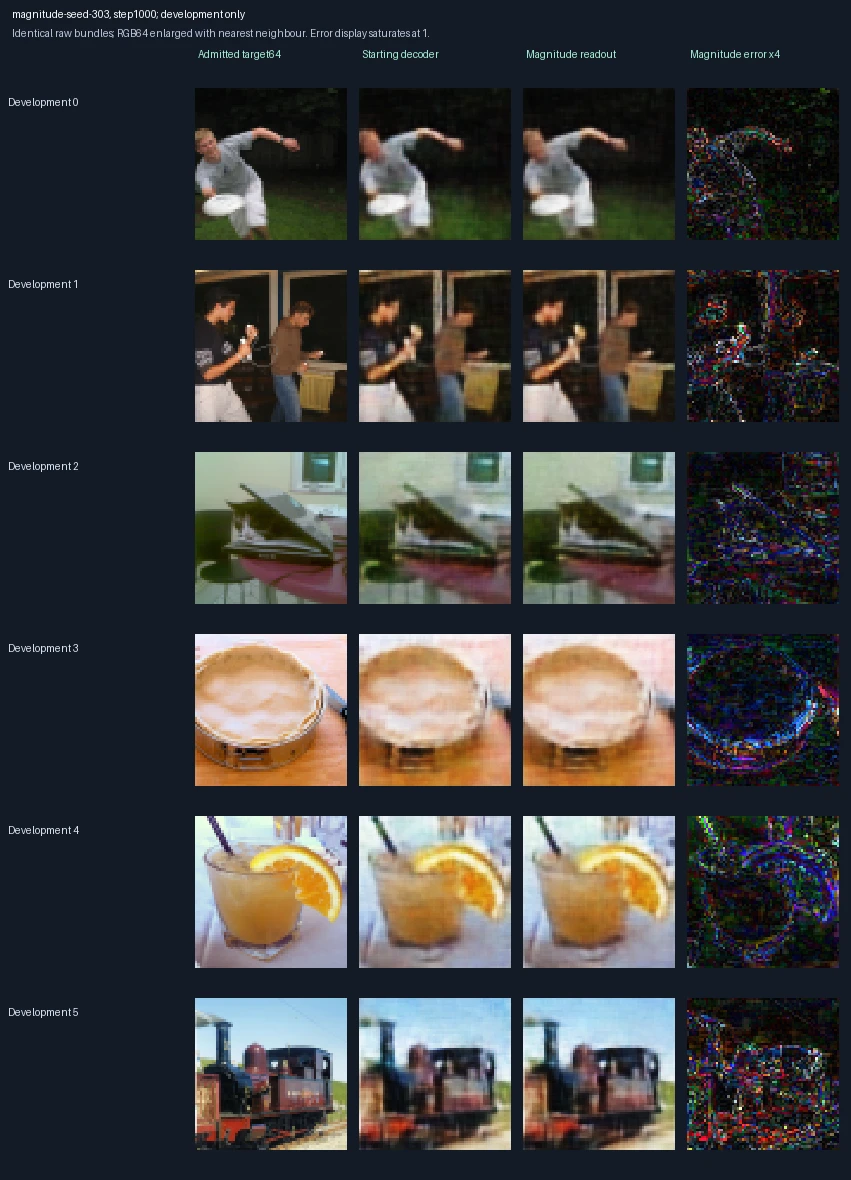
Six fixed development photographs. Left to right: the 64 × 64 input, the unchanged starting decoder using phase-only readout, this candidate’s reconstruction, and this candidate’s error. This is training repetition 3; the image label “seed-303” identifies its randomization setting. The encoder is fixed; only the decoder learns. These examples guide model selection, not final test claims. Phase-only readout keeps each complex coordinate’s angle; magnitude-preserving readout also keeps its amplitude, with one fixed scale learned from training data. Error panels show four times the absolute RGB difference from the reference, separately for each color channel, clipped at full brightness. Darker pixels mean smaller errors; black is zero or below the display’s precision. The scale is fixed across examples, not adjusted to make each image look better.
Magnitude-preserving readout, training repetition 3: 1,250 weight updates
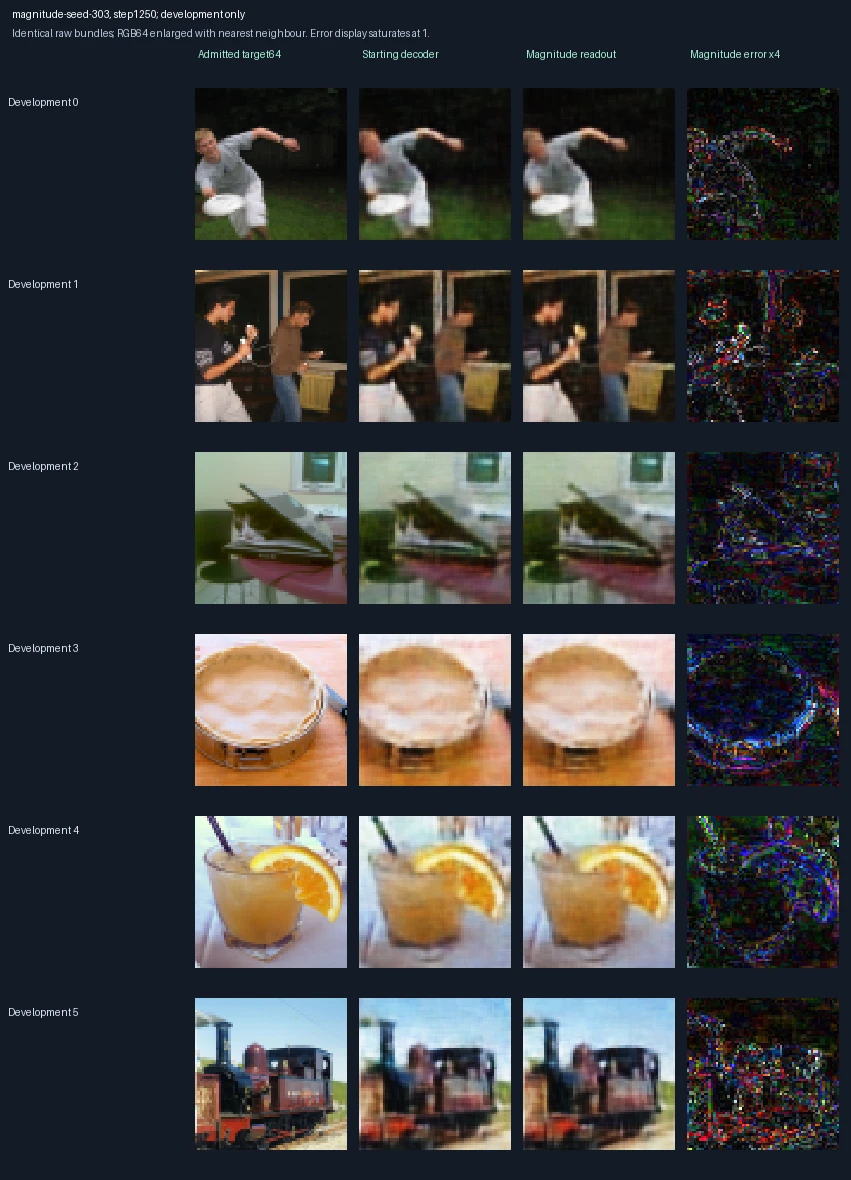
Six fixed development photographs. Left to right: the 64 × 64 input, the unchanged starting decoder using phase-only readout, this candidate’s reconstruction, and this candidate’s error. This is training repetition 3; the image label “seed-303” identifies its randomization setting. The encoder is fixed; only the decoder learns. These examples guide model selection, not final test claims. Phase-only readout keeps each complex coordinate’s angle; magnitude-preserving readout also keeps its amplitude, with one fixed scale learned from training data. Error panels show four times the absolute RGB difference from the reference, separately for each color channel, clipped at full brightness. Darker pixels mean smaller errors; black is zero or below the display’s precision. The scale is fixed across examples, not adjusted to make each image look better.
Magnitude-preserving readout, training repetition 3: 1,500 weight updates
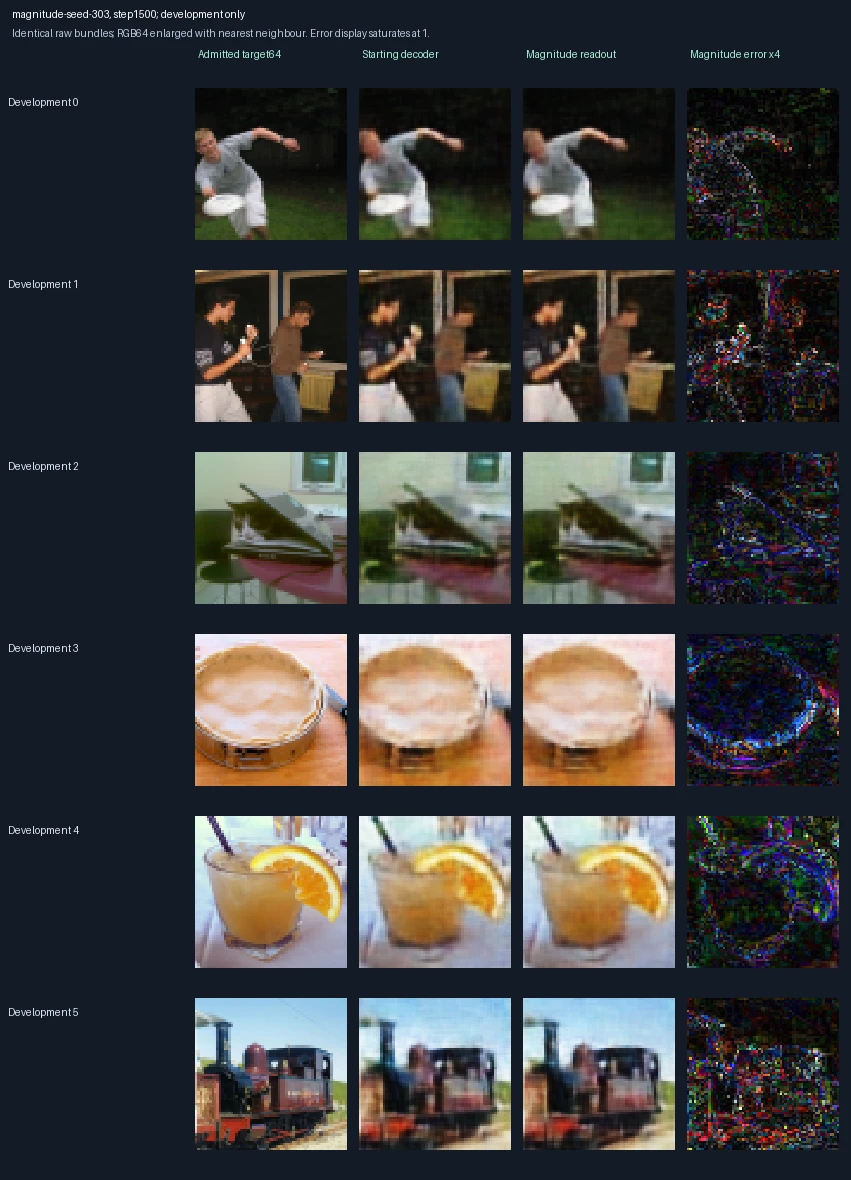
Six fixed development photographs. Left to right: the 64 × 64 input, the unchanged starting decoder using phase-only readout, this candidate’s reconstruction, and this candidate’s error. This is training repetition 3; the image label “seed-303” identifies its randomization setting. The encoder is fixed; only the decoder learns. These examples guide model selection, not final test claims. Phase-only readout keeps each complex coordinate’s angle; magnitude-preserving readout also keeps its amplitude, with one fixed scale learned from training data. Error panels show four times the absolute RGB difference from the reference, separately for each color channel, clipped at full brightness. Darker pixels mean smaller errors; black is zero or below the display’s precision. The scale is fixed across examples, not adjusted to make each image look better.
Magnitude-preserving readout, training repetition 3: 1,750 weight updates
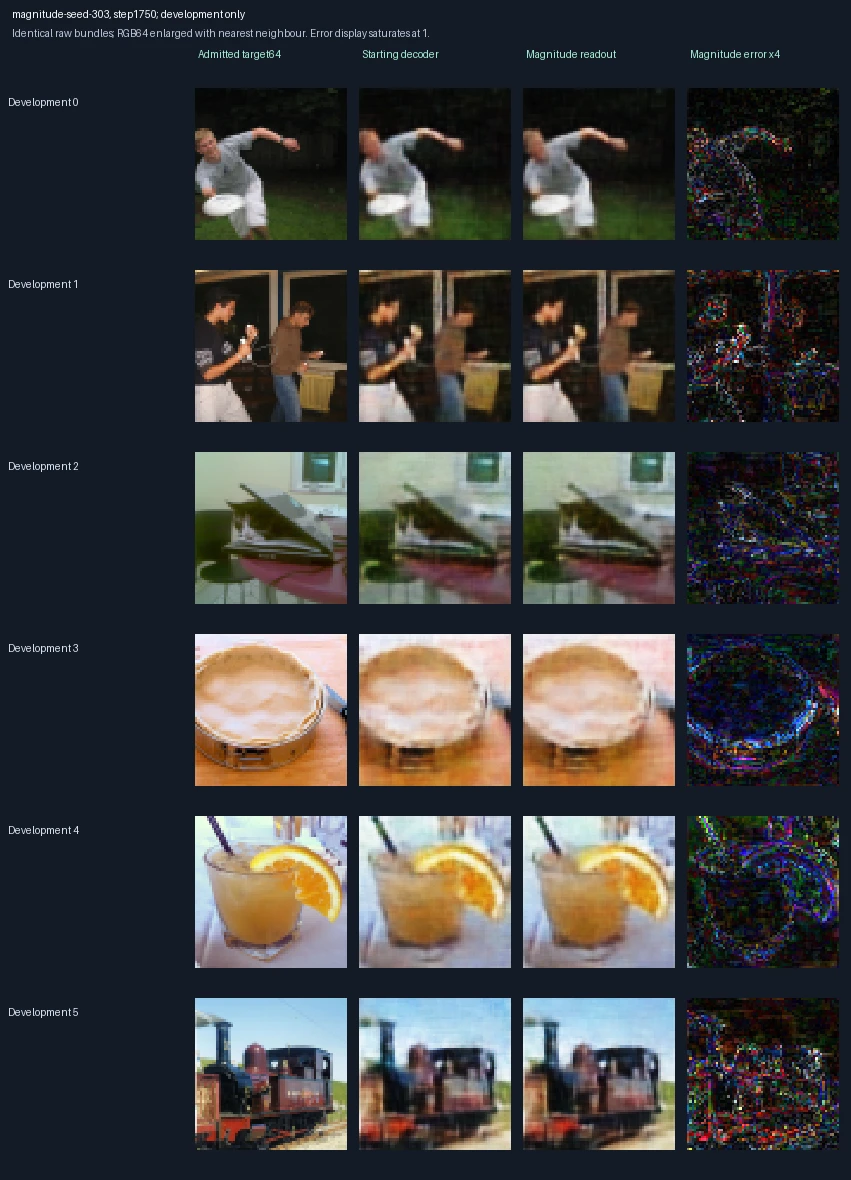
Six fixed development photographs. Left to right: the 64 × 64 input, the unchanged starting decoder using phase-only readout, this candidate’s reconstruction, and this candidate’s error. This is training repetition 3; the image label “seed-303” identifies its randomization setting. The encoder is fixed; only the decoder learns. These examples guide model selection, not final test claims. Phase-only readout keeps each complex coordinate’s angle; magnitude-preserving readout also keeps its amplitude, with one fixed scale learned from training data. Error panels show four times the absolute RGB difference from the reference, separately for each color channel, clipped at full brightness. Darker pixels mean smaller errors; black is zero or below the display’s precision. The scale is fixed across examples, not adjusted to make each image look better.
Magnitude-preserving readout, training repetition 3: 2,000 weight updates
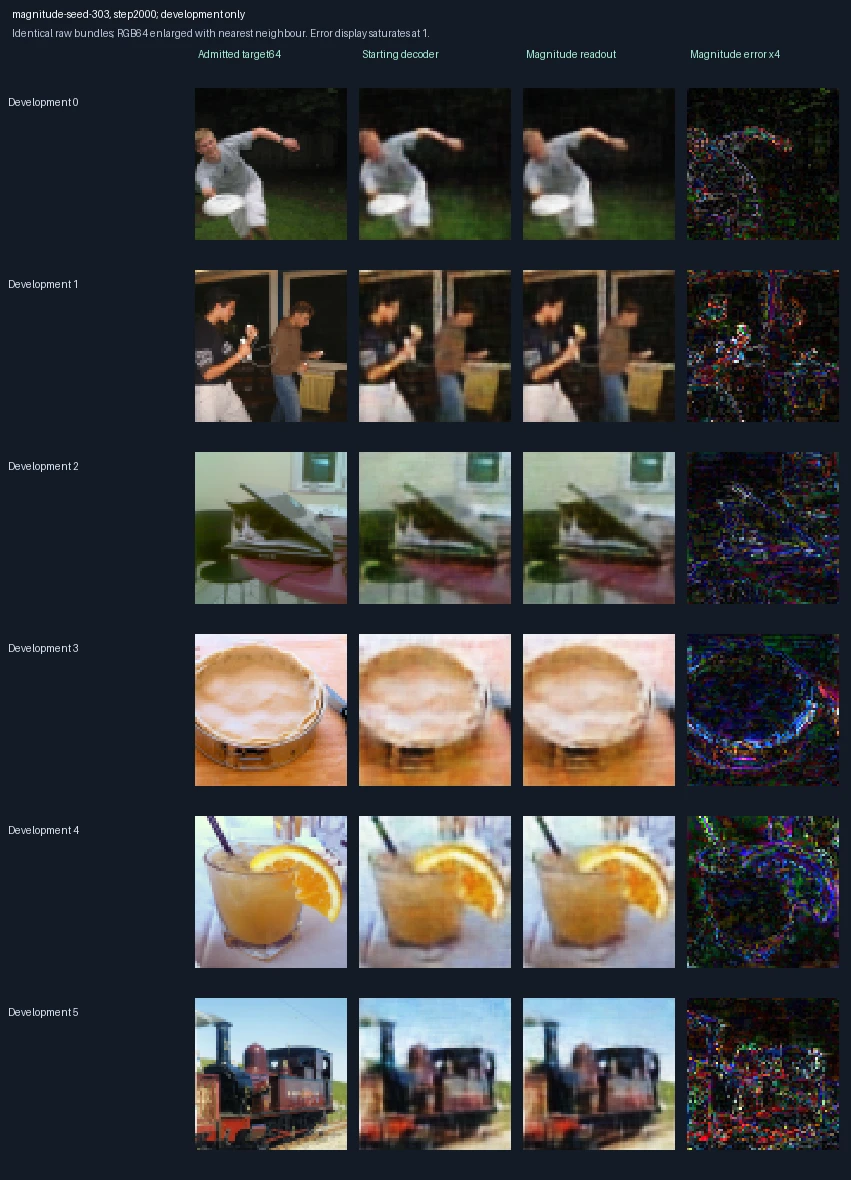
Six fixed development photographs. Left to right: the 64 × 64 input, the unchanged starting decoder using phase-only readout, this candidate’s reconstruction, and this candidate’s error. This is training repetition 3; the image label “seed-303” identifies its randomization setting. The encoder is fixed; only the decoder learns. These examples guide model selection, not final test claims. Phase-only readout keeps each complex coordinate’s angle; magnitude-preserving readout also keeps its amplitude, with one fixed scale learned from training data. Error panels show four times the absolute RGB difference from the reference, separately for each color channel, clipped at full brightness. Darker pixels mean smaller errors; black is zero or below the display’s precision. The scale is fixed across examples, not adjusted to make each image look better.
Magnitude-preserving readout, training repetition 3: 2,250 weight updates
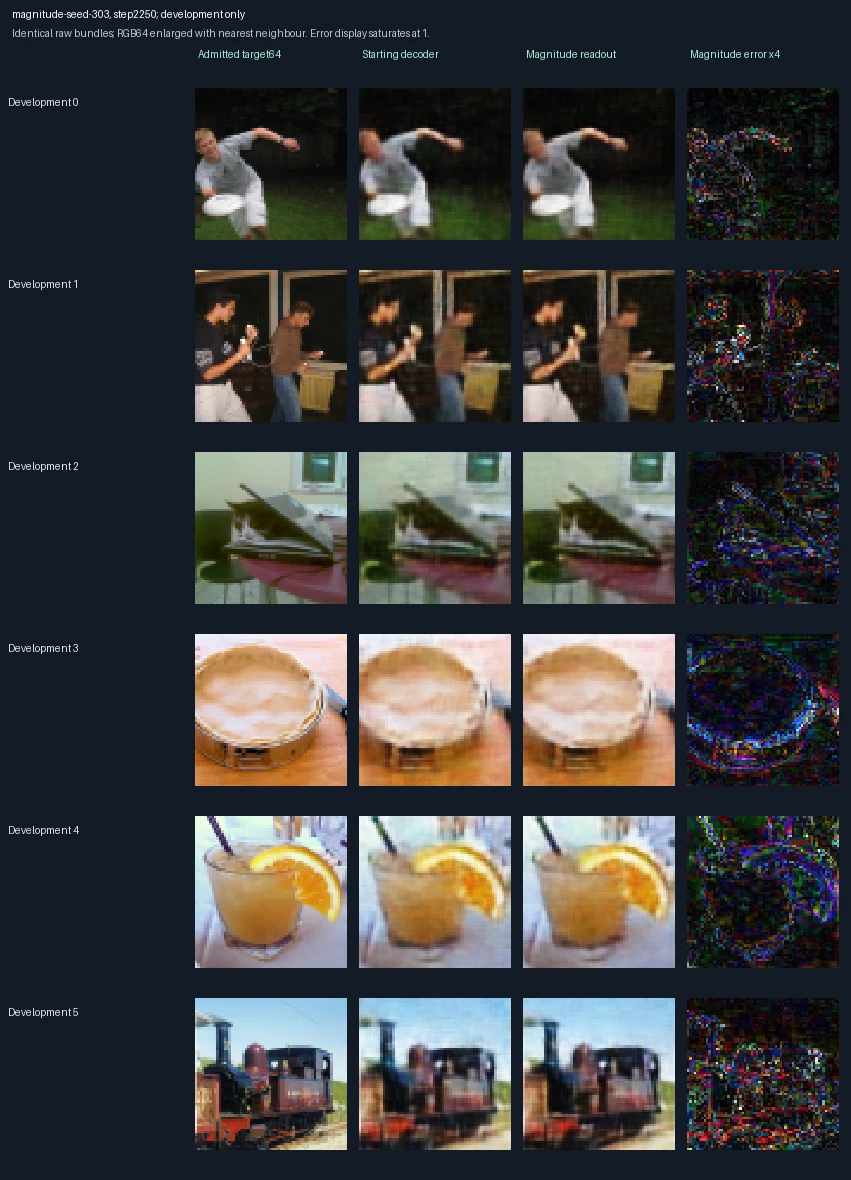
Six fixed development photographs. Left to right: the 64 × 64 input, the unchanged starting decoder using phase-only readout, this candidate’s reconstruction, and this candidate’s error. This is training repetition 3; the image label “seed-303” identifies its randomization setting. The encoder is fixed; only the decoder learns. These examples guide model selection, not final test claims. Phase-only readout keeps each complex coordinate’s angle; magnitude-preserving readout also keeps its amplitude, with one fixed scale learned from training data. Error panels show four times the absolute RGB difference from the reference, separately for each color channel, clipped at full brightness. Darker pixels mean smaller errors; black is zero or below the display’s precision. The scale is fixed across examples, not adjusted to make each image look better.
Magnitude-preserving readout, training repetition 3: 2,500 weight updates
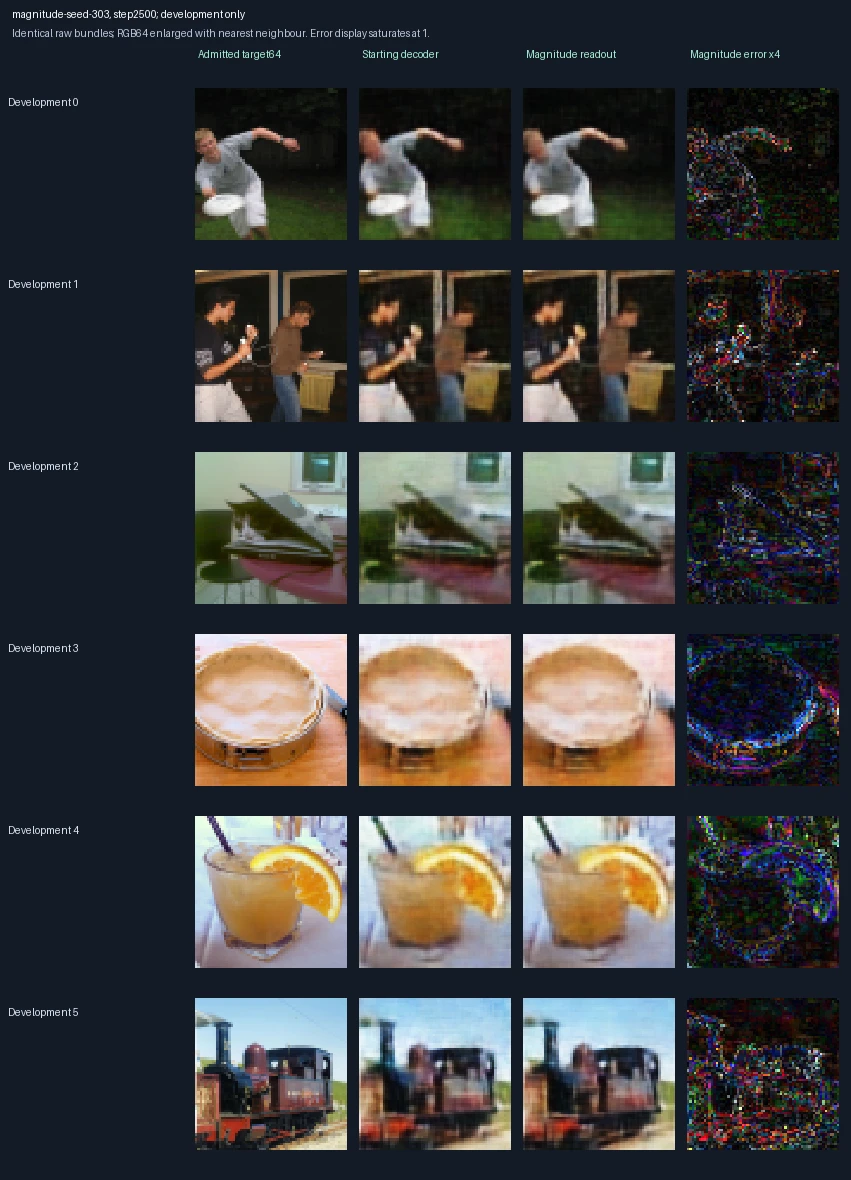
Six fixed development photographs. Left to right: the 64 × 64 input, the unchanged starting decoder using phase-only readout, this candidate’s reconstruction, and this candidate’s error. This is training repetition 3; the image label “seed-303” identifies its randomization setting. The encoder is fixed; only the decoder learns. These examples guide model selection, not final test claims. Phase-only readout keeps each complex coordinate’s angle; magnitude-preserving readout also keeps its amplitude, with one fixed scale learned from training data. Error panels show four times the absolute RGB difference from the reference, separately for each color channel, clipped at full brightness. Darker pixels mean smaller errors; black is zero or below the display’s precision. The scale is fixed across examples, not adjusted to make each image look better.
Magnitude-preserving readout, training repetition 3: 2,750 weight updates
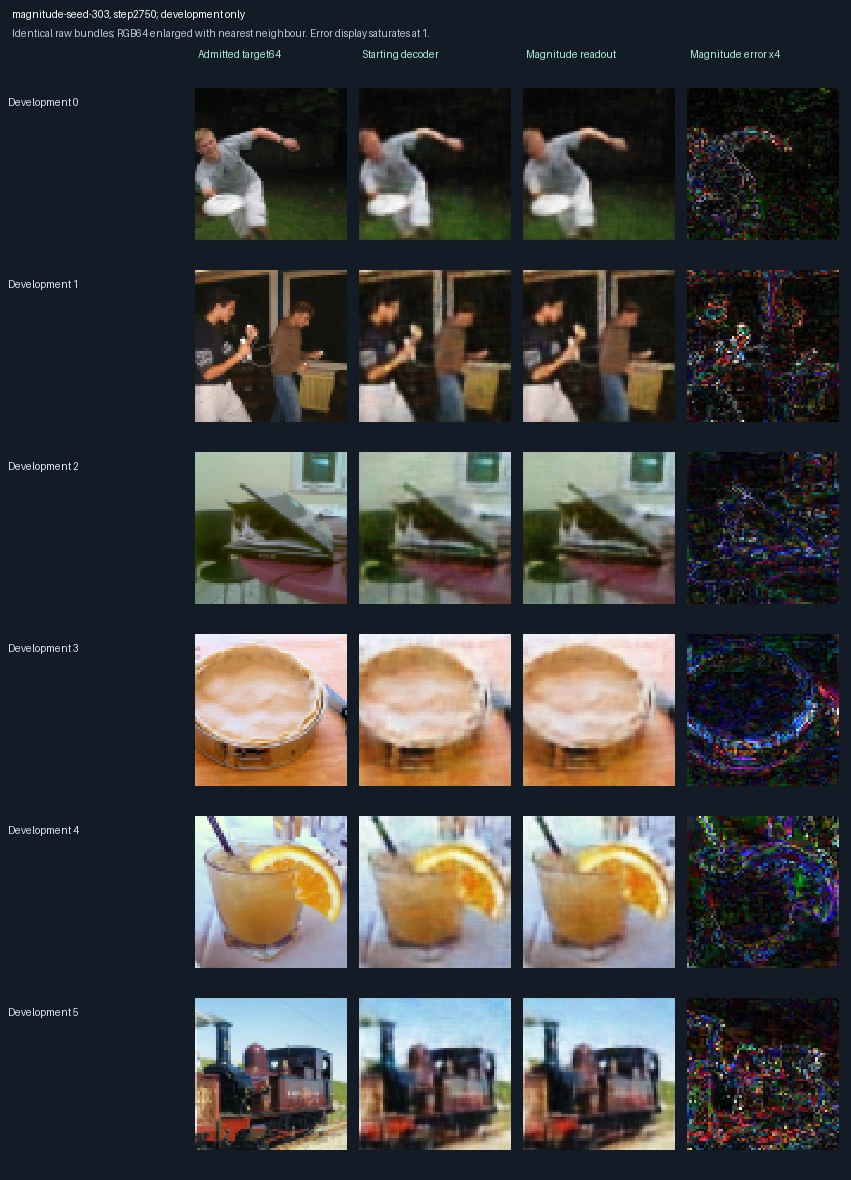
Six fixed development photographs. Left to right: the 64 × 64 input, the unchanged starting decoder using phase-only readout, this candidate’s reconstruction, and this candidate’s error. This is training repetition 3; the image label “seed-303” identifies its randomization setting. The encoder is fixed; only the decoder learns. These examples guide model selection, not final test claims. Phase-only readout keeps each complex coordinate’s angle; magnitude-preserving readout also keeps its amplitude, with one fixed scale learned from training data. Error panels show four times the absolute RGB difference from the reference, separately for each color channel, clipped at full brightness. Darker pixels mean smaller errors; black is zero or below the display’s precision. The scale is fixed across examples, not adjusted to make each image look better.
Magnitude-preserving readout, training repetition 3: 3,000 weight updates
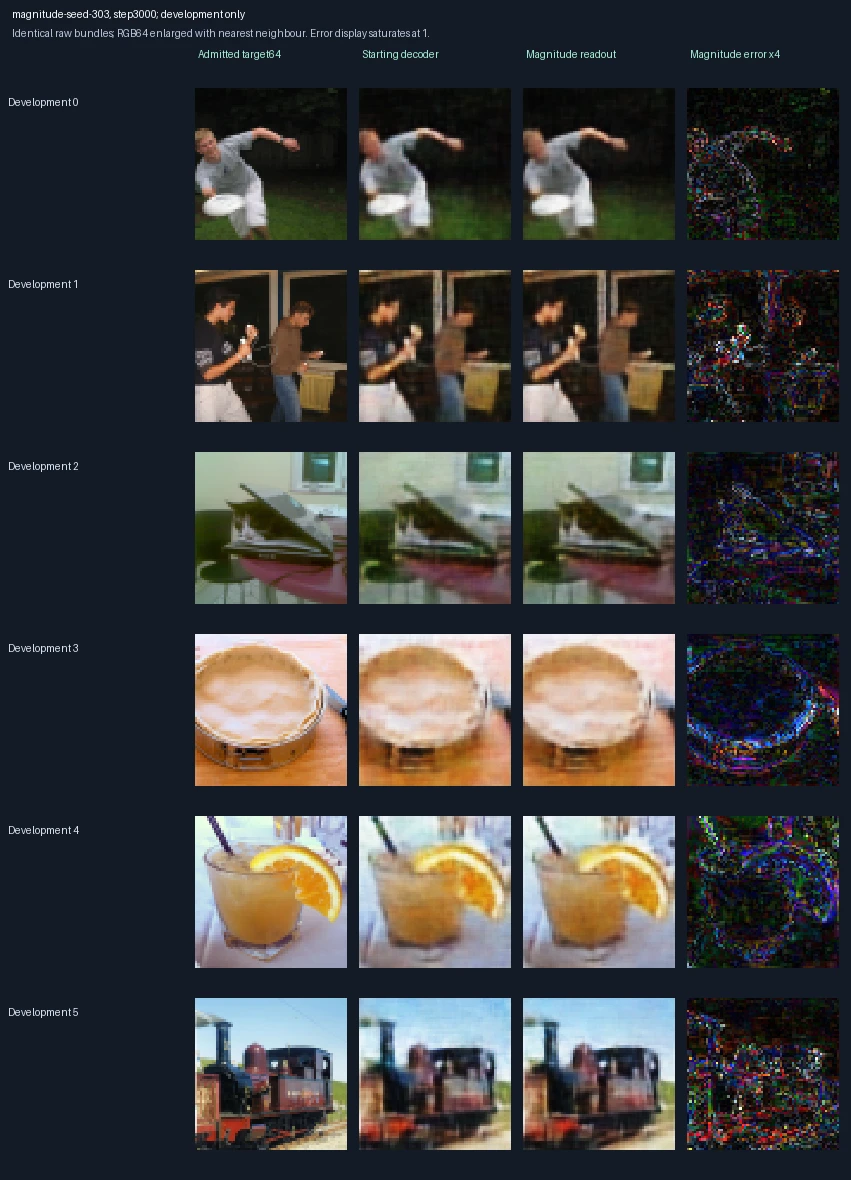
Six fixed development photographs. Left to right: the 64 × 64 input, the unchanged starting decoder using phase-only readout, this candidate’s reconstruction, and this candidate’s error. This is training repetition 3; the image label “seed-303” identifies its randomization setting. The encoder is fixed; only the decoder learns. These examples guide model selection, not final test claims. Phase-only readout keeps each complex coordinate’s angle; magnitude-preserving readout also keeps its amplitude, with one fixed scale learned from training data. Error panels show four times the absolute RGB difference from the reference, separately for each color channel, clipped at full brightness. Darker pixels mean smaller errors; black is zero or below the display’s precision. The scale is fixed across examples, not adjusted to make each image look better.
Magnitude-preserving readout, training repetition 3: 3,250 weight updates
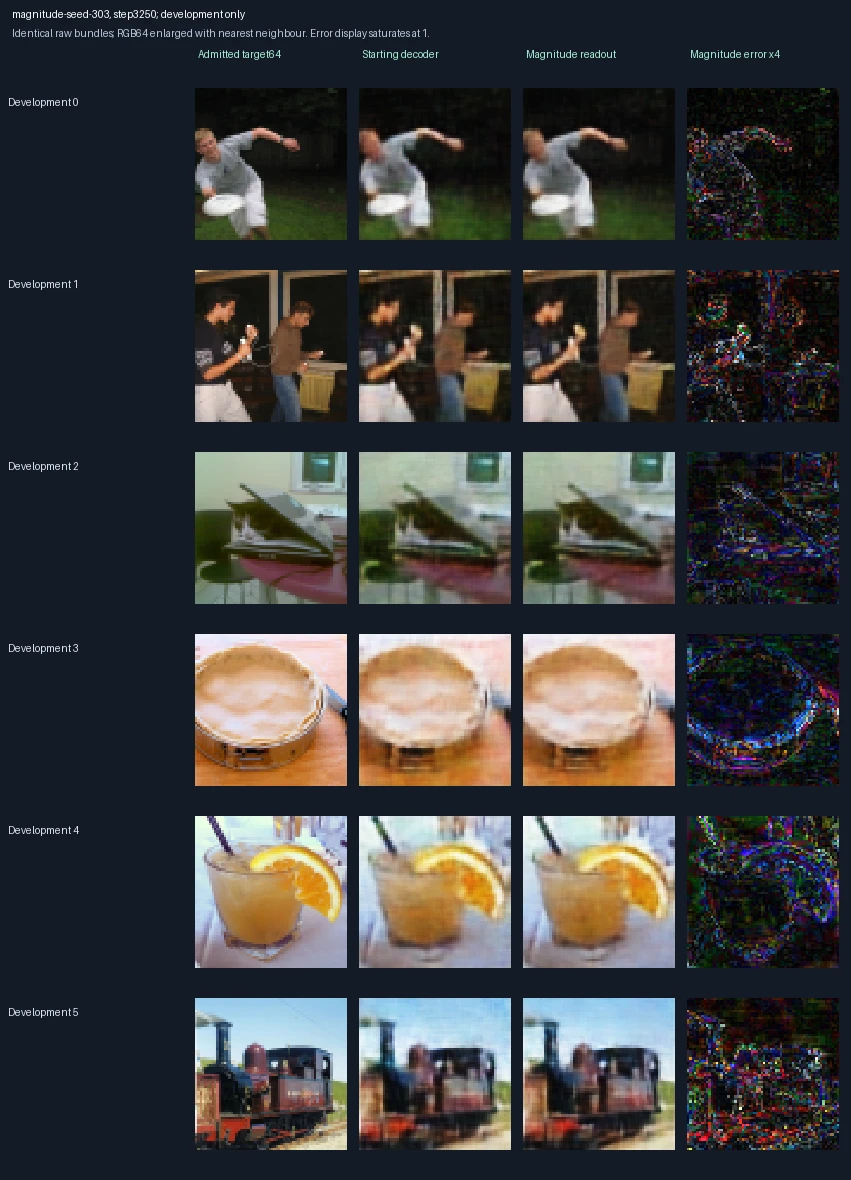
Six fixed development photographs. Left to right: the 64 × 64 input, the unchanged starting decoder using phase-only readout, this candidate’s reconstruction, and this candidate’s error. This is training repetition 3; the image label “seed-303” identifies its randomization setting. The encoder is fixed; only the decoder learns. These examples guide model selection, not final test claims. Phase-only readout keeps each complex coordinate’s angle; magnitude-preserving readout also keeps its amplitude, with one fixed scale learned from training data. Error panels show four times the absolute RGB difference from the reference, separately for each color channel, clipped at full brightness. Darker pixels mean smaller errors; black is zero or below the display’s precision. The scale is fixed across examples, not adjusted to make each image look better.
Magnitude-preserving readout, training repetition 3: 3,500 weight updates
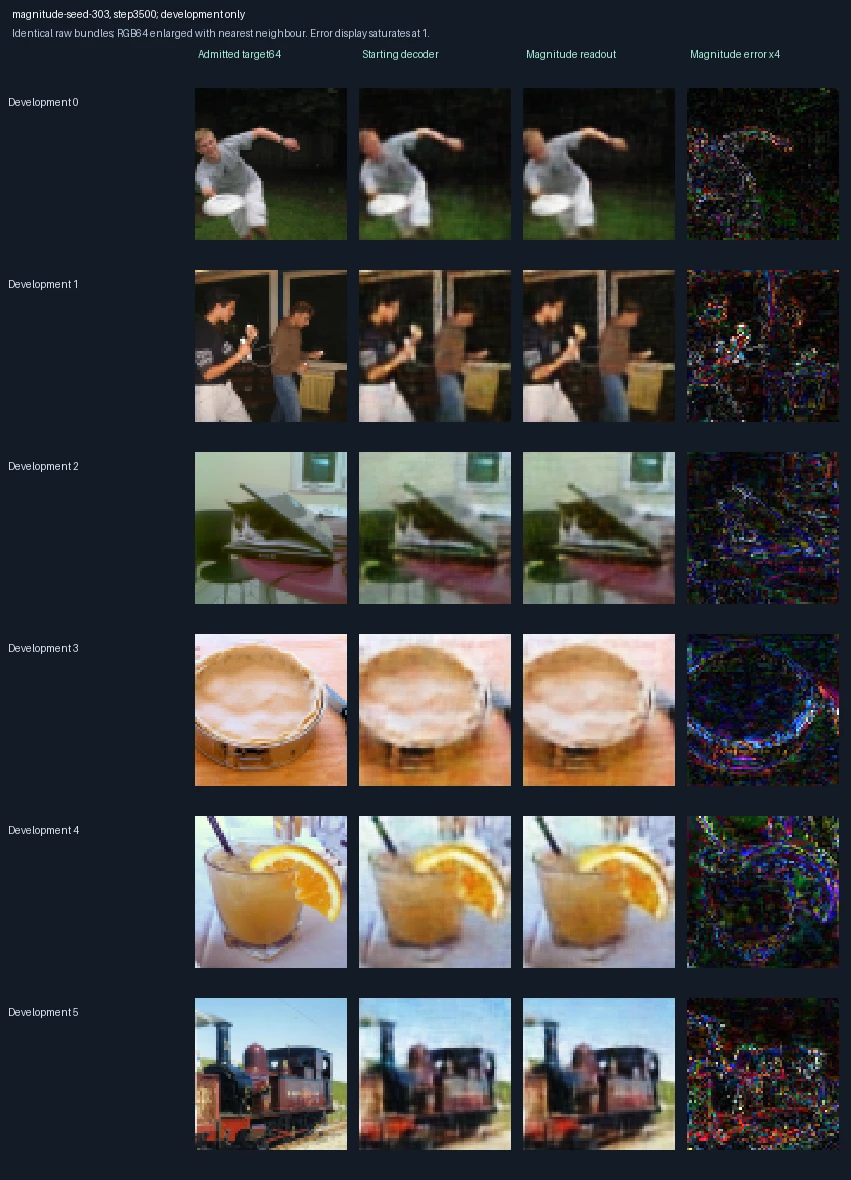
Six fixed development photographs. Left to right: the 64 × 64 input, the unchanged starting decoder using phase-only readout, this candidate’s reconstruction, and this candidate’s error. This is training repetition 3; the image label “seed-303” identifies its randomization setting. The encoder is fixed; only the decoder learns. These examples guide model selection, not final test claims. Phase-only readout keeps each complex coordinate’s angle; magnitude-preserving readout also keeps its amplitude, with one fixed scale learned from training data. Error panels show four times the absolute RGB difference from the reference, separately for each color channel, clipped at full brightness. Darker pixels mean smaller errors; black is zero or below the display’s precision. The scale is fixed across examples, not adjusted to make each image look better.
Magnitude-preserving readout, training repetition 3: 3,750 weight updates
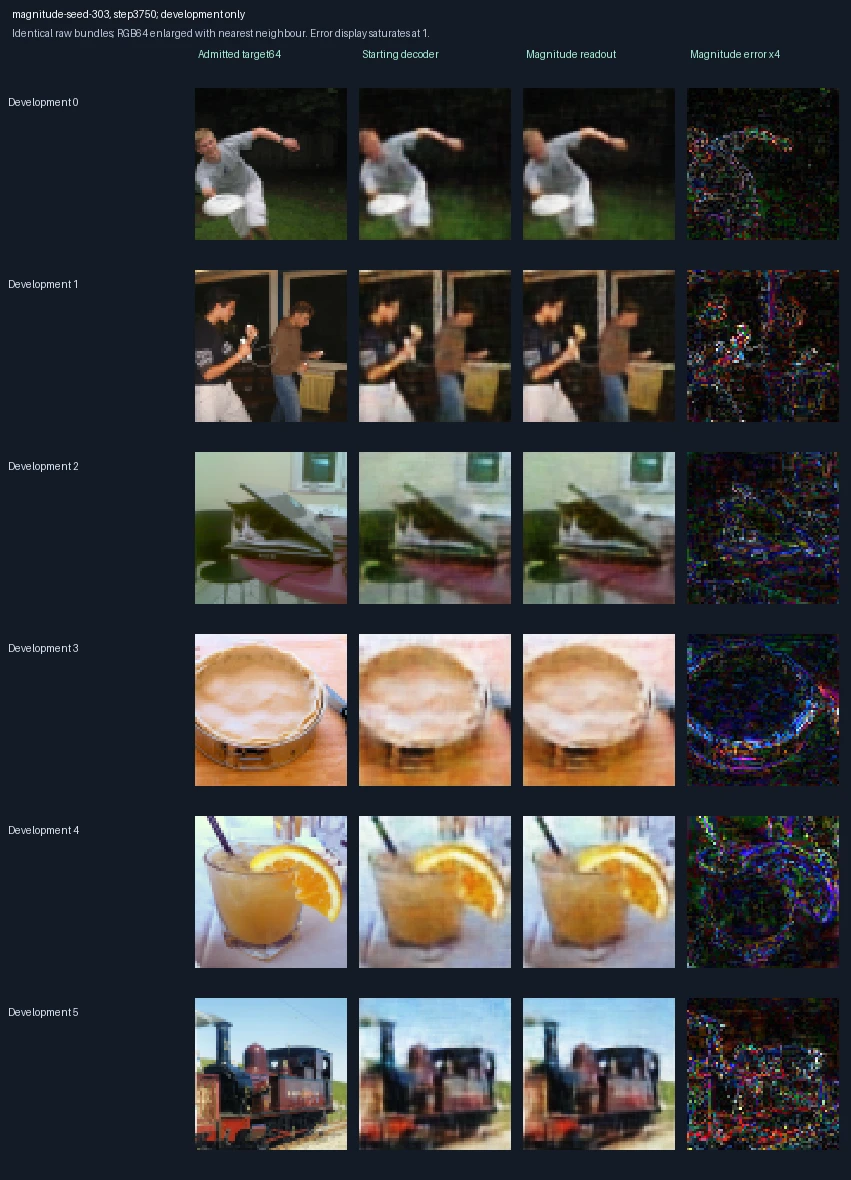
Six fixed development photographs. Left to right: the 64 × 64 input, the unchanged starting decoder using phase-only readout, this candidate’s reconstruction, and this candidate’s error. This is training repetition 3; the image label “seed-303” identifies its randomization setting. The encoder is fixed; only the decoder learns. These examples guide model selection, not final test claims. Phase-only readout keeps each complex coordinate’s angle; magnitude-preserving readout also keeps its amplitude, with one fixed scale learned from training data. Error panels show four times the absolute RGB difference from the reference, separately for each color channel, clipped at full brightness. Darker pixels mean smaller errors; black is zero or below the display’s precision. The scale is fixed across examples, not adjusted to make each image look better.
Magnitude-preserving readout, training repetition 3: 4,000 weight updates
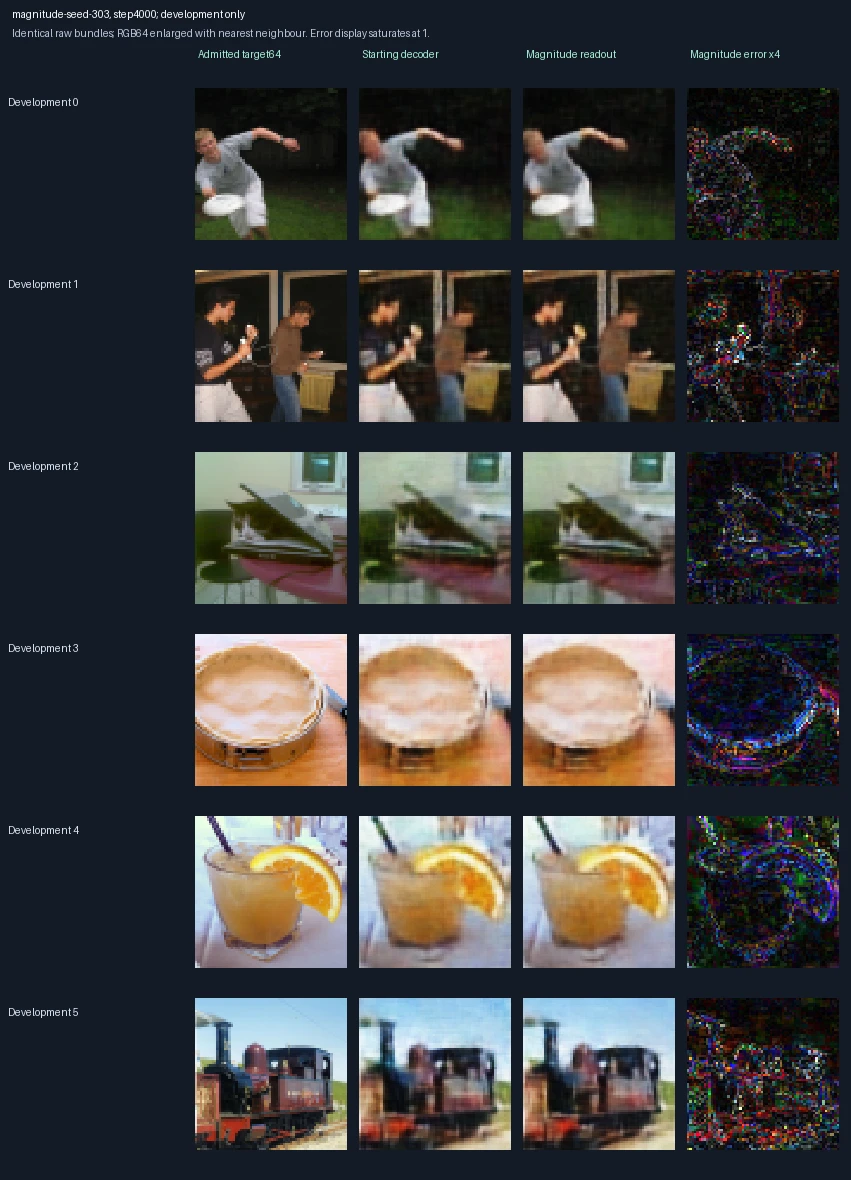
Six fixed development photographs. Left to right: the 64 × 64 input, the unchanged starting decoder using phase-only readout, this candidate’s reconstruction, and this candidate’s error. This is training repetition 3; the image label “seed-303” identifies its randomization setting. The encoder is fixed; only the decoder learns. These examples guide model selection, not final test claims. Phase-only readout keeps each complex coordinate’s angle; magnitude-preserving readout also keeps its amplitude, with one fixed scale learned from training data. Error panels show four times the absolute RGB difference from the reference, separately for each color channel, clipped at full brightness. Darker pixels mean smaller errors; black is zero or below the display’s precision. The scale is fixed across examples, not adjusted to make each image look better.

Limits and next question

The admission reference is a declared 256-pixel crop, not native truth or an information ceiling. The matched readout study uses one fixed refined encoder, equal decoder parameter counts and a finite mixed-input training recipe; its pretrained initialization favors phase inputs. Gains do not establish general acuity, reading, acquired meaning or compositional usefulness. Magnitude corruption is an out-of-distribution dependence diagnostic. No negative result establishes a VSA ceiling. Earlier lives retain their original models; a magnitude checkpoint requires its declared readout mode and training-derived scale.

Next question. Choose the next fidelity investigation from separate admission, readout, detail, transfer and retention evidence; encoding, composition, resolution and decoder architecture remain open.

Inspect the evidence

Download the methods and measurements for this experiment. Large training and saved-state files are not included.