Type a section name and press Enter. Use “help” for the list.
Cliste experiment
Native size visual perception
Registered 8 Oct 2026 · Snapshot 12 Oct 2026
The question
Retain complete images at their native pixel dimensions and aspect ratios through VSA, recover geometry from bound size vectors, and establish component quality alongside time and memory costs.
Why this experiment?
A memory can only preserve what its sensory interface encodes. These studies separate encoder quality, decoder quality and compatibility with earlier stored vectors.
How it works
Change one component or input representation at a time and evaluate immediate reconstruction on separate images. Keep old-vector readback visible so gains on new inputs do not hide compatibility losses.
Follow this part of the investigation: Sharper perception can also change the language of memory →Implementation and comparison details
Admit complete RGB images at their native dimensions and aspect ratios. Recover dimensions from bound VSA vectors and decode position-bound native regions with a coarse VSA overview. Compare unchanged, encoder-only, decoder-only and joint refinement with fixed spatial machinery and normalization buffers. Measure native-pixel quality, geometry, borders, seams, compatibility, bytes and latency separately; existing lives remain unchanged.
What happened
Execution failed during train: ValueError('native neural pixels must be finite in[0,1]'); no rescued scientific verdict.
Results and visual artifacts
Open a figure for its input, comparison, and result. Click an image to enlarge it.
Native-size perception keeps the complete image at its original dimensions and encodes overlapping regions into VSA vectors. The encoder converts pixels to vectors; the decoder reconstructs pixels. “None” in original figure labels means the unchanged starting model. Encoder, decoder and joint labels indicate which weights were trained. A seed identifies a repeated training trial, not a different input category. Whole-image views are fitted to the page; detail views magnify a specified crop. Error panels show four times the absolute RGB difference from the reference, separately for each color channel, clipped at full brightness. Darker pixels mean smaller errors; black is zero or below the display’s precision. The scale is fixed across examples, not adjusted to make each image look better.
Original photographs used to monitor native-size perception
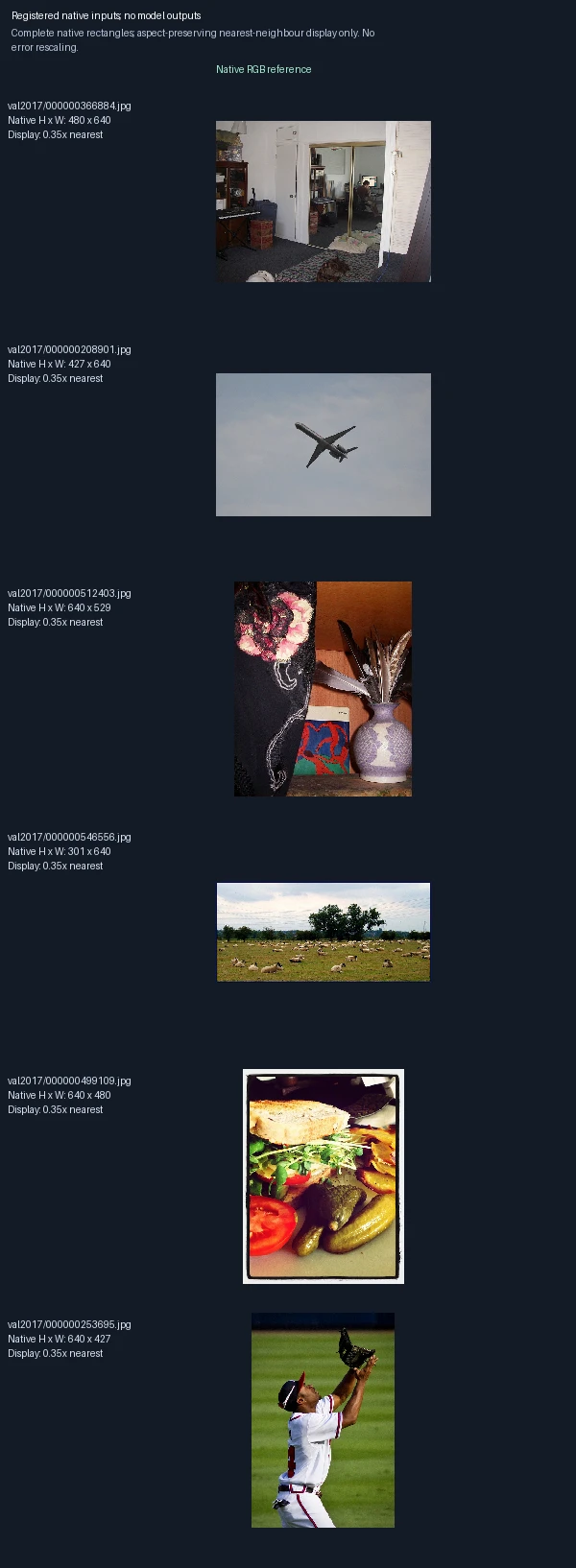
Display derivative: WebP quality 90; maximum edge 2400 px. Original scientific pixels remain in the source run; do not measure this preview.
Limits and next question
Geometry, binary size coding and spatial bindings are supplied sensory structure, not learned number concepts or relations. Native regions and the overview consume additional vectors; fidelity gains are not equal-compression superiority. Each current complex128 region costs 256 KiB before overlap and other state. Report bytes per image and megapixel, latency, training exposure and peak memory. The overview is intentionally coarse; native detail regions preserve the complete admitted field. Component regimes have different trainable subsets. Earlier lives retain their original models; no candidate is installed. Better appearance does not establish reading, acquired meaning, general cognition or a VSA capacity ceiling.
Next question. Use native-pixel fidelity, border/seam detail, source-free geometry, compatibility, time and storage evidence to choose further encoding, decoding, spatial composition or continuing-life integration work.
Inspect the evidence
Download the methods and measurements for this experiment. Large training and saved-state files are not included.