Type a section name and press Enter. Use “help” for the list.
Skala · Physical construction & embodiment research
A body to learn through.
Skala is the physical robotics project behind my embodiment research: a platform for exploring how moving, sensing and acting can shape a continuing mind.
Current statePartly assembled prototype; CAD, mounting checks and control design. Powered operation and physical sensor capture remain unqualified.
Reviewed November 18, 2026 · Construction notes through November 9; mounting evidence dated November 3 and 6.
What changes when experience follows an action?
A body lets a learner test its expectations. Turning the camera changes the view; moving changes what is nearby; an action can succeed, fail or produce an unexpected consequence. I want those consequences to become part of what the system remembers and uses when deciding what to do next.
The longer-term ambition is an adaptable tracked robot with independently positioned limbs. The first platform uses two fixed tracks so construction, sensing and basic control can provide useful experience before more complex locomotion is attempted.
What exists, and what the evidence covers
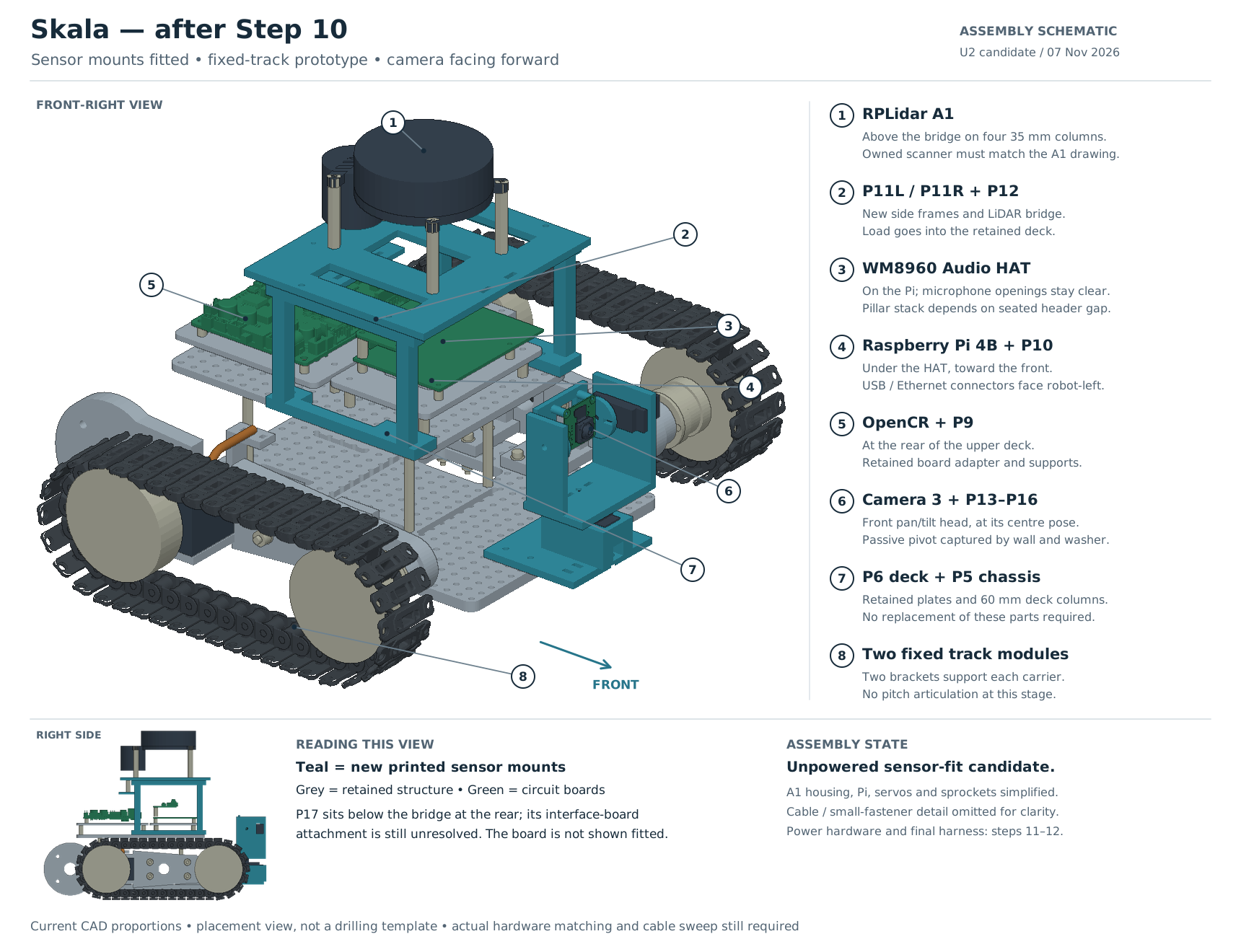
The repository contains parametric CAD, printable parts, assembly drawings and geometric audits. The construction record reports printed parts and partial assembly. The design reuses TurtleBot3 components, with an OpenCR controller, Raspberry Pi, camera, microphone hardware and LiDAR.
| Area | Evidence | Remaining work |
|---|---|---|
| Deck and electronics mounts | 68/68 saved geometry checks passed on November 3; source hashes still match. | Physical fit, wiring, thermal and structural checks. |
| Sensor mounting candidates | 60/60 saved geometry checks passed on November 6; source hashes still match. | Owned-part seating, servo/horn fit, moving camera ribbon and strength. |
| Physical construction | Printed components and partial assembly recorded in November. | Complete the platform and demonstrate powered operation. |
| Body control and drivers | Interface and control plans; the Skala firmware and Talos directories contain no executable drivers yet. | Implement and qualify commands, feedback and physical sensor capture. |
| Cognitive use of the body | Cliste has separate recorded visual and audio memory experiments. | Exercise physical inputs and actions together through the body interface. |
The saved CAD checks concern geometry. They do not measure strength, reliable motion, acoustics or learning on the physical robot.
Skala, Talos, Cliste and Sophia
Skala is the physical platform. Talos supplies the intended interface for sensors, actuators, behaviors and body state. A requested action, its acknowledgment and the observed outcome need to remain distinguishable so the learner can discover what actually happened.
Cliste develops the cognitive mechanisms. Its audio-sequence experiment connects ordered sounds to retained visual experience. That gives physical capture a useful next question: will the same mechanism remain useful when sound arrives through a microphone in a real room? Microphone capture, room acoustics and motor noise need their own tests.
Sophia is the larger continuing individual I’m working toward. The body and cognitive machinery can develop at different rates, and processing can run on a separate host. The eventual test is whether physical experience changes what she expects and chooses, beyond executing supplied actions.
From construction to an interpretable experiment
Complete and check the physical platform, capture real sensor streams, and record bounded actions alongside their feedback and outcomes. Then test whether retained experience helps the learner recognize a situation or choose a useful next action.
Looking toward a sound, revisiting a view and recognizing the effects of movement are motivating possibilities. Each needs evidence connecting perception, action and memory on the actual platform.