How can perception, memory, language and action grow together in a continuing mind? I’m exploring that question through Cliste’s cognitive machinery and Skala’s physical body, with the longer-term aim of developing Sophia.
The brain guides the questions. Code, recorded experiments and physical construction provide ways to test the ideas. The studies below include a model update whose unchanged score concealed new failures, and a visual transformation that passed numerical criteria but failed on inspection. Those experiences inform how I design checks for client applications, where the useful behavior and acceptance criteria depend on the client’s workflow.
Vector symbolic architectures offer an algebra for combining perceptual content with spatial and temporal context. Cliste tests how those representations can support remembering, composition and further learning.
Recorded work includes visual recall, acquired visual patterns, sound-to-image recall and checks for capability loss during training.
A robot gives the research a way to encounter consequences: move, change a view, hear something in a room, and compare what happened with what was expected. Talos is the planned interface between the body and cognition.
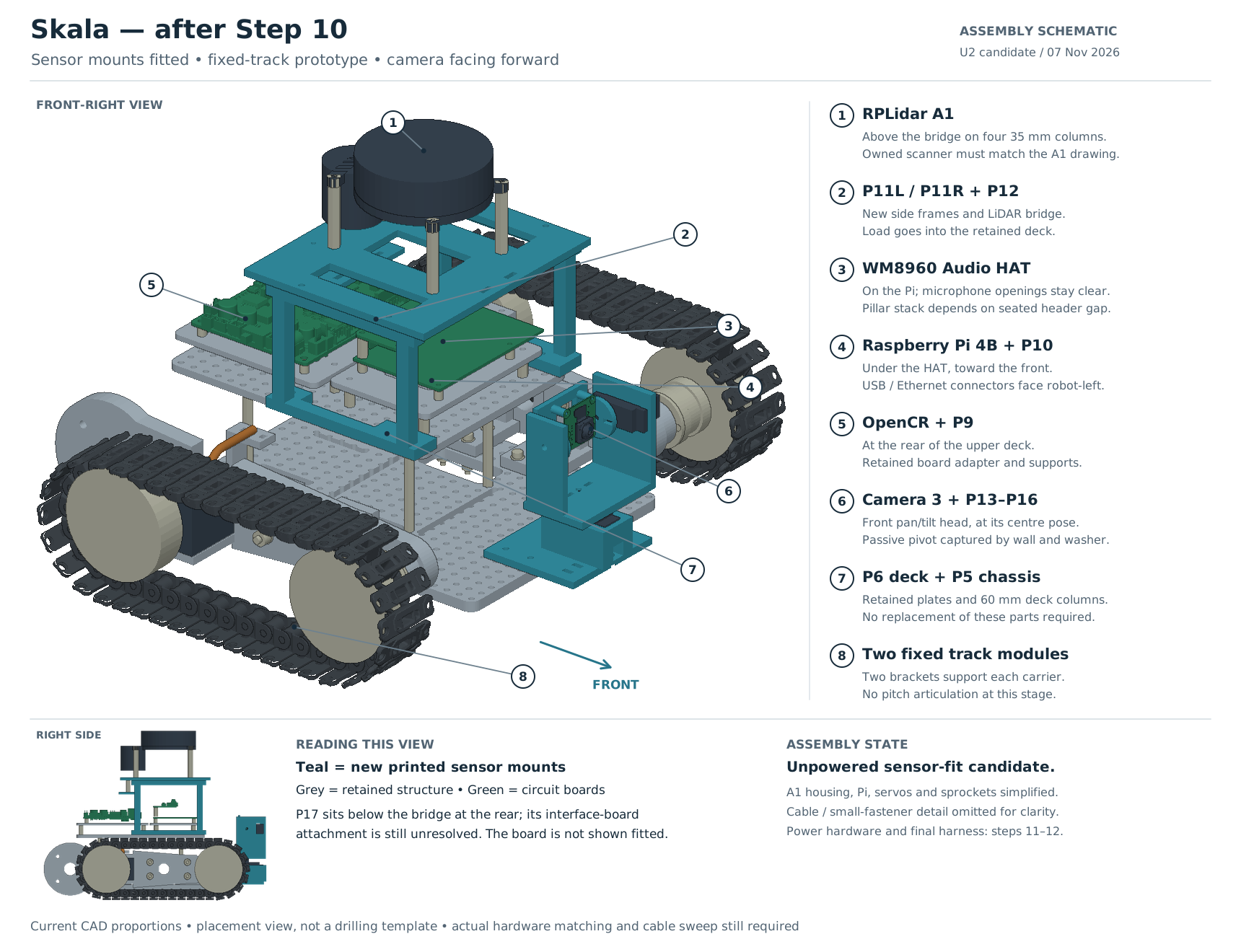
Current work is a partly assembled tracked platform, sensor mounts and control design. Physical capture and learned closed-loop behavior still need to be demonstrated.
Skala’s sensor-mounting design, November 2026. This is a CAD assembly schematic, not a photograph of a completed robot. Construction and validation status →
Four ordered sound blocks retrieved an associated image in 213 of 216 moderate-condition queries from fresh qualification recordings. Removing the order check increased false recognition of environmental sounds from 1/100 to 26/100.
Overall result: partial. Strong noise yielded only 1/24 correct acceptances, and the challenge improvement missed its target. This tests remembered recordings, not sound categories or speech.
After 2,048 encounters with photographs and images of writing, recurring arrangements did not establish a recall advantage over their individual pieces. A follow-up search over sampling alignments improved moved-image recall to 15/16, from 9/16 with a matched single alignment.
The follow-up used 16 fresh sources and lost one previously correct unchanged-image recall. Writing entered as pixels; recognizing letters or understanding words was not established.
After 500 training updates, obscured-cue retrieval still scored 78/96. Checking individual cases revealed two gains and two losses. Monitoring compared each checkpoint with both its predecessor and the original model.
No checkpoint was adopted. This was a bounded diagnostic on previously inspected inputs, and it did not establish general retention across all capabilities.
I want to understand how experience becomes something a mind can use: how it acquires reusable structure, keeps learning without losing earlier abilities, and changes its expectations and choices through the consequences of acting.
Language belongs in that picture. The current visual-acquisition direction begins with writing as something seen, while embodiment brings in the relationship between action and perception. These are routes toward a larger system, with distinct experiments and unresolved connections.